
Pour-Over Troubleshooting
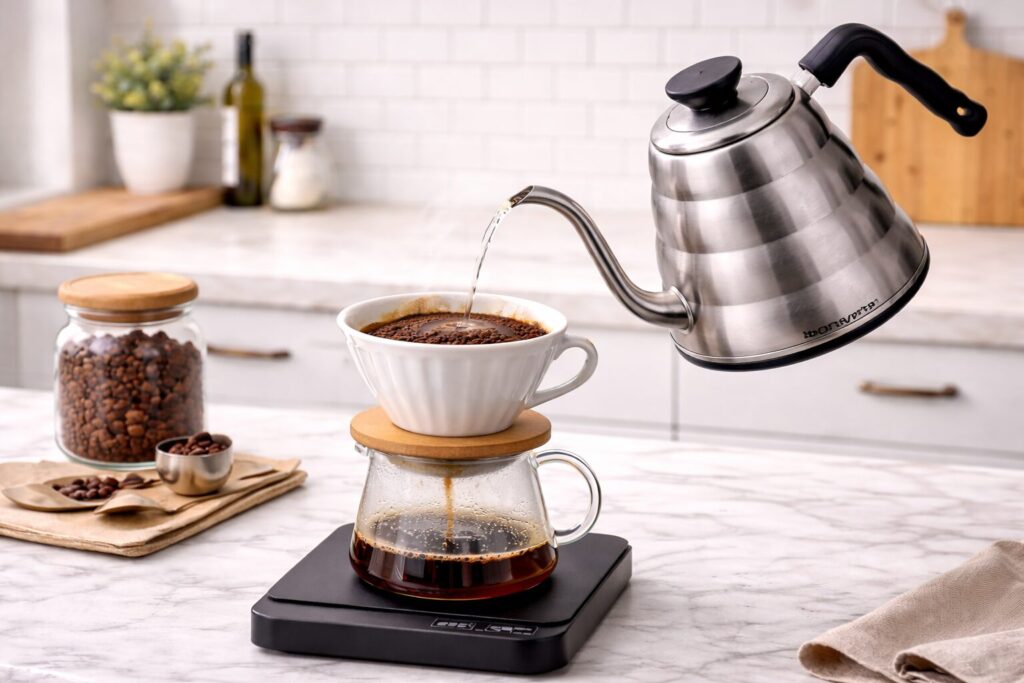
Editorial standards: this guide uses extraction principles and practical workflow diagnostics. Brew time, temperature, and bloom guidance are starting references rather than universal rules.
At a glance
What this guide covers
Sour, bitter, weak, slow, fast, muddy, and inconsistent pour-over brews—plus channeling, bloom, drawdown, temperature, dripper differences, grinder diagnosis, and a reset method.
Editorial analysis
Fix the symptom with one controlled change
Pour-over troubleshooting gets confusing when grind, ratio, temperature, agitation, and pouring all change at once. Start with the symptom, stabilize the recipe, change one variable, and compare the result with a known-good brew.
The 30-Second Answer
Use taste to identify the direction of the problem, then confirm it with flow and recipe data. Sour/thin often points toward under-extraction; harsh/dry often points toward too much extraction or roast character; weak-but-balanced usually points toward ratio. Change one variable at a time and compare against your own successful baseline.
The Science Behind Pour-Over Flavor Problems
Pour-over troubleshooting becomes much easier once you understand what’s actually happening inside the dripper. Pour-over is a percolation brew: hot water passes through a bed of grounds, dissolving compounds in sequence, then drains through a filter. The flavor of your cup reflects exactly which compounds were dissolved — and which weren’t.
Coffee compounds extract in a predictable order: acids and salts extract first (bright, sharp, sometimes sour), sugars and aromatics extract mid-way (sweetness, body, “coffee flavor”), and bitter compounds and astringents extract last (drying, harsh finish). The goal of pour-over troubleshooting is to dial in the sweet middle zone — enough extraction to develop sweetness and body, not so much that you’re pulling bitter, drying compounds into the cup.
Three variables control how far extraction progresses: grind size (surface area exposed to water), water temperature (rate of chemical reactions), and contact time (how long water and grounds interact). Of the three, grind size is the most powerful and should always be adjusted first.
🔬 The one-variable rule: Change only one thing per brew — almost always grind first. If you change grind, temperature, and ratio simultaneously, you’ll never know which fix worked and you’ll spend weeks chasing the same problems.
Pour-Over Troubleshooting Matrix: Symptom → Check First
| Symptom | Likely direction | Check first | Useful experiment |
|---|---|---|---|
| Sour, sharp, thin | Often under-extracted | Grind, water temperature, flow speed, channeling | Try a slightly finer grind while keeping ratio and pour pattern stable |
| Harsh, bitter, drying | Often over-extracted or roast-driven | Grind, agitation, stalled drawdown, temperature | Try slightly coarser grind or less agitation |
| Weak but balanced | Strength issue | Coffee-to-water ratio | Use a slightly stronger ratio before changing grind |
| Weak and sour | Strength + extraction issue | Ratio, grind, flow | Strengthen ratio and then refine grind one change at a time |
| Sour and bitter together | Uneven extraction | Bed saturation, channeling, grind distribution | Improve evenness before chasing temperature |
| Very slow / stalled drawdown | Too much resistance | Fine grind, fines, filter clogging, agitation | Go coarser and reduce agitation |
| Very fast drawdown | Too little resistance | Coarse grind, low dose, pour pattern | Go finer while keeping the pouring structure stable |
| Inconsistent day to day | Workflow instability | Dose, grinder setting, water, pour height, bed level | Standardize the recipe before changing equipment |
Fix Sour Pour-Over Coffee
Sour, thin, sharp coffee often points toward under-extraction, but acidity alone is not proof. Some coffees are naturally bright. Look for the combination of sharpness, low sweetness, thin body, and a short finish.
Check these causes first
- Grind too coarse: water may move through the bed before enough soluble material is extracted.
- Water too cool for the coffee: especially relevant with dense, lighter-roasted coffee.
- Uneven saturation or channeling: parts of the bed may be bypassed.
- Recipe too weak: a very wide ratio can make an otherwise balanced brew seem thin.
- Pour structure: very fast or uneven pouring can change contact and agitation.
A controlled fix sequence
- Keep dose and total water fixed.
- Try one small grind adjustment finer.
- If the coffee is still sharp and thin, consider slightly hotter water or a modestly longer contact time.
- Check that the bloom and first pour wet the whole bed evenly.
- Taste before making another change.
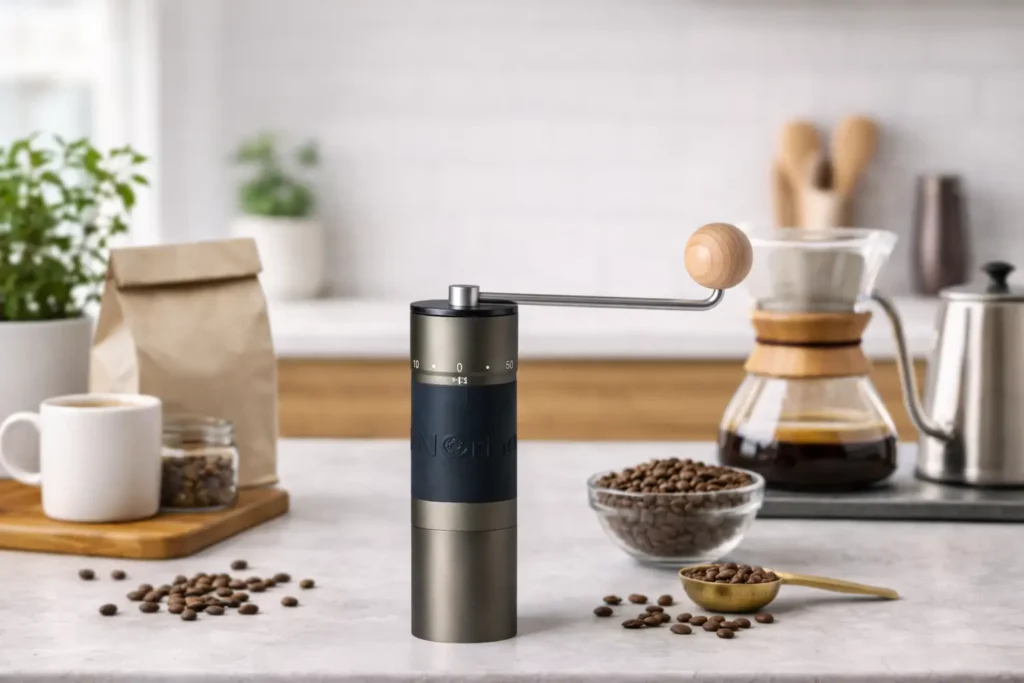
KINGrinder K6 — manual fine adjustment
The K6 is one current manual-grinder example with fine external adjustment. It can be useful when you need repeatable small changes around a pour-over setting.
Two useful troubleshooting tools
Control grind and water delivery before adding more accessories
A grinder with repeatable small adjustments and a controlled-pour kettle address two of the most common variables in pour-over troubleshooting.
KINGrinder K6Manual fine adjustment for repeatable grind changes during filter dial-in.Check current Amazon listing → 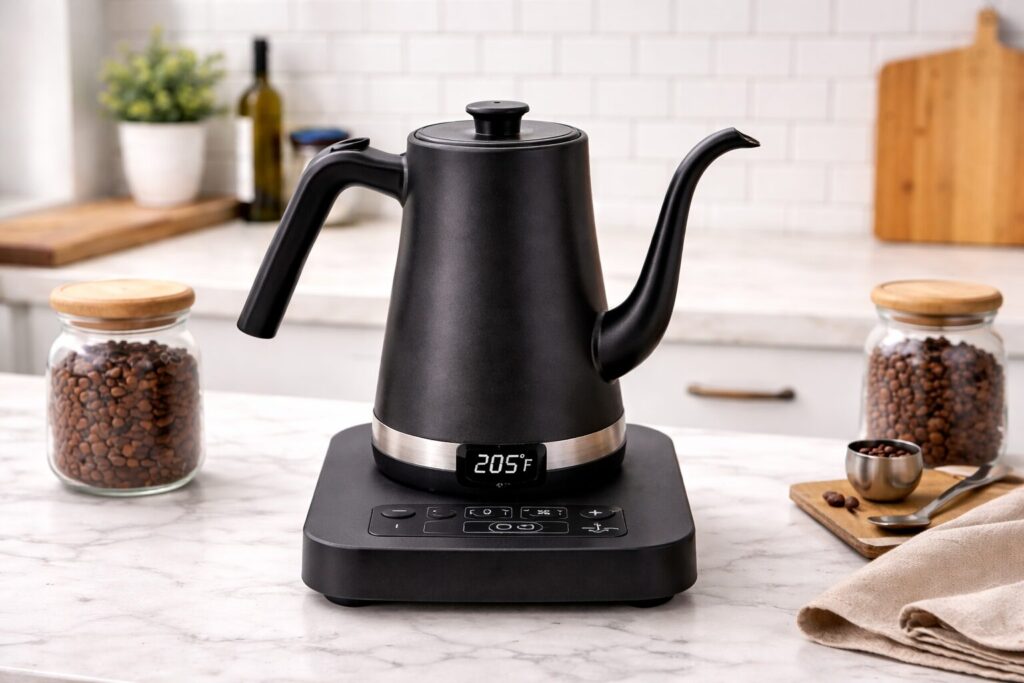 Fellow Stagg EKGTemperature control and gooseneck pouring for repeatable water delivery.Check current Amazon listing →
Affiliate disclosure: Amazon links may earn CoffeeGearHub a commission at no additional cost to you. Prices and availability can change.
Fix Bitter or Dry Pour-Over Coffee
Harsh bitterness and a drying finish can point toward excessive extraction, but roast level, coffee quality, water, and filter behavior also matter. Darker coffees naturally carry more roast bitterness than lighter coffees.
Check these causes first
- Grind too fine: higher resistance can extend contact and increase extraction.
- Too much agitation: aggressive swirling or pouring can increase extraction and fines migration.
- Stalled drawdown: filter clogging can make the brew finish much slower than your normal baseline.
- Water hotter than the coffee needs: a useful variable once grind and flow are stable.
A controlled fix sequence
- Try a small move coarser.
- Reduce unnecessary stirring or aggressive swirling.
- Compare drawdown with a brew that tasted good on the same dripper.
- If a darker roast still tastes harsh, experiment with slightly cooler water.
Temperature-controlled gooseneck kettle
A variable-temperature kettle gives you a repeatable way to test temperature after grind, ratio, and pouring are stable. The gooseneck also makes pour rate easier to control.
Fix Weak or Watery Pour-Over Coffee
Weakness describes concentration; sourness or bitterness describe flavor balance. That distinction matters because a cup can be weak but well extracted, or strong and badly extracted.
| What you taste | Likely issue | First move |
|---|---|---|
| Balanced but thin | Ratio too weak | Use a slightly stronger coffee-to-water ratio |
| Thin and sour | Strength plus under-extraction | Strengthen ratio, then refine grind |
| Flat and muted | Coffee freshness, water, or broad extraction issue | Check coffee and water before over-correcting grind |
Make small ratio changes rather than jumping between extreme recipes. A scale is the easiest way to keep dose and water repeatable while you troubleshoot.
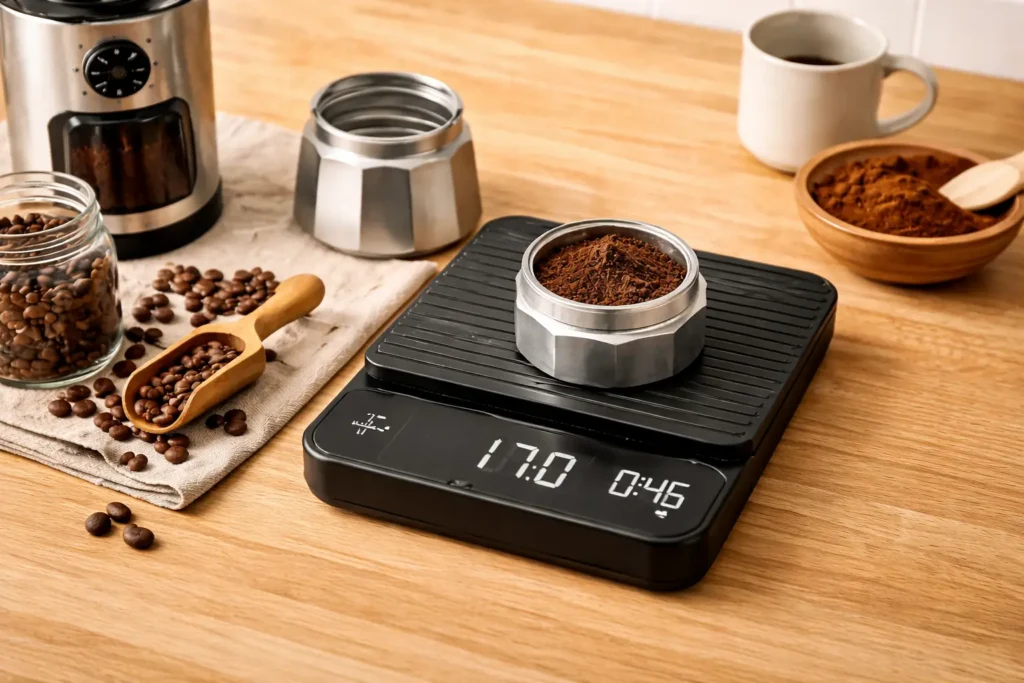
Digital scale with timer
A 0.1 g scale helps separate strength from extraction by making coffee dose and water weight repeatable. A timer is useful for comparing flow against your own successful brews.
Channeling: When Pour-Over Tastes Sour AND Bitter
If your cup somehow tastes both sharp and harsh at once, you’re almost certainly dealing with channeling. This happens when water finds cracks, gaps, or dry spots in the coffee bed and rushes through those paths instead of flowing evenly through all the grounds. The result is a split cup: water that channels through fast is under-extracted (sour, thin) while water that sits longer in dense areas is over-extracted (bitter, drying).
Signs of channeling in pour-over
- Cup tastes both sour and bitter — not one or the other
- Unpredictable brews using the same recipe and settings
- Cratered, uneven, or “volcano” coffee bed after brewing
- Fast drawdown despite a fine grind setting
- Coffee looks dry in some spots while others look saturated
How to fix channeling
- Level the coffee bed before brewing. Tap or gently shake the dripper to create a flat, even surface. Any slope or mound creates uneven flow paths from the first pour.
- Bloom fully with 2–3x the coffee dose in water. 40–60g water for a 20g dose. Ensure every part of the bed is saturated before the 30–45 second bloom ends. Dry spots during bloom become channels during the main pour.
- Pour in slow circles and never directly down the center. Start inside the filter wall and work inward in spirals. A hard, central stream punches through the bed and creates instant channels.
- Never pour directly onto the filter paper. This washes grounds aside, creates dry spots, and pulls water to the walls instead of through the bed.
- Upgrade to a burr grinder. Blade grinders and low-quality burrs produce wide particle distributions (very coarse + very fine simultaneously). The fine particles pack into dense clumps while coarse particles create gaps — the exact structure that causes channeling. This is the most common underlying root cause.
⚠️ Channeling vs. bad grind: If leveling your bed and improving pour technique reduces the problem but doesn’t eliminate it, grinder upgrade is the next step. A wide particle distribution makes channeling structurally inevitable — no amount of technique fixes an inconsistent grind.
The Bloom: Saturate the Bed, Then Continue
The bloom helps wet the grounds and release trapped gas before the main pour. Fresh coffee may expand and bubble more than older coffee, so the useful bloom depends on the coffee rather than one mandatory time.
A practical bloom method
- Use enough water to wet the entire bed evenly.
- Pour gently and make sure no dry pockets remain.
- Continue the brew once the most active bubbling and expansion have slowed.
- If channeling persists, focus on even saturation rather than simply making the bloom longer.
Brew Time Diagnostics: Compare With Your Own Baseline
Brew time is useful because it shows how quickly water moved through the bed, but there is no single correct time for every pour-over. Dose, grinder, coffee, brewer geometry, filter paper, agitation, and pour structure all change drawdown.
| Observation | What it may suggest | Check next |
|---|---|---|
| Much faster than your normal good brew | Too little resistance or bypass | Grind, dose, bed saturation, pour pattern |
| Much slower than your normal good brew | Too much resistance or filter clogging | Grind, fines, agitation, filter |
| Time changed but taste improved | The new recipe may simply be better | Do not force it back to a target number |
Use taste first and time second. The most useful comparison is with a previous brew on the same brewer, coffee, dose, and filter.
Water Temperature: Use Roast Level as a Clue, Not a Rule
Hotter water generally increases extraction potential; cooler water reduces it. Lighter roasts often tolerate or benefit from hotter water, while darker roasts may taste smoother with slightly cooler water. But coffee density, processing, grinder, ratio, and brewer all matter.
| Coffee tendency | Starting idea | Adjust if… |
|---|---|---|
| Lighter roast | Start relatively hot | Go hotter if sharp and under-developed; cooler if harsh |
| Medium roast | Start near the middle of your kettle’s normal brewing range | Move by taste after grind is stable |
| Darker roast | Start somewhat cooler | Go cooler if roast bitterness dominates |
If the roaster provides a brew temperature, use that as the first reference.
Dripper-Specific Notes: V60, Chemex, and Kalita Wave
| Brewer | What changes troubleshooting | Common mistake | Useful check |
|---|---|---|---|
| V60 | Cone geometry and large opening make pour structure and grind highly visible | Chasing one target time instead of taste and flow | Watch bed saturation and compare drawdown with a successful recipe |
| Chemex | Thicker paper changes flow and cup clarity | Assuming a slower drawdown is automatically wrong | Use taste first; adjust grind only when the brew is clearly stalled or imbalanced |
| Kalita Wave | Flat bed and restricted outlets can make filter clogging more obvious | Too much agitation causing fines migration | Use a level bed and restrained agitation |
When Grinder Quality Is the Bottleneck
Grinder quality matters because particle distribution and adjustment repeatability affect flow and extraction. But a difficult cup is not automatically a grinder problem. First control dose, ratio, water, filter, and pouring.
Suspect the grinder when small setting changes produce erratic results, the brew alternates between fast and clogged without recipe changes, or the cup repeatedly combines sharp under-extracted flavors with drying bitterness even after technique is standardized.
A better grinder does not guarantee a good recipe, but a grinder with more consistent output can make troubleshooting easier because each adjustment produces a more predictable change.
A Reset Method When Everything Tastes Wrong
When several variables have changed at once, return to a simple baseline rather than chasing the last bad cup.
- Use a coffee dose and water amount you can measure accurately.
- Choose a moderate ratio that has worked for the brewer before.
- Use a medium-fine grind as a general starting direction, then adjust by flow and taste.
- Bloom until the bed is evenly saturated and active bubbling has slowed.
- Keep the pour pattern simple and repeatable.
- Record total water, grind setting, and drawdown time.
From that baseline, change one variable at a time. Start with grind when flow is clearly too fast or too slow; use ratio when the cup is balanced but too weak or too strong; use temperature after the core recipe is stable.
Grinder Examples for Pour-Over
These are useful reference points for different workflows. The important buying criteria are adjustment resolution, particle consistency in the filter range, retention, cleaning, and whether you prefer electric or manual grinding.
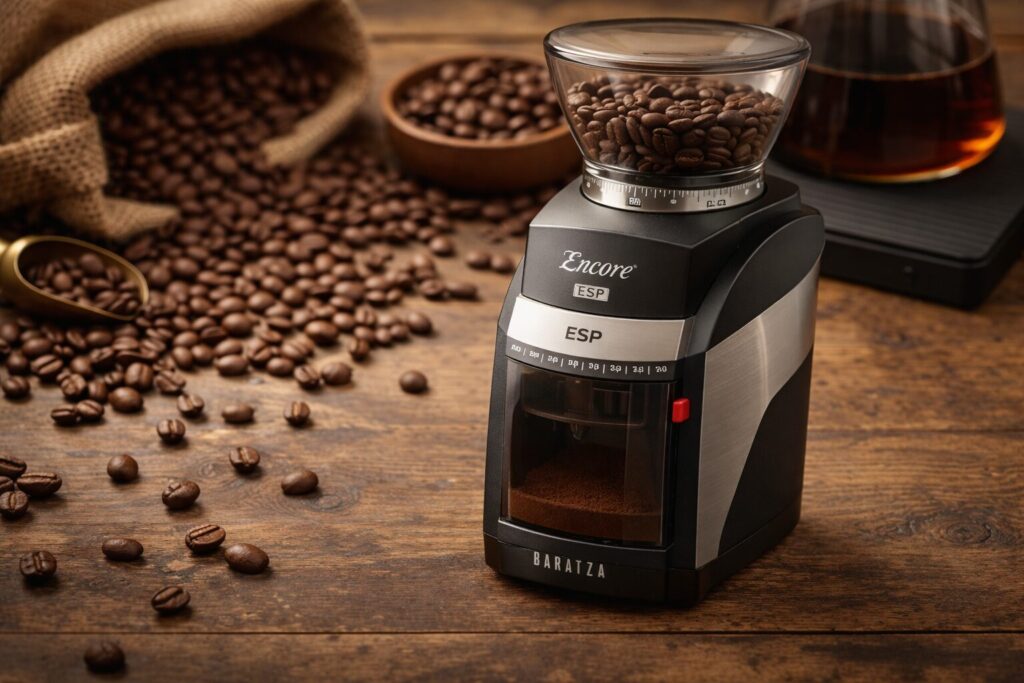
Baratza Encore — straightforward electric filter grinder
A simple stepped electric workflow with long-running parts/support availability. Useful for users who value repeatability and easy adjustment.
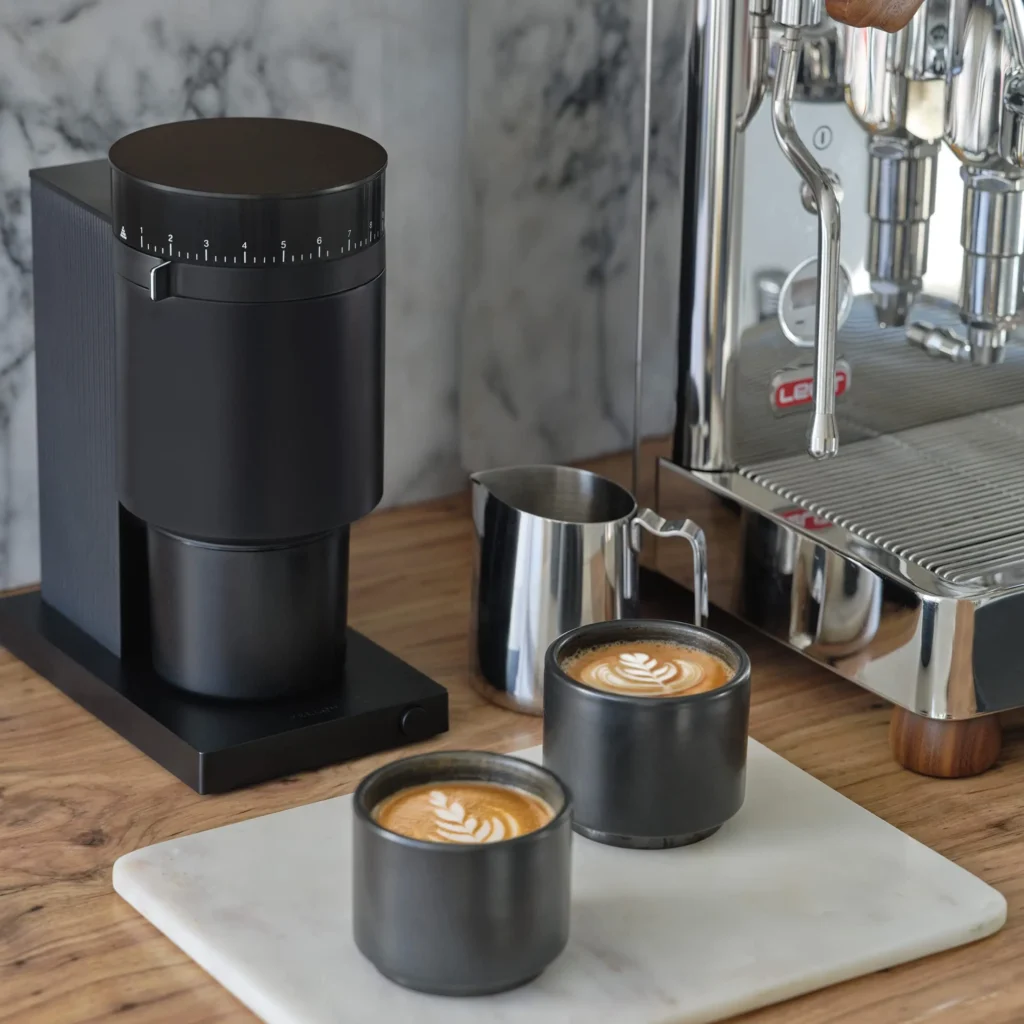
Fellow Opus — multi-method electric option
A compact electric grinder aimed at users who move between filter brewing and finer settings. Its workflow differs from the Encore but it fills a similar multi-method role.
KINGrinder K6 — manual fine-adjustment option
A manual grinder for users who value portability and fine external adjustment and do not mind hand grinding.
FAQs: Pour-Over Troubleshooting
Why does my pour-over taste sour?
Why does my pour-over taste bitter or drying?
Why is my pour-over weak and watery?
What causes channeling in pour-over?
What is a good pour-over brew time?
How important is the bloom?
Does grinder quality matter?
What water temperature should I use?
CoffeeGearHub shortlist
Keep dialing in before you replace everything
These CoffeeGearHub guides cover the grinder, kettle, grind-size, and brewer decisions most closely related to troubleshooting.
Continue Learning
In this guide
- The 30-Second Answer
- The Science Behind Pour-Over Flavor Problems
- Pour-Over Troubleshooting Matrix: Symptom → Check First
- Fix Sour Pour-Over Coffee
- Fix Bitter or Dry Pour-Over Coffee
- Fix Weak or Watery Pour-Over Coffee
- Channeling: When Pour-Over Tastes Sour AND Bitter
- The Bloom: Saturate the Bed, Then Continue
- Brew Time Diagnostics: Compare With Your Own Baseline
- Water Temperature: Use Roast Level as a Clue, Not a Rule
- Dripper-Specific Notes: V60, Chemex, and Kalita Wave
- When Grinder Quality Is the Bottleneck
- A Reset Method When Everything Tastes Wrong
- Grinder Examples for Pour-Over
- FAQs: Pour-Over Troubleshooting
- Continue Learning