
Great coffee doesn’t come from owning more gear—it comes from owning the right gear. Learn which accessories improve flavor, which improve consistency, and which you can safely skip.
New to home coffee? Start with Coffee Brewing Foundations, then use this guide to upgrade in the right order. (If you want the full beginner path: Coffee for Beginners.)
Why Coffee Accessories Are So Confusing
Coffee accessories are often marketed as “essential,” but they don’t all solve the same problem. Some improve extraction and flavor. Some improve repeatability. Others mostly improve workflow—or simply look nice on the counter.
The problem is that many beginners upgrade the wrong accessory first. When coffee still tastes sour, bitter, or flat, frustration sets in—even after spending more money.
The key is understanding what problem each accessory actually fixes. If you’re troubleshooting taste, your fastest shortcut is usually grind size: Grind Size Explained (plus the quick reference: Coffee Grind Sizes Chart).
Accessories That Directly Improve Coffee Taste
These accessories affect grind consistency, extraction balance, or freshness. If flavor is the goal, these matter most.
⚙️ Burr Grinder
The Single Biggest Upgrade
Uneven grind size causes uneven extraction—some particles over-extract while others under-extract. This leads to bitterness and sourness in the same cup, no matter how good the beans are.
In real-world use, upgrading from a blade grinder to a burr grinder improves cup quality more than switching brewers. (If you’re unsure why: Burr vs Blade.)
If you’re deciding where to spend first, start with the grinder. Need help choosing quickly? Use Choose Your First Coffee Grinder, then jump into the hub: Best Coffee Grinders (2026).
⚖️ Digital Coffee Scale
Precision Control
Without a scale, most beginners accidentally use 10–20% more coffee than intended. This alone can cause bitterness, muddled flavors, and inconsistent results from brew to brew.
A scale allows you to control coffee-to-water ratio precisely. Even if everything else stays the same, this single change often stabilizes flavor immediately.
Accurate measurements eliminate guesswork. If your coffee tastes “off,” use ratio + grind together: Grind Size Explained.
💧 Fresh Filters & Proper Water
Foundation of Flavor
Old or low-quality paper filters can clog, slow drawdown, and add papery flavors. Water quality matters even more—because water makes up nearly the entire cup.
Hard, chlorinated, or poorly balanced water can flatten acidity or exaggerate bitterness. Fixing water quality often improves flavor more than changing recipes.
Start with fresh, quality filters and filtered water. For a simple, no-chemistry approach: Water Quality for Coffee.
Accessories That Improve Consistency (But Not Flavor)
These tools help you repeat good results once you already have them—but they won’t fix poor extraction on their own. If taste is off, start with grind size before buying more gear.
- Gooseneck kettle – Improves pour control for pour-over. Pair with: Best Gooseneck Kettles.
- Timer – Helpful while learning. If your brew is consistently too fast/slow, use the Grind Size Chart to correct.
- Milk pitcher – Necessary for milk drinks, but unrelated to espresso extraction quality.
Accessory Comparison Chart
| Accessory | Improves Taste | Improves Consistency | Beginner Priority |
|---|---|---|---|
| Burr Grinder | Yes | Yes | Essential |
| Digital Scale | Yes | Yes | Essential |
| Paper Filters | Yes | Moderate | Essential |
| Water Quality Tools | Yes | Moderate | High |
| Gooseneck Kettle | No | Yes | Optional |
| Timer | No | Yes | Optional |
| WDT / Distribution Tools | No | Low | Advanced |
Accessories Beginners Can Safely Skip (For Now)
These accessories are frequently marketed as upgrades, but most beginners won’t see meaningful improvement early on.
- Premium tampers and distribution tools (worth it later, after grinder + dial-in basics)
- Complex WDT tools (useful only once your espresso workflow is consistent)
- High-end kettles with advanced displays (nice-to-have; focus on technique first)
- Pour-over gadgets promising “perfect extraction” (most issues are grind + ratio + pour)
If your coffee tastes bad, don’t buy gadgets. Fix it with a small grind change first. Start here: Grind Size Explained.
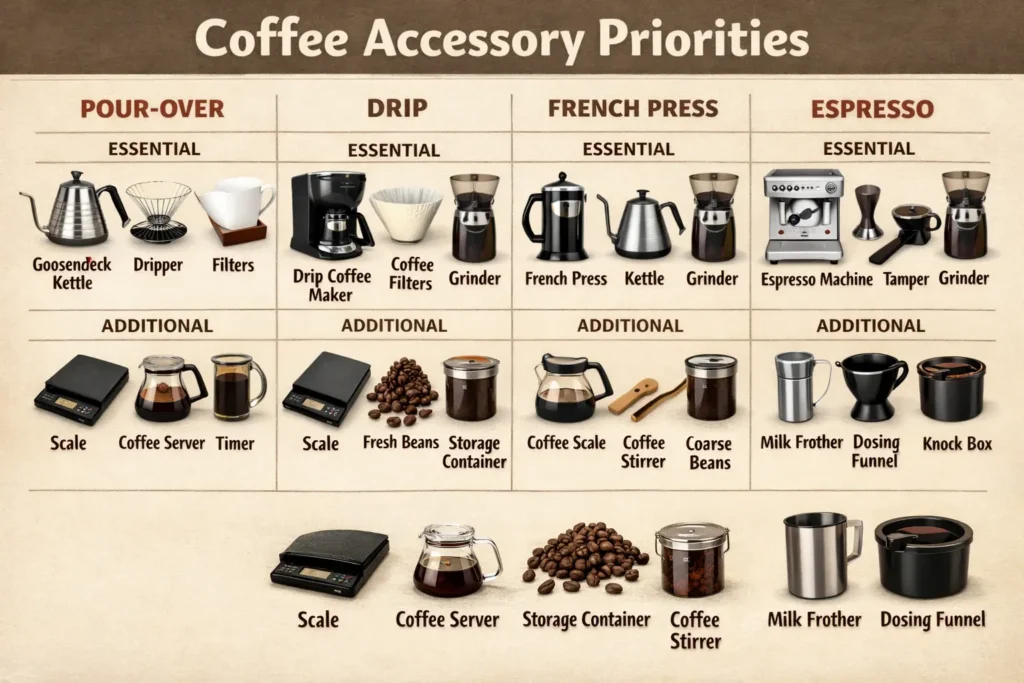
Accessory Priorities by Brew Method
Different brewing methods benefit from different accessories. Here’s what matters most for each.
☕ Pour-Over Coffee
Hands-on, clean flavor
Top priorities: burr grinder, scale, fresh filters. A gooseneck kettle improves consistency but isn’t required.
🏠 Drip Coffee Machines
Everyday brewing
Top priorities: grinder and water quality. Most machines already control water volume accurately.
🫘 French Press
Simple immersion
Top priorities: consistent coarse grind and a scale. Kettles and timers are optional.
☕ Espresso
High precision
Top priorities: espresso-capable grinder and scale. Advanced tools become useful later, not at the beginning.
Bottom Line: Buy Fewer Accessories—In the Right Order
If an accessory doesn’t improve grind consistency, measurement accuracy, or water quality, it probably won’t improve taste. Master the basics first, then upgrade intentionally.
FAQs
-
What coffee accessory improves taste the most?
A burr grinder. Grind consistency has the biggest impact on extraction, and uneven grounds can create sour and bitter flavors in the same cup. If you’re upgrading one thing first, upgrade the grinder before buying new brewers or gadgets.
-
Is a coffee scale really necessary?
It’s one of the easiest ways to improve results fast. A scale removes guesswork and makes your coffee-to-water ratio repeatable. If your coffee tastes “random” from day to day, consistent dosing with a scale usually fixes that.
-
Do I need a gooseneck kettle for pour-over?
Not at first. A gooseneck kettle helps with control and repeatability, but it won’t solve under-extraction or over-extraction if your grind size and ratio are off. Many people get great pour-over results using a regular kettle once their basics are dialed in.
-
Do coffee filters affect flavor?
Yes. Paper filter quality and freshness can influence drawdown and clarity. Poor filters can clog or add papery flavors. If your pour-over is suddenly drawing down slower or tasting dull, swapping filters is a simple troubleshooting step.
-
Does water quality really matter for coffee?
Absolutely. Water makes up almost the entire cup, and chlorine or the wrong mineral balance can flatten flavor or emphasize bitterness. If your coffee tastes “off” even when the recipe seems right, water quality is one of the first things to check.
-
What coffee accessories are mostly optional?
Gooseneck kettles, timers, and workflow tools are helpful once you already make good coffee consistently. They can make brewing easier and more repeatable, but they generally don’t improve flavor as much as a grinder, scale, and good water.
-
Which accessories should beginners skip?
Most advanced espresso tools (premium tampers, distribution tools, complex WDT tools) and “perfect extraction” pour-over gadgets. These can be useful later, but beginners usually get bigger improvements from dialing in grind size, ratio, and technique first.
-
What’s the best order to upgrade coffee gear?
Start with:
1. Burr grinder
2. Scale
3. Water/filter improvements
4. Brew-method-specific upgrades (like a gooseneck kettle for pour-over)
5. Advanced tools once your results are consistent