
Last Updated: March 2026 • 25–35 min read • Cornerstone Guide: Coffee Bean Selection — Origins, Processing, Roast + Top Picks + Troubleshooting
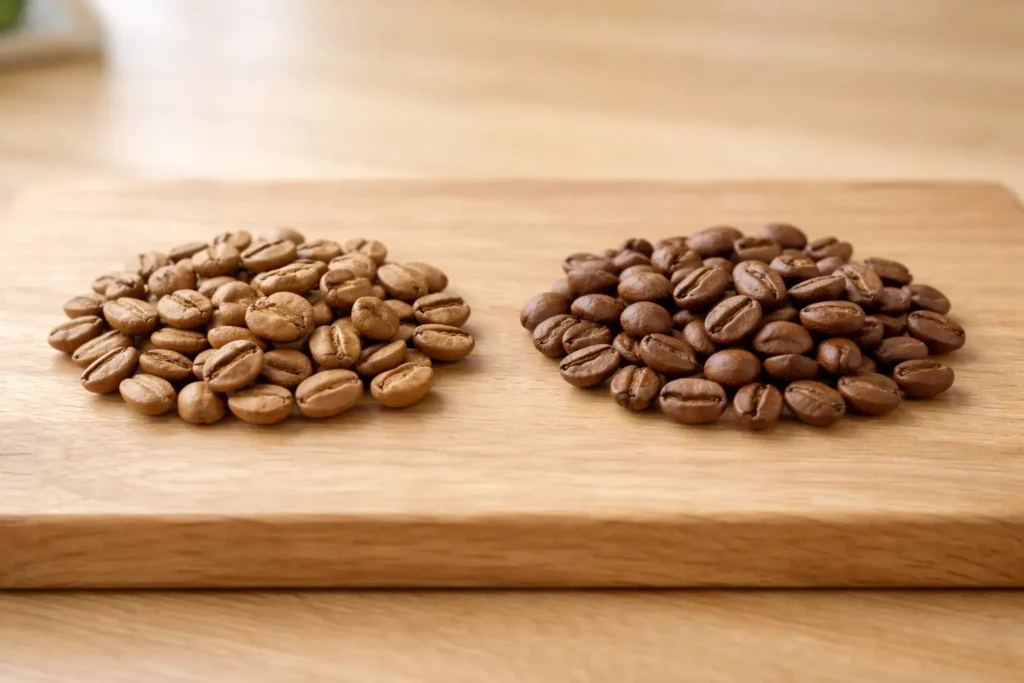
This is our coffee bean buying guide. The single biggest quality upgrade most home brewers can make has nothing to do with their machine. It’s the beans. Origin, processing method, and roast level together determine the vast majority of what you taste in your cup — before the water temperature, the grind size, or the brew ratio gets any say in the matter. Yet most buyers pick beans by brand recognition, price, or whatever looks good on the shelf. This guide gives you a better system: a clear framework for choosing beans based on the flavor profile you’re chasing, matched to the brew method you already own. By the end, you’ll be able to read a specialty coffee bag like a set of flavor instructions — and make better purchases from the first bag forward. We also cover where freshness and storage fit in, which grinder makes a difference for which beans, and what to do when a coffee isn’t tasting the way the bag suggested it should.
✍️ Editorial note: This guide is researched and written by the editors at CoffeeGearHub.com using published brewing science, SCA brewing standards, roaster community knowledge, and established specialty-coffee sourcing principles. All product links are affiliate links — we may earn a commission at no cost to you. Affiliate Disclosure: CoffeeGearHub.com participates in the Amazon Services LLC Associates Program. As an Amazon Associate, we earn from qualifying purchases.
🛒 New to Amazon? Try Prime free for fast, free shipping on every pick in this guide — or try Audible free if you’d rather listen while your coffee brews.
The 30-Second Answer
If you only buy one style of coffee, buy a medium roast from Colombia or Guatemala — washed or honey process. It’s the most forgiving, works across drip, pour-over, and espresso, and gives you a baseline to calibrate everything else against. If you want something bright and fruit-forward, move to a washed Ethiopian light roast brewed in a pour-over or AeroPress. If you want bold and smooth, move to a natural-process Brazilian medium-dark for French press or cold brew. The most important variable after roast and origin isn’t the brand — it’s freshness. Always look for a visible roast date and buy whole bean whenever possible. Grind immediately before brewing. That single habit delivers more flavor improvement than any gear upgrade at any price point.
- Best All-Rounder: Colombian medium roast, washed — the universal starting point
- Best for Pour-Over: Ethiopian washed light-medium — maximum clarity and aromatic complexity
- Best for Espresso: Medium-dark blend with cocoa/nut notes — easier extraction, great in milk drinks
- Best for French Press / Cold Brew: Brazilian natural medium-dark — full body, low acidity, smooth
- Best Grinder Pairing: KINGrinder K6 — the standard CoffeeGearHub manual grinder across all brewing content
Who This Guide Is For — Jump to What You Need
🫘 First Specialty Coffee Purchase
Start with Bean Foundations to understand origin, processing, and roast — then jump to Bean Picks.
🎯 Flavor Chaser
Go directly to Choose by Taste — find your preferred flavor profile and get the origin + processing + roast combination that matches.
🔧 Something Tastes Off
Jump to the Troubleshooting Matrix — sour, bitter, flat, and watery cups all have specific causes and fixes covered there.
📦 Storage & Freshness
Go to Bean Storage for the correct way to store whole beans and how to extend peak flavor after opening.
Table of Contents
Coffee Bean Buying Guide Foundations
Three variables control almost everything you taste in a cup of coffee before brewing begins. Once you understand them, specialty coffee labels stop feeling random and start working as useful flavor predictions.
🌍 Origin
Your fastest flavor shortcut. Where beans are grown — altitude, climate, soil — determines their fundamental character. Africa trends brighter and more aromatic; Central and South America trend sweeter and more chocolatey; Asia and the Pacific trend heavier and earthier.
🍒 Processing
How the coffee cherry is turned into a green bean after harvest. Processing is the single best predictor of a coffee’s sweetness, body, and how fruit-forward or clean it will taste. Washed = clean and crisp. Natural = fruity and heavy. Honey = balanced middle.
🔥 Roast
Roast level determines whether you taste more of the bean’s origin character (lighter) or more roast flavor and body (darker). It also affects density, solubility, and how forgiving the bean is to brew. Medium is the most forgiving starting point for any brewer.
Arabica vs Robusta: What the Label Actually Means
Almost every specialty coffee bag says “100% Arabica.” Here’s why that matters, what Robusta actually is, and when you’d deliberately want it.
| Arabica (Coffea arabica) | Robusta (Coffea canephora) | |
|---|---|---|
| Where it grows | Higher altitudes (600–2,200m) — Ethiopia, Colombia, Kenya, Guatemala, Brazil highlands | Lower altitudes (0–800m) — Vietnam, Uganda, Indonesia, India (used widely in blends) |
| Caffeine | ~1.2–1.5% caffeine by dry weight | ~2.2–2.7% caffeine — roughly twice the caffeine of Arabica |
| Flavor profile | Wide range: floral, fruity, nutty, chocolatey, caramel — complex sugars produce more nuanced flavor | Stronger, more bitter, grain-like or rubbery at lower grades; earthy and bold at higher grades |
| Crema in espresso | Good crema from fresh beans; crema dissipates more quickly | Produces thicker, longer-lasting crema due to higher oil and CO₂ content — this is why Italian espresso blends often include 10–20% Robusta |
| Price | Higher — harder to grow, lower yield, more climate-sensitive | Lower — higher yield, more disease-resistant, easier to cultivate at scale |
| Where you’ll find it | All specialty single-origins; most quality blends; premium supermarket coffee | Instant coffee (the main ingredient); budget supermarket blends; traditional Italian espresso blends |
| When to choose it | Always, for specialty brewing — the full flavor range and nuance only exists in Arabica | If you want maximum caffeine, thick espresso crema, or are using a Moka pot with dark Italian-style blends |
Practical rule: If a bag doesn’t say “100% Arabica,” assume it contains Robusta. This isn’t necessarily bad — it’s just a different profile. For specialty brewing (pour-over, AeroPress, manual espresso), always choose 100% Arabica. For a Moka pot or a strong dark espresso blend, a small percentage of Robusta is traditional and adds crema and body. See our full Robusta Coffee Guide for more on when it works well.
Origin Guide: Predict Flavor by Region
Origin is your first flavor filter. Geography, altitude, and local climate create consistent flavor tendencies within each region — not a guarantee, but a reliable starting prediction before you factor in processing and roast.
| Region / Origin | Typical flavor tendencies | Common processing | Best brew methods | Who it’s best for |
|---|---|---|---|---|
| Ethiopia | Bright, floral, blueberry, jasmine, bergamot — the most complex and aromatic origins available | Washed (clean/floral) or Natural (jammy/fruity) | Pour-over, Chemex, AeroPress | Flavor-forward brewers; anyone who enjoys tea-like complexity |
| Kenya | Blackcurrant, tomato, bright citric acidity, winey finish — one of the most distinctive and polarizing origins | Washed (double-washed is common) | Pour-over, AeroPress | Experienced brewers who enjoy high acidity and intensity |
| Rwanda / Burundi | Peach, apricot, red fruit, clean sweetness — similar to Ethiopian but often milder and rounder | Washed | Pour-over, Chemex | Arabica lovers who want fruit without Ethiopia’s intensity |
| Colombia | Caramel, red apple, mild citrus, chocolate — the most balanced and versatile origin | Washed or Honey | Drip, pour-over, espresso, AeroPress | Everyone — the default recommendation for first-time specialty buyers |
| Guatemala | Dark chocolate, brown sugar, almond, mild stone fruit — similar to Colombia, slightly nuttier | Washed | Drip, espresso, French press | Drinkers who want sweetness without brightness |
| Costa Rica | Honey, peach, clean sweetness, bright finish — distinctive from nearby origins | Honey or Washed | Pour-over, drip, AeroPress | Honey-process fans; balanced palates |
| Brazil | Chocolate, peanut, low acidity, heavy body — the smoothest and least confrontational origin | Natural or Pulped Natural | Espresso, French press, cold brew | Anyone who finds bright or acidic coffee harsh; espresso blend base |
| Peru | Mild chocolate, walnut, gentle sweetness — similar to Brazil, slightly lighter | Washed or Natural | French press, drip, espresso | Smooth-coffee drinkers; good espresso blend component |
| Sumatra (Indonesia) | Earthy, cedar, dark chocolate, heavy body, low acidity — the most distinctive “non-traditional” origin | Wet-hulled (Giling Basah) — unique to Indonesia | French press, Moka pot, cold brew | Dark roast lovers; drinkers who want maximum body |
| India | Spice, wood, mild earthiness — often used in dark espresso blends; Monsoon Malabar is the famous regional style | Washed or Monsooned (weather-exposed) | Espresso blends, Moka pot | Dark and earthy coffee lovers; Moka pot brewers |
🔬 Altitude matters within origins: High-altitude beans (1,500m+) grow more slowly, develop denser structure, and accumulate more complex sugars. This is why a high-altitude Ethiopian or Colombian coffee at the same roast level will typically taste more nuanced than a lower-altitude example. When two bags from the same country look similar on price and roast, the one listing higher altitude (or specific farm region) is usually the better bet.
Processing Guide: Washed, Natural, Honey
After harvest, the coffee cherry must be separated from the bean inside. The method used — and how long the bean is exposed to the fruit’s sugars during that process — is one of the strongest predictors of sweetness, body, and overall character in the final cup.
| Process | What happens | Flavor result | Body | Who should choose it | Watch out for |
|---|---|---|---|---|---|
| Washed (Wet) | Fruit removed mechanically before drying. Bean fermented briefly in water to remove remaining mucilage, then dried. | Clean, crisp, origin-forward. Acidity and floral/fruit notes from the bean itself are the star — no fruit sweetness from the processing layer. | Light to medium — cleaner mouthfeel | Anyone who wants to taste the terroir clearly; pour-over brewers; people new to specialty coffee who want predictability | Can taste sharp or sour if under-extracted (light washed Ethiopians particularly) |
| Natural (Dry) | Whole cherry dried with fruit still on the bean. Bean absorbs fruit sugars over weeks before hulling. | Fruity, sweet, heavier — blueberry, strawberry, tropical fruit notes are common. Can taste “funky” or fermented if process wasn’t carefully controlled. | Full — more oil-forward, heavier mouthfeel | Drinkers who want maximum sweetness and fruit intensity; French press and cold brew; adventurous brewers | Inconsistent quality — poorly processed naturals taste overfermented or musty; buy from reputable roasters |
| Honey (Pulped Natural) | Fruit skin removed but some or all mucilage (the sticky fruit layer) left on the bean during drying. Yellow, Red, and Black Honey grades indicate how much mucilage remains. | Balanced — more sweetness than washed, more clarity than natural. Stone fruit, caramel, and smooth finish. | Medium — the practical sweet spot for most brewers | Brewers who want sweetness without full natural intensity; excellent espresso processing; a reliable default | Less widely available than washed; quality varies more by producer than washed coffees |
| Wet-Hulled (Giling Basah) | Specific to Indonesia. Beans are hulled at unusually high moisture content, then dried at a partially-processed stage. | Heavy body, low acidity, earthy, cedar, dark chocolate — the characteristic “Sumatra” profile. | Very full — the heaviest body of any common process | Dark roast lovers; French press and Moka pot drinkers; anyone who wants maximum body over brightness | Can taste muddy or over-earthy if not from a quality source |
Roast Guide: Light, Medium, Dark
Roast level is a dial between two extremes: full origin expression at one end, full roast character at the other. Understanding what each roast level does to the bean explains why certain roasts work better for certain brew methods — and why the same bean can taste completely different at different roast levels.
| Roast level | What you taste most | Bean density | Extraction difficulty | Best brew methods | Brew temp (kettle) |
|---|---|---|---|---|---|
| Light | Origin character — floral, fruit, bright acidity. Minimal roast flavor. Highest clarity. | High (dense, less soluble) — harder to extract evenly | Least forgiving — grind consistency and temperature precision matter most | Pour-over, Chemex, AeroPress (low-temp method) | 94–96°C |
| Medium-Light | Origin + early sweetness developing. Bright but more balanced. The specialty sweet spot for pour-over. | Medium-high | Moderately demanding — benefits from a quality burr grinder | Pour-over, AeroPress, drip | 93–95°C |
| Medium | Balanced — sweetness, body, and acidity in rough equilibrium. Most forgiving across all brew methods. | Medium | Most forgiving — works well even with moderate grinder quality and imprecise technique | Drip, pour-over, espresso, AeroPress, French press | 91–94°C |
| Medium-Dark | More body, less acidity — chocolate, caramel, nut notes dominant. Origin recedes but sweetness remains. | Medium-low (more porous) | Forgiving — dark roasts mask minor grind and technique inconsistencies better | Espresso, French press, Moka pot, cold brew | 89–92°C |
| Dark | Roast flavor dominant — bitter chocolate, smoke, toasty notes. Little origin character remains. | Low (most porous and soluble) | Easy to extract — too easy; over-extraction happens quickly with fine grinds or high temps | French press, Moka pot, cold brew, milk-based espresso drinks | 87–91°C |
Why medium is the default recommendation: Medium roast sits at the extraction sweet spot — dense enough to have complexity, porous enough to extract evenly. It’s the only roast level that works well in every common brew method without requiring precision equipment or advanced technique. If you’re unsure, always default to medium.
Choose by Taste: Bean Path Selector
Use this table as your shortcut. Find the flavor profile you want, then buy beans that match the origin + processing + roast combination shown. Grind settings reference the KINGrinder K6 from zero (burrs touching).
| If you want coffee that tastes like… | Roast | Processing | Best origins | Best brew methods | K6 grind (pour-over) |
|---|---|---|---|---|---|
| Bright, fruity, floral — clean and lively | Light–Medium | Washed | Ethiopia, Kenya, Rwanda | Pour-over, Chemex, AeroPress | 96–106 clicks |
| Sweet, balanced, easy — daily driver | Medium | Washed or Honey | Colombia, Guatemala, Costa Rica | Drip, pour-over, espresso, AeroPress | 94–104 clicks |
| Chocolatey, nutty, smooth — low bite | Medium–Medium-Dark | Natural or Washed | Brazil, Peru, Colombia | Espresso, French press, cold brew | See French press guide |
| Heavy, earthy, low-acid — bold and deep | Medium-Dark–Dark | Wet-hulled or Natural | Sumatra, Java, India | French press, Moka pot, cold brew | See French press guide |
| Jammy, wine-like, intense fruit — adventurous | Light–Medium | Natural | Ethiopia (natural), Brazil (natural), Costa Rica (natural) | AeroPress, pour-over, espresso (advanced dial-in) | 94–104 clicks |
| Sweet, syrupy espresso shots — café quality at home | Medium–Medium-Dark | Washed or Honey | Colombia, Brazil, Guatemala blend | Espresso machine, Moka pot | 38–45 clicks (espresso range) |
Fast default if you’re unsure: Buy a medium roast from Colombia (washed or honey process). It’s the most versatile bean across every brew method and the safest first specialty purchase at any price point.
🍋 Bright & Fruity
Clean, lively, “tea-like”
- Origin: Ethiopia / Kenya / Rwanda
- Processing: Washed (or clean natural)
- Roast: Light to medium-light
- Best brewers: Pour-over / Chemex / AeroPress
- Grinder note: Grind consistency matters most here — use a quality burr grinder
🍫 Balanced & Sweet
Easy daily driver
- Origin: Colombia / Guatemala / Costa Rica
- Processing: Washed or Honey
- Roast: Medium
- Best brewers: Drip / pour-over / espresso
- Grinder note: Entry-level burr grinder works well at medium roast
🥜 Chocolatey & Smooth
Comforting, low bite
- Origin: Brazil / Peru
- Processing: Natural or Pulped Natural
- Roast: Medium to medium-dark
- Best brewers: Espresso / French press / cold brew
- Grinder note: Dark roasts tolerate minor grind inconsistency better
Top Bean Picks by Category
These are dependable, widely available picks matched to the flavor profiles covered above — reliable choices you can buy without needing to research the roaster first. All product links use the CoffeeGearHub Amazon Associates tag.
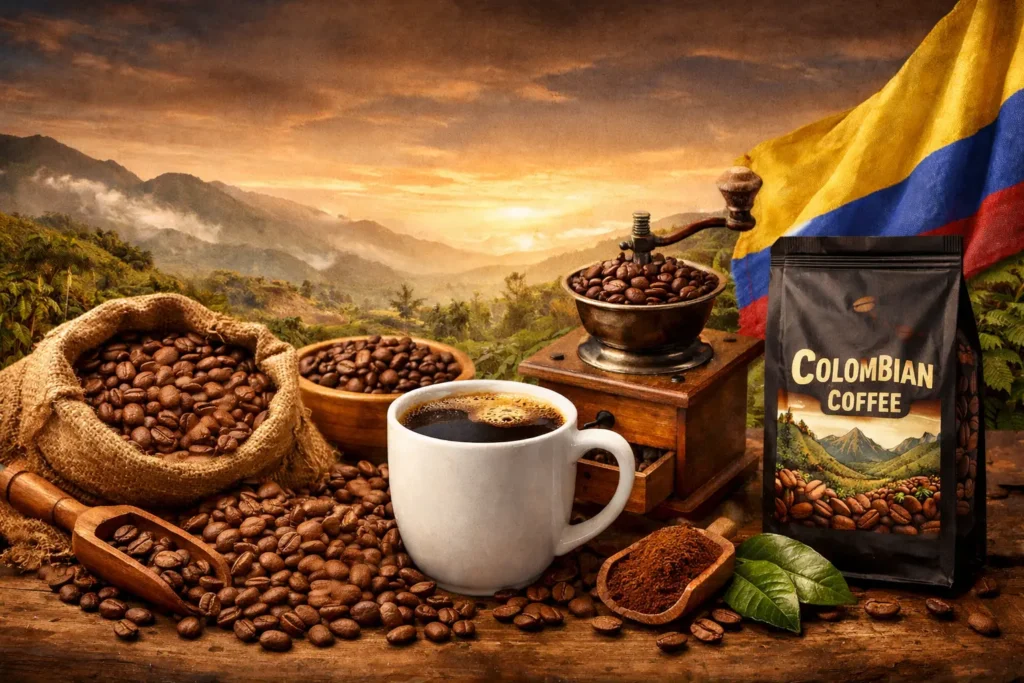
⭐ Best All-Rounder: Colombian Medium Roast Whole Bean
If you only buy one style of coffee, this is the one. Colombian medium roast (washed or honey process) sits at the sweet spot where balanced sweetness, mild acidity, and chocolate-caramel body all coexist without any one characteristic dominating. It’s the most forgiving coffee for any brewing method, and the most predictable result across different grind settings and water temperatures — making it ideal as a baseline while you calibrate your setup. Look for a roast date on the bag (7–21 days post-roast is the target window) and buy whole bean.
- Flavor: Caramel, mild red fruit, milk chocolate, clean finish
- Processing: Washed or honey — either works well
- Roast: Medium — the most forgiving extraction range
- Best for: Drip, pour-over, espresso, AeroPress, French press — works everywhere
- K6 grind starting point: 94–104 clicks for pour-over; 38–42 clicks for espresso
Disclosure: CoffeeGearHub may earn from qualifying purchases.
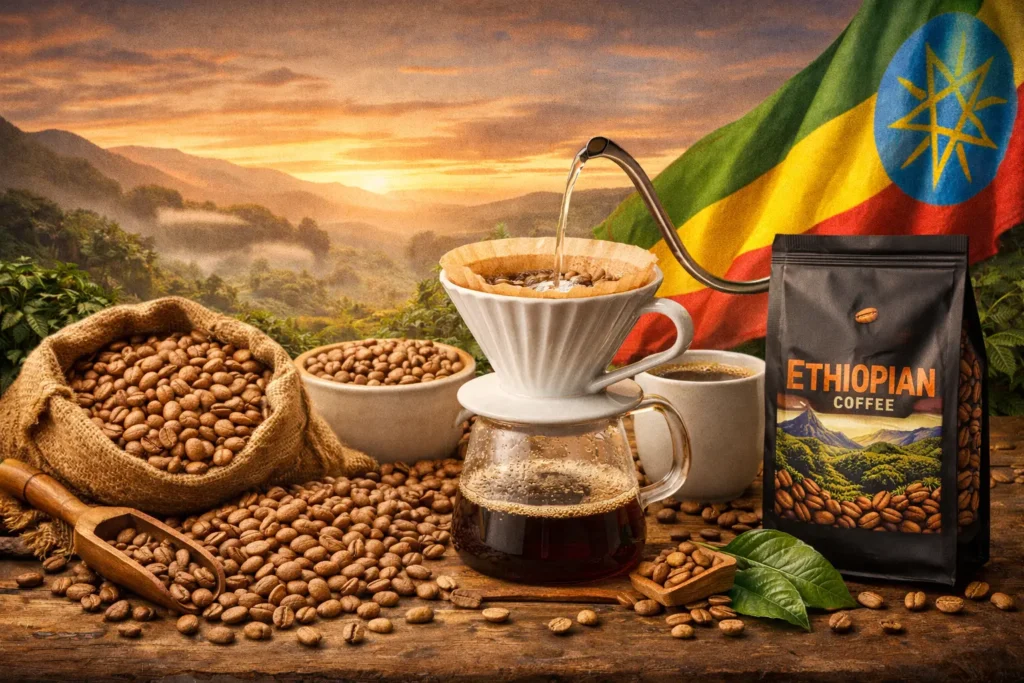
🌸 Best for Pour-Over: Ethiopian Washed Light-Medium Roast
For pour-over brewing — V60, Chemex, AeroPress — washed Ethiopian light roast is the reference-point coffee that defines what pour-over is capable of. At a lighter roast, the washed process strips away any fruit sweetness from processing and leaves the bean’s own flavor fully exposed: florals, citrus, bergamot, jasmine, sometimes blueberry or stone fruit depending on the region of origin. It’s more demanding to brew than a medium roast (it needs hotter water — 94–96°C — and a finer grind than most beginners start with), but when dialed in correctly it produces a clarity and aromatic complexity no other style can match. Requires a quality burr grinder for best results — this is where the KINGrinder K6 earns its keep.
- Flavor: Floral, jasmine, citrus, bergamot, sometimes blueberry or peach
- Processing: Washed — maximizes clarity and origin expression
- Roast: Light to medium-light — highest aroma intensity, brightest acidity
- Best for: Pour-over (V60, Chemex), AeroPress, Chemex — not recommended for French press or espresso beginners
- K6 grind starting point: 96–106 clicks; brew at 94–96°C
Disclosure: CoffeeGearHub may earn from qualifying purchases.
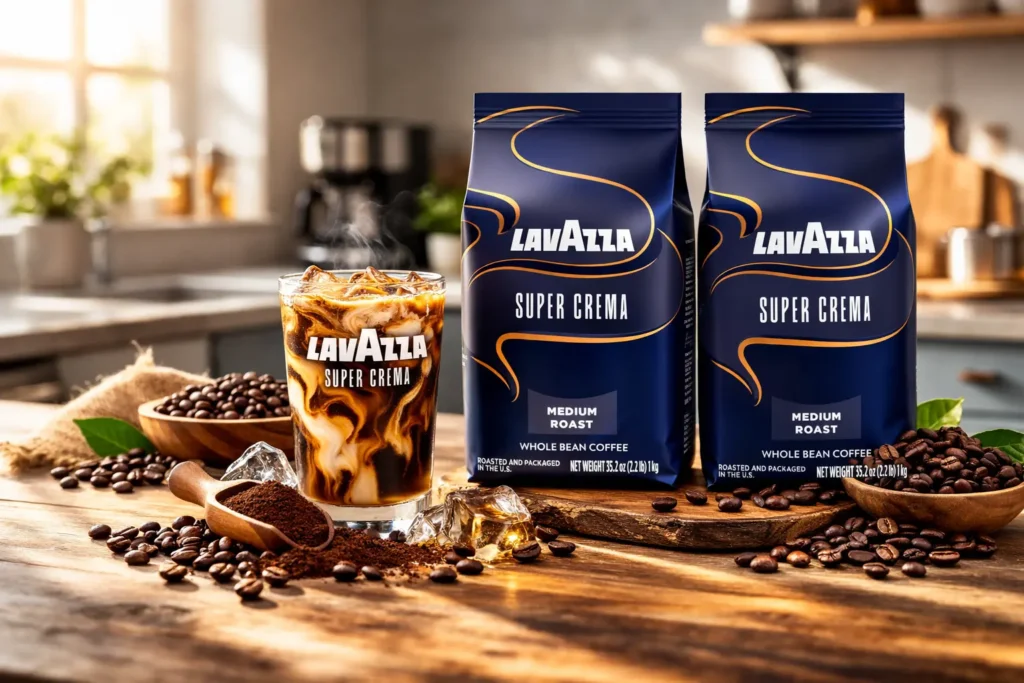
☕ Best for Espresso: Lavazza Super Crema Espresso Blend
Lavazza Super Crema is the best-selling espresso blend on Amazon for good reason — it’s dialed in for exactly what most home espresso setups need: a medium-light roast with enough sweetness and body to produce thick crema and a balanced shot without the bitter edge that dark espresso blends can develop. The blend combines Brazilian and other South American Arabica with a small percentage of Robusta (which contributes the dense, persistent crema the name refers to). It’s particularly well-suited to milk-based drinks — lattes, cappuccinos, flat whites — where the chocolate and hazelnut notes hold up through the milk without disappearing. Easier to extract consistently than single-origin light roasts, and more interesting than most Italian-style dark blends.
- Flavor: Hazelnut, honey, dried fruit, mild chocolate — balanced and crowd-pleasing
- Blend: Predominantly Arabica (Brazilian + other South American) with Robusta for crema
- Roast: Medium-light — easier to extract than dark espresso roasts without sacrificing body
- Best for: Espresso machines, Moka pot, milk-based drinks (latte, cappuccino, flat white)
- K6 grind starting point: 38–42 clicks for espresso; 65–72 clicks for Moka pot
Disclosure: CoffeeGearHub may earn from qualifying purchases.
Match Beans to the Right Grinder
Lighter, brighter coffees are less forgiving of grind inconsistency than darker ones. The grinder matters most when the bean is most demanding — and grind consistency determines how much of the bean’s flavor actually makes it into your cup.
| Bean style | Roast | Best grinder type | Why it matters | Recommended brew methods |
|---|---|---|---|---|
| Bright, fruity, floral | Light–Medium | Quality burr grinder — grind uniformity is critical | Even small inconsistencies make light roasts taste sour, sharp, or thin. The bean’s complexity only expresses fully with even particle distribution. | Pour-over, Chemex, AeroPress |
| Sweet, balanced | Medium | Any burr grinder — entry-level is sufficient | Medium roasts are forgiving; a consistent grind still improves sweetness and clarity, but minor inconsistencies are masked by the balanced profile. | Drip, pour-over, espresso |
| Chocolatey, smooth | Medium–Medium-Dark | Burr grinder — wide range and stable settings | Consistency keeps body rich without turning bitter or muddy at coarser French press settings. | Espresso, French press, cold brew |
| Heavy, earthy | Medium-Dark–Dark | Burr grinder — or pre-ground in a pinch | Dark roasts mask grind flaws better than any other style. Blade grinders are still not recommended, but the margin is wider here. | French press, Moka pot, cold brew |
| Espresso-focused | Medium–Medium-Dark | Espresso-capable burr grinder — fine adjustment steps essential | Espresso requires 1–2 click precision adjustments. Wide-step grinders make dialing in a frustrating guessing game. | Espresso machines |
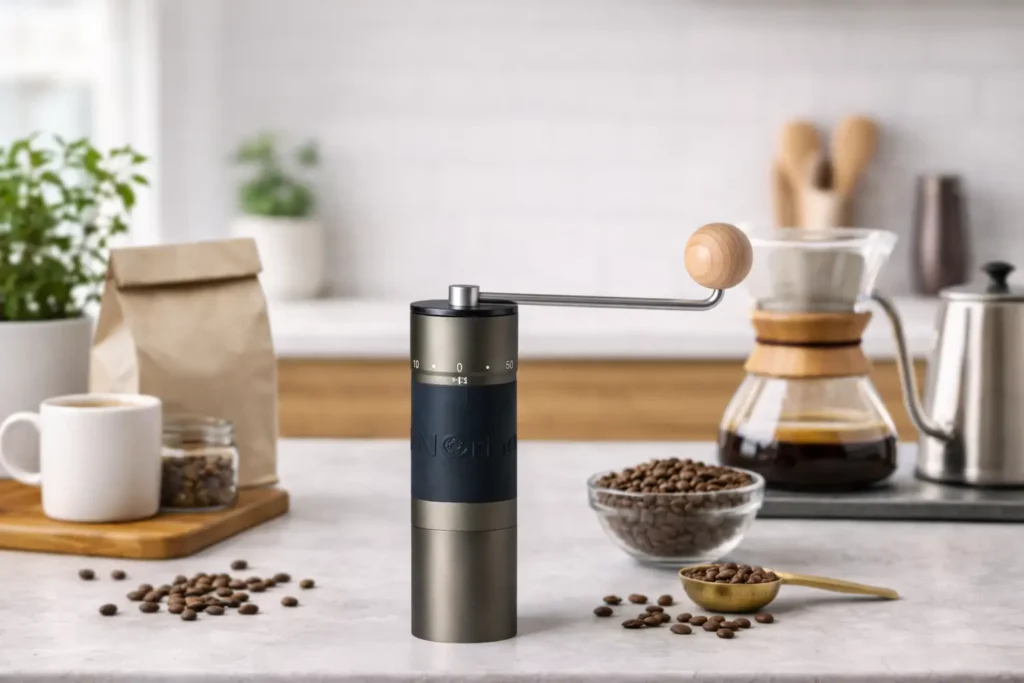
KINGrinder K6 — The Standard CoffeeGearHub Grinder Recommendation
Fresh beans only reach their potential when ground consistently immediately before brewing. The KINGrinder K6 is the CoffeeGearHub standard manual grinder recommendation across all brewing guides — its 60-clicks-per-rotation adjustment covers every brew method from espresso (clicks 35–45) through AeroPress and pour-over (70–110 clicks) to French press (135–150 clicks), and the 48mm stainless conical burrs produce low fines at the medium-fine settings that pour-over and AeroPress require. A 5-click adjustment at pour-over settings produces a readable extraction shift — enough to move from sour to balanced in a single brew session.
- 60 clicks per rotation: Fine enough for espresso, wide enough for French press
- 48mm conical burrs: Low fines at pour-over settings — reduces filter stalling on V60 and Chemex
- All-metal body: Handles daily 18–22g doses without wear
Disclosure: CoffeeGearHub may earn from qualifying purchases.
For a full breakdown of grinder types, see our companion guides: Burr vs Blade Grinders, Manual vs Electric Grinders, and Best Coffee Grinders (2026).
Troubleshooting Matrix: Fix Bad Coffee
Most coffee problems that seem like bean problems are actually extraction problems — or freshness problems. Find your symptom and follow the fix order before blaming the bag.
| Symptom | Most likely cause | Fix (in order of probability) |
|---|---|---|
| Sour or sharp — tastes under-developed | Under-extraction: water too cool, grind too coarse, or light roast at medium temperature | 1. Raise brew temperature 2°C → 2. Grind 5 clicks finer → 3. For light roasts specifically, target 94–96°C not 91°C → 4. Extend brew time slightly |
| Bitter or harsh — too much roast flavor | Over-extraction: temperature too high, grind too fine, or dark roast brewed at standard temp | 1. Lower brew temperature 2°C → 2. Grind 5 clicks coarser → 3. For dark roasts, target 88–91°C not 93°C → 4. Reduce brew time |
| Flat, papery, no aroma | Stale beans — CO₂ gone, volatile aromatics lost, past peak | Buy fresher beans — look for a roast date, not a best-by date. This symptom has no extraction fix. No temperature or grind adjustment recovers stale coffee. |
| Watery or thin body | Ratio too weak (not enough coffee), grind too coarse, or under-extraction | 1. Increase dose (try 1:15 ratio instead of 1:17) → 2. Grind 3–4 clicks finer → 3. Raise temperature 1–2°C → 4. Check your scale — measure by weight, not volume |
| “Funky” or off-fermented flavor from a natural process bean | Poor natural processing — low-quality or poorly stored natural process coffee | Buy from a reputable specialty roaster rather than supermarket natural process. Poor naturals are an upstream sourcing problem — no brew fix available. |
| Tastes fine, but nothing like the bag’s tasting notes | Beans need degassing; brewing too soon after roast; or expectations mismatched to roast level | Wait 5–7 days after roast date for medium roasts; 10–14 days for lighter roasts. Also check: dark roasts show less tasting-note variety by design. |
| Inconsistent cup-to-cup from the same bag | Blade grinder (uneven particle size); or variable pour speed and technique | Switch to a burr grinder — this is the single most impactful hardware change for consistency. Also use a kitchen scale: measure by gram, not scoop. |
| Correct flavor notes but coffee tastes “muddy” or cloudy | Excessive fines from grinder; over-extraction in immersion brew; or French press plunged too early | Grind 3–5 clicks coarser → For French press, extend steep and plunge slowly → Consider a paper filter on AeroPress |
| Great first day from the bag, noticeably worse after a week | Bag not resealed airtight; or storing near heat/light source | Transfer to an airtight opaque container — see Bean Storage below. Do not store in original bag unless it has a proper one-way valve and reseal. |
| Light roast tastes sour no matter what you adjust | Grind too coarse for the brew method; water temperature below 93°C for light roast | Light roasts need finer grind AND higher temperature than medium roasts. Try: 1. 95°C water → 2. Grind to 94–100 clicks on K6 → 3. Pour slowly and extend total brew time by 30 seconds |
Bean Storage: Keep Your Coffee Fresh
Fresh beans are the most impactful variable in home coffee quality — more than brew method, more than grinder price. The right storage approach extends the peak flavor window significantly. The wrong approach stales a quality bag in under a week.
✅ Do This
- Store in an airtight, opaque container at room temperature
- Keep away from heat sources, direct light, and moisture
- Buy in smaller quantities more frequently — 250g every 1–2 weeks beats a 1kg bag every 6 weeks
- Look for a roast date on the bag — not just a best-by date
- Buy whole bean and grind immediately before brewing
- Allow 5–14 days after roast before brewing (especially for lighter roasts that need degassing)
❌ Avoid This
- Do not refrigerate — condensation and odor absorption damage beans rapidly
- Do not store on or near the espresso machine, kettle, or stovetop — heat is the primary enemy of freshness
- Do not store in the original bag long-term if it has no proper one-way degassing valve and reseal
- Do not buy pre-ground unless it’s your only option — ground coffee loses most aromatics within 15–30 minutes of grinding
- Do not buy coffee with no roast date — you have no way to assess freshness
Freshness Timeline: When Does Coffee Peak?
| Days after roast | What’s happening | Ideal for brewing? |
|---|---|---|
| 0–5 days | Beans actively degassing CO₂ — bloom in pour-over will be very vigorous; flavor can taste “green” or muted | Too fresh for most methods; acceptable for espresso where degassing helps crema |
| 5–14 days | Peak window for most light and medium roasts — CO₂ has stabilized, volatile aromatics are at maximum | ✅ Ideal — buy and brew here for maximum flavor |
| 14–30 days | Still excellent for medium and medium-dark roasts; light roasts may begin to soften in brightness | ✅ Still very good — especially for medium roasts |
| 30–60 days | Noticeable flatness in lighter roasts; medium-dark roasts hold well; dark roasts still acceptable | ⚠️ Usable but past peak — buy fresher next time |
| 60+ days | Significant staling across all roasts — flat, papery, minimal aroma | ❌ Stale — no extraction technique can compensate |
⚠️ On freezing: Freezing whole bean coffee can work for long-term storage of large quantities — but only if the beans are vacuum-sealed and frozen once, then thawed completely without opening before use. Repeatedly freezing and thawing, or opening a bag while cold, introduces condensation that damages the beans irreversibly. For everyday brewing, room-temperature airtight storage is always the better approach.
Coffee Bean Buying Checklist
Run through this before buying any bag — it covers the questions most buyers skip until they’re already disappointed.
| Question | What to look for | Red flag |
|---|---|---|
| Is there a roast date on the bag? | A specific roast date — not just “best by” — within the last 30 days ideally | No roast date at all; only a “best before” or “use by” date; roast date more than 60 days ago |
| Is it whole bean? | Whole bean for maximum freshness — grind immediately before brewing | Pre-ground unless you have no grinder; pre-ground at coarse setting for a method requiring fine (e.g., espresso) |
| Does the origin match my flavor goal? | Match origin to the flavor profile from the table above — Africa for bright, South America for balanced/smooth, Asia for heavy | Buying an origin you’ve had before and didn’t enjoy, hoping the roaster changes the profile — origin character is consistent |
| Does the process match my preference? | Washed for clean; Natural for fruity; Honey for balanced | No processing information on the bag — typically indicates commodity-grade coffee with no specialty sourcing |
| Does the roast level match my brew method and skill level? | Medium for any method and any skill level; Light only if you have a good burr grinder and temperature-controlled kettle | Buying light roast with a blade grinder or standard kettle without a thermometer — the results will disappoint |
| Is the bag size appropriate for how fast I brew? | Buy what you’ll use in 3–4 weeks maximum — 250g for solo brewing, 500g if you brew daily or for two people | Buying 1kg at once to save money — unless you can freeze a portion correctly, you’ll be drinking stale coffee before the bag is done |
| Do I have the right grinder for this roast level? | Any burr grinder for medium; quality burr grinder (K6 or equivalent) for light or espresso | Planning to use a blade grinder with a specialty light roast — you will not get the cup quality the beans are capable of |
FAQs: Coffee Bean Buying Guide
What roast level should I buy if I’m new to specialty coffee?
Start with a medium roast. It’s the most forgiving option, works across drip, pour-over, and espresso, and balances sweetness with clarity. Very light roasts can taste sour if brewed incorrectly, and very dark roasts can taste bitter or flat
Does dark roast coffee have more caffeine?
No — not in a meaningful way. Caffeine depends more on how much coffee you use and how you brew it than roast level. By weight, light roasts may actually have slightly more caffeine because the beans are denser and less porous.
What is the difference between Arabica and Robusta coffee?
Arabica represents the majority of specialty coffee. It grows at higher altitudes, has lower caffeine, more complex sugars, and a wider flavor range. Robusta has roughly twice the caffeine, a stronger and more bitter profile, and produces better crema in espresso blends. Most specialty single-origins are 100% Arabica. Robusta is most commonly found in blends, instant coffee, and Italian-style espresso.
What’s the difference between washed, natural, and honey process coffee?
Washed (wet process): Clean, crisp, highlights origin flavors
Natural (dry process): Sweeter, fruitier, heavier body — can taste funky if poorly processed
Honey (pulped natural): A balanced middle ground with smooth sweetness
Processing is one of the strongest predictors of a coffee’s sweetness and body.
Which coffee beans are best for pour-over brewing?
For pour-over, look for light to medium roasts with washed or honey processing from Ethiopia, Kenya, or Colombia. These offer clarity and aromatic complexity that pour-over highlights better than any other brew method.
Which coffee beans are best for espresso?
Espresso is easier to dial in with medium to medium-dark roasts that emphasize sweetness and body. Brazilian and Colombian coffees are common, especially for milk drinks. Very light roasts require advanced grinders and careful dialing — not recommended for beginners
How fresh should coffee beans be when I buy them?
Look for a roast date, not just a “best by” date. Coffee usually tastes best 5–30 days after roasting. If no roast date is listed, the coffee may already be stale.
Should I buy whole bean or pre-ground coffee?
Always buy whole bean if possible. Ground coffee loses most of its volatile aromatics within 15–30 minutes of grinding. Grinding immediately before brewing is one of the highest-impact quality improvements at any equipment level.
Why do light roast coffees taste sour sometimes?
Sourness almost always means under-extraction, not bad beans. Light roasts are denser and less soluble than darker roasts — they need a finer grind, hotter water (94–96°C), or longer brew time to extract evenly. Adjust extraction before blaming the beans.
How should I store coffee beans to keep them fresh?
Store in an airtight, opaque container at room temperature, away from heat, light, and moisture. Do not refrigerate (condensation damages beans). Do not freeze unless storing a large sealed quantity for longer than 6 weeks. Buy in smaller quantities more frequently — 250g every 1–2 weeks is better than 1kg every 6 weeks.
If you’re still unsure, start with a fresh medium roast from Colombia, grind it with a burr grinder, and adjust grind size before changing anything else. That single habit solves 80% of home coffee problems.
Continue Learning
BEANS BY BREW METHOD
Now that you know what beans to buy, are you getting the most out of your grinder? Our grind size guide covers the exact settings for every brew method — with full KINGrinder K6 click references and a visual reference chart.
☕
Written by the CoffeeGearHub Editorial Team
CoffeeGearHub is a specialty coffee equipment resource run by home brewers and enthusiasts. Our guides are researched using published brewing science, SCA standards, grinder manufacturer specifications, and established specialty-coffee sourcing and community knowledge. We review and update pillar content regularly. About CoffeeGearHub →