
Drip Coffee Ratio Chart: Grams, Cups & Strength Fixes
Editorial standards: this guide uses coffee-to-water ratios as repeatable starting points rather than absolute rules. Brewer calibration, roast level, grind, water, filter type, batch size, and personal taste can all shift the ideal dose.
At a glance
What this guide covers
This guide converts drip-coffee ratios into practical gram and cup amounts, explains how to scale batches, and shows when strength problems should be fixed with dose versus grind size.
Editorial analysis
Strength and extraction are related, but they are not the same problem
Adding more coffee makes the beverage stronger, but it does not automatically correct under-extraction. A cup can be strong and sour or weak and bitter depending on grind, contact time, and water distribution.
Use ratio to set concentration first, then use grind and technique to correct flavor. That separates two problems that are often confused when dialing in drip coffee.
The 30-Second Answer
A practical drip starting point is about 1:16 coffee to water by weight, then adjust to taste. Use more coffee or less water to change strength; use grind and brewing conditions to correct sour, bitter, or uneven extraction.
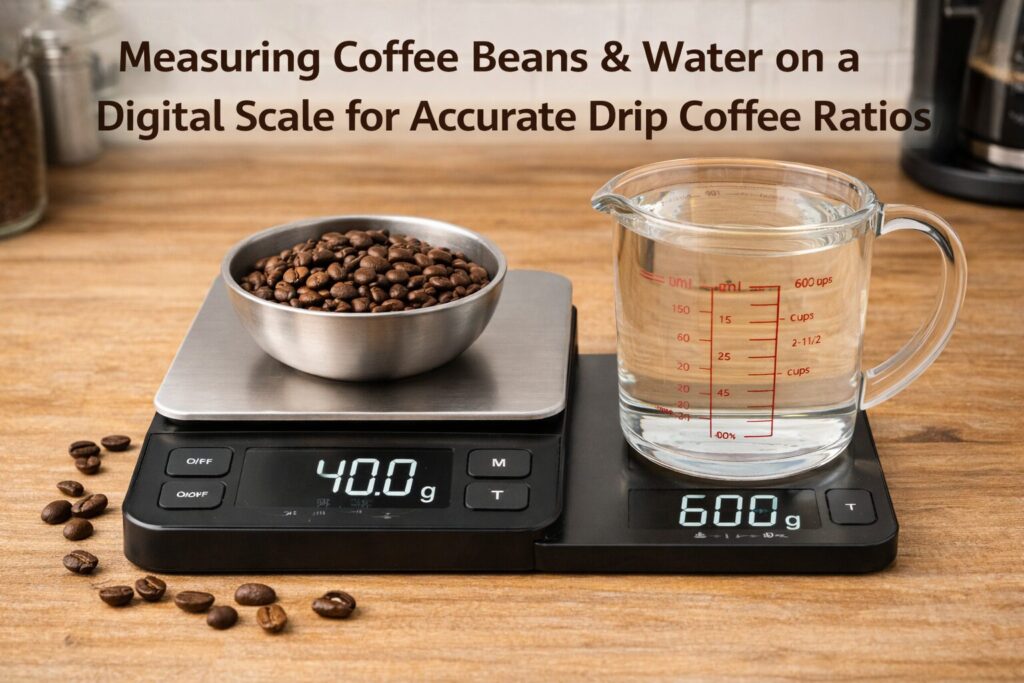
Start with a 1:16 ratio — 1 gram of coffee for every 16 grams of water. For a single large mug using 300g of water, that is 19g of coffee. For a full 12-cup carafe using 1,800g of water, that is 113g of coffee. If your coffee tastes weak, tighten to 1:15. If it tastes bitter or harsh, loosen to 1:17. Always measure by weight, not scoops — a standard coffee scoop can vary by 20% or more between roast levels and grind sizes, making scoop-based ratios unrepeatable by design.
- Best starting ratio: 1:16 — balanced, works across most machines and roast levels
- Strong preference: 1:15 — more concentrated; good for dark roasts or milk drinks
- Light preference: 1:17 — gentler extraction; good for light roasts or sensitive palates
- SCA Golden Cup standard: 1:18 (55g/L) — calibrated for certified machines at 92–96°C; most home machines need 1:16 to compensate for lower brew temperature
- Measure by weight: A kitchen scale removes all scoop-related variation in one step
- Full carafe rule: Scale batches slightly tighter — use 1:15 for 8–12 cups instead of 1:16
Quick Reference: Drip Coffee Ratio Chart for Every Carafe Size
Use this chart to find your dose by carafe size and preferred ratio. All weights are in grams — weigh water directly into your reservoir or a separate vessel rather than relying on machine volume markings, which are routinely inaccurate by 5–15%.
| Carafe size* | Water (g) | 1:15 (strong) | 1:16 (balanced) | 1:17 (lighter) | SCA 1:18 |
|---|---|---|---|---|---|
| Single mug | 300g | 20g | 19g | 18g | 17g |
| 2–3 cups | 500g | 33g | 31g | 29g | 28g |
| 4 cups | 700g | 47g | 44g | 41g | 39g |
| 6 cups | 900g | 60g | 56g | 53g | 50g |
| 8 cups | 1,200g | 80g | 75g | 71g | 67g |
| 10 cups | 1,500g | 100g | 94g | 88g | 83g |
| 12 cups | 1,800g | 120g | 113g | 106g | 100g |
A note on “cups”: Coffee maker cup markings represent 5–6 oz (150–180ml) — not the standard 8 oz measuring cup. A “12-cup coffee maker” holds approximately 1,800ml, not 2,800ml. This is why the chart uses water grams rather than machine cup markings — those markings are not standardized and vary by manufacturer.
Table of Contents
What a Drip Coffee Ratio Is and Why It Matters
A drip coffee ratio describes how much coffee you use relative to how much water you brew with — written as coffee:water. A ratio of 1:16 means 1 gram of coffee for every 16 grams of water. The ratio controls overall strength and is the primary lever for making coffee consistently taste the way you want.
Drip machines offer very little control during the actual brew cycle — water temperature, flow rate, and extraction time are largely fixed by the machine’s hardware. Ratio and grind size are the two variables that remain in your hands. That makes them especially important: a small, consistent ratio change produces a reliably different cup every time, which means once you find what you like, you can hit it repeatedly.
🚫 Why scoops can’t produce a consistent ratio: Coffee density varies by up to 20% between roast levels and grind sizes. A level scoop of light-roast whole beans, medium-roast ground coffee, and dark-roast pre-ground coffee all weigh measurably different amounts — meaning the “same scoop” is a different dose every time the beans or grind changes. Weighing eliminates this entirely. One gram is one gram regardless of roast, grind, or bean origin.
Why 1:16 Is the Right Starting Point for Home Brewers
The SCA Golden Cup standard is 55 grams per litre — approximately 1:18. That standard is calibrated for SCA-certified machines that brew at 92–96°C with precise temperature consistency. Most basic home drip machines brew significantly cooler than this — often 75–85°C — which means water contacts the coffee at a temperature where extraction is slower and less complete. At a 1:18 ratio, a cool-running machine produces a noticeably weak, under-extracted cup.
A 1:16 ratio compensates for this: the stronger concentration produces a balanced cup from machines that would otherwise under-extract at the SCA standard. If you own a certified SCA machine like the Breville Precision Brewer or OXO Brew 9-Cup — machines that genuinely reach and hold 92–96°C — you can try moving toward 1:17 or 1:18 and may prefer the result. For everything else, 1:16 is the reliable starting point.
Ratio by Roast Level
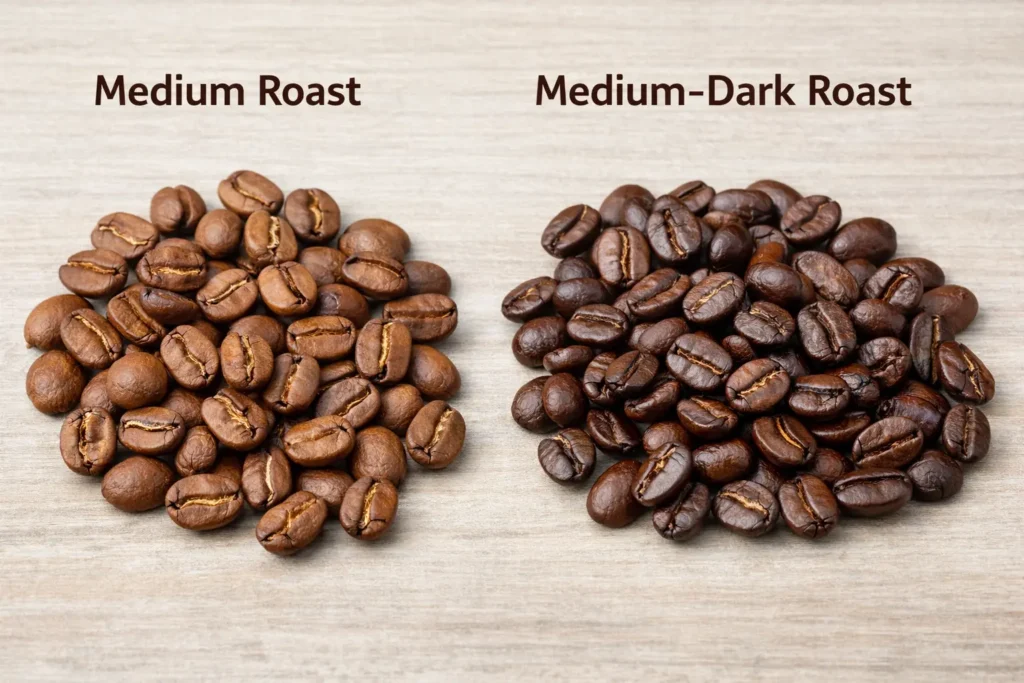
Roast level changes how soluble and porous beans are — which affects how much extracts at a given ratio. Light roasts are denser and require more extraction energy; dark roasts are more porous and release compounds faster. Using a fixed 1:16 ratio across all roast levels produces meaningfully different cups — adjusting by roast produces more consistent results.
| Roast level | Starting ratio | Grind | Why | Taste signal to adjust |
|---|---|---|---|---|
| Light roast ☀️ | 1:15 to 1:15.5 | Medium-fine | Dense beans extract slowly — tighter ratio and finer grind compensates; most home machines can’t fully extract light roasts at 1:16 | Sour or sharp → grind finer. Thin body → tighten ratio to 1:14.5 |
| Medium roast ✓ | 1:16 (start here) | Medium | The most forgiving roast level — extracts cleanly at standard ratio with medium grind on most home machines | Weak → 1:15. Bitter → 1:17. This is your baseline for all ratio learning |
| Medium-dark roast | 1:16 to 1:16.5 | Medium to medium-coarse | Slightly more soluble than medium — standard ratio works; coarser grind prevents over-extraction of heavier compounds | Bitter or harsh → grind coarser before adjusting ratio |
| Dark roast 🌑 | 1:16.5 to 1:17 | Medium-coarse | Highly porous — extracts quickly and heavily; lighter ratio and coarser grind prevents the sharp, ashy bitterness dark roast is prone to | Still bitter → grind coarser. Flat or hollow → tighten slightly to 1:16 |
How Batch Size Changes Your Ratio
Drip coffee does not scale proportionally between small and large batches. When you brew a full 12-cup carafe, water moves through a deeper, more tightly packed coffee bed — contact time changes, and the extraction dynamics shift. Most home brewers notice that their “same recipe” tastes noticeably weaker when they scale from a small to a full batch. This is not a measurement error — it is a physical property of drip brewing that requires ratio compensation.
| Batch size | Water | Recommended ratio | Why |
|---|---|---|---|
| Single mug | 250–350g | 1:16 | Standard ratio performs correctly at small volumes; easy to adjust by taste |
| Small batch (2–4 cups) | 500–700g | 1:16 | Standard ratio; use this as your reference point for dialing in preferences |
| Medium batch (6 cups) | 800–1,000g | 1:15.5 to 1:16 | Extraction efficiency begins to change; a slight tightening often improves balance |
| Full carafe (8–12 cups) | 1,200–1,800g | 1:15 | Full carafes extract measurably less efficiently — tighter ratio compensates; weaker-than-expected full carafes are almost always a dose issue, not a machine issue |
How Grind Size and Ratio Interact
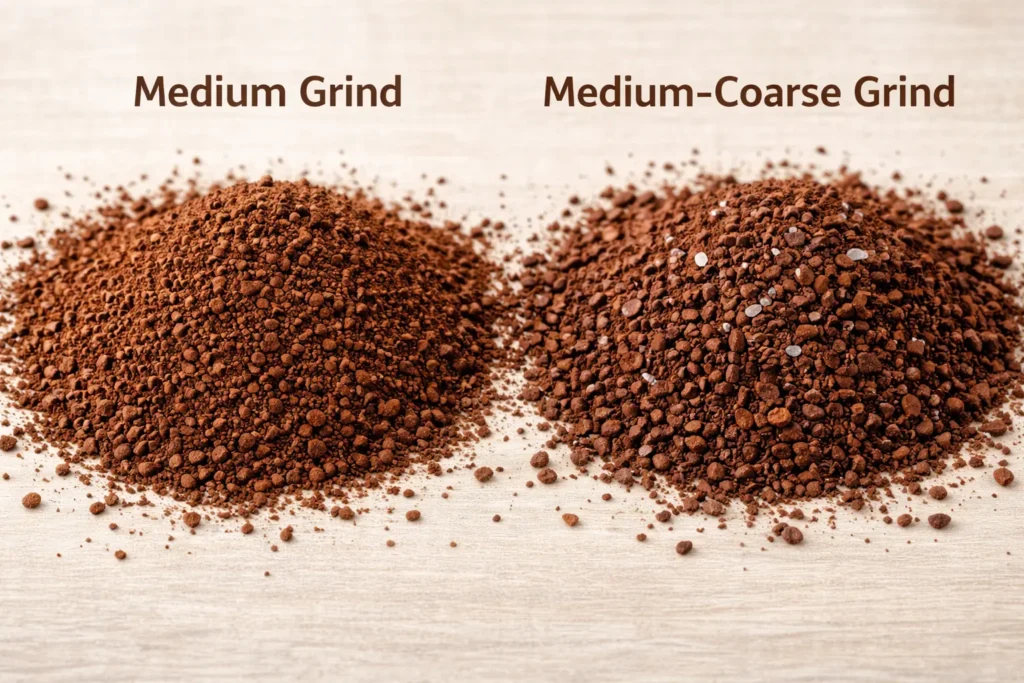
Grind size and ratio are linked variables — adjusting one without considering the other is the most common source of “chasing your tail” in home espresso and drip brewing. A coarser grind extracts fewer compounds per gram of coffee, so a coarse grind at a tight ratio may still taste weak. A finer grind extracts more per gram, so a fine grind at a loose ratio may still taste bitter. The correct diagnostic sequence is always: adjust grind first, then ratio.
| Situation | What’s happening | Fix — in order |
|---|---|---|
| Weak at 1:16, correct dose | Grind too coarse — water passing through too quickly without extracting enough soluble compounds | Grind one step finer → rebrew at same ratio → taste before adjusting ratio |
| Bitter at 1:16, correct dose | Grind too fine — over-extracting harsh bitter compounds | Grind one step coarser → rebrew at same ratio → if still bitter, try 1:17 |
| Changed grind, now tastes different | Finer grind extracts more — cup is now over-concentrated even at same ratio | If grind went finer and cup is now too strong or bitter: loosen ratio 0.5 steps (1:16 → 1:16.5) |
| Swings between weak and bitter on different days | Grinder producing inconsistent output; or dose varying because scoops are being used | Confirm grinder setting hasn’t shifted → weigh every dose on a scale → if using a blade grinder, switch to a burr grinder |
Gear That Makes Drip Coffee Ratios Actually Work
Understanding ratio is the first step. The second step is having the tools to measure it correctly every morning without effort. Two pieces of equipment do this — a kitchen scale and a burr grinder. Everything else is optional.
Disclosure: CoffeeGearHub may earn a commission on qualifying purchases through affiliate links. CoffeeGearHub.com participates in the Amazon Services LLC Associates Program. As an Amazon Associate, we earn from qualifying purchases.
⚖️ Essential for Ratio Accuracy — Digital Coffee Scale
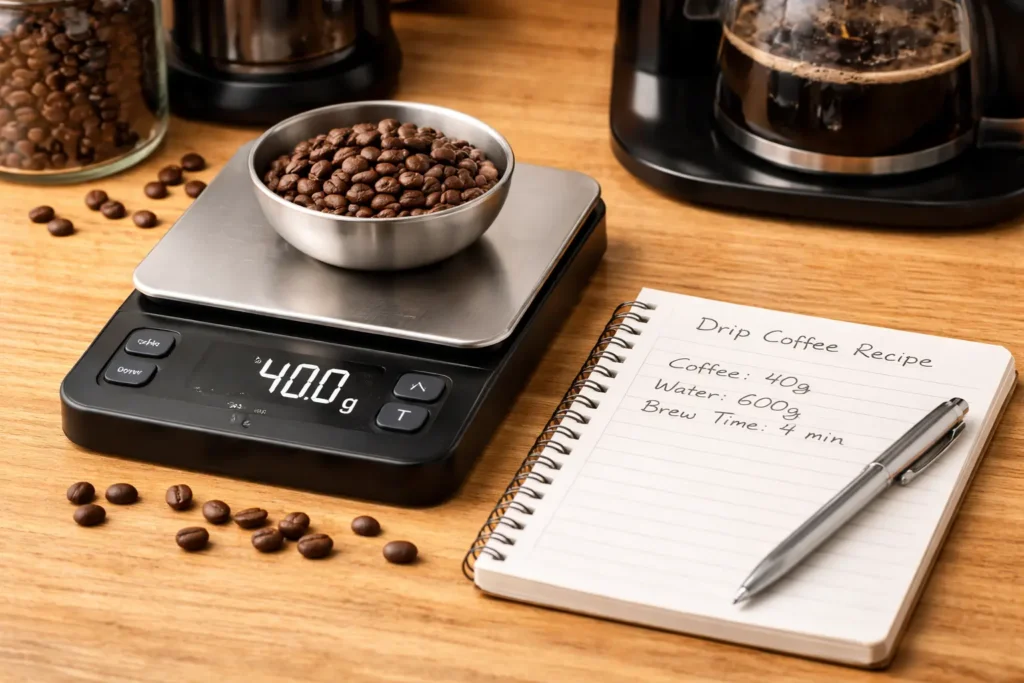
Digital Coffee Scale — The Most Impactful Ratio Upgrade
A kitchen scale with 0.1g resolution is the single most impactful change most home brewers can make. It converts ratio from a concept into a number — a number you hit exactly, every morning, regardless of which beans or grind you’re using. Scoops introduce dose variation of 15–20% between sessions because coffee density changes with roast and grind; a scale reduces that variation to essentially zero. For drip coffee, you need at least 2kg capacity (full carafe plus server weight), 0.1g resolution, and ideally a built-in timer if you also brew pour-over. The Timemore Black Mirror Basic Plus is the CoffeeGearHub recommendation for most home brewers — fast response, USB-C rechargeable, and works correctly for every brew method. See the full Best Coffee Scales guide for every option by budget.
- Resolution needed: 0.1g minimum — 1g resolution masks meaningful dose differences
- Capacity needed: 2kg+ — full 12-cup carafe setups approach this limit
- Timer: Useful for pour-over; optional for automatic drip
- Best for: Any home brewer who wants repeatable ratio control — which is every home brewer
Disclosure: CoffeeGearHub may earn from qualifying purchases.
🔬 CoffeeGearHub Grinder Standard — KINGrinder K6
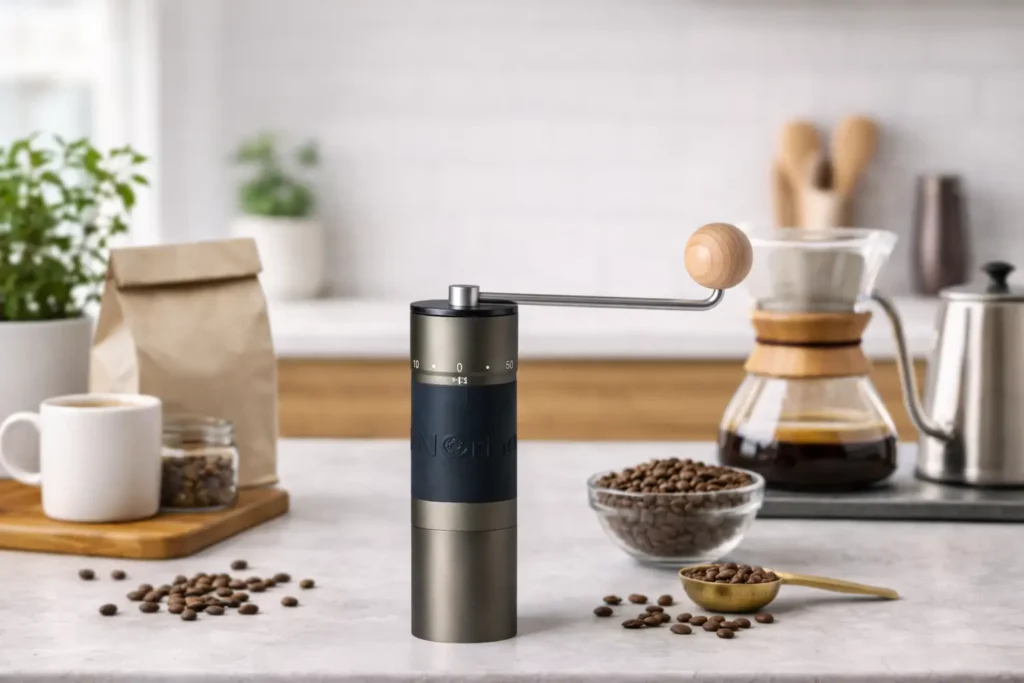
KINGrinder K6 — Best Manual Grinder for Drip Coffee
A scale fixes the dose side of the ratio equation. A quality burr grinder fixes the extraction side. The two work together: consistent grind particle size means water extracts the same compounds from the same dose every time — which is what makes ratio adjustment meaningful. If the grinder produces uneven particles, a fine-dust-and-chunk mixture over- and under-extracts simultaneously, producing cups that are simultaneously bitter and weak — a problem no ratio change can fix. The KINGrinder K6 is the CoffeeGearHub standard manual grinder recommendation. Its 100-click adjustment system puts the medium drip grind range (approximately 32–42 clicks from zero) within a precision that entry electric grinders cannot match at the same price point. For drip coffee, a 20g dose grinds in under 60 seconds — a completely practical daily habit. Paired with a scale and a consistent ratio, it removes grind inconsistency as a variable entirely.
- Drip setting: 32–42 clicks from zero (medium); adjust within range by roast level and taste
- 100-click system: More grind steps in the medium range than most entry electric grinders
- Also covers: pour over (35–55 clicks), French press (65–80 clicks), AeroPress (20–30 clicks)
- Best for: Solo to couple daily drip; anyone who wants one grinder for all non-espresso methods
Disclosure: CoffeeGearHub may earn from qualifying purchases. ASIN: B09W9Q7GNK
Troubleshooting Matrix: Drip Coffee Ratio Problems → Causes → Fixes
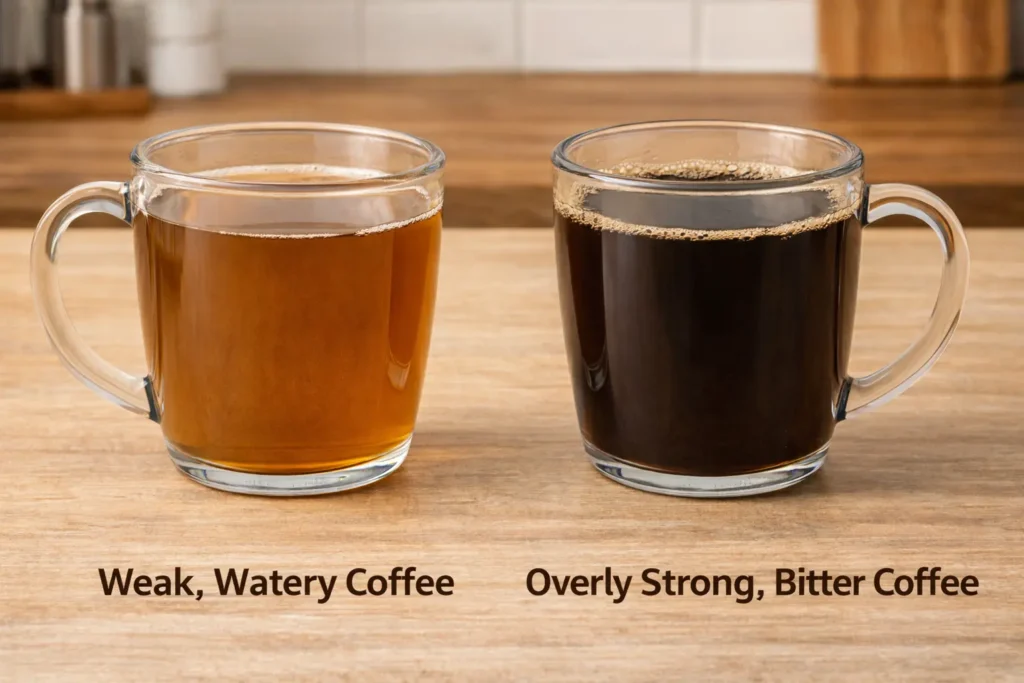
Change one variable at a time. Rebrew. Taste. Most drip problems come down to dose, grind, or bean freshness — in that order of likelihood. Use this matrix to identify the root cause before adjusting anything else.
| Symptom | Most likely cause | Fix — in order |
|---|---|---|
| Weak / watery / thin body | Under-dosed for batch size, grind too coarse, or machine brewing below 85°C | Increase dose by 3–5g and rebrew at same ratio → if still weak, grind one step finer → for full carafes, move from 1:16 to 1:15 → if problem persists: confirm machine is reaching adequate brew temperature |
| Bitter / harsh / drying finish | Grind too fine causing over-extraction, or ratio too tight for roast level | Grind one step coarser → rebrew at same ratio → if still bitter, move from 1:15 to 1:16 → for dark roasts specifically: try 1:17 with medium-coarse grind |
| Sour / sharp / acidic | Under-extraction — grind too coarse for the roast level, or coffee too short in the brew basket | Grind one step finer → confirm dose is correct (sour coffee is often under-dosed) → for light roasts: move to 1:15 and medium-fine grind |
| Flat / dull / no aroma | Stale beans — soluble aromatic compounds have off-gassed and oxidized | Check bean roast date — drip coffee benefits most from beans roasted within 3–4 weeks → switch to whole beans if using pre-ground → store in an airtight container away from heat and light → no ratio or grind change fixes stale beans |
| Good first cup, weaker or bitter later cups from same carafe | Warming plate scorching coffee sitting in the glass carafe — not a ratio problem | Transfer entire carafe to a thermal vessel immediately when the brew cycle ends → do not leave coffee on a warming plate for more than 10–15 minutes |
| Tastes different day to day despite “same recipe” | Dose varying because scoops are being used instead of weight; or grinder setting drifting | Weigh every dose on a scale — scoop variation causes 15–20% dose inconsistency → confirm grinder setting has not shifted (manual grinders can drift if the adjustment ring is not locked) → confirm same bean batch is being used |
| Full carafe tastes noticeably weaker than small batches at same ratio | Batch size scaling — larger batches extract less efficiently as contact dynamics change | Move from 1:16 to 1:15 for full carafes (8–12 cups) → weigh water rather than using machine markings, which are often less accurate at full-capacity fills |
| Machine markings and weighed water consistently disagree | Machine volume markings are not standardized — almost all drip machine markings are inaccurate by 5–15% | Weigh water every time → use a separate vessel if necessary → never use machine markings as the primary water measurement when ratio accuracy matters |
| Simultaneously weak AND bitter in the same cup | Grinder producing chaotic particle distribution — fine dust over-extracts while large chunks under-extract, both arriving in the same cup | This symptom combination cannot be fixed by ratio adjustment — it is the signature of a blade grinder or severely worn burr grinder. Switch to a quality burr grinder; no dose or ratio change resolves uneven particle distribution |
| Coffee tastes good at home but weak at full carafe for guests | Full carafe batch size scaling issue compounded by under-dosing for the larger batch | Use the 1:15 column from the ratio chart above for full carafes → weigh water directly rather than using the machine fill line → this situation is almost always a dose problem, not a machine problem |
FAQs: Drip Coffee Ratio Guide
What is the best coffee-to-water ratio for drip coffee?
For most home drip coffee makers, a 1:16 ratio is the best starting point — 1 gram of coffee for every 16 grams of water. This produces a balanced cup across most machines, roast levels, and grind sizes. Adjust to 1:15 if you prefer stronger coffee and 1:17 if you prefer lighter.
How much coffee should I use per cup of drip coffee?
At a 1:16 ratio, use approximately 9–10 grams of coffee per standard drip ‘cup’ (150ml or 5 oz of water). Most drip machine cup markings represent 5–6 oz, not 8 oz standard cups — always measure water by weight for accuracy.
Why does my drip coffee taste weak even with the right ratio?
Weak coffee at a correct ratio is almost always caused by one of three things: stale beans that have lost soluble compounds, a grind that is too coarse and extracting too little, or inaccurate water measurement using the machine’s volume markings instead of weighing. Try grinding slightly finer or increasing your dose by 2–3 grams before assuming the ratio is wrong.
Why does my drip coffee taste bitter at a 1:16 ratio?
Bitterness at a correct ratio usually comes from grind size, not dose. Grinding too fine causes over-extraction — too many harsh compounds dissolving into the cup. Grind coarser first, rebrew, and taste. If bitterness persists, the machine may be brewing at too high a temperature, or the beans may be over-roasted for your preference.
Should I change the ratio for light or dark roast coffee?
Yes. Light roasts are denser and require more extraction energy — a stronger ratio of 1:15 to 1:15.5 and slightly finer grind compensates. Dark roasts are more porous and soluble — a slightly lighter ratio of 1:16 to 1:17 and coarser grind prevents over-extraction and bitterness. Medium roast is the most forgiving at standard 1:16.
Does grind size affect the drip coffee ratio?
Yes — grind size and ratio are linked. A coarser grind extracts fewer compounds per gram, which can make coffee taste weak even at a correct ratio. A finer grind extracts more per gram, which can make coffee taste bitter even at a correct ratio. Adjust grind size one step first before adjusting ratio — grind is the faster, more precise diagnostic tool.
Do I need a scale to measure drip coffee ratios?
A scale is the most accurate way to measure dose and water. Scoops vary by up to 20% between roast levels and grind sizes due to density differences — meaning the same scoop delivers a measurably different dose every time you switch beans. A 0.1g resolution kitchen scale eliminates this variable entirely and costs less than a bag of specialty coffee.
Why does my coffee taste different when brewing a full pot versus a small batch?
Drip coffee does not scale proportionally. Larger batches extract less efficiently because the water-to-bed contact dynamics change. Full carafes often need a slightly tighter ratio — try 1:15 instead of 1:16 for 8–12 cup batches to compensate for the reduced extraction efficiency.
What is the SCA Golden Cup standard and should I use it?
The SCA Golden Cup standard is 55 grams of coffee per litre of water — approximately 1:18. It is calibrated for SCA-certified machines that brew at 92–96°C with precise temperature stability. Most basic home drip machines brew cooler (75–85°C), which under-extracts at 1:18. For standard home machines, 1:16 compensates for the lower temperature and produces a balanced cup.
How do I convert a drip coffee ratio to tablespoons if I don’t have a scale?
A level tablespoon of whole-bean medium-roast coffee weighs approximately 5–6 grams. For a 1:16 ratio with 300g of water, you need approximately 19g of coffee — roughly 3 level tablespoons. However, density varies significantly between roast levels and grind sizes, so tablespoon measurements are inherently imprecise. A 0.1g scale eliminates this variation and is the recommended long-term solution.
CoffeeGearHub product shortlist
Compare drip-coffee brewing gear
Review CoffeeGearHub brewer, scale, and grinder pages before opening merchant offers.
Continue Learning
Drip coffee guides
Dial in the variables
In this guide
- The 30-Second Answer
- Quick Reference: Drip Coffee Ratio Chart for Every Carafe Size
- What a Drip Coffee Ratio Is and Why It Matters
- Why 1:16 Is the Right Starting Point for Home Brewers
- Ratio by Roast Level
- How Batch Size Changes Your Ratio
- How Grind Size and Ratio Interact
- Gear That Makes Drip Coffee Ratios Actually Work
- Troubleshooting Matrix: Drip Coffee Ratio Problems → Causes → Fixes
- FAQs: Drip Coffee Ratio Guide
- Continue Learning