Last Updated: February 18, 2026 • 18–22 min read
Flow control espresso machines can absolutely help improve espresso—but only if you already have the fundamentals (grind, puck prep, temperature stability) under control. In this pillar guide, you’ll learn what flow control really changes inside the puck, how it compares to pressure profiling, which drinks and roast styles benefit most, and whether the upgrade is worth your money. You’ll also get buyer-focused recommendations, conversion-optimized Amazon product cards (Amazon-only picks), and comparison tables to help you choose the right path.
Quick Takeaways
- Flow control adjusts water flow through the puck (often via a needle valve/paddle or lever technique) which indirectly shapes pressure and extraction.
- It’s most valuable for light roasts, high-solubility challenges, and preventing channeling with aggressive pump ramps.
- It’s not a shortcut. If your grinder, distribution, or consistency is weak, flow control often makes results worse (more variables to mismanage).
- For milk drinks and medium-dark roasts, the ROI is usually modest compared to spending the same money on a grinder + workflow tools.
- If you love tinkering and pull straight shots, flow control can be one of the most satisfying “skill-based” upgrades in home espresso.
Helpful first step: If you still struggle with basics (ratio, grind changes, shot time, sour/bitter diagnosis), start with our authority guide: How to Dial In Coffee at Home (Drip, Pour-Over, Espresso).
What “Flow Control” Actually Means (In Plain English)
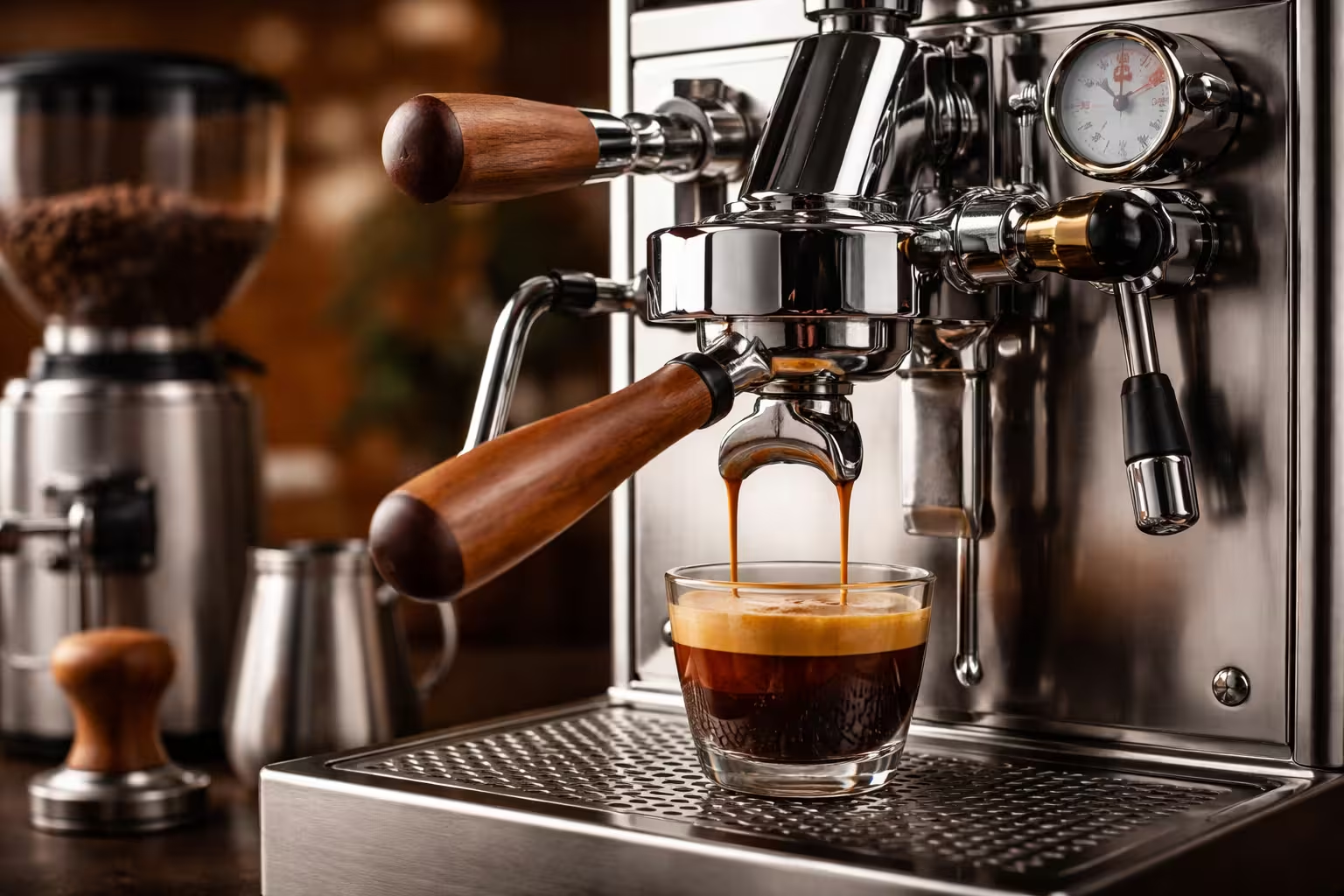
Most pump espresso machines are designed to deliver water quickly to the puck and hit a target brew pressure—often somewhere near the classic “9 bar” idea. A flow control setup gives you a way to restrict or increase water flow on purpose during the shot. In practice, this changes how the puck saturates, how pressure builds, and how evenly extraction progresses across the coffee bed.
Flow control is not the same thing as pressure profiling, but the two are related. When you restrict flow with a valve (or with lever technique), the puck resists water and pressure usually rises more slowly. When you open flow, pressure can rise faster or remain higher—depending on the machine, puck resistance, and pump behavior. You’re shaping how the machine “gets” to its operating pressure and how it behaves once there.
Simple mental model: Espresso is a controlled tug-of-war between water and coffee resistance. Flow control lets you change the water’s “push” at different moments, which can reduce channeling early and prevent harsh extraction late.
Flow Control vs Pressure Profiling vs Pre-Infusion
These terms get mixed together online, so let’s separate them clearly:
| Feature | What you control | How it’s done | Typical benefit |
|---|---|---|---|
| Pre-infusion | Low-pressure wetting phase | Timed line pressure, pump “soak,” or valve control | More even saturation, less channeling |
| Flow control | Water flow rate into group/puck | Needle valve/paddle (pump machines) or manual lever technique | Shape pressure indirectly + control extraction pace |
| Pressure profiling | Pressure curve directly | Lever pressure, variable pump/valves, or software control | Lever-like shots; custom curves |
| Flow profiling (advanced) | Flow rate at puck (measured/controlled) | Machines with sensors + closed-loop control | Maximum repeatability across coffees |
The Science: What Changes Inside the Puck When You Control Flow
To understand why flow control can help, you need a rough picture of what’s happening in the puck. Espresso extraction is fast—typically 20–35 seconds—but a lot happens in that time:
- Wetting & swelling: Dry grounds absorb water, swell, and reduce open pathways.
- Permeability shifts: As fines migrate and coffee swells, resistance changes—sometimes dramatically.
- Channel formation risk: If water finds a weak spot early, it can carve a channel and “bypass” much of the puck.
- Extraction phases: Early flow extracts acids and bright compounds; later flow tends to pull more bitters and astringency if pushed too hard.
A standard pump shot often ramps to high pressure quickly. If your puck isn’t perfectly prepared, that rapid ramp can cause micro-fractures, edge gaps, or localized weak spots. Once a channel forms, it tends to get worse because water keeps taking the easiest path.
Flow control helps most during the first 5–12 seconds (depending on your coffee and dose), where gentle wetting and controlled pressure rise can reduce channeling risk. Then it helps again in the final third of the shot, where backing off can reduce harshness, improve sweetness, and keep the finish clean—especially with light roasts or high-acidity coffees.
Pressure Curves: Why “9 Bar Flat” Isn’t Always Ideal
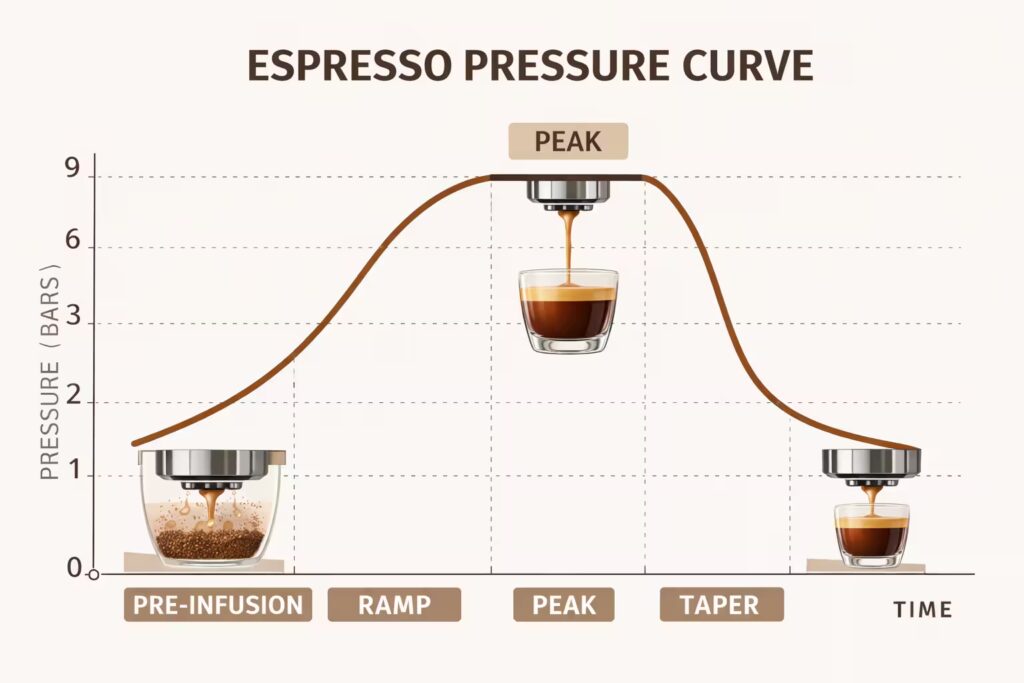
The classic “9 bar” concept came from historical pump designs and a desire for consistency, not because 9 bar is a universal sweet spot. Many great extractions happen below that, above that, or in curves that move throughout the shot.
Three reasons flat pressure can be suboptimal:
- Early puck fragility: High pressure early is the most likely time to cause channeling.
- Extraction balance: Late-shot high pressure can increase bitter/astringent pull and emphasize harshness.
- Coffee variability: Light roasts, different processes (washed vs natural), and different grinders change puck permeability.
Flow control gives you a practical way to experiment with curves like: long pre-infusion → slow ramp → moderate peak → taper. Lever machines naturally create a declining pressure profile as the shot progresses, which many people associate with sweetness and clarity.
Who Benefits Most From Flow Control?
Flow control is a high-skill, high-feedback feature. It shines for specific drink styles and specific user personalities.
You’ll love flow control if…
- You drink straight espresso or americanos more than milk drinks
- You enjoy light roasts or modern “bright” espresso
- You like experimenting and keeping notes
- You already have a serious espresso grinder
- You want to reduce channeling and improve consistency
Skip (for now) if…
- You mainly make lattes/cappuccinos (milk hides subtle differences)
- You’re still struggling to dial in basics consistently
- You prefer fast, push-button workflow
- You have a limited budget and your grinder is the weak link
- You don’t enjoy “tinkering” as a hobby
A Practical Flow Control Recipe (Start Here)
If you’re new to flow control, start with a basic, repeatable curve. Keep everything else stable: same dose, same coffee, same basket, same temperature, same yield.
Beginner-Friendly Flow Curve
- Pre-infusion: 6–10 seconds at low flow (gentle wetting, slow drips)
- Ramp: Open gradually over 3–6 seconds until you reach normal extraction flow
- Middle: Maintain steady flow until you’re ~70% of target yield
- Taper: Slightly restrict flow for the last 6–10 seconds to soften finish
Target baseline: Start with a classic 1:2 ratio (e.g., 18g in → 36g out) in ~25–32 seconds, then adjust based on taste.
Best-Selling Flow-Control & Profiling Machines on Amazon
Top Amazon Sellers (Flow Control / Manual Profiling)
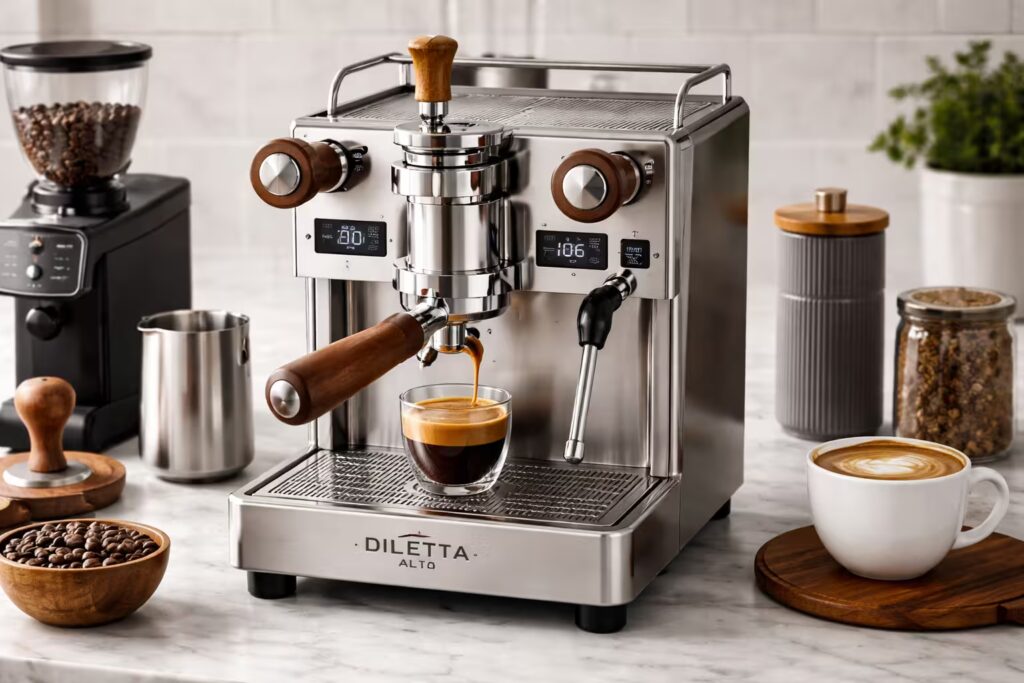
Diletta Alto with Flow Control (Dual Boiler)
Why it’s here: One of the clearest “true flow control” pump machines sold on Amazon with strong category traction. Great if you want a prosumer dual boiler workflow plus real-time extraction shaping.
- Manual flow control + group pressure gauge (shot shaping in real time)
- Dual boiler for simultaneous brew + steam
- Strong option for light roasts and reducing early-shot channeling
Amazon note: category Best Sellers Rank can change daily.
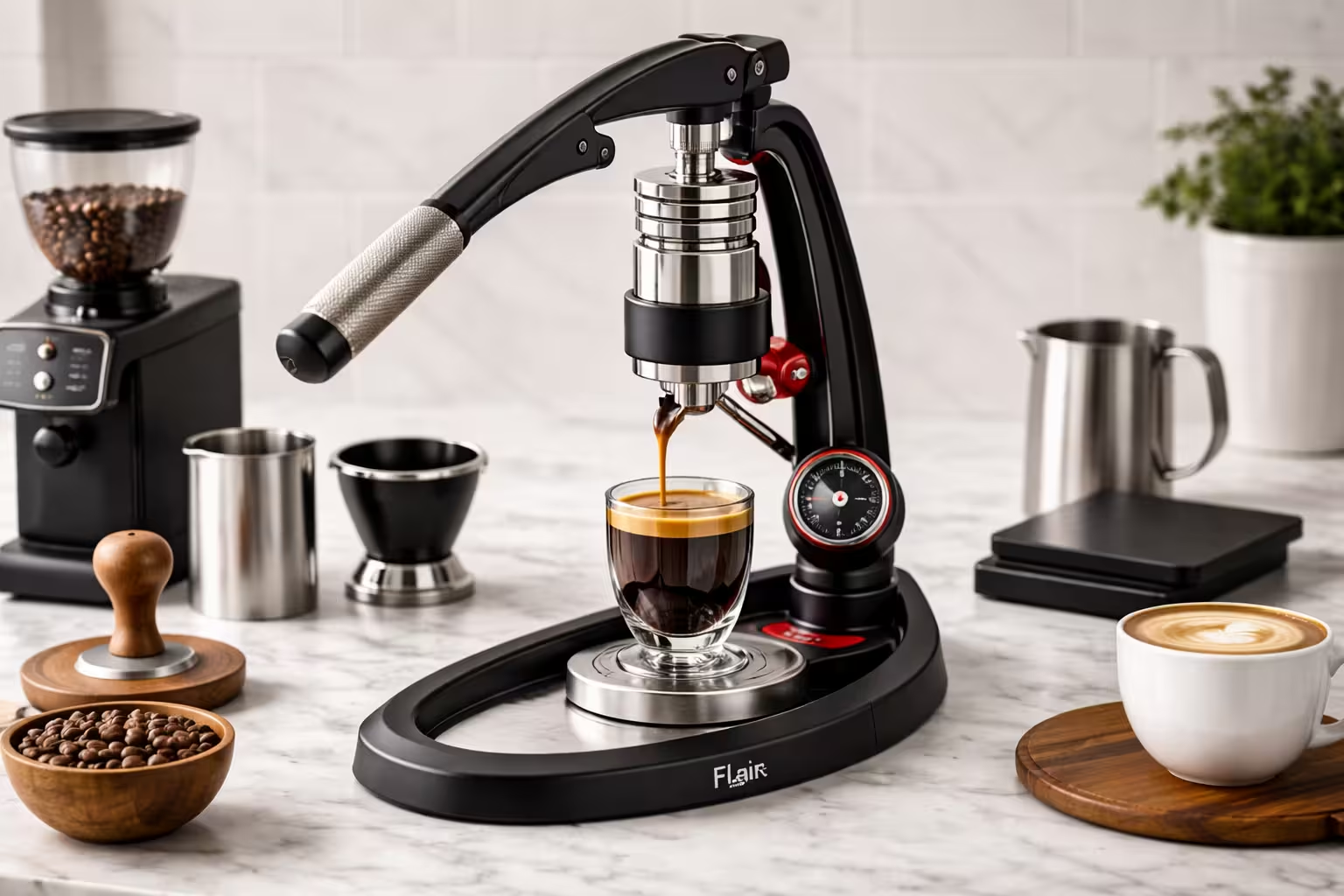
Flair PRO 3 (Manual Lever Pressure Profiling)
Why it’s here: A consistent Amazon best-seller in manual espresso with a pressure gauge—meaning you can profile shots by feel and feedback (gentle pre-infusion, controlled ramp, tapered finish).
- Pressure gauge feedback for controlled “curves”
- Excellent for experimenting with light roasts on a budget
- Travel-friendly compared to prosumer machines
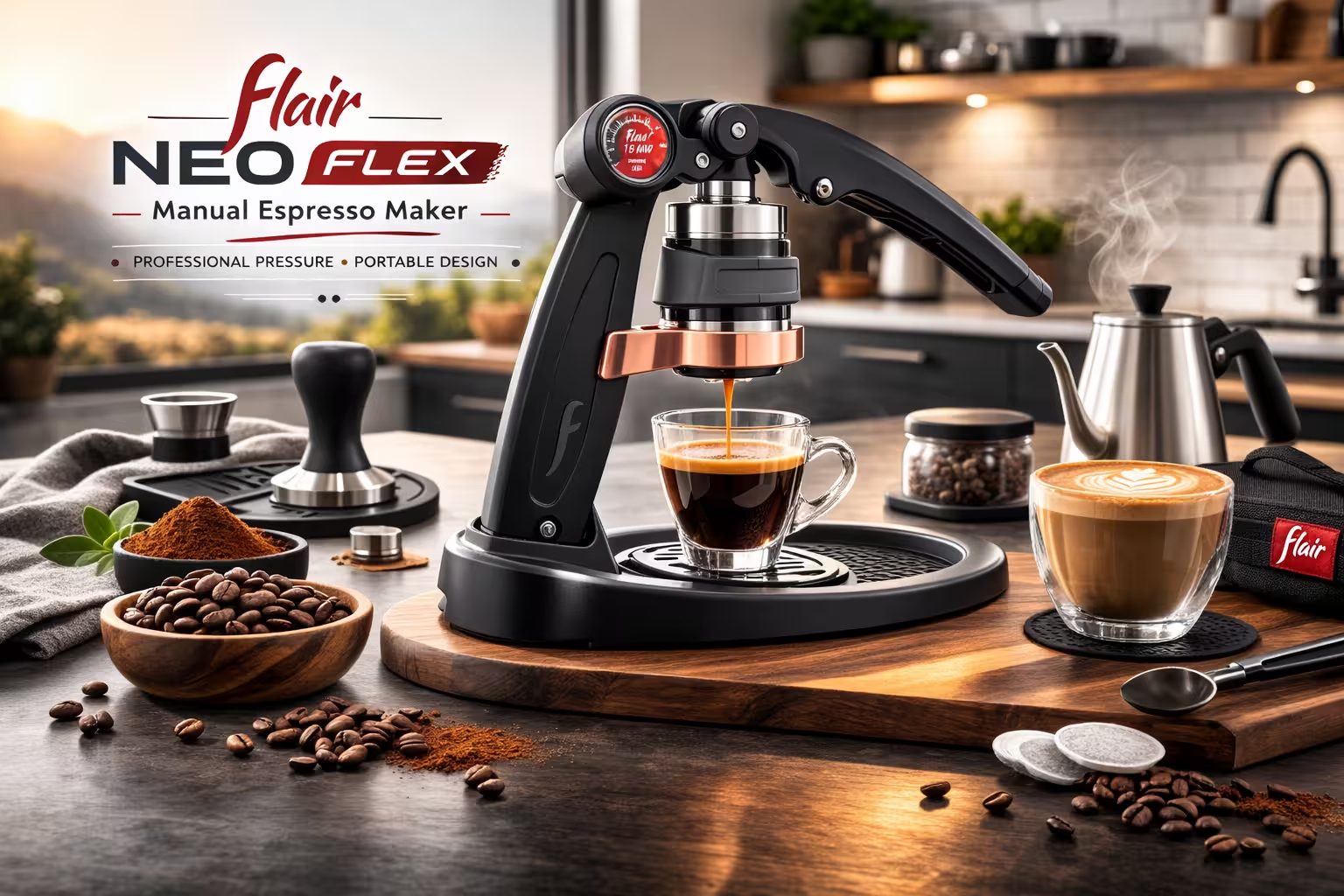
Flair NEO Flex (Entry-Level Manual Profiling)
Why it’s here: One of the most popular low-cost ways on Amazon to learn profiling fundamentals (pre-infusion control, shot pacing) before jumping to expensive prosumer gear.
- Low barrier to entry for learning “flow/pressure thinking”
- Great as a second setup or travel brewer
- Pairs best with a capable grinder and scale
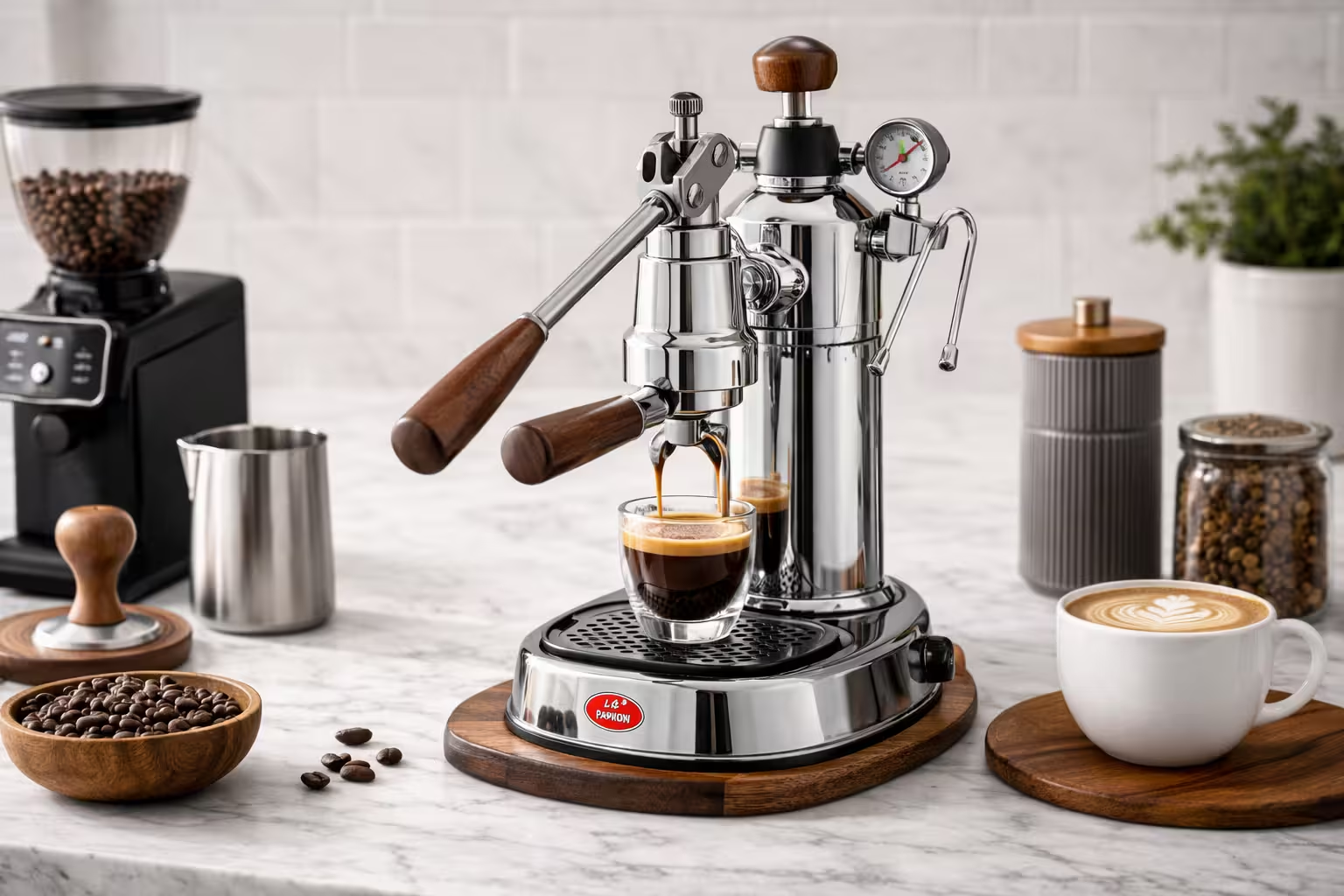
La Pavoni Europiccola (Classic Lever Profiling)
Why it’s here: A legendary lever machine sold on Amazon that naturally produces lever-style declining pressure shots. Best for hands-on users who enjoy learning temperature + pressure technique.
- Classic lever workflow: pre-infusion by feel, then controlled ramp + taper
- Huge “skill ceiling” (rewarding once mastered)
- Excellent for straight espresso and experimentation
Don’t Buy Flow Control Before These Essentials
If you want the upgrade to feel “worth it,” your workflow must support it. Flow control doesn’t replace fundamentals—if anything, it exposes weaknesses faster.
| Essential | Why it matters with flow control | Example Amazon search |
|---|---|---|
| Espresso-capable grinder | Profiling is sensitive to grind changes; inconsistency becomes obvious | Search grinders |
| WDT tool | Reduces clumps and channeling—critical when shaping early pressure rise | Search WDT tools |
| Level tamper | Prevents uneven density that creates weak points under pressure | Search tampers |
| Scale with timer | Teaches repeatability; helps you compare curves fairly | Search scales |
| Bottomless portafilter (optional) | Instant feedback for channeling—so you learn faster | Search bottomless PF |
Flow Control Shot Troubleshooting (Taste → Fix)
Use this section when you’re experimenting with curves and something tastes “off.” Make one change at a time.
| What you taste/see | Likely cause | Flow-control fix |
|---|---|---|
| Sour, thin, fast shot | Under-extraction; too much early flow or too coarse | Extend pre-infusion slightly; ramp more gradually; tighten grind |
| Bitter, dry, harsh finish | Over-extraction late; too much pressure/flow at end | Add a gentle taper in last 6–10 seconds; stop at lower yield |
| Spraying/striping from bottomless PF | Channeling; puck weakness early | Lower early flow; longer wetting phase; improve WDT/tamp |
| Shot stalls/chokes mid-way | Too much restriction + swelling fines | Open valve slightly earlier; reduce taper; coarsen grind a touch |
| Muted flavors, “flat” espresso | Curve too conservative; insufficient extraction | Shorten pre-infusion; slightly higher mid-shot flow; adjust ratio |
Are Flow Control Espresso Machines Worth It? A Decision Framework
Instead of a one-size-fits-all answer, use this quick framework:
- What do you drink? Straight espresso → bigger payoff. Milk drinks → smaller payoff.
- What roasts do you prefer? Light roast → bigger payoff. Medium-dark → smaller payoff.
- Is your grinder already excellent? If not, upgrade grinder first for the best ROI.
- Do you enjoy manual control? If yes, you’ll love flow control. If no, you may resent it.
- Do you want repeatability? Manual profiling is repeatable with practice; pump flow control is repeatable with disciplined technique; programmable profiling is the most repeatable (usually higher cost).
Flow Control & Profiling Paths
| Path | Best for | What you “control” | Skill curve |
|---|---|---|---|
| Pump machine with flow control (e.g., Diletta Alto w/ FC) | Prosumer workflow + real-time shot shaping | Flow into group/puck (indirect pressure shaping) | High |
| Manual lever w/ pressure gauge (e.g., Flair PRO 3) | Learning profiling on a smaller budget | Pressure directly + shot pacing | High |
| Entry-level manual lever (e.g., Flair NEO Flex) | Start learning extraction control basics | Manual shot pacing; pre-infusion feel | Medium–High |
| Classic lever machine (e.g., La Pavoni Europiccola) | Hands-on purists and long-term hobbyists | Lever pressure curve + technique-driven pre-infusion | High |
FAQs
Does flow control make espresso taste better?
It can—especially for light roasts and straight espresso—because it lets you control puck saturation early (reducing channeling) and taper late (reducing harshness). But it won’t fix weak puck prep or a poor grinder.
Is flow control the same as pressure profiling?
Not exactly. Flow control adjusts water flow into the group/puck (often via a valve/paddle). Pressure profiling controls pressure more directly (via lever technique, pump control, or software). Flow changes often influence pressure, but it’s indirect on pump machines.
Do I need flow control for milk drinks?
Usually not. Milk hides many subtle flavor differences. You’ll typically get more value from improving grinder quality, steaming workflow, and consistency than from profiling.
Can I add flow control to my existing espresso machine?
Sometimes—mainly on certain E61 machines with compatible kits. Compatibility varies by brand/model, and installation can require mechanical confidence. If you’re unsure, buying a machine that includes flow control from the factory is simpler.
What’s the best beginner flow curve?
Start with gentle pre-infusion (6–10 seconds), a gradual ramp to normal extraction flow, hold steady in the middle, and then a slight taper in the last 6–10 seconds. Keep dose, ratio, and temperature constant while learning.
Will flow control help with channeling?
Often yes—especially early-shot channeling—because you can wet the puck more gently before ramping pressure. Pair it with WDT, level tamping, and consistent grind.
What’s the biggest mistake people make with flow control?
Changing too many variables at once. Lock in dose, basket, temperature, and ratio, then adjust only the flow curve (or grind) until you understand cause and effect.
Is flow control worth it if my grinder is mediocre?
Usually no. Flow control/profiling is sensitive to grind consistency. Upgrading the grinder first typically produces a bigger improvement in flavor and repeatability than adding flow control.
Next Reads
Espresso Shot Troubleshooting
Fix sour, bitter, channeling, and inconsistent shots with fast diagnostics.
Best Espresso Grinders
The grinder upgrade that often beats any machine upgrade for taste.
How to Dial In Coffee at Home
Ratios, grind size, extraction logic—your foundation before profiling.