Last Updated: March 16, 2026 • 16–20 min read • Covers: Daily Cleaning + Deep Cleaning + Descaling Step-by-Step + Vinegar vs. Commercial Descalers + Machine-Specific Tips + Troubleshooting Matrix
✍️ Editorial note: This guide is researched and written by the editors at CoffeeGearHub.com using published brewing science, SCA certification standards, equipment manufacturer specifications, and established specialty-coffee community knowledge. Recommendations reflect research consensus rather than in-house lab testing. All product links are affiliate links — we may earn a commission at no cost to you.
The 30-Second Answer
Learn how to clean and descale a drip coffee maker because a dirty coffee maker is the most overlooked reason for bad-tasting coffee. Two separate problems are at work: coffee oil buildup (on the carafe, basket, and showerhead) and mineral scale (inside the boiler and water lines). They require different fixes. Cleaning with soap and water handles oils; descaling with an acid solution handles mineral deposits. Rinse removable parts after every use. Deep clean weekly. Descale every one to three months depending on your water hardness. Machines that haven’t been descaled in six months or more are almost always brewing 10–20°F below the ideal 195–205°F range — which means chronically under-extracted, flat-tasting coffee that no amount of better beans or grind adjustment will fix.
- Best commercial descaler: Urnex Dezcal Activated Descaler — purpose-formulated, residue-free, compatible with all drip machines
- Best budget descaling option: citric acid powder — as effective as commercial solutions, odorless, and far cheaper per use
- Best carafe and basket cleaner: Urnex Cafiza Espresso Machine Cleaning Tablets — works on drip carafes and baskets too, cuts through baked-on coffee oils in minutes
- Vinegar works — but requires at least two full rinse cycles and leaves a residual smell some people find persistent
- The most missed step: cleaning the showerhead — the spray plate above the filter basket that accumulates oils and mineral deposits most people never touch
Who This Guide Is For — Jump to What You Need
🧹 The Daily Maintainer
You want a quick rinse-and-clean routine that prevents buildup. Jump to Daily Cleaning →
🔬 The Deep Cleaner
Your machine smells off and coffee tastes stale. Jump to Deep Clean →
💧 The Descaler
You haven’t descaled in months and want the step-by-step. Jump to Descaling →
🛒 The Gear Shopper
You want to know which cleaning products actually work. Jump to Supplies →
Table of Contents
Cleaning vs. Descaling: What’s the Difference?
Most people use “cleaning” and “descaling” interchangeably — but they address completely different problems, and doing one does not do the other. Understanding the distinction is the foundation of a proper maintenance routine.
| Task | What It Removes | Where It Applies | How Often |
|---|---|---|---|
| Cleaning | Coffee oils, grounds residue, surface stains, bacterial buildup | Carafe, filter basket, lid, showerhead, exterior | Rinse daily; soap wash weekly |
| Descaling | Mineral scale (calcium and magnesium deposits from water) | Boiler, heating element, water tubes, internal passages | Every 1–3 months |
Coffee oils are extracted from the beans during every brew and coat every surface the liquid touches. Left to accumulate, they turn rancid — usually within a week of regular use — and introduce sour, stale, or bitter off-notes into an otherwise good cup. This is a surface problem fixed with soap, hot water, and a brush.
Mineral scale is a completely different issue. Every time water is heated, dissolved minerals precipitate and form a hard, chalk-like deposit on heating elements and internal tube walls. This is invisible from the outside — you can’t see it, and a visually clean machine can have significant internal scaling. Scale acts as thermal insulation around the heating element, forcing the machine to work harder to reach brewing temperature — and often failing to get there at all. A scaled machine brews at 170–185°F instead of 195–205°F, producing systematically under-extracted, flat, weak coffee regardless of how good your beans or grind are.
💡 The hidden performance killer: A machine that hasn’t been descaled in six months or more is almost certainly brewing 10–20°F below the optimal range. Upgrading your beans or grinder won’t fix this — only descaling will. If your coffee has tasted progressively flatter over the past few months, this is almost certainly why.
How Often to Clean and Descale
Frequency depends on how often you brew and how hard your water is. Hard water — which contains high levels of dissolved calcium and magnesium — scales machines far faster than soft water. Most of the US Midwest, South, and Southwest has moderately hard to very hard water. If you’re unsure, a basic water hardness test strip will tell you within a minute.
| Task | Daily Brewers | Occasional Brewers (3–4x/week) | Hard-Water Areas |
|---|---|---|---|
| Rinse carafe and basket | After every use | After every use | After every use |
| Soap wash (carafe, basket, lid) | Every 1–2 days | Every use | Every 1–2 days |
| Full deep clean (showerhead, exterior) | Weekly | Every 2 weeks | Weekly |
| Descaling | Every 4–6 weeks | Every 2–3 months | Every 3–4 weeks |
💡 The descale indicator shortcut: Most modern machines (Breville, Moccamaster, Cuisinart) have a descale indicator light that triggers automatically. Use it as a minimum — not as permission to go longer. In very hard water areas, you may benefit from descaling before the light triggers.
Daily and Weekly Cleaning Routine
The daily routine takes under two minutes and prevents the vast majority of off-flavor problems before they start. The weekly routine adds 10–15 minutes and covers everything the daily rinse misses.
After Every Brew (2 Minutes)
- Remove the used paper filter and grounds immediately — don’t let them sit and steam inside the basket.
- Rinse the filter basket under warm running water. No soap needed for a quick daily rinse.
- Rinse the carafe and lid with warm water, swirling to coat all interior surfaces.
- Leave the carafe upside down on a drying rack or with the lid off to allow airflow and prevent moisture buildup.
Weekly Deep Wash (10–15 Minutes)
- Filter basket: wash with warm soapy water and a small brush or sponge. Scrub every surface, including the underside and any mesh screens. Rinse thoroughly.
- Carafe: add a few drops of dish soap and warm water. Use a long-handled bottle brush to scrub the interior, especially the bottom and the curve at the spout. Rinse until no soap residue remains.
- Carafe lid: disassemble if possible (many lids have a removable inner seal) and wash all components separately. Coffee oils concentrate inside lid seals and are a common source of persistent rancid smell.
- Showerhead: this is the most commonly skipped step. Locate the spray plate above the filter basket (it usually twists counterclockwise or unclips). Remove it and soak in warm soapy water for 10–15 minutes. Use a toothbrush or small cleaning brush to scrub each hole. The showerhead accumulates both mineral deposits and oils — a clogged showerhead causes uneven water distribution, which is one of the top causes of channeling and inconsistent extraction.
- Exterior and warming plate: wipe down all exterior surfaces with a damp cloth. Use a paste of baking soda and water on the warming plate to remove baked-on coffee stains — let it sit for a few minutes, then wipe off.
💡 The showerhead test: Remove your showerhead and hold it up to a light source. If you can’t see light through most of the holes, it needs a good soak and scrub. Blocked holes redirect water to fewer exit points, concentrating flow over part of the coffee bed and leaving the rest under-extracted — the same channeling problem that plagues cheap budget machines.
How to Deep Clean a Drip Coffee Maker (Monthly)
A monthly deep clean goes further than the weekly wash — it uses the machine’s own brew cycle to flush coffee oils from the internal water path, and addresses stubborn buildup on carafes and baskets that routine washing leaves behind.
- Prepare the machine: remove and wash all removable parts (carafe, basket, lid, showerhead) using the weekly method above. Set them aside to dry.
- Clean the carafe of stubborn stains: if your glass carafe has dark coffee staining that soap won’t shift, fill it with warm water and add one or two Urnex Cafiza tablets (or a tablespoon of baking soda). Let it soak for 20–30 minutes. The alkaline solution breaks down polymerized coffee oils. Scrub with a bottle brush, rinse thoroughly, and repeat if needed.
- Run a cleaning cycle through the machine: reassemble the basket (no filter or grounds), fill the reservoir with a mixture of two tablespoons of white vinegar per cup of water (or a mild dish soap solution if your machine manufacturer allows it), and run a full brew cycle. Discard the output. This flushes oil residue from the internal water tubes that normal cleaning can’t reach.
- Run two full fresh-water rinse cycles: fill the reservoir with clean cold water and run a complete brew cycle. Repeat. Do not skip this step — any soap or vinegar left in the water lines will affect your next few brews.
- Inspect and reassemble: check that the showerhead holes are clear, the basket sits properly, and the carafe lid seal is clean. Run a test brew with your normal dose and assess the result.
How to Descale a Drip Coffee Maker: Step-by-Step
Descaling is the most impactful maintenance task for long-term machine performance. Follow these steps exactly — particularly the rinse cycles. Incomplete rinsing is the number-one user complaint after descaling, and it’s entirely avoidable.
What You Need
- Descaling solution (commercial packet, citric acid, or white vinegar — see comparison below)
- Fresh cold water for rinse cycles
- An empty filter basket (paper filter optional — most descale guides recommend removing it)
- 45–60 minutes of total time (mostly waiting)
The Descaling Process
- Empty and rinse the machine. Remove any grounds, used filters, and leftover water from the reservoir. Give the carafe and basket a quick rinse.
- Mix your descaling solution. For commercial descaler, follow the packet ratio — typically one packet dissolved in the amount of water specified. For citric acid, use one to two tablespoons per liter of water. For white vinegar, use a 1:1 ratio of vinegar to water. Pour the mixture into the reservoir.
- Run a half brew cycle, then pause. Start a brew cycle. Once roughly half the solution has passed through (check the carafe level), pause the machine if your model allows it, or flip the brew basket switch to the closed position on a Moccamaster. Let the machine sit with the solution inside for 30 minutes. This soak time is what actually dissolves stubborn scale deposits — skipping it reduces effectiveness significantly.
- Complete the brew cycle. Resume and let the remaining descaling solution finish running through. Discard the entire contents of the carafe.
- Run the first full rinse cycle. Fill the reservoir to maximum with fresh cold water. Run a complete brew cycle. Discard the water from the carafe.
- Run the second full rinse cycle. Repeat step 5 with a fresh reservoir of cold water. Two full cycles is the minimum for commercial descalers and citric acid. If you used white vinegar, run a third rinse cycle to be safe.
- Wash all removable parts. Hand wash or dishwasher-clean the carafe, lid, and filter basket. Wipe the showerhead and machine exterior with a damp cloth. The machine is ready to brew.
🔬 Why the 30-minute soak matters: Running the descaling solution straight through without pausing is one of the most common mistakes. Acid dissolves calcium carbonate scale through sustained contact time, not just flow-through. Without the soak, you’re washing the surface of the scale but not penetrating the thicker deposits around the heating element. The 30-minute pause is what separates a proper descale from a surface rinse.
Vinegar vs. Citric Acid vs. Commercial Descaler
All three options work. The choice comes down to convenience, smell tolerance, and cost. Here’s an honest comparison.
| Option | Effectiveness | Smell | Rinse Cycles Needed | Cost per Use | Machine Manufacturer Approval |
|---|---|---|---|---|---|
| White vinegar (1:1) | Good | Strong — lingers | 3 minimum | Very low (~$0.10) | Acceptable for most; Breville and Technivorm prefer commercial |
| Citric acid powder (1–2 tbsp/liter) | Excellent | None | 2 | Low (~$0.15–0.25) | Safe for all machines |
| Commercial descaler (Urnex Dezcal, etc.) | Excellent | Very mild | 2 | Moderate (~$1.50–$3.00/use) | Recommended by most manufacturers |
Our recommendation: citric acid powder is the best overall value — it descales as effectively as commercial products, has no odor, and costs a fraction of the price per use when bought in bulk. Keep a commercial descaler packet on hand for machines with finicky descale indicator sensors (some sensors expect a specific electrical conductivity reading that only commercial solutions produce reliably). For everyday maintenance, citric acid is the smart choice.
Machine-Specific Cleaning Notes
The general process above applies to all drip machines, but a few popular models have quirks worth knowing before you start.
Breville Precision Brewer
The Precision Brewer has a dedicated descale mode accessible via the front panel — enter it by holding the STRENGTH and BREW buttons simultaneously (check your specific model’s manual for exact steps, as this varies slightly between Precision Brewer versions). The descale mode runs a slower, automated cycle with programmed pauses designed for Breville’s descaling solution. Breville recommends their own descaler but explicitly acknowledges that citric acid solutions work. Avoid vinegar — Breville’s documentation cautions that the acetic acid can degrade internal rubber seals over time with repeated use.
Technivorm Moccamaster
The Moccamaster doesn’t have a dedicated descale mode — you use the standard brew cycle. The key Moccamaster-specific step is using the manual brew basket switch. Once you’ve added the descaling solution, flip the switch to the half-open position after about half the liquid has passed through, which effectively pauses the flow. Let it soak for 30 minutes, then return the switch to the full-open position to complete the cycle. Technivorm recommends Urnex Dezcal or their own branded solution. Because of the copper boiler and high-quality seals, the Moccamaster is especially sensitive to over-descaling — don’t use stronger concentrations than specified.
Cuisinart (Most Models)
Cuisinart machines are among the simplest to descale — fill with a 1:1 vinegar-to-water mixture or Cuisinart’s branded descaling solution, press the clean button (marked with a self-clean icon on most models), and let the machine run its automated 30-minute cleaning cycle. A red light will blink during the cycle and turn off when complete. Run two full rinse cycles after. Cuisinart’s carafe is typically dishwasher-safe on the top rack — check your manual to confirm for your specific model.
Hamilton Beach and Budget Machines
Most budget machines don’t have a dedicated clean mode — just run the descaling solution through a standard brew cycle and pause manually halfway through. Because budget machines tend to scale faster (they run at lower temperatures and often have smaller-diameter water tubes), err toward monthly descaling regardless of use frequency. If your machine has a glass carafe and warming plate rather than a thermal carafe, pay special attention to descaling: the warming plate holding brewed coffee at a lower temperature speeds up flavor degradation and can mask the effect of improved brew temperature post-descale.
Recommended Cleaning Supplies
You don’t need a cabinet full of specialty products. Three items cover everything — a quality descaler, a coffee-specific equipment cleaner for oils and stains, and a good carafe brush. Here are the products we actually recommend.
Descaling Solutions
⭐ COFFEEGEARHUB TOP PICK — BEST COMMERCIAL DESCALER
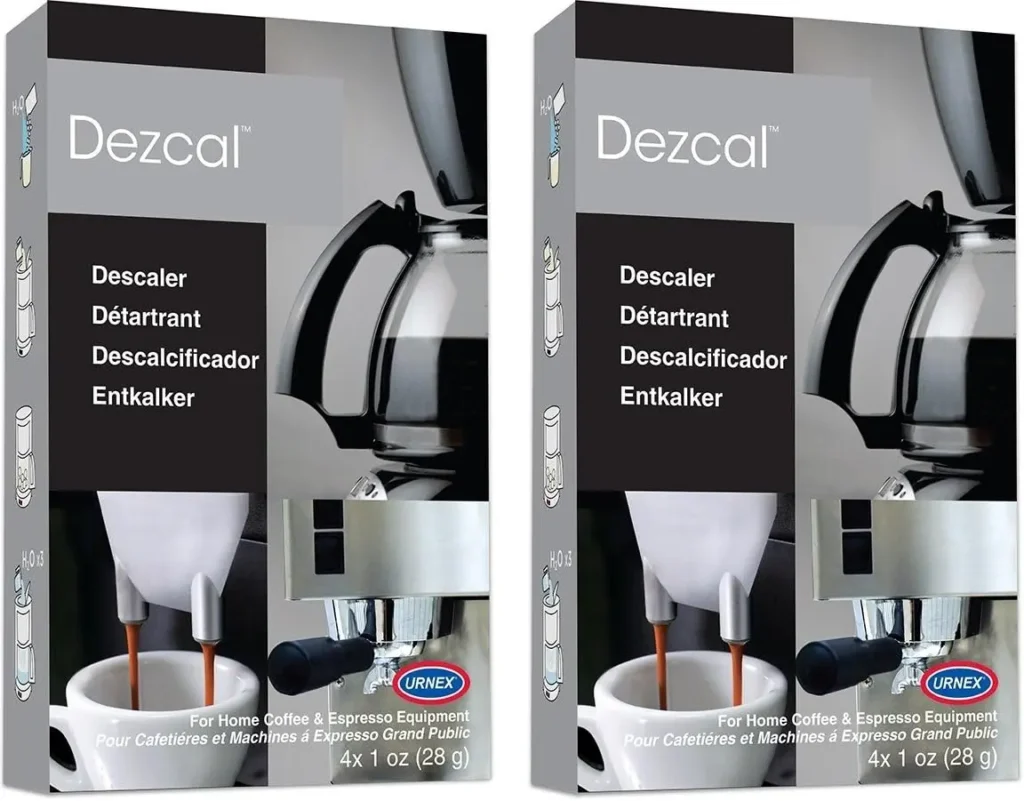
Urnex Dezcal Activated Descaler — Best Commercial Descaler
Dezcal is the industry-standard descaling solution used by specialty coffee shops, equipment manufacturers, and home brewers globally. It’s a powder-based activated descaler that dissolves quickly in water, works at the correct concentration to remove heavy mineral buildup without damaging machine components, and rinses out completely after two water cycles with no residual odor or taste. Breville, Jura, and other premium manufacturers reference Dezcal-type solutions in their maintenance documentation. Each packet treats one full machine cycle.
- Activated descaler formula — removes calcium and limescale from boilers, tubes, and heating elements
- Biodegradable and NSF-listed — safe for home use, rinses residue-free
- Compatible with all drip coffee makers, espresso machines, and pod machines
- No smell, no residual taste after proper rinsing
Affiliate link — we may earn a commission at no cost to you.
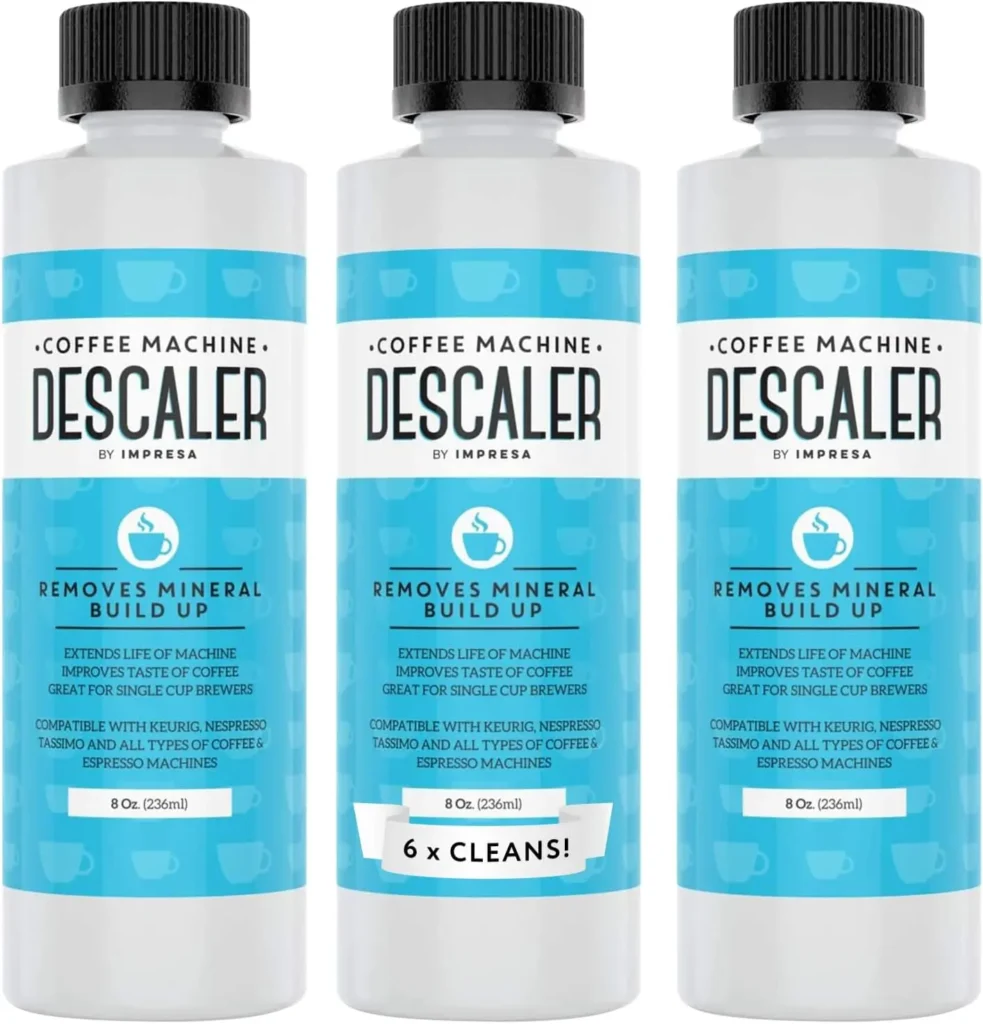
Impresa Descaler — Best Value Multi-Use Descaler
Impresa’s descaling solution comes in a larger bottle that yields multiple uses per purchase, making it more economical for monthly descalers than single-use packets. The liquid formulation works as well as powder-based options and is safe for all machine types. It’s a solid choice if you have multiple machines to maintain — a drip machine, an espresso setup, and a kettle — or if you descale frequently due to hard water. No dilution guesswork needed; the bottle includes a measuring cup.
- Multi-use bottle — more economical per use than single-packet formats
- Compatible with all coffee makers, espresso machines, Keurig, and Nespresso
- Includes measuring cap for correct dilution
Affiliate link — we may earn a commission at no cost to you.
Cleaning Tablets and Carafe Cleaner
⭐ COFFEEGEARHUB TOP PICK — BEST EQUIPMENT CLEANER FOR CARAFES AND BASKETS
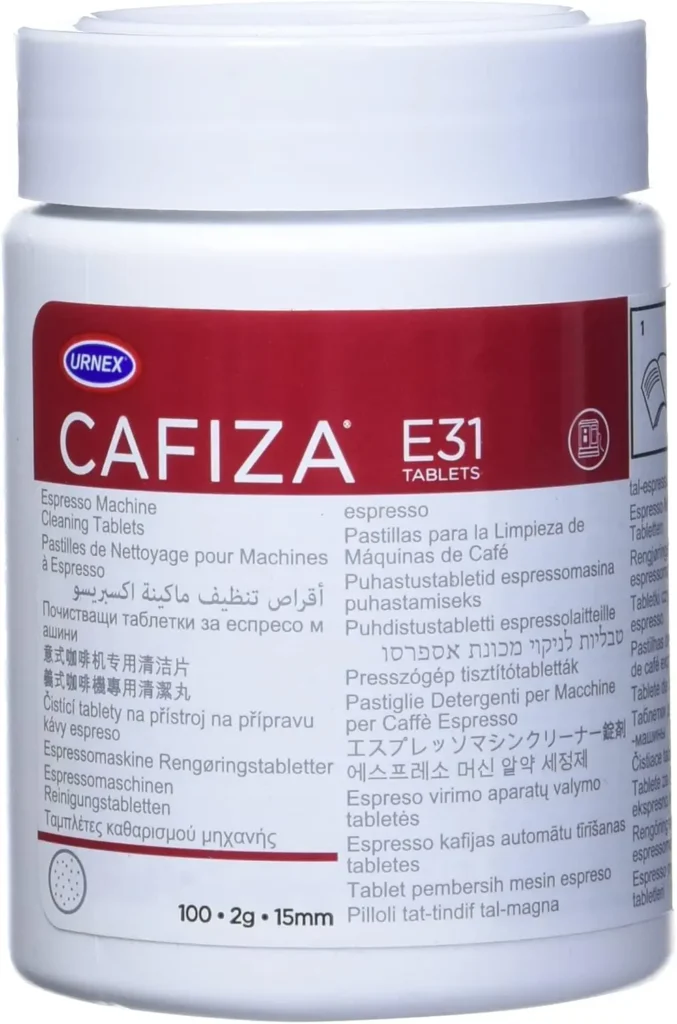
Urnex Cafiza Cleaning Tablets — Best for Stubborn Coffee Oil Stains
Cafiza is marketed primarily for espresso machines, but it’s the single best product for removing baked-on coffee oil staining from drip carafes, filter baskets, and carafes that soap and water won’t touch. Drop one tablet into a carafe with warm water, let it soak for 20–30 minutes, and stubborn brown staining lifts away without scrubbing. The same soak works for severely stained baskets. Cafiza uses a sodium percarbonate-based formula that releases oxygen to break down polymerized oils — highly effective and food-safe when rinsed.
- Removes polymerized coffee oil stains that dish soap can’t dissolve
- Works on glass carafes, thermal carafes, filter baskets, and showerheads
- Food-safe sodium percarbonate formula — rinse thoroughly after use
- One tablet per cleaning session; long shelf life
Affiliate link — we may earn a commission at no cost to you.
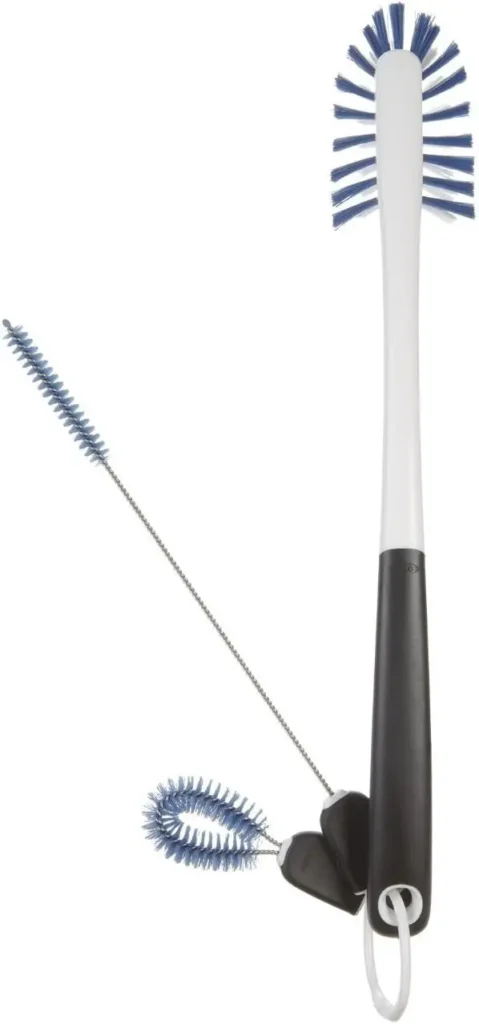
OXO Good Grips Carafe and Bottle Brush — Best Cleaning Brush
A proper bottle brush is not optional for glass carafes — your hand and a cloth cannot reach the bottom of a narrow-necked carafe, and that’s exactly where the most stubborn oil residue accumulates. The OXO Good Grips brush has a long, flexible handle that reaches the base of even narrow Chemex-style vessels, a dense bristle head that scrubs effectively without scratching glass, and a removable detail brush in the handle for spouts and small openings. It’s dishwasher-safe and built to outlast multiple carafe lifetimes.
- Long flexible handle — reaches the base of narrow-necked carafes and thermal vessels
- Dense bristle head — scrubs glass and stainless without scratching
- Built-in detail brush for spouts and small openings
Affiliate link — we may earn a commission at no cost to you.
The Grinder: Clean It Too
Your grinder accumulates stale coffee oils and fine particles just like your brewer — and those residues end up in every cup you make. Brush out the burrs and grounds chute weekly. For a deeper clean monthly, use a dry grinder cleaning tablet (such as Grindz) to absorb oils from the burr chamber without disassembly. If you’re grinding fresh beans into a clean machine but still tasting staleness, the grinder is usually the culprit.
⭐ COFFEEGEARHUB SITE STANDARD MANUAL GRINDER RECOMMENDATION
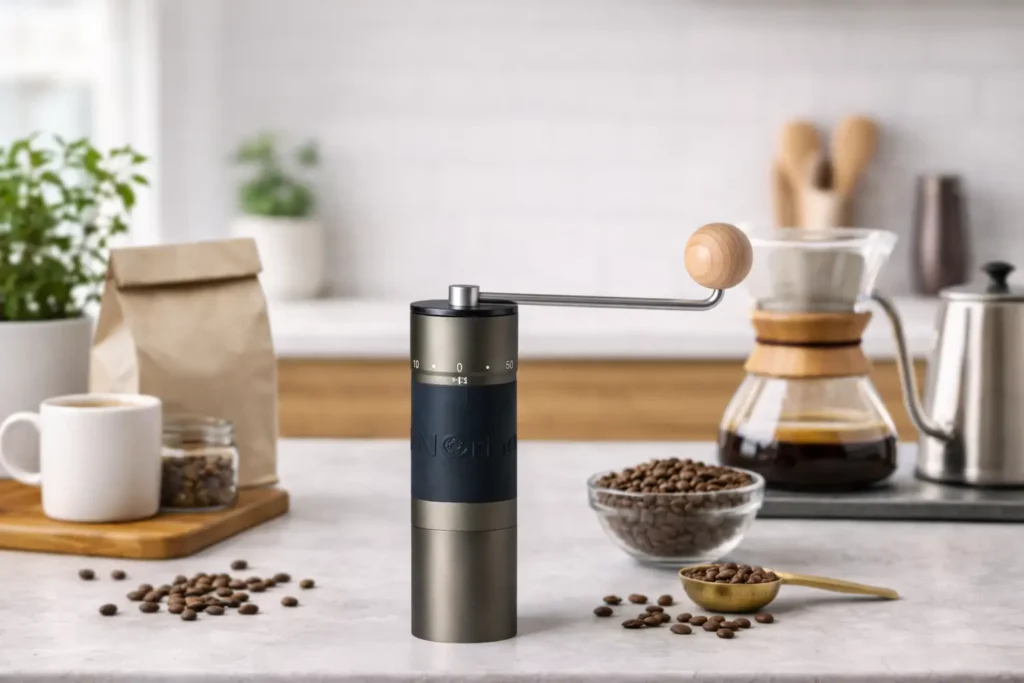
KINGrinder K6 — Best Manual Grinder (Drip and Pour Over)
The KINGrinder K6 is our recommended manual burr grinder across CoffeeGearHub. Its 48mm stainless steel burrs produce a consistent, uniform grind at medium (for drip) and medium-fine (for pour over) settings, and the click-stop adjustment ring makes it easy to return to your preferred grind size after cleaning. For drip coffee, set to steps 24–28; for pour over V60, set to steps 18–22. Unlike electric grinders, the K6 is trivially easy to clean — the burr assembly disassembles by hand in under a minute, and low retention means virtually no stale carry-over between sessions. Starting with fresh, correctly ground coffee is the single most impactful upgrade you can pair with a clean, well-maintained machine.
Affiliate link — we may earn a commission at no cost to you.
Full Cleaning Kit Cost Summary
| Item | Use | Approx. Entry Cost | Frequency of Purchase |
|---|---|---|---|
| Urnex Dezcal (6-pack) | Descaling | ~$12–$16 | Every 6–12 months (6 uses) |
| Urnex Cafiza tablets (100-count) | Carafe and basket oil removal | ~$18–$22 | Every 12–18 months |
| OXO carafe brush | Carafe scrubbing | ~$10–$14 | Every 2–3 years |
| Citric acid powder (1 lb) | Budget descaling alternative | ~$8–$12 | Every 12–18 months (many uses) |
Troubleshooting Matrix: Fix Coffee Maker Problems at the Source
Most drip coffee problems trace back to one of three root causes: coffee oil buildup, mineral scale, or user error in the cleaning or descaling process. This matrix works through the most common symptom patterns and gives you a fix sequence to follow in order.
| Symptom | Most Likely Cause | Fix (in order) |
|---|---|---|
| Coffee tastes flat or weak even with good beans | Mineral scale preventing machine from reaching 195–205°F | Descale immediately → run two rinse cycles → test with a fresh grind → if still flat, grind finer by 2 clicks |
| Coffee tastes bitter or harsh | Coffee oil buildup turning rancid; or over-extraction | Deep clean carafe, basket, and showerhead → check grind isn’t too fine → switch to thermal carafe to avoid warming plate |
| Coffee tastes like vinegar after descaling | Insufficient rinsing after vinegar descale | Run 2–3 more full fresh-water cycles → switch to citric acid or commercial descaler for future descales |
| Machine brews slowly or makes gurgling sounds | Significant scale buildup restricting water flow | Descale with the 30-minute mid-cycle soak → repeat descale cycle if improvement is partial → check showerhead for blockage |
| Coffee has papery or cardboard taste | Paper filter not pre-rinsed; or new machine with manufacturing residue | Always rinse paper filter with hot water before adding grounds → run a water-only brew cycle on a new machine before first use |
| Machine smells of rancid coffee despite cleaning | Buildup in showerhead holes or inside carafe lid seal | Remove and soak showerhead 15 min in soapy water → disassemble carafe lid and scrub the rubber seal → run monthly cleaning cycle |
| Descale indicator light won’t reset after descaling | Machine’s sensor expects specific descaler conductivity; citric acid or vinegar may not trigger reset | Run a commercial descaler (Urnex Dezcal or brand-specific solution) → follow machine’s exact reset procedure in the manual |
| Coffee still tastes stale after cleaning everything | Stale coffee beans or dirty grinder burrs | Check roast date on beans (use within 2–4 weeks of roast) → disassemble and brush out grinder burrs → run a grinder cleaning tablet |
| White deposits visible on showerhead or carafe | Mineral scale — regular cleaning missed internal parts | Soak showerhead in citric acid solution for 30 min → descale machine → add showerhead inspection to weekly cleaning routine |
| Machine leaks water from the basket during brewing | Scale or grounds buildup clogging filter basket drainage | Remove and deep clean the basket and basket seat → check that paper filter is correctly seated → grind coarser to reduce flow restriction |
🔬 The diagnosis sequence: When coffee tastes bad after cleaning or descaling, work through the problem in this order: (1) confirm you completed two full rinse cycles, (2) check your grind size and dose haven’t changed, (3) verify your beans are fresh. 90% of “cleaning made it worse” complaints resolve at step one.
FAQs: How to Clean and Descale a Drip Coffee Maker
How often should I clean my drip coffee maker?
You should rinse removable parts — the carafe, lid, and filter basket — after every use. Run a full deep clean with dish soap weekly if you brew daily. If you brew less often, a thorough clean every two weeks is sufficient. Daily rinsing prevents coffee oil buildup, which turns rancid and is the main source of stale or bitter off-flavors.
How often should I descale my drip coffee maker?
Descale every one to three months depending on your water hardness. In hard-water areas (most of the US Midwest, Southwest, and South), monthly descaling keeps performance optimal. In soft-water areas, every two to three months is usually sufficient. A clear sign your machine needs descaling is when brew time slows noticeably or the coffee tastes flat and under-extracted.
Can I use white vinegar to descale a drip coffee maker?
Yes — white vinegar is an effective descaler and is safe for most drip coffee makers. Use a 1:1 ratio of white vinegar to water. The main downside is that vinegar has a strong odor and requires at least two full rinse cycles to remove completely. Some machine manufacturers (including Breville and Technivorm) recommend commercial descalers over vinegar to avoid any risk of residual taste. Either option works well when followed by thorough rinsing.
What is the difference between cleaning and descaling a coffee maker?
Cleaning removes coffee oils, grounds residue, and surface grime from parts like the carafe, filter basket, and showerhead. Descaling removes mineral scale — calcium and magnesium deposits from water — that builds up inside the boiler, heating element, and water tubes. Both are necessary. Cleaning maintains flavor; descaling maintains temperature accuracy and flow rate. A clean machine that hasn’t been descaled will still underperform because mineral buildup acts as insulation around the heating element.
Does descaling improve coffee taste?
Yes, significantly — especially if the machine hasn’t been descaled in several months. Mineral scale insulates the heating element, preventing water from reaching the 195–205°F extraction range. The result is chronically under-extracted, flat, or weak coffee. Removing that scale restores the machine’s ability to brew at the correct temperature, which often produces a noticeable improvement in flavor clarity, brightness, and body within the first post-descale brew.
How do I know if my coffee maker needs descaling?
The clearest signs are: brew time is slower than usual, the machine makes more gurgling or sputtering sounds than normal, coffee tastes flat or under-extracted despite a fresh grind, the machine struggles to complete a full brew cycle, or you can see white or chalky residue on the showerhead or around the basket. Most modern machines also have a descale indicator light that triggers based on either brew cycle count or built-in water hardness sensors.
Can I use citric acid instead of a commercial descaler?
Yes — citric acid is an excellent descaler, widely used by specialty coffee professionals. Mix one to two tablespoons of food-grade citric acid powder per liter of water. It descales as effectively as commercial solutions, is odorless (unlike vinegar), and rinses out completely after one to two water cycles. It’s also significantly cheaper per use than branded descaling packets. Citric acid is safe for all drip machine brands.
Is it safe to run a coffee maker with just water after descaling?
Yes, and you must. Running at least two full water-only cycles after descaling is non-negotiable. The first cycle flushes the bulk of descaler or vinegar from the boiler and water lines. The second cycle removes remaining trace residue that would otherwise end up in your coffee. With vinegar, two cycles is the minimum; some people prefer three. With commercial descalers, follow the manufacturer’s instructions — most specify two rinse cycles.
Why does my coffee maker still smell after cleaning?
A persistent smell after cleaning is almost always one of two things: vinegar residue from insufficient rinsing, or coffee oil buildup in a part you haven’t cleaned thoroughly. If it’s a vinegar smell, run one or two additional water-only brew cycles. If it’s a stale or rancid coffee smell, the most commonly missed culprit is the showerhead — the small spray plate above the filter basket. Remove it, soak it in hot soapy water for 15 minutes, and scrub the holes with a toothbrush.
How do I clean a coffee maker without removable parts?
For machines with a fixed carafe or non-removable basket, use the brew cycle itself as your cleaning tool. Fill the reservoir with your descaling solution and run the full cycle, then rinse twice with fresh water. To clean the inside of a fixed-glass carafe, add warm water, a few drops of dish soap, and a tablespoon of uncooked rice; swirl vigorously and the rice acts as a gentle abrasive to scrub the interior. A long-handled bottle brush also works. For stubborn coffee stains, a paste of baking soda and warm water left to sit for 15 minutes will lift most discoloration.
Continue Learning
DRIP COFFEE GUIDES
GEAR AND EQUIPMENT
Thinking about upgrading to an SCA-certified drip machine? Our buying guide covers every model worth considering — with head-to-head comparisons of the Breville Precision Brewer, Technivorm Moccamaster, and Oxo Brew — so you can pick the right machine for your household size, budget, and brewing habits.
☕
Written by the CoffeeGearHub Editorial Team
CoffeeGearHub is a specialty coffee equipment resource run by home brewers and coffee enthusiasts. Our brewing method guides are researched using published extraction science, SCA certification standards, equipment manufacturer specifications, and established specialty-coffee community knowledge. We review and update our pillar content regularly to reflect current product availability and community consensus. About CoffeeGearHub →