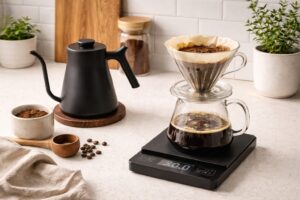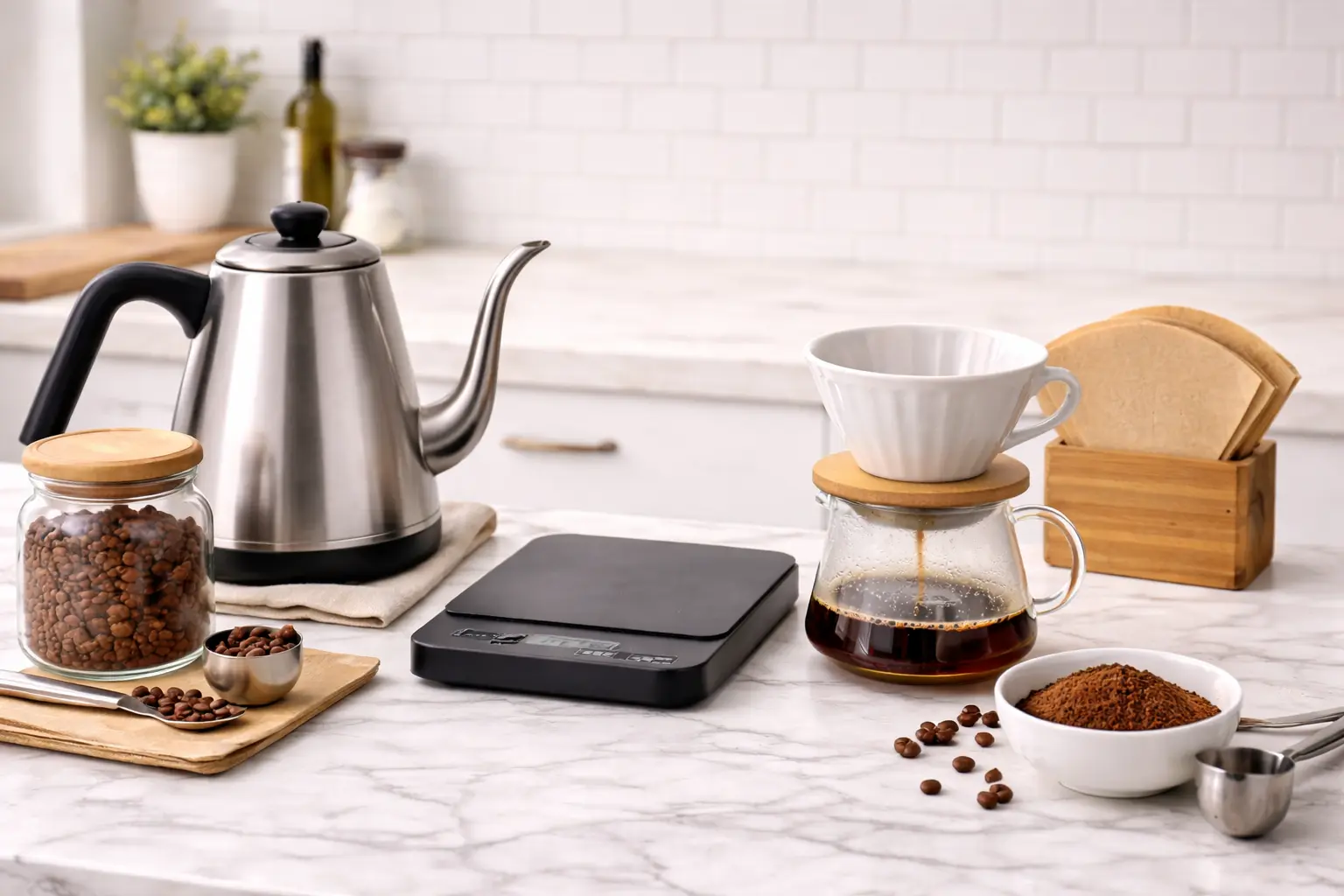
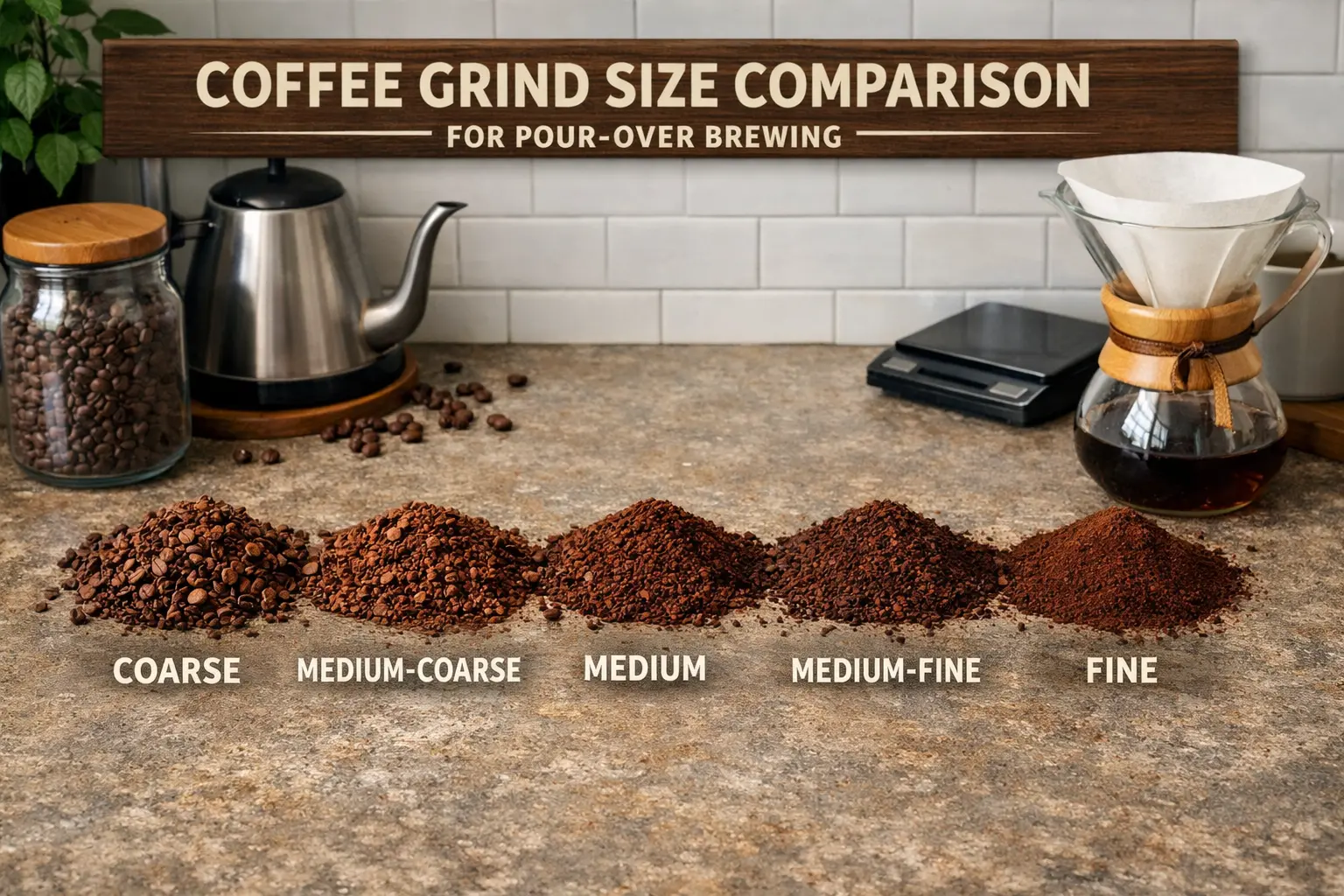
Quick Summary: Grind size is the single most important variable in pour-over coffee. If your brew tastes sour, bitter, weak, or inconsistent, the fix is almost always a small grind adjustment—not new beans or a new dripper. This grind size for pour-over guide gives you the right starting point and the real-world rules for adjusting based on taste.
Key Takeaways (Read This First)
- Pour-over grind size should be medium to medium-fine for most brewers
- Sour coffee = grind too coarse → go finer
- Bitter coffee = grind too fine → go coarser
- Weak coffee is often a ratio issue (use more coffee)
- Flat coffee often comes from grinder buildup/retention or water
- Charts are starting points—taste is the final judge
New to pour-over? Start with Pour-Over Coffee Brewing Setup. If your coffee tastes off, use Pour-Over Troubleshooting before changing gear.
Pour-Over Grind Size Chart
Use this chart as your starting point. Then adjust based on taste and brew time (most pour-overs land around 2:30–3:30 depending on brewer and recipe).
| Brew Method | Starting Grind | Texture Reference | Typical Brew Time |
|---|---|---|---|
| V60 (cone) | Medium-fine | Granulated sugar | 2:45–3:30 |
| Kalita Wave (flat-bottom) | Medium | Table salt | 2:45–3:30 |
| Chemex | Medium-coarse | Coarse sea salt | 3:30–4:30 |

Why Grind Size Matters for Pour-Over
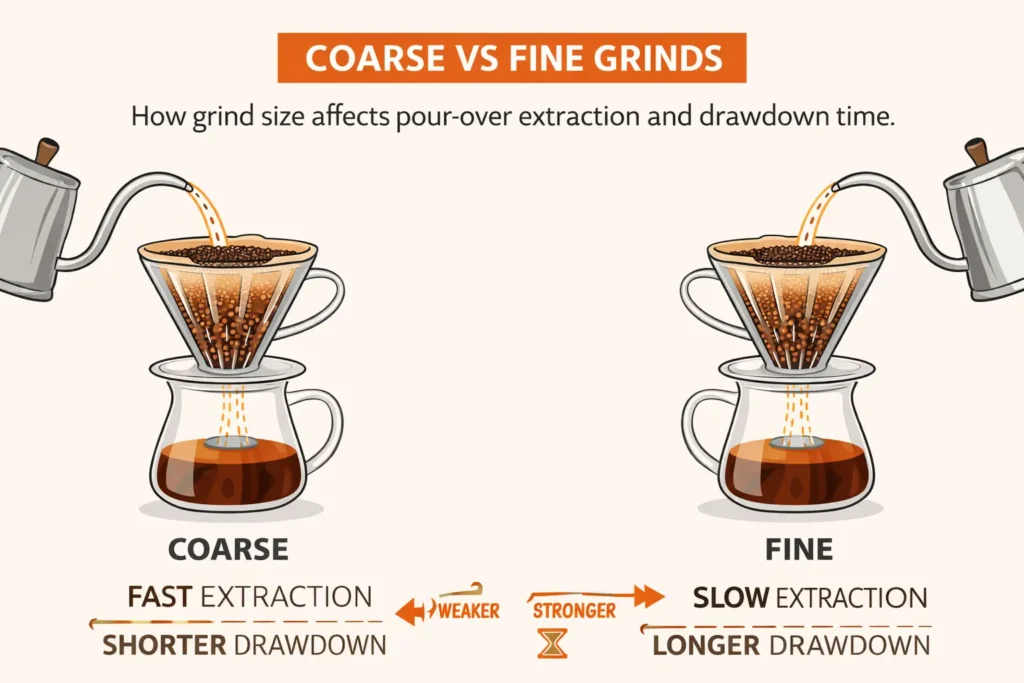
Grind size controls how fast water flows through the coffee bed and how much flavor is extracted. Too coarse and water rushes through without extracting enough. Too fine and water lingers too long, pulling out harsher flavors.
Why “Medium” Grind Size Is Misleading
Most grind charts say “medium” for pour-over—but that advice hides an important truth: there is no universal medium grind size.
Grind size depends on:
- Your grinder’s burr geometry and particle distribution
- The roast level of your coffee
- The brewer’s flow resistance (V60 vs Kalita)
- Paper filter thickness and brand
This is why two people using “medium” can get completely different results. Use charts as your starting point, then let taste and brew time guide your adjustment.
How to Adjust Grind Size Based on Taste
Rule of thumb: Change grind size in small steps. Re-brew the same recipe. Taste. Repeat. Don’t change multiple variables at once.
If Your Pour-Over Tastes Sour or Sharp
Sour coffee usually means under-extraction (water didn’t extract enough from the grounds).
- Grind slightly finer first
- Target a longer drawdown (within your brewer’s normal range)
- Keep your pour steady and avoid “rushing” the final pour
If Your Pour-Over Tastes Bitter or Harsh
Bitter, harsh, or drying coffee usually means over-extraction (too much was pulled from the grounds).
- Grind slightly coarser first
- Reduce agitation (gentler pour, less swirling/stirring)
- Watch for stalled or very slow drawdowns
If Your Pour-Over Tastes Weak or Watery
Weak coffee is often a ratio issue, not a skill issue.
- Use more coffee (try 1:15 as a baseline)
- If still weak, grind slightly finer
- Make sure the bloom fully saturates all grounds
How Grinder Quality Changes the “Correct” Grind Size
Two grinders set to the “same” grind size do not produce the same particles. This is one of the biggest reasons people struggle with pour-over.
- Entry-level grinders often produce more fines (tiny particles) that slow flow and add bitterness
- Better grinders produce a tighter particle distribution (more consistent extraction)
This means:
- Budget grinders often need to grind slightly coarser than charts suggest to avoid harshness
- High-quality grinders can grind finer without turning bitter (more sweetness/clarity)
If grind changes don’t seem to fix your coffee, the issue may be particle inconsistency, not the number on the dial.
Recommended Tools for Grind Consistency
If you’re chasing consistent pour-over coffee, grinder consistency matters more than “perfect settings.” These are the most useful upgrades for this specific problem. Replace the links with your affiliate URLs.
Paper Filters Change the Ideal Grind Size
Filter thickness affects flow rate more than most people realize. Even within the same brewer, changing filter brands can change drawdown time enough to change flavor.
- Thicker filters (Chemex-style) slow flow → often require coarser grinds
- Thinner filters (some V60 papers) allow faster flow → can tolerate finer grinds
If you switch filters and your coffee suddenly tastes off, adjust grind size before changing anything else.
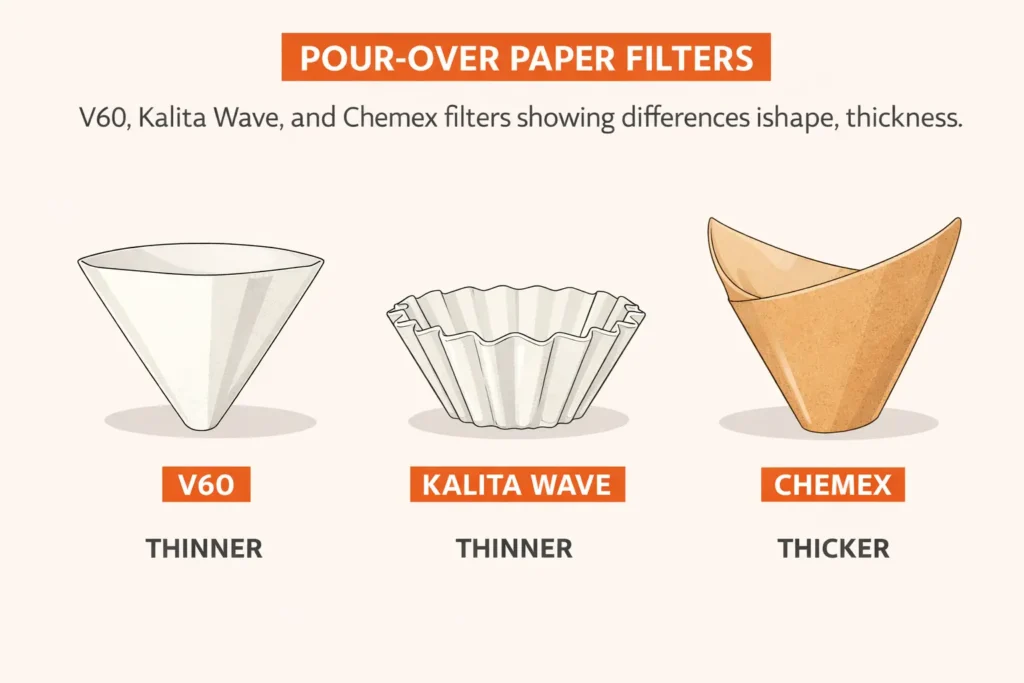
Filters That Match Your Brewer
Filters change flow and can change the “correct” grind size. If your brews suddenly taste different after switching filter brands, start by adjusting grind before changing your recipe. Replace links with your affiliate URLs.
V60 vs Kalita: Grind Size Differences
Cone drippers like the V60 are more sensitive to grind size than flat-bottom drippers like the Kalita Wave.
- V60: tends to prefer a slightly finer grind and more precise pouring
- Kalita: tends to work best slightly coarser and is more forgiving
For the full brewer comparison, see Flat-Bottom vs Cone Drippers (Kalita vs V60).
When Grind Size Isn’t the Real Problem
If you’ve adjusted grind size multiple times and coffee still tastes flat or harsh, stop adjusting. The most common hidden issues are old oils and retained grounds inside the grinder.
- Grinder burrs coated with old coffee oils mute sweetness and clarity
- Retention mixes stale grounds into fresh brews (especially noticeable with pour-over)
- Inconsistent water can dull flavor even when extraction is “right”
Before buying new gear, clean your grinder and reset your baseline: Grinder Cleaning & Retention.
Tools That Help With Retention + Freshness
Flat flavor can come from stale oils and retained grounds mixing into fresh coffee. These small tools make a bigger difference than most people expect. Replace links with your affiliate URLs.
The Core Tools That Make Grind Adjustments Repeatable
Without these tools, grind size changes can feel random—even when you’re following a chart. Together, they create consistency so adjustments actually work.
- Burr coffee grinder (particle consistency)
- Digital coffee scale with timer (ratio + brew time control)
- Correct paper filters (flow rate consistency)
- Grinder cleaning tools (freshness and retention control)
Need a simple starter setup order? See Best Coffee Gear for Beginners. If your coffee tastes off, use Pour-Over Troubleshooting.
FAQ
What grind size should I use for pour-over?
Start medium-fine for V60, medium for Kalita Wave, and medium-coarse for Chemex. Then adjust based on taste and brew time. Charts are starting points—taste is the final judge.
Why does my pour-over taste sour?
Sour coffee is usually under-extracted. The fastest fix is grinding slightly finer to slow the flow and increase extraction.
Why is my pour-over bitter?
Bitter coffee is usually over-extracted from grinding too fine, too much agitation, or very slow drawdown. Grind slightly coarser and pour more gently.
What if grind adjustments don’t fix my coffee?
If small grind changes don’t improve flavor, the issue is often grinder consistency, dirty burrs, or retained grounds mixing into fresh coffee. Cleaning your grinder and resetting your baseline can help immediately.