
Pour-Over Grind Size Chart: V60, Kalita & Chemex Settings
Editorial standards: grind recommendations are starting points built around brewer geometry, filter resistance, flow, taste, and repeatability rather than universal grinder numbers.
At a glance
What this guide covers
Use the chart to choose a starting grind for V60, Kalita Wave, or Chemex, then use taste and drawdown together to decide whether to move finer or coarser. The guide also explains when filters, grinder quality, pouring, or water—not grind—are controlling the result.
Editorial analysis
A chart should narrow the search, not pretend every grinder is calibrated the same
Published grind settings are most useful as a shared language for texture. Once brewing begins, the correct setting is the one that gives a balanced cup for your grinder, coffee, dose, filter, and brewer. Small controlled changes teach more than chasing an exact number from someone else’s grinder.
Start With the Brewer, Then Use Taste to Finish the Grind
Pour-over grind charts are useful only when they are treated as starting points. “Medium” is not a universal particle size, and two grinders can produce noticeably different distributions at settings that carry the same label. Brewer geometry, paper thickness, dose, coffee density, pouring pattern, and the amount of fines produced by the grinder all change the drawdown.
The most reliable approach is to use a brewer-specific starting texture, hold the rest of the recipe stable, and then move the grinder in small steps based on taste and flow. A fast V60 that tastes hollow is asking for a different correction than a slow Chemex that tastes balanced. The chart gets you close; the cup tells you when to stop adjusting.
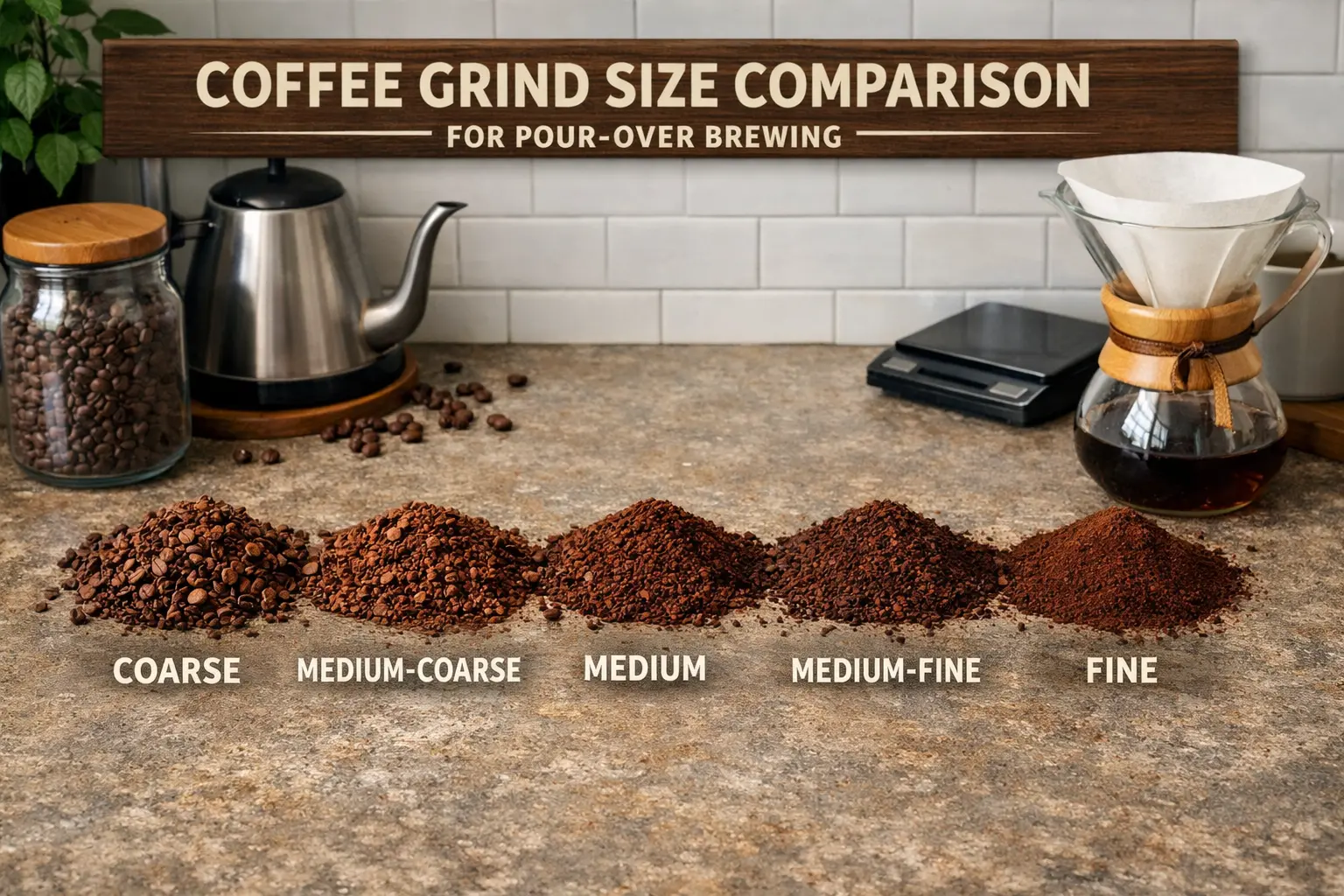
Pour-Over Grind Size Chart
| Brewer | Starting grind | Texture reference | Typical drawdown context |
|---|---|---|---|
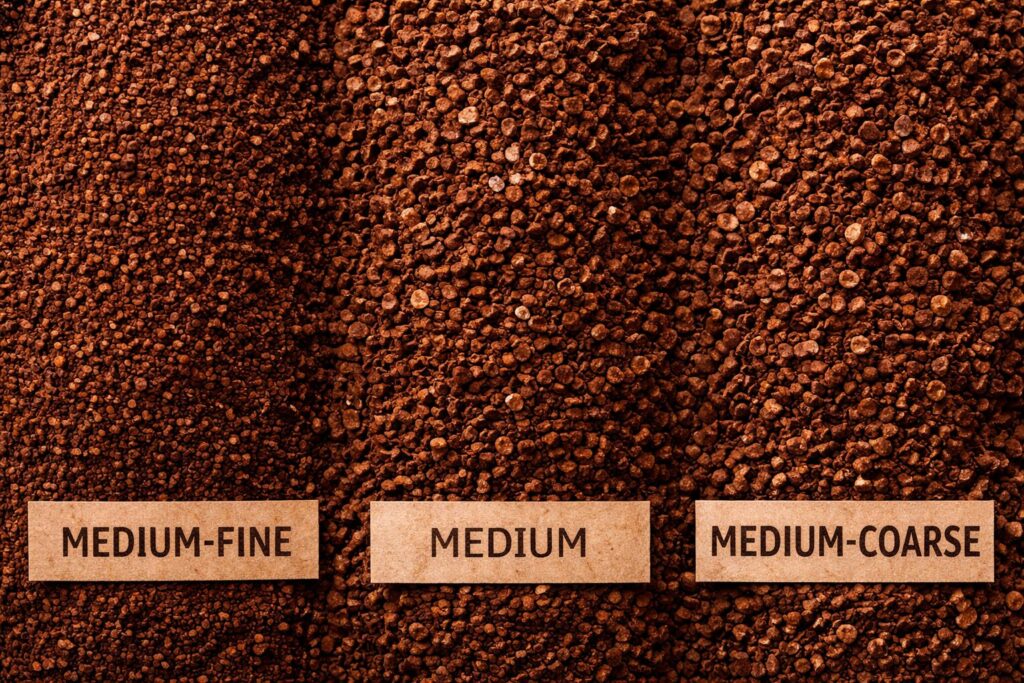
| Hario V60 | Medium-fine | Fine granulated sugar | Often around 2:45–3:30 for common single-cup recipes |
| Kalita Wave | Medium | Table salt to slightly finer | Often around 2:45–3:30, with more built-in flow resistance than V60 |
| Chemex | Medium-coarse | Coarse sand / fine sea salt | Often around 3:30–4:30 for larger batches and thick bonded paper |
Those time ranges are diagnostic context, not pass/fail targets. A coffee that tastes balanced outside the range does not need to be forced back toward a number. Conversely, a brew that lands inside the range but tastes sour, drying, or flat still needs adjustment.
Why Grind Size Changes Both Flow and Extraction
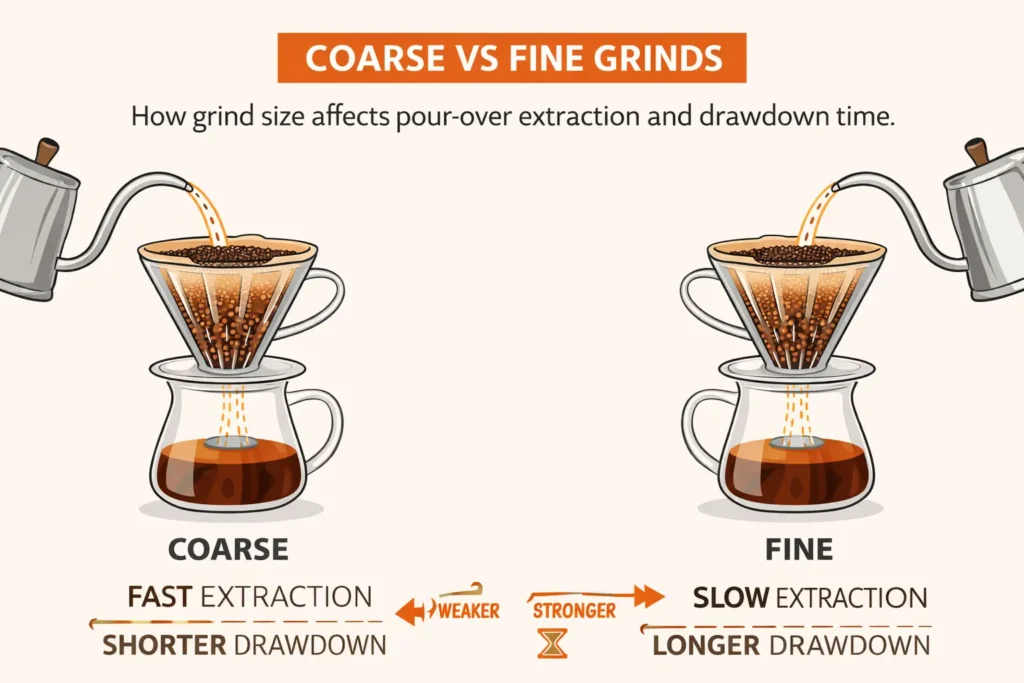
Smaller coffee particles expose more surface area and pack more tightly, so water tends to move through the bed more slowly and extract more material. Coarser particles create larger pathways, increasing flow and usually reducing extraction for the same dose, ratio, and pouring pattern. That is why grind is the first variable to adjust when a brew is consistently too fast or too slow.
The relationship is not perfectly linear because fines can migrate toward the filter and create localized resistance. A grinder that produces a large amount of powder can make a nominally “medium” setting behave much slower than a cleaner grinder at a visually similar texture. This is also why grinder quality changes how transferable grind charts are.
Filter flow matters too
Match the filter to the brewer before you blame the grind
Paper thickness and shape change flow resistance, so the same grind can behave differently across a V60, Kalita Wave, and Chemex. These are the brewer-specific filters referenced in the guide.
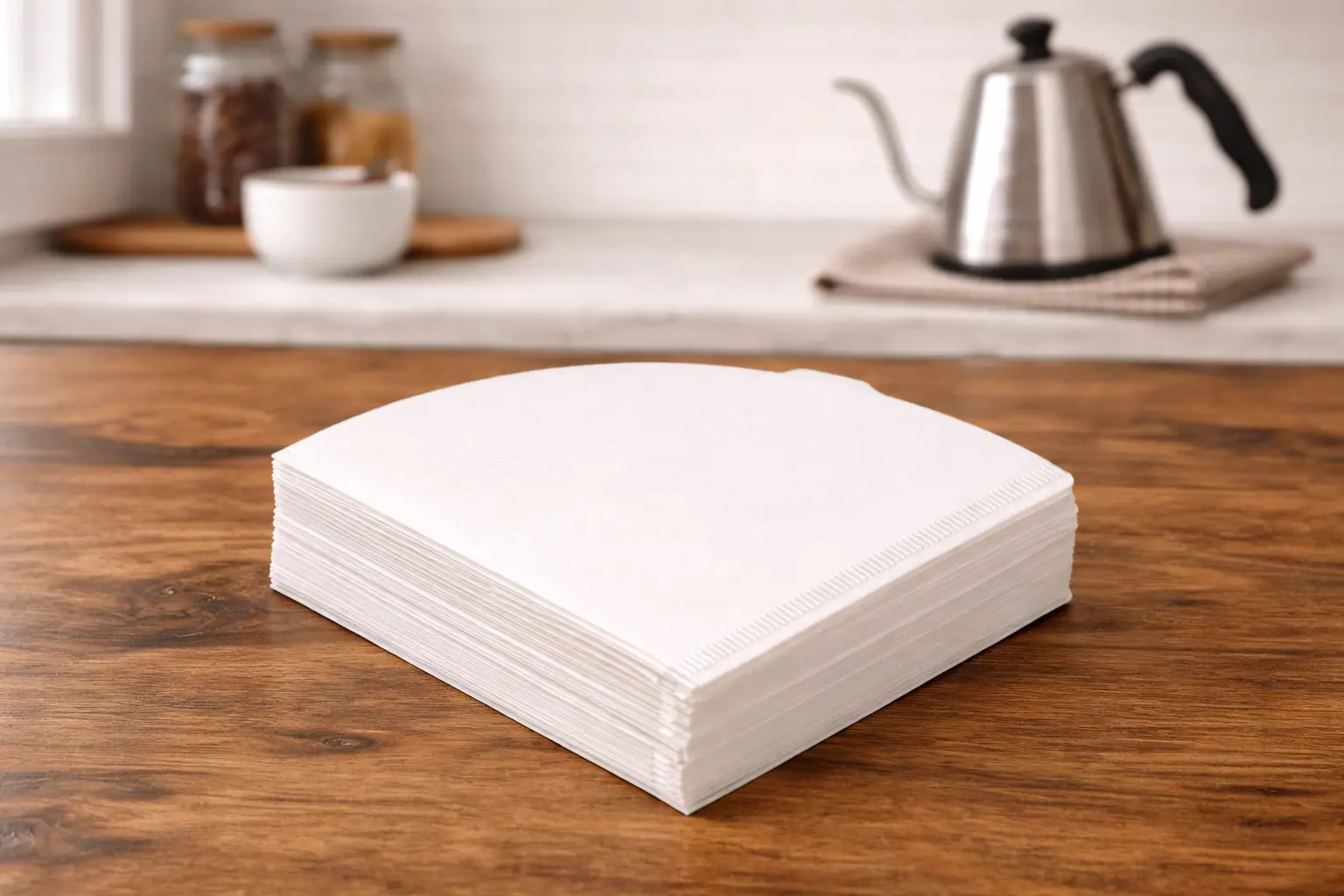 V60 02 Paper FiltersThin cone paper with relatively open flow, which often pairs with a medium-fine starting grind.View on Amazon →
 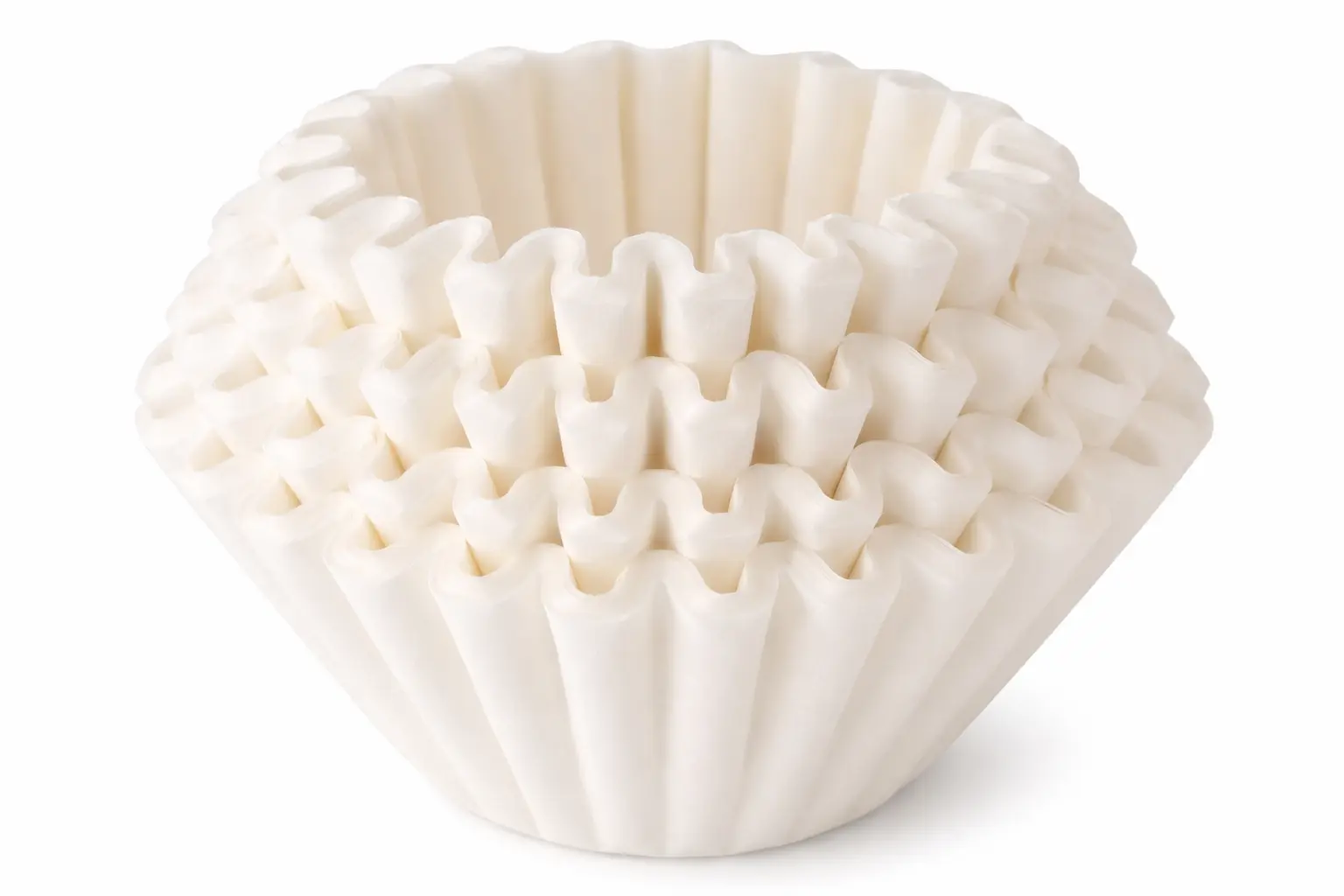 Kalita Wave 185 FiltersFlat-bottom wave filters add their own flow characteristics and should be dialed independently from cone brewers.View on Amazon →
 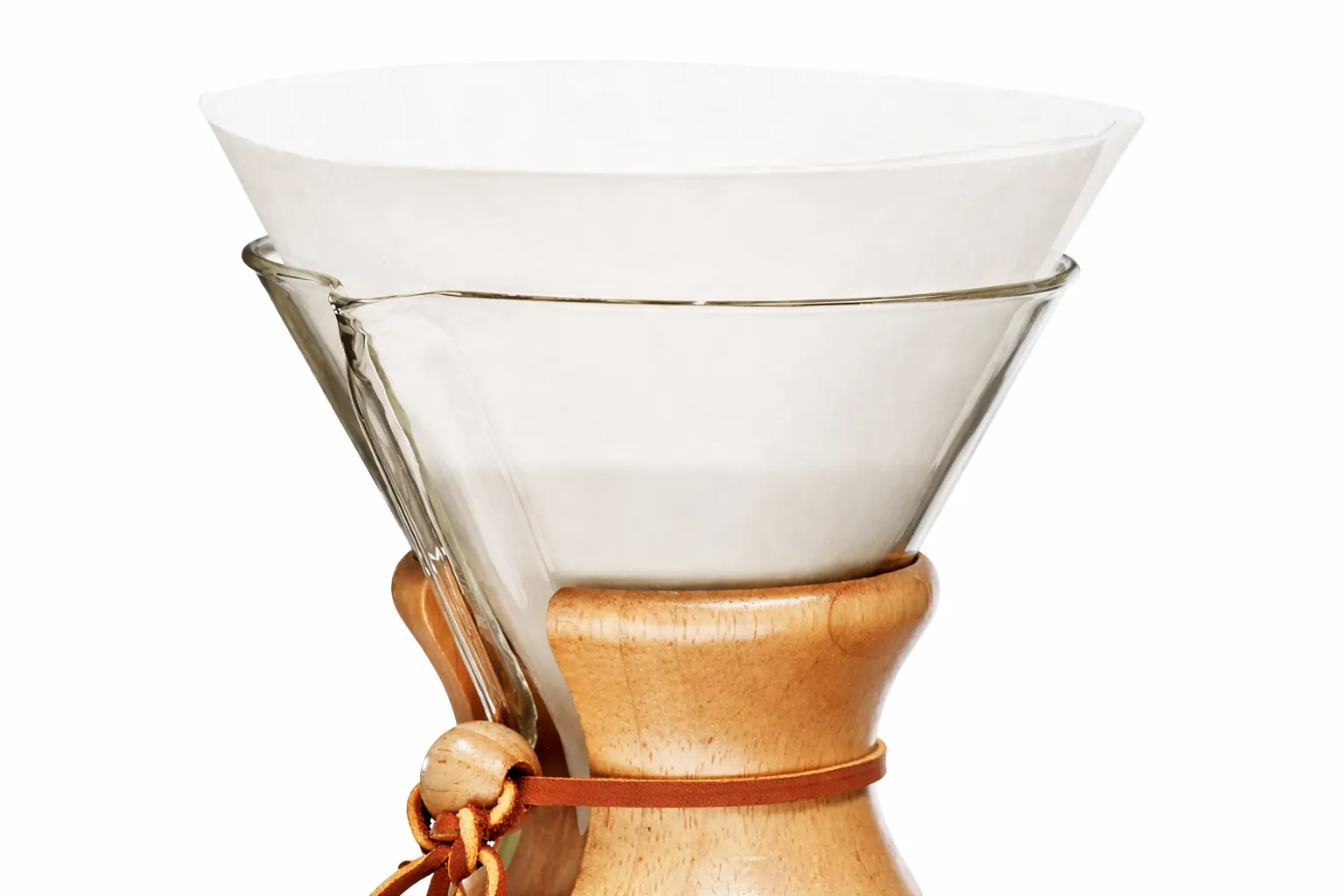 Chemex Bonded FiltersThicker paper creates more resistance and often calls for a coarser grind than smaller cone brewers.View on Amazon →
Affiliate disclosure: These links may earn CoffeeGearHub a commission at no additional cost to you. As an Amazon Associate, we earn from qualifying purchases. Prices and availability can change.
Why V60, Kalita, and Chemex Do Not Use the Same Grind
The V60 has one large drain opening and relatively open paper, so much of the flow control comes from the grind and the way water is poured. A medium-fine starting point gives the coffee bed enough resistance to prevent water from racing through, while still leaving room to go coarser if the brew stalls. Our Hario V60 recipe pairs this starting grind with a complete dose, bloom, and pour schedule.
The Kalita Wave uses a flat bed and three smaller drain holes. That geometry builds more resistance into the brewer, so a slightly coarser starting point than many V60 recipes can produce a similar total contact time. The flatter bed also makes the brewer somewhat less sensitive to small pouring differences.
The Chemex changes the system most dramatically because the bonded paper is much thicker. Its filter retains more oils and fines and adds substantial flow resistance. That is why Chemex recipes often begin coarser, particularly when the batch is larger than a typical single-cup V60 brew.
How Dose and Batch Size Shift the Starting Grind
A grind setting that works well for a 15-gram single-cup brew may not behave the same way when the dose doubles. A deeper coffee bed creates more resistance, so larger batches often need a slightly coarser grind to keep flow from slowing excessively. This effect is especially noticeable in brewers with thicker paper or limited drainage.
The practical lesson is to treat grind as part of a complete recipe. If you scale from 20 grams of coffee to 30 or 40 grams while keeping the same brewer, do not assume the old setting will transfer unchanged. Start near the original setting, watch the drawdown, and be prepared to move coarser if the larger bed stalls or develops a drying finish.
| Recipe change | What usually happens to flow | Useful starting response |
|---|---|---|
| Smaller dose in the same brewer | Shallower bed usually offers less resistance | May need a slightly finer grind to maintain extraction |
| Larger dose in the same brewer | Deeper bed usually slows flow | May need a slightly coarser grind |
| Same dose, more water | Longer brew and more total extraction potential | Keep grind stable first, then judge strength and finish |
| Same dose, less water | Shorter brew with a stronger cup | Do not automatically grind finer; evaluate strength separately from extraction |
Roast Level Changes How Aggressively You Need to Extract
Roast level does not dictate one exact grind size, but it changes the starting direction. Lighter coffees are generally denser and less soluble than darker coffees, so they often respond well to a somewhat finer grind, hotter water, or both. Darker coffees extract more readily and can become harsh when the grind is too fine or the brew is too hot.
That does not mean every light roast should be ground fine or every dark roast coarse. Grinder quality, bean density, processing method, age, and brewer design can all move the ideal setting. Roast level is best used as a first nudge, not a fixed prescription.
| Roast tendency | Starting grind direction | What to watch for |
|---|---|---|
| Light roast | Slightly finer than your neutral baseline | Sharp acidity, hollow sweetness, or very fast drawdown can indicate under-extraction |
| Medium roast | Use the brewer baseline | Balance sweetness, clarity, and finish before making large changes |
| Dark roast | Slightly coarser than the baseline | Drying bitterness, roast harshness, or sluggish flow suggest reducing extraction pressure |
A Three-Brew Calibration Method Is More Useful Than Chasing Grinder Numbers
The fastest way to find a workable setting is to run a controlled three-brew test. Keep coffee dose, water amount, water temperature, filter, and pouring pattern the same. Change only the grinder. That creates a clean comparison instead of a moving target.
For the first brew, use the chart’s starting texture. Record the total drawdown and one short taste note. If the cup is clearly under-extracted, move one or two small steps finer for brew two. If it is clearly drying or bitter, move one or two steps coarser. Brew three should be a smaller correction in the direction that improved the cup.
This method is intentionally simple. It does not guarantee a perfect recipe in exactly three attempts, but it usually tells you which side of the useful range you are on. Once the grind is close, smaller changes in water temperature, ratio, or pouring can refine the cup without losing the baseline.
| Brew | What stays fixed | What changes | What you learn |
|---|---|---|---|
| 1 — Baseline | Dose, water, temperature, filter, pour | Nothing | Whether the chart starting point is broadly too fine, too coarse, or close |
| 2 — Direction test | Everything except grind | One or two small grind steps | Whether finer or coarser improves sweetness and balance |
| 3 — Refinement | Everything except grind | A smaller step in the better direction | Whether you are entering the useful range for that coffee |
Use Taste to Decide Which Direction to Move
| What you taste | What may be happening | First grind adjustment |
|---|---|---|
| Sharp, sour, hollow, or thin | Extraction may be too low or flow too fast | Move finer by one small step, then repeat the same recipe |
| Drying, harsh, bitter, or heavy | Extraction may be too high or drawdown too slow | Move coarser by one small step before changing several other variables |
| Weak but otherwise balanced | Strength may be the issue rather than extraction | Keep grind stable and consider a stronger ratio |
| Strong but balanced | The recipe may simply be concentrated | Adjust water or dose rather than using grind to solve a strength problem |
Taste should be interpreted together with drawdown. A sour cup that also drains extremely quickly strongly points toward a finer grind. A sour cup with a very slow drawdown may indicate channeling, poor saturation, unusually cool water, or another problem that grind alone will not fix.
Brewer-Specific Dial-In Examples
The same flavor problem can require a different-size adjustment depending on the brewer. An open V60 reacts quickly to grind changes because the drain offers little built-in restriction. A Kalita Wave already has more flow resistance, so a small move can be enough. Chemex combines a larger dose with thick paper, making overly fine grinds especially likely to create long drawdowns.
| Brewer | If the brew is fast and sour | If the brew is slow and drying | What else to verify |
|---|---|---|---|
| V60 | Move finer in a small step | Move coarser; reduce excessive agitation if needed | Pour rate and whether the coffee bed is draining evenly |
| Kalita Wave | Move slightly finer | Move coarser before adding more agitation | Filter seating and whether the bottom outlets are unobstructed |
| Chemex | Move finer cautiously | Move coarser; check filter orientation around the spout | Batch size, bonded-filter resistance, and whether the air channel is blocked |
Read Drawdown as a Diagnostic, Not a Target
Brew time is useful because it tells you how the coffee bed and filter are behaving, but it should never override taste. A V60 that finishes outside a published time range can still be excellent. The useful question is whether drawdown and flavor are pointing in the same direction.
| Drawdown pattern | Taste pattern | What it suggests |
|---|---|---|
| Very fast | Sour, thin, hollow | Grind is probably too coarse or the bed is being bypassed |
| Very fast | Balanced but light | Extraction may be fine; ratio may simply be too dilute |
| Very slow | Dry, harsh, bitter | Grind is probably too fine, fines are clogging the filter, or agitation is excessive |
| Very slow | Sweet and balanced | No correction is required simply to match a time target |
| Normal-looking time | Uneven sourness and dryness together | Channeling or inconsistent particle distribution may be more important than average grind size |
Know When to Change Grind—and When Not To
Grind is usually the first adjustment because it changes both flow and extraction, but using it to solve every problem creates confusion. Once the grind is close, other variables can make cleaner, more targeted corrections.
| Problem | Best first variable | Why |
|---|---|---|
| Brew is obviously too fast or too slow | Grind | Particle size directly changes bed resistance and extraction rate |
| Cup is balanced but too weak or too strong | Ratio | This is primarily a concentration problem, not necessarily an extraction problem |
| Light roast tastes dull even after grind is close | Water temperature | A modest temperature increase can raise extraction without changing flow |
| Drawdown changes wildly between identical brews | Pouring consistency / agitation | Technique variation can move fines and create channeling or clogging |
| Flavor is flat at every setting | Water and coffee freshness | Grind cannot restore stale aromatics or fix strongly unsuitable water |
Grinder Quality Changes What “Correct” Looks Like
A good burr grinder narrows the particle distribution enough that one setting produces a predictable flow pattern. Entry-level grinders can still make excellent pour-over, but their settings may need to move farther from published charts because more fines and large fragments are present at the same time.
That does not mean every brewer needs a premium grinder. It means a grind-size chart becomes more useful when the grinder is consistent. If two brews made at the same setting behave very differently, check dose, bean age, filter seating, and pouring technique before assuming the chart itself is wrong.
Paper Filters Can Shift the Ideal Grind
Paper is part of the hydraulic system. A thick or slow-flowing filter can make a recipe stall even when the coffee grind has not changed, while a faster paper can shorten drawdown enough to make the same grind taste less extracted. Filter brand, manufacturing batch, and how thoroughly the paper is rinsed can all matter.
For that reason, dial in grind only after choosing the filter you intend to use regularly. If you switch from standard V60 paper to a slower premium paper, or from cone paper to Chemex bonded filters, expect to revisit the grind rather than assuming the previous setting should transfer unchanged.
When Grind Size Is Not the Real Problem
If repeated grind changes move drawdown but do not improve flavor, another variable is probably dominating the brew. Inconsistent pouring can create channeling, a partially seated filter can restrict or redirect flow, and stale coffee can taste flat regardless of particle size. Water chemistry and temperature can also make a technically “correct” brew taste muted or harsh.
| Symptom after several grind changes | What to check next |
|---|---|
| Drawdown swings from brew to brew | Pour rate, agitation, dose accuracy, grinder retention, and filter seating |
| Flavor stays flat at every setting | Coffee freshness and water quality |
| Brew stalls despite a fairly coarse setting | Excess fines, aggressive agitation, slow paper, or a clogged filter wall |
| Fast brew still tastes bitter | Water temperature, roast level, channeling, or an overly strong ratio |
FAQ
What grind size should I use for pour-over?
Start medium-fine for V60, medium for Kalita Wave, and medium-coarse for Chemex. Then adjust based on taste and brew time. Charts are starting points—taste is the final judge.
Why does my pour-over taste sour?
Sour coffee is usually under-extracted. The fastest fix is grinding slightly finer to slow the flow and increase extraction.
Why is my pour-over bitter?
Bitter coffee is usually over-extracted from grinding too fine, too much agitation, or very slow drawdown. Grind slightly coarser and pour more gently.
Does changing filters affect grind size?
Yes. Filter thickness, pore structure, and shape affect flow resistance, so switching paper types can change drawdown even when the grinder setting stays the same. If you change from a faster V60 paper to a slower paper or to Chemex bonded filters, expect to recheck the grind rather than assuming the old setting will transfer perfectly.
What if grind adjustments don’t fix my coffee?
If small grind changes don’t improve flavor, the issue is often grinder consistency, dirty burrs, or retained grounds mixing into fresh coffee. Cleaning your grinder and resetting your baseline can help immediately.
CoffeeGearHub shortlist
Compare the brewers behind the grind settings
Use the product pages to compare the brewer geometry and verified merchant offers referenced throughout the guide.
Continue Learning
Use these guides to connect grind size with the rest of the pour-over system.
In this guide
- Start With the Brewer, Then Use Taste to Finish the Grind
- Pour-Over Grind Size Chart
- Why Grind Size Changes Both Flow and Extraction
- Why V60, Kalita, and Chemex Do Not Use the Same Grind
- How Dose and Batch Size Shift the Starting Grind
- Roast Level Changes How Aggressively You Need to Extract
- A Three-Brew Calibration Method Is More Useful Than Chasing Grinder Numbers
- Use Taste to Decide Which Direction to Move
- Brewer-Specific Dial-In Examples
- Read Drawdown as a Diagnostic, Not a Target
- Know When to Change Grind—and When Not To
- Grinder Quality Changes What “Correct” Looks Like
- Paper Filters Can Shift the Ideal Grind
- When Grind Size Is Not the Real Problem
- FAQ