
How to Store Coffee Beans (Beginner vs Advanced)
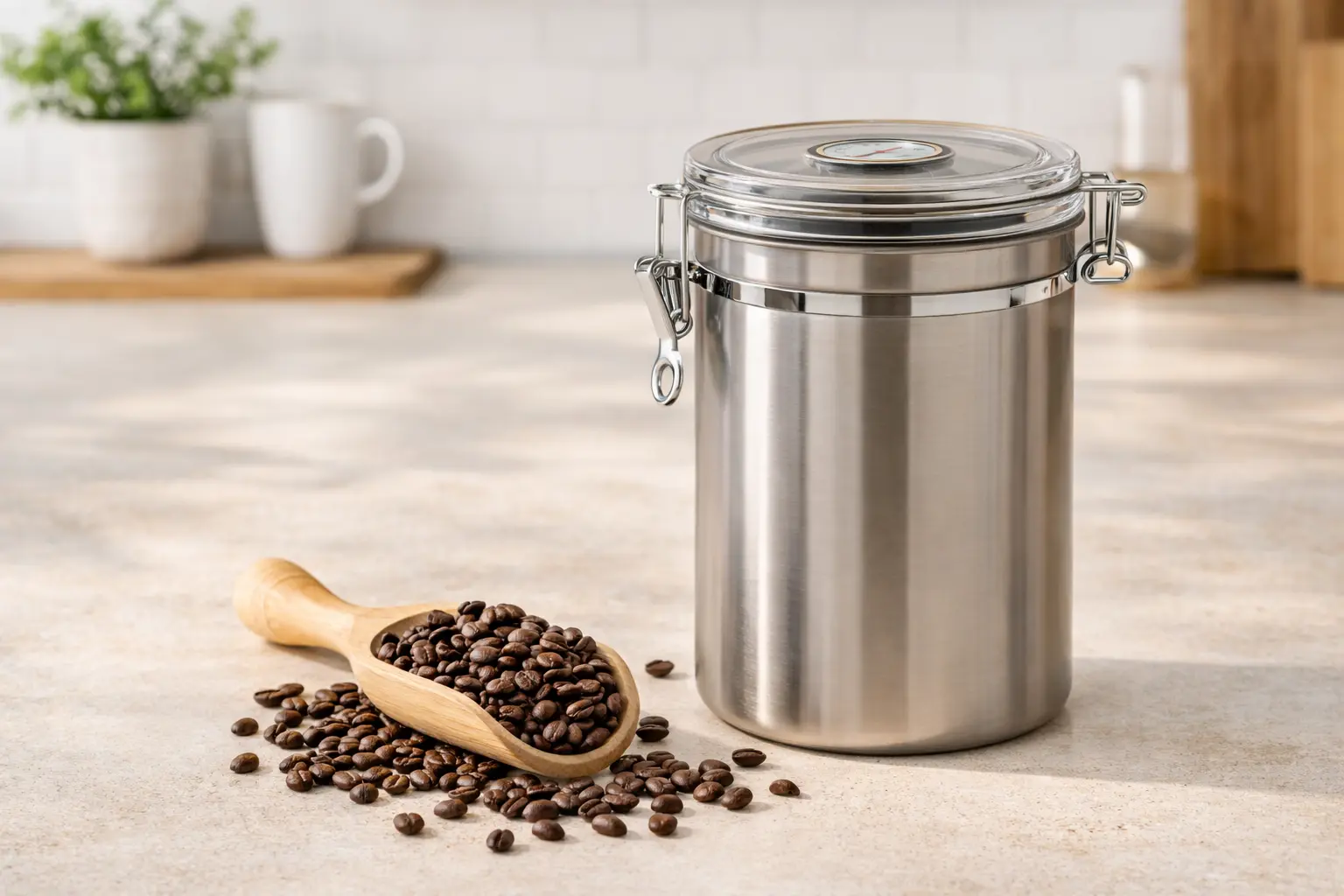
Editorial standards: this guide focuses on freshness, oxygen, heat, light, moisture, container choice, and realistic home turnover. Recommendations distinguish everyday storage from longer-term freezing and avoid implying that any container can restore already-stale coffee.
At a glance
What this guide covers
This guide compares simple pantry storage, airtight containers, portion freezing, and common mistakes so you can keep coffee fresher without turning storage into an elaborate ritual.
Editorial analysis
Buy less coffee more often before buying more storage gear
The biggest freshness advantage usually comes from matching bag size to how quickly you drink coffee. A good container helps after opening, but it cannot compensate for buying several months of coffee that sits warm and exposed.
For normal home use, keep beans sealed, cool, dry, and away from light. Freezing becomes useful when you intentionally buy more coffee than you can finish while it is still fresh, especially when portions are sealed before freezing.
The 30-Second Answer
Store coffee beans sealed, cool, dry, and away from light, and buy quantities you can finish while they are fresh. Use an airtight container for everyday storage and portion-freeze excess coffee only when longer storage is actually necessary.
Quick Overview
Coffee goes stale from air, light, heat, and moisture — in that order of damage rate. The fastest improvement for most home brewers is moving beans from a clear jar on the counter into an opaque airtight container in a cool, dark cabinet. If you finish a bag within 2–3 weeks, that’s all you need. If you buy in bulk or drink slowly, portion beans into 3–5 day batches in sealed mason jars and freeze the portions you won’t use this week — thaw one at a time, never refreeze. No storage method, however sophisticated, compensates for a bad grind size or ratio: fix extraction fundamentals first.
- Fastest improvement: Move from a clear jar on the counter to an opaque airtight container in a dark cabinet
- Best for daily drinkers (1–3 week bags): Fellow Atmos or OXO POP container in a cool cabinet
- Best for bulk buyers / slower drinkers: Portion + freeze in sealed Ball Mason Jars; thaw one batch at a time
- Best for specialty beans / maximum aroma retention: Airscape or Fellow Atmos vacuum canister
- Never: refrigerator for daily use (moisture + odor absorption); clear jars in sunlight; storing near oven, dishwasher, or any appliance that generates heat
- Storage doesn’t fix extraction: flat, sour, or bitter coffee with fresh beans is a grind or ratio problem — not storage
Quick-Pick: Storage Methods and Product Comparison
Use this table to find the right storage method and product for your situation in under a minute. Detailed reviews and the freezing method guide follow below.
Disclosure: CoffeeGearHub may earn a commission on qualifying purchases. All links use the coffeegearhub-20 Associates tag.
| Our Pick | Best For | Method | Capacity | Key Advantage | Link |
|---|---|---|---|---|---|
| 🏆 Fellow Atmos Vacuum Canister | Daily drinkers who want the easiest freshness upgrade with vacuum sealing | Vacuum + room temp storage | 250g whole beans | Integrated twist-pump removes residual air; opaque stainless; date tracker on lid; dishwasher-safe | Check Price on Amazon → |
| ⚡ OXO Good Grips POP Container | Budget-conscious beginners who want excellent freshness without premium pricing | Airtight + room temp storage | 450g whole beans | One-button push-seal; stackable; best value-to-freshness ratio for most home setups | Check Price on Amazon → |
| 🔬 Airscape Coffee Canister | Specialty bean and single-origin enthusiasts who drink more slowly | Active valve displacement + room temp | 500g whole beans | Patented valve physically pushes air out; preserves aromatics 2–3x longer than standard containers; lifetime warranty | Check Price on Amazon → |
| 🧊 Ball Mason Jars (8oz, 4-pack) | Bulk buyers and slower drinkers using the portion-freeze method | Portion + freeze | 60–70g per jar (3–5 day batch) | Best freshness-per-dollar for long-term storage; freezer-safe glass; reusable for years | Check Price on Amazon → |
Table of Contents
Why Coffee Beans Go Stale — The Four Enemies
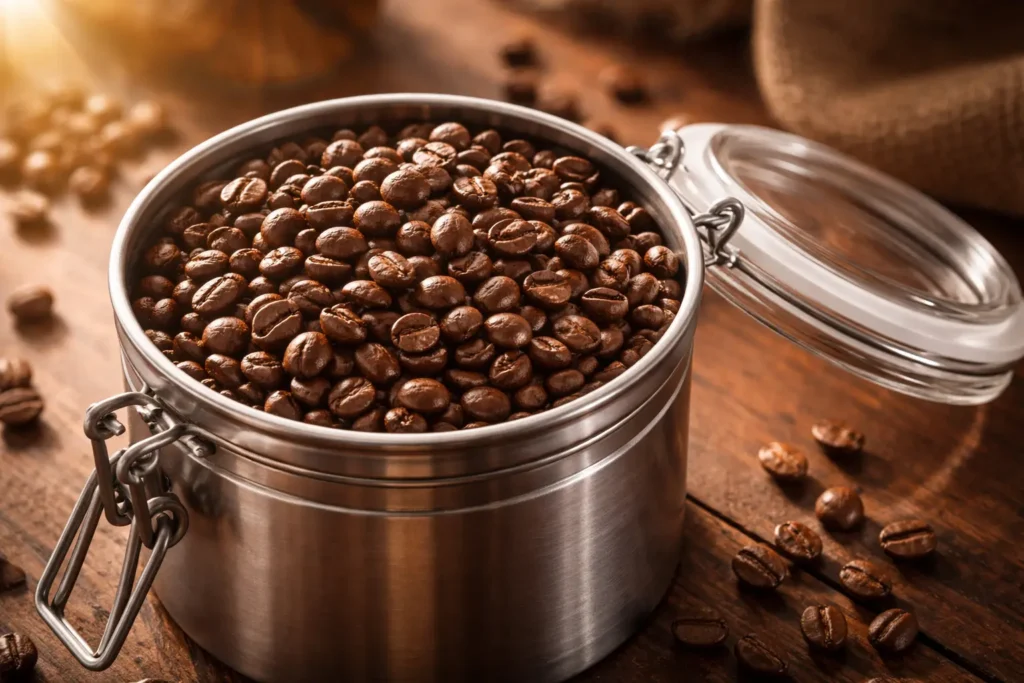
Fresh coffee beans contain hundreds of aromatic compounds that produce its characteristic smell and flavor. Those compounds are volatile — they degrade and escape over time when exposed to the four freshness enemies below. Understanding what each one does is what makes the storage rules feel logical rather than arbitrary: every storage recommendation is a direct response to blocking one or more of these mechanisms.
| Enemy | What it does to beans | Where it comes from | How to block it |
|---|---|---|---|
| Oxygen (air) | Oxidizes aromatic oils — the same reaction that makes cut fruit brown. The single fastest freshness killer; begins the moment beans are exposed to air | Every time you open the container; headspace in loosely filled containers; bags that don’t reseal completely | Airtight seal after every opening; vacuum canisters remove residual air in the headspace; smaller containers reduce headspace |
| Light | Accelerates oxidation through photochemical reactions — UV wavelengths are especially damaging and can stale beans visibly faster within days | Clear glass or plastic containers on countertops; storage near windows or under bright kitchen lighting | Opaque container (stainless steel or ceramic); storing a clear container in a dark cabinet; any opaque packaging |
| Heat | Accelerates all chemical degradation reactions; activates remaining CO2 degassing in fresh beans; warm environments speed oxidation and oil rancidity | Countertops near the oven, above the dishwasher (which exhausts hot air), top of the refrigerator, or near any appliance that generates heat | Store in a genuinely cool location — ideally below 70°F (21°C); a dark kitchen cabinet away from all appliances is usually correct |
| Moisture | Destroys crisp aromatic compounds; accelerates mold risk in severe cases; creates musty or flat off-flavors; condensation is especially damaging because it wets bean surfaces directly | Humid kitchens; refrigerator daily storage (condensation on beans when they cycle between temperatures); leaving containers open near steam | Sealed dry container; never refrigerate for daily use; let frozen beans reach room temperature in their sealed container before opening |
🚫 Storage protects flavor — it cannot create it. If your coffee tastes sour, bitter, or weak with beans you know are fresh, the problem is extraction: grind size too coarse or too fine, ratio wrong, or machine brewing at the wrong temperature. No container, however airtight, compensates for a fundamentally off extraction. Fix ratio and grind before concluding the beans are the problem.
Beginner vs Advanced: Which Storage Method Do You Actually Need?
Most home brewers don’t need advanced storage. The right method depends almost entirely on how quickly you go through beans — which determines how long they need to stay at peak freshness. Use the comparison below to find the right approach before spending anything on storage gear.
✅ Beginner Storage
- You drink coffee daily or nearly daily
- You finish a bag within 1–3 weeks of opening
- You want maximum improvement with minimum effort
- You’re not chasing peak specialty-bean performance
Do this: opaque airtight container in a cool, dark cabinet. Buy smaller bags more frequently. That’s it.
🧊 Advanced Storage
- You buy 2+ bags at once, or in bulk quantities
- A bag takes you 4+ weeks to finish
- You use multiple brew methods with different doses
- You’re chasing peak flavor from specialty or single-origin beans
Do this: portion into 3–5 day batches at purchase, freeze sealed portions, thaw one at a time.
🔬 Why whole beans always outperform pre-ground in storage: Grinding increases a bean’s surface area by approximately 10,000 times. That means every freshness enemy — oxygen, light, heat, moisture — attacks exponentially more surface simultaneously. Whole beans stored correctly retain peak flavor for 2–4 weeks. Pre-ground coffee at room temperature is noticeably stale within 3–5 days and meaningfully degraded within hours of grinding. If you’re currently buying pre-ground coffee and noticing flat, lifeless cups, switching to whole beans with a burr grinder will improve coffee quality more than any storage upgrade.
Beginner Coffee Storage: The Three Rules
For daily drinkers who finish bags in 1–3 weeks, these three rules produce 90% of the freshness improvement available to most home brewers — with no complicated methods, no portioning, and no freezer involvement.
| Rule | What to do | What to avoid | Why it matters |
|---|---|---|---|
| 1. Use an opaque airtight container | Transfer beans to stainless steel, ceramic, or any opaque container with a genuine airtight seal immediately after purchase | Clear glass or plastic jars; loosely clipped bags; containers that don’t seal completely when closed | Blocks both light and oxygen simultaneously — the two fastest freshness killers |
| 2. Store in a cool, dark location | A kitchen cabinet away from all heat-generating appliances; ideally below 70°F (21°C) year-round | Top of the refrigerator (warm, vibrating); above or near the dishwasher (hot exhaust air); near the oven; any sunny countertop | Heat accelerates all degradation reactions — the coolest accessible spot in the kitchen is correct |
| 3. Buy smaller, buy fresher | Purchase bags you can finish within 2–3 weeks of opening; prioritize roasters who print roast dates on their bags | Buying 2lb bags when you drink 250g per week; buying from retailers who don’t date their bags (beans may be months old) | No storage method compensates for beans that were already stale when purchased — freshness at purchase is the ceiling |
Product Picks: Full Reviews
Disclosure: CoffeeGearHub may earn a commission on qualifying purchases through affiliate links on this page. CoffeeGearHub.com participates in the Amazon Services LLC Associates Program. As an Amazon Associate, we earn from qualifying purchases. Our editorial recommendations are independent of any commercial relationship.
🏆 CoffeeGearHub Pick — Best Overall Coffee Canister
Fellow Atmos Vacuum Canister — Best Overall Coffee Storage
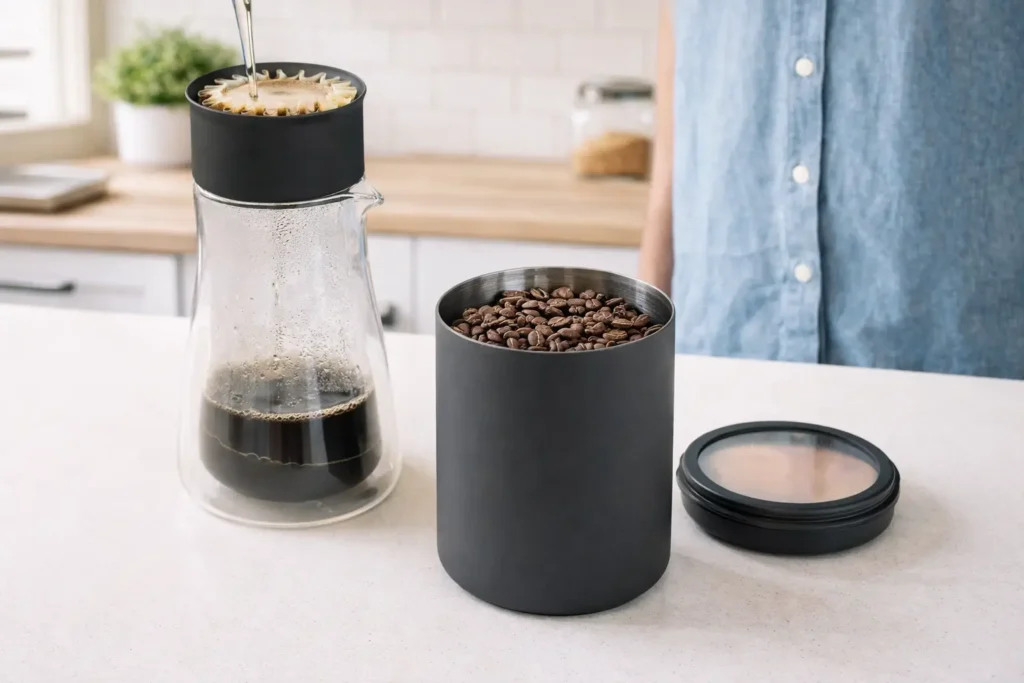
The Fellow Atmos is the easiest, most satisfying freshness upgrade available for daily coffee drinkers — and the CoffeeGearHub recommendation for anyone who wants the best combination of convenience and protection. Twisting the lid once or twice activates an integrated pump that removes residual air from the canister after every closure, reducing oxygen exposure beyond what any standard airtight seal can achieve. The opaque matte stainless steel blocks light completely and the 0.7L size holds approximately 250g of whole beans — a practical 1–2 week supply for most households. The date wheel on the lid lets you track exactly when the beans went in, which is the single most useful habit change for freshness-conscious brewing. For daily drinkers who want to stop thinking about staleness and just brew better coffee, the Atmos is the most convenient path there.
- Sealing mechanism: Integrated twist-pump — removes residual air headspace after each closure; no separate pump tool required
- Material: Opaque matte stainless steel — blocks 100% of light; no UV degradation risk
- Capacity: 0.7L (approximately 250g whole beans) — ideal 1–2 week supply for 1–2 person households
- Date tracker: Built-in date wheel on lid — the fastest way to build a “roast date awareness” habit
- Maintenance: Dishwasher-safe — easiest cleaning of any canister in this guide
- Best for: Daily drinkers who want vacuum protection without any extra effort; households that go through 200–300g per week
Disclosure: CoffeeGearHub may earn from qualifying purchases.
⚡ Best Budget Pick — Excellent Freshness, No Premium Price
OXO Good Grips POP Container — Best Budget Coffee Canister
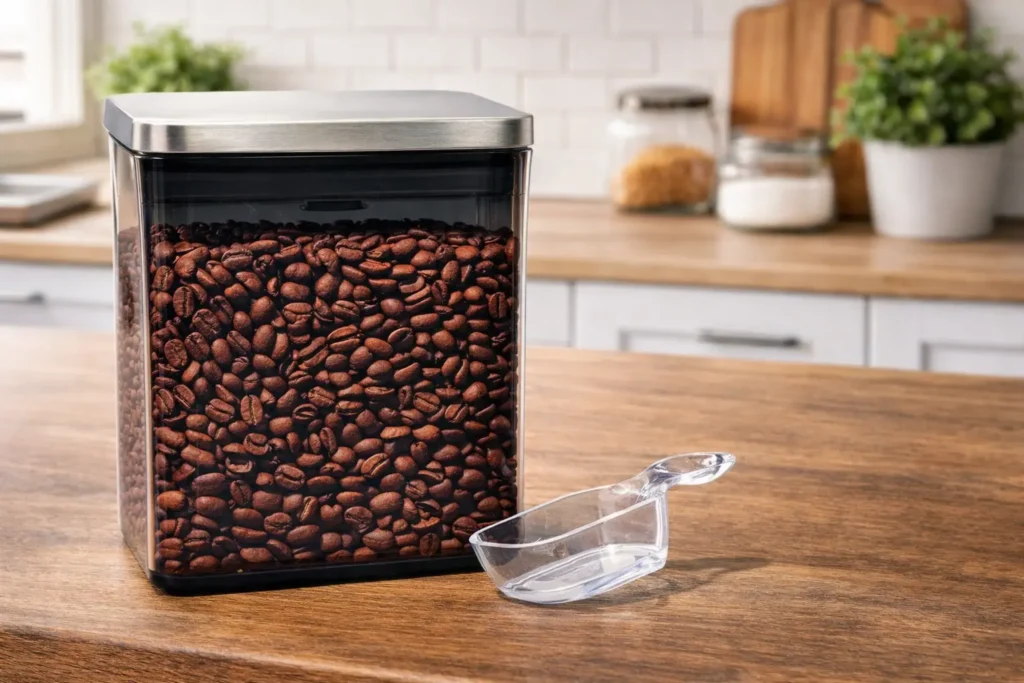
The OXO Good Grips POP Container is the clearest recommendation when cost is the primary constraint and the need is accurate, repeatable freshness for daily drip brewing. The one-button push-to-seal mechanism creates a genuinely airtight closure — not a friction fit or a loose clip, but a mechanical seal that activates with a single press. The 1.4L size holds a full 450g bag of whole beans, which is the most common retail purchase size and a practical 2–3 week supply for most households. The clear body lets you see when you’re running low — a genuinely useful daily-use feature — but because it’s clear, it needs to live in a dark cabinet, not on the counter. Stackable design integrates well into most cabinet configurations. For beginners making their first freshness upgrade, this container produces results that are indistinguishable from canisters at three times the price in a side-by-side taste test of 1–2 week storage.
- Sealing mechanism: One-button push-to-seal — mechanical airtight closure; opens and closes in one hand
- Material: Clear BPA-free plastic — light-blocking requires dark cabinet storage; do not use on an open countertop
- Capacity: 1.4L (approximately 450g whole beans) — holds a full standard retail bag; 2–3 week supply for most households
- Stackable: Designed to stack with other OXO POP containers — useful for households with multiple beans or grains
- Maintenance: Dishwasher-safe; BPA-free materials
- Best for: Budget-conscious beginners; anyone making their first freshness upgrade from a loose bag or open jar
Disclosure: CoffeeGearHub may earn from qualifying purchases.
☕ Beans sorted — now dial in your ratio. The Drip Coffee Ratio guide covers exact dose targets for every carafe size using the SCA Golden Cup standard.
Advanced Storage: The Portion-Freeze Method
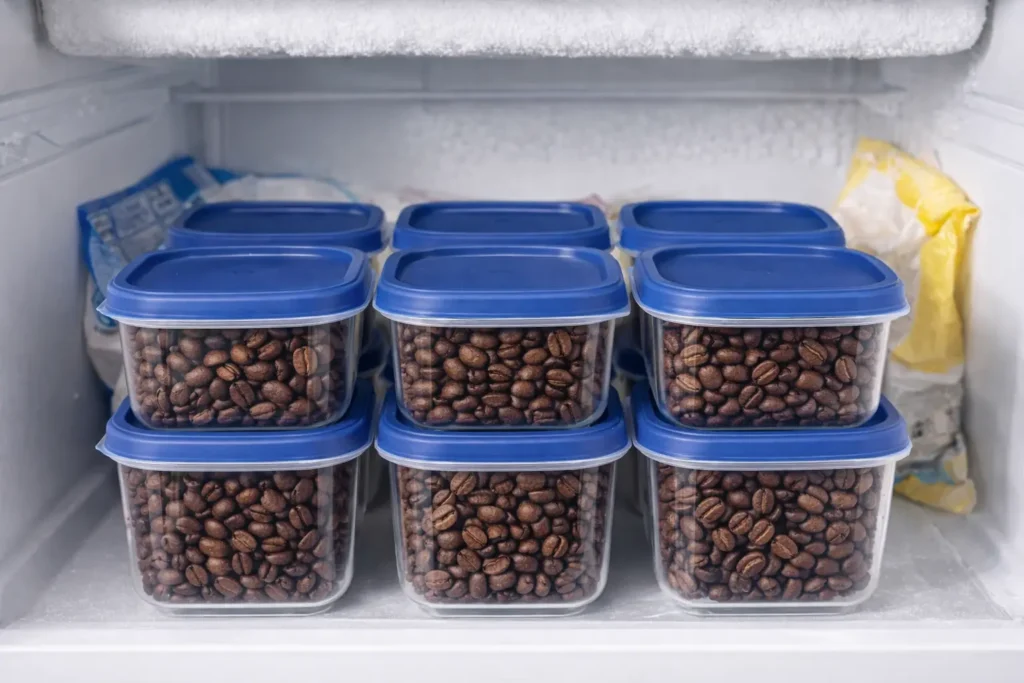
The portion-freeze method is the most effective long-term coffee storage technique available to home brewers — done correctly, beans frozen at peak freshness and thawed individually can taste nearly identical to week-1 quality even 8 weeks later. The method works because the freezer eliminates all four freshness enemies simultaneously: near-zero temperature halts oxidation, moisture condensation is prevented by sealing before freezing, and light and heat are non-factors at freezer temperature. The critical mistake is the one most people make: opening the same frozen container repeatedly. Every time a frozen container opens in a warm kitchen, condensation forms on the beans — moisture directly on the surface. Portioning into small single-use batches before freezing eliminates this entirely.
| Step | What to do | Why |
|---|---|---|
| 1. Portion at purchase | Immediately after buying, divide beans into 3–5 day batches (approximately 60–80g depending on your daily dose). Do this before any degradation begins — not after the bag has been open for a week | You can only portion once before the clock starts — the sooner portions are sealed and frozen, the better the peak flavor they lock in |
| 2. Seal airtight | Place each portion in an 8oz Ball Mason Jar with a two-piece lid sealed tightly, or in a heavy-duty freezer bag with all air pressed out. Remove as much air as possible before sealing | Residual air in the container is what causes freezer burn and oxidation even at low temperature — minimize it before sealing |
| 3. Freeze sealed | Place sealed jars or bags in the freezer. Label each with the roast date and freeze date. Keep frozen portions undisturbed — do not open to check or sample | Frozen beans sealed correctly maintain peak flavor for 3–6 months; opening introduces condensation and defeats the purpose |
| 4. Thaw one portion at a time | When you need the next batch, remove one jar from the freezer and let it sit sealed on the counter for 1–2 hours until it reaches room temperature. Only open the jar after it has fully equalized to ambient temperature | Opening a cold jar introduces warm humid air that condenses directly on the cold beans — letting the jar warm sealed prevents all condensation from forming on the beans themselves |
| 5. Never refreeze | Once a portion is thawed and opened, treat it like a fresh bag — use within 3–5 days at room temperature in an airtight container. Do not return unused beans to the freezer | Each freeze-thaw-refreeze cycle damages bean cell structure and accelerates the condensation risk that degrades flavor |
🔬 Why the freezer works — and the fridge doesn’t: Freezing slows oxidation to near zero by dramatically reducing the kinetic energy available for chemical reactions. The fridge does not get cold enough for this — it slows reactions modestly while creating daily condensation risk as beans cycle in and out to room temperature. A sealed jar in the freezer is a genuinely inactive storage environment. The same jar in the fridge is a slow-motion degradation chamber with a moisture problem.
🔬 Best for Specialty Beans — Active Valve Air Displacement
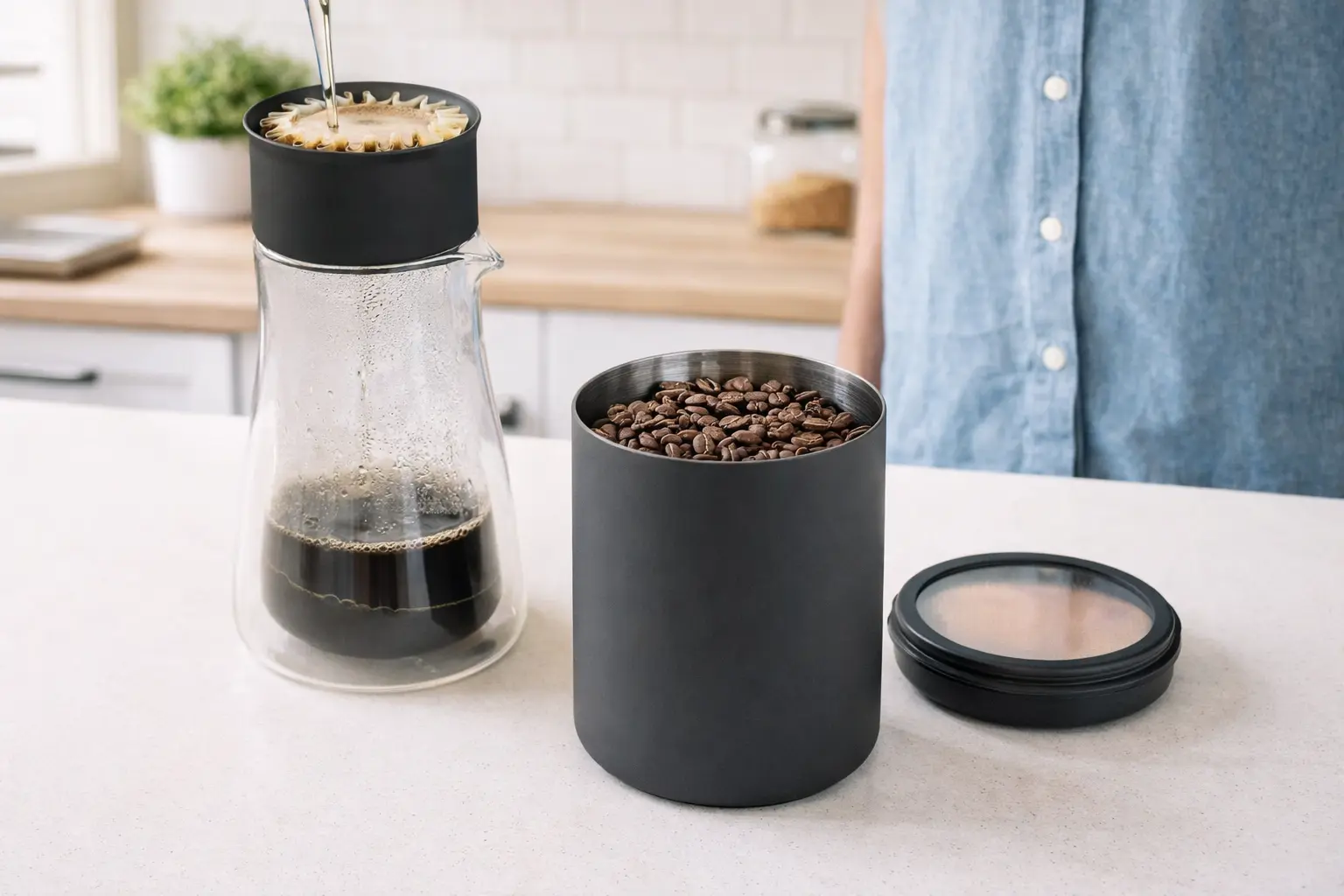
Airscape Coffee Canister — Best for Specialty Beans and Slower Consumption
The Airscape uses a different approach to freshness than the Fellow Atmos: rather than a twist-pump that creates a vacuum in the headspace, it uses a spring-loaded inner lid that physically descends to the level of the beans and pushes air out through a patented two-way valve as you press it down. The result is a container where the inner lid sits directly on top of the beans with essentially no air gap — which is mechanically different from standard vacuum canisters and is what Airscape users credit for the unusually long aroma retention they report. The opaque outer shell (available in stainless or ceramic) blocks light completely. For specialty bean enthusiasts who buy high-quality single-origin coffee and consume it over 3–5 weeks, the Airscape’s active displacement mechanism produces the most noticeable aroma preservation of any room-temperature storage solution in this guide. The lifetime warranty reflects the product’s durable construction.
- Sealing mechanism: Patented spring-loaded inner lid presses down to the bean level, actively displacing air through a two-way valve — different from vacuum pump canisters
- Material: Opaque stainless steel or ceramic — 100% light-blocking in either variant
- Capacity: 500g whole beans (1lb size) — approximately 2–4 week supply depending on daily dose
- Aroma retention: Noticeably preserves aromatic complexity for 2–3x longer than standard airtight containers — most impactful for light roast single origins
- Warranty: Lifetime warranty — built to outlast the coffee it protects
- Best for: Specialty and single-origin enthusiasts; slower drinkers; anyone who wants maximum aroma retention at room temperature
Disclosure: CoffeeGearHub may earn from qualifying purchases.
🧊 Best for Freezing — Ideal Portion Size, Unbeatable Value
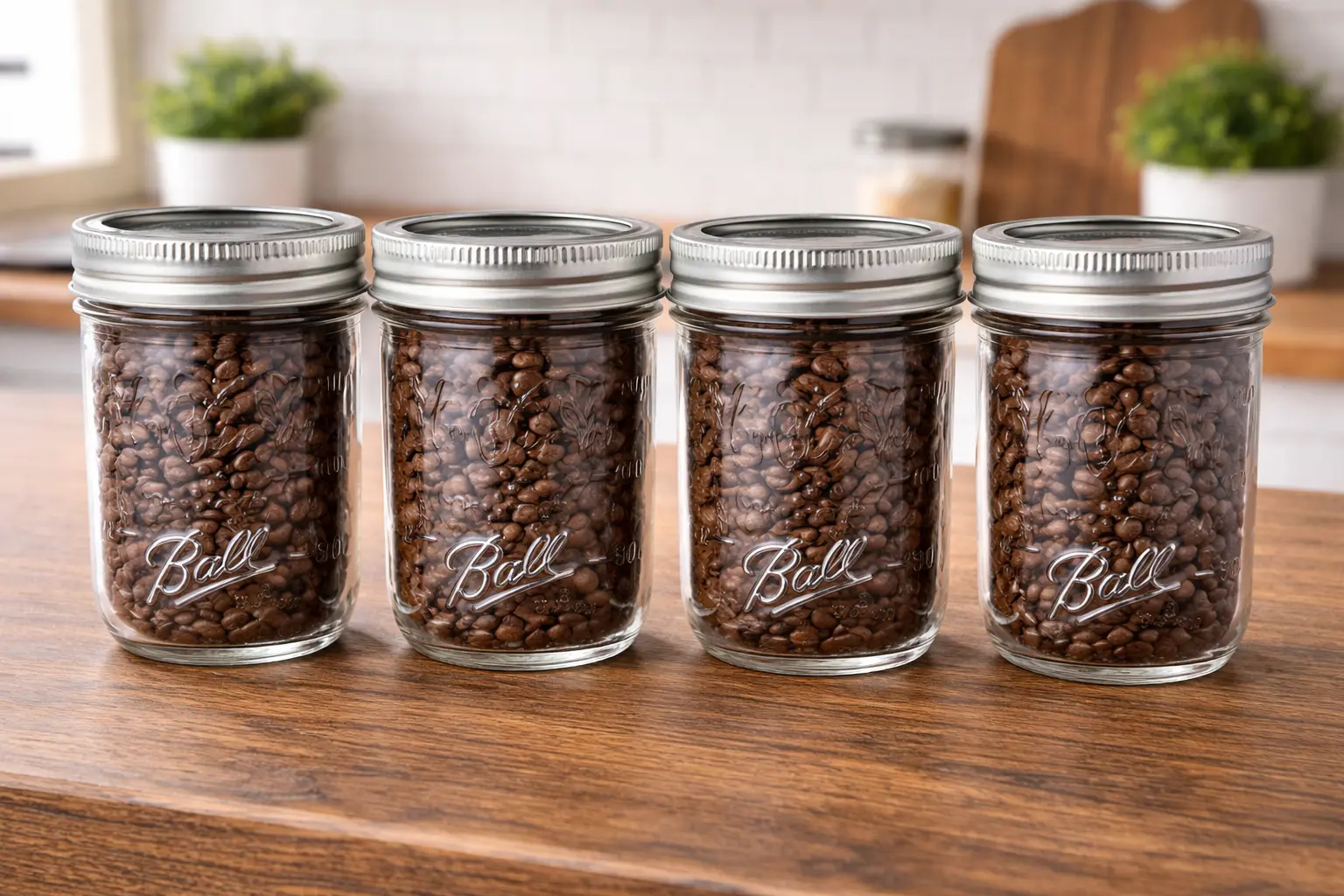
Ball Mason Jars 8oz (4-Pack) — Best for the Portion-Freeze Method
Ball Mason Jars are the CoffeeGearHub recommendation for the portion-freeze method because the 8oz size is the practical ideal for coffee portioning: each jar holds approximately 60–80g of whole beans — a 3–5 day supply for a single-person household brewing 18–22g per session. The two-piece metal lid creates a genuinely airtight seal that survives freezer temperatures without cracking or warping, which is a failure point for many plastic alternatives. The glass itself is freezer-safe and blocks nearly all light, which means frozen portions are protected from every freshness enemy simultaneously. At four jars per pack, one purchase divides a standard 12oz retail bag into a full month’s worth of portions — approximately the best freshness-per-dollar of any storage product in this guide. Use a permanent marker on the lid to track roast date and freeze date per jar.
- Capacity per jar: 8oz / approximately 60–80g whole beans — the ideal 3–5 day portion size for the freeze method
- Sealing: Standard two-piece metal lid — genuinely airtight when properly closed; freezer-safe
- Material: Freezer-safe glass — blocks most light; does not crack or warp at freezer temperature unlike many plastic alternatives
- Value: 4 jars per pack — divides a standard 12oz bag into a full month’s portions; reusable for years
- Labeling: Write roast date and freeze date on the lid with a permanent marker; wipes off with rubbing alcohol for reuse
- Best for: Anyone doing the portion-freeze method; bulk buyers; households that want week-8 coffee to taste like week 1
Disclosure: CoffeeGearHub may earn from qualifying purchases.
Who Should Use Which Storage Method?
| If you… | Use this method | Best product pick | Why |
|---|---|---|---|
| Drink daily and finish a bag in 1–2 weeks | Opaque airtight container in cool cabinet | OXO Good Grips POP | The simplest method is correct for the fastest consumption — vacuum sealing and freezing add effort without proportional benefit at this turnover rate |
| Drink daily and finish a bag in 2–3 weeks | Vacuum canister in cool cabinet | Fellow Atmos Vacuum Canister | Removing residual headspace air after each opening extends peak flavor noticeably over the 2–3 week window |
| Drink slowly — a bag takes 4–6 weeks | Vacuum canister + portion earlier in the bag | Airscape + partial portion into mason jar | For slower drinkers still working from a single bag, the Airscape’s active displacement provides the best room-temperature protection; consider freezing the back half of the bag |
| Buy multiple bags or in bulk quantities | Portion + freeze in sealed batches | Ball Mason Jars (8oz, 4-pack) | The only method that genuinely maintains week-1 quality past week 3 — portion at purchase, freeze sealed, thaw one at a time |
| Brew specialty or single-origin beans and chase peak aroma | Vacuum canister for current bag + freeze future bags | Airscape for daily canister; Ball Mason Jars for freezer | Specialty beans degrade most noticeably in the aroma complexity that makes them worth their price — maximum protection at both storage stages is justified |
| Want the lowest-effort option with the highest improvement over doing nothing | Any opaque airtight container in a dark cabinet | OXO Good Grips POP | Moving from a clear jar on the counter or a loose bag to any properly sealed opaque container is the single highest-impact storage change available — and the OXO delivers that at the lowest cost |
Troubleshooting Matrix: Coffee Storage Problems → Causes → Fixes
If your coffee tastes off despite fresh beans, use this matrix to identify whether the cause is genuinely storage-related — or whether it’s an extraction problem that no canister can solve. Start with the symptom and work through the fix column before changing anything else.
| Symptom | Most likely cause | Fix — in order |
|---|---|---|
| Coffee tastes flat or dull despite “fresh” beans | Light or heat exposure from a clear jar on the counter or warm storage location — oxidation has already degraded aromatics | Move to an opaque airtight container in a cool, dark cabinet immediately → discard any beans that smell like cardboard or have no detectable aroma → confirm beans are genuinely fresh (check roast date — “fresh” means within 4 weeks of roast, not purchase) |
| Coffee tastes different day to day with the same beans | Container not fully airtight; or opening the container multiple times per session introduces variable amounts of fresh air each time | Check that your container seals completely — press the lid firmly and try to pull air through the seal → switch to a container with a mechanical seal (OXO POP, Fellow Atmos) rather than a friction or clip closure → open the container once per brew session, not multiple times |
| Frozen beans taste flat or watery after thawing | Condensation formed on beans during thawing because the container was opened before it reached room temperature | Always let the sealed frozen jar reach room temperature before opening — 1–2 hours on the counter, still sealed → if condensation is visible inside the jar, the jar was opened too early; use a paper towel to gently absorb any surface moisture before grinding → never open a cold jar in a warm kitchen |
| Coffee beans developing oily, rancid surface quickly | Heat damage accelerating oil migration and oxidation — common in containers stored near heat-generating appliances | Move storage away from all appliances — especially the top of the refrigerator (compressor heat), above the dishwasher (exhaust hot air), and any countertop near the oven → surface oil on dark roasts is normal; surface oil with a rancid smell is heat damage |
| Pre-ground coffee tastes stale within a few days | Pre-ground coffee’s vastly increased surface area stales 10–20x faster than whole beans — no container fully compensates for this | This is a fundamental limitation of pre-ground coffee, not a container problem → switch to whole beans and a burr grinder; grind immediately before each brew → if whole-bean grinding is not possible, buy only the amount you can use within 3–5 days and store in an airtight container |
| Coffee tastes like other foods (musty or savory notes) | Beans absorbing refrigerator odors and moisture — the fridge is not a suitable daily storage environment for coffee | Never use the refrigerator for daily coffee storage → transfer to an opaque airtight container in a cool kitchen cabinet → if the flavor contamination is severe, the batch may be unrecoverable; discard and start with a fresh bag stored correctly |
| Good beans, correct storage, but coffee still tastes bad | Extraction problem — grind size too coarse (flat, weak, sour) or too fine (bitter, harsh, drying); or ratio wrong; or grinder has old oil residue on burrs | Storage is not the problem → fix grind size using the Coffee Grind Sizes guide → confirm ratio is correct for your carafe size → clean grinder burrs (old coffee oils produce a rancid undertone that mimics stale beans) → test with a different batch of beans to rule out a bean-specific problem |
| Original bag coffee tastes great; canister coffee tastes worse | Canister not fully clean before use; or beans transferred too long after opening the original bag; or canister material absorbing previous bean flavors | Wash and fully dry the canister before first use — any residue from packaging, previous beans, or dishwasher detergent affects flavor → transfer beans immediately after purchase, not after they’ve been sitting in the bag for a week → glass and stainless canisters have no flavor absorption; plastic canisters can retain flavors over many cycles |
| Coffee tastes sour or sharp — thought it was fresh | Under-extraction — not a storage problem even if it feels like staleness | Sour coffee with genuinely fresh beans is grind too coarse, ratio too loose, or machine brewing at too low a temperature → adjust grind finer first → if still sour, increase dose slightly → storage does not cause sour coffee; under-extraction does |
🔧 Still getting bad cups despite fresh beans and good storage? The equipment maintenance guide covers grinder cleaning, brewer descaling, and every maintenance variable that affects flavor.
FAQs: How to Store Coffee Beans
What is the best way to store coffee beans at home?
For most daily drinkers, the best method is an opaque airtight container stored in a cool, dark cabinet — away from heat sources like the oven, dishwasher top, and direct sunlight. Buy bags you can finish within 2–3 weeks. If you buy in bulk, portion beans into 3–5 day batches in sealed mason jars and freeze the portions you won’t use immediately. Thaw one batch at a time, sealed, at room temperature before opening.
Should I store coffee beans in the fridge?
No. The refrigerator introduces two problems: moisture condensation when beans cycle between cold and room temperature each time you open the container, and odor absorption from other foods. Neither of these happens in the freezer with properly sealed portions — which is why freezing in airtight mini-batches is the correct long-term storage method, not refrigerating.
Is it okay to freeze coffee beans?
Yes — if done correctly. Portion beans into 3–5 day batches in airtight sealed containers before freezing. Thaw one portion at a time, and let the sealed container reach room temperature before opening it (this prevents condensation from forming on the beans). Never refreeze a thawed portion. Done this way, frozen beans from week 8 can taste nearly identical to week 1.
How long do coffee beans stay fresh after opening?
Whole beans in an opaque airtight container taste best within 2–3 weeks of opening. Pre-ground coffee degrades significantly faster — within 3–5 days of grinding at room temperature. If it takes you more than 3 weeks to finish a bag of whole beans, portion and freeze the remainder at the time of purchase to maintain peak flavor.
Does an expensive vacuum canister actually make a difference?
For daily drinkers finishing beans within 2 weeks, the difference is minor — a basic opaque airtight container is adequate. For slower drinkers or specialty bean enthusiasts, a vacuum canister like the Fellow Atmos or Airscape meaningfully extends peak aroma by removing residual oxygen after each opening. The biggest gains come from switching from a clear jar on the counter to any opaque airtight container — not from the vacuum feature specifically.
Should I keep coffee beans in the original bag or transfer to a container?
If the original bag has a resealable one-way valve and you finish it within 1–2 weeks, keeping it in the bag is fine. The one-way degassing valve allows CO2 to escape while blocking oxygen. For bags without a proper reseal, or if you drink slowly, transfer to an opaque airtight container. Beyond 2 weeks, a dedicated canister outperforms any original bag.
Why does my coffee taste stale even with fresh beans?
Stale-tasting coffee despite fresh beans is usually a brewing problem, not a storage problem. The most common causes are: grinder residue producing a rancid undertone, grind size too coarse producing a flat, hollow cup, or ratio too low producing a dilute result. Fix grind size and ratio before concluding the beans are the problem.
What matters more — storage or brewing technique?
Brewing technique matters more for day-to-day flavor. Storage protects the ceiling of what’s possible — good storage preserves good beans. But if extraction is wrong (bad grind, wrong ratio, wrong temperature), no storage method compensates. Fix grind and ratio first, then optimize storage to make sure you’re brewing beans at their best.
How much faster does pre-ground coffee go stale compared to whole beans?
Dramatically faster. Grinding increases surface area by roughly 10,000 times, which means every freshness enemy — oxygen, light, heat, moisture — attacks far more surface simultaneously. Whole beans stored correctly retain peak flavor for 2–4 weeks. Pre-ground coffee at room temperature begins noticeably degrading within 15–30 minutes of grinding and is meaningfully stale within 3–5 days. For the best results, grind immediately before brewing using a quality burr grinder.
Does the one-way valve on a fresh coffee bag count as proper storage?
For the first 1–2 weeks after purchase, yes — a resealable bag with a functional one-way degassing valve is adequate storage. The valve allows CO2 from fresh-roasted beans to escape while blocking oxygen from entering. Beyond 2 weeks, repeated opening and closing reduces the seal’s effectiveness. Transfer to a dedicated opaque airtight container if it takes you more than 2 weeks to finish the bag.
CoffeeGearHub product shortlist
Compare coffee and storage gear on CoffeeGearHub
Use CoffeeGearHub’s catalog to compare current coffee products and accessories before opening a merchant offer.
Continue Learning
Beans and freshness
Choose coffee for your brewer
In this guide
- The 30-Second Answer
- Quick-Pick: Storage Methods and Product Comparison
- Why Coffee Beans Go Stale — The Four Enemies
- Beginner vs Advanced: Which Storage Method Do You Actually Need?
- Beginner Coffee Storage: The Three Rules
- Product Picks: Full Reviews
- Advanced Storage: The Portion-Freeze Method
- Who Should Use Which Storage Method?
- Troubleshooting Matrix: Coffee Storage Problems → Causes → Fixes
- FAQs: How to Store Coffee Beans
- Continue Learning