
Best Coffee Grinders by Brew Method
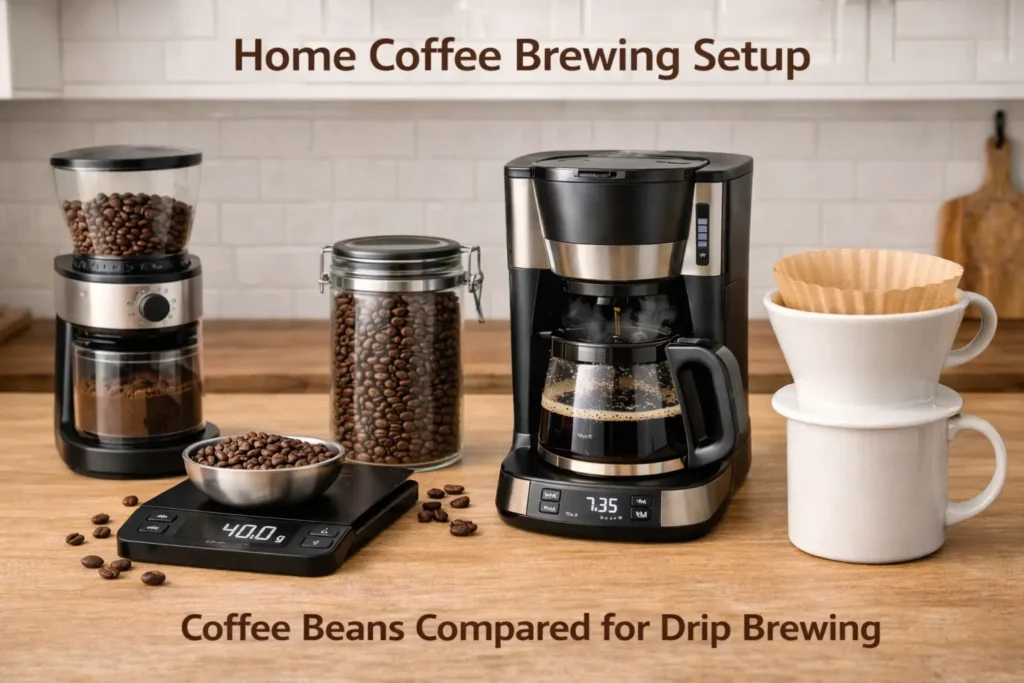
Editorial standards: product recommendations are based on manufacturer specifications, published documentation, brewing workflow, maintenance, and product limitations. CoffeeGearHub does not claim hands-on testing where it has not occurred.
At a glance
What this buying guide covers
Match electric and manual burr grinders to drip, pour-over, French press, AeroPress, moka pot, and mixed home setups, with the emphasis on brew-method fit, adjustment range, workflow, and daily volume.
Editorial analysis
Match the grinder to the brew method before the brand
A grinder that is excellent for French press or batch drip may be frustrating for espresso, while an espresso-first grinder can be unnecessary for a filter-only setup. Start with the brew methods you use most, then compare adjustment range, daily volume, retention, noise, and whether manual grinding fits your routine.
The 30-Second Answer
Choose by brew range first. The Baratza Encore ESP is the flexible electric reference when one grinder needs to cover filter coffee plus entry-level espresso; the KINGrinder K6 is the manual multi-method value reference. For serious daily espresso, use an espresso-first grinder with finer adjustment rather than forcing a general filter grinder into that role.
Compare current options
Start with these representative choices
These two grinders show the first decision for a mixed home setup: flexible electric coverage versus high-value manual control.
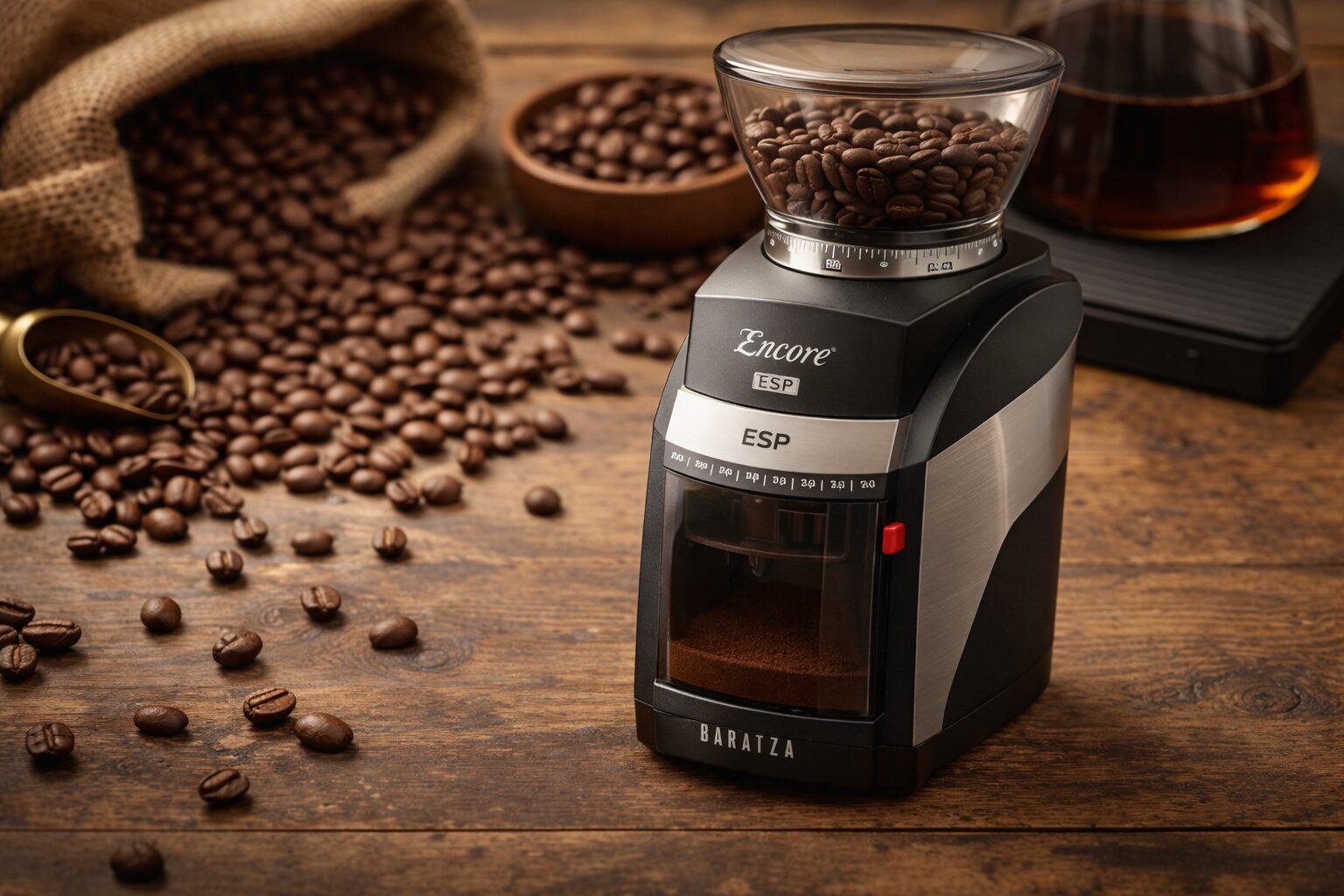
Multi-Method Electric — Baratza Encore ESP
The Encore ESP covers a higher-resolution espresso range plus a separate filter range, making it the practical electric reference for mixed home brewing.
Start here if: you want one electric grinder for espresso plus filter coffee.
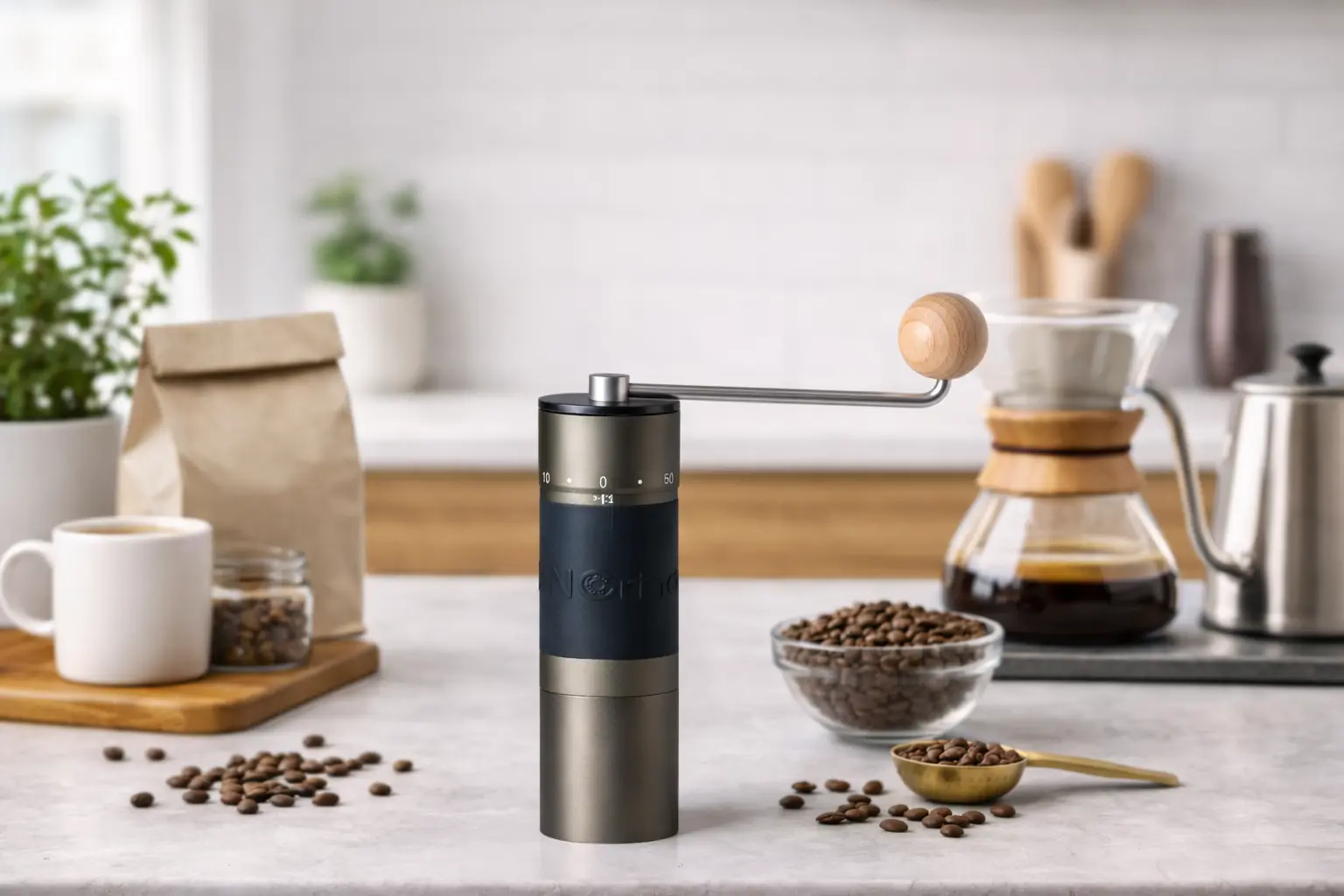
Manual Multi-Method Value — KINGrinder K6
The K6 offers external adjustment and fine control across a broad brew range without requiring counter space or electricity.
Start here if: grind quality per dollar, portability, and manual control matter most.
Affiliate disclosure: Amazon links may earn CoffeeGearHub a commission at no additional cost to you. Prices and availability can change.
Why Your Grinder Matters More Than Your Coffee Maker
Most home coffee buyers make the same mistake: they invest in a better coffee maker — a nicer drip machine, a pour-over set, an AeroPress — while continuing to use pre-ground coffee or a blade grinder. The result is always the same: marginal improvement at best, and persistent frustration at worst. The coffee maker is not the primary variable in home brew quality. The grinder is.
The reason is extraction physics. Every cup of coffee is the result of water dissolving soluble compounds from ground coffee particles — acids, sugars, oils, and bitter compounds — at different rates depending on particle size. Smaller particles have more surface area and extract faster; larger particles have less surface area and extract more slowly. When your grinder produces a consistent particle size, all the grounds extract at the same rate, and you can tune your brew time, temperature, and ratio to hit the sweet spot where the desirable compounds are fully extracted and the undesirable ones are not. When your grinder produces a random mix of fine powder and large chunks — which is what every blade grinder does — some particles over-extract (bitter, harsh) and others under-extract (sour, weak) in the same cup, simultaneously, with no adjustment capable of fixing both at once. This is why the grinder is the foundation of any home brewing setup. For a full overview of how brewing variables interact, see our Coffee Brew Ratio Guide.
🔬 The freshness factor: Whole beans begin losing aromatic volatiles — the compounds responsible for the complex, differentiated flavours that make specialty coffee worth buying — as soon as they are ground. Pre-ground coffee has already lost most of these volatiles before it reaches you. Grinding immediately before brewing preserves the full aromatic profile of the bean. Even a modest burr grinder grinding fresh beans just before brewing will outperform pre-ground coffee in any quality home press, dripper, or machine — regardless of the price gap between the two bean options.
Burr vs Blade: What the Difference Actually Means for Your Cup
The single most important decision in home grinder selection is not brand, not price, and not electric vs manual. It is burr vs blade. These two types of grinders operate on fundamentally different mechanical principles and produce fundamentally different results in the cup.
| Burr Grinder | Blade Grinder | |
|---|---|---|
| How it works | Crushes beans between two abrasive surfaces set at a precise distance — particle size is determined by the gap between burrs | Spins a blade that chops beans randomly — particle size is determined by how long you run it |
| Particle consistency | Highly consistent — all particles exit at approximately the same size for a given setting | Highly inconsistent — produces fine powder and large chunks in every grind |
| Cup result | Even extraction — balanced acidity, sweetness, and body; diallable and repeatable | Mixed extraction — simultaneously bitter (fines over-extract) and sour (chunks under-extract) in the same cup |
| Adjustability | Yes — change burr gap to change grind size for any home brew method | No — only variable is run time, which does not fix consistency |
| Repeatability | High — same setting produces same result every session | None — no two grinds are identical |
| Relative cost | Ranges from entry manual models to premium electric grinders | Usually low-cost, but with major consistency trade-offs |
| Verdict | ✓ The only option for quality home brewing | ✗ Produces unresolvable extraction problems regardless of other variables |
⚠️ The blade grinder problem: No technique adjustment, no water temperature change, no ratio tweak can fix the extraction problem created by inconsistent grind particle size. If you are currently using a blade grinder and your home coffee tastes simultaneously harsh and weak, that is a grinder problem with one solution: replace it with a burr grinder. A true entry-level burr grinder will generally produce more repeatable particle size than a blade grinder, making dial-in adjustments far more useful.
What Makes a Great Home Coffee Grinder: 5 Variables That Actually Matter
The home grinder market is crowded with options at every price point. Most will produce a usable grind. What separates genuinely excellent home grinders from the rest is a combination of five factors — none of which are about aesthetics, display screens, or grind speed.
| Factor | Why it matters | What to look for | What to avoid |
|---|---|---|---|
| Burr size | Larger burrs produce more consistent output, generate less heat, and wear more slowly — heat during grinding degrades flavour | 38mm+ for manual grinders; 40mm+ for electric grinders at entry home-use prices | Grinders with burr size not disclosed — usually a sign of very small, low-quality burrs |
| Grind adjustment range | More adjustment steps means more precise dial-in and more control over extraction across home brew methods | 40+ settings for electric; 30+ clicks for manual; stepless adjustment ideal but uncommon at entry prices | Fewer than 15 settings; large jumps between settings that make it impossible to land between two adjacent positions |
| Fines production | Fines cause over-extraction, bitterness, and filter stalling in pour-over — lower fines production means a cleaner home cup | Conical burr designs generally produce fewer fines at equivalent price; check community reviews for fines assessment | Grinders without user reviews specifically mentioning grind consistency |
| Build quality | A grinder used daily in a home kitchen needs a motor and burr carrier that handles repetitive stress | Metal burr carrier; rigid housing; replaceable burrs available from the manufacturer | All-plastic burr carrier; no replacement parts available — grinder is disposable when burrs dull |
| Grounds retention | Coffee retained in the grinding path stales between sessions and contaminates fresh grinds with stale grounds | Low-retention designs; grounds bins that fully empty after each dose | Large hoppers holding multiple sessions of beans — beans in a hopper stale faster than in an airtight bag |
Flat Burr vs Conical Burr: Which Is Right for Home Brewing
Within the burr grinder category, there are two distinct burr geometries: flat and conical. Both produce excellent home coffee. The differences matter more at intermediate and advanced levels than at the entry home-use stage — but understanding them explains why certain grinders are recommended at certain price points.
| Conical Burr | Flat Burr | |
|---|---|---|
| Geometry | Cone-shaped inner burr inside a ring-shaped outer burr; coffee travels downward through the grinding gap | Two parallel rings with abrasive faces; coffee is ground in the gap between the flat faces |
| Particle distribution | Bimodal — a primary peak at target size plus a secondary fines peak; fines add body and texture to the home cup | More unimodal — tighter distribution around the target size; produces a cleaner, brighter cup |
| Heat generation | Lower — conical geometry is self-clearing; less friction during home use grinding | Higher — flat burrs require more friction; matters most for large doses |
| Noise | Quieter — typical of most home electric grinders; better for shared living situations | Louder — common in commercial and prosumer equipment |
| Best for | Drip, French press, pour-over, AeroPress — the full range of home non-espresso brewing | Espresso and high-precision pour-over where particle uniformity is prioritised |
| Relative cost | Often the better-value route, especially for manual and general-purpose conical grinders | Typically a step-up purchase when filter clarity or a specialized workflow matters |
| Verdict for home brewing | ✓ Correct choice — conical burr grinders dominate the home market for good reason | ⚠ Not necessary at home entry level; revisit when brewing espresso or advanced pour-over |
Choose a Grinder by Brew Method and Workflow
Use this table to match a grinder type to your home routine before reviewing individual product picks. The right choice depends on how you brew, how many cups you make per session, and whether counter space and noise are constraints in your kitchen.
| Best For | Recommended Style | Why It Works | Trade-Off | Budget Range |
|---|---|---|---|---|
| Home drip or pour-over daily use | Entry electric burr (Baratza Encore) | Consistent, easy to use, covers all non-espresso home brew methods from one unit | Higher upfront cost than blade; takes counter space | mid-range |
| Budget home brewer | Budget electric burr (OXO Brew) | Reliable improvement over blade at an accessible price; good for home drip and French press | Fewer settings; less precise for advanced pour-over | lower-cost |
| Manual / small kitchen / travel | Manual burr grinder (KINGrinder K6) | Exceptional grind quality for price; no counter space required; quiet; works without electricity | Requires physical effort; slower for doses above 25g | lower-to-mid range |
| Serious home pour-over brewer | Mid-range electric burr (Baratza Virtuoso+) | 40mm M2 conical burrs plus 0.1-second timer dosing for repeatable filter-coffee workflow | Higher price; still not suitable for espresso | step-up |
| Home office or shared kitchen | Electric burr with hopper (Baratza Encore) | Hopper holds enough for multiple users; easy interface anyone in the household can operate | Beans in hopper stale faster — empty daily if possible | mid-range |
Go deeper by brew method
Use the dedicated grinder guide for your main brew method
This hub helps with the overall grinder decision. If one brewing method drives most of your coffee routine, use the dedicated guide for tighter product fit, grind-range guidance, and method-specific trade-offs.
Espresso
Fine adjustment resolution and repeatability matter most.
Pour-Over
Prioritize uniformity, low fines, and filter-coffee clarity.
Moka Pot
Look for repeatable medium-fine adjustment without excessive fines.
AeroPress
A wide usable range is valuable because recipes vary from fine to coarse.
French Press
Coarse consistency and fewer fines help reduce sediment and muddiness.
Drip Coffee
Repeatable medium settings and convenient daily dosing matter most.
Coffee Grinders by Brew Method: Recommended Starting Points
These picks represent useful starting points for different home-brewing workflows. The goal is not to name one universal winner, but to match grind range, adjustment precision, convenience, and serviceability to the brew methods you actually use. All product links use the CoffeeGearHub Amazon Associates tag. Grind settings reference the KINGrinder K6 from zero (burrs touching).
Best Multi-Method Electric: Baratza Encore ESP
The Baratza Encore ESP is the stronger fit when one electric grinder needs to cover both filter coffee and entry-level espresso. Baratza uses a dual-range adjustment system: settings 1–20 provide higher-resolution espresso adjustment, while 21–40 cover filter coffee, French press, and cold brew. It uses 40mm M2 conical steel burrs and retains Baratza’s repairable, parts-supported platform.
- Burr: 40mm M2 conical steel
- Adjustment: 40 settings; 1–20 high-resolution espresso range, 21–40 filter range
- Best for: households that want one electric grinder for filter coffee plus starter espresso
- Trade-off: dedicated espresso users may still prefer a grinder with even finer or stepless adjustment
Best Budget Electric: OXO Brew Conical Burr Coffee Grinder
The OXO Brew Conical Burr Grinder is the most practical budget electric recommendation for home brewers who want to step up from a blade grinder at a lower entry cost than step-up electric models. The 15-setting adjustment range is more limited than the Baratza Encore but covers the core home brewing range adequately — drip, French press, and basic pour-over are all accessible. The one-touch timer allows dosing by time rather than weighing, which simplifies the morning home routine for new grinder users. The conical stainless burrs produce consistent output that is a clear and immediate improvement over any blade grinder. It is not the grinder you will keep forever — the settings range will feel limiting once you start dialling in V60 or Chemex — but as a first step into home burr grinding, it is reliable and honestly priced.
- Burr type: Conical stainless steel burrs
- Grind settings: 15 settings — adequate for home drip, French press, and basic pour-over
- Dose control: One-touch timer dosing — accessible for home use
- Brew method coverage: Drip (setting 7–9), pour-over (5–7), French press (11–14)
- Best for: budget-conscious home brewers; first step up from blade grinder; home drip and French press daily use
Disclosure: CoffeeGearHub may earn from qualifying purchases.
Best Manual: KINGrinder K6
The KINGrinder K6 is the CoffeeGearHub standard manual grinder recommendation across all home brewing content — and for home brewers choosing between manual and electric, it deserves serious consideration over budget electric options. The heptagonal stainless-steel burrs are large for the price class, producing noticeably lower fines than the smaller 38mm burrs common in competing manual grinders at similar price points. The fine-step adjustment system is the K6’s defining feature for home use: 5-click increments at any brew method setting produce a clear, readable extraction shift that makes dial-in methodical rather than random. The full range covers every home brew method from a single unit, and the click settings carry across every CoffeeGearHub brewing guide so you never need to estimate your starting point when switching methods.
- Burr type: heptagonal stainless-steel burrs — large for the price class; low fines production
- Grind settings: external adjustment system with 60 clicks per rotation — the most precise home grinder adjustment available at this price point
- Brew method coverage: All non-espresso home brew methods — see full click reference table below
- Practical dose: 15–25g per session — ideal for 1–2 home cups; 30g+ requires 2–3 minutes of grinding
- Best for: small home kitchens, travel, anyone prioritising grind quality per dollar spent
Disclosure: CoffeeGearHub may earn from qualifying purchases.
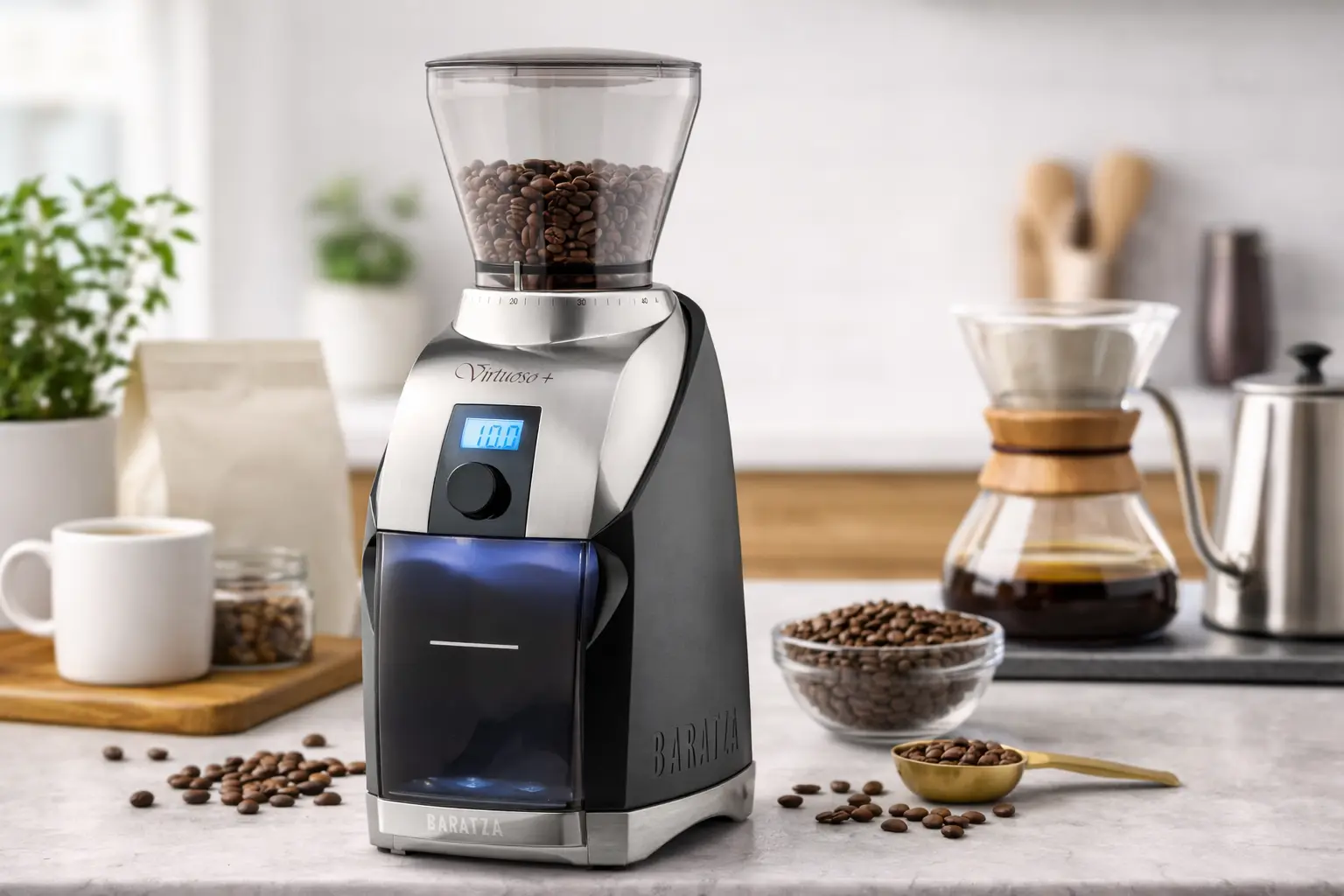
Best Step-Up Upgrade: Baratza Virtuoso+
The Baratza Virtuoso+ is the natural upgrade from the Encore for home brewers who have outgrown the Encore’s precision on advanced pour-over or who want a meaningfully lower fines output in their home V60 or Chemex. The 54-setting range, DC motor, and 40mm high-carbon steel burrs produce a noticeably cleaner particle distribution than the standard Encore — the difference is most audible in pour-over clarity and filter draw-down speed at home. The built-in digital timer allows precise dose-by-time grinding with one-second resolution. This is not a necessary purchase for most home brewers — the Encore handles everything the Virtuoso+ does with slightly less precision. It is the right buy for home brewers who have been using the Encore for 12–18 months and are hitting the limit of its pour-over precision on lighter specialty roasts.
- Burr type: 40mm high-carbon steel conical burrs — cleaner output than standard Encore burrs
- Grind settings: 54 settings — more resolution than Encore at medium-fine home pour-over range
- Motor: DC motor — quieter and more consistent than Encore’s AC motor; better for shared home use
- Timer: Digital dose-by-time — repeatable home dosing without a scale mid-grind
- Best for: Encore graduates; serious home V60 and Chemex brewers; anyone brewing 2+ cups daily long-term
Disclosure: CoffeeGearHub may earn from qualifying purchases.
Manual vs Electric Coffee Grinder: Full Comparison for Home Brewing
For many home brewers the manual vs electric choice is the most practically consequential decision after burr vs blade — it determines counter space, morning routine, noise, and cost. Neither type is universally better for home use. Each solves a different set of problems.
| Manual Burr Grinder (K6) | Electric Burr Grinder (Baratza Encore) | |
|---|---|---|
| Grind quality per dollar | Often strong — a manual grinder concentrates more of the product cost on the burr set and adjustment system rather than a motor | Good — Encore’s 40mm burrs are excellent at the price for home brewing |
| Speed per dose | Slow — 20g takes 60–90 seconds of active grinding | Fast and hands-off compared with manual grinding; better suited to busy home mornings |
| Convenience for home use | Low — requires active physical effort per dose; fine for 1–2 home cups, tedious for 4+ | High — press a button; grind completes while you do something else |
| Counter space | None — stores in a home drawer or cabinet between uses | Permanent footprint — approximately 15cm × 15cm base |
| Noise | Very quiet — minimal noise; apartment and early-morning household friendly | Moderate — most home electric burr grinders run 70–80dB |
| Portability | Excellent — fits in a bag; works anywhere; no power required; great for travel from home | None — requires outlet; not practical beyond the home kitchen |
| Dose range | 1–30g practical for home use; above 30g requires multiple grinding sessions | 10–60g per home session; no practical upper limit |
| Best home use scenario | Small kitchens, 1–2 cup daily home brewing, anyone prioritising grind quality per dollar spent | Households brewing 3+ cups daily, multiple home brewers, convenience-first households |
Grind Size Guide: What Each Home Brew Method Requires
Every home brew method requires a different grind size because every method extracts coffee at a different rate. The grind size determines surface area — fine grinds have more surface area and extract faster; coarse grinds have less surface area and extract more slowly. Match the grind size to the brew method’s contact time so extraction finishes at the correct point. Too fine for the home method produces over-extraction: bitter, harsh. Too coarse produces under-extraction: sour, thin, watery.
| Brew method | Grind size | Visual reference | K6 starting clicks | Too fine result | Too coarse result |
|---|---|---|---|---|---|
| Espresso | Extra-fine | Smooth powder — finer than table salt | Use the manufacturer’s espresso range; dial in by shot flow and taste | Choked shot, no flow, burnt taste | Watery, sour, fast shot |
| AeroPress (standard) | Medium-fine to medium | Fine sand — slightly coarser than table salt | 18–26 clicks | Bitter, slow press, clogged filter | Watery, sour, hollow body |
| V60 / Pour-over | Medium-fine | Coarse sand — like beach sand | 26–34 clicks | Stalling draw-down, bitter | Fast draw-down, sour, thin |
| Chemex | Medium to medium-coarse | Slightly coarser than V60 — Chemex paper is thicker | 32–40 clicks | Very slow draw-down, bitter, heavy | Fast, sour, pale cup |
| Home drip / filter machine | Medium | Coarse sand — texture of granulated sugar | a medium-range starting point; adjust by flow and taste | Slow flow, bitter, over-extracted | Fast flow, weak, watery |
| French press | Coarse | Coarse sea salt or rough breadcrumbs | 68–78 clicks | Hard to press, bitter, muddy | Weak, thin, flat body |
| Cold brew | Extra-coarse | Very rough — almost pebble-like | 80–92 clicks | Over-extracted, bitter concentrate | Under-extracted, sour, flat |
Extraction Science: Why Grind Consistency Changes Everything in the Home Cup
Understanding the mechanism behind grind consistency is not academic — it directly tells you what to adjust and why when your home coffee is off, and it explains why certain grinder investments are worth making. Three principles cover everything a home brewer needs to know.
- Particle size determines extraction rate, and extraction rate determines flavour balance in the home cup. Coffee’s soluble compounds extract in a predictable order: acids and light fruity notes extract first, sweetness and body compounds extract in the middle phase, and bitter phenolics extract last. The goal of any home brew method is to stop extraction after the desirable compounds are dissolved but before the undesirable ones dominate. A consistent grind lets all particles hit this window at the same time. An inconsistent grind — produced by any blade grinder — means fine particles blast past the window (over-extracted, bitter) while large particles never reach it (under-extracted, sour) simultaneously. No adjustment to any other home brewing variable can fix this because you are fighting two opposite extraction problems at once.
- Fines are the hidden variable in home grind quality. All burr grinders produce some ultra-fine particles as a by-product of grinding. The quantity varies significantly between grinder designs: cheap burrs produce more fines; large, quality burrs produce fewer. Fines extract almost instantly, contributing bitterness and muddiness to the home cup before the main particles have reached their optimal extraction point. This is why the KINGrinder K6’s heptagonal stainless-steel burrs produce a noticeably cleaner home cup than lower-priced manual grinders with 38mm burrs — and why home grinder burr size matters more than most buyers realise.
- Freshness and grind are inseparable in home brewing. Ground coffee begins losing aromatic volatile compounds within minutes of grinding. Pre-ground coffee sold in bags has been oxidising since it was ground at the roastery — typically days to weeks before it reaches your home. Grinding immediately before brewing preserves the full aromatic profile of the bean, and a quality burr grinder is what makes this practical for daily home use. This is not a snob preference: it is the most efficient per-cup quality improvement available at any home brewing budget.
🔬 Why weigh your home dose: Grind setting alone does not fully control extraction — dose weight matters equally. A 1g variance in dose at a 1:15 ratio changes effective brew strength by approximately 6%. Always weigh your coffee in grams rather than scooping by volume. Roast level affects bean density significantly — a scoop of light roast weighs 15–20% more than the same volume of dark roast, meaning scoop-based home recipes produce dramatically different brews depending on the bean. A basic digital coffee scale paired with a quality burr grinder makes dose and water ratio repeatable, which is more useful than relying on scoops.
KINGrinder K6 Adjustment Reference
The K6 uses external adjustment with 60 clicks per full rotation and 16 μm steps per click. KINGrinder’s published guidance places pour-over around 90–100 clicks from zero. Treat manufacturer ranges as starting points rather than universal recipes: brewer geometry, roast, dose, water, and taste all change the final setting.
For espresso, AeroPress, French press, drip, and cold brew, use the manufacturer’s current range as the baseline and then adjust by flow and taste. CoffeeGearHub no longer publishes one fixed K6 click number for every brew method because that can create false precision across different recipes and coffees.
Dial-In Guide: How to Adjust Grind Size for Home Brewing
Dial-in is the process of finding the correct grind setting for a specific bean, brew method, and home recipe. Most home brewers try to fix everything at once — they change the grind, the dose, the temperature, and the brew time in the same session and end up with no useful information about what actually changed. The correct approach is methodical: one variable per brew, always starting with grind.
The Dial-In Rule
- Start at the recommended K6 click for your home method and roast from the table above
- Brew using the standard recipe parameters for your method
- Taste the cup and identify the primary off-note: sour/thin or bitter/harsh
- Adjust grind only: 3–5 clicks finer if sour; 3–5 clicks coarser if bitter
- Re-brew at new setting — everything else identical
- Repeat until the home cup is balanced — no primary sour or bitter note
- Only then adjust dose (strength) or temperature (body/brightness)
Taste → Adjustment Order
- Sour / sharp / thin body: grind 3–5 clicks finer → re-brew
- Bitter / harsh / dry finish: grind 3–5 clicks coarser → re-brew
- Grind adjusted but still sour: raise water temp 2°C + extend brew time 15s
- Grind adjusted but still bitter: lower water temp 2°C + shorten brew time 15s
- Balanced but too weak: increase dose 2–3g; keep water volume the same
- Balanced but too strong: reduce dose 2–3g; keep water volume the same
- Flat / no aroma at any grind: buy fresh beans — stale coffee cannot be fixed by grind adjustment
Troubleshooting Matrix: Home Brewing Grinder Symptoms → Causes → Fixes
Identify your symptom below. Most home brewing problems trace back to grind size or bean freshness — not equipment quality. Confirm the cause before changing your grinder or recipe.
| Symptom | Most likely cause | Fix (in order) |
|---|---|---|
| Home coffee tastes bitter regardless of brew time | Grind too fine for method; or dark roast ground at medium-roast setting | Grind 4–5 clicks coarser → lower water temp 2°C → for dark roasts target 88–92°C not 93–94°C |
| Home coffee tastes sour and thin | Grind too coarse; or light roast brewed at too-low temperature | Grind 3–5 clicks finer → raise water temp 2°C → for light roasts target 94–96°C |
| Bitter AND sour in the same home cup | Blade grinder — simultaneous over-extraction (fines) and under-extraction (large chunks) | Replace blade grinder with any burr grinder — this home brewing problem cannot be fixed any other way |
| Home V60 or Chemex draw-down stalls mid-brew | Grind too fine; fines clogging the paper filter; or aggressive pouring during bloom | Grind 3 clicks coarser → pour bloom more gently → ensure filter is seated flat with no folds |
| Home French press is muddy and hard to press | Grind too fine for immersion method | Grind 5+ clicks coarser → press more slowly over 30 seconds → do not force the plunger |
| Flat home cup with no aroma despite correct parameters | Stale beans — CO2 and aromatics depleted before reaching your home | Buy beans with a visible roast date under 3 weeks old — no grind or technique fix works on stale coffee |
| Home coffee tastes different between two bags of same roaster | Seasonal crop variation — bean density and moisture differ between harvest lots | Use existing home grind as starting point; adjust 2–3 clicks based on taste; same roast level does not mean same bean density |
| Grinder produces staticky, clumping grounds at home | Low moisture content in beans or low ambient humidity in the home kitchen | Add one or two drops of water to beans before grinding (Ross Droplet Technique); clumping reduces immediately |
| Electric grinder sounds different or slows mid-grind | Motor strain from too-fine setting; or clogged burrs from infrequent home cleaning | Do not force the motor — grind coarser; disassemble and brush clean burrs; check grinding pathway for fragments |
| Good first home cup, noticeably worse second from same session | Stale retained grounds from previous home session purging into fresh grind | Purge 3–5g of beans before each dose when switching beans or after a gap between home brewing sessions |
Cleaning and Maintenance: Keeping Your Home Grinder Performing
Coffee oil is the home grinder’s primary maintenance problem. It coats burr surfaces, accumulates in the grinding pathway, and goes rancid within days — producing a stale, flat off-taste in otherwise fresh coffee that most home brewers attribute to their beans rather than their uncleaned grinder. The home cleaning routine is simple and takes under five minutes when performed regularly.
After Every Home Session
- Empty the grounds bin completely — do not leave spent grounds in the home grinder between sessions
- Wipe the grounds bin with a dry cloth to remove surface oil
- For manual home grinders: wipe the catch cup and reassemble loosely to allow airflow
- Do not use water on burr surfaces — moisture causes burr corrosion and promotes rancidity in the home grinder
Every 2–4 Weeks (Daily Home Users)
- Fully disassemble: remove hopper, upper burr, grounds bin, and accessible interior components
- Brush all burr surfaces and grinding pathway with a stiff dry brush — never use water on burrs
- For home electric grinders: Urnex Grindz cleaning tablets are the easiest full-clean method — run through per instructions, then purge with a small sacrificial dose before your next home brew
- Inspect upper burr for wear — burrs that appear smooth rather than sharp have dulled and should be replaced
Home Coffee Grinder Buying Checklist
Use this checklist before purchasing any home coffee grinder — it covers the questions most home buyers don’t think to ask until after they’ve already bought the wrong grinder.
| Question | What to look for | Red flag |
|---|---|---|
| Is it a burr grinder? | Confirms burrs — conical or flat — as the grinding mechanism; no blade grinders in your home brewing setup | Any grinder described as a “chopper” or “spice and coffee grinder,” or with a single spinning blade in product photos |
| What home brew methods do I use? | Match grind range to your home methods — drip and pour-over need 15–40 settings minimum; espresso needs a dedicated espresso grinder | General-purpose grinder marketed as espresso-capable without sufficiently fine adjustment or documented espresso-oriented range |
| Manual or electric for my home setup? | Electric for daily home convenience at 3+ cups; manual for small kitchen, travel, 1–2 cup home brewing, or grind quality per dollar priority | Very low-cost electric grinder with limited adjustment, weak serviceability, or inconsistent output |
| What is the burr size? | 38mm+ for manual home grinders; 40mm+ for electric home grinders — larger burr means lower fines and a cleaner home cup | Burr size not disclosed in product specifications |
| Are replacement parts available? | Major brands (Baratza, KINGrinder) sell replacement home grinder burrs and parts — burrs wear over time and should be replaceable | Generic imports with no brand name and no spare parts — the home grinder becomes disposable when burrs dull |
| Do I have a kitchen scale at home? | A scale accurate to 1g is the essential companion to any home burr grinder — dose by weight, not volume | Planning to dose by scoops — scoop volume varies by roast density by up to 20%, making consistent home recipes impossible |
Final Takeaway: The Best Home Coffee Grinder for Your Setup
The right home grinder depends on the brew methods you actually use. The Baratza Encore ESP is the flexible electric reference when one grinder needs to cover filter coffee plus entry-level espresso; Baratza’s dual-range adjustment gives settings 1–20 higher resolution for espresso and 21–40 for filter methods. The original Baratza Encore remains a sensible filter-focused alternative when espresso is not part of the plan. The KINGrinder K6 is the manual multi-method value option when hand grinding is acceptable, while the OXO Brew Conical Burr Grinder is the simpler lower-cost electric route. Whichever format you choose, prioritize repeatable adjustment, fresh whole beans, a consistent dose, and small taste-driven changes rather than chasing a single universal “best” grinder.
FAQs: Best Coffee Grinders for Home Brewing
Is a burr grinder really worth it for home brewing?
What is the best coffee grinder for home brewing?
What is the difference between flat burr and conical burr grinders?
Manual vs electric coffee grinder: which should I buy for home brewing?
Can I use one grinder for all home brew methods?
What grind size should I use for home drip coffee?
Why does my home coffee taste bitter after I upgraded my grinder?
How often should I clean my home coffee grinder?
Do I need an expensive grinder for good home drip or pour-over?
What burr size should I look for in a home coffee grinder?
CoffeeGearHub shortlist
Compare CoffeeGearHub product pages
Review specifications and current verified merchant offers on CoffeeGearHub before leaving the site.
Continue Learning
In this guide
- The 30-Second Answer
- Why Your Grinder Matters More Than Your Coffee Maker
- Burr vs Blade: What the Difference Actually Means for Your Cup
- What Makes a Great Home Coffee Grinder: 5 Variables That Actually Matter
- Flat Burr vs Conical Burr: Which Is Right for Home Brewing
- Grinder Style: Quick-Comparison by Home Brewing Use Case
- Best Coffee Grinders for Home Brewing: Our Top Picks
- Manual vs Electric Coffee Grinder: Full Comparison for Home Brewing
- Grind Size Guide: What Each Home Brew Method Requires
- Extraction Science: Why Grind Consistency Changes Everything in the Home Cup
- KINGrinder K6 Grind Settings: Full Home Brewing Reference Table
- Dial-In Guide: How to Adjust Grind Size for Home Brewing
- Troubleshooting Matrix: Home Brewing Grinder Symptoms → Causes → Fixes
- Cleaning and Maintenance: Keeping Your Home Grinder Performing
- Home Coffee Grinder Buying Checklist
- Final Takeaway: The Best Home Coffee Grinder for Your Setup
- FAQs: Best Coffee Grinders for Home Brewing
- Continue Learning