
Last Updated: March 2026 • 50–65 min read • Cornerstone Guide: Extraction Science + Dial-In System + Grinder Picks
✍️ Editorial note: This guide is researched and written by the editors at CoffeeGearHub.com using published brewing science, grinder manufacturer specifications, and established specialty-coffee community knowledge. Recommendations reflect research consensus rather than in-house lab testing. All product links are affiliate links — we may earn a commission at no cost to you.
The 30-Second Answer
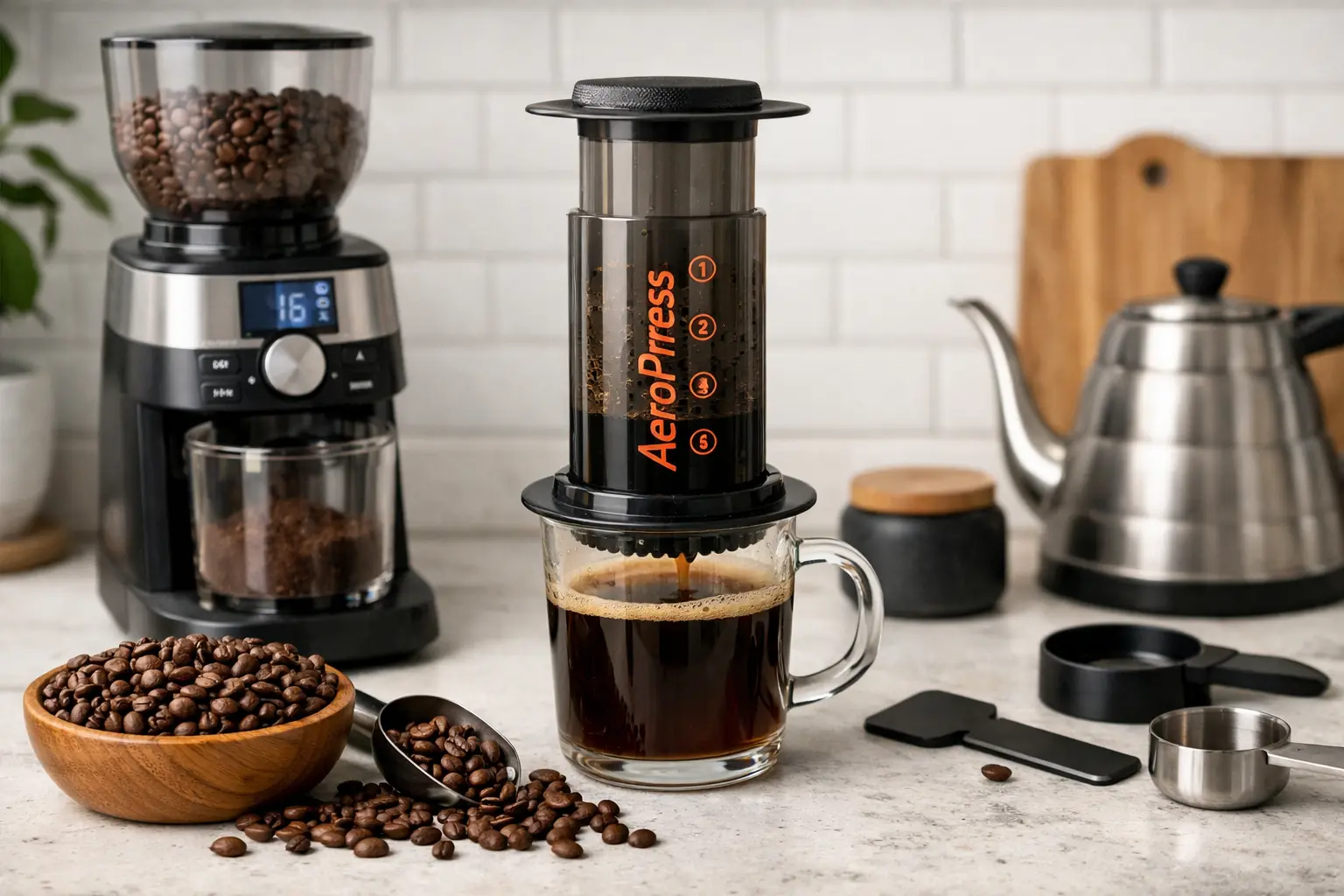
Start at medium-fine — table-salt texture — and aim for a smooth, steady press that finishes in 20–30 seconds. If the cup tastes sour or hollow, grind slightly finer. If it tastes bitter or the press fights back, go slightly coarser. Keep your dose, temperature, and water volume fixed while you adjust grind, and stop when sweetness clearly “pops” and the finish is clean. That’s your locked setting for that coffee.
- Target press time: 20–30 seconds (steady, never forced)
- Target flavor: integrated acidity + sweetness + clean finish with no drying aftertaste
- Fastest path: adjust grind only across 2–3 brews, then fine-tune time or temperature
Who This Guide Is For — Jump to What You Need
☕ Complete Beginner
Read the Quick Answer, then the Dial-In Framework and Testing Protocol.
🔧 Troubleshooter
Jump straight to the Troubleshooting Matrix.
🎒 Traveler / AeroPress Go Owner
See AeroPress Go + travel grinder picks in Best Grinders.
🔬 Extraction Nerd
Read Extraction Science + Burr vs Blade.
Table of Contents
- Why grind size is the biggest variable
- Best grind size for AeroPress (quick ranges)
- Grind-range table (fast dial-in)
- Starting settings by grinder type
- How does AeroPress grind compare to other methods?
- How does AeroPress extraction actually work?
- Surface area & diffusion science
- Permeability, fines & plunge pressure
- Why does my AeroPress taste muddy?
- Essential tools before you dial in
- The CoffeeGearHub dial-in framework
- Testing protocol (dial in 2–3 brews)
- How does brew style change your grind?
- AeroPress Go grind and dose adjustments
- Recipe playbooks with grind targets
- How does roast level change your grind?
- Paper vs metal filters & grind
- Temperature, agitation & time
- Strength vs extraction: what’s the difference?
- Freshness & water quality
- Troubleshooting matrix
- Why do burr grinders make such a difference?
- Which grinder is best for AeroPress?
- FAQ
Why Is Grind Size the Most Important AeroPress Variable?
Grind size is the single biggest lever you have over AeroPress flavor — more influential in most cases than water temperature, brew time, or even the beans themselves. If you’ve ever brewed two cups from the same bag with the same AeroPress and gotten wildly different results, grind size is almost certainly why.
This guide covers practical grind ranges for every brew style and roast level, the extraction science behind them, a step-by-step protocol for dialing in any coffee in 2–3 brews, and grinder recommendations at every budget. If you’re also deciding between paper and metal filters, that choice directly affects your grind target too — we cover the interaction in the filter section below.
What Is the Best Grind Size for AeroPress?
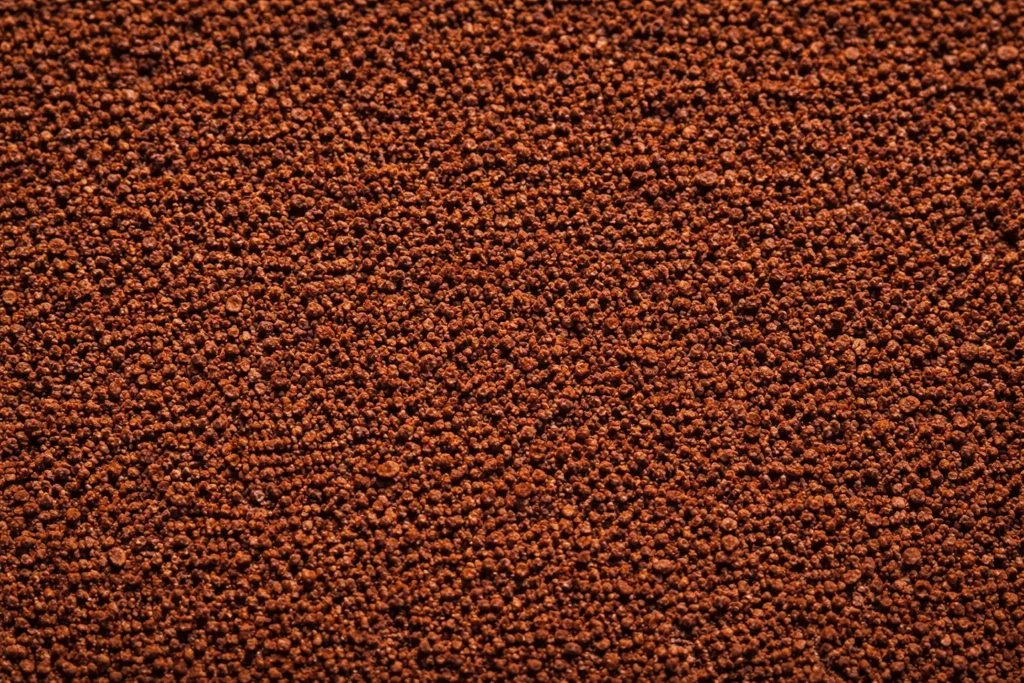
The best starting grind for AeroPress is medium-fine — the texture of table salt. From there, let taste and press feel guide you: sour or hollow means go finer; bitter, drying, or a hard press means go coarser. Keep every other variable fixed while you move the grind, one step at a time.
- Daily balanced cup: medium-fine (table salt)
- Inverted method with longer steep: medium to medium-fine
- Concentrate, iced, or milk drinks: fine (fine sand, not flour)
- Dark roast: 1–2 steps coarser than baseline
- Light roast: 1–2 steps finer than baseline
The Grind-Range Table: Fastest Way to Dial In
Start at Medium-Fine, then move one row at a time based on what you taste and feel. This table maps every grind setting to its expected press behavior, flavor profile, and the single most useful fix when something is off. It’s the fastest reference for diagnosing a bad cup.
| Grind range | Texture reference | Press feel / time | Most common taste | Best use | Most useful fix |
|---|---|---|---|---|---|
| Coarse | Sea salt / chunky sand | Very easy • 10–20s | Thin; often sour/hollow | Long steeps, very dark roasts | Sour: go finer or add 20–30s steep |
| Medium | Sand / kosher salt | Easy • 15–25s | Balanced but can feel light | Inverted method, darker roasts | Flat: slightly finer or increase dose |
| Medium-Fine ✦ Baseline | Table salt | Smooth • 20–30s | Sweet + balanced when dialed | Most recipes | Sour: finer. Bitter/hard press: coarser. |
| Fine | Fine sand | More resistance • 25–45s | Intense; can turn drying | Concentrates, iced, milk | Harsh: coarser or shorter steep |
| Espresso-fine | Powdery | Stall risk • 45s+ | Strong but harsh quickly | Experiments only | Stalls: coarser, less agitation |
What Are the Right Starting Settings for My Grinder?
Grind numbers don’t translate between grinder models — a “14” on a Baratza Encore is completely different from a “14” on a Fellow Opus. Use these ranges as directional starting points only; taste and press time are always the final authority for your specific grinder.
| Grinder type | Start here | Target signal | How to adjust |
|---|---|---|---|
| Entry electric conical burr (Encore-class) | Mid-drip band, slightly finer (ex: 14–16 on a 40-step) | 20–30s smooth press; sweet finish | Sour → 1–2 steps finer. Bitter/hard → 1–2 steps coarser. |
| Modern precision electric (Opus-class) | Lower-middle range, closer to fine than drip | Intensity without harshness | Stalls → 1 step coarser + reduce agitation. |
| Hand grinder (click-based) | Mid pour-over band, slightly finer (about 2–3 rotations from closed on many) | Clean cups with low silt | Move 2–4 clicks at a time until sweetness pops. |
| Blade grinder | Avoid where possible | Sour and bitter simultaneously | Upgrade to burr grinder — see Best Grinders. |
💡 Pro tip: If you’re torn between two adjacent settings, choose the one that gives a smoother press, then fine-tune time by ±15–30 seconds. Repeatability beats theoretical “perfect fineness” — a setting you can hit consistently every morning beats one that’s optimal on paper.
How Does AeroPress Grind Size Compare to Other Brew Methods?
AeroPress sits between drip and espresso on most grinder dials — but much closer to drip. If you’re coming from pour-over or drip, start 1–3 steps finer than your usual setting. AeroPress’s shorter brew window benefits from the extra surface area that a slightly finer grind provides.
| Brew method | Grind range | Texture | Contact time | Why different |
|---|---|---|---|---|
| French press | Coarse | Breadcrumbs / sea salt | 3–5 min | Long immersion; coarse reduces sludge and over-extraction |
| Drip | Medium | Sand / kosher salt | 3–5 min | Gravity flow; medium prevents clogging |
| Pour-over | Med → med-fine | Salt → fine salt | 2:30–4:00 | Often slightly coarser than AeroPress due to longer time |
| AeroPress | Medium-fine | Table salt | 1:30–2:30 + press | Shorter brew window benefits from slightly finer grind |
| Moka pot | Fine (not espresso) | Fine sand | 4–6 min | Pressure-driven; too fine stalls |
| Espresso | Extra fine | Powder | 25–30s | High pressure requires very fine grind |
How Does AeroPress Extraction Actually Work?
AeroPress is primarily an immersion brewer: coffee and water steep together, then the press pushes brewed liquid through the filter. Most extraction happens during the steep phase — the press mainly separates liquid from the grounds bed, not extract more flavor. This is why grind size has such a large effect: it controls how fast and how evenly compounds move from the coffee into the water.
Grind size controls extraction rate via surface area and diffusion distance: finer extracts faster; too coarse under-extracts (sour/hollow), too fine over-extracts (bitter/drying) and can stall the press. The Specialty Coffee Association’s brewing protocols and research identify particle size as the primary extraction variable in filter coffee — the same principle applies directly to AeroPress.
Surface Area & Diffusion Science
Finer grinding increases total particle surface area and shortens the diffusion distance from the center of each particle to the surrounding water. This makes it easier to reach the “sweet” middle band of extraction within AeroPress’s compact brew window — typically 1:30–2:30 total contact time.
Coffee compounds extract in a predictable sequence as surface exposure and contact time increase:
- Early extracts: acids and salts (brightness; can be sharp if isolated)
- Mid extracts: sugars and aromatics (sweetness + the “coffee flavor” center)
- Late extracts: bitters and astringents (drying, harsh finish)
The goal with any grind adjustment is to land in that middle band — bright without sharp acidity, sweet without bitterness, clean without thinness.
How Do Fines and Plunge Pressure Affect the Press?
Finer particles pack more tightly and reduce bed permeability, which directly increases resistance during the press. Pressing too hard under those conditions forces fines through the filter and risks channeling; pressing too slowly on a very fine grind unintentionally extends contact time and can push extraction into bitter or drying territory.
The target is a steady, gentle press that finishes in 20–30 seconds — this is your calibration signal that grind size and recipe are balanced. For full control over contact time, the inverted AeroPress method eliminates drip-through during steeping entirely, making it easier to isolate grind as the only variable.
Why Does My AeroPress Taste Muddy or Gritty?
A cup that tastes simultaneously sour and muddy — or just gritty and harsh — is almost always a fines problem. “Boulders + fines” is the classic blade-grinder result: coarse particles under-extract while tiny fines over-extract and dirty the cup at the same time. This is the #1 sign that a burr grinder upgrade will produce immediate, dramatic improvement.
- Switch to paper (or double paper) to block fines — see our paper vs metal filter guide for the full comparison
- Reduce agitation — swirl gently instead of vigorous stirring to keep fines from suspending
- Go 1 step coarser and add 10–20 seconds steep time to compensate
- Upgrade your grinder for a narrower particle distribution that eliminates the problem at the source
🔬 If your cup tastes both sour and bitter at the same time: that’s classic inconsistent grinding — not a recipe problem. No amount of grind adjustment fully fixes a blade grinder’s uneven particle spread. It’s the #1 sign a burr grinder upgrade will produce immediate improvement.
What Tools Do You Need to Dial In AeroPress Properly?
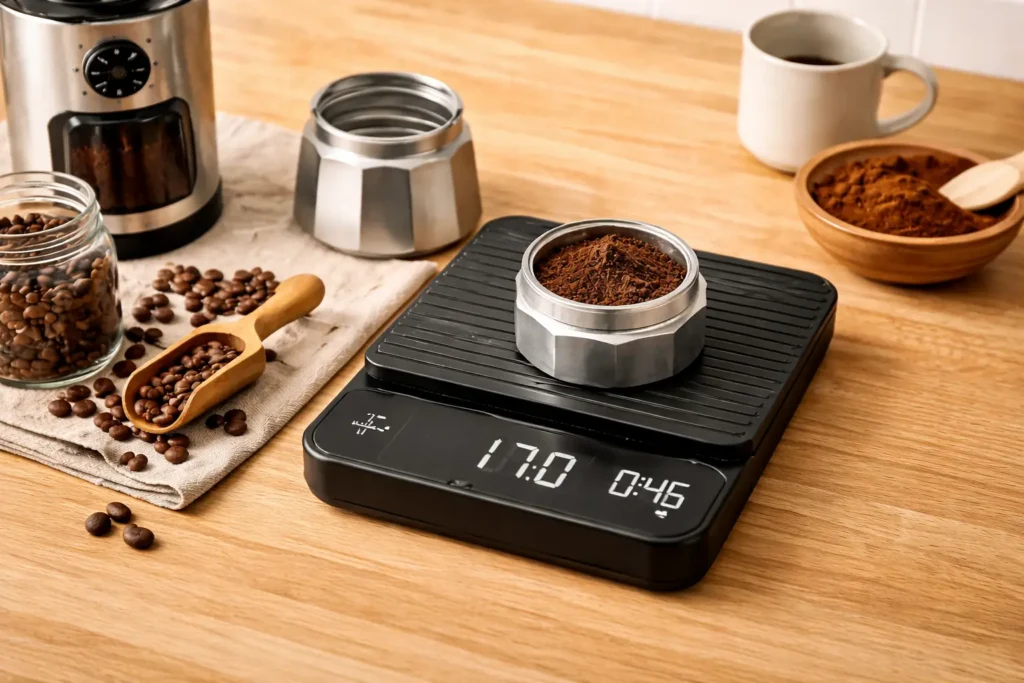
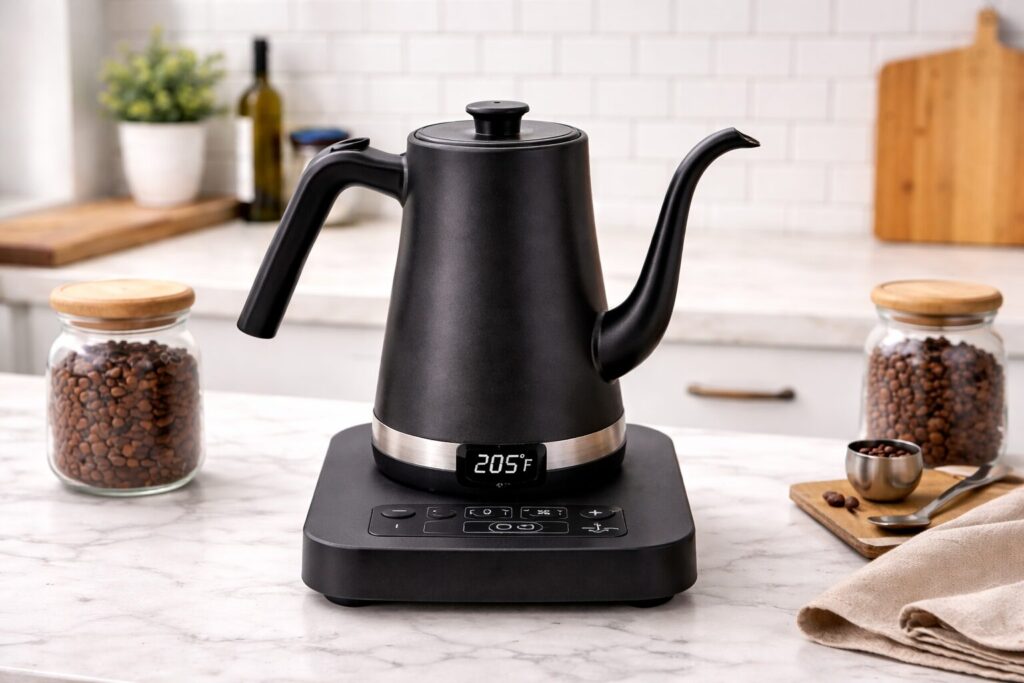
Two tools make everything else work: a digital scale and a temperature-controlled kettle. Without both, you’re adjusting two or three variables at once and can’t tell what’s actually changing the cup. A scale eliminates dose variability so grind changes show clean feedback; a temp kettle removes the last major uncontrolled variable during testing.
A Coffee-Capable Digital Scale
You can’t reliably dial in AeroPress grind size without weighing dose and water. Look for 0.1g resolution and a built-in brew timer.
- Eliminates dose variability so grind changes show up clearly
- Makes the testing protocol repeatable brew to brew
- Pays for itself in fewer wasted brews during dial-in
Disclosure: CoffeeGearHub may earn from qualifying purchases.
Temperature-Controlled Gooseneck Kettle
Temperature is a major extraction lever — especially with light and dark roasts at opposite ends of the dial. A temperature-controlled kettle removes the last uncontrolled variable during grind testing.
- Light roast: 96–100°C helps extract sweetness fully
- Dark roast: 85–91°C reduces harshness significantly
- Consistent temp = cleaner, faster grind feedback
Disclosure: CoffeeGearHub may earn from qualifying purchases.
The CoffeeGearHub Dial-In Framework
Dial-in works fastest when you isolate grind first, then use time and temperature for fine-tuning. Changing multiple variables at once makes it impossible to know what’s actually improving the cup — the cardinal sin of dialing in.
Baseline “Control” Recipe
- Coffee: 15 g (weighed)
- Water: 245 g
- Temperature: 93°C / 200°F
- Filter: paper (rinsed)
- Steep: 1:15
- Agitation: 1 gentle swirl (or 6-second stir)
- Press: 20–30 seconds, steady and gentle
This is intentionally repeatable. It’s a diagnostic recipe that makes grind changes easy to isolate and taste clearly.
Taste → Fix Order
- Sour or sharp: grind slightly finer
- Bitter/drying or hard press: grind slightly coarser
- Almost there: steep ±15–30 seconds
- Dark roast harsh: lower temp 3–6°C
- Balanced but weak: increase dose (strength issue — not a grind issue)
Rule: change one variable per brew, always. No exceptions during dial-in.
How Do You Dial In AeroPress in 2–3 Brews?
The key is clean feedback: keep everything fixed except grind. Most people dial in a new bag of coffee in 2–3 brews using this protocol. If you want even more control over steep time during testing, try the inverted AeroPress method — it eliminates drip-through and makes grind the only active variable.
- Brew #1 baseline: use the control recipe above. Note press time and how the finish tastes.
- Log 3 things: press time, press effort, and a one-word finish (clean / sour / drying / hollow / muddy).
- Adjust grind: 1–2 steps (electric) or 2–4 clicks (hand). Change nothing else.
- Brew #2: repeat exactly. Compare sweetness and finish quality.
- Brew #3 (optional): make a smaller move in the same direction — or reverse if you overshot.
Stop when: sweetness is obvious, the finish is clean, and the press is smooth throughout. That’s your locked grind setting for this coffee.
How Does Brew Style Change Your Grind Target?
Different AeroPress styles change contact time and flow behavior, which changes the ideal grind. Standard method lets some coffee drip through during steeping; inverted gives you true immersion control; concentrate recipes need a finer grind to maximize extraction in a very short window. Choose the row that matches your brewing style and use it as your new starting point.
| Style | Why it’s different | Start grind | Steep window | Best for |
|---|---|---|---|---|
| Standard | Some drip-through during steep | Medium-fine | 1:30–2:00 | Clean, bright cups |
| Inverted | True immersion — no drip-through | Medium to med-fine | 2:00–2:45 | Sweetness + body |
| Concentrate | High dose, low water, then diluted | Fine (not powder) | 0:45–1:20 | Iced + milk drinks |
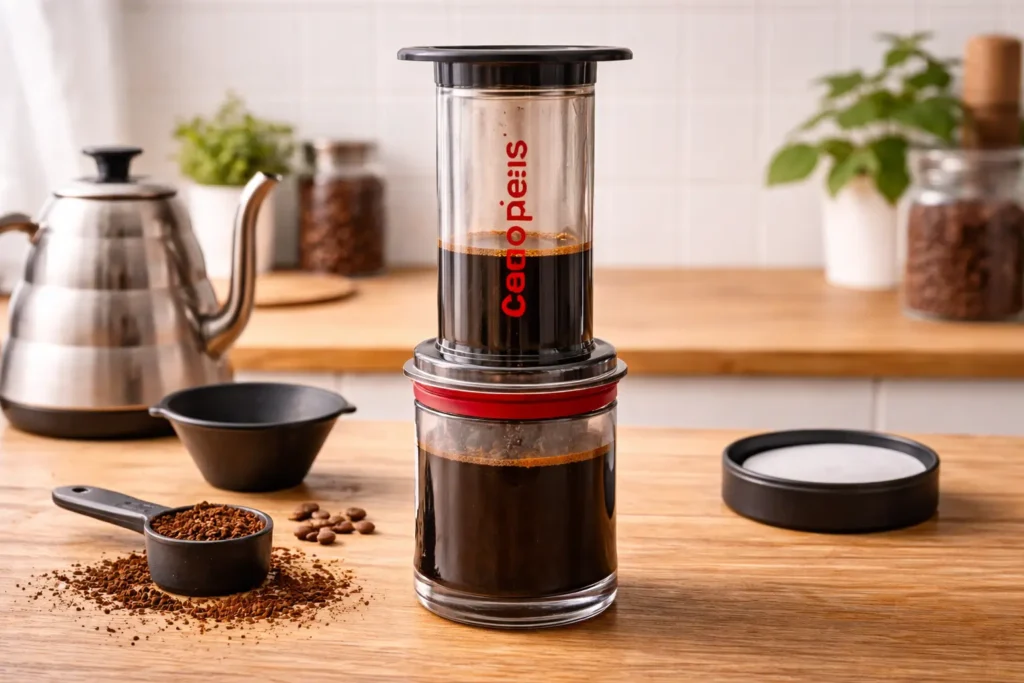
AeroPress Go: How Do You Adjust Grind and Dose?
The Go’s smaller chamber requires scaling down dose and water, but the target grind size stays exactly the same as the original AeroPress. Use the same smooth 20–30 second press as your calibration signal — it tells you grind is dialed regardless of which model you’re using.
| Parameter | Original AeroPress | AeroPress Go | Why it differs |
|---|---|---|---|
| Dose | 15–18g | 12–15g | Scale down ratio for smaller volume |
| Water | 230–260g | 180–220g | Avoid overflow and leaks |
| Grind | Medium-fine baseline | Medium-fine baseline | Same particle target — no change needed |
| Steep | 1:15–2:30 | 1:00–2:00 | Lower volume can extract slightly faster |
| Press target | 20–30s | 20–30s | Same diagnostic signal for both models |
💡 Go travel shortcut: Scale any standard recipe down ~20% on both coffee and water, keep the same grind setting, and trust press feel over the timer. A smooth 20–30s press tells you everything you need to know.
Recipe Playbooks with Grind Targets
These two recipes are the most useful starting points for everyday AeroPress brewing — a clean daily cup and a high-ratio concentrate base for iced drinks and lattes. For competition-style, inverted method, and cold brew recipes, see our full AeroPress recipes guide.
Playbook #1 — Daily Sweet Cup
- Coffee: 15g (weighed)
- Water: 245g
- Temp: 93°C / 200°F
- Filter: paper (rinsed)
- Grind: medium-fine (table salt)
- Method: steep 1:15 → 1 gentle swirl → press 20–30s
Fix sour: grind finer. Fix bitter: grind coarser or swirl less aggressively.
Playbook #2 — Iced Concentrate
- Coffee: 18g (weighed)
- Water: 100–110g
- Temp: 90–95°C
- Filter: paper (rinsed)
- Grind: fine — not powder
- Method: stir 10s → steep to 0:50 → press gently 25–40s → pour over ice
Fix harsh/drying: grind coarser or shorten steep by ~10s.
How Does Roast Level Change Your AeroPress Grind?
Roast level changes cell structure and solubility, which changes how aggressively you should grind. Light roasts are denser and harder to extract — they need a finer grind and hotter water to reach the sweet center. Dark roasts are more porous and over-extract easily — they need a coarser grind and cooler water to avoid harshness.
☀️ Light Roast
- Grind: 1–2 steps finer than baseline
- Temp: 96–100°C
- Steep: 2:00–2:30
🌤 Medium Roast
- Grind: baseline medium-fine
- Temp: 91–94°C
- Steep: 1:15–2:00
🌑 Dark Roast
- Grind: 1–2 steps coarser than baseline
- Temp: 85–91°C
- Steep: 1:00–1:30
How Does Filter Type Change Your AeroPress Grind?
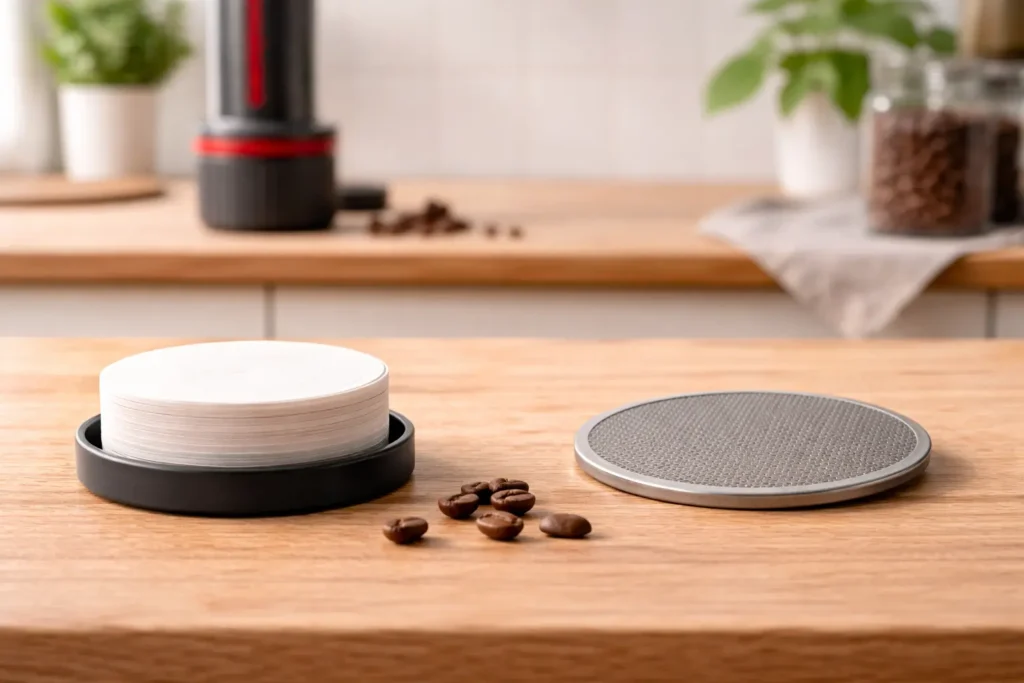
Filter type directly shifts your grind sweet spot — because it changes both resistance during the press and which particles make it into the cup. Paper catches fines and oils for a cleaner, brighter cup at medium-fine. Metal lets more pass through, which usually means going 1–2 steps coarser and pressing more gently. For the full breakdown of taste differences, health considerations, and the best filter picks, see our complete paper vs metal filter guide.
Paper Filter
- Cleanest cup — easiest dial-in
- Baseline grind: medium-fine (table salt)
- Stack double paper for maximum clarity
Metal Filter
- More body, aroma oils, and mouthfeel
- Go 1–2 steps coarser than paper baseline
- Reduce agitation; stop pressing at the hiss
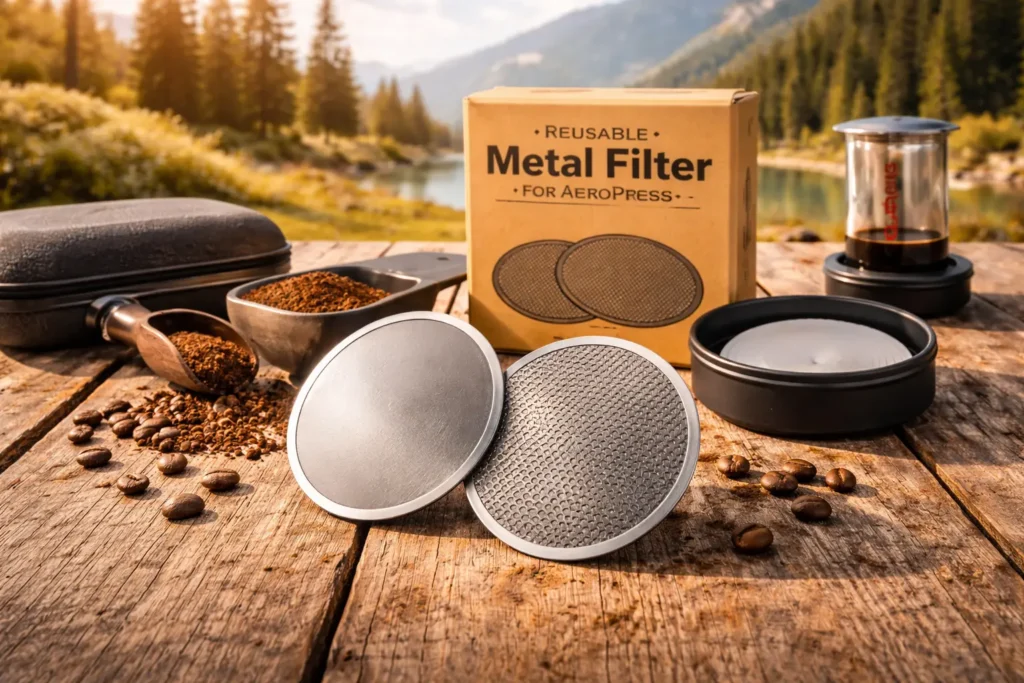
Fellow Prismo or Able Disk Fine (Metal Filter)
If you want a body-forward cup without excessive silt, these are the most popular quality metal filter options. Prismo’s pressure valve prevents drip-through during steeping, making it ideal for concentrate-style brews and iced AeroPress.
- Less sediment than generic mesh filters
- Reusable indefinitely — no restocking
- Prismo valve supports “espresso-style” concentrates
Disclosure: CoffeeGearHub may earn from qualifying purchases.
How Do Temperature, Agitation, and Time Work as Secondary Levers?
Once your grind is dialed in, temperature, agitation, and steep time let you fine-tune without blowing up the recipe. Think of them as precision instruments — useful only after grind has gotten you into the right ballpark. Using them before grind is sorted creates compounding variables that make diagnosis impossible.
| Lever | Increase it to… | Decrease it to… | Best use case |
|---|---|---|---|
| Temperature | Boost extraction and sweetness | Reduce harshness and bitterness | Light roast sour → raise. Dark roast bitter → lower. |
| Agitation | Speed up extraction | Reduce fines impact and muddiness | Paper: moderate OK. Metal: minimal. |
| Time | Increase extraction without going finer | Avoid late-stage bitterness | When you’re between two grind settings |
What Is the Difference Between Strength and Extraction?
Strength and extraction are two separate things, and confusing them is the most common dial-in mistake. Strength is your dose-to-water ratio — how concentrated the brew is. Extraction is flavor balance — whether you’re pulling the right compounds out of the grounds. If it tastes balanced but weak, the fix is ratio, not grind.
- Balanced but weak: +1–2g dose or −10–20g water (ratio issue)
- Sour/thin: grind finer or brew longer/hotter (extraction issue)
- Bitter/drying: grind coarser or brew shorter/cooler (extraction issue)
- Good flavor but too strong: add bypass water after pressing to dilute
How Do Bean Freshness and Water Quality Affect Dial-In?
If cups stay flat or lifeless despite correct grind and technique, check roast date and water quality before anything else. Fresh beans (ideally 2–6 weeks from roast) and filtered water with adequate mineral content are non-negotiable for the “sweetness pop” you’re chasing. Stale beans dial in differently from fresh ones even at the same grinder setting — cell structure degrades and CO₂ off-gassing changes how water penetrates the grounds.
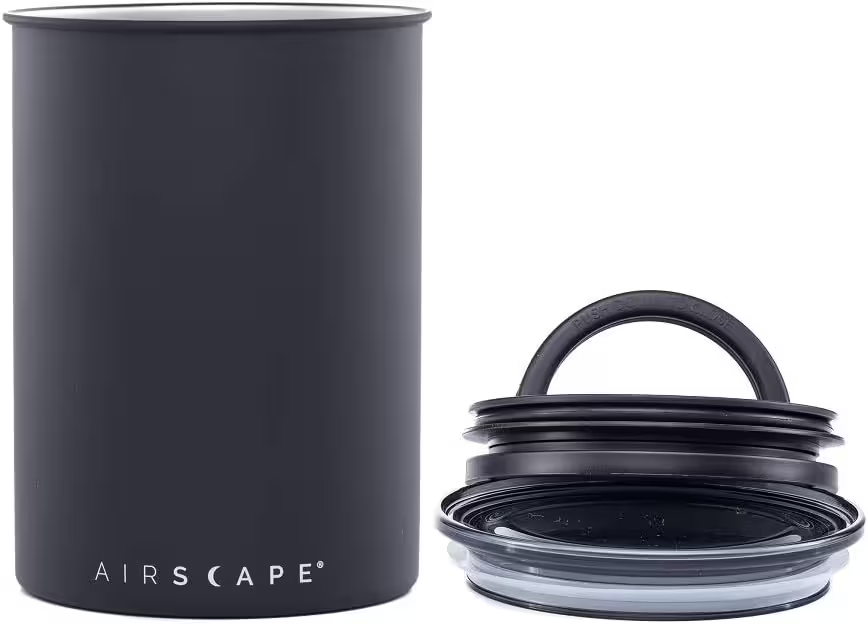
Airtight Coffee Storage Canister
Protecting beans from oxygen preserves sweetness and aromatics, making dial-in results more consistent from day to day — especially important once you’ve locked in your grind setting and want to trust it every morning.
Disclosure: CoffeeGearHub may earn from qualifying purchases.
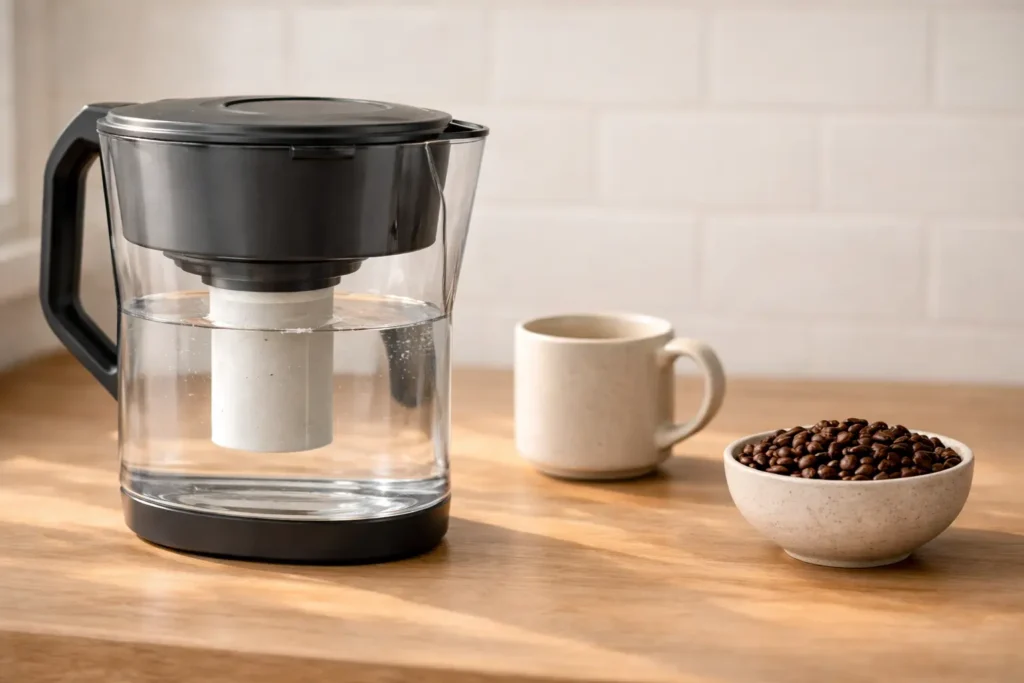
Coffee-Friendly Water Filter Pitcher
If your tap water tastes off — chlorine, metallic, or flat — your coffee will absorb those characteristics regardless of how well you dial in your grind. Filtered water makes grind adjustments significantly easier to taste clearly.
Disclosure: CoffeeGearHub may earn from qualifying purchases.
Troubleshooting Matrix: Taste → Fix
Start with grind — always. Use time and temperature only after grind is close. This matrix maps every common AeroPress problem to its most likely cause and the fastest, most logical fix order.
| Symptom | What it usually means | Fix (in order) |
|---|---|---|
| Sour + fast press | Too coarse / under-extracted | Finer → +15–30s steep → hotter water (light roasts) |
| Bitter + hard/slow press | Too fine / too many fines | Coarser → less agitation → shorter steep → cooler (dark roasts) |
| Muddy/silty | Fines passing through metal or aggressive stirring | Paper or double paper → swirl only → slightly coarser |
| Balanced but weak | Ratio/strength issue — not extraction | +1–2g dose or reduce water; don’t touch grind |
| Press stalls | Clogged bed — grind too fine | Coarser → reduce agitation → apply gentle, steady pressure |
| Sour AND bitter simultaneously | Inconsistent particle distribution | Grinder upgrade (burr) — see Burr vs Blade below |
Why Do Burr Grinders Make Such a Big Difference?
Blade grinders create “boulders + fines” — a chaotic mix of huge and tiny particles that extract simultaneously at opposite ends of the flavor spectrum. The result is a cup that tastes sour and bitter at the same time, and no amount of recipe adjustment fully compensates. Burr grinders create a much narrower particle distribution, so your adjustments behave predictably and dial-in is actually possible.
The difference isn’t subtle. Most people who switch from a blade grinder to any decent burr grinder describe it as the single most impactful coffee improvement they’ve ever made — more impactful than beans, water, or any other variable. For the full evidence on how particle consistency affects extraction, see our burr vs blade grinder comparison.
🏆 Highest-impact AeroPress upgrade: if you’re using a blade grinder, switching to any decent burr grinder — even an entry-level hand grinder — is the fastest path to dramatically better coffee. Everything else in this guide works much better once your grind is consistent.
Which Grinder Is Best for AeroPress?
The best AeroPress grinder delivers repeatable medium-fine consistency, fine enough adjustment increments to dial in properly, and low enough fines production to avoid muddiness. These picks are organized by use case — not just price — so you can match the right grinder to your actual brewing habits.
🔍 Quick Pick: Which Grinder Is Right for You?
Home daily use — best overall electric value
→ Baratza Encore
Multi-method home (AeroPress + pour-over + espresso)
→ Fellow Opus
Budget electric with simple workflow
→ OXO Brew Conical Burr
Travel grinder + best manual value
→ KINGrinder K6
First upgrade from a blade grinder
→ Timemore Chestnut C3
Ultra-compact travel (fits inside AeroPress)
→ Porlex Mini II

Baratza Encore
- Best overall electric value
- Strong medium-fine consistency
- Repairable + long-term manufacturer support
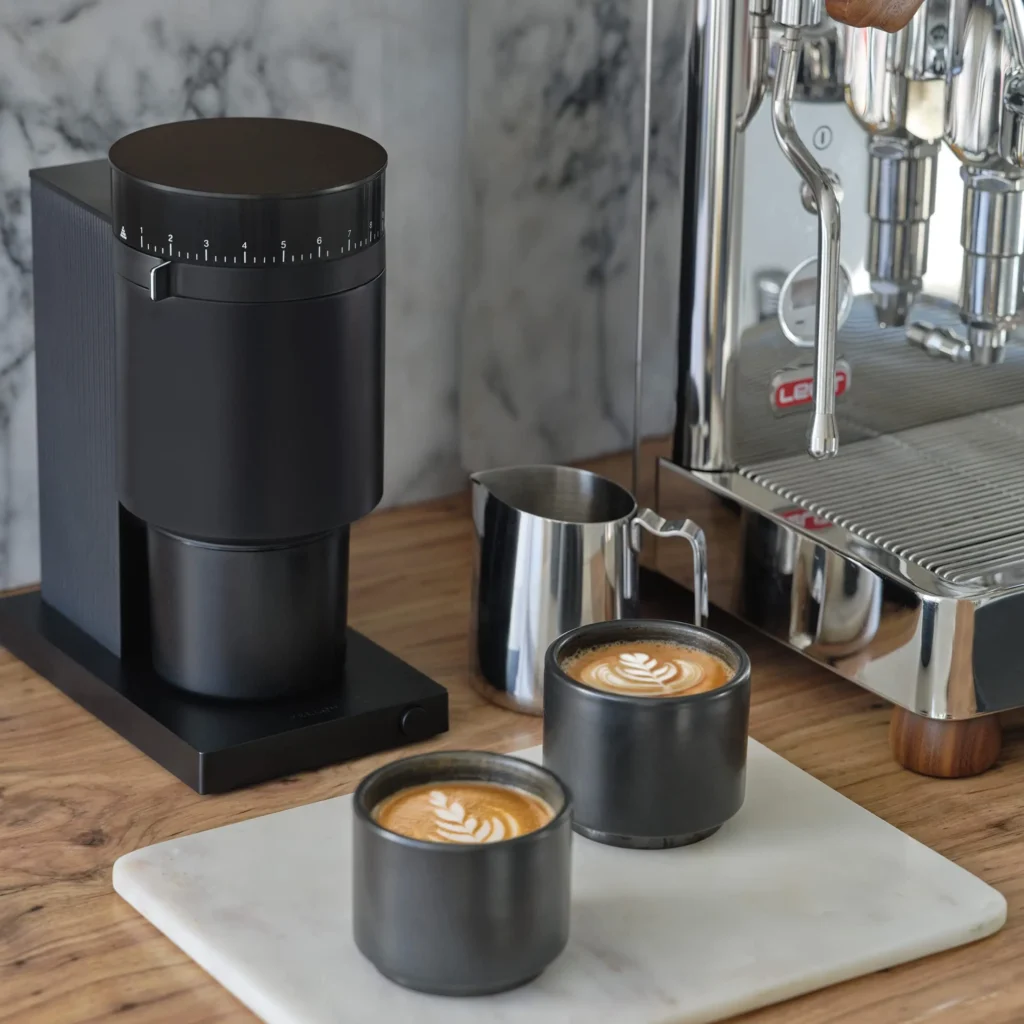
Fellow Opus
- Modern workflow + wide grind range
- Low static, tidy dosing
- Best for multi-method homes
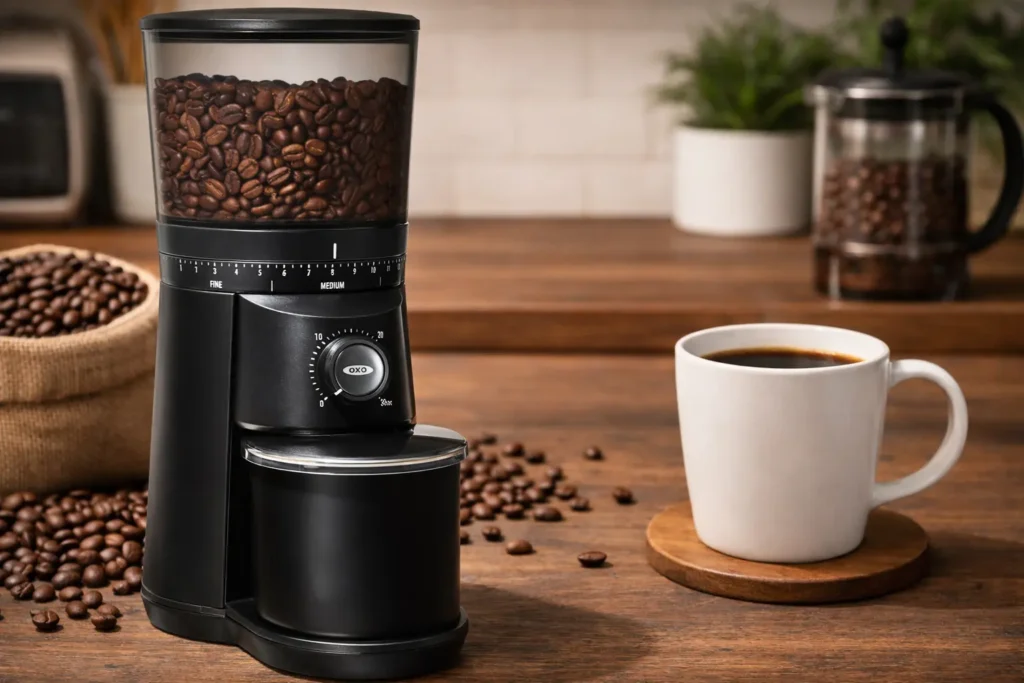
OXO Brew Conical Burr
- Best budget electric pick
- Simple, easy daily workflow
- Good everyday consistency
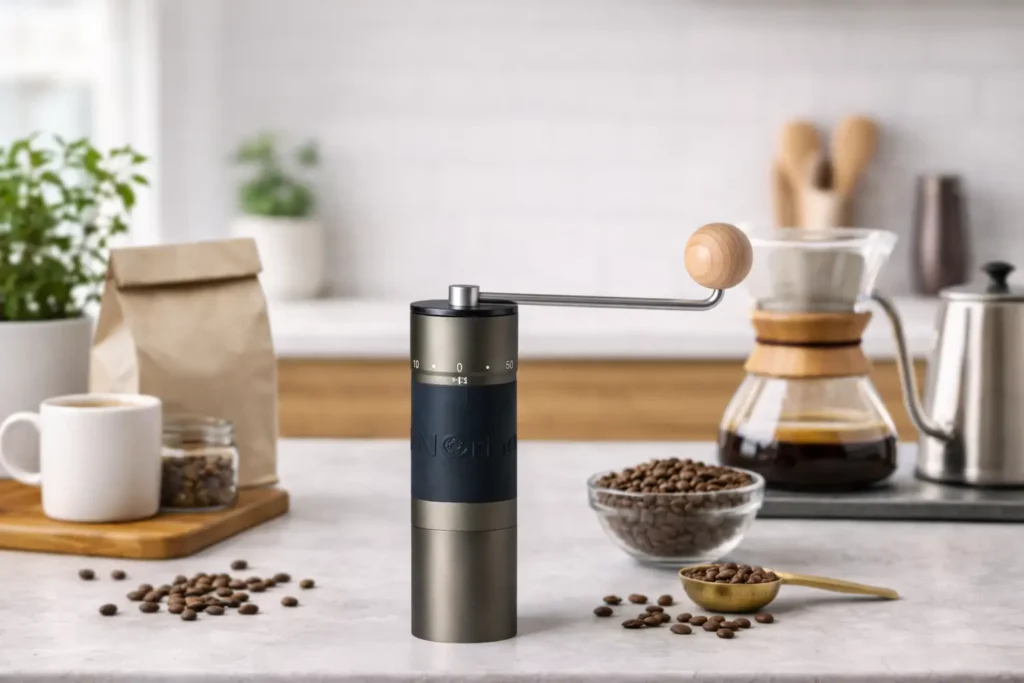
KINGrinder K6
- Best manual value
- Precise click-based adjustments
- Excellent travel pick

Timemore Chestnut C3
- Best first upgrade from blade
- Biggest flavor improvement per dollar
- Solid, durable build quality
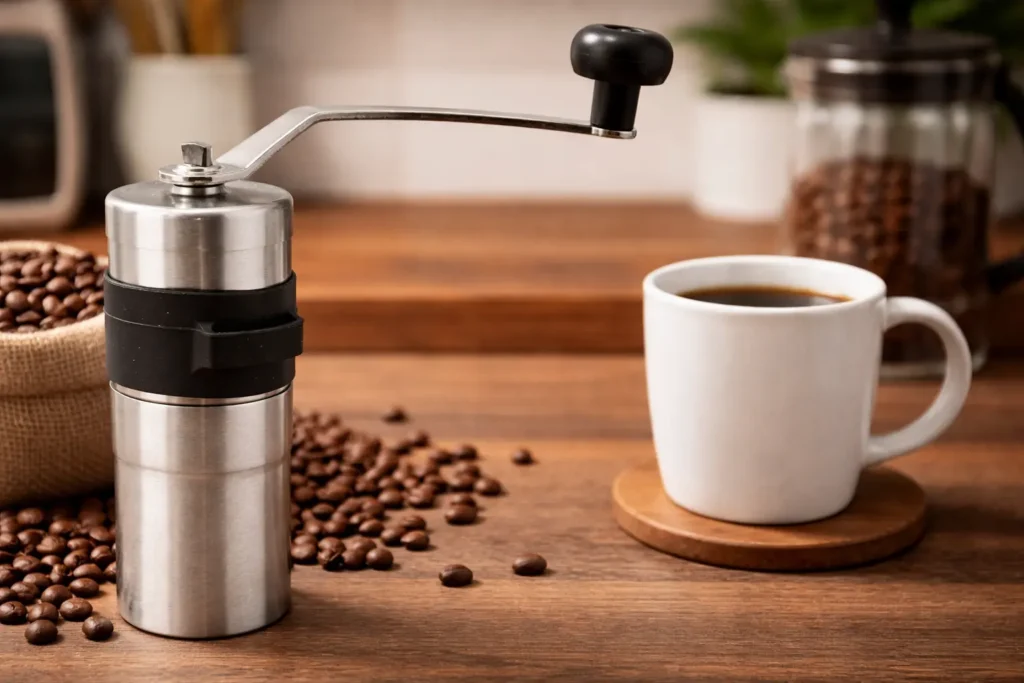
Porlex Mini II
- Ultra-portable ceramic burr
- Fits inside the AeroPress chamber
- Excellent travel durability
Full Grinder Comparison Table
| Grinder | Type | Price | Med-fine consistency | Adjustment resolution | Retention | Travel | Best for |
|---|---|---|---|---|---|---|---|
| Baratza Encore | Electric conical burr | $$ | Excellent | Good | Medium | Low | Daily home, multi-method |
| Fellow Opus | Electric conical burr | $$ | Very good | Good | Low–medium | Low | Multi-brew, exploration |
| OXO Brew | Electric conical burr | $ | Good | Fair | Medium | Low | Budget electric |
| KINGrinder K6 | Manual steel burr | $ | Excellent | Very good | Very low | High | Solo + travel |
| Timemore C3 | Manual steel burr | $ | Very good | Good | Very low | High | First burr upgrade |
| Porlex Mini II | Manual ceramic burr | $ | Good | Fair | Very low | Very high | Ultra-compact travel |
Final Takeaway
Medium-fine is your baseline. Taste is your feedback loop. A smooth 20–30 second press is your calibration signal. Change grind first — one variable at a time — and stop when sweetness pops and the finish is clean. Everything else: temperature, steep time, ratio — is fine-tuning once grind is dialed in.
FAQs: AeroPress Paper vs Metal Filter
What grind size is best for AeroPress?
Medium-fine — the texture of table salt — is the best starting point for most AeroPress recipes and filter types. Aim for a smooth 20–30 second press, then adjust finer if the cup tastes sour and coarser if it tastes bitter or drying.
What pre-ground coffee grind should I buy for AeroPress?
Choose a bag labeled “drip” or “medium-fine.” Avoid espresso grinds (often too fine — causes stalling and bitterness) and coarse grinds (often under-extract into sour, hollow cups). Medium or medium-fine pre-ground will get you close enough to taste and adjust from.
Why does my AeroPress taste sour?
Almost always under-extraction: grind too coarse, steep too short, or water too cool. Go slightly finer first — that’s the fastest fix. For light roasts specifically, also raise temperature to 96–100°C and extend steep time by 15–30 seconds.
Why is my AeroPress bitter or drying?
Almost always over-extraction: grind too fine, too much agitation, water too hot, or steep too long. Go slightly coarser first. For dark roasts, also lower temperature to 85–91°C and shorten steep time by 10–20 seconds.
My AeroPress tastes balanced but weak — should I grind finer?
No — almost never. A balanced-but-weak cup is a strength issue, not an extraction issue. Increase your dose by 1–2g or reduce water by 10–20g before touching grind. Grinding finer will just make it bitter.
Why does my AeroPress press stall or feel impossible to push?
Your grind is almost certainly too fine for that recipe and filter combination. Go 1–2 steps coarser, reduce agitation (stir less or skip stirring), and apply steady gentle pressure rather than forcing it. With metal filters, go one additional step coarser beyond what you’d use with paper.
How does the inverted AeroPress method change grind size?
Inverted method gives you true immersion with no drip-through during steeping, so you can use medium to medium-fine and extend steep to 2:00–2:45. Standard method has some drip-through, so medium-fine with a shorter steep (1:30–2:00) typically works better.
Does paper vs metal filter change what grind I should use?
Yes, noticeably. Metal filters let more fines pass through, so you generally need to grind 1–2 steps coarser than with paper and use gentler agitation. Paper filters catch fines for a cleaner cup and let you grind slightly finer. See our full paper vs metal filter guide for the complete breakdown.
Can I use the same grind setting for different bags of coffee?
As a rough starting point, yes — but different origins, roast levels, processing methods, and freshness all change extraction behavior. Plan to dial in at least once per new bag, and expect bigger adjustments when switching between light and dark roasts.
Is a burr grinder worth it for AeroPress — is the improvement real?
The improvement is dramatic and immediate for most people. Blade grinders produce uneven particles that simultaneously under- and over-extract, making it impossible to dial in properly. Even a budget burr hand grinder produces dramatically better and more consistent results. Most people describe it as the single biggest coffee improvement they’ve ever made.
Continue Learning
AEROPRESS CLUSTER
Want espresso-style AeroPress for lattes? Use the concentrate playbook above, then pair it with a strong milk frother for café-style drinks at home.
☕
Written by the CoffeeGearHub Editorial Team
CoffeeGearHub is a specialty coffee equipment resource run by home brewers and coffee enthusiasts. Our guides are researched using published brewing science, grinder manufacturer specifications, and established specialty-coffee community knowledge. We review and update our pillar content regularly. About CoffeeGearHub →