
Last Updated: September 2026 • 22–26 min read • Complete Fresh Roast SR800 Review: Specs + Build + Controls + 5 Roast Profiles + Origin Recipes + Extension Tube Mod + Thermocouple Upgrade + Troubleshooting + Head-to-Head Comparisons + FAQ
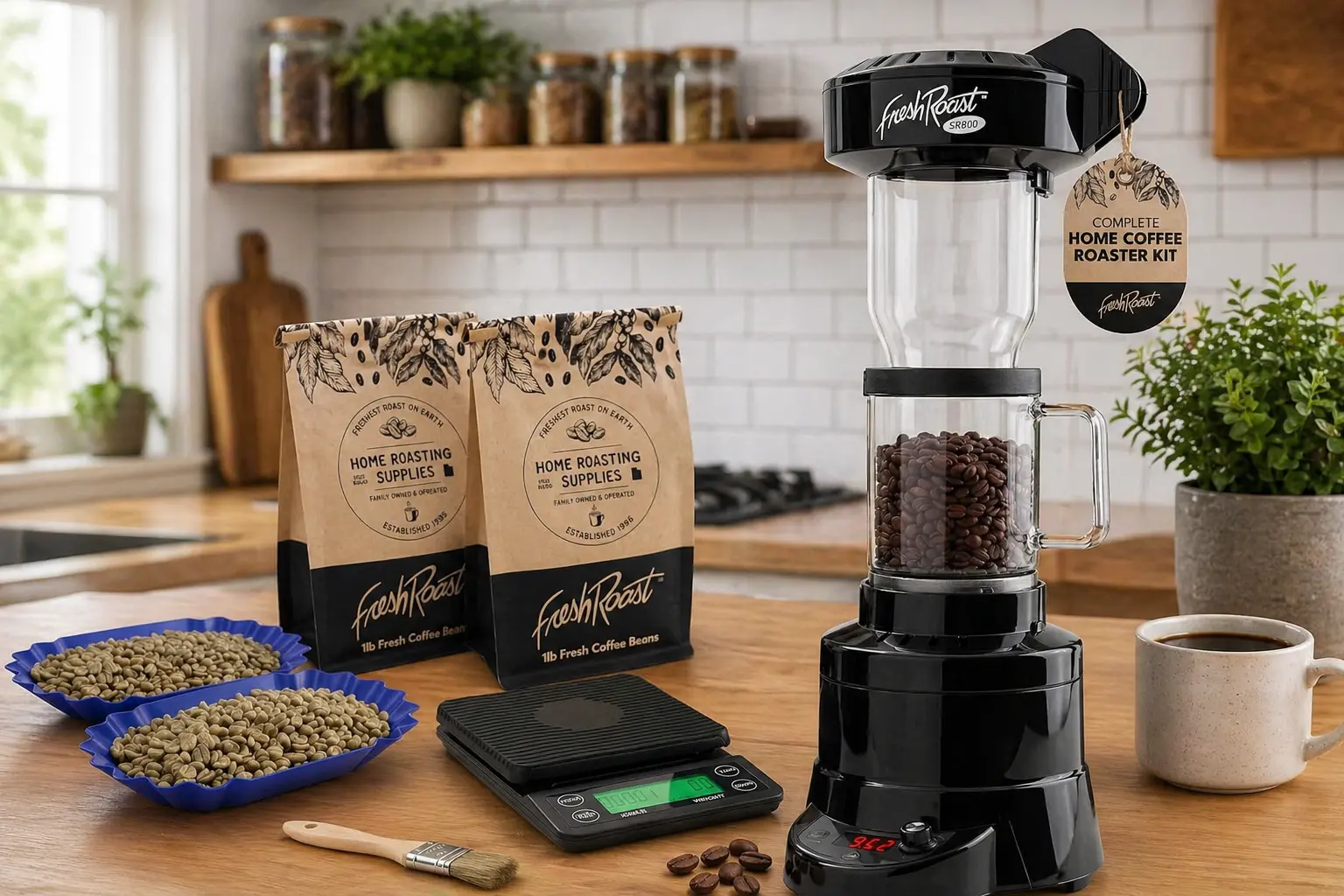
The Fresh Roast SR800 is a fluid-bed home coffee roaster built around direct operator control: a visible glass chamber, a rated batch capacity of up to 8 oz, and independent 9-level heat and 9-level fan adjustment. This guide evaluates the SR800 from current published specifications, Sweet Maria’s operating resources, manufacturer documentation, and clearly identified owner/community observations. The goal is to explain how the controls, batch limits, upgrade path, and roast-profile starting points fit different home-roasting needs—not to imply undocumented CoffeeGearHub hands-on testing.
This is the complete CoffeeGearHub review and roast profile reference for the Fresh Roast SR800: full specifications, build quality, the controls system, a beginner walk-through of your first roast, five named roast profiles (City, City+, Full City, Full City+, plus a light-medium “Filter Sweet Spot”), origin-specific recipes for Ethiopia, Colombia, Brazil, and Sumatra, the extension tube and thermocouple upgrade path, troubleshooting for the most common SR800 issues, and head-to-head comparisons against the Fresh Roast SR540, Behmor 2000AB Plus, and Aillio Bullet R1. If you are still deciding whether to roast at home at all, start with our complete home coffee roasting guide, then return here for the deeper SR800 review.
📋 Editorial note: This is a research-based review built from current Fresh Roast/Sweet Maria’s documentation, manufacturer specifications, published roast guidance, and clearly identified owner/community observations. CoffeeGearHub does not claim undocumented hands-on SR800 testing. Roast profiles below are starting points, not lab-validated recipes. Product links may be affiliate links at no extra cost to you.
🛒 Quick picks: SR800 + the two upgrades most owners eventually buy
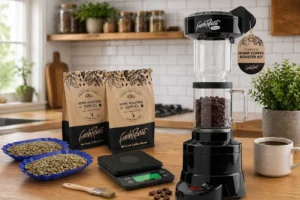
Fresh Roast SR800
Manual-control air roaster
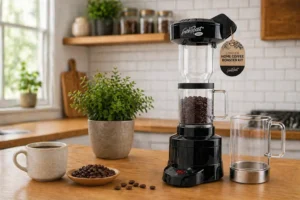
SR800 Extension Tube
Airflow + low-voltage aid
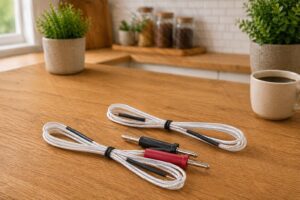
Type K Thermocouple
Bean temp data + Artisan logging
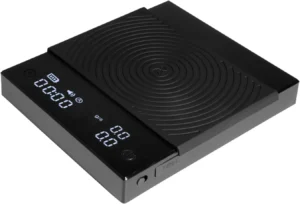
Coffee Scale
0.1g resolution for batch consistency
As an Amazon Associate, CoffeeGearHub earns from qualifying purchases. Jump to the verdict →
Fresh Roast SR800 Review — The 60-Second Verdict
The Fresh Roast SR800 is a strong fit for home roasters who want direct manual control in a compact fluid-bed machine. Its rated 8 oz capacity, independent 9-level heat and 9-level fan controls, visible glass chamber, and established accessory ecosystem give beginners room to learn without immediately outgrowing the platform. The trade-offs are equally important: there is no smoke suppression, the fan can mask first crack, results vary with line voltage and ambient conditions, and the operator needs to stay engaged throughout the roast.
- Best for: daily home roasters, intermediates, anyone who values a well-supported manual air-roaster platform
- Not for: set-and-forget users, one-pound-per-batch households (look at Behmor 2000AB Plus), or apartment dwellers with no ventilation
- Capacity: up to 8 oz (about 225–227g) wet-processed / up to 6 oz (170g) dry-processed; Sweet Maria’s reports strong results around 215g
- Power: 120V operation with independent 9-level heat and 9-level fan control
- Roast time: varies with bean and conditions; Sweet Maria’s example reaches City+ around 8 minutes and second crack around 10–12 minutes
- Upgrade ceiling: high — extension tubes, thermocouples, Artisan logging, PID add-ons all widely supported
Jump to What You Need
📋 Just want the verdict
Read the 60-Second Verdict above and the Pros and Cons at the bottom — then decide.
🔥 New to the SR800
Jump to Your First Roast — a step-by-step walkthrough using the Sweet Maria’s recommended Fan 9, Heat 9, Timer 20 default reset.
📊 Looking for roast profiles
Go to 5 Named Roast Profiles and Origin-Specific Recipes for Ethiopia, Colombia, Brazil, and Sumatra.
⚙️ Ready to upgrade
Jump to Extension Tube and Thermocouple — the two mods 90% of SR800 owners eventually buy.
Table of Contents
Fresh Roast SR800 Specifications — Full Tech Sheet (2026)
The SR800 is a fluid-bed (hot air) home coffee roaster manufactured by Home Roasting Supplies. It is the larger sibling of the Fresh Roast SR540, with roughly twice the batch capacity, a stronger heater, and a heavier-duty fan. Below are the verified manufacturer specifications:
| Specification | Fresh Roast SR800 |
|---|---|
| Roaster type | Fluid-bed (hot air) |
| Maximum capacity (washed beans) | 8 oz / 227g |
| Maximum capacity (natural beans) | 6 oz / 170g — naturals produce more chaff |
| Minimum batch size | 4 oz / 113g |
| Practical starting batch | about 215g washed / 200–220g naturals |
| Heating element | high-output resistive (some current units rated 1600W) |
| Voltage | 120V AC, 60Hz — North America only |
| Heat control | 9 levels (independent of fan) |
| Fan control | 9 levels (independent of heat) |
| Timer | 0–20 minutes — adjustable mid-roast |
| Roast time | 8–15 minutes plus 3–5 minute cool cycle |
| Roasting chamber | Glass — fully visible during roast |
| Chaff collector | Yes, integrated — top-mounted, removable |
| Real-time temperature display | Yes — chamber temperature readout |
| Smoke suppression | No — roast near a window or under a vent hood |
| Dimensions (packaged) | 14″H × 8.5″W × 8.5″D |
| Construction | Glass, silicone, stainless steel |
| Warranty | 1-year base unit / 6-month chaff collector, top cap, basket |
| Aftermarket support | Extension tubes, thermocouples, PID controllers, Artisan logging |
A practical specification note: the SR800 is voltage sensitive. Home Roasting Supplies and the Sweet Maria’s tip sheet are explicit about this — the roaster is engineered for a true 120–122V at the wall. Even modest sag from a long extension cord or a shared circuit can delay first crack and reduce maximum chamber temperature. Plug the SR800 directly into a wall outlet on its own circuit if possible.
What’s in the Box
Out of the box, the Fresh Roast SR800 ships with everything you need to roast your first batch — minus the green beans themselves. The 1-year warranty covers the base unit; the chaff collector, top cap, and basket carry a 6-month warranty.
- SR800 base unit with built-in high-output heater, fan, and electronic control panel
- Glass roasting chamber with stainless mesh basket
- Top assembly with integrated chaff collector and lid
- Multi-function control knob (toggles between heat, fan, and timer with a single push)
- Owner’s manual and quick-start instructions
- Power cord (120V North America only — does not ship outside North America)
What is not in the box: green coffee, a scale for repeatable batch weighing, a heat-safe cooling setup if you want extra airflow after the built-in cool cycle, and optional accessories such as the glass extension tube or a temperature probe. Add accessories only when they solve a specific workflow need; they are not prerequisites for learning the stock SR800.
Build Quality and Footprint
At 14 inches tall by 8.5 inches square, the SR800 is roughly the footprint of a kitchen blender — not the smallest home roaster on the market, but small enough to live on a counter or fit easily under a stove range hood for ventilation. The base is a hard plastic shell that houses the heating element, the fan, and the control board; the upper assembly is borosilicate glass with a stainless steel mesh basket and a top-mounted chaff collector with a fine wire mesh insert.
The build philosophy is “simple and serviceable rather than premium”. Replacement glass chambers, mesh baskets, chaff collectors, top caps, and even motors are sold individually through Home Roasting Supplies and Sweet Maria’s, and the unit is designed to be field-serviceable with basic tools. That trade-off is part of why the SR800 has remained relevant for so long: when something wears out — and a glass chamber will eventually crack if dropped — you replace the part for $20–$80, not the whole machine.
- Materials: hard plastic base, borosilicate glass chamber, stainless steel mesh basket, silicone gaskets
- Footprint: 14″H × 8.5″W × 8.5″D — fits under most stove range hoods
- Weight: approximately 8–10 lbs — counter-stable but easy to move
- Visibility: full glass chamber — colour change is the most reliable roast indicator
- Serviceability: almost every part is replaceable through Home Roasting Supplies and Sweet Maria’s
How the Fresh Roast SR800 9×9 Fan and Heat Controls Work
The SR800’s defining feature is its independent 9-level heat and 9-level fan control. Every fluid-bed roaster has to balance two variables: how much heat the chamber generates and how aggressively the fan moves air through the bean mass. On cheaper popcorn-popper-style roasters those variables are mechanically coupled — turn up the heat and the fan also speeds up. On the SR800 they are independent. You can run Heat 9 with Fan 4, or Heat 5 with Fan 9, or any combination in between. That independence is what enables real profile work.
Operationally, the SR800 has one large multi-function knob and a digital display. Push the knob to toggle between heat, fan, and timer; rotate to adjust the active parameter. All three can be changed at any moment during the roast — useful when first crack arrives early and you need to drop the fan or pull heat in the same second.
| Control | Range | What it does | Master variable in |
|---|---|---|---|
| Heat | 1–9 | Sets heating element output — direct chamber temperature driver | Drying phase, second crack |
| Fan | 1–9 | Sets airflow — controls bean motion and heat transfer to the bean mass | Maillard, development, profile shaping |
| Timer | 0:00–20:00 | Counts down — heater shuts off automatically when timer reaches zero | Safety net only — set to 20 and ignore |
The Sweet Maria’s SR800 tip sheet is unambiguous about how to use these controls: keep heat high (7–9) for nearly the entire roast and use the fan as the master profile control. The reason is that on the SR800, dropping the fan does two things simultaneously — it slows bean motion and raises chamber temperature, because there is less cool incoming airflow. So as the roast progresses and the beans get lighter (and need less air to stay aloft), you step the fan down level by level, which both keeps the bean motion correct and pushes more heat into the bean mass right when you need it for first crack and development.
🧪 Reset the default settings before your first roast. The SR800 ships with a default of Fan 5, Heat 9, Timer 6.0 — short and aggressive, designed to demonstrate the machine quickly. Sweet Maria’s recommends resetting the default to Fan 9, Heat 9, Timer 20, and that change alone fixes most of the “roast stalls” and “timer expired mid-roast” complaints from new owners. The reset procedure is in the SR800 manual — typically a button-hold sequence at startup.
How to Roast Coffee on the Fresh Roast SR800: Your First Roast
The single most common reason first-time SR800 owners get an inconsistent first roast is using too small a batch. The chamber is engineered for 200–240g of green beans — under that you get violent bean motion, beans pinging into the chaff collector, and a roast that flies through development before you can react. Start with a forgiving washed Latin American — Colombia, Brazil, Guatemala — at about 215g. Avoid Ethiopia naturals or Yemeni for your first three roasts; they are wonderful coffees but unforgiving roasters.
- Set up: place the SR800 directly on a wall outlet (no extension cord), near a window or under a vent hood. Have a metal colander, a digital scale, a notepad, and a stopwatch ready.
- Weigh: about 215g of washed-process green coffee beans. Cleaner-roasting beans for first-time users include Colombia Huila, Brazil Cerrado, and Guatemala Antigua.
- Reset defaults: follow the manual reset procedure to set defaults to Fan 9, Heat 9, Timer 20:00.
- Charge and start: tip the green beans into the chamber, replace the chaff collector top, push start. The fan should ramp instantly, the heater follows within seconds, and the green beans should be in steady visible motion.
- Drying phase 0:00–4:00: Fan 9, Heat 9 for the first 1:30. At 1:30, drop fan to 8. At 3:00, drop fan to 7. The beans turn from green to yellow.
- Maillard phase 4:00–6:30: hold Fan 7, Heat 9. Beans go from yellow to tan to light brown. You should start to smell warm bread, then caramel.
- First crack window 6:30–8:30: drop fan to 6 at the first hint of crackling. First crack is a popcorn-like popping that builds over 90–120 seconds. Note the time first crack starts — that’s the most useful data point you will collect today.
- Development phase: for a forgiving City+ roast, hold Fan 6, Heat 9 and ride 60–90 seconds past the start of first crack — then hit cool. For a Full City, ride 2–3 minutes past first crack, dropping fan to 5 if needed to drive temperature.
- Cool: press the cool button. The heater shuts off and the fan continues at high speed. After 3–5 minutes, dump beans into a metal colander and stir gently to finish off-gassing.
- Rest and brew: rest 24 hours minimum, 3–5 days for filter coffee, 7–14 days for espresso. Brew, taste, write notes, change one variable for the next roast.
Roasting safety: Never leave the SR800 unattended. Roast under appropriate ventilation, keep the chaff collector clear, stay within the manufacturer’s rated capacity, and use the cool cycle promptly. These profiles are starting points and must be adjusted to the coffee and your operating conditions.
Five Fresh Roast SR800 Roast Profiles: City Through Dark
The five profiles below are research-based starting points synthesized from Sweet Maria’s published Fresh Roast guidance and the SR800’s documented controls. They are not CoffeeGearHub test results. Bean density, processing, line voltage, ambient temperature, batch size, and the individual machine can shift timing substantially, so use color, aroma, bean movement, and first-crack cues rather than treating the clock as a guarantee.
Profile 1 — Filter Sweet Spot (Light-Medium, City)
Best for: pour-over and AeroPress brewing of bright single-origin coffees — Ethiopia, Kenya, Colombia naturals.
| Time | Heat | Fan | Phase / cue |
|---|---|---|---|
| 0:00 | 9 | 9 | Charge — beans in motion |
| 1:30 | 9 | 8 | Drying — green to yellow |
| 3:30 | 9 | 7 | End of drying — yellow tan |
| 6:00 | 9 | 6 | Maillard — caramel aroma |
| 7:30 | 9 | 6 | First crack starts |
| 8:00–8:30 | 9 | 6 | DROP at end of first crack |
| 8:30+ | — | 9 | Cool cycle 4 minutes |
Profile 2 — Balanced All-Purpose (City+)
Best for: the daily driver — works for filter, AeroPress, and milk drinks. The most forgiving profile on the SR800.
| Time | Heat | Fan | Phase / cue |
|---|---|---|---|
| 0:00 | 9 | 9 | Charge |
| 1:30 | 9 | 8 | Drying |
| 3:30 | 9 | 7 | End of drying |
| 6:30 | 9 | 6 | Maillard |
| 8:00 | 9 | 6 | First crack |
| 9:00 | 9 | 5 | 1 min into development |
| 9:30 | — | 9 | DROP — 90s development |
Profile 3 — Espresso-Friendly (Full City)
Best for: espresso and milk drinks. Sugars develop, body builds, surface is matte just before second crack.
| Time | Heat | Fan | Phase / cue |
|---|---|---|---|
| 0:00 | 9 | 9 | Charge |
| 1:30 | 9 | 8 | Drying |
| 3:30 | 9 | 7 | End of drying |
| 7:00 | 9 | 6 | Maillard — deep caramel aroma |
| 8:30 | 9 | 6 | First crack |
| 9:30 | 9 | 5 | 1 min into development |
| 10:30 | 9 | 4 | Driving for second crack |
| 10:45 | — | 9 | DROP just before 2nd crack |
Profile 4 — Dark Italian-Style (Full City+)
Best for: classic Italian-style espresso, French press, milk drinks where you want oils on the bean surface and a chocolatey body. Air roasters can push past second crack — go gently.
| Time | Heat | Fan | Phase / cue |
|---|---|---|---|
| 0:00 | 9 | 9 | Charge |
| 1:30 | 9 | 8 | Drying |
| 4:00 | 9 | 7 | End of drying |
| 7:30 | 9 | 6 | Maillard |
| 9:00 | 9 | 6 | First crack |
| 10:30 | 9 | 5 | Mid-development |
| 11:30 | 9 | 4 | Driving into 2nd crack |
| 12:00 | — | 9 | DROP at first 2nd-crack pop |
Profile 5 — Slow Development (Sweetness-Focused)
Best for: Brazil, Honduras, Guatemala — coffees where you want maximum sweetness and a longer Maillard window. A slightly extended drying and Maillard phase costs about a minute and yields noticeably sweeter cups.
| Time | Heat | Fan | Phase / cue |
|---|---|---|---|
| 0:00 | 9 | 9 | Charge |
| 2:00 | 9 | 8 | Drying — extended |
| 4:00 | 9 | 7 | End of drying |
| 7:00 | 9 | 6 | Maillard — extended |
| 9:00 | 9 | 6 | First crack |
| 10:30 | 9 | 5 | Long development |
| 11:00 | — | 9 | DROP — City+ with deep sweetness |
Origin-Specific Recipes — Ethiopia, Colombia, Brazil, Sumatra
Bean density, processing method, and screen size all change how a coffee responds to the SR800. The four origin recipes below are starting points — refine them by varying the development time first, then the Maillard length.
Ethiopia (Yirgacheffe / Sidama, washed)
Smaller, denser beans that move easily in the SR800 chamber. Capable of brilliant floral and citrus expression at light roast, but goes from City to Full City fast — watch closely.
- Batch: 220–230g — slightly smaller for naturals (210g)
- Use: Profile 1 (Filter Sweet Spot) or Profile 2 (City+)
- Watch for: first crack arrives slightly later (~8:00–8:30) due to bean density
- Drop at: end of first crack for jasmine and bergamot, or 60s into development for blueberry-forward naturals
Colombia (Huila / Nariño, washed)
The most forgiving origin on the SR800 — large screen size, even moisture, broad roast window. Use this for your first three roasts.
- Batch: 230–240g
- Use: Profile 2 (City+) or Profile 3 (Full City) for milk drinks
- Watch for: first crack at 7:30–8:30; clear, sustained popping
- Drop at: 90 seconds into development for caramel-cocoa balance
Brazil (Cerrado / Sul de Minas, natural / pulped natural)
Lower-altitude, lower-density beans that develop sweetness with longer Maillard. Often run in espresso blends — push to Full City for chocolatey body.
- Batch: 220–230g (naturals chaff more — keep below 230g)
- Use: Profile 5 (Slow Development) or Profile 3 (Full City)
- Watch for: first crack at 7:00–8:00; quieter than washed origins
- Drop at: 90s past first crack (City+ for filter) or just before second crack (Full City for espresso)
Sumatra (Mandheling, wet-hulled)
Wet-hulled processing produces irregular bean shapes and uneven moisture — Sumatran greens look like nothing else on the bench. Best at darker roasts where the syrupy, herbal character emerges.
- Batch: 230g
- Use: Profile 3 (Full City) or Profile 4 (Full City+) — Sumatra rarely shines lighter than Full City
- Watch for: uneven colour development through first crack — normal for wet-hulled
- Drop at: just before or at the very start of second crack for cedar, dark chocolate, and herbal notes
Fresh Roast SR800 Upgrades: Extension Tube and Thermocouple Mod
The SR800 has a mature accessory and owner-support ecosystem. Two commonly discussed upgrades are the glass extension tube and an external temperature probe. Neither is required for basic roasting: the extension tube primarily changes airflow and bean movement, while a probe can add another temperature data source for logging and repeatability.
Upgrade 1 — Glass Extension Tube
The Fresh Roast glass extension tube is designed to improve bean movement and can help users dealing with inadequate line voltage. Sweet Maria’s explicitly states that the SR800 extension tube does not increase the machine’s rated batch size: the SR800 remains an 8 oz roaster with or without the tube. Exceeding the specified quantity can overfill the chaff basket and increase fire risk.
Upgrade 2 — Type K Bean-Probe Thermocouple
The SR800’s onboard temperature display reads chamber temperature under the bean mass — useful but not the same as bean temperature. Adding a Type K bean-probe thermocouple connected to a handheld thermometer (Mastech MS6514 is the community favourite) or a Phidgets interface to Artisan logging software gives you actual bean temperature data — the variable that drives roast development. The mod is straightforward: drill a small hole in the chaff collector lid, insert the probe, secure with a fitting, and connect the leads to your thermometer or Phidgets.
- Probe length: 110–150mm for stock chamber, 250–300mm for extension tube
- Probe diameter: 3.2mm for Phidgets fittings, 4mm for Mastech setups
- Thermometer options: Mastech MS6514 (handheld, simple), Phidgets TMP1101 (USB, integrates with Artisan)
- Tools needed: drill with appropriate bit, mounting fitting/nut, wire stripper, mini screwdriver for plug assembly
- Add when: you want repeatable roasts, are running data-driven profile work, or are training someone else on the machine
Fresh Roast SR800 Troubleshooting: The Top 7 Issues, Fixed
| Issue | Cause | Fix |
|---|---|---|
| Roaster not getting hot enough | Line voltage below 120V | Plug directly into wall outlet (no extension cord), test outlet with multimeter, ideally use dedicated circuit. |
| Roast stalls before first crack | Fan too high in late drying / Maillard | Step fan down to 6–7 by 4:00 mark — Sweet Maria’s tip sheet emphasizes this |
| Beans pinging into chaff collector | Batch too small or fan too high | Increase to 220g+ batch and reduce starting fan to 8 if running a small batch |
| Cannot hear first crack (fan noise) | Fan noise masking audible cracks at ~75–80 dB | Keep kitchen quiet during 6:00–9:00 window, or add a Type K thermocouple for temperature-based first-crack detection — the most reliable long-term fix. |
| Timer expires mid-roast | Default Timer is 6:00 from factory | Reset default to Timer 20:00 per Sweet Maria’s tip sheet |
| Uneven roast colour | Insufficient bean motion or batch too small | Increase fan one level until beans are in steady gentle motion, or increase batch to about 215g |
| Cool cycle leaving beans warm | Ambient air too warm or short cool | Cool full 4–5 minutes; transfer to metal colander and stir for additional convective cooling |
🔌 Voltage matters more than any other variable. The SR800 is engineered for 120–122V. The Sweet Maria’s troubleshooting list and the Home Roasting Supplies support page both rank line voltage as the number one cause of “not hot enough” complaints. A $15 multimeter check at your roasting outlet will save more frustration than any settings change. If your reading is below 118V, switch outlets or add the extension tube to compensate.
Fresh Roast SR800 vs SR540 vs Behmor vs Aillio Bullet: Head-to-Head Comparison
| Spec | Fresh Roast SR540 | Fresh Roast SR800 | Behmor 2000AB Plus | Aillio Bullet R1 |
|---|---|---|---|---|
| Type | Fluid-bed | Fluid-bed | Drum | Induction drum |
| Max capacity (washed) | 4 oz / 113g | 8 oz / 227g | 1 lb / 454g | 2.2 lb / 1000g |
| Heater | lower-output | high-output | 1050W (2× 525W quartz) | Induction |
| Heat / fan control | 9 × 9 | 9 × 9 | 5 presets + manual time | Continuous PID |
| Smoke suppression | No | No | Yes — patented | No |
| Roast time | 7–10 min | 8–15 min | 18–22 min | 10–15 min |
| Aftermarket support | Moderate | Largest | Limited | Strong |
| Price tier | Entry | Mid | Mid | Premium |
| Best for | 1–2 cup households | Daily roasters, intermediates | Larger batches, smoke-sensitive kitchens | Pro-grade home roasters, small commercial |
| Check price | SR540 on Amazon → | SR800 on Amazon → | Behmor review → | — |
SR540 vs SR800: the same control logic, the same form factor, but twice the capacity, more heater wattage, and a heavier-duty fan in the SR800. Choose the SR540 only if budget is tight or you brew 1–2 cups per day; otherwise the SR800 is worth the upgrade. Read the full home coffee roasting comparison for both.
SR800 vs Behmor 2000AB Plus: the Behmor wins on capacity and indoor-friendliness — its patented smoke suppression makes it the kitchen-friendly choice for households roasting one pound at a time. The SR800 wins on speed, control granularity, and aftermarket. Many home roasters eventually own one of each. See our full Behmor 2000AB Plus review.
SR800 vs Aillio Bullet R1: the Bullet is a different category — a 1 kg induction drum roaster with continuous PID control and pro-grade thermal mass, priced at roughly four to five times the SR800. The right comparison is “starter roaster vs forever roaster”. The SR800 is the right machine for years one through three of home roasting; the Bullet is what you upgrade to when capacity or repeatability becomes the limiting factor.
Where to Buy the Fresh Roast SR800
The Fresh Roast SR800 is available direct from Home Roasting Supplies and through Amazon. Amazon is the most convenient option for most buyers — faster shipping, easy returns, and the SR800 qualifies for Prime. The extension tube and thermocouple are also on Amazon if you want to bundle your order.
🏆 CGH Editor’s Pick — Fresh Roast SR800
The SR800 is one of the more capable manual air-roaster options for readers who prioritize visibility, direct fan/heat control, and an upgrade path. CoffeeGearHub’s recommendation is based on published specifications, current support resources, and practical feature fit—not an undocumented in-house usage claim.
Disclosure: CoffeeGearHub earns from qualifying Amazon purchases at no extra cost to you.
Recommended SR800 Accessories
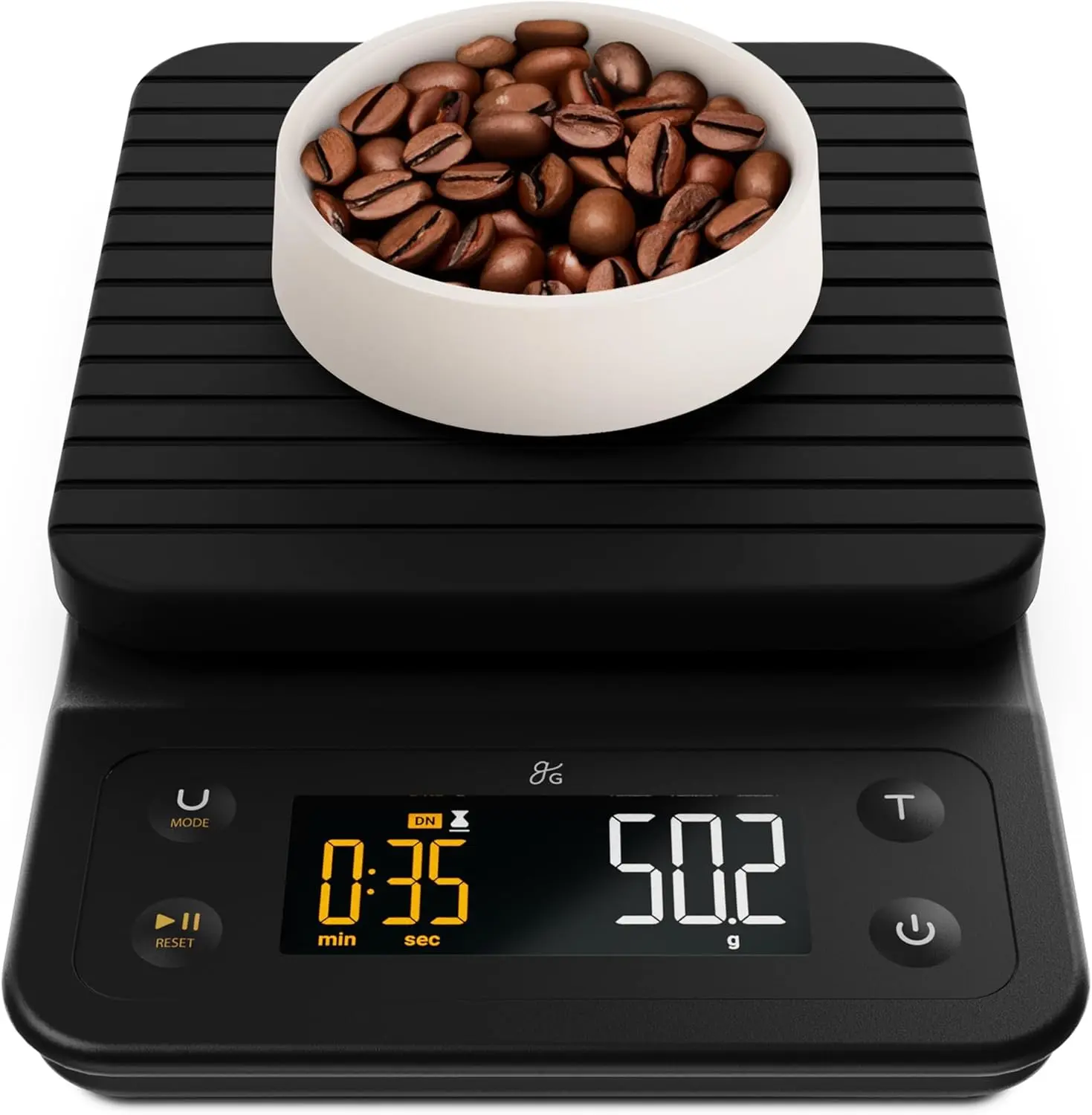
⚖️ Essential — Greater Goods Digital Coffee Scale
A 0.1g-resolution digital scale is non-negotiable for repeatable SR800 roasting. Even 10g of variation between batches shifts your first-crack time by 30+ seconds. Use the same scale for green-bean weight in and roasted-bean weight out — the percentage weight loss is the single most useful indicator of roast level (12–14% loss for City, 14–16% for City+, 16–18% for Full City, 18–20% for Full City+).
Disclosure: CoffeeGearHub may earn from qualifying purchases.
Cooling after the roast: The SR800 includes a cool cycle. If you want additional airflow after the cycle finishes, transfer beans to a clean, heat-safe metal colander or dedicated cooling tray and stir gently. This is a workflow tip rather than a specific product recommendation.
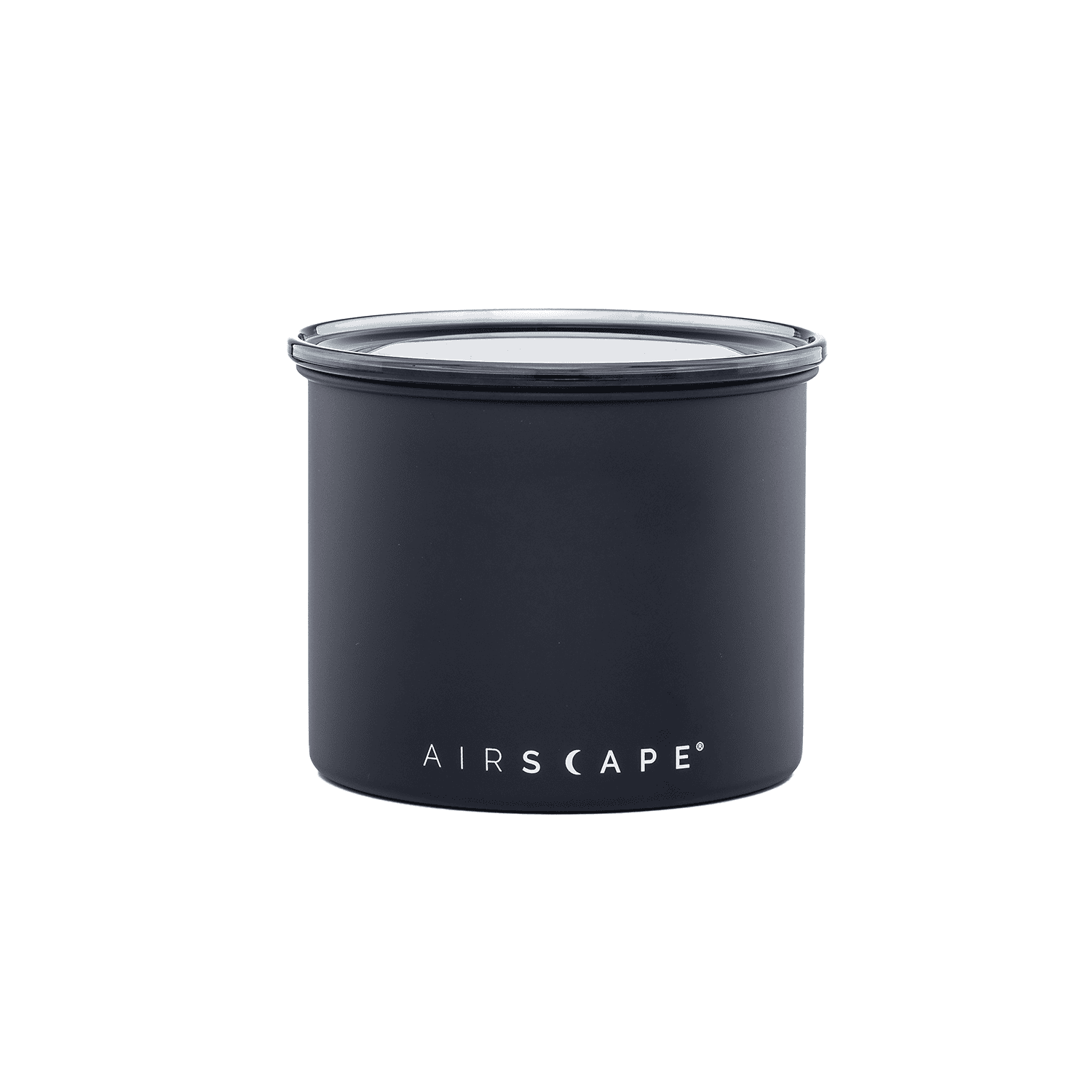
☕ Recommended — Airscape Classic Coffee Canister
Freshly roasted coffee off-gasses CO₂ for 24–72 hours — sealing it in a standard airtight container causes pressure buildup and off-flavours. A canister with a one-way degassing valve (Airscape, Fellow Atmos, or Friis) lets CO₂ escape while blocking oxygen. The 250g size is a perfect match for the SR800’s batch output. Rest City+ in the canister for 3–5 days before grinding for filter; rest espresso roasts 7–14 days.
Disclosure: CoffeeGearHub may earn from qualifying purchases.
- Roast log notebook or app: the difference between 60 random roasts and 60 learning roasts is a written log of fan, heat, time, and tasting notes
- Stovetop range hood or window fan: light and medium roasts produce manageable smoke; dark roasts need real ventilation
- Multimeter — check price on Amazon →: a $15 voltage check at your outlet eliminates the most common “not hot enough” complaint
Fresh Roast SR800 Pros and Cons
✅ Pros
- Independent 9-level heat and 9-level fan control — true profile work possible
- high-output heater — fastest heat-up of any roaster in this price tier
- Glass chamber — full visibility of every colour change
- Largest aftermarket of any home roaster — extension tube, thermocouples, PID, Artisan integration
- Sweet Maria’s reports best results around 215g while the rated maximum remains 8 oz — enough for one to two pounds of weekly drinking coffee
- User-serviceable — replacement parts available for nearly every component
- Compact 14″H × 8.5″ footprint — fits under a stove range hood
- Strong upgrade path — same control logic as the SR540 means muscle memory transfers
⚠️ Cons
- No smoke suppression — needs ventilation for medium and darker roasts
- Voltage sensitive — requires true 120V outlet, no extension cords
- Fan noise can make first crack harder to hear at high airflow settings
- Onboard temperature display reads chamber, not bean temperature
- 120V only — does not ship outside North America
- 1-year base unit warranty (6-month on chaff collector / top cap / basket) — shorter than premium roasters
- Manual roast — not a set-and-forget machine; you stand at it for 12 minutes
- Aggressive default settings — must reset to Fan 9, Heat 9, Timer 20 before first roast
FAQs: Fresh Roast SR800
Is the Fresh Roast SR800 worth it?
It is a strong choice for home roasters who want a manual fluid-bed machine with direct fan and heat control, an 8 oz rated maximum batch size, visible bean movement, and readily available support resources. It is a weaker fit for anyone who wants automated profiles, built-in smoke suppression, or one-pound batches.
What is the maximum batch size?
Home Roasting Supplies rates the SR800 for up to 8 oz (226 g) of wet-processed coffee and up to 6 oz (170 g) of dry-processed coffee because of the additional chaff. Sweet Maria’s reports best results around 215 g in its tip sheet.
Does the glass extension tube increase capacity?
No. Sweet Maria’s explicitly states that its SR800 extension tube does not increase the machine’s rated 8 oz batch size. Its purpose is to change airflow and roasting behavior, including helping users dealing with inadequate line voltage.
What settings should a beginner use?
Treat published settings as starting points rather than fixed recipes. Sweet Maria’s tip sheet reports first crack at about 6 minutes, City+ around 8 minutes, and second crack around 10–12 minutes in its example roast, while emphasizing that color and crack cues matter more than the clock.
Why might an SR800 run cool?
Home Roasting Supplies identifies low supply voltage, extension cords or power strips, cold ambient temperatures, and excessive fan use as common reasons for low heat output. Plug the roaster directly into a suitable wall outlet and follow the manufacturer’s operating guidance.
What warranty does the SR800 have?
Home Roasting Supplies lists a one-year warranty on the base roaster and six months on the glass chamber, top cap, and chaff basket for manufacturer defects. Replacement parts and repair support are also available from the manufacturer and specialty retailers.
Sources & methodology
This review is research-based. CoffeeGearHub does not claim in-house SR800 testing. Specifications and operating guidance were checked against current Home Roasting Supplies and Sweet Maria’s resources; roast-profile tables are editorial starting points derived from published guidance rather than proprietary test data.
Continue Learning
💡 New to Amazon? Try Prime free for fast shipping on picks like these.
HOME ROASTING GUIDES
SR800 dialled in — now ready to compare it against drum roasting? Our complete Behmor 2000AB Plus review covers the same five-profile workflow on a 1 lb drum roaster with patented smoke suppression — the natural next stop for households roasting larger batches indoors.
☕
Written by the CoffeeGearHub Editorial Team
CoffeeGearHub is a specialty coffee equipment resource run by home brewers and coffee enthusiasts. Our guides are researched using manufacturer specifications, appliance-care best practices, and community troubleshooting experience. We review and update our pillar content regularly. About CoffeeGearHub →