
Last Updated: September 2026 • 25–30 min read • Complete Guide: Rankings + Buying Advice + Boiler Types + Grinder Pairings + Comparison Table + Troubleshooting
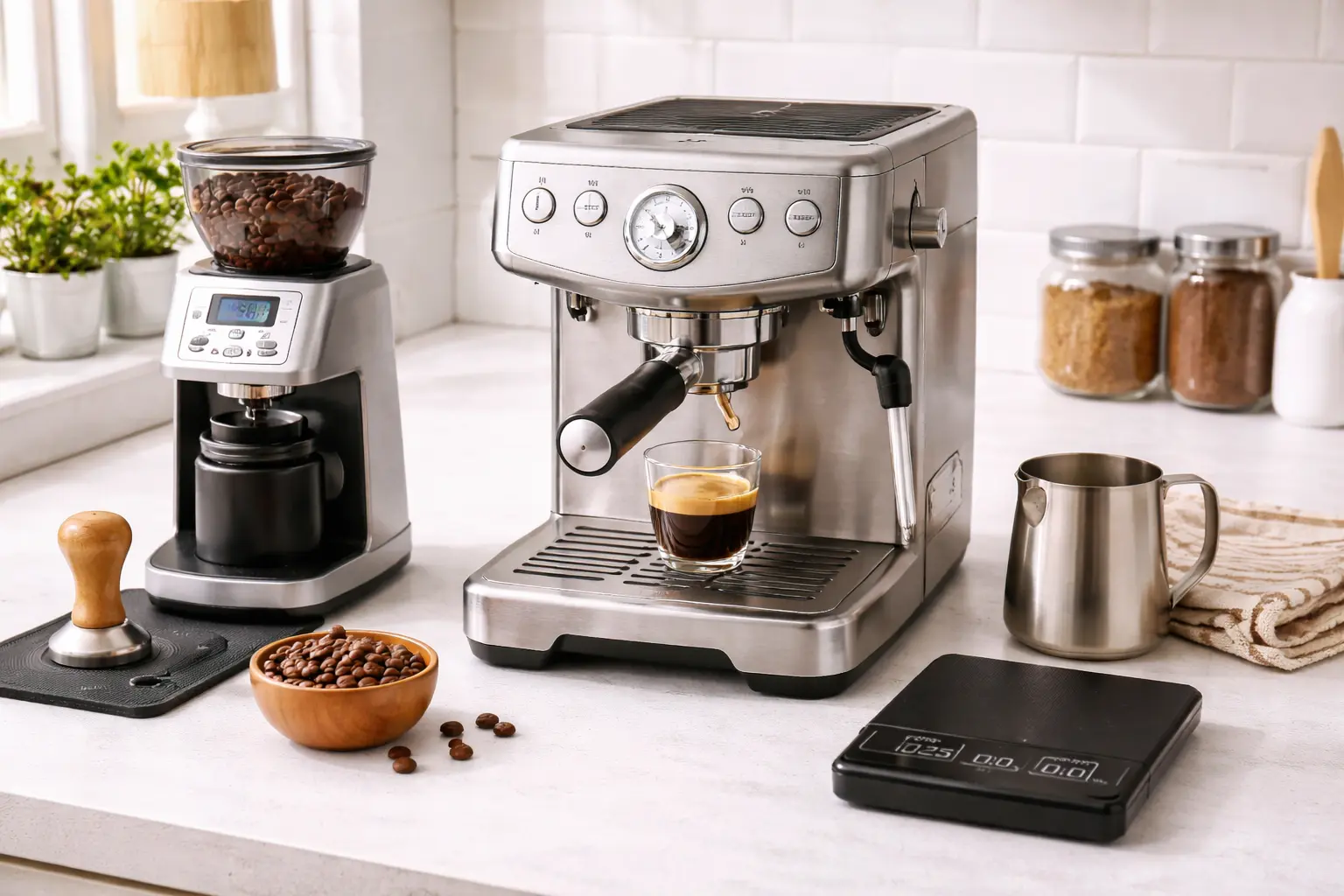
Buying a home espresso machine in 2026 means navigating a market with better options at more price points than ever — but also more ways to get it wrong. Spend too little and you’ll fight the machine for every decent shot. Overspend before you’re ready and you’ll waste money on features you can’t use yet. Buy the wrong category entirely and no amount of technique will help.
To cut through the noise, we reviewed current rankings and in-depth coverage from Tom’s Guide, Reviewed, Consumer Reports, CNN Underscored, Coffeeness, and Cliff & Pebble, then cross-checked key specifications against manufacturer information. We use those sources to compare fit, features, trade-offs, and value; CoffeeGearHub does not claim hands-on testing of these machines. The machines below have proven themselves across multiple rigorous review processes — not just one outlet’s opinion.
✍️ Editorial note: This guide is researched and written by the editors at CoffeeGearHub.com using expert review analysis, specialty coffee community feedback, and established specialty coffee sources. CoffeeGearHub curates recommendations — we do not conduct hands-on product testing. All product links are affiliate links — we may earn a commission at no cost to you. Affiliate Disclosure: CoffeeGearHub.com participates in the Amazon Services LLC Associates Program. As an Amazon Associate, we earn from qualifying purchases.
🛒 New to Amazon? Try Prime free for fast, free shipping on every pick in this guide — or try Audible free if you’d rather listen while your coffee brews.
🏆 Already know what you need? Jump straight to our top picks.
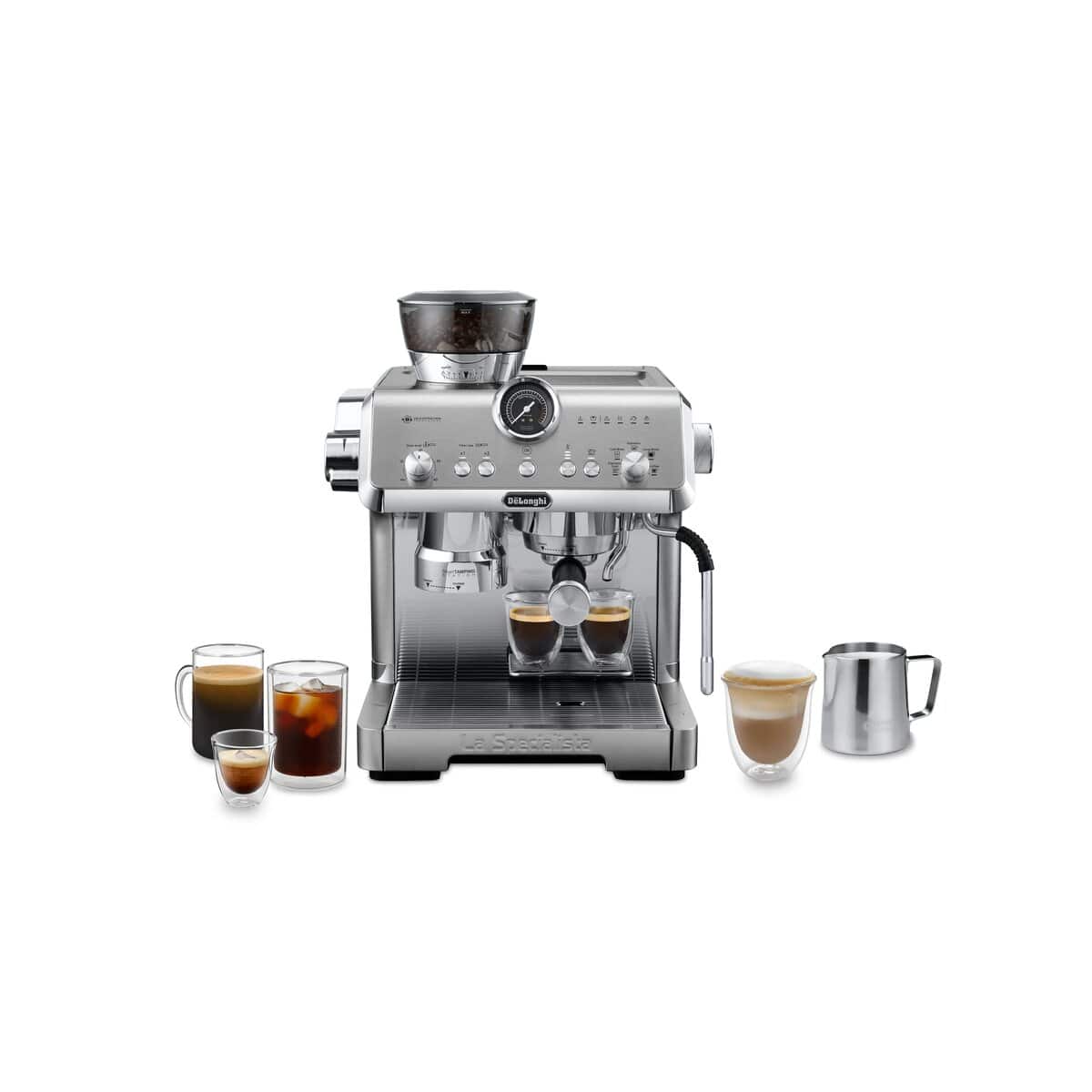
La Specialista Opera
Best overall
Breville Bambino Plus
Best value / beginners
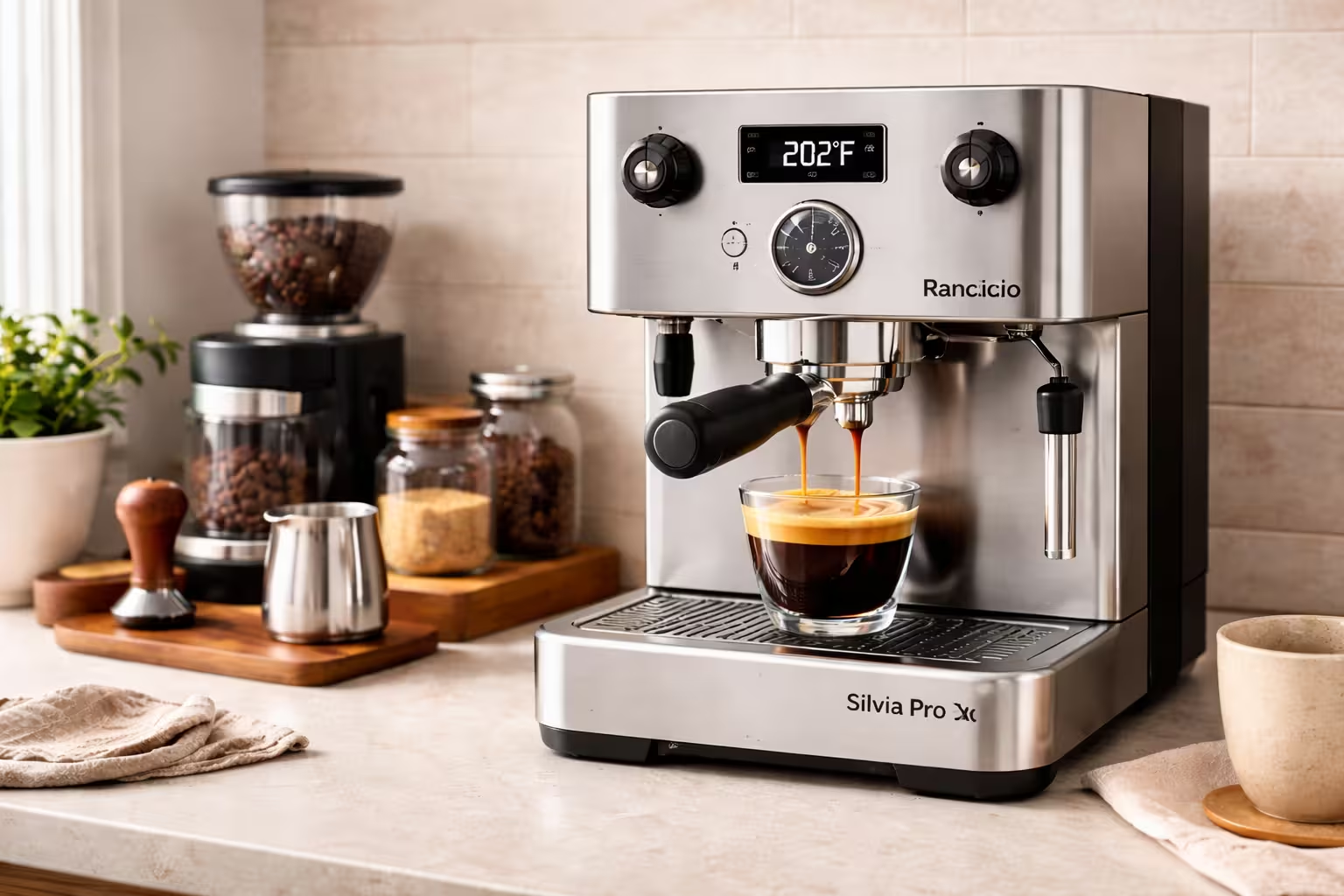
Rancilio Silvia Pro X
Best enthusiast semi-auto
Lelit Mara X
Best prosumer HX
As an Amazon Associate, CoffeeGearHub earns from qualifying purchases. See full rankings with all 8 machines →
The 30-Second Answer
The best home espresso machine for most people in 2026 is the De’Longhi La Specialista Opera — built-in grinder, guided brewing, near-café results from day one. For pure value the Breville Bambino Plus is the most consistently recommended beginner machine across all major review outlets. Serious enthusiasts should look at the Rancilio Silvia Pro X or Gaggia Classic Pro E24. Buyers who want maximum automation without learning a craft should consider the De’Longhi Rivelia superautomatic.
- Best overall: De’Longhi La Specialista Opera — built-in grinder, guided brewing, excellent results out of the box
- Best value / beginners: Breville Bambino Plus — 3-second heat-up, auto steam wand, compact, forgiving
- Best guided semi-auto: Breville Barista Touch Impress — touchscreen coaching, Auto MilQ, built-in grinder
- Best enthusiast machine: Rancilio Silvia Pro X — dual boiler, dual PID, commercial 58mm portafilter
- Best budget: De’Longhi Stilosa — real semi-auto under $200
- Best prosumer HX: Lelit Mara X — simultaneous brew and steam, compact for its class
- Best superautomatic: De’Longhi Rivelia — full bean-to-cup automation, one-touch drinks
Jump to What You Need
🆕 New to espresso machines
Start at How to Choose — three questions that narrow the field.
🏆 Want the rankings now
Jump to Full Rankings — all 8 machines with expert notes.
⚙️ Confused by boiler types
See Boiler Types Explained — single, HX, dual.
⚠️ Shot not tasting right
Jump to Troubleshooting Matrix — every common problem diagnosed.
Table of Contents
How to Choose the Right Home Espresso Machine
The single biggest mistake home espresso buyers make is choosing based on features without accounting for their own skill level and daily routine. A machine with pressure profiling and flow control paddles is genuinely exciting — but useless, or even counterproductive, for someone who hasn’t yet learned to pull a consistent shot. Answer these three questions before comparing specific models.
Question 1: What is your skill level and commitment to learning?
New to espresso or want reliable results with minimal effort: Start with the Breville Bambino Plus, De’Longhi La Specialista Opera, or Breville Barista Touch Impress. These machines guide you through the process rather than requiring prior knowledge.
Willing to learn and enjoy the craft side: The Gaggia Classic Pro E24 and Rancilio Silvia have been relied on by home barista communities for decades because they reward skill with genuinely exceptional results. The learning curve is real — but the ceiling is very high.
Want maximum automation with zero learning curve: A superautomatic like the De’Longhi Rivelia handles grinding, tamping, brewing, and milk frothing at the touch of a button. Accept a lower quality ceiling and enjoy the convenience.
Question 2: Do you need a built-in grinder?
Grind quality is one of the most significant variables in espresso extraction. If you don’t already own a quality burr grinder, a machine with a built-in grinder (La Specialista Opera, Barista Touch Impress, Barista Express) is a practical starting point that avoids a secondary purchase. If you already own or plan to invest in a dedicated burr grinder, skip the built-in and put that budget toward machine quality instead.
Question 3: How often do you make milk drinks?
If you regularly make lattes, cappuccinos, or flat whites, workflow efficiency matters significantly. Dual boiler and heat exchanger machines allow simultaneous brewing and steaming without the temperature-switch wait of single boiler machines. For high-volume milk drink households, the Rancilio Silvia Pro X, Lelit Mara X, or De’Longhi La Specialista Opera are substantially more practical day-to-day.
⚠️ The most common buying mistake: choosing on features before accounting for skill level. A $2,000 machine with a flow control paddle does not make better espresso than a $600 machine in the hands of someone who hasn’t learned to tamp consistently. Match the machine to where you are now, not where you aspire to be.
The Best Home Espresso Machines in 2026: Full Rankings
The machines below are ranked within their category — not in a single unified order — because the best machine for a beginner is not the best machine for a skilled home barista. Each entry covers what expert reviewers consistently highlight as strengths, trade-offs, and who the machine is actually for.
1. De’Longhi La Specialista Opera with Cold Brew — Best Overall
🏆 Best Overall: De’Longhi La Specialista Opera
Best for: most home users — beginners through intermediate — who want excellent results without needing a barista credential
The De’Longhi La Specialista Opera with Cold Brew has emerged as the go-to recommendation for home espresso buyers who want genuinely excellent results without prior training. CNN Underscored’s reviewer called it the best all-around espresso machine tested — producing “rich, smooth and balanced results” from the very first use with near-perfect shots requiring minimal adjustments. Tom’s Guide’s SCA-certified barista ranked the La Specialista Touch (its close sibling) as the best espresso machine for most people, citing its ideal balance between user-friendly design and elevated features.
The Opera bridges guided and hands-on brewing: its built-in burr grinder, active temperature control, and My LatteArt technology provide real espresso-making structure without the rigid automation of a superautomatic. Five drink presets cover the everyday lineup including a cold brew mode, and advanced users can dive into dose, grind size, and temperature customization. The dual heating system allows simultaneous brewing and steaming without single-boiler wait times.
- Balanced espresso shots from day one with minimal calibration required
- Built-in burr grinder removes the need for a separate grinder purchase
- Cold brew preset adds genuine versatility beyond espresso drinks
- Trade-off: Larger footprint than minimalist machines; steam wand requires practice to master
Disclosure: CoffeeGearHub may earn from qualifying purchases.
2. Breville Bambino Plus — Best Value & Best for Beginners
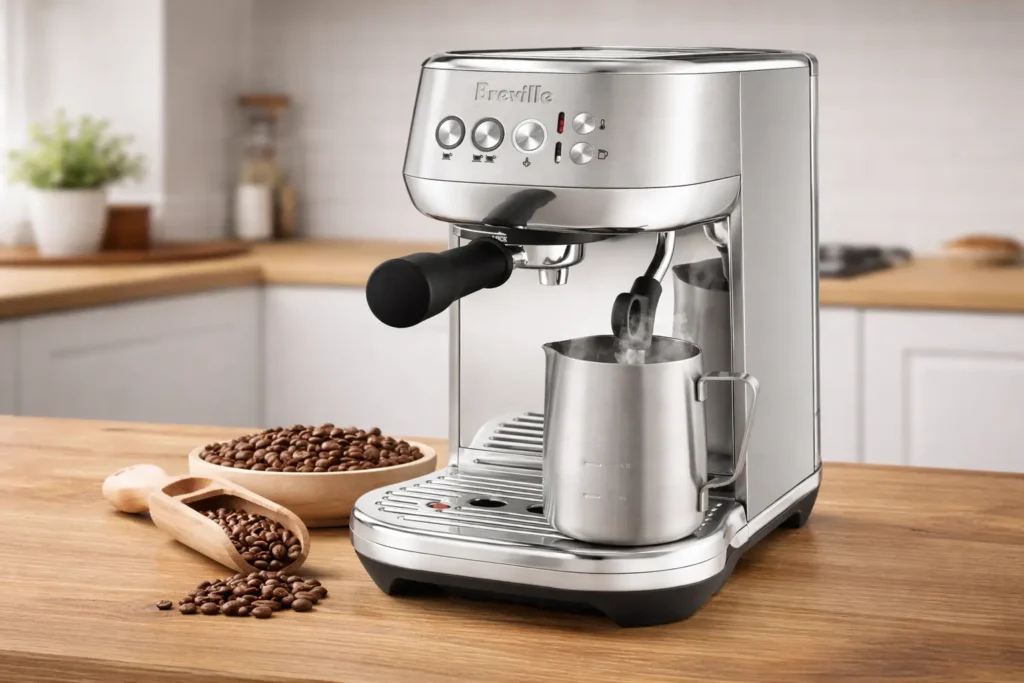
Best Value / Best for Beginners: Breville Bambino Plus
Best for: beginners and small kitchens — the most consistently recommended entry-level machine across all 2026 expert roundups
The Breville Bambino Plus is the most consistently recommended espresso machine for beginners across every major 2026 review roundup. Reviewed called it “an incredible value for the price.” Food Network named it Best Overall in their testing of 15 models. Tom’s Guide’s SCA-certified barista called it the benchmark for home baristas who want quality without complexity. Its ThermoJet heating system reaches optimal brewing temperature in approximately three seconds — the fastest in its class — while PID temperature control maintains consistency across the brew. The automatic steam wand takes the guesswork out of milk texturing by automatically adjusting temperature and froth level.
One consistent note from expert reviewers: budget for a quality burr grinder separately. The Bambino rewards good beans and good grinding — limiting it to pre-ground coffee undersells what this machine can do. At just 7.6 inches wide, it fits countertops where larger machines won’t.
- 3-second heat-up via ThermoJet — fastest in class
- Automatic milk frother produces excellent microfoam without manual technique
- Compact footprint suits apartments and galley kitchens
- Trade-off: No built-in grinder; steam wand direction pulls toward user
Disclosure: CoffeeGearHub may earn from qualifying purchases.
3. Breville Barista Touch Impress — Best Semi-Auto with Guided Features
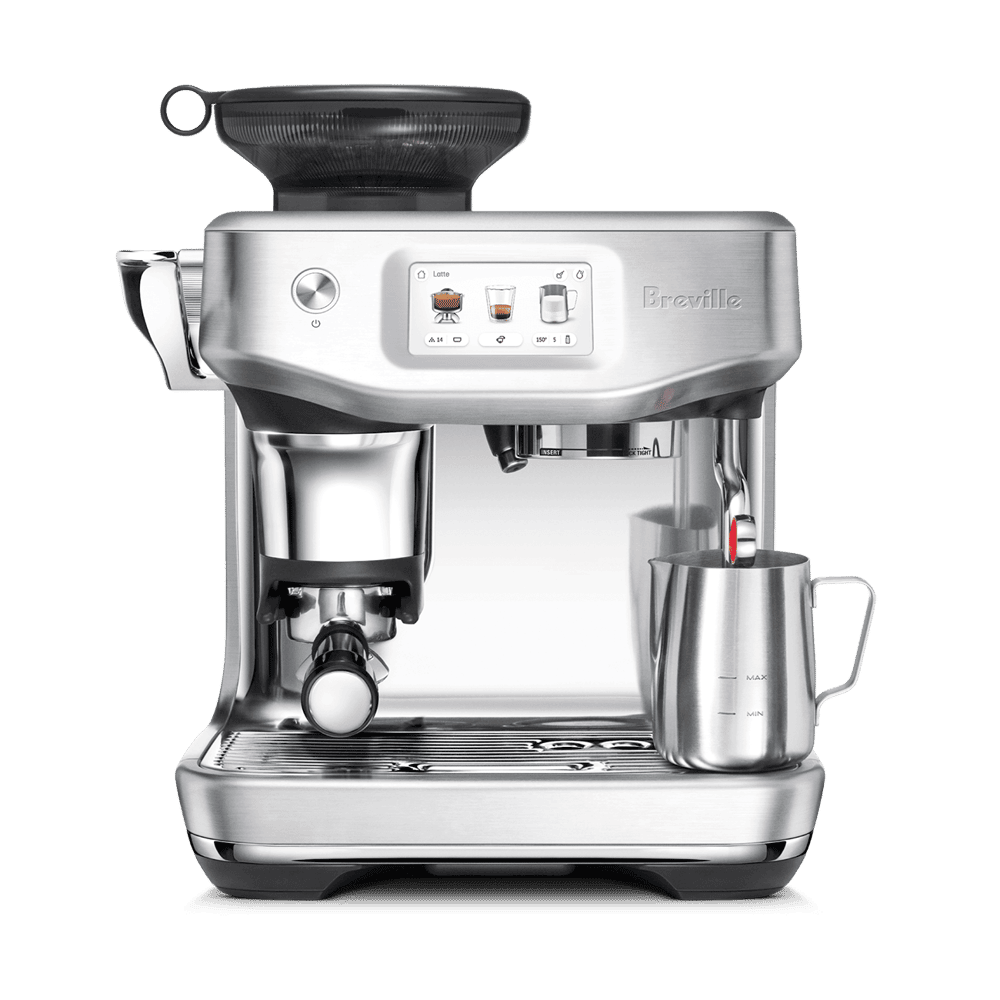
Best Guided Semi-Auto: Breville Barista Touch Impress
Best for: skill-builders who want coaching built into the hardware — touchscreen guidance, grind feedback, and assisted tamping
Reviewed called the Barista Touch Impress “the best espresso machine we’ve ever tested.” TechRadar’s SCA-certified barista placed it at the top of their 2026 guide, crediting the Impress Puck System — an integrated tamping tool built into the grinder — as a meaningful step forward. After each shot the machine evaluates extraction time and prompts you to adjust grind size for the next pull, building an active coaching loop into the hardware. The Auto MilQ system includes programmed dairy-free settings for oat, soy, and almond milk, adjusting steam parameters per milk type — a feature reviewers consistently praised as genuinely practical.
- Impress Puck System guides consistent tamping from the first shot
- Post-shot grind feedback actively helps you dial in extraction over time
- Auto MilQ with dairy-free profiles for oat, soy, and almond milk
- Trade-off: Premium price; built-in grinder limits future grinder upgradability
Disclosure: CoffeeGearHub may earn from qualifying purchases.
4. Rancilio Silvia Pro X — Best Enthusiast Semi-Automatic
Best Enthusiast Semi-Auto: Rancilio Silvia Pro X
Best for: skilled home baristas who want commercial-grade performance and dual-boiler workflow at home
The Rancilio Silvia is one of the most beloved espresso machines in home barista history — and the Pro X takes that legacy and upgrades it substantially. Where the original Silvia is a demanding single-boiler machine, the Pro X adds a full dual-boiler system with independent PID control on both the brew and steam boilers, eliminating temperature-surf timing entirely and enabling simultaneous brewing and steaming. TechGearLab’s expert barista panel found that Silvia-pulled shots were “fan favorites” — one tester remarked that a blind comparison between a Silvia shot and a coffee shop shot would be genuinely difficult to call.
The 58mm commercial portafilter is the same standard found on commercial machines, meaning accessories, baskets, and tampers from the professional ecosystem are fully compatible. The steam wand is powerful and rewards technique with exceptional microfoam.
- Dual boiler + dual PID for precise, simultaneous brew and steam
- Commercial 58mm portafilter — compatible with professional accessories
- Café-comparable shot quality ceiling in skilled hands
- Trade-off: No built-in grinder; steep learning curve; requires technique investment
Disclosure: CoffeeGearHub may earn from qualifying purchases.
5. Gaggia Classic Pro E24 — Best Entry-Level Enthusiast Machine
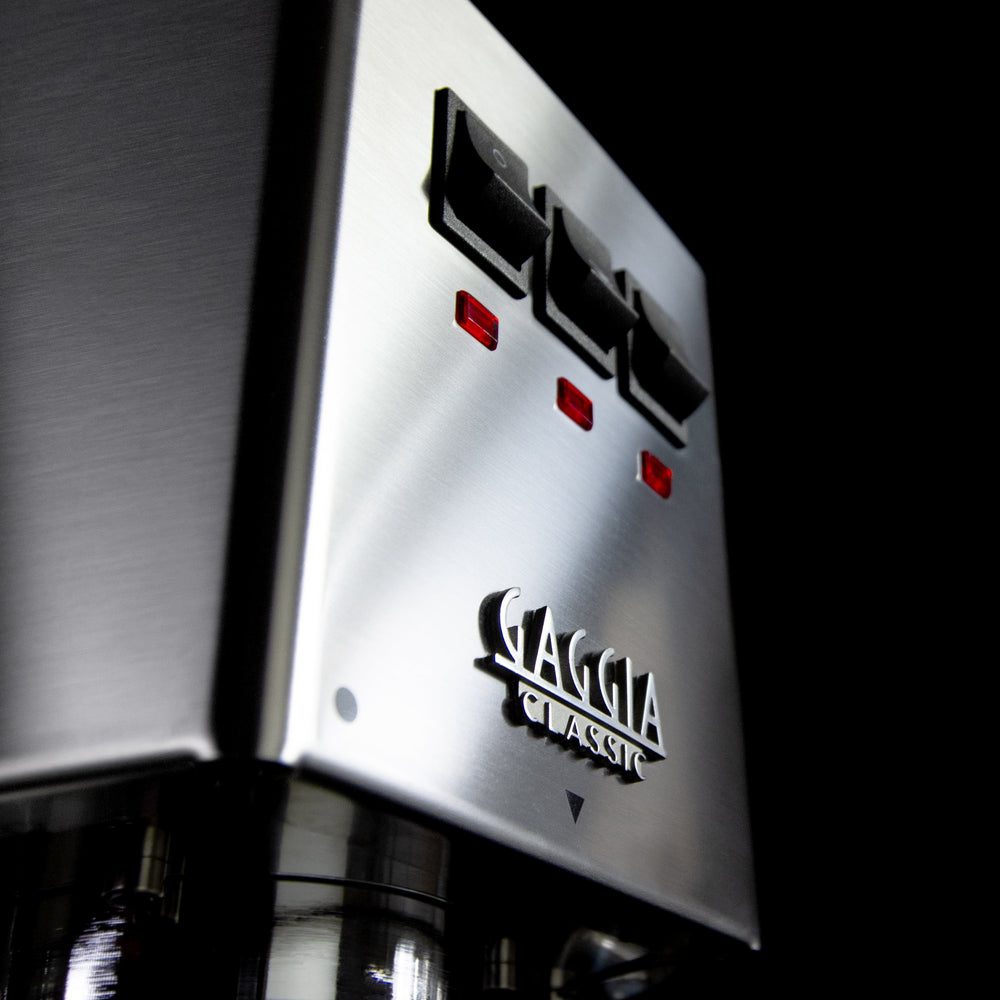
Best Entry Enthusiast: Gaggia Classic Pro E24
Best for: enthusiasts on a budget who want commercial-spec hardware and are ready to learn temperature management
The Gaggia Classic Pro E24 is the current version of Gaggia’s long-running entry enthusiast machine. The E24 adds a solid lead-free brass boiler and group head, a 58mm stainless-steel portafilter, 9-bar brew-pressure calibration, and a commercial-style two-hole steam wand. It remains a hands-on single-boiler machine with no built-in grinder or stock PID, so it best suits buyers who want serviceable hardware and are willing to learn temperature management.
- Commercial 58mm portafilter and commercial-style steam wand
- Simple, distraction-free interface — three buttons, one dial
- Highly modifiable — one of the most popular PID mod platforms in home espresso
- Trade-off: No PID stock; requires temperature management skill; no built-in grinder
Disclosure: CoffeeGearHub may earn from qualifying purchases.
6. De’Longhi Stilosa — Best Budget Espresso Machine
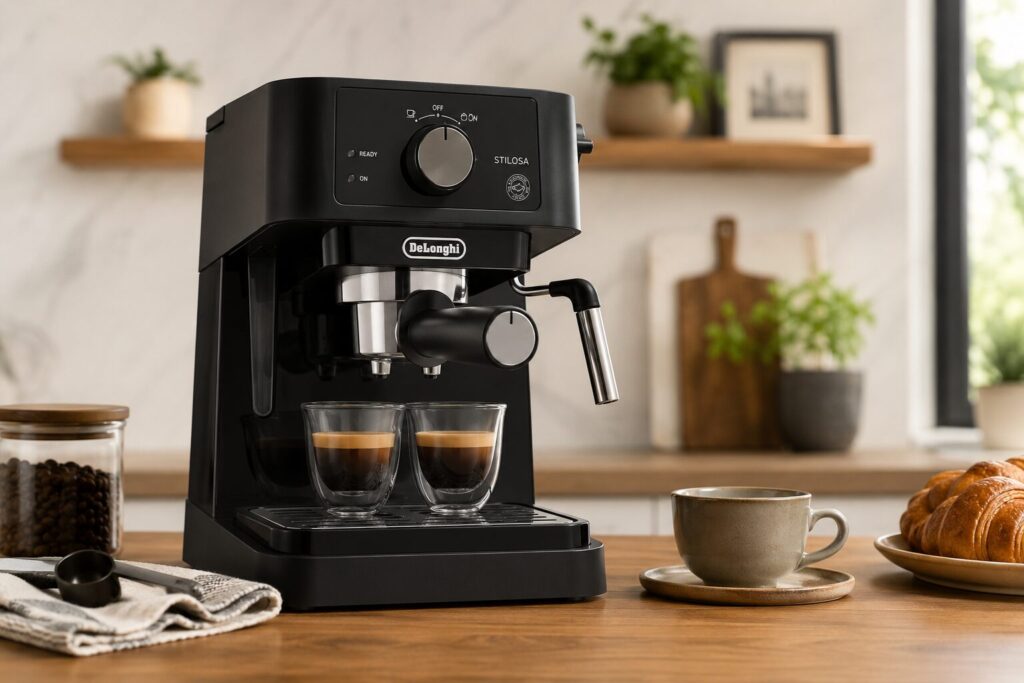
Best Budget: De’Longhi Stilosa
Best for: true budget buyers who want genuine semi-automatic espresso at the lowest possible price
If your primary goal is genuine espresso — not pods, not concentrate — at the lowest possible price, the De’Longhi Stilosa is the machine multiple 2026 review outlets name as the entry point. Tom’s Guide’s barista ranked it Best Budget Espresso Machine, highlighting its capable performance relative to its entry-level price. The Stilosa is honest about what it is: a minimalist, ultra-compact machine that gets the job done without extras. Its higher-pressure steam wand heats milk quickly, though reviewers at TechGearLab noted the speed makes temperature control more demanding than on lower-pressure wands. It can struggle with consecutive drinks. For a single-espresso household learning the basics, it’s a reasonable and low-risk entry point.
- Genuine espresso at the lowest price of any semi-automatic in this roundup
- Ultra-compact footprint — one of the smallest machines reviewed here
- Trade-off: High-pressure wand harder to control; struggles with back-to-back drinks; limited longevity vs premium machines
Disclosure: CoffeeGearHub may earn from qualifying purchases.
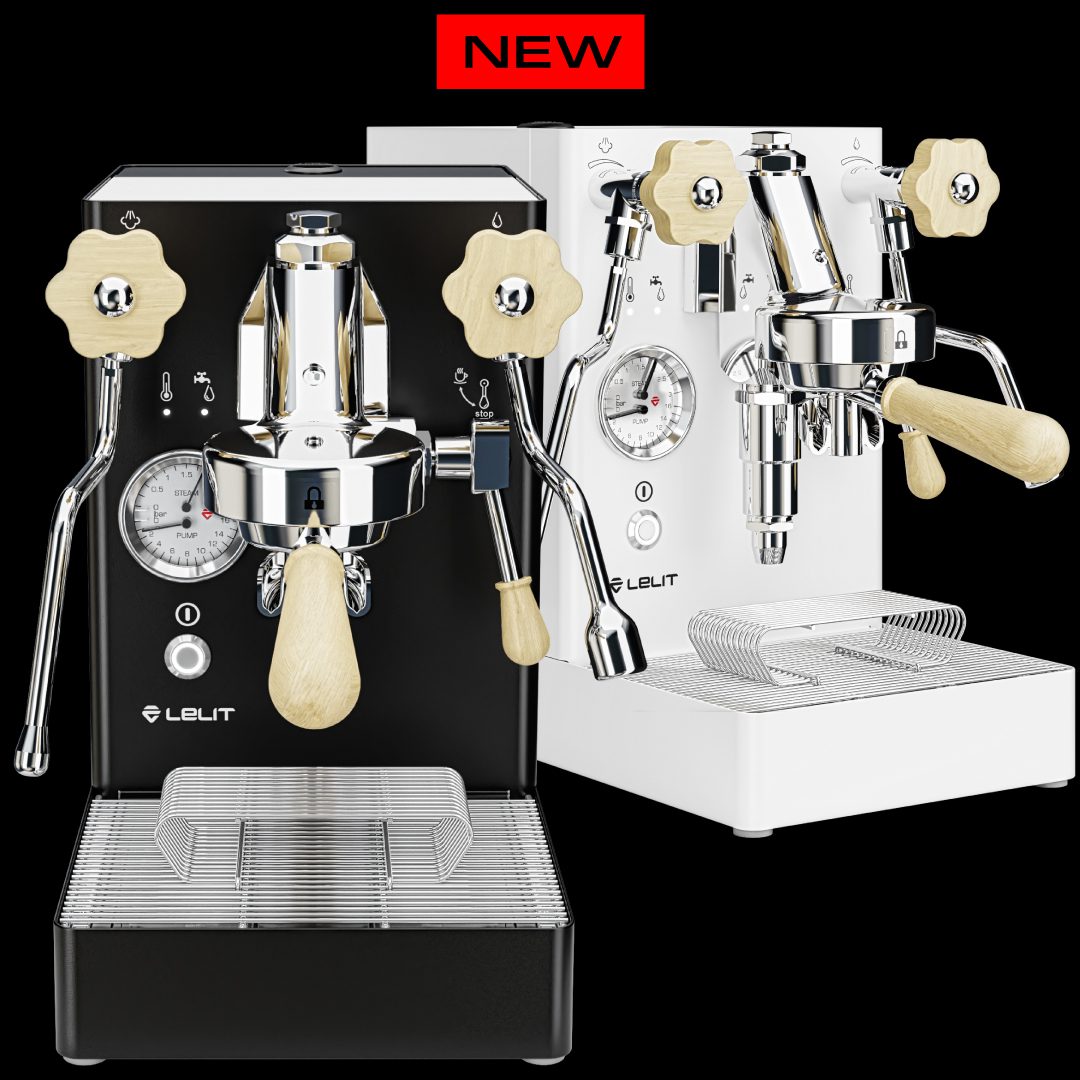
7. Lelit Mara X — Best Prosumer Heat Exchanger Machine
Best Prosumer HX: Lelit Mara X
Best for: advanced home baristas who want simultaneous brew and steam in a compact prosumer footprint
The Lelit Mara X sits at a compelling intersection: prosumer-grade heat exchanger performance in a footprint compact enough for most home kitchens. Coffeeness called it a “big step up in quality and performance” from single-boiler machines in the same price range. Cliff & Pebble — a specialty coffee retailer with a decade of customer satisfaction data — consistently lists the Mara X among its most recommended prosumer machines based on long-term ownership happiness. The heat exchanger design allows simultaneous brewing and steaming without the wait associated with single-boiler temperature switching. A unique dual-mode boiler can switch between brew-priority and steam-priority modes — a refinement not found on standard HX machines.
- Simultaneous brew and steam without the wait of single-boiler machines
- Dual-mode boiler — switchable between brew-priority and steam-priority
- E61 group head for thermal stability and accessory compatibility
- Trade-off: Premium price; requires separate grinder; not a beginner machine
Disclosure: CoffeeGearHub may earn from qualifying purchases.
8. De’Longhi Rivelia — Best Superautomatic for Convenience-First Buyers
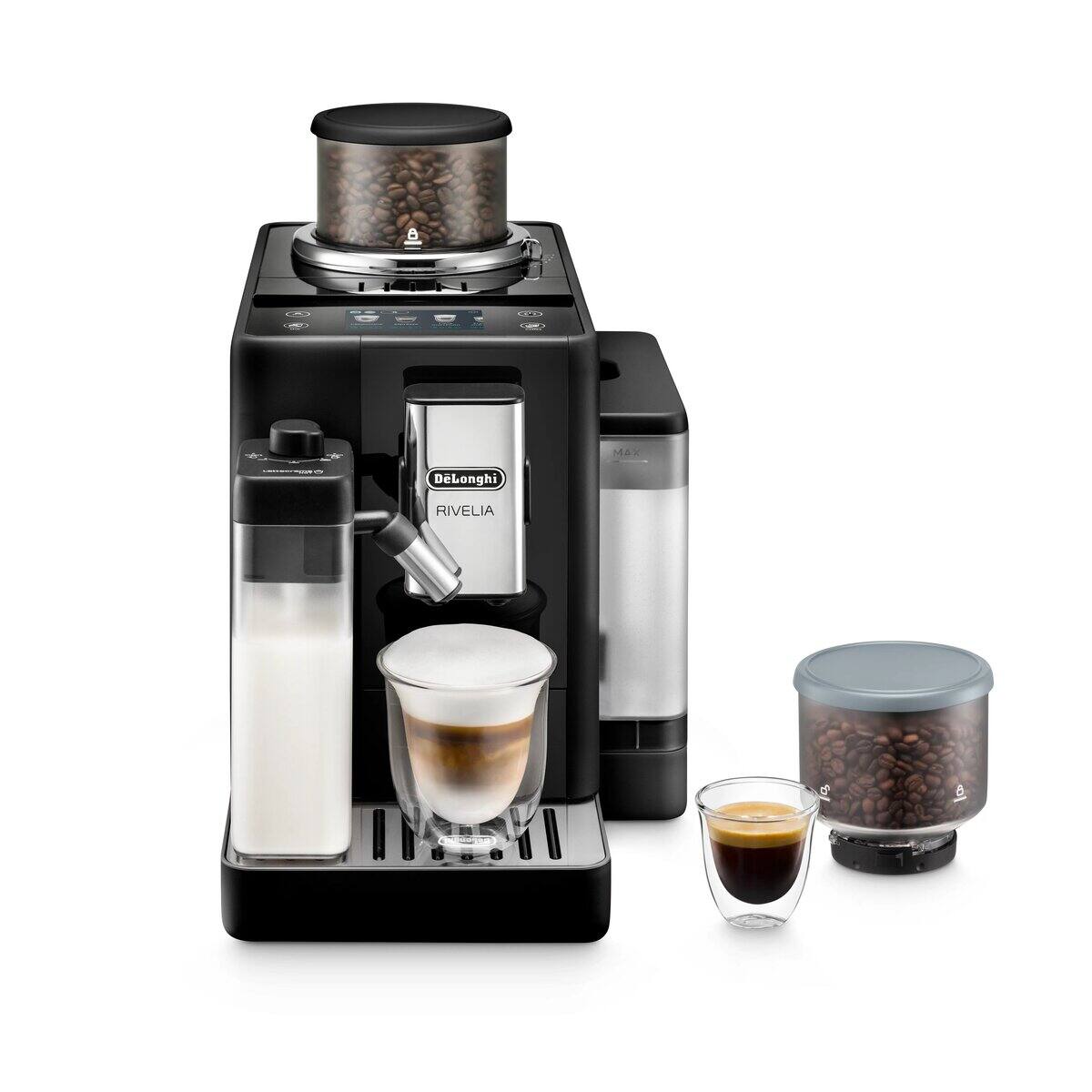
Best Superautomatic: De’Longhi Rivelia
Best for: maximum convenience, multi-user households, and buyers who want whole-bean freshness without the craft
The De’Longhi Rivelia is Coffeeness’s 2026 recommendation as the top superautomatic for home use, replacing the Dinamica Plus in their updated rankings. Superautomatic machines handle grinding, tamping, brewing, and milk frothing entirely on their own. As Canyon Coffee co-owner Casey Wojtalewicz explained to CNN Underscored, they represent “the ultimate convenience and luxury for making quality espresso” for buyers who want whole-bean freshness without the process of manual preparation. The Rivelia’s LatteCrema milk system handles lattes, cappuccinos, and flat whites automatically and with good consistency. For multi-person households where different family members want different drinks at different times, the one-touch operation is a meaningful quality-of-life benefit that no semi-automatic machine can match.
- Fully automatic bean-to-cup process for maximum daily convenience
- LatteCrema milk system handles lattes, cappuccinos, and flat whites automatically
- Built-in conical burr grinder with adjustable grind fineness
- Trade-off: Lower quality ceiling than semi-automatic; less user control over extraction variables
Disclosure: CoffeeGearHub may earn from qualifying purchases.
Boiler Types Explained: Single, Heat Exchanger, and Dual Boiler
The boiler configuration is arguably the most important technical factor in an espresso machine’s performance and daily workflow. Here’s how the three main types compare — and what each means for real-world use.
| Boiler type | How it works | Brew and steam simultaneously? | Best for | Examples |
|---|---|---|---|---|
| Single boiler | One boiler handles both brewing and steaming; requires switching and waiting between modes | No — must switch and wait | Single-espresso households; beginners; budget builds | Gaggia Classic Pro E24, Breville Bambino Plus, De’Longhi Stilosa |
| Heat exchanger (HX) | One large steam boiler with internal copper circuit heats brew water at lower temperature simultaneously | Yes — with a cooling flush before each shot | Milk drink workflow; intermediate–advanced users; prosumer value | Lelit Mara X, Rocket Appartamento |
| Dual boiler | Two fully independent boilers — one for brewing, one for steam — each with its own PID | Yes — no flush, no waiting, no compromise | Serious home baristas; high-volume households; maximum consistency | Rancilio Silvia Pro X, Lelit Bianca V3, Breville Oracle Jet |
🔬 Why the boiler type matters for milk drink workflow: If you regularly make lattes or cappuccinos for two people in the same session, single-boiler temperature switching adds 5–10 minutes of wait time per round. Most buyers who upgrade from a single-boiler machine cite this friction point specifically. If milk drinks are part of your daily routine, budget for at least a heat exchanger machine from the start.
Quick Comparison: Best Home Espresso Machines 2026
| Machine | Best for | Boiler type | Built-in grinder | PID | Skill level |
|---|---|---|---|---|---|
| De’Longhi La Specialista Opera | Best overall / all-in-one | Dual heating | Yes | Yes | Beginner–Intermediate |
| Breville Bambino Plus | Best value / beginners | Single (ThermoJet) | No | Yes | Beginner |
| Breville Barista Touch Impress | Guided skill-building | Single (ThermoJet) | Yes | Yes | Beginner–Intermediate |
| Rancilio Silvia Pro X | Enthusiast semi-auto | Dual boiler | No | Dual PID | Intermediate–Advanced |
| Gaggia Classic Pro E24 | Entry-level enthusiast | Single aluminum | No | No (aftermarket available) | Intermediate |
| De’Longhi Stilosa | Best budget | Single thermoblock | No | No | Beginner |
| Lelit Mara X | Prosumer HX | Heat exchanger | No | Yes | Advanced |
| De’Longhi Rivelia | Best superautomatic | Single | Yes (conical burr) | Yes | All levels |
⚡ Compare Prices Before You Buy
Before committing to a new machine, it may be worth checking eBay for discounted kits, lightly used machines, or bundled accessories — especially on models like the Gaggia Classic Pro E24 and Rancilio Silvia where the used market is strong.
Suggested eBay search term:breville espresso machine
Grinder Pairings for Machines Without a Built-In Grinder
If you choose a machine without a built-in grinder — which includes the Bambino Plus, Gaggia Classic Pro E24, Rancilio Silvia Pro X, and Lelit Mara X — grinder selection is critical. Espresso requires consistent, fine, and uniform particle size that most entry-level grinders cannot reliably achieve. Blade grinders are not suitable for espresso under any circumstances.
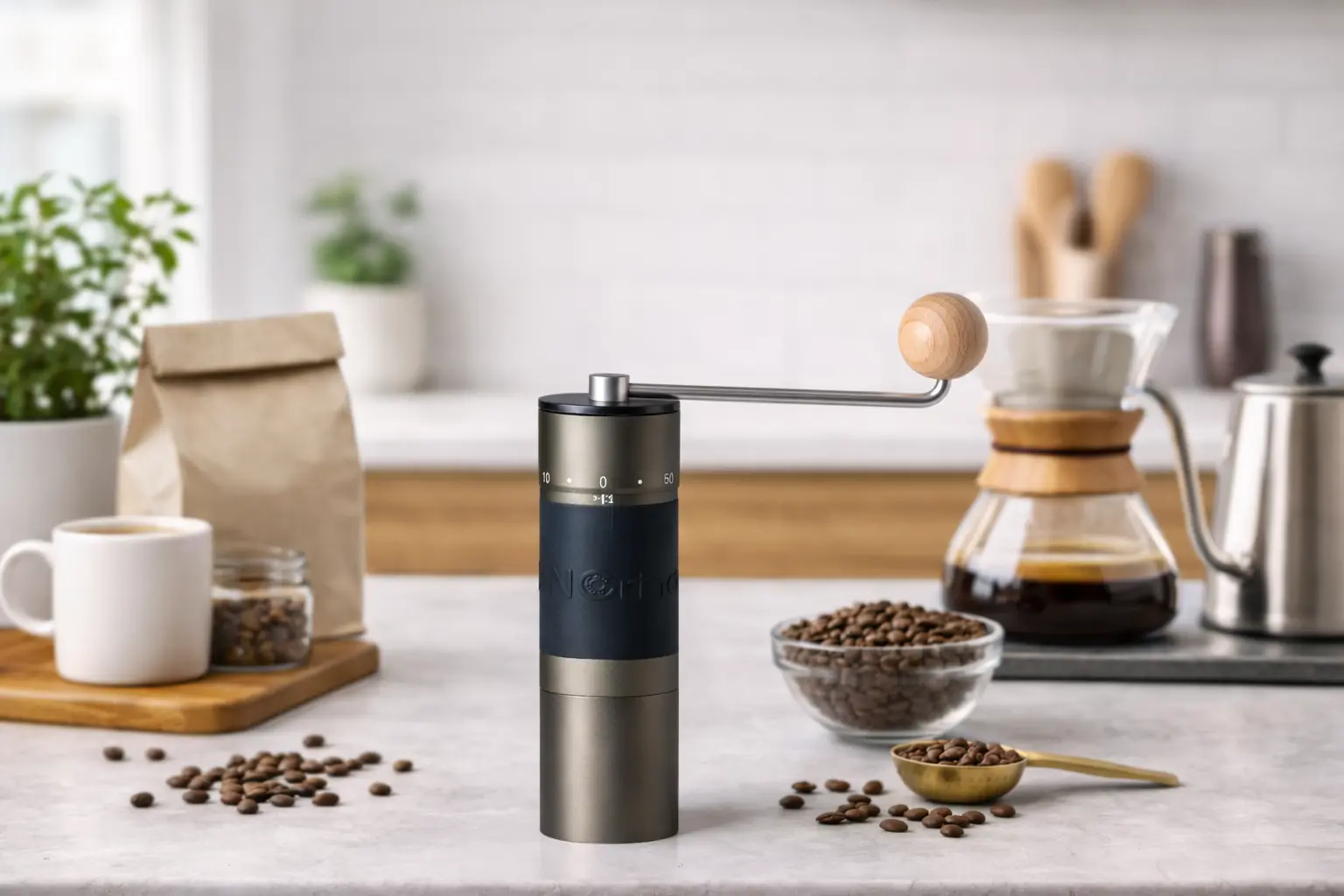
⚙️ Our site-standard manual grinder recommendation: the KINGrinder K6 offers espresso-capable grind consistency, stepless adjustment, and meaningful build quality at a price that does not require a separate four-figure grinder budget. It is our go-to recommendation across all CoffeeGearHub espresso content where a manual option is appropriate.
As an Amazon Associate, CoffeeGearHub earns from qualifying purchases.
For electric grinders at the mid-range espresso level, the Baratza Sette 270 and Eureka Mignon Silenzio are consistently recommended by specialty coffee reviewers as strong options. A common and expensive mistake is pairing a serious espresso machine with a cheap burr grinder. The machine cannot compensate for inconsistent grind — you will waste good coffee and blame the machine. Budget for both components from the start.
💸 Save on Espresso Equipment: Check eBay Deals
Looking for a lower-cost way to get into home espresso? eBay can be useful for open-box, used, and refurbished machines — as well as standalone grinders, tampers, and portafilter upgrades.
Suggested eBay search term:espresso machine steam wand
Troubleshooting Matrix: Common Home Espresso Problems
Identify your symptom in the first column. Apply fixes in the order listed — the first fix resolves the problem in the majority of cases. Change one variable per attempt and re-test.
| Problem | Likely cause | Fix — in order |
|---|---|---|
| Sour, thin, or weak shots | Under-extraction — grind too coarse, dose too low, or brew temp too low | Grind finer in small increments → verify dose → check brew temperature setting |
| Bitter, harsh, or dry finish | Over-extraction — grind too fine or brew ratio too long | Grind slightly coarser → shorten shot time → verify dose weight |
| Shot pulls too fast (under 20 seconds) | Grind too coarse or under-tamped | Grind finer → apply consistent tamp pressure → check basket dose weight |
| Shot pulls too slow (over 40 seconds) | Grind too fine, over-tamped, or channeling | Grind slightly coarser → distribute grounds evenly before tamping |
| Channeling — uneven extraction, pale streaks | Uneven grounds distribution or uneven tamp | Use a WDT tool before tamping → ensure level tamp → confirm flat puck surface |
| No crema or very thin crema | Stale beans, under-dosed, or grind too coarse | Use freshly roasted beans within 2–4 weeks of roast → check grind size and dose |
| Milk foam has large bubbles | Steam wand technique — too much air introduced too fast | Lower pitcher slightly during aeration; listen for soft hissing not loud gurgling |
| Machine takes too long to heat up | Scale buildup in boiler | Descale per manufacturer instructions → use filtered water going forward |
| Portafilter leaks or won’t lock | Group head gasket worn | Replace group head gasket — normal maintenance, typically every 1–2 years |
| Inconsistent results day to day | Variable dose weight, grind size drift, or temperature instability | Use a scale for every dose → keep grinder setting consistent → warm machine up fully before first shot |
Final Takeaway: Matching Machine to Barista
Home espresso is not complicated when you understand what each variable controls. The machine you choose sets the ceiling — but your technique, grinder, and beans determine whether you ever get close to it. Match the machine to your actual skill level and workflow, not to an aspirational version of yourself. Start with the right category and upgrade within it when you’ve genuinely outgrown what you have. The home barista community’s most consistent advice, across decades of forum posts and review threads, is simply this: buy less machine than you think you need, learn it properly, and upgrade from a position of genuine knowledge rather than spec-sheet anxiety.
FAQs: Best Home Espresso Machines 2026
What is the best home espresso machine for beginners?
The Breville Bambino Plus is the most consistently recommended beginner espresso machine across 2026 expert review sites. It heats up in about three seconds via its ThermoJet system, features an automatic steam wand, and produces consistently well-extracted shots without requiring professional barista skills. The De’Longhi La Specialista Opera is also an excellent choice for beginners who want the convenience of a built-in grinder.
How much should I spend on a home espresso machine?
Entry-level machines start around $200–$500 (Breville Bambino Plus, De’Longhi Stilosa). Mid-range all-in-one semi-automatics with built-in grinders run $700–$1,200 (De’Longhi La Specialista Opera, Breville Barista Touch Impress). Enthusiast-grade prosumer machines range from $1,500–$2,500+ (Rancilio Silvia Pro X, Lelit Mara X). The biggest mistake is underspending and frustrating yourself early, or overspending on complexity you’re not ready to use.
Do I need a separate grinder for an espresso machine?
Yes, unless your machine includes a built-in burr grinder. For machines like the Breville Bambino Plus or Rancilio Silvia Pro X, a quality burr grinder is essential — grind consistency is one of the single biggest variables in espresso extraction quality. Blade grinders are not suitable for espresso.
What is the difference between a single boiler, heat exchanger, and dual boiler?
Single boiler machines use one boiler for both brewing and steaming, requiring a temperature switch and wait between tasks. Heat exchanger machines use one large steam boiler with an internal channel to brew at lower temperature simultaneously — good for milk drink workflow. Dual boiler machines have two fully independent boilers for precise simultaneous brewing and steaming — preferred by serious home baristas.
Is a superautomatic espresso machine worth buying?
Superautomatic machines are ideal for buyers who value maximum convenience over craft. They grind, tamp, brew, and often froth milk at the touch of a button. The trade-off is less control over extraction variables and a lower quality ceiling compared to a well-dialed semi-automatic setup. Buyers with very discerning palates often prefer semi-automatic machines for the control they provide.
What is the best espresso machine under $500?
The Breville Bambino Plus is the top-rated espresso machine under $500 across multiple 2026 expert review roundups. It delivers fast heat-up via ThermoJet, precise temperature control, and a capable auto-steam wand at a price point that outperforms most competitors in its range.
Which espresso machines have a built-in grinder?
Machines with integrated burr grinders include the De’Longhi La Specialista series (Touch, Opera, Arte Evo), Breville Barista Express, Breville Barista Touch Impress, Breville Oracle Jet, and superautomatic models like the De’Longhi Rivelia. Having a built-in grinder adds convenience but limits future grinder upgradability.
How long do home espresso machines last?
Quality home espresso machines typically last 5–10 years with proper maintenance. Commercial-inspired machines such as the Rancilio Silvia and Gaggia Classic Pro E24 use durable, serviceable components, but actual lifespan depends on water quality, maintenance, usage, and parts availability. Regular cleaning and manufacturer-recommended maintenance can extend useful life.
Do I need a PID controller on my espresso machine?
A PID controller allows precise digital temperature control of your boiler, which directly improves shot consistency. It is recommended for any serious home espresso setup. Many modern enthusiast machines include PID control as standard. The Gaggia Classic Pro E24 does not include a stock PID, though aftermarket PID kits are available for experienced owners who accept the modification trade-offs.
What espresso machine do most home baristas recommend?
The Breville Bambino Plus and Rancilio Silvia consistently top home barista community recommendations. The Gaggia Classic Pro E24 remains a common entry point for buyers who want a traditional, serviceable semi-automatic machine. For higher budgets, the Lelit Mara X and Rocket Appartamento appear frequently in prosumer community discussions.
Continue Learning
💡 New to Amazon? Try Prime free for fast shipping on picks like these.
ESPRESSO TECHNIQUE
Machine chosen — now ready to master the technique? The steam milk guide covers everything from wand position and aeration timing to dairy-free milk steaming, with a full troubleshooting matrix for every foam problem.
☕
Written by the CoffeeGearHub Editorial Team
CoffeeGearHub is a specialty coffee equipment resource run by home brewers and coffee enthusiasts. Our guides are researched using expert review analysis, specialty coffee community feedback, and established specialty coffee sources. We curate recommendations — we do not conduct hands-on product testing. We review and update our pillar content regularly. About CoffeeGearHub →
Compare current CoffeeGearHub product pages
Use these stable CoffeeGearHub product pages to compare specifications and current verified merchant offers before leaving the site.