Last Updated: March 10, 2026 • 20–26 min read • Covers: SCA Certification + Brew Temperature Science + Eight Machine Picks + Thermal vs. Glass Carafe + Grinder Pairing + Troubleshooting Matrix
✍️ Editorial note: This guide is researched and written by the editors at CoffeeGearHub.com using published brewing science, SCA certification standards, equipment manufacturer specifications, and established specialty-coffee community knowledge. Recommendations reflect research consensus rather than in-house lab testing. All product links are affiliate links — we may earn a commission at no cost to you.
The 30-Second Answer
The best drip coffee maker is one that consistently brews at 197°F–205°F, distributes water evenly across the grounds, and completes an 8-cup brew in 4–8 minutes. Most machines sold at major retailers fail all three criteria. SCA certification is the most reliable shortcut to knowing a machine actually meets these standards — and it matters far more than programmability, carafe style, or brand recognition.
- Best overall: OXO Brew 9-Cup — SCA-certified, excellent showerhead distribution, compact footprint
- Best SCA-certified runner-up: Cuisinart PerfecTemp DCC-3400 — programmable, widely available, strong everyday performer
- Best thermal carafe: Zojirushi Fresh Brew Plus — best-in-class heat retention, no hot plate required
- Best SCA-certified premium: Technivorm Moccamaster KBG Select — handmade in the Netherlands, proven 10–20 year lifespan
- Key rule: brew temperature is the single most important spec — a machine that can’t reach 197°F will under-extract regardless of how much it costs
Who This Guide Is For — Jump to What You Need
☕ Everyday Home Brewing
Start at Top Picks Table + Best Overall + Buying Guide.
🏆 Best Possible Cup
Jump to SCA-Certified Picks + Brew Temperature Science.
💰 Budget or First Machine
Jump to Best Budget Pick + Decision Guide.
🛠️ Fixing Weak or Bitter Coffee
Go straight to the Troubleshooting Matrix.
Table of Contents
Top Picks: Best Drip Coffee Makers (2026)
| Pick | Machine | Best For | SCA Certified | Our Take |
|---|---|---|---|---|
| 🥇 Best Overall | OXO Brew 9-Cup | Most home brewers | ✅ Yes | Best balance of performance, size, and value |
| 🥈 Runner-Up | Cuisinart PerfecTemp DCC-3400 | SCA quality + programmability | ✅ Yes | Best everyday SCA-certified workhorse |
| 💰 Best Budget | Hamilton Beach 12-Cup | Entry-level buyers | ❌ No | Best cup quality per dollar under $50 |
| ⏰ Best Programmable | Cuisinart DCC-3200P1 | Auto-brew convenience | ✅ Yes | Best 24-hour programming + keep-warm control |
| 🌡️ Best Thermal | Zojirushi Fresh Brew Plus | Slow drinkers, quality preservation | ✅ Yes | Best heat retention without a hot plate |
| ☕ Best Compact | Bonavita 5-Cup One-Touch | Small households, 1–4 cups | ✅ Yes | Best SCA-certified small-batch machine |
| 🏆 Best Premium | Technivorm Moccamaster KBG Select | Enthusiasts, long-term investment | ✅ Yes | The benchmark SCA-certified machine — built to last decades |
Why Brew Temperature Is the Single Most Important Spec in a Drip Coffee Maker
Most people buy a drip coffee maker based on carafe style, programmability, or brand recognition. None of those things affect what ends up in the cup as directly as one variable that almost never appears in marketing materials: brew water temperature.
Coffee extraction is a chemistry problem. The soluble compounds that create sweetness, body, and complexity dissolve most efficiently in water between 197°F and 205°F (92°C–96°C). Drop below that range — as most sub-$75 drip machines do, often brewing at 185°F or lower — and you are physically unable to dissolve enough of the good compounds before the water passes through the grounds. The result is chronically under-extracted coffee: flat, weak, sometimes sour, and no amount of extra grounds will fix it because the water temperature itself is the limiting factor.
This is why the Specialty Coffee Association’s home brewer certification program exists. SCA testing verifies not just that a machine can reach the correct temperature, but that it maintains it consistently throughout the entire brew cycle — including during the critical first two minutes when most extraction occurs. A machine that hits 200°F at the start and drops to 183°F midway through has effectively failed the test, even if the average looks acceptable on paper.
💡 The temperature rule for drip coffee: if a manufacturer doesn’t publish brew temperature data, assume the machine doesn’t meet SCA standards. Machines that do meet the standard almost always advertise it — because it’s a meaningful differentiator they’ve paid to verify.
What SCA Certification Actually Means — and What It Doesn’t
The SCA Home Brewer Certification Program is run by the Specialty Coffee Association and subjects machines to a standardized test battery: brew temperature must consistently hit 197.6°F–204.8°F, an 8-cup brew must complete in 4–8 minutes, and the final beverage must achieve a standard Total Dissolved Solids concentration indicating complete, even extraction.
What certification doesn’t guarantee: grinder quality, bean freshness, or water quality — all of which independently affect the cup. A certified machine with stale pre-ground coffee and untreated hard water will still produce mediocre coffee. Think of SCA certification as the machine doing its job correctly — it removes equipment as a variable, so that your coffee’s quality ceiling is set by your beans, water, and grinder rather than by a machine that can’t physically brew hot enough.
| SCA Standard | Requirement | Why It Matters |
|---|---|---|
| Brew temperature | 197.6°F–204.8°F throughout brew cycle | Ensures full extraction of desirable compounds |
| Brew time (8-cup) | 4–8 minutes | Too fast = under-extraction; too slow = stale, bitter notes |
| Beverage temperature | 160°F–185°F at serving | Drinkable immediately without burning; hot enough for heat retention |
| TDS (Total Dissolved Solids) | 1.15%–1.35% target | Indicates proper extraction yield from the grounds |
| Water volume accuracy | Within ±4% of stated capacity | Consistent dose-to-water ratio across brews |
The Best Drip Coffee Makers in 2026
Every machine below was selected based on documented brew temperature performance, extraction consistency, user-reported durability, and overall value within its category. SCA certification status is noted for each. Where a machine is not SCA-certified, it appears because it represents the best available option in its specific segment by other meaningful criteria.
⭐ COFFEEGEARHUB TOP PICK — BEST OVERALL
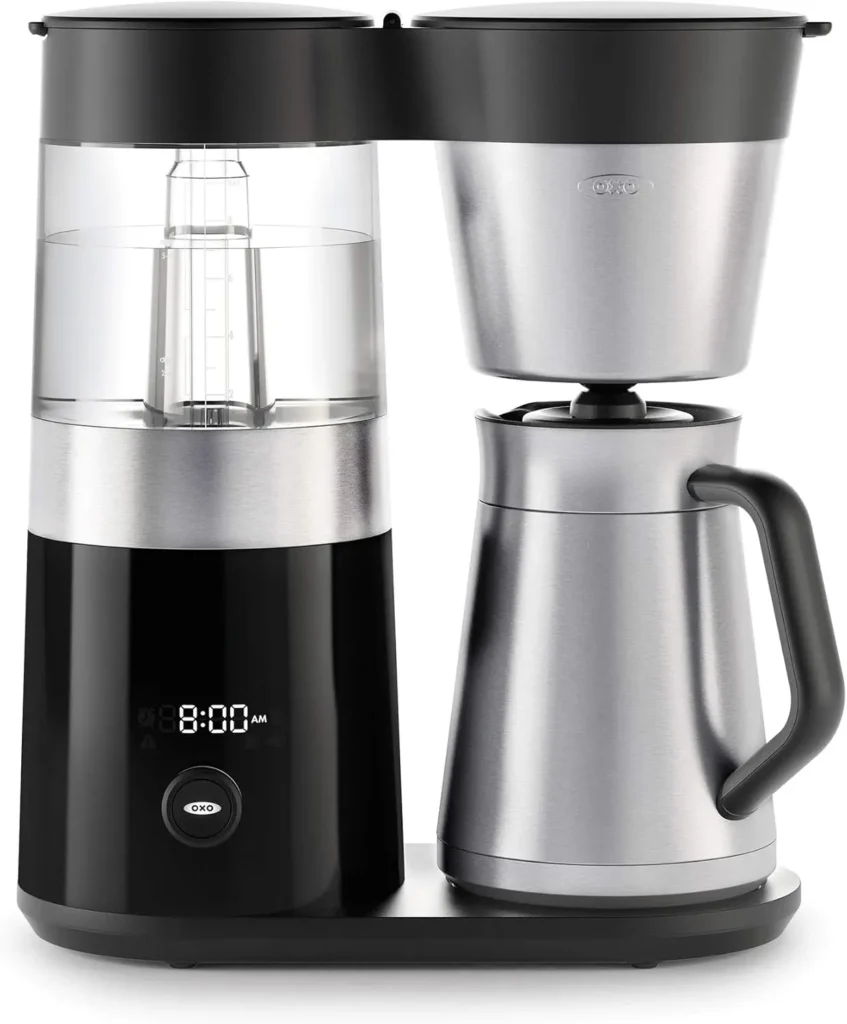
OXO Brew 9-Cup — Best Overall Drip Coffee Maker
Why it earns the top spot: The OXO Brew 9-Cup is the machine we point most home brewers toward when they want the best possible everyday drip coffee without stepping into premium territory. It is SCA-certified, brews at 197°F–205°F consistently across the full cycle, and uses a RainMaker showerhead that distributes water evenly over the entire filter basket — solving the single biggest engineering flaw in most drip machines, which is channeling, where water finds the path of least resistance and leaves half the grounds under-extracted. The result is noticeably more even, balanced extraction compared to machines that simply dump water from a central spout. At its footprint, it fits comfortably under most standard kitchen cabinets.
It is not the cheapest machine on this list, and it lacks the brand recognition of Cuisinart or Ninja. But for pure cup quality at a rational price, it is the benchmark for what a home drip brewer should deliver. If you only read one section of this guide, this is the machine to understand first.
- SCA-certified — verified 197°F–205°F brew temperature throughout cycle
- RainMaker showerhead — 9-hole water distribution for even saturation
- Optimal Brew Control — three brew strength settings
- Glass carafe with comfortable handle and drip-free pour
- Compact footprint — fits under standard 18-inch kitchen cabinets
- Auto-shutoff after 9 minutes — prevents hot plate over-cooking
Affiliate link — we may earn a commission at no cost to you.
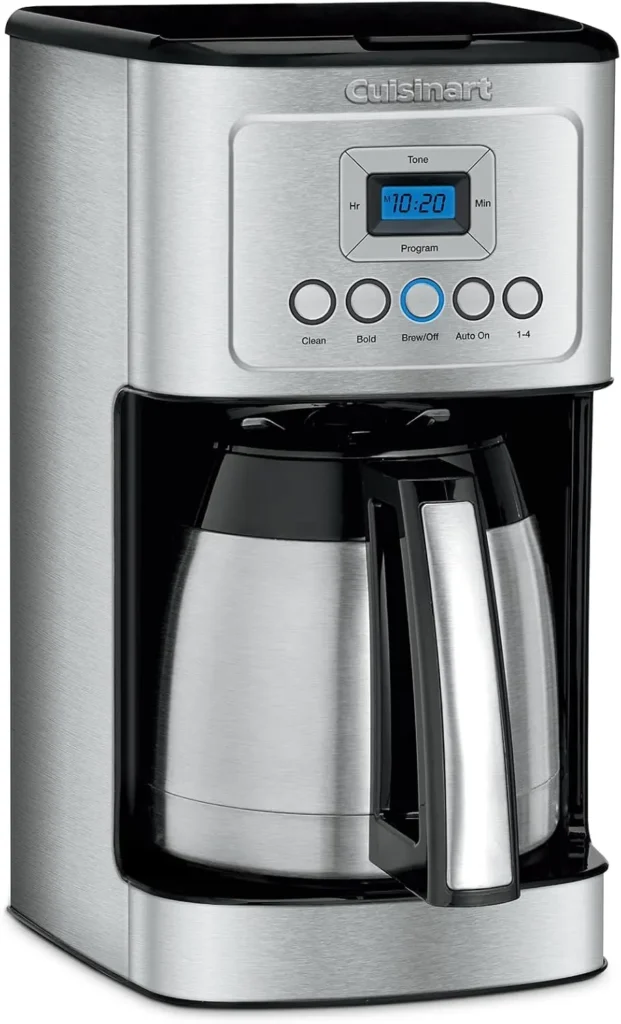
Cuisinart PerfecTemp DCC-3400 — Best SCA-Certified Everyday Workhorse
Why it stands out: The Cuisinart PerfecTemp DCC-3400 earns the runner-up position because it is the most accessible SCA-certified machine for buyers who want verified brew temperature performance plus the full suite of programmability features — 24-hour scheduling, adjustable keep-warm temperature, and brew-strength control — in one package. It has earned a reliable reputation for consistent performance over multi-year ownership, which is the benchmark that matters most for a machine you will use every morning. Where the OXO slightly edges it out is water distribution uniformity; the PerfecTemp’s showerhead system is competent but less precision-engineered than the OXO RainMaker. For most home brewers, that gap is small enough to be irrelevant in daily use.
- SCA-certified — verified brew temperature and extraction standards
- 24-hour programmable auto-start — coffee ready when you wake up
- Adjustable keep-warm temperature — 1–4 hours with temperature control
- Brew strength selector — regular and bold settings
- Stainless steel thermal carafe option available in the DCC-3500 variant
- Large water reservoir with clear window — easy to see fill level
Affiliate link — we may earn a commission at no cost to you.
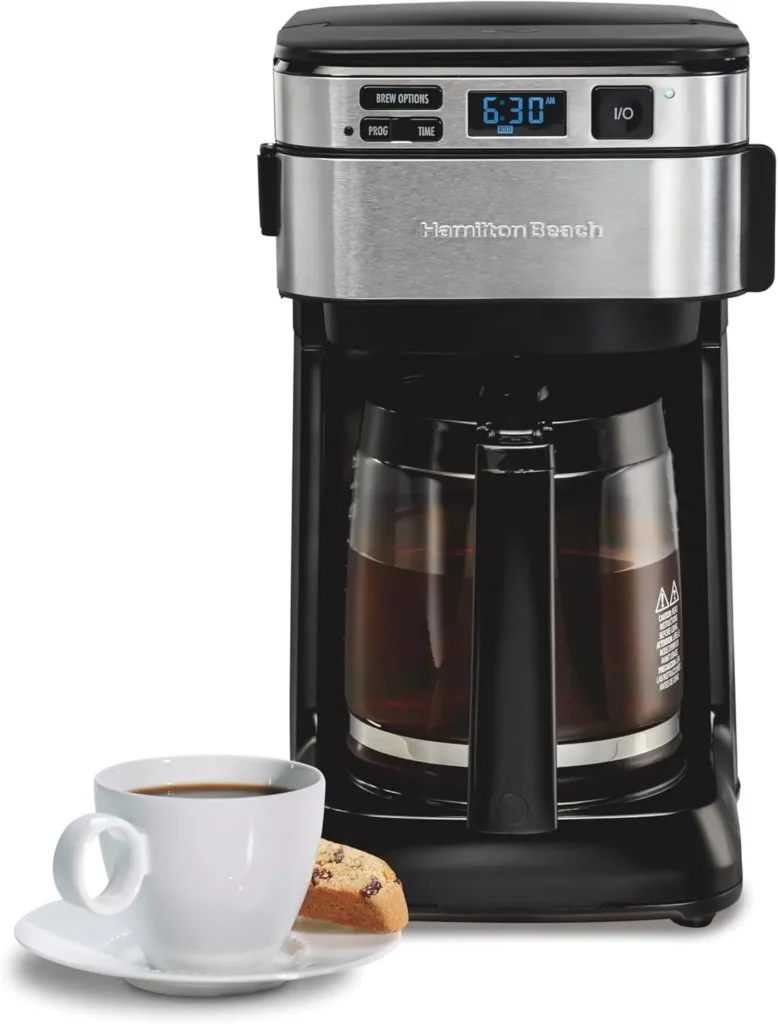
Hamilton Beach 12-Cup Programmable — Best Budget Drip Coffee Maker
Why it earns the budget pick: This is the machine we recommend to someone stepping up from a decade-old budget brewer who wants a reliable daily driver without a significant financial commitment. The Hamilton Beach 12-Cup Programmable is not SCA-certified — most machines in its price tier aren’t — but it consistently delivers better-than-average results for the category. It brews reasonably hot relative to other budget machines, programs reliably, and its track record for longevity across thousands of user reviews is genuinely strong. The honest caveat: if you pair it with freshly ground coffee, it will make noticeably better coffee than it has any right to at this price. If you’re using month-old pre-ground coffee from a can, no machine will fix that.
- 24-hour programmable timer — schedule brewing up to a day in advance
- Brew-strength selector — regular and bold
- 2-hour auto keep-warm followed by auto-shutoff
- Pause-and-pour feature — brew into your cup mid-cycle
- Large-capacity water reservoir — easy front-fill design
Affiliate link — we may earn a commission at no cost to you.
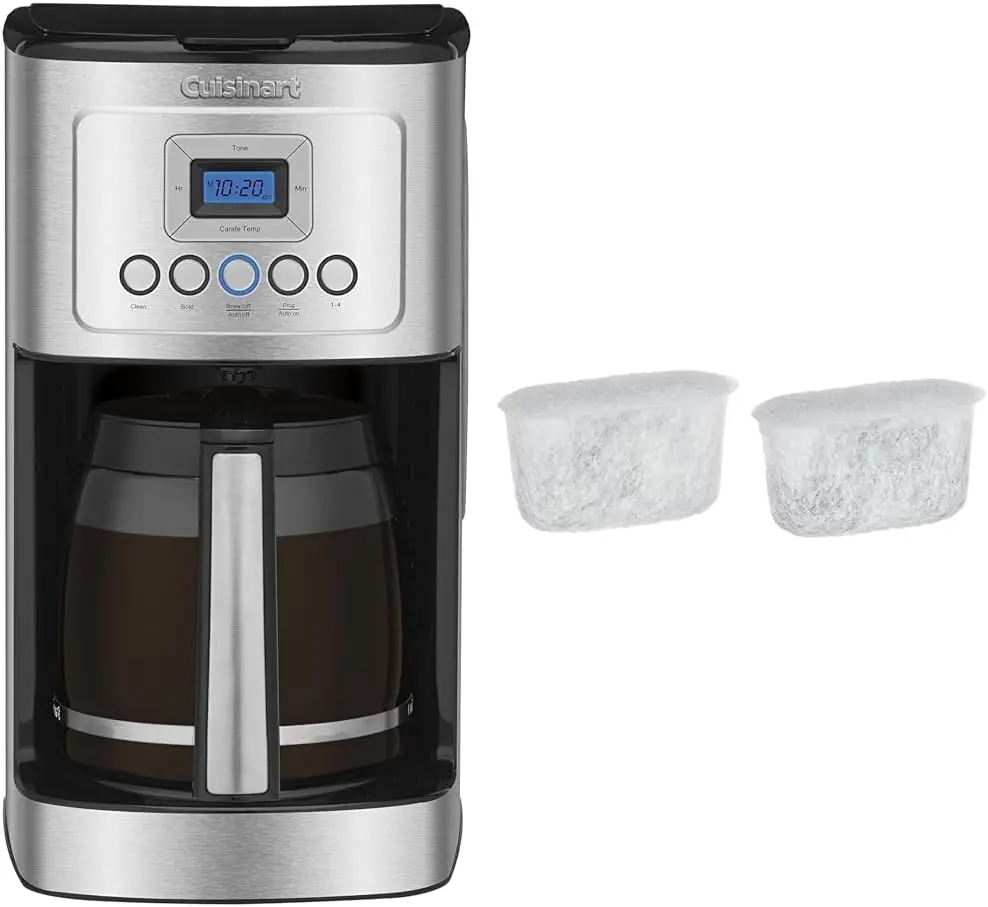
Cuisinart DCC-3200P1 — Best Fully-Featured Programmable
Why it earns the programmable pick: The Cuisinart DCC-3200P1 has become one of the best-selling drip coffee makers in North America for a straightforward reason — it does everything reliably, is SCA-certified, and handles the daily-driver role without asking much from the person using it. The 24-hour programmability is intuitive, the 1–4 hour keep-warm function is adjustable to reduce heat-plate damage to the coffee, and the 1–12 cup brew-capacity selector makes it practical for households where the number of drinkers varies. If you want to set-it-and-forget-it without compromising on extraction quality, this is the machine.
- SCA-certified — consistent brew temperature across full cycle
- Fully programmable 24-hour auto-start
- Adjustable keep-warm 1–4 hours with temperature control
- Brew-pause feature — pour a cup mid-brew without spillage
- 1–12 cup brew-volume selector for smaller batches
- Backlit LCD with clock — easy to read in a dim kitchen
Affiliate link — we may earn a commission at no cost to you.
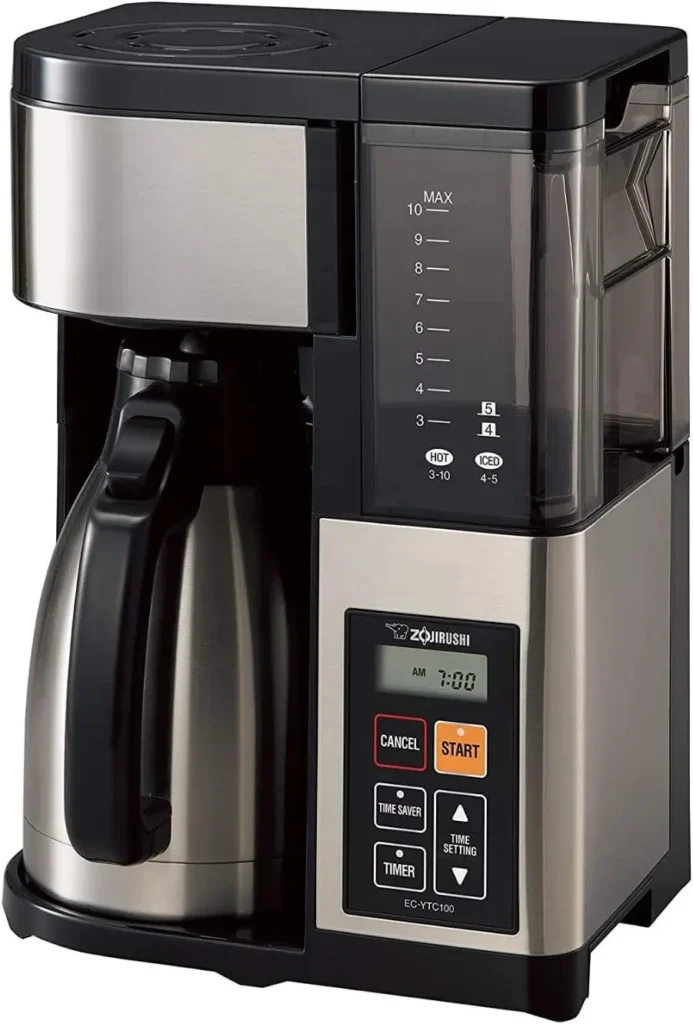
Zojirushi Fresh Brew Plus — Best Thermal Carafe Drip Coffee Maker
Why the thermal pick matters: A glass carafe sitting on a hot plate is slow-cooking your coffee. Within 20–30 minutes of brewing, oxidation and sustained heat begin breaking down aromatics and intensifying bitter, stale notes. The Zojirushi Fresh Brew Plus solves this elegantly — it brews directly into a vacuum-insulated stainless steel thermal carafe, maintains temperature for 1–2 hours without any heat source, and eliminates the hot plate entirely. It is SCA-certified, which means the brew temperature meets the same standard as the machines with hot plates — just without the flavor penalty of continued heating afterward. For households that brew a pot and return to it over the course of a morning, the thermal carafe approach produces measurably better coffee than a glass carafe machine at the same quality tier.
- SCA-certified — verified brew temperature throughout cycle
- Vacuum-insulated stainless steel thermal carafe — 1–2 hours of heat retention
- No hot plate — eliminates the primary cause of stale, bitter carafe coffee
- Programmable 24-hour auto-start
- Water filtration — charcoal water filter included
- Durable Japanese engineering — Zojirushi’s reputation for longevity is well-earned
Affiliate link — we may earn a commission at no cost to you.
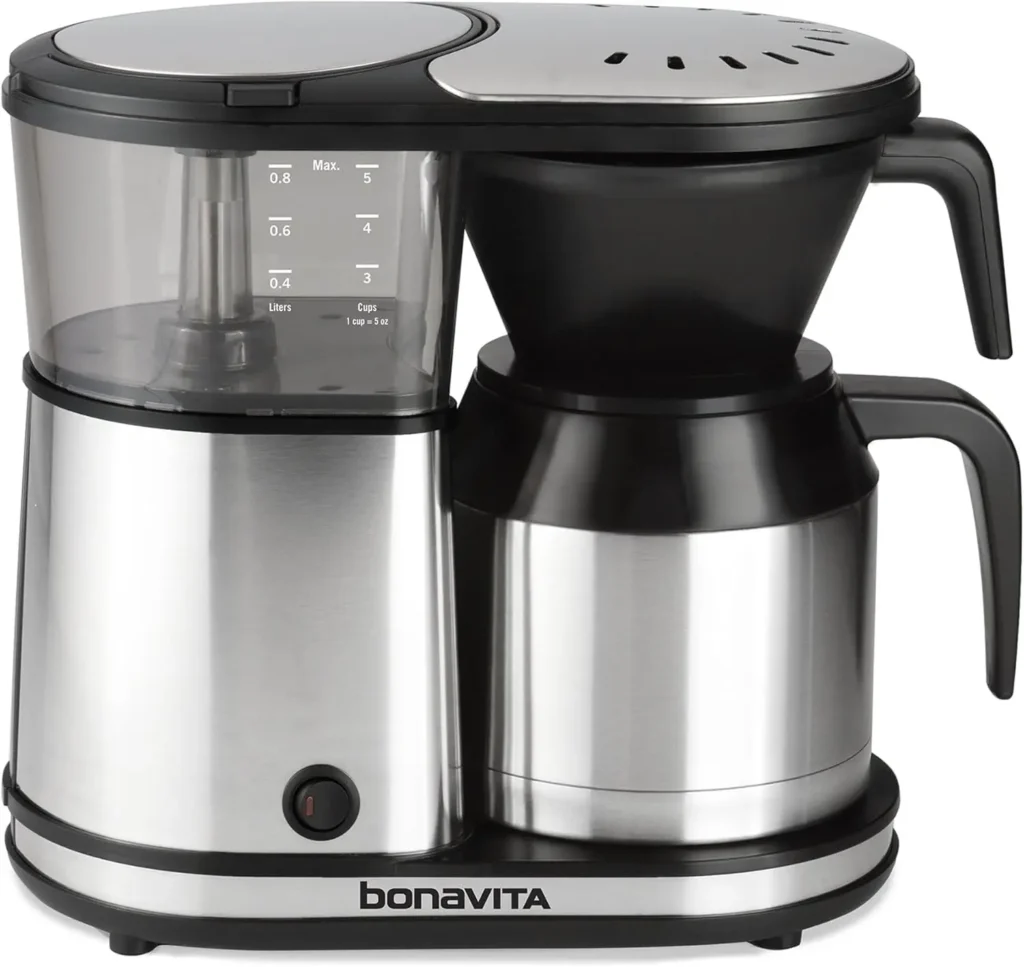
Bonavita 5-Cup One-Touch — Best Compact Drip Coffee Maker
Why small households should care: Most drip coffee makers are designed to brew 8–12 cups, and when you regularly brew smaller quantities in a large machine, you get proportionally worse extraction — the water moves through the grounds too quickly because the machine’s pump and heating system are calibrated for full capacity. The Bonavita 5-Cup One-Touch is engineered specifically for 1–5 cup brewing, is SCA-certified at that volume, and reduces to its essential function: a single button that brews excellent coffee. No clock, no programming, no keep-warm plate — just a thermal carafe and a machine that works. For solo drinkers or two-person households who don’t want to think about their coffee maker, it is a quietly excellent choice.
- SCA-certified for 5-cup brewing — optimized for small-batch extraction
- One-touch brewing — single button, no programming required
- Stainless steel thermal carafe — no hot plate, maintains temperature passively
- Pre-infusion mode — wets the grounds before full brew begins for better extraction
- Compact footprint — 10 inches tall, fits anywhere
Affiliate link — we may earn a commission at no cost to you.
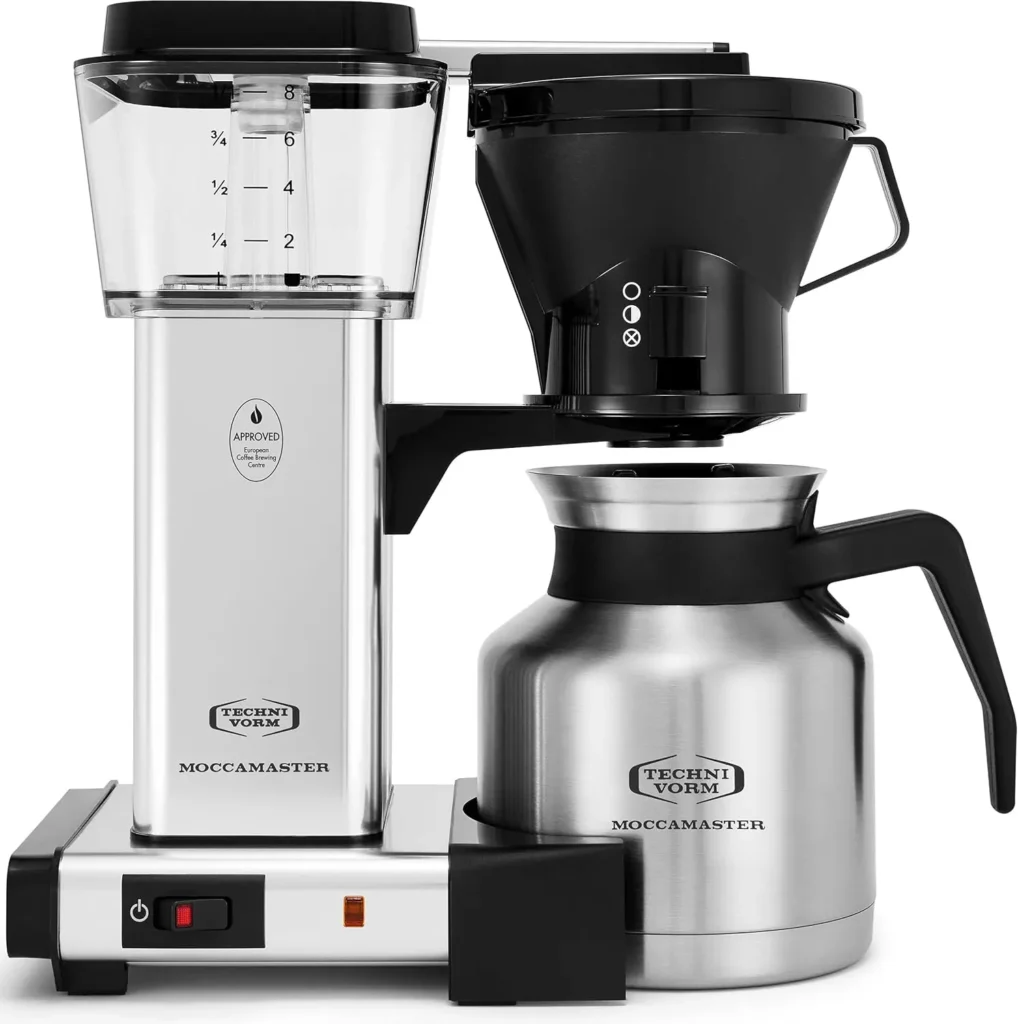
Technivorm Moccamaster KBG Select — Best Premium Drip Coffee Maker
Why it justifies the premium: The Technivorm Moccamaster is the reference-standard drip coffee maker in the specialty coffee world, and has been for decades. It is handmade in the Netherlands, SCA-certified, brews a full 10-cup carafe in under six minutes thanks to its copper heating element — the fastest heat-up of any machine on this list — and is built from components designed to be individually replaced rather than discarded. The typical Moccamaster owner measures its lifespan in decades, not years. Technivorm sells a full catalog of spare parts and maintains a service program for older machines. That is a fundamentally different value proposition than a $90 machine that brews adequately for 3–4 years before a heating element fails. For buyers who want to buy once and stop thinking about their coffee maker, the Moccamaster is the rational choice despite the higher entry cost.
- SCA-certified — among the longest-standing certified machines in the program
- Copper heating element — rapid heat-up, precise temperature control
- Full 10-cup brew in under 6 minutes — faster than most competitors
- Handmade in Amerongen, Netherlands — component-level repairability
- Five-year warranty — backed by service and spare parts availability
- Manual brew basket switch — control flow rate for lighter or darker roasts
Affiliate link — we may earn a commission at no cost to you.
Drip Coffee Maker Buying Guide: What Specs Actually Matter
Most drip coffee maker marketing leads with the wrong information — cup capacity, color options, how many buttons it has. The specs that actually determine whether your coffee tastes good or not are rarely front and center. Here’s what to evaluate before you buy, ranked by actual impact on cup quality.
| Spec | Why It Matters | What to Look For |
|---|---|---|
| Brew temperature | The single biggest determinant of extraction quality — too cool means under-extraction regardless of all other factors | 197°F–205°F consistently throughout cycle; SCA certification is the most reliable verification |
| Water distribution | Uneven saturation leaves some grounds under-extracted; showerhead or spray-bar systems outperform single-spout designs | Multi-hole showerhead or rotating spray bar; avoid single-point pour |
| Brew time | Too fast = under-extraction; too slow = over-extraction and staleness | 4–8 minutes for 8–10 cups; SCA testing verifies this range |
| Carafe type | Glass + hot plate cooks coffee beyond the first 20 minutes; thermal preserves flavor without a heat source | Thermal carafe if you drink coffee over 30+ minutes; glass fine for quick drinkers |
| Filter type | Cone filters extend contact time slightly; basket filters produce faster flow — both work | More important: use #4 or basket paper or a quality permanent filter that fits the basket properly |
| Programmability | Convenience, not cup quality — but a useful feature for morning routines | 24-hour scheduling; adjustable keep-warm temperature (lower = less flavor damage) |
| Capacity | Brewing far below a machine’s stated capacity degrades extraction — calibration is for full loads | Match machine size to how many cups you actually brew; 5-cup machines for 1–3 drinkers |
| Repairability | A repairable machine lasts 10+ years; a sealed-unit machine becomes landfill when one part fails | Technivorm (best), Baratza-equivalent repairability; check if replacement parts are sold |
💡 What doesn’t matter as much as marketed: Watt ratings, the number of brew settings, built-in grinders on budget machines (low-quality burrs undermine the benefit), and stainless steel exteriors. A machine that looks premium but brews at 185°F will produce worse coffee than a plain plastic machine that hits 200°F every time.
The Best Grinder to Pair With Your Drip Coffee Maker
Upgrading your grinder will do more for your drip coffee than upgrading your machine — assuming your machine at least hits a reasonable brew temperature. This is not a marketing claim; it follows directly from the extraction science. Coffee begins losing its most volatile aromatics within 15–30 minutes of grinding. Pre-ground coffee from a sealed bag purchased weeks ago has already lost those compounds permanently, and no drip machine — not even the Moccamaster — can recover them.
For drip coffee, the target is a medium grind — roughly the texture of coarse sand. Flat-bottom basket brewers generally perform best at a consistent medium, while cone-filter machines can tolerate slightly finer. The priority is consistency: every particle the same size, so every particle extracts at the same rate.
⭐ COFFEEGEARHUB SITE STANDARD MANUAL GRINDER RECOMMENDATION
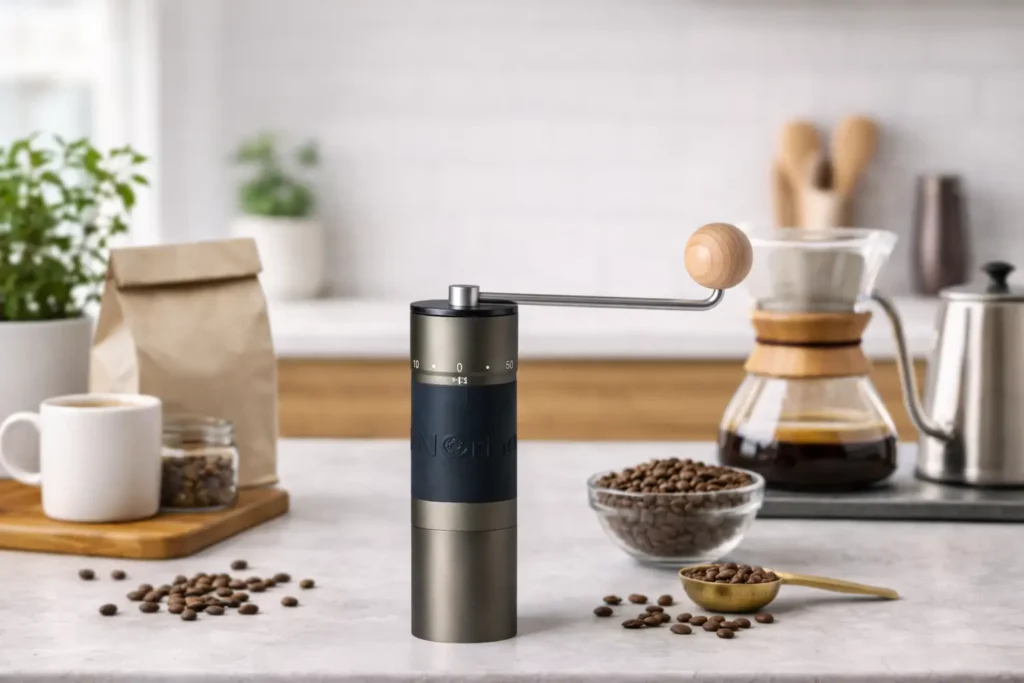
KINGrinder K6 — Best Manual Grinder for Drip Coffee
The KINGrinder K6 is the manual grinder we recommend across CoffeeGearHub, and it performs just as well for drip coffee as it does for AeroPress or moka pot. Set it to medium — around 4–6 on its click-step range, then adjust to taste — and it produces the clean, consistent particle size that a quality drip machine needs to perform at its best. Low retention means no stale grounds carry over between sessions. For a single-dose morning cup or a full 9-cup carafe, it handles the volume quickly and reliably.
Affiliate link — we may earn a commission at no cost to you.
For those who want an electric burr grinder for larger daily volumes, the Baratza Encore ESP is the natural companion to any of the machines on this list — it covers the drip medium range reliably, is highly repairable, and its grind consistency at the medium setting matches or exceeds electric grinders costing significantly more. See the full breakdown in our Best Coffee Grinders guide.
Troubleshooting Matrix: Fix Drip Coffee Problems at the Source
Most drip coffee problems are not machine problems — they’re grind problems, water problems, or maintenance problems. This matrix works through the most common symptom patterns and traces them to their most likely causes. Start with the simplest fix before assuming the machine is at fault.
| Symptom | Most Likely Cause | Fix (in order) |
|---|---|---|
| Coffee tastes weak or watery | Grind too coarse; under-extraction; incorrect ratio | Go finer by 1–2 clicks → check coffee-to-water ratio (1:15–1:17 by weight) → verify machine is reaching brew temperature |
| Coffee tastes bitter or harsh | Grind too fine; over-extraction; mineral scale on heating element | Go coarser → descale machine → reduce keep-warm time → switch to thermal carafe |
| Coffee tastes flat or stale | Old beans; old pre-ground coffee; grind retention in grinder | Use fresh beans within 2–6 weeks of roast date → grind fresh per brew → purge grinder between sessions |
| Coffee tastes sour | Under-extraction; grind too coarse; machine not reaching 197°F | Go finer → test machine temperature (non-SCA machines often undershoot) → consider upgrading to SCA-certified machine |
| Machine brewing slowly | Mineral scale buildup on heating element and water lines | Run descaling cycle with white vinegar or citric acid → repeat if flow doesn’t improve → descale every 1–3 months based on water hardness |
| Coffee not hot enough in cup | Glass carafe heat loss; machine below 197°F brew temp | Pre-warm carafe with hot water before brewing → switch to thermal carafe → if machine is SCA-certified, issue is carafe not machine |
| Inconsistent results day to day | Variable grind; variable dose; scale buildup affecting temperature | Use a digital scale for coffee dose → use click-step grinder → descale regularly → keep water source consistent |
| Grounds overflow the basket | Too much coffee; grind too fine causing slow flow-through | Reduce dose → go slightly coarser → ensure basket is appropriate size for machine |
🔬 The descaling rule: If your water is hard (common across most of the US), scale builds up faster than most people expect. A machine that brewed great coffee 18 months ago and now brews noticeably weaker or cooler hasn’t worn out — it needs descaling. Run a vinegar cycle, let it sit for 30 minutes, run two clear-water cycles, and re-test before concluding the machine is failing.
Which Drip Coffee Maker Should You Buy? Practical Decision Guide
| Your situation | Best pick | Why |
|---|---|---|
| Best overall for most home brewers | OXO Brew 9-Cup | SCA-certified, excellent water distribution, compact, auto-shutoff after 9 minutes |
| You want SCA quality + full programmability | Cuisinart PerfecTemp DCC-3400 | SCA-certified with 24-hour scheduling, adjustable keep-warm, and widespread availability |
| First drip machine, limited budget | Hamilton Beach 12-Cup Programmable | Best cup-quality-per-dollar in the budget tier; reliable track record |
| You brew a pot and drink it over 1–2 hours | Zojirushi Fresh Brew Plus | Thermal carafe eliminates hot-plate flavor degradation; SCA-certified brew temp |
| Solo drinker or 1–2 cup household | Bonavita 5-Cup One-Touch | SCA-certified for small batches; one-button operation; thermal carafe; compact |
| You want to buy once and never buy again | Technivorm Moccamaster KBG Select | Handmade, repairable, SCA-certified, proven 10–20 year lifespan, five-year warranty |
| You want auto-start + keep-warm + proven reliability | Cuisinart DCC-3200P1 | SCA-certified daily driver with the most complete programmability feature set |
| Your current machine makes weak coffee | Any SCA-certified machine above | If your current machine isn’t SCA-certified, it almost certainly brews below 197°F — the fix is a new machine, not a new grind |
FAQs: Best Drip Coffee Makers
What is the best drip coffee maker for home use in 2026?
The OXO Brew 9-Cup is our top overall pick for home use in 2026. It is SCA-certified, brews at the correct 197°F–205°F temperature range, features a RainMaker showerhead for even saturation, and is compact enough for most kitchen counters. For those who want SCA certification with full programmability, the Cuisinart PerfecTemp DCC-3400 is the best runner-up.
What temperature should a drip coffee maker brew at?
The Specialty Coffee Association specifies a brew water temperature of 197.6°F–204.8°F (92°C–96°C) for optimal extraction. Most budget drip machines brew closer to 185°F–190°F, which leads to chronic under-extraction and flat, weak coffee. SCA-certified machines are tested to verify they hit this range consistently throughout the brew cycle — not just at startup.
Are SCA-certified coffee makers worth it?
Yes, for most home brewers who care about cup quality. SCA certification guarantees verified brew temperature, brew time, and extraction yield. It is the most reliable third-party signal that a machine will actually produce specialty-grade results with quality beans and a good grinder. Most SCA-certified machines cost more than non-certified equivalents, but the performance gap is real and consistent.
How often should I clean my drip coffee maker?
Rinse the carafe and basket daily. Descale with a white vinegar or citric acid solution every 1–3 months depending on your water hardness. Hard water accelerates mineral buildup on heating elements, which lowers brew temperature and slows brew time over time — both degrade cup quality. Use your machine’s descale indicator as a minimum interval, not a maximum.
Thermal vs. glass carafe — which is better for drip coffee?
Thermal carafes are better for coffee quality if you drink your coffee over more than 20–30 minutes. A glass carafe on a hot plate continues cooking the coffee — oxidation and sustained heat cause noticeable flavor degradation. A thermal carafe maintains temperature without heat, preserving flavor for 1–2 hours. If you drink your coffee immediately after brewing, a glass carafe is perfectly fine.
Can I use pre-ground coffee in a drip coffee maker?
Yes. Pre-ground coffee works in any drip machine. However, coffee begins losing aromatics within 15–30 minutes of grinding, and most pre-ground coffee has been exposed to air for weeks. For the best results from any drip machine, freshly ground coffee at a consistent medium grind makes a larger difference to cup quality than almost any machine upgrade.
What is the difference between a cone and basket filter for drip coffee?
Cone filters concentrate water through a smaller outlet, extending contact time with the grounds and generally producing a slightly more complex cup. Basket filters spread water over a wider, shallower ground bed and typically brew faster. Both produce excellent coffee. More important than filter shape is even water distribution across all the grounds — a showerhead system matters more than whether the filter is cone or flat-bottom.
How long does a drip coffee maker last?
A quality drip coffee maker, properly maintained with regular descaling, typically lasts 5–10 years. Budget machines with lower-quality heating elements tend to degrade faster. Technivorm Moccamaster machines are well-documented for lasting 10–20 years with basic maintenance and are designed with component-level repairability. The most common failure points — heating elements and carafe components — can be replaced on most quality machines.
Is a programmable drip coffee maker worth buying?
For most home brewers, yes. Programming lets you wake up to freshly brewed coffee without waiting. The key caveat: grind your beans the night before and load the filter basket, since pre-ground coffee sitting in a basket overnight will be noticeably staler than grinding fresh. Programmability adds real convenience without compromising quality, as long as the machine also meets SCA brew temperature standards.
What grind size should I use for drip coffee?
Medium grind is the standard for flat-bottom basket drip brewers — roughly the texture of coarse sand. Cone-filter machines can benefit from a slightly finer medium grind to compensate for faster flow-through. Adjust based on taste: bitter means go coarser; sour or weak means go finer. Freshly ground coffee at a consistent medium size will improve cup quality more than almost any other variable.
Continue Learning
DRIP COFFEE CLUSTER
GRINDER GUIDES
BREWING METHOD COMPARISONS
Ready to grind fresh for your drip machine? The grind size guide covers the full spectrum from coarse French press to espresso fine — with a drip-specific dial-in section that walks through how to adjust by taste, not guesswork.
☕
Written by the CoffeeGearHub Editorial Team
CoffeeGearHub is a specialty coffee equipment resource run by home brewers and coffee enthusiasts. Our buying guides are researched using published brewing science, SCA certification standards, equipment manufacturer specifications, and established specialty-coffee community knowledge. We review and update our pillar content regularly to reflect current product availability and community consensus. About CoffeeGearHub →