
Last Updated: March 2026 • 25–30 min read • Comparison Guide: French Press vs Drip Coffee — Flavor, Gear, Grind, Cleanup & Top Picks
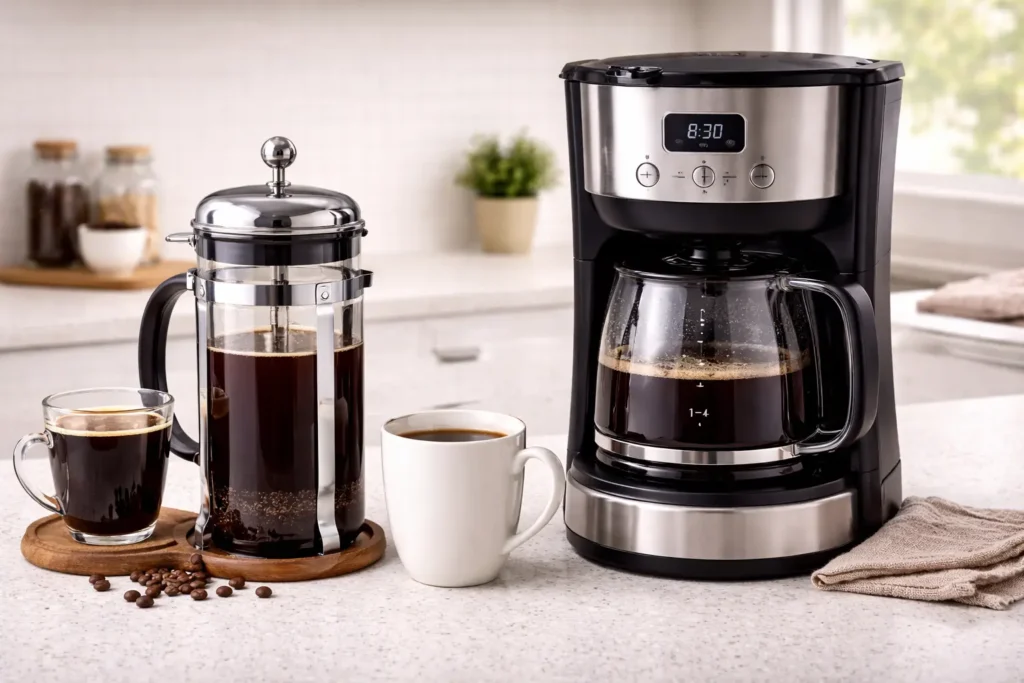
Choosing between a French press and a drip coffee maker is one of the most practical decisions in home coffee — and the answer turns almost entirely on two questions: how much coffee do you brew at once, and how involved do you want to be in the brewing process? French press produces a richer, more oil-forward cup through a simple 4-minute immersion method that rewards engaged, intentional brewing. Drip coffee makers produce a cleaner, more consistent cup through fully automated percolation that rewards the desire to press one button and walk away. This guide compares both methods across every dimension that matters to a real home brewer — flavor, ease of use, volume, grind requirements, cleanup, gear cost, and long-term practicality — and gives you our verified top product picks for each, with K6 grind settings and brew parameters to get you started immediately.
✍️ Editorial note: This guide is researched and written by the editors at CoffeeGearHub.com using published brewing science, SCA brewing standards, and established specialty-coffee community knowledge. All product links are affiliate links — we may earn a commission at no cost to you. Affiliate Disclosure: CoffeeGearHub.com participates in the Amazon Services LLC Associates Program. As an Amazon Associate, we earn from qualifying purchases.
🛒 New to Amazon? Try Prime free for fast, free shipping on every pick in this guide — or try Audible free if you’d rather listen while your coffee brews.
The 30-Second Answer
Choose French press if you want rich, full-bodied, oil-forward coffee and don’t mind a 4-minute active brew process for one to four cups. Choose a drip coffee maker if you want push-button automation, multi-cup volume, and the ability to program your coffee the night before. French press produces a more complex, distinctive cup from quality beans. Drip produces a cleaner, more consistent cup at volume. Both methods are easy — they’re just easy in different ways and suit different morning routines.
- Best French Press: Bodum Chambord — the benchmark home French press, reliable triple-layer filter, multiple sizes
- Best Drip Machine (quality): Breville Precision Brewer — SCA Gold Cup certified, thermal carafe, programmable auto-start
- Best Drip Machine (value): OXO Brew 9-Cup — SCA certified, intuitive controls, consistently excellent everyday drip
- Best Grinder for Both: KINGrinder K6 — 100-click precision covers coarse French press and medium drip from the same tool
- Best Electric Grinder: Baratza Encore — the standard electric grinder recommendation for filter brewing at any volume
Who This Guide Is For — Jump to What You Need
☕ First-Time Buyer
Start with Flavor Difference and Which Is Right for You, then go straight to product picks.
🔧 Troubleshooter
Jump to the Troubleshooting Matrix for fixes to common French press and drip coffee problems.
🛒 Gear Shopper
See French Press Picks, Drip Machine Picks, and Grinder Picks for verified product recommendations.
🔬 Grind Nerd
Read Grind Size Guide and Brew Parameters for full K6 click references and water temperature guides.
Table of Contents
French Press vs Drip Coffee: Quick Comparison
Use this table as your decision-making anchor. Every section below expands on each row in detail — if you’re short on time, this covers the essential tradeoffs.
| Feature | French Press | Drip Coffee Maker |
|---|---|---|
| Flavor profile | Rich, full-bodied, oil-forward, heavy mouthfeel | Clean, consistent, lighter-bodied, paper-filtered clarity |
| Difficulty | Easy — minimal technique; active for 4 minutes | Very easy — fill, press start, walk away |
| Filter type | Metal mesh — oils and fine particles pass through | Paper basket filter — removes oils and fine particles |
| Brew time | ~5–6 minutes total (4 min hands-off steep) | ~5–8 minutes total (fully hands-off) |
| Volume | Limited by brewer size — 1L press = ~4 cups | Excellent — most machines brew 8–12 cups per cycle |
| Automation | None — fully manual | Full — programmable timer, keep-warm, auto-shutoff |
| Gear needed | Brewer + burr grinder; no filters or kettle upgrade required | Machine + burr grinder; paper basket filters (ongoing) |
| Cleanup | Moderate — grounds disposal, carafe rinse, monthly filter clean | Moderate — filter disposal, basket rinse, descale every 1–3 months |
| Portability | Good — glass or stainless travel models available; no electricity needed | Poor — mains power required, not portable |
| Best beans | Medium to medium-dark, natural process, fresh roast-dated | Medium roast blends; SCA-certified machines handle light roast well |
| Grind size (K6) | Coarse — ~65–80 clicks | Medium — ~32–42 clicks |
| Best for | Bold coffee lovers, 1–4 cups, engaged brewers, travelers | Multi-cup households, busy mornings, anyone wanting push-button convenience |
What Is a French Press?
A French press is an immersion brewer — ground coffee steeps in full contact with hot water for a fixed time, then a metal mesh plunger is pressed down to physically separate the grounds from the brewed coffee. There is no paper filter, no controlled flow rate, and no machine. Water temperature, grind size, steep time, and coffee-to-water ratio are the only variables the brewer controls. Because the filter is metal rather than paper, coffee oils, dissolved fine particles, and the diterpene compounds cafestol and kahweol all pass directly into the cup — producing French press’s characteristic heavy body, rich mouthfeel, and oil-forward sweetness.
The French press is one of the most forgiving manual brew methods available: slightly inconsistent grind? Still drinkable. Steep time drifts by 30 seconds? Still good. Water temperature a few degrees off target? You’ll barely notice. The only real penalty for inattention is forgetting to pour the brewed coffee out immediately after plunging — leaving coffee sitting on the pressed grounds continues extraction and produces bitterness within 10–15 minutes. Beyond that, French press is genuinely hard to brew badly.
☕ French press in five steps: (1) Add coarsely ground coffee. (2) Pour hot water (93°C for medium roast). (3) Stir once, place lid on with plunger raised. (4) Steep 4 minutes. (5) Press slowly and pour immediately into cups or a separate carafe — never leave brewed coffee sitting on the grounds.
What Is a Drip Coffee Maker?
A drip coffee maker is an automated percolation brewer — a machine heats water to brew temperature and releases it through a showerhead over a basket of grounds, where gravity pulls the water through a paper filter into a carafe below. The brewer controls water temperature, flow rate, and distribution. The operator adds water, adds grounds, and presses start. The machine does everything else. Unlike the French press’s immersion steeping, drip brewing is a continuous percolation method — water contacts the grounds progressively rather than all at once, then drains immediately through the filter.
The drip coffee maker’s quality varies more dramatically with price than almost any other brewing method. A budget drip machine that fails to reach proper brew temperature (92–96°C by SCA standards) produces sour, flat, under-extracted coffee that no grind adjustment can fully fix. A quality SCA-certified machine like the Breville Precision Brewer or OXO Brew reaches proper temperature consistently and produces genuinely excellent coffee, hands-off, every morning. The difference between a budget drip machine and an SCA-certified machine is larger than the difference between a quality drip machine and a French press.
🔬 What SCA certification actually means: The Specialty Coffee Association certifies drip machines that consistently achieve 92–96°C water temperature at the brew head and brew a standard 6-cup batch within the SCA’s target extraction window of 4–8 minutes. Most budget machines fail the temperature requirement — brewing at 75–85°C, which leaves bitter and sweet compounds under-extracted and produces flat, sour, thin coffee. SCA certification is the single most important specification to check when buying a drip machine. It narrows the field to machines that are engineered to produce properly extracted coffee.
Flavor Difference: The Biggest Decision
Flavor is the most important reason to choose one method over the other — and the difference between French press and drip is significant enough that someone who loves French press’s rich, heavy cup will often find quality drip too thin, while a drip coffee drinker may find French press too oily or heavy. Understanding why the cup tastes different explains which style fits your palate.
French Press Flavor
The metal filter passes everything into the cup — oils, fine particles, and the diterpene lipids that create texture and richness. Extraction happens through 4 minutes of full immersion, where all the grounds are simultaneously saturated in hot water. The result is a full-bodied, heavy, oil-forward cup. Many drinkers describe it as “stronger” than drip at the same ratio — this is the mouthfeel and oil content, not additional caffeine. French press produces coffee that feels like a complete experience in a cup.
- Full, heavy body with thick, coating mouthfeel
- Rich sweetness — chocolate, caramel, roasted nut
- Low perceived acidity; round, smooth finish
- Slight sediment and oiliness — inherent to the method
- Best beans: medium to medium-dark, natural process, fresh roast-dated
Drip Coffee Flavor
Paper filtration removes oils and fine particles, producing a cleaner, brighter cup where the bean’s flavour character comes through without the heaviness of metal filtration. Drip coffee is the most widely understood coffee flavor in the world — it’s the baseline most people grew up with. On a quality machine, it’s also genuinely excellent: clean, consistent, aromatic, and well-balanced. It lacks the richness and body of French press, but pairs this cleaner character with ease, volume, and automation.
- Light to medium body — clean, accessible mouthfeel
- Balanced sweetness and mild acidity — the universal everyday cup
- Clear flavour — notes are more transparent without oil coating
- No sediment; clean finish
- Best beans: medium roast blends; SCA machines handle light roast well
💡 Simple decision rule: If you drink coffee black and want rich, heavy, oil-forward coffee that rewards engaged brewing — choose French press. If you want clean, consistent, automated coffee in volume for a household or busy morning — choose a quality drip machine. If you want both at different times, the two methods complement each other well and together cover the full spectrum of everyday home coffee needs.
Ease of Use
French Press: Easy but Active
French press is one of the most forgiving manual brew methods — but it is still a manual method that requires your presence and attention for the full brew cycle. The technique is minimal: add coffee and water, stir once, wait four minutes, press slowly and evenly, pour immediately. Even if your grind is slightly off, your steep time drifts by 30 seconds, or your water is a few degrees cooler than ideal, the cup will still be good. French press punishes only two errors reliably: using a blade-ground or too-fine grind (produces muddy, gritty, bitter cups) and leaving brewed coffee on the grounds after pressing (continues extraction, produces bitterness). For everyone who avoids those two mistakes, French press delivers a satisfying cup consistently from the first attempt.
Drip: Easiest of All — Fully Automated
A drip machine is the most passive brewing method in home coffee. Fill the water reservoir, load the basket with grounds, press start, and return to a full carafe. That’s the entire active process. Most quality drip machines include a programmable timer — you set up the machine the night before and wake up to coffee that has already brewed. The machine controls water temperature, flow rate, and extraction timing without any input from you. The quality ceiling is determined almost entirely by the machine’s engineering (especially brew temperature) and your grinder — not by technique. This is why drip is the default for busy households, offices, and anyone who prioritises coffee availability over coffee exploration.
Brew Time Comparison
| Method | Hands-on setup time | Brew cycle time | Total time | Active involvement |
|---|---|---|---|---|
| French Press (1L / 4 cups) | ~1 min | ~4 min steep | ~5–6 min | Present throughout — stir, time, plunge, pour |
| Drip (6 cups) | ~1 min | ~5–7 min | ~6–8 min | Minimal — setup only; machine runs unattended |
| Drip (12 cups) | ~1 min | ~7–10 min | ~8–11 min | Minimal — longer brew cycle, still unattended |
| French Press (pre-programmed) | N/A — cannot program | N/A | N/A | Always requires active morning involvement |
| Drip (pre-programmed) | ~1 min the night before | Unattended AM brew | 0 min active in morning | None — coffee is ready when you wake up |
Total clock time is roughly comparable for the same volume — but what you do during that time differs significantly. French press requires you to be present and engaged: stir, time, plunge, pour. A drip machine runs entirely while you do something else. For the morning priority of coffee-while-getting-ready, drip wins outright. For the deliberate morning ritual of making something intentionally, French press is the more satisfying process.
Volume and Serving Size
Volume is where the two methods diverge most dramatically — and for many households, it is the deciding factor regardless of flavor preference.
| Scenario | French Press | Drip Coffee Maker | Best for this scenario |
|---|---|---|---|
| Solo drinker — 1–2 cups daily | Excellent — a 350ml or 500ml press is perfect; minimal waste | Many machines under-extract at partial carafe volumes | 🏆 French press |
| Couple — 2–4 cups daily | Good — a 1L press handles this comfortably | Good — most drip machines handle 4 cups without issues | Tie |
| Family of 4+ — 6–10 cups daily | Poor — requires multiple 1L press cycles | Excellent — one cycle, hands-off | 🏆 Drip machine |
| Office / group — 10+ cups | Not practical at scale | Excellent — designed for volume; programmable for timing | 🏆 Drip machine |
| Keeping coffee warm | No warming — serve immediately or use a thermal carafe to transfer | Warming plate (most machines) or thermal carafe (better models) | 🏆 Drip machine |
⚠️ The French press volume ceiling: A 1L French press brews approximately 4 standard cups per cycle. For households brewing more than this simultaneously, you either need a very large French press (1.5L models exist) or multiple press cycles — which is impractical for busy mornings. A 1L press is also the largest convenient size before the device becomes unwieldy to press and clean. If you regularly need more than 4 cups at once, a drip machine is the correct tool regardless of flavor preference.
Cleanup and Maintenance
French Press Cleanup
After brewing, the compressed grounds puck sits at the bottom of the carafe. The best approach: pour a little water in, swirl, and dump the grounds into the trash or compost — never the sink drain, as grounds cause blockages. Rinse the carafe thoroughly. The plunger filter assembly should be fully disassembled and cleaned weekly — oils accumulate in the mesh over time and produce rancid off-notes if left. A monthly deep clean of the plunger discs keeps the filter performing correctly. Borosilicate glass carafes (Bodum Chambord) are dishwasher-safe for the carafe component.
- Daily cleanup: 2–3 minutes (grounds disposal + carafe rinse)
- Weekly: disassemble plunger filter, clean mesh thoroughly
- Monthly: deep clean filter discs to prevent oil rancidity
- Descaling: not required — no internal heating element
Drip Machine Cleanup
Daily drip machine cleanup is straightforward: discard the paper filter and grounds, rinse the brew basket, and wash the carafe. Budget 2–4 minutes. The carafe requires more thorough scrubbing if coffee sits on the warming plate and caramelises — glass carafes are especially prone to this. More significantly, drip machines require descaling every 1–3 months depending on local water hardness: mineral deposits build up in the heating element and internal tubing, reducing brew temperature and shortening the machine’s lifespan. Neglecting descaling is one of the most common reasons quality drip machines begin producing under-temperature, flat coffee after a year of use.
- Daily cleanup: 2–4 minutes (filter disposal, basket rinse, carafe wash)
- Weekly: wipe warming plate, check basket for coffee oil buildup
- Monthly (or per indicator): descale heating element and internal tubing
- Descaling: essential — skipping this shortens machine life and drops brew temp
Gear You’ll Need: French Press vs Drip Coffee
| Gear item | French Press | Drip Machine | Notes |
|---|---|---|---|
| Brewer / machine | ✅ Required — French press brewer | ✅ Required — drip machine | French press quality ceiling is lower; drip quality varies enormously with machine price |
| Burr grinder | ✅ Strongly recommended | ✅ Strongly recommended | The single highest-impact purchase for either method — K6 covers both |
| Paper filters | ❌ Not needed — metal filter built in | ✅ Required — ongoing purchase | Basket filters for drip are inexpensive and widely available |
| Gooseneck kettle | ❌ Not needed — any kettle works | ❌ Not needed — machine heats water internally | Neither method requires a gooseneck kettle |
| Kitchen scale | ⚠️ Recommended | ⚠️ Recommended | Volume scoops are unreliable for both — weight-based ratios are far more consistent |
| Separate carafe / server | ⚠️ Recommended for groups | ✅ Included with machine | French press: transfer brewed coffee immediately to prevent over-extraction |
| Descaler | ❌ Not needed | ✅ Required periodically | Drip machines need descaling every 1–3 months; French press has no heating element |
⚠️ The grinder is the most impactful purchase for either method. A consistent burr grinder at a coarse setting (French press) or medium setting (drip) produces dramatically better-tasting coffee than any brewer or machine upgrade at the same spend. For French press, a coarse burr grind eliminates the fines that produce muddy, gritty cups. For drip, consistent particle size produces even extraction across the basket. The KINGrinder K6 covers both methods from the same tool with 100-click precision — one grinder, two methods.
Best French Press Brewers
Three picks covering every use case — everyday home brewing, cleaner-cup brewing with a finer filter, and travel or camping. All use metal mesh filtration; the distinction is filter quality, material durability, and what happens after the press. All product links use the coffeegearhub-20 affiliate tag.
Disclosure: CoffeeGearHub may earn a commission on qualifying purchases through affiliate links on this page, at no cost to you. Our recommendations are editorially independent.
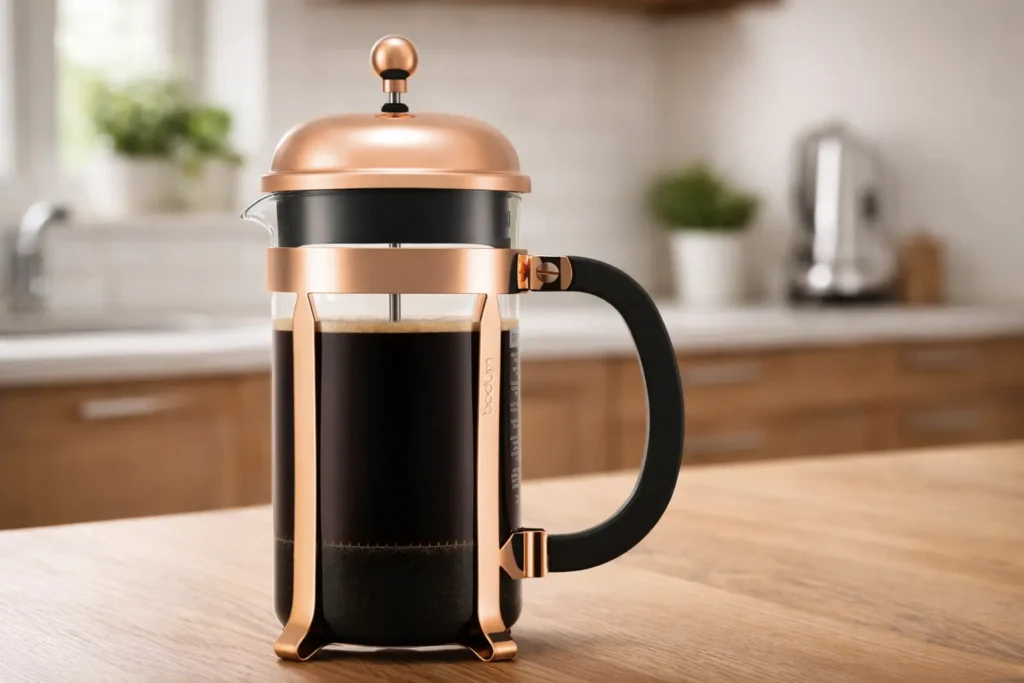
Best Overall: Bodum Chambord French Press
The Bodum Chambord is the benchmark French press — the design every other French press is measured against, and the one that appears in more home coffee setups worldwide than any other. Its stainless steel frame, borosilicate glass carafe, and three-part stainless mesh filter assembly produce a well-filtered, consistently rich cup at any brew volume. The three-layer mesh significantly reduces fine sediment passage compared to single-layer budget filters without impeding oil extraction — you get the full body and mouthfeel of French press with noticeably less grit in the cup. Available in 350ml (1–2 cups), 500ml (2 cups), 1L (4 cups), and 1.5L (6 cups); the 1L is the best everyday choice for most households. Borosilicate glass handles thermal shock reliably; the carafe is dishwasher-safe. Replacement carafes and filter assemblies are widely available if anything breaks — Bodum replacement parts are stocked by most major retailers.
- Sizes: 350ml / 500ml / 1L / 1.5L — choose based on how many cups you brew daily
- Filter: Three-part stainless mesh — reduced sediment, full oil retention
- Material: Borosilicate glass + stainless frame — dishwasher safe, replacement parts available
- Best for: all skill levels, everyday French press, anyone brewing 2–4 cups
Disclosure: CoffeeGearHub may earn from qualifying purchases.
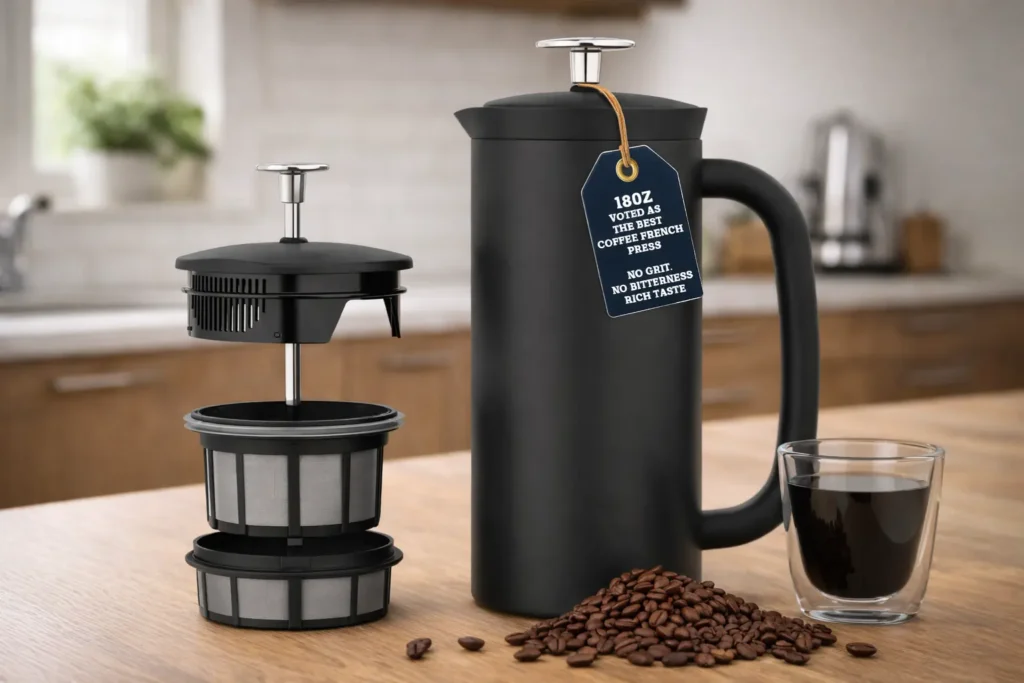
Best for a Cleaner Cup: Espro P3 French Press
The Espro P3 uses a patented double micro-filter — two nested stainless mesh filters significantly finer than any standard French press — that dramatically reduces sediment and fines while preserving the oil-forward body that separates French press from drip. The practical result is a cup that sits midway between a standard French press and pour over: full-bodied and rich like French press, but noticeably cleaner and less gritty than a standard Bodum. This is the pick for anyone who loves French press richness but finds the sediment in a standard press too pronounced. The P3’s double-sealed plunger creates a true barrier that stops extraction after pressing — coffee can sit in the carafe for 20 minutes without continuing to extract, solving the most common French press over-extraction problem. An excellent choice for anyone who brews and then pours over time rather than serving everything immediately.
- Filter: Patented double micro-filter — significantly less sediment than any standard French press
- Key feature: Double-sealed plunger stops extraction after pressing — safe to leave in the carafe
- Material: Borosilicate glass + stainless steel body
- Best for: drinkers who find standard French press too gritty; anyone switching from drip who wants French press body without French press sediment
Disclosure: CoffeeGearHub may earn from qualifying purchases.
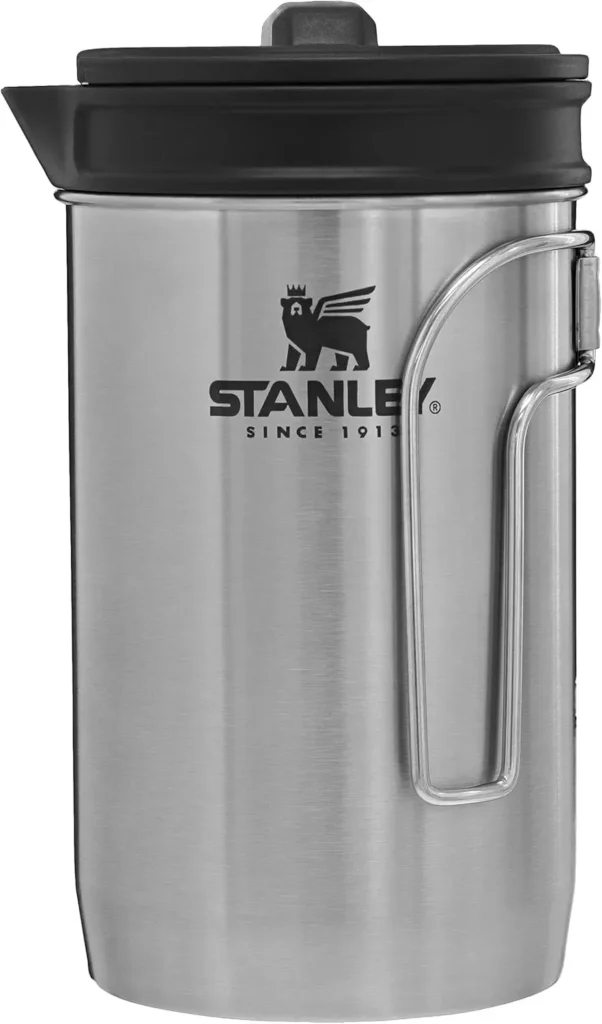
Best for Travel and Camping: Stanley Adventure French Press
The Stanley Adventure solves the main practical problem with glass-bodied French presses — fragility — by replacing the carafe with a double-wall vacuum-insulated stainless steel body. It keeps coffee hot for hours, survives drops that would shatter a glass carafe, and goes anywhere without electricity. This is the French press for anyone who camps, travels frequently, works in an outdoor setting, or wants a dedicated office French press that won’t break. The stainless body eliminates French press’s primary fragility without changing any of its brewing characteristics — the metal filter system works identically to glass-bodied brewers, and vacuum insulation means you can brew and then pour over 30–45 minutes without the coffee cooling significantly. Available in 24oz and 48oz versions; the 24oz suits most solo or couple travel situations.
- Body: Double-wall vacuum-insulated stainless steel — indestructible, no glass
- Insulation: Keeps coffee at temperature for hours — ideal for outdoor or slow mornings
- Sizes: 24oz and 48oz
- Best for: travel, camping, outdoor use, office use, anyone who has broken a glass French press
Disclosure: CoffeeGearHub may earn from qualifying purchases.
Best Drip Coffee Makers
Two picks covering quality-focused and value-focused drip brewing — both SCA Gold Cup certified, which is the minimum specification we recommend for a drip machine that produces properly extracted coffee. The difference between these two picks is features and build quality, not cup quality — both produce excellent results from fresh beans and a good grinder.
Best Overall Drip Machine: Breville Precision Brewer
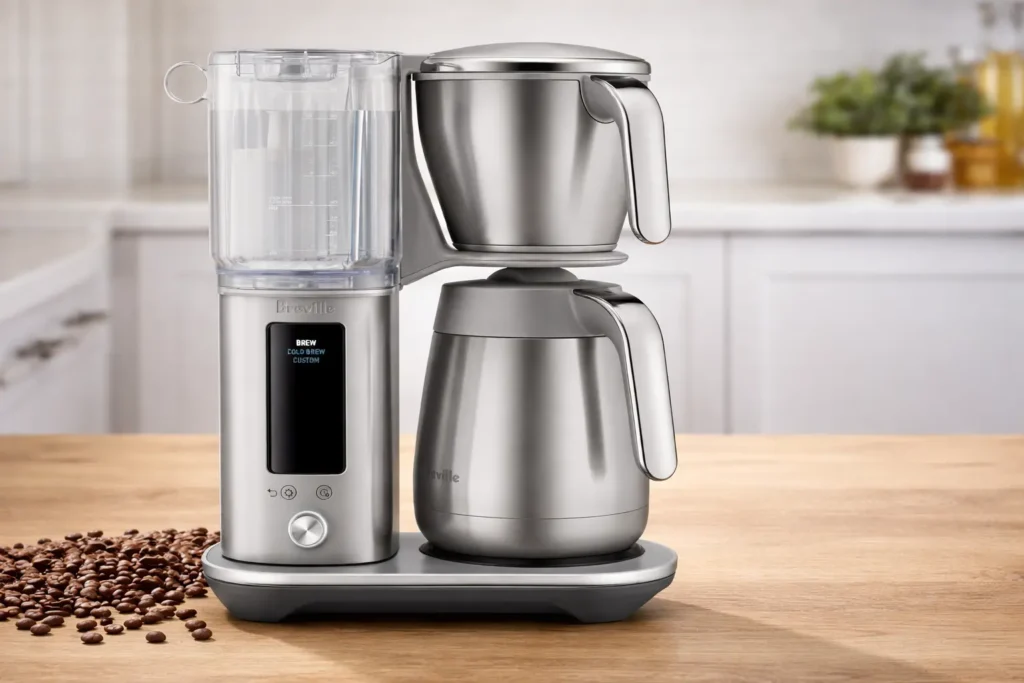
The Breville Precision Brewer is the drip machine we recommend most often to anyone who is serious about their coffee and wants hands-off automation — SCA Gold Cup certified, meaning it consistently achieves the 92–96°C brew temperature that separates genuinely good drip coffee from the flat, under-extracted output of budget machines. The feature that sets it above most competitors is the thermal carafe: rather than a glass carafe on a warming plate (which progressively scorches and oxidises the coffee), the Precision Brewer delivers directly into a stainless thermal carafe that keeps coffee at temperature for hours without degrading it. The programmable timer allows full overnight setup for morning auto-start, and a dedicated single-cup brew setting optimises extraction for small volumes — solving the common problem of drip machines that under-extract when half-full. For anyone transitioning from French press who wants to understand what quality drip coffee can actually taste like, this is the machine to do it on.
- SCA Gold Cup certified: achieves proper 92–96°C brew temperature consistently
- Carafe: Thermal stainless — keeps coffee hot without scorching; no warming plate
- Programmable timer: set up the night before for auto-start in the morning
- Single-cup mode: optimised extraction for small volumes without under-extraction
- Best for: quality-focused households brewing 4–12 cups daily; anyone wanting SCA-certified performance
⚠️ Verify ASIN before publishing. Disclosure: CoffeeGearHub may earn from qualifying purchases.
Best Value Drip Machine: OXO Brew 9-Cup
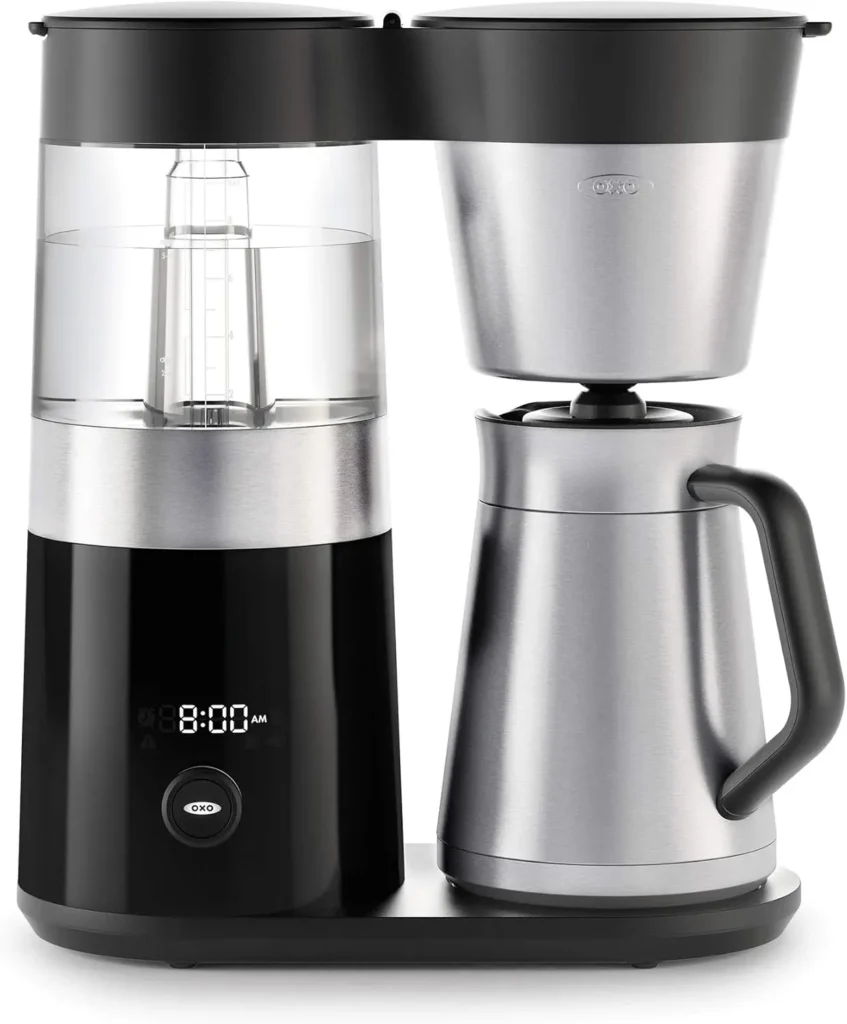
The OXO Brew 9-Cup is the most intuitive SCA Gold Cup certified drip machine available — easy to set up, easy to operate, and consistently excellent in the cup. OXO’s rainmaker showerhead distributes water in a wide, even pattern across the full surface of the grounds bed — one of the most common failure points in cheaper drip machines, which wet only the center of the basket and leave the edges under-extracted. The result is more even saturation and better extraction across the full dose. Like the Breville, it delivers into a thermal stainless carafe (not a warming plate), uses a programmable timer for morning auto-start, and handles a range of volumes without under-extracting at partial carafe fills. For anyone wanting SCA-certified performance in a slightly more accessible package with OXO’s characteristic ergonomic design, this is the pick.
- SCA Gold Cup certified: consistent 92–96°C brew temperature
- Rainmaker showerhead: even water distribution across full grounds bed — better extraction uniformity
- Carafe: Thermal stainless — keeps coffee hot without scorching
- Programmable timer: overnight setup for auto-start morning brewing
- Best for: quality-focused households wanting SCA certification at a strong value; anyone who prioritises intuitive controls and even extraction
⚠️ Verify ASIN before publishing. Disclosure: CoffeeGearHub may earn from qualifying purchases.
Best Grinders for French Press and Drip Coffee
A consistent burr grinder is the single most impactful purchase for either method — more important than upgrading the brewer itself. The KINGrinder K6 handles both coarse French press and medium drip settings from the same tool. The Baratza Encore is the recommended electric option for anyone brewing daily volume without wanting to hand-grind.
Best Manual Grinder: KINGrinder K6
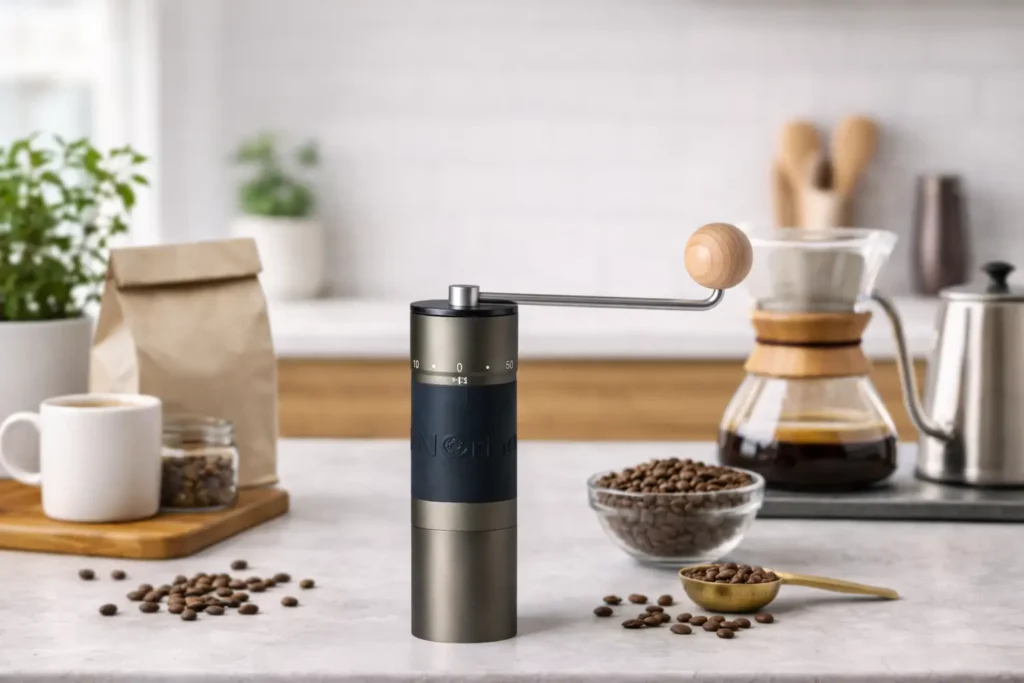
The KINGrinder K6 is our standard grinder recommendation across all CoffeeGearHub manual brewing content — and it covers both French press and drip coffee from a single device with genuine precision. Its 100-click adjustment system spans both the coarse French press range (clicks 65–80) and the medium drip range (clicks 32–42) with consistent, reproducible results. At French press coarse settings, the K6 produces low fines — the main quality issue with cheaper grinders at coarse settings, where excessive fine particles pass through the metal filter and produce muddy, bitter cups. At medium drip settings, it produces consistent particle size for even basket saturation. Moving between methods requires a click adjustment and a short purge of retained grounds — easily managed for a daily habit that alternates both. At French press and drip grind settings, 30g grinds in under 75 seconds.
- French press setting: 65–80 clicks (coarse) — low fines, clean extraction, less sediment
- Drip setting: 32–42 clicks (medium) — consistent particles for even basket extraction
- Burrs: 48mm stainless conical — excellent grind consistency across the full filter coffee range
- Best for: anyone wanting one grinder for both methods; travel use paired with French press
Disclosure: CoffeeGearHub may earn from qualifying purchases.
Best Electric Grinder: Baratza Encore
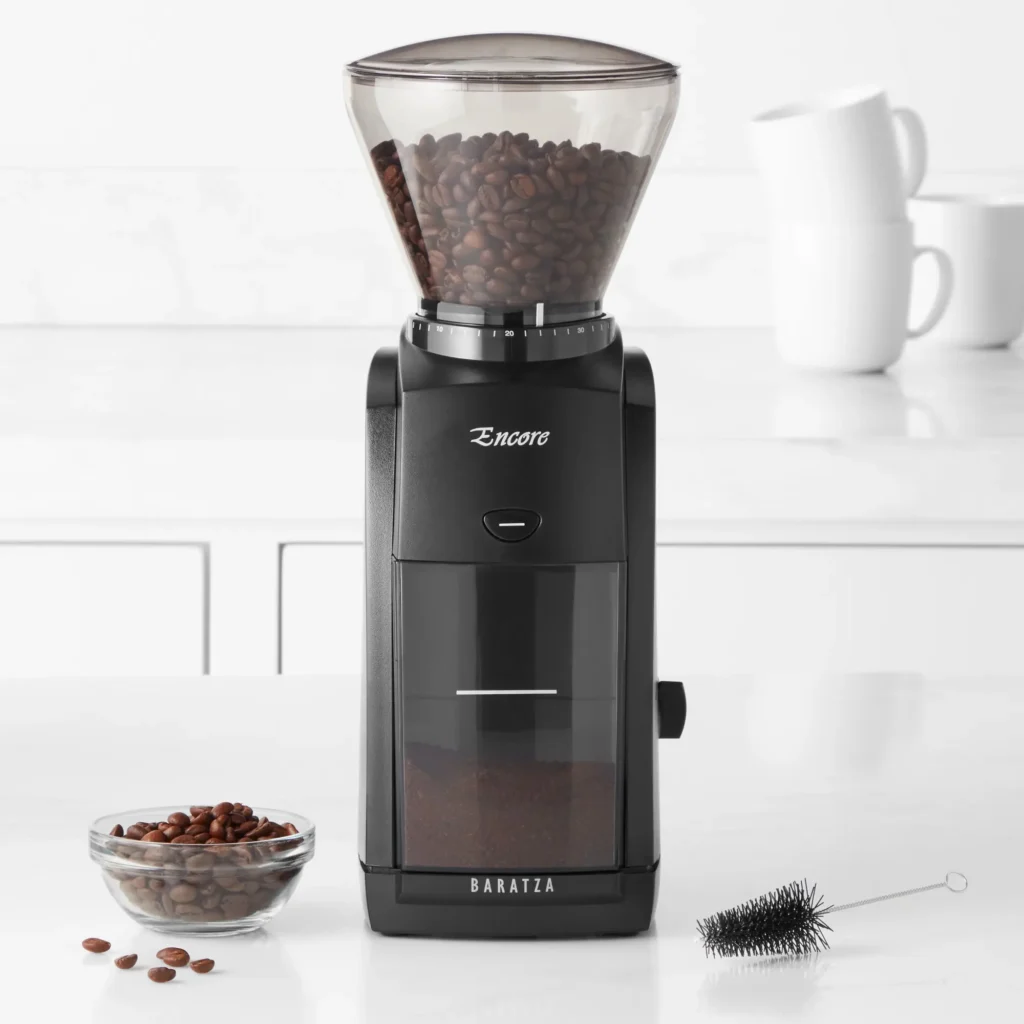
The Baratza Encore is the most widely recommended entry-level electric burr grinder in specialty coffee — the grinder that appears in more “start here” coffee guides than any other, and for good reason. Its 40-step adjustment system covers both French press (settings 28–38, coarse) and drip (settings 14–22, medium) with consistent results that rival manual grinders at a similar price while eliminating the hand-cranking effort for high-volume daily use. For households brewing 30–60g daily into a full French press or a drip carafe, the Encore’s push-button operation makes it the more practical choice than a hand grinder. What sets the Encore apart long-term is Baratza’s industry-leading repair program: replacement parts, burr sets, and repair guides are freely available, making the Encore one of the most long-lived grinder investments in home coffee. A well-maintained Encore runs for a decade.
- French press setting: Steps 28–38 (coarse range)
- Drip setting: Steps 14–22 (medium range)
- Key advantage: Baratza’s repair program — designed to be fixed, not replaced
- Best for: households grinding 30–60g daily who prefer push-button over hand-cranking
Disclosure: CoffeeGearHub may earn from qualifying purchases.
Grind Size Guide: French Press vs Drip (K6 Reference)
Grind size is the most critical variable in both methods — using the wrong grind setting for either method produces problems that no other adjustment fully compensates for. French press needs a coarse grind to slow immersion extraction. Drip needs a medium grind matched to the machine’s flow rate. All K6 click settings are measured from zero (burrs touching).
| Method / Roast | K6 Clicks | Grind descriptor | Brew time target | If sour / weak → | If bitter / slow → |
|---|---|---|---|---|---|
| French press — light roast | 60–65 | Medium-coarse | 4.5–5 min steep | Finer 3 clicks + raise temp 2°C | Coarser 3 clicks + shorten steep 30s |
| French press — medium roast | 65–72 | Coarse | 4 min steep | Finer 3 clicks | Coarser 3 clicks |
| French press — medium-dark roast | 70–78 | Coarse | 4 min steep | Finer 3 clicks | Coarser 3 clicks + lower temp 1°C |
| French press — dark roast | 74–82 | Very coarse | 3.5–4 min steep | Finer 3 clicks | Coarser 4 clicks + shorten steep 30s |
| Drip — light roast | 30–36 | Medium-fine | 4–6 min brew cycle | Finer 2–3 clicks + raise machine temp | Coarser 2–3 clicks |
| Drip — medium roast | 34–40 | Medium | 4–6 min brew cycle | Finer 2–3 clicks | Coarser 2–3 clicks |
| Drip — medium-dark roast | 36–42 | Medium | 4–6 min brew cycle | Finer 2 clicks | Coarser 2–3 clicks |
🔬 Why French press needs a much coarser grind than drip: In French press, coffee steeps in full contact with water for 4 full minutes. Coarse grind reduces particle surface area, deliberately slowing extraction to prevent over-extraction at this extended contact time. It also reduces fines — the very small particles that pass through the metal filter and produce muddy, bitter sediment in the cup. In drip brewing, water passes through the grounds bed progressively over 4–6 minutes of gravity-fed percolation. Medium grind provides the right particle size for water to flow at the correct speed for even extraction across the basket. French-press-ground coffee in a drip machine drains too fast and produces a weak, watery cup. Drip-ground coffee in a French press over-extracts into bitterness and produces heavy sediment. Grind to the method — they are not interchangeable.
Brew Parameters: Ratio, Temperature, and Timing
Both methods use the same fundamental parameter set — coffee dose, water weight, water temperature, and time. Use a scale whenever possible; volume scoops and measurements are unreliable because coffee density varies significantly across roast levels, origins, and freshness. A weight-based ratio produces the same cup every time regardless of bean; a scoop-based measurement does not.
| Parameter | French Press (1L) | Drip (standard 6-cup carafe) | Notes |
|---|---|---|---|
| Coffee dose | 60g | 60g | Same 1:15 ratio produces comparable starting strength in both methods |
| Water volume | 900ml | 900ml | Weigh water rather than using the machine’s cup markings if possible |
| Ratio | 1:15 (1g per 15ml) | 1:15 (1g per 15ml) — SCA recommended | Adjust to 1:14 for stronger or 1:16 for lighter based on preference |
| Water temp — light roast | 93–96°C | 93–96°C (SCA standard — requires certified machine) | Budget drip machines rarely reach this — one reason SCA certification matters |
| Water temp — medium roast | 92–94°C | 92–94°C | French press: controllable with any kettle; drip: machine-controlled |
| Water temp — dark roast | 90–92°C | 90–93°C | Drip machines rarely let you reduce temperature — less issue with dark roast extraction speed |
| Brew / steep time | 4 minutes immersion | 4–6 minutes percolation (machine-controlled) | French press: you control the time; drip: machine controls the flow rate and time |
| Post-brew action | Press and pour immediately — do not leave on grounds | Pour from carafe; avoid leaving on warming plate more than 20 min | Both methods degrade if left too long after brewing — serve promptly or transfer to thermal vessel |
⚠️ Pour French press immediately after plunging. Extraction does not stop when the plunger is pressed — the puck of grounds continues steeping in the brewed coffee below. A French press left sitting for 10–15 minutes after pressing will taste noticeably more bitter and astringent. If you are not serving all the coffee at once, pour the entire brew into a thermal carafe or pitcher immediately after pressing. The Espro P3’s double-sealed plunger is the exception — it creates a true extraction barrier that makes leaving brewed coffee in the press safe.
Which Is Right for You? A Scenario-by-Scenario Guide
The honest answer to “French press or drip?” depends almost entirely on volume, schedule, and flavor preference — not on which one sounds better on paper. Here is the scenario breakdown.
| Your situation | Recommended method | Why |
|---|---|---|
| Solo drinker, 1–2 cups daily, quality-focused | 🏆 French press | Native small-volume method; produces a more distinctive, complex cup than most drip machines; no electricity required |
| Couple brewing 2–4 cups, both want hands-off convenience | 🏆 Drip machine | Programmable auto-start and multi-cup capacity make mornings frictionless for both people |
| Family of 4+ brewing 6–10 cups daily | 🏆 Drip machine | French press cannot practically match this volume; quality drip machine handles it hands-off every morning |
| “I want press-a-button and walk away” | 🏆 Drip machine | French press requires presence throughout the brew cycle; drip is fully unattended after setup |
| “I want coffee ready when I wake up” | 🏆 Drip machine | Programmable timer is a drip machine exclusive — French press cannot be pre-programmed |
| Beginner wanting best cup quality on a limited budget | 🏆 French press | A quality French press + KINGrinder K6 produces a more complex, impressive cup than a budget drip machine at any price; no electricity required for the brewer |
| Frequent traveller who wants quality coffee everywhere | 🏆 French press | A Stanley Adventure French press + K6 hand grinder = quality coffee anywhere with no electricity; drip machines are not travel-capable |
| Bold coffee lover who wants heavy, rich, oily cups | 🏆 French press | Metal filtration and immersion brewing produce body and richness that paper-filtered drip cannot match regardless of machine quality |
| Clean-cup drinker who wants less sediment and oil | 🏆 Drip machine (or Espro P3) | Paper filtration removes oils and fines; drip produces the cleanest, most sediment-free cup; Espro P3 bridges the gap for French press lovers |
| Already owns a drip machine — is French press worth adding? | French press as addition | A quality French press is an accessible addition; keep the drip machine for volume mornings, use French press for personal best-cup brews or when guests want something special |
| Wants to understand specialty coffee flavour | 🏆 French press | French press’s metal filter and immersion method reveal more oil-forward complexity from specialty beans than most budget-to-mid drip machines |
Troubleshooting Matrix: French Press and Drip Coffee
Identify your symptom, confirm the method, then apply fixes in the order listed — change one variable per brew and note what changed before adjusting again.
| Symptom | Method | Most likely cause | Fix — in order |
|---|---|---|---|
| Bitter, harsh, unpleasant finish | French press | Grind too fine, steep too long, water too hot, or coffee left on grounds after pressing | Grind 3–5 clicks coarser → shorten steep 30s → lower temp 1–2°C → pour immediately after plunging every time |
| Bitter, flat, drying | Drip | Grind too fine, machine temperature too high, or stale beans | Grind 2–3 clicks coarser → check roast date (discard if 60+ days old) → check machine temperature (SCA certified reaches 92–96°C) |
| Sour, weak, thin body | French press | Grind too coarse, steep too short, or water too cool | Grind 3–4 clicks finer → extend steep by 30s → raise temp 2°C (especially important for light roast) |
| Sour, watery, hollow | Drip | Machine brewing below 92°C (most common in budget machines), or grind too coarse | If budget machine: this is a machine-temperature problem — upgrade to SCA-certified machine; if already certified: grind 2–3 clicks finer → increase dose by 3g |
| Muddy, gritty sediment in cup | French press | Grind too fine — fines passing through metal filter | Grind 5+ clicks coarser → press more slowly and evenly → upgrade to burr grinder if currently using blade grinder → consider Espro P3 for cleaner-cup French press |
| Flat, hollow, no sweetness or aroma | Both | Stale beans — buy fresh with a visible roast date within 30 days | No technique or equipment fix for stale beans — buy fresh roast-dated beans; this is the most commonly overlooked problem in home coffee |
| Too strong / intense | Both | Ratio too concentrated — too much coffee per ml of water | Reduce dose by 5g without changing water amount → try 1:16 or 1:17 ratio → or dilute finished cup with a small amount of hot water |
| Too weak / dilute (correct flavour, just not enough) | Both | Ratio too dilute — not enough coffee | Increase dose by 5g → try 1:14 ratio → grind 2 clicks finer to improve extraction without changing dose |
| Coffee bitter only when left in machine after brewing | Drip | Warming plate overheating coffee — slow caramelisation and oxidation | Pour entire brew into a thermal carafe immediately after the brew cycle completes → upgrade to a machine with a thermal carafe (Breville Precision Brewer, OXO Brew) if your current machine uses a glass carafe on a warming plate |
| Coffee bitter after plunging but not immediately | French press | Not pouring immediately — extraction continuing through pressed puck | Pour all brewed coffee into cups or a thermal carafe immediately after pressing — do not leave brewed coffee in contact with the grounds for any length of time |
| Drip machine brewing slower than usual | Drip | Mineral scale in heating element and internal tubing | Descale the machine immediately (white vinegar or commercial descaler) — run 2–3 clean water cycles after → this is a sign descaling has been overdue; machine temperature has also been dropping |
| Drip machine tastes fine but quality has declined over months | Drip | Scale buildup gradually dropping brew temperature — common in hard water areas | Full descale cycle → if quality still reduced, run a second descale cycle → set a monthly reminder to descale going forward |
FAQs: French Press vs Drip Coffee
Is French press better than drip coffee?
Neither is objectively better — they produce fundamentally different cups and serve different needs. French press produces rich, full-bodied, oil-forward coffee through metal filtration and immersion brewing. Drip coffee produces a cleaner, more consistent cup through paper filtration and automated brewing. French press wins on flavor complexity and body; drip wins on volume, automation, and convenience for multi-cup households. The right choice depends on how many cups you brew, how much active involvement you want in the process, and which flavor profile you prefer.
Which is easier to use — French press or drip coffee maker?
Both are easy, but they are easy in different ways. Drip is easier in the sense of requiring the least active involvement — add water, add grounds, press start, walk away. French press requires a few more active steps (stir, time, plunge, pour immediately) but is still one of the most forgiving manual brew methods. The main way French press punishes inattention is forgetting to pour immediately after plunging — leaving coffee on compressed grounds for 10+ minutes over-extracts and tastes bitter. Drip machines have no equivalent post-brew timing penalty.
Does French press coffee taste better than drip?
French press produces a richer, more complex, oil-forward cup that many coffee enthusiasts prefer. Drip coffee from a quality SCA-certified machine produces a cleaner, more consistent cup that suits everyday multi-cup household needs better. Whether French press ‘tastes better’ depends entirely on whether you prefer full-bodied, heavy coffee (French press) or clean, bright, lighter-bodied coffee (drip). At comparable quality tiers, French press from fresh beans with a consistent burr grinder produces a more distinctive cup than most drip machines at the same spend level.
What grind size does French press need?
French press requires a coarse grind — the coarsest setting of any common brew method. On the KINGrinder K6, this is approximately 65–80 clicks from zero depending on roast level. A coarse grind slows extraction through the metal filter’s long immersion contact, reducing fines that cause muddy, gritty cups. If your French press tastes bitter or gritty, your grind is too fine. If it tastes weak and watery, grind slightly finer or extend your steep time.
What grind size does drip coffee need?
Drip coffee requires a medium grind — finer than French press but coarser than AeroPress or espresso. On the KINGrinder K6, medium grind for drip is approximately 32–42 clicks from zero depending on your machine’s flow rate and the roast level. Grind too coarse and your drip coffee will be weak and under-extracted. Grind too fine and the basket will flow slowly, over-extracting into bitterness.
Which makes stronger coffee — French press or drip?
French press tastes stronger at the same coffee-to-water ratio because coffee oils, dissolved fine particles, and diterpene lipids all pass through the metal filter into the cup, creating a heavier mouthfeel and perceived intensity. Drip coffee filters these compounds out through paper filtration, producing a cleaner, lighter-bodied cup. Actual caffeine content is similar at the same ratio — what differs is body and perceived strength, not chemistry. You can make drip coffee taste equally strong by increasing the dose, but it will still taste cleaner and lighter-bodied than French press at the same ratio.
Is French press or drip better for multiple cups?
Drip is significantly better for brewing multiple cups simultaneously. Most drip machines brew 8–12 cups per cycle hands-off and keep coffee warm in a thermal carafe or on a warming plate. French press volume is limited by the size of your brewer — a 1L French press brews approximately 4 cups, and the entire brewing process requires active involvement. For solo drinkers or couples, French press is a reasonable multi-cup solution. For families or offices brewing 6+ cups daily, a drip machine is the only practical choice.
Which is easier to clean — French press or drip?
Neither method is particularly difficult to clean, but they require different types of effort. French press cleanup involves disposing of the grounds (never down the drain), rinsing the carafe, and periodically disassembling the plunger filter to clean oil residue from the mesh. Drip machine cleanup involves discarding the paper filter and grounds, rinsing the basket, and washing the carafe. However, drip machines also require descaling every 1–3 months to remove mineral buildup from the heating element, which French press never needs. French press is simpler to maintain long-term; drip machines require more attention to internal maintenance.
Do I need a burr grinder for French press or drip?
A burr grinder is strongly recommended for both methods and produces a more noticeable improvement in cup quality than almost any other upgrade. For French press, a burr grinder at coarse settings dramatically reduces fines — the tiny particles that pass through the metal filter and cause muddy, bitter, gritty cups. For drip, consistent particle size ensures even extraction through the basket. The KINGrinder K6 covers both methods from the same device at a coarse French press setting and a medium drip setting.
Can you use the same beans for French press and drip coffee?
Yes — the same whole bean coffee can be used in both methods, but you need to grind at different settings and will get different cups from the same bag. French press amplifies body, richness, and oil-forward character through its metal filter. Drip reveals a cleaner, more transparent version of the same bean through paper filtration. Medium to medium-dark roasts work excellently in both methods. Light roast single-origin beans reveal more oil-forward character in French press than in many drip machines, though a quality SCA-certified drip machine handles light roasts well.
Continue Learning
FRENCH PRESS GUIDES
DRIP COFFEE GUIDES
Comparing all three main filter methods? Our French Press vs Pour Over guide runs the same head-to-head comparison between immersion and paper-filtered percolation — covering the flavor science, grind requirements, and gear picks for both.
☕
Written by the CoffeeGearHub Editorial Team
CoffeeGearHub is a specialty coffee equipment resource produced by the CoffeeGearHub Editorial Team. Our guides are researched using published brewing science, SCA standards, grinder manufacturer specifications, and established specialty-coffee community knowledge. We review and update our pillar content regularly. About CoffeeGearHub →