Last Updated: March 2026 • 25–35 min read • Complete Setup Guide: Gear Priority + Extraction Science + Dial-In System + Dripper Picks
✍️ Editorial note: This guide is researched and written by the editors at CoffeeGearHub.com using published brewing science, grinder and equipment manufacturer specifications, and established specialty-coffee community knowledge. Recommendations reflect research consensus rather than in-house lab testing. All product links are affiliate links — we may earn a commission at no cost to you.
The 30-Second Answer
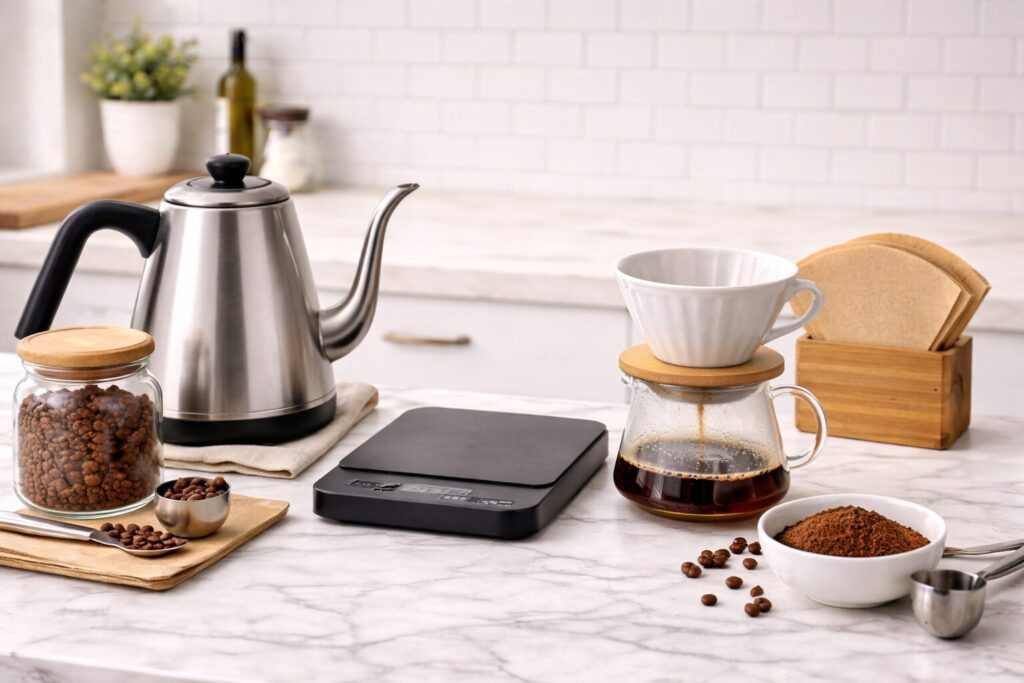
The essential pour-over coffee brewing setup is: burr grinder → scale → gooseneck kettle → dripper + paper filters — in that priority order. Start with a 1:16 ratio (20g coffee : 320g water), grind medium / medium-fine (coarse sand texture), brew at 200°F (93°C), and target a total draw-down of 2:45–3:30. If it tastes sour, grind finer. If it tastes bitter, grind coarser. Keep everything else fixed while you adjust, and stop when sweetness is obvious and the finish is clean.
- Target draw-down time: 2:45–3:30 total
- Target flavor: integrated sweetness + clarity + clean finish with no drying aftertaste
- Fastest upgrade path: replace blade grinder with any burr grinder first — nothing else comes close to that single improvement
Who This Guide Is For — Jump to What You Need
🆕 Building from scratch
Start with Gear Priority Order + Budget Tiers Table.
☕ Ready to brew now
Jump to the Step-by-Step Recipe + Ratio Scaling Table.
🛠️ Fixing a bad cup
Go straight to the Troubleshooting Matrix.
🔬 Extraction nerd
Read Extraction Science + Cone vs Flat-Bottom.
Table of Contents
Why Your Setup Makes or Breaks the Cup
If you’ve ever brewed two pour-overs from the same bag of coffee and gotten wildly different results, your setup is almost certainly why. Pour-over is brutally honest: it amplifies both good and bad variables. A blade grinder, an uncalibrated pour, water that’s too cool — any one of these will flatten or ruin what should be a clean, layered cup.
This guide covers the full pour-over setup from first principles: what to buy, in what order, at what price, plus the extraction science behind why each piece matters, a step-by-step recipe, and a dial-in system for any coffee in 2–3 brews.
Gear Priority Order: What to Buy First
Don’t buy everything at once. Each of these upgrades produces a clearly better cup before you need the next one. The order matters — the grinder gap is the largest single jump you can make.
- 🥇 Priority 1 — Burr grinder: uniform particle size → even extraction → clean, sweet cup. Nothing else comes close in impact.
- 🥈 Priority 2 — Digital scale with timer: repeatability. Without weighing dose and water, grind adjustments can’t give clean feedback.
- 🥉 Priority 3 — Gooseneck kettle: pour control. Even saturation, no channeling. Doubles as temperature control with an electric model.
- 4️⃣ Priority 4 — Dripper + matching filters: shape and filter material tune flavor profile once everything else is dialed.
- 5️⃣ Priority 5 — Filtered water: coffee is ~98.5% water. Chlorine and metal off-notes will limit your ceiling regardless of everything else.
The Gear Quick-Reference Table: Fastest Way to Dial In Your Setup
Start with the grinder, then add each piece in priority order. The “what it changes” column tells you exactly what improves when you add that item.
| Gear | Priority | What it changes | Minimum spec | Skip if… |
|---|---|---|---|---|
| Burr grinder | 1st | Extraction evenness → flavor clarity + sweetness | Conical or flat burrs; fine-step adjustment | You already own one |
| Digital scale + timer | 2nd | Repeatability → consistent cups day to day | 0.1g resolution; built-in timer | Never |
| Gooseneck kettle | 3rd | Pour evenness → no channeling; temp control (electric) | Curved gooseneck spout; variable temp for electric | Already have one |
| Dripper | 4th | Flow rate and extraction style → cup profile | Cone or flat-bottom; matches available filters | Already have one |
| Paper filters | 4th | Oil and fines filtration → clarity and mouthfeel | Matching size for your dripper | Using metal filter by choice |
| Filtered water | 5th | Off-note removal → cleaner baseline | 75–150 ppm TDS, near-neutral pH | Your tap water already tastes neutral |
Pro tip: A $60 hand burr grinder paired with a $10 plastic V60 will outperform a $200 ceramic dripper used with a blade grinder, every single time. Invest in the grinder first and feel the difference immediately.
How Pour-Over Extraction Actually Works
Pour-over is a percolation brewer: hot water passes through a bed of ground coffee, dissolving soluble compounds as it flows, then drains through a filter. Unlike immersion methods (AeroPress, French press), extraction happens continuously and progressively from the moment water contacts grounds to the moment the last drop drains.
Compounds extract in a predictable sequence: bright acids and salts come out first, sweetness and “coffee flavor” come next, and bitter/astringent compounds extract last. The goal is to stop the flow in the sweet spot — past the hollow early-extraction zone, before the harsh over-extraction zone.
Three variables control where you land in that window:
- Early extracts: acids and salts (brightness; can be sharp or hollow alone)
- Mid extracts: sugars and aromatics (sweetness + recognizable “coffee” flavor)
- Late extracts: bitter compounds and astringents (drying finish)
Grind size controls surface area and diffusion distance — finer grinds extract faster by exposing more surface to water; coarser grinds slow extraction. Water temperature accelerates or slows solubility. Pour technique (flow rate and evenness) controls contact time and prevents channeling — the single biggest source of inconsistency in pour-over specifically.
🔬 If your cup tastes simultaneously sour and bitter: that’s the classic blade-grinder symptom — fine powder over-extracting while coarse chunks under-extract in the same dose. It’s the #1 sign a burr grinder upgrade will produce immediate, dramatic improvement.
The Burr Grinder: The Make-or-Break Piece
If your pour-over tastes sour, weak, or bafflingly bitter even with good beans, the grind is almost always the culprit. Pour-over’s continuous percolation is particularly sensitive to particle size distribution — a wide range of particle sizes produces both over- and under-extracted compounds in the same cup, with no way to fix it at the pouring stage.
Manual vs Electric Burr Grinders
Manual burr grinders punch above their price point for grind quality. A $50–$100 hand grinder can match the grind consistency of electric grinders in the $200+ range. The tradeoff: 60–90 seconds of hand-cranking per dose. They’re also compact and the best travel option.
Electric burr grinders are faster and more convenient for daily multi-cup brewing. The entry-level point worth considering for pour-over is around $100–$150 — below that, burr quality and consistency drop off quickly.
What to Look For When Buying a Grinder for Pour-Over
- True burrs — conical or flat, not blades
- Fine-step adjustment — small, predictable changes between settings
- Low retention — old grounds trapped inside stale your dose
- Rigid burr assembly — wobble and flex degrade consistency at every grind
Not sure which grinder fits your situation? Start here: Best Burr Grinders for Pour-Over (2026).
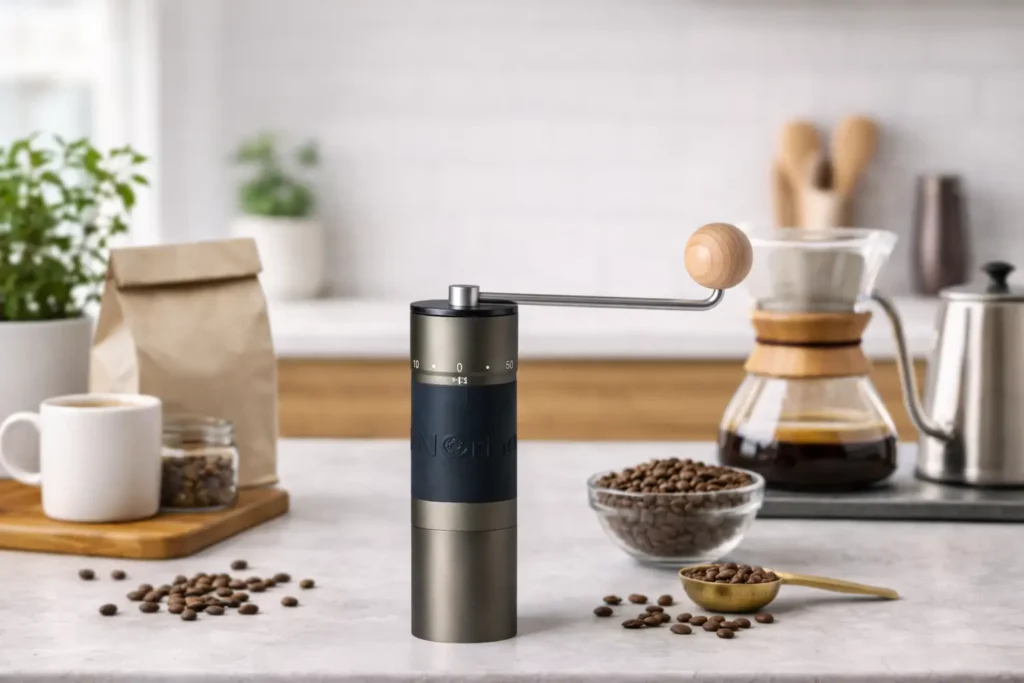
Hand Burr Grinder — Best Value Upgrade
A quality hand burr grinder delivers grind consistency that matches or exceeds electric grinders at 2–3× the price. Look for stepless or fine-step adjustment, a rigid burr assembly, and low retention. This is the highest-impact, lowest-cost upgrade in any pour-over setup.
- Consistent particle size → cleaner, sweeter cup immediately
- Predictable adjustments so dial-in actually works
- Compact — doubles as a travel grinder
Disclosure: CoffeeGearHub may earn from qualifying purchases.
Coffee Scale + Timer: Your Shortcut to Consistency
Pour-over is controlled extraction — and you can’t control what you can’t measure. A scale lets you repeat your best cup exactly: same dose, same yield, same timing. Without one, small errors in measurement compound across every brew variable and you can’t tell whether a change in taste came from a grind adjustment or a dose inconsistency.
To dial in reliably, a digital scale and a temperature-controlled kettle remove guesswork so grind and technique changes give clean, isolated feedback.
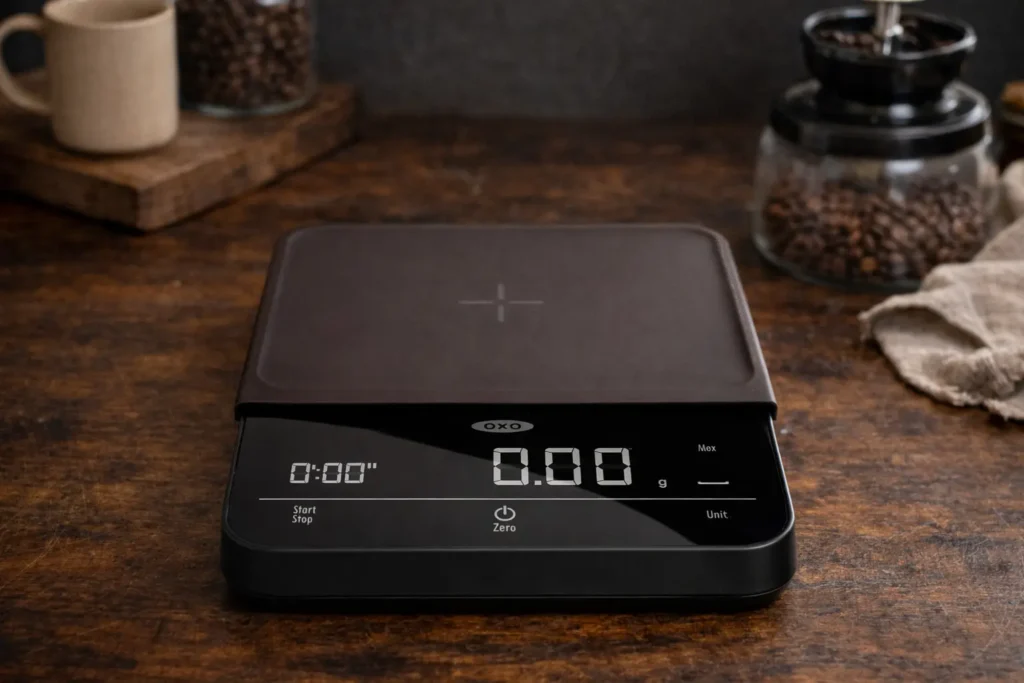
A Coffee-Capable Digital Scale
You can’t reliably dial in pour-over without weighing dose and water. Look for 0.1g resolution, a fast refresh rate (so you can pour by weight in real time), and a built-in timer.
- Eliminates dose variability so grind and technique changes show up clearly
- Makes every recipe repeatable from one brew to the next
- Pays for itself in fewer wasted brews during dial-in
Disclosure: CoffeeGearHub may earn from qualifying purchases.
Gooseneck Kettle: Control the Pour, Control the Cup
A gooseneck kettle solves a problem most beginners don’t realize they have: uncontrolled water flow. A standard kettle dumps water too fast and too hard, blasting channels through your coffee bed and causing uneven extraction — thin, sharp cups even from quality beans and a good grinder. The gooseneck’s long, curved spout slows and precisely directs the pour.
Electric gooseneck kettles with variable temperature control are the gold standard for daily pour-over use. You set the temperature, it holds it while you grind — no thermometer, no timing your cool-down. Stovetop gooseneck kettles cost less and are more durable, but you’ll need a thermometer to dial water temperature accurately.
Target water temperature for pour-over: 195–205°F (90–96°C). Light roasts do better at the hotter end; dark roasts taste cleaner toward the cooler end. 200°F (93°C) is the safe default for medium roasts.
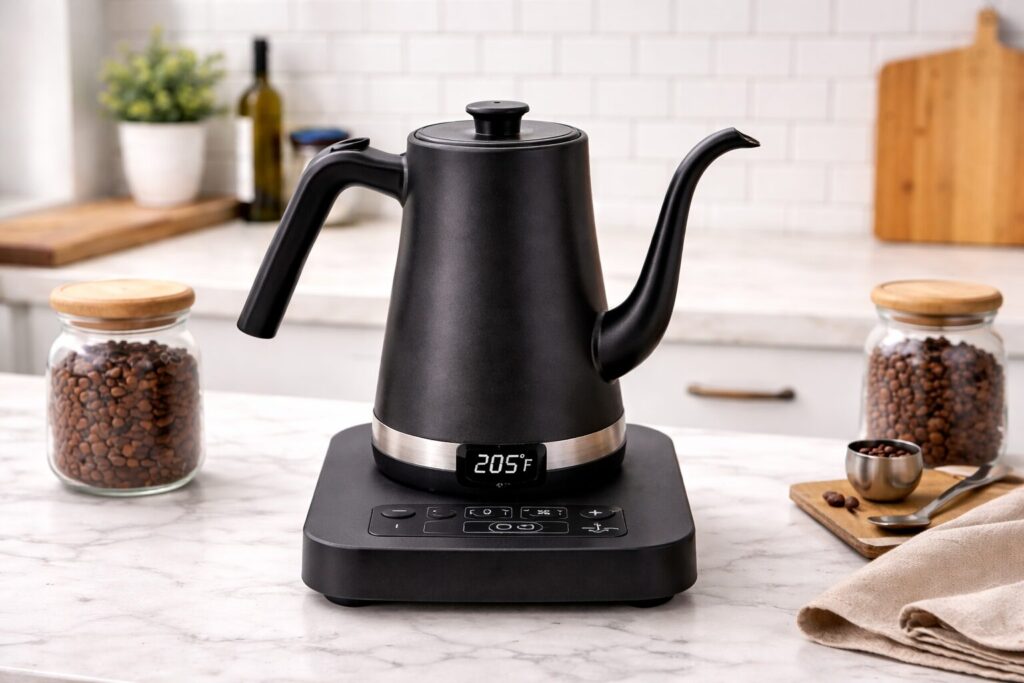
Temperature-Controlled Gooseneck Kettle
For daily pour-over use, variable temperature control removes the most annoying variable in the whole process. Set your temp, walk away, and it’s ready when your grinder is done.
- Light roast: 200–205°F (93–96°C) helps sweetness develop fully
- Dark roast: 195–199°F (90–93°C) reduces harshness
- Hold-temp feature keeps water ready while you prep
Disclosure: CoffeeGearHub may earn from qualifying purchases.
Cone vs Flat-Bottom Drippers: What Changes in the Cup
The dripper shape controls how water flows through the coffee bed, which directly affects extraction evenness and flavor profile. There’s no universally best dripper — there’s the best match for how you like coffee to taste and how carefully you want to pour.
| Feature | Cone Drippers | Flat-Bottom Drippers |
|---|---|---|
| Cup profile | Bright, clean, high-definition | Rounder, sweeter, more body |
| Flow rate | Faster (single large drain hole) | Slower (multiple small holes) |
| Extraction style | Higher — emphasizes clarity and acidity | More even — softer, balanced extraction |
| Pour sensitivity | Higher — rewards careful technique | Lower — more forgiving for beginners |
| Best for | Light/medium roasts, fruit and floral notes | Medium/dark roasts, chocolate and nutty notes |
| Popular models | Hario V60, Origami, April | Kalita Wave, Orea, Stagg [X] |
| Price range | $10–$80+ | $25–$100+ |
💡 Beginner recommendation: Start with a flat-bottom dripper (Kalita Wave) or a plastic V60. Both are inexpensive, widely documented, and have huge communities of recipes and dial-in advice behind them. See all picks: Best Pour-Over Coffee Makers (2026).
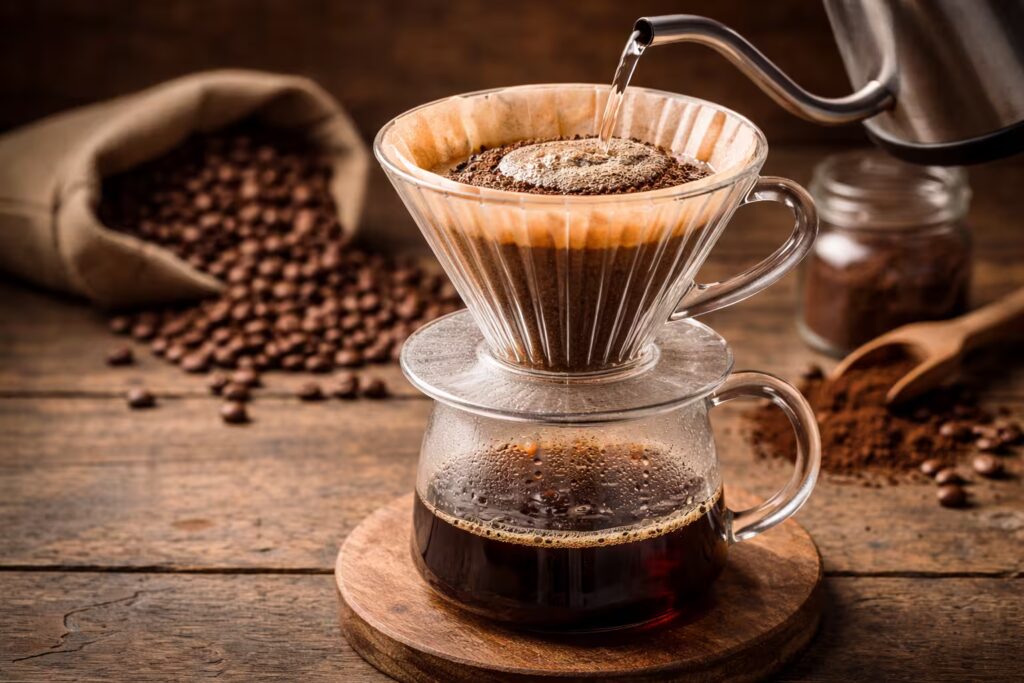
Pour-Over Dripper — Our Pick
For most people starting out, a plastic or ceramic V60 (cone) or a Kalita Wave (flat-bottom) hits the best balance of performance and affordability. Both are well-documented with hundreds of community recipes and a clear upgrade path if you want to go further.
Disclosure: CoffeeGearHub may earn from qualifying purchases.
Paper vs Metal vs Cloth Filters
Filter material determines how much oil passes into your cup, which directly affects body, mouthfeel, and clarity. Paper catches fines and oils for maximum clarity; metal passes more oils through for body and texture (and typically needs a slightly coarser grind and less agitation).
Paper
- Cleanest cup, brightest flavor, easiest dial-in
- Very low oil passage
- Always rinse before brewing — removes paper taste and pre-warms the dripper
Metal
- More body and oils in the cup
- Go 1–2 steps coarser than paper baseline
- Reduce pour agitation; rinse after every brew
Cloth
- Balanced — between paper and metal in body and clarity
- Rinse and air dry after each brew; replace monthly
- Higher maintenance; best for experienced brewers who know what they want
Water Quality: The Hidden Upgrade Most People Skip
Coffee is roughly 98.5% water. If your tap water tastes like chlorine or metal, your pour-over will too — no matter how good your grinder, beans, or technique. If cups stay flat despite careful dial-in, check roast date and water quality before changing anything else.
💧 Avoid
- Distilled water — 0–5 ppm; flat, lifeless, under-extracted
- Unfiltered chlorinated tap — chemical off-notes dominate
✅ Good
- Brita / pitcher filtered — 50–120 ppm typical; clean and neutral
- Bottled spring water — 70–150 ppm; mineral sweetness, good body
⭐ Best
- Third Wave Water / remineralized — ~150 ppm calibrated; optimized extraction and full sweetness
- SCA target range: 75–150 ppm TDS, pH ~7
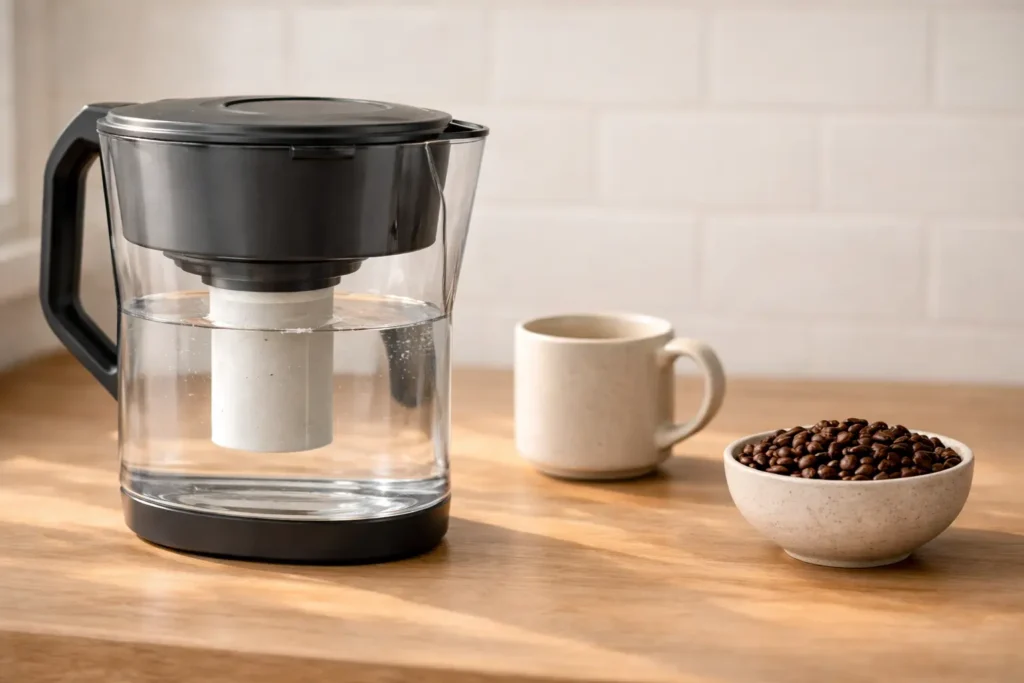
Coffee-Friendly Water Filter Pitcher
If your tap water tastes “off” (chlorine or metallic), your coffee will too — and no amount of grind tweaking will fix it. Filtering improves baseline flavor clarity and makes dial-in adjustments much easier to taste.
Disclosure: CoffeeGearHub may earn from qualifying purchases.
Budget Tiers: Beginner to Enthusiast Setup
You don’t need to buy everything at once. Each tier produces noticeably better coffee than the one below it. The biggest jump happens when you go from no burr grinder to any burr grinder — everything else is refinement on top of that foundation.
| Tier | Budget | Grinder | Kettle | Dripper | Scale | What you get |
|---|---|---|---|---|---|---|
| Starter | ~$60–80 | Entry hand burr grinder | Stovetop gooseneck + thermometer | Plastic V60 01/02 | Basic kitchen scale | Dramatically better than drip or pods — real flavor clarity |
| Mid-Range | ~$150–200 | Quality hand grinder (e.g., Timemore C3) | Electric gooseneck with temp control | Ceramic V60 or Kalita Wave | Coffee scale with timer (0.1g) | Café-quality at home — consistent, clean, repeatable every brew |
| Enthusiast | ~$400–600+ | Electric burr grinder (e.g., Fellow Opus, Baratza Encore) | Variable temp electric with hold (e.g., Fellow Stagg EKG) | Premium dripper (Origami, April, Stagg [X]) | High-refresh scale (e.g., Acaia Pearl) | Full variable control — for those who genuinely geek out on coffee |
💡 Best value upgrade path: Start at Starter tier, then replace the grinder first with a quality hand burr grinder. That single swap — blade grinder to burr grinder — is the largest single jump in cup quality you will ever experience at home.
The Pour-Over Dial-In Framework
Dial-in works fastest when you isolate one variable at a time — grind first, then use temperature and pour technique for fine-tuning.
Baseline “Control” Recipe
- Coffee: 20g (weighed)
- Water: 320g filtered
- Ratio: 1:16
- Temperature: 200°F / 93°C
- Filter: paper (rinsed)
- Bloom: 50–60g, wait 30–45s
- Target draw-down: 2:45–3:30 total
This is an intentionally repeatable recipe. It’s a diagnostic baseline that makes grind changes easy to taste and easy to evaluate.
Taste → Fix Order
- Sour or sharp: grind slightly finer
- Bitter or drying: grind slightly coarser
- Almost there: adjust draw-down time (grind ±1 step)
- Dark roast harsh: lower temp 3–6°C
- Balanced but weak: increase dose — strength issue, not extraction
Rule: change one variable per brew, then taste before adjusting again.
The Testing Protocol: Dial In Any Coffee in 2–3 Brews
Goal: clean feedback. Keep everything fixed except grind.
- Brew #1 baseline: brew the control recipe. Note draw-down time and finish.
- Log 3 things: draw-down time, pour effort, and a one-word finish (clean / sour / bitter / hollow / muddy).
- Adjust grind: 1–2 steps (electric) or 2–4 clicks (hand). Change nothing else.
- Brew #2: repeat exactly. Compare sweetness and finish quality.
- Brew #3 (optional): smaller move in the same direction, or reverse if you overshot.
Stop when: sweetness is obvious, finish is clean, and draw-down lands in the 2:45–3:30 window.
Two Recipe Playbooks with Grind and Temp Targets
These cover the standard daily cup and a stronger, more concentrated style for those who add milk or want more intensity.
Playbook #1 — Daily Sweet Cup
- Coffee: 20g
- Water: 320g filtered
- Temp: 200°F / 93°C
- Filter: paper (rinsed)
- Grind: medium / medium-fine
- Method: bloom 50–60g for 30–45s → pour to 180g by 1:15 → finish to 320g by 2:15 → drain
Fix sour: finer. Fix bitter: coarser or pour slower.
Playbook #2 — Strong / Milk-Friendly Cup
- Coffee: 22–24g
- Water: 330–360g
- Ratio: 1:15
- Temp: 200–203°F / 93–95°C
- Filter: paper (rinsed)
- Grind: medium-fine (slightly finer than Playbook #1)
Fix harsh: coarser or drop temp by 3–5°F. Holds up well with milk or oat milk.
Brew Ratio Scaling Table
Once your 1:16 recipe is dialed in, scaling for cups or adjusting strength is simple. Keep the ratio fixed and change the dose — the method and timing stay the same.
| Cups | Coffee (g) | Water (g) | Ratio | Strength |
|---|---|---|---|---|
| 1 small (6 oz) | 11g | 175g | 1:16 | Standard |
| 1 standard (10 oz) | 18g | 285g | 1:16 | Standard |
| 1–2 cups (12 oz) | 20g | 320g | 1:16 | Standard (baseline recipe) |
| 2 cups (16 oz) | 25g | 400g | 1:16 | Standard |
| Carafe (24 oz / 700ml) | 44g | 700g | 1:16 | Standard |
| Strong single | 20g | 300g | 1:15 | Strong |
| Light single | 20g | 340g | 1:17 | Light / tea-like |
Roast Level: Grind + Temperature Targets
Light roasts need finer grind and hotter water to fully extract their delicate, complex compounds. Dark roasts need slightly coarser grind and cooler water to avoid extracting harsh bitter compounds that are more soluble after heavy roasting.
☀️ Light Roast
- Grind: 1–2 steps finer than baseline
- Temp: 202–205°F (94–96°C)
- Draw-down target: 3:00–3:30
🌤 Medium Roast
- Grind: baseline medium / medium-fine
- Temp: 198–202°F (92–94°C)
- Draw-down target: 2:45–3:15
🌑 Dark Roast
- Grind: 1–2 steps coarser than baseline
- Temp: 195–199°F (90–93°C)
- Draw-down target: 2:30–3:00
Troubleshooting Matrix: Taste → Fix
Start with grind. Use temperature and technique only after grind is close. Change one variable per brew.
| Symptom | What it usually means | Fix (in order) |
|---|---|---|
| Sour + drains fast (<2:30) | Too coarse / under-extracted | Finer → raise temp (light roasts) → pour slower |
| Bitter + drains slow (>3:45) | Too fine / over-extracted | Coarser → lower temp (dark roasts) → pour faster |
| Muddy / cloudy / gritty | Fines in cup, aggressive pour, or metal filter | Rinse paper filter → swirl pour only → slightly coarser |
| Balanced but weak / watery | Strength issue — not extraction | Increase dose (+1–2g) or reduce water — don’t change grind |
| Papery / cardboard taste | Filter not rinsed | Always rinse paper filter with hot water before brewing |
| Flat / no sweetness despite correct draw-down | Stale beans or poor water quality | Check roast date (use within 2–6 weeks); switch to filtered water |
| Drains too fast (<2:30) | Grind too coarse | Grind finer in small increments until draw-down slows |
| Drains too slow (>3:45) | Grind too fine or fines clogging filter | Grind coarser; level coffee bed before blooming |
| Sour AND bitter simultaneously | Inconsistent particle distribution — blade grinder | Upgrade to a burr grinder — see Gear Picks |
| Inconsistent cup day to day | No scale; variable dose and yield | Add a scale; weigh dose and water every brew |
Best Gear Picks for Pour-Over
These picks prioritize pour-over grind consistency, adjustment resolution, and value at each price point.

Baratza Encore
- Best overall value (electric)
- Strong medium-fine consistency
- Repairable + long-term support
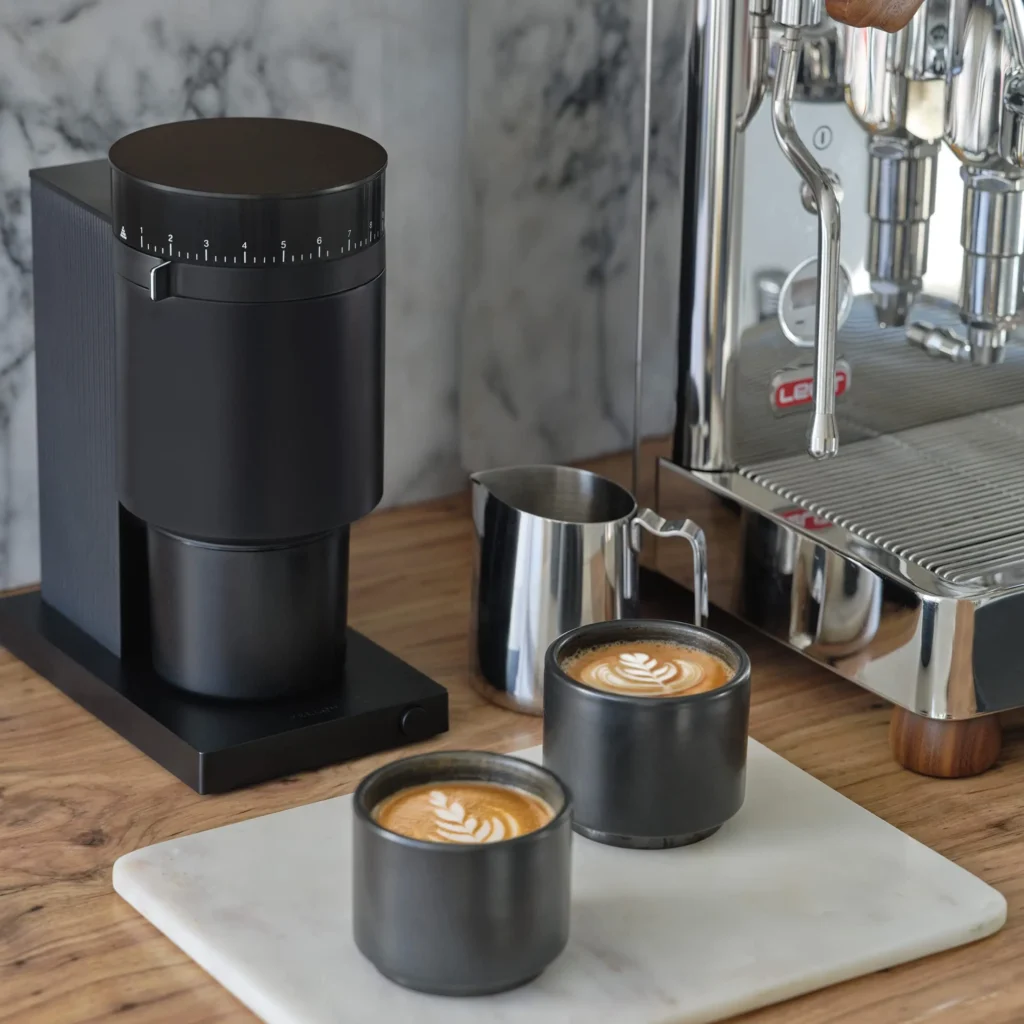
Fellow Opus
- Modern workflow + wide grind range
- Low static, tidy dosing
- Great for multi-method households
KINGrinder K6
- Best manual value
- Precise click adjustment
- Excellent travel and home pick
Full Gear Comparison Table
| Grinder | Type | Price | Med-fine consistency | Adjustment resolution | Retention | Travel | Best for |
|---|---|---|---|---|---|---|---|
| Baratza Encore | Electric conical burr | $$ | Excellent | Good | Medium | Low | Daily home, multi-method |
| Fellow Opus | Electric conical burr | $$ | Very good | Good | Low–medium | Low | Multi-brew, exploration |
| KINGrinder K6 | Manual steel burr | $ | Excellent | Very good | Very low | High | Home + travel, best manual value |
| Timemore C3 | Manual steel burr | $ | Very good | Good | Very low | High | First burr upgrade, biggest flavor jump per $ |
Final Takeaway
Grinder first, always. Scale second. A controlled pour third. Everything after that is refinement on a solid foundation. Get the grind consistent, measure dose and yield, and pour gently — and you’ll brew pour-over that tastes cleaner, sweeter, and more intentional than most specialty café drip at a fraction of the cost.
FAQs
Do I really need a gooseneck kettle for pour-over coffee?
Yes, if you want consistent results. A gooseneck kettle gives you precise control over flow rate and pour direction, helping saturate the coffee bed evenly and preventing channeling. You can brew without one, but repeating great cups becomes significantly harder — especially with cone drippers like the V60.
What grind size is best for pour-over coffee?
Start at medium to medium-fine — a texture similar to coarse sand or table salt. If your coffee tastes sour or weak, grind slightly finer. If it tastes bitter or drying, grind slightly coarser. Always change one variable at a time and re-taste before adjusting again.
What coffee-to-water ratio should I use for pour-over?
A 1:16 ratio is the standard starting point — 20g of coffee to 320g of water. Adjust to 1:15 for a stronger cup, or 1:17 for a lighter, more tea-like brew. Keep the ratio fixed when scaling up to larger batches.
Why does my pour-over coffee taste bitter?
Bitterness means over-extraction. Most common causes: grind too fine, water too hot, or brew time too long (draw-down over 3:45). Start by grinding coarser and keep everything else the same.
Why does my pour-over coffee taste sour?
Sourness points to under-extraction. Common causes include grinding too coarse, water not hot enough (below 195°F), or a brew that drains too fast (under 2:30). Try grinding finer first, then check your water temperature.
Can I use a blade grinder for pour-over coffee?
Technically yes, but you’ll get inconsistent results. Blade grinders produce a wide range of particle sizes in the same dose. Fine particles over-extract (bitter) while coarse chunks under-extract (sour), giving you a confused, muddy cup. A burr grinder is the single most impactful upgrade you can make.
What water temperature is best for pour-over coffee?
Brew between 195–205°F (90–96°C). Light roasts prefer the hotter end; dark roasts often taste cleaner around 195–199°F. For medium roasts, 200°F (93°C) is a reliable, consistent starting point.
Should I use paper or metal filters for pour-over?
Paper filters produce a cleaner, brighter cup with less oil. Metal filters pass more oils through, adding body and texture. For beginners, start with paper — it’s more forgiving and makes it easier to taste what your grind and recipe are doing.
How long should a pour-over take from start to finish?
Target a total draw-down time of 2:45–3:30. If the dripper drains in under 2:30, your grind is too coarse. If it’s still draining past 3:45, your grind is likely too fine — try grinding coarser and ensuring a level coffee bed before you bloom.
What’s the best pour-over setup for beginners?
A quality hand burr grinder (~$50–80), a basic kitchen scale, a stovetop or entry-level electric gooseneck kettle, and a plastic Hario V60 or Kalita Wave with matching paper filters. This setup costs $80–120 total and produces dramatically better coffee than any pod machine or drip maker at the same price point.
Continue Learning
POUR-OVER CLUSTER
Want a stronger pour-over for lattes or milk drinks? Use Playbook #2 above with a 1:15 ratio — it holds up to milk without going flat.
☕
Written by the CoffeeGearHub Editorial Team
CoffeeGearHub is a specialty coffee equipment resource run by home brewers and coffee enthusiasts. Our guides are researched using published brewing science, equipment manufacturer specifications, and established specialty-coffee community knowledge. We review and update our pillar content regularly. About CoffeeGearHub →