
Best Pour-Over Coffee Makers: Beginner to Pro Picks
Editorial standards: recommendations are based on brewer design, filter format, workflow, capacity, maintenance, cost, and published specifications rather than a simple popularity ranking.
At a glance
What this buying guide covers
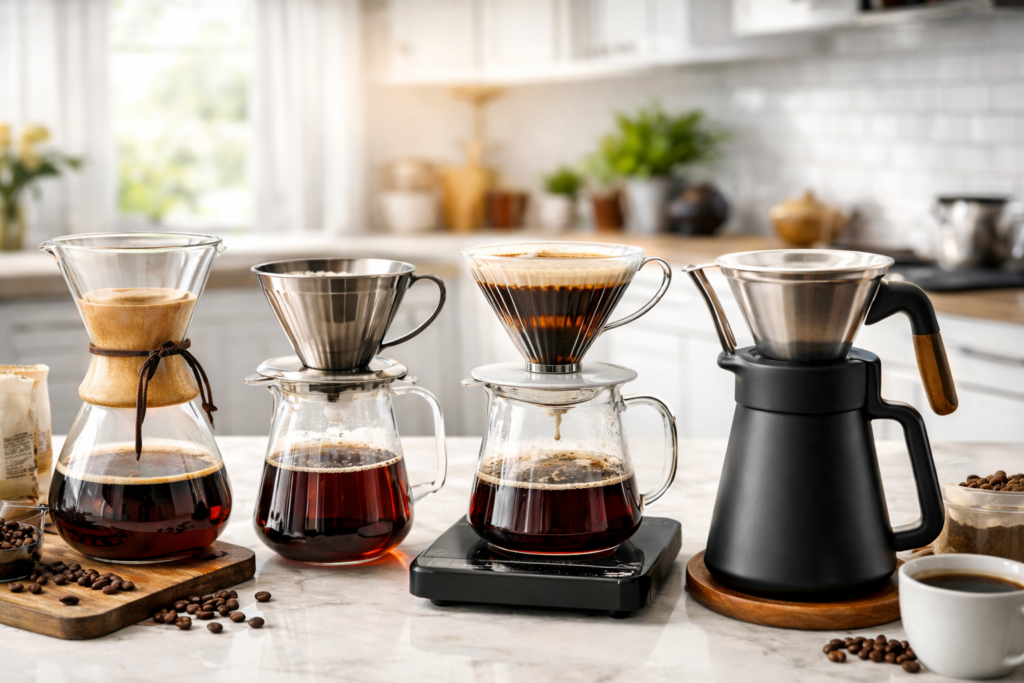
This guide compares the V60, Kalita Wave, Chemex, and Hario Switch as different brewing systems. The goal is to match each brewer to a real workflow: maximum control, easier consistency, larger batches, or immersion-assisted repeatability.
Editorial analysis
There is no useful “best overall” without a use case
The V60 gives more control, the Kalita Wave gives more built-in forgiveness, the Chemex handles larger batches cleanly, and the Hario Switch adds immersion to the equation. Choose the brewer that matches the way you want to make coffee rather than treating the list as a universal ranking.
Choose a Pour-Over Brewer by Workflow, Not Popularity
Pour-over brewers look simple, but their geometry and filter design change how much technique the user must supply. A large open drain gives more control but also makes the brew more sensitive to grind and pouring. A flat bed or immersion valve builds more forgiveness into the system. Thick filters change both flow and cup texture. Those differences matter more than brand recognition.
The right brewer therefore depends on how you actually make coffee. Someone brewing one light-roast cup and enjoying the dial-in process has different needs from someone preparing two or three cups before work. The guide below treats each brewer as a workflow decision rather than a ranked list.
Pour-Over Coffee Makers Compared
| Brewer | Technique demand | Typical cup style | Batch fit | Best use case |
|---|---|---|---|---|
| Hario V60 | Higher | Bright, clear, expressive | Single to small batch | Users who enjoy dialing in grind and pouring technique |
| Kalita Wave | Moderate | Balanced, sweet, slightly fuller | Single to small batch | Users prioritizing consistency and forgiveness |
| Chemex | Moderate | Very clean, smooth, lighter body | Best for larger batches | Households serving multiple cups |
| Hario Switch | Low to moderate | Balanced, flexible, repeatable | Single to small batch | Users who want immersion consistency with paper filtration |
Compare current options
Start with these representative choices
These two brewers show the most useful first split in pour-over: a high-control cone brewer versus a flatter, more forgiving daily workflow.
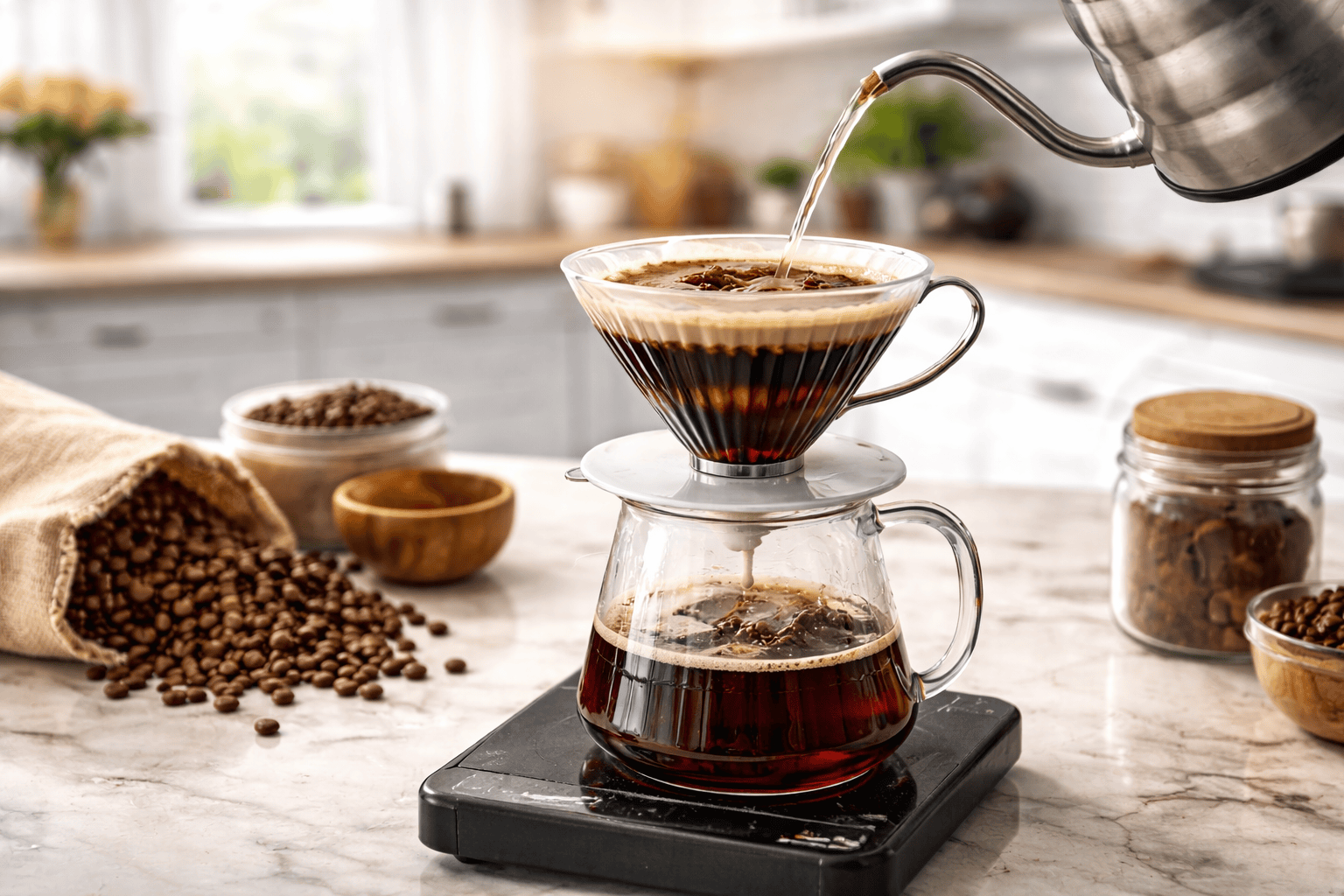
Hario V60 — control and clarity reference
A responsive cone brewer for readers who enjoy adjusting grind and pouring technique and want a clear, expressive cup.
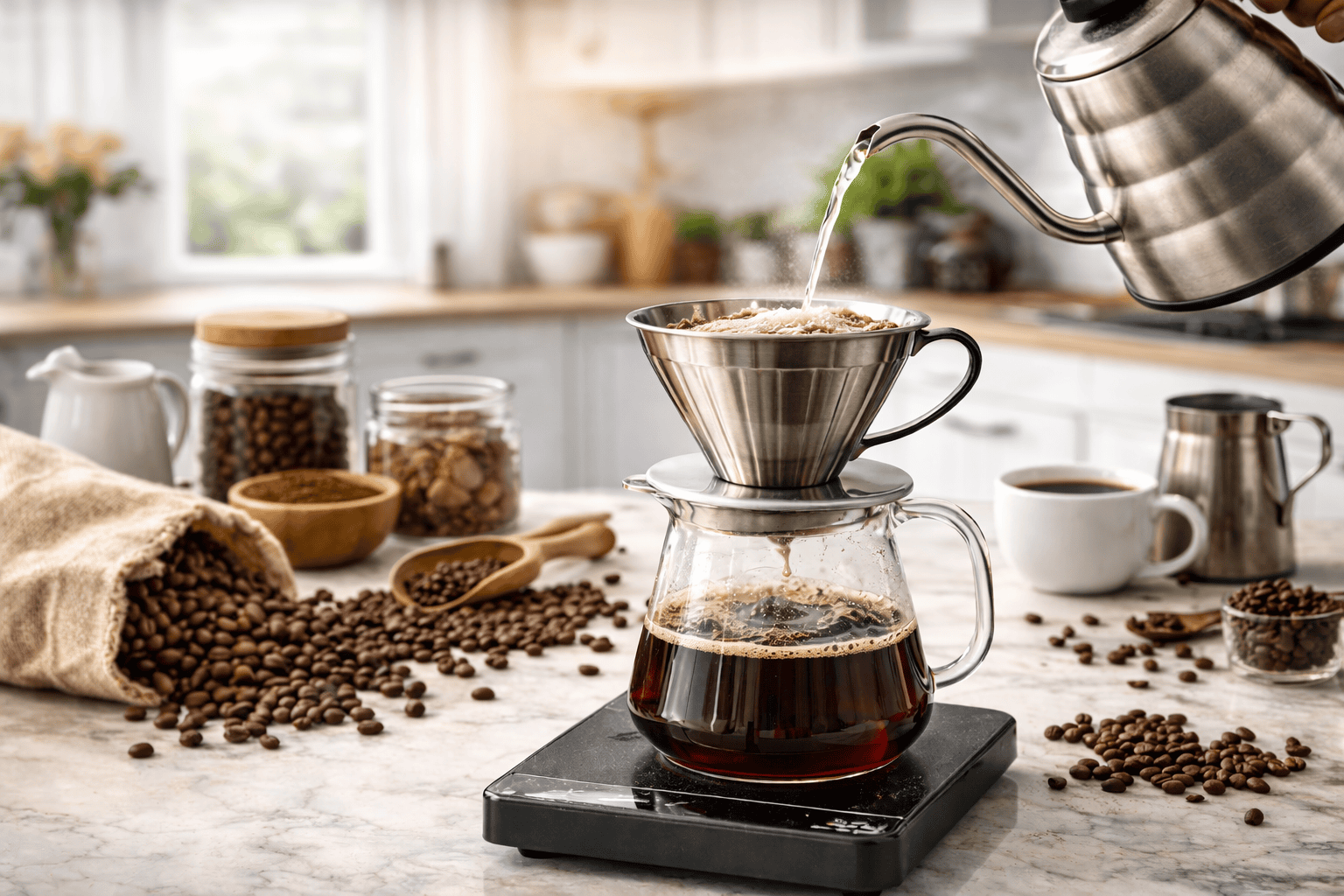
Kalita Wave — consistency and forgiveness reference
A flat-bottom brewer that adds more flow resistance and is easier to repeat when daily consistency matters more than maximum technique control.
Affiliate disclosure: Amazon links may earn CoffeeGearHub a commission at no additional cost to you. Prices and availability can change.
Hario V60: The Most Control for the Lowest Entry Cost
The V60 remains the benchmark cone brewer because its steep walls, spiral ribs, and single large drain opening give the user a great deal of control over flow. That design can produce excellent clarity and flavor separation, particularly with light and medium roasts, but it also exposes weaknesses in grinder consistency and pouring technique more clearly than a more restricted brewer.
The biggest advantage is that the V60 itself is inexpensive. A plastic V60 performs extremely well thermally and is harder to break than ceramic or glass, so the budget version is not a compromise in cup quality. Ceramic, glass, and metal versions mainly change heat management, durability, and aesthetics. If the rest of the setup is limited, money is usually better spent on the grinder and scale than on a premium dripper material.
The V60 makes the most sense when brewing itself is part of the hobby. If you enjoy changing grind, pour rate, bloom, and agitation to learn what the coffee is doing, the open design gives you room to experiment.
Kalita Wave: A More Forgiving Daily Brewer
The Kalita Wave uses a flat-bottom bed and three smaller drain holes, adding more resistance to the system and spreading the coffee more evenly across the base of the brewer. That geometry reduces some of the sensitivity to pouring pattern that makes the V60 both rewarding and frustrating.
The cup usually lands in a balanced middle ground: more body than a Chemex, less extreme clarity than a perfectly dialed V60, and an emphasis on sweetness and consistency. For a beginner, that predictability is valuable because small mistakes in pour height or spiral pattern do not immediately ruin the brew.
The main ownership caveat is filter availability. Kalita Wave filters are more specialized than standard cone filters, and the 155 and 185 sizes are not interchangeable. If local availability matters, check supply before making the brewer your daily system.
Chemex: The Strongest Choice for Larger Batches
The Chemex combines brewer and serving carafe in one glass vessel. Its bonded paper filters are substantially thicker than typical pour-over paper, removing more oils and fine material and producing a very clean, smooth cup. That makes it especially attractive for coffees where clarity matters more than body.
The system becomes most compelling when brewing for more than one person. Larger Chemex models comfortably handle batches that would feel awkward in a small V60 or Kalita Wave, and the vessel can move directly to the table. The trade-offs are proprietary filters, more fragile glass construction, and a brew that can become slow if the grind is too fine or the filter is not positioned correctly around the spout.
For a household that routinely serves two to four cups and prefers a clean profile, those trade-offs are often reasonable. For one small cup every morning, the Chemex is less efficient than the smaller drippers.
Hario Switch: Pour-Over Control With an Immersion Safety Net
The Hario Switch takes a V60-style cone and adds a valve that can hold water in the brewer. Close the valve and the coffee steeps like an immersion brewer; open it and the brew drains through paper. That makes the Switch unusually flexible because it can be used as a simple steep-and-release brewer or as a hybrid recipe that combines immersion with controlled pouring.
The key benefit is repeatability. Immersion reduces the importance of precise pour rate, so the Switch is easier to use when the morning routine needs to be consistent without a lot of attention. It also gives an experienced brewer more variables to explore rather than fewer, since immersion time can be combined with later percolation.
The downside is that the extra mechanism adds cost compared with a basic V60. If you know you want pure percolation and enjoy controlling every pour, the standard V60 is simpler. If you value flexibility and a forgiving baseline, the Switch earns the premium.
Batch Size and Filter Availability Change the Ownership Experience
Brewer capacity is easy to overlook because most product pages emphasize cup quality rather than daily workflow. A brewer that is excellent for one 300-gram cup can become awkward when the household routinely needs 700 grams of finished coffee. The Chemex is the most natural multi-cup system here because the brewer and serving carafe are the same vessel. The V60, Kalita Wave, and Switch are strongest in single-cup and small-batch use unless you deliberately choose a larger size.
Filter availability matters for the same reason. V60 papers are widely available and come from several manufacturers. Kalita Wave filters are more specialized and size-specific. Chemex bonded filters are proprietary to the system and cost more per brew, while the Switch uses familiar V60-format paper. If you dislike ordering consumables online, filter availability should be part of the buying decision before you commit to the brewer.
| Brewer | Comfortable batch role | Filter availability | Ownership note |
|---|---|---|---|
| V60 | Single cup to small batch, size dependent | Excellent | Low brewer cost; many paper options |
| Kalita Wave | Single cup to small batch | Good online, variable locally | 155/185 sizing must match the brewer |
| Chemex | Strongest for larger batches | Good but proprietary | Higher ongoing filter cost and fragile glass |
| Hario Switch | Single cup to small batch | Excellent | Uses V60 paper and adds a valve mechanism |
Match the Brewer to Your Experience Level and Attention Budget
“Beginner” does not necessarily mean someone who needs the cheapest brewer. It means someone who benefits from a system that produces a useful result before technique is fully developed. The Kalita Wave and Hario Switch both reduce the penalty for imperfect pouring, which makes them easier to learn on. The V60 is inexpensive but asks the user to control more variables. That makes it a good first brewer for someone who wants to learn technique, but a less forgiving choice for someone who simply wants consistency.
Experienced brewers often move in the opposite direction: they may prefer the V60 precisely because it exposes changes in grind, flow, and agitation. The Switch also remains interesting at an advanced level because its valve supports hybrid recipes that combine immersion and percolation rather than locking the user into a single technique.
| User profile | Most natural fit | Why |
|---|---|---|
| First manual brewer, wants easy consistency | Kalita Wave or Hario Switch | More built-in forgiveness and less dependence on perfect pouring |
| First manual brewer, wants to learn technique | V60 | Low cost and clear feedback from grind and pour changes |
| Brews for several people | Chemex | Large-batch workflow and integrated serving vessel |
| Enthusiast who likes experimentation | V60 or Hario Switch | Either maximum percolation control or hybrid immersion options |
Brewer Material Changes Heat Management More Than Flavor Identity
Material choices are often marketed as if they create entirely different cup profiles, but their biggest effect is thermal behavior and durability. Plastic V60s heat quickly and lose relatively little energy during brewing, which is one reason they remain a practical performance choice despite their low price. Ceramic and glass require more preheating but offer a different feel and appearance. Metal is durable and travel-friendly but can also pull heat from the slurry if it is not preheated.
The same principle applies across brewer families: choose material for durability, thermal workflow, weight, and aesthetics. Do not expect an expensive ceramic or metal version to automatically outperform a well-preheated plastic brewer using the same geometry and filter.
The Brewer Is Only One Part of the Setup
Differences between drippers are easier to hear in the cup when the rest of the system is stable. A burr grinder improves particle consistency, a scale holds dose and water constant, and a gooseneck kettle makes water delivery easier to repeat. None of those accessories needs to be expensive, but each removes a source of uncertainty.
| Setup component | Why it matters | Upgrade priority |
|---|---|---|
| Burr grinder | Controls particle distribution and therefore extraction consistency | Highest if currently using a blade grinder or pre-ground coffee |
| Digital scale | Keeps coffee dose and water ratio repeatable | High; inexpensive and immediately useful |
| Gooseneck kettle | Makes flow and pour placement easier to control | Moderate; especially valuable for V60 |
| Filtered water | Removes obvious off-flavors and gives a stable brewing baseline | High when tap water tastes chlorinated, metallic, or unusually hard |
A Basic Pour-Over Recipe Works Across All Four Brewers
A useful starting recipe is 20 grams of coffee to about 320 grams of water, or roughly a 1:16 ratio. Begin with water near 200°F / 93°C, rinse the paper, bloom with enough water to fully wet the grounds, and then complete the brew with controlled pours. The exact grind and pouring pattern will change by brewer, but the ratio gives you a stable baseline.
Use taste to decide the next move. A sharply sour or hollow cup often needs more extraction, which usually means a finer grind or slightly hotter water. A drying or harsh cup often needs less extraction, which usually means a coarser grind or gentler brewing. Change one variable at a time so the result teaches you something.
Common Pour-Over Problems Are Usually System Problems
| Symptom | Likely cause | First correction |
|---|---|---|
| Sour or sharp | Under-extraction or very fast flow | Move finer before changing the whole recipe |
| Bitter or drying | Over-extraction, slow drawdown, or excessive agitation | Move coarser and simplify the pour |
| Weak but balanced | Ratio may be too dilute | Use slightly more coffee or less water |
| Inconsistent from brew to brew | Grind, dose, pouring, or filter seating varies | Measure the recipe and simplify the workflow |
When a Drip Machine May Be the Better Choice
Manual pour-over is valuable because the brewer can control grind, water delivery, agitation, and contact time. That control is only an advantage if you actually want to participate in the brew. A good automatic drip machine is the better tool when several cups need to be ready with minimal attention, when multiple people use the same setup, or when repeatability matters more than experimentation.
| Priority | Manual pour-over | Automatic drip |
|---|---|---|
| Flavor control | High; variables are directly adjustable | Lower; machine controls most flow and temperature behavior |
| Hands-on time | Several minutes of active brewing | Load, start, and walk away |
| Consistency across users | Depends on technique | Usually higher with a capable machine |
| Batch convenience | Brewer dependent | Usually stronger for repeated multi-cup use |
If the ritual and control are part of what you want from coffee, pour-over earns the extra attention. If convenience is the priority, choosing an automatic machine is not a compromise; it is choosing a tool that better fits the job.
Which Pour-Over Brewer Fits Your Routine?
Choose the V60 when clarity and technique control are the point of the exercise. Choose the Kalita Wave when you want a more forgiving manual brew without giving up the character of pour-over. Choose the Chemex when batch size and a very clean cup matter more than compactness. Choose the Hario Switch when you want the option to simplify brewing with immersion or combine immersion and percolation in one device.
That decision framework is more durable than a “best overall” ranking because it matches the brewer to the job. All four can make excellent coffee. The practical difference is how they distribute control between the brewer design and the person using it.
FAQs: Best Pour-Over Coffee Makers
What is the best pour-over coffee maker for beginners?
The Kalita Wave and Hario Switch are the best options for beginners. Both are forgiving of minor pour inconsistencies and produce consistently good results without requiring precise technique. The Kalita Wave is the better daily driver; the Hario Switch adds immersion flexibility for those who want to experiment.
Is pour-over coffee better than drip coffee?
Pour-over usually produces more flavor clarity and sweetness, especially with fresh beans and a quality grinder. Drip machines are more convenient for hands-off brewing. The best drip machines can get close to pour-over quality, but most budget drip machines can’t match a well-brewed V60 or Kalita Wave.
Which pour-over brewer makes the cleanest coffee?
Chemex produces the cleanest cup because its thicker bonded paper filters remove more oils and fine sediment than any other brewer on this list. If clean, smooth, low-bitterness coffee is your goal, Chemex is the pick.
Do I need a gooseneck kettle for pour-over?
Not strictly required, but a gooseneck kettle significantly improves pour control and consistency. It’s one of the highest-value supporting upgrades for any pour-over brewer. A standard kettle can work, but you’ll have less control over your pour rate and pattern.
How much should I spend on a pour-over setup?
A great brewer can cost under $15 (plastic V60), but your best results come from investing in a burr grinder ($50–$150) and a scale ($15–$30). Prioritize the grinder first — it will improve your cup more than any brewer upgrade.
What is the best pour-over coffee ratio?
The standard pour-over ratio is 1:15 to 1:16 coffee to water by weight. For a single cup, use 18–20g of coffee to 300ml of water. Use a digital scale for consistent results — eyeballing makes it much harder to diagnose and fix your brew.
Are Chemex filters different from V60 filters?
Yes — Chemex uses its own proprietary bonded paper filters that are thicker than standard V60 or Kalita filters. They are not interchangeable. Chemex filters typically cost more and can be harder to find locally, so it’s worth ordering in bulk.
CoffeeGearHub shortlist
Compare CoffeeGearHub brewer pages
Review specifications and current verified merchant offers before leaving the site.
Continue Learning
Use these guides to choose the rest of the setup and dial in whichever brewer fits your routine.
In this guide
- Choose a Pour-Over Brewer by Workflow, Not Popularity
- Pour-Over Coffee Makers Compared
- Hario V60: The Most Control for the Lowest Entry Cost
- Kalita Wave: A More Forgiving Daily Brewer
- Chemex: The Strongest Choice for Larger Batches
- Hario Switch: Pour-Over Control With an Immersion Safety Net
- Batch Size and Filter Availability Change the Ownership Experience
- Match the Brewer to Your Experience Level and Attention Budget
- Brewer Material Changes Heat Management More Than Flavor Identity
- The Brewer Is Only One Part of the Setup
- A Basic Pour-Over Recipe Works Across All Four Brewers
- Common Pour-Over Problems Are Usually System Problems
- When a Drip Machine May Be the Better Choice
- Which Pour-Over Brewer Fits Your Routine?
- FAQs: Best Pour-Over Coffee Makers