
Espresso Beans vs Coffee Beans: What’s the Real Difference?
Editorial standards: this guide is based on established brewing principles, manufacturer documentation where relevant, and practical maintenance or workflow considerations. CoffeeGearHub does not claim hands-on testing where it has not occurred.
At a glance
What this guide covers
Understand what the labels “espresso beans” and “coffee beans” really mean, how roast level and grind change the cup, and whether either type is restricted to a particular brewing method.
Editorial analysis
The label matters less than the roast and recipe
Espresso beans are not a separate species of coffee. Roasters often use the label for blends or roast profiles designed to extract predictably under pressure, but the same beans can be brewed as drip, pour-over, moka pot, or espresso when grind and recipe are adjusted.
The 30-Second Answer
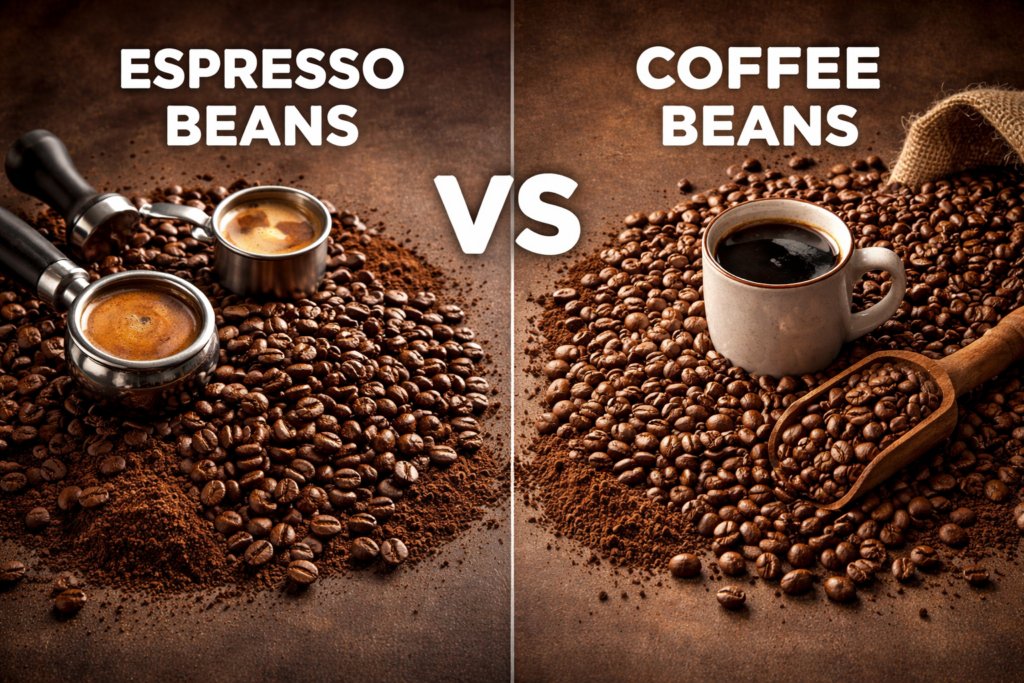
Espresso beans and regular coffee beans come from the same coffee plants. The practical differences are usually roast profile, blend design, and how the coffee is ground and brewed. You can use either in espresso or filter coffee if you adjust grind size and extraction appropriately.
If you have ever stood in the coffee aisle wondering whether to buy espresso beans or regular coffee beans, you are not alone. The terms are used interchangeably by some roasters and treated as entirely different products by others. The confusion is understandable — but the answer is simpler than the marketing suggests.
This guide explains exactly what separates espresso beans from coffee beans, what actually changes in the cup depending on roast level and brewing method, and how to choose the right beans for your setup — whether you are pulling espresso shots, brewing pour over, or running a drip coffee maker.
What Are Espresso Beans?
Espresso beans are coffee beans — usually a blend of multiple origins — that have been roasted and selected to perform well under the specific conditions of espresso brewing: high pressure (9 bars), short extraction time (25-30 seconds), and a very fine grind.
The term “espresso beans” is not a botanical category. It is a roasting and blending decision. Most commercial espresso blends are roasted to a medium-dark or dark level for a specific set of reasons:
- Darker roasts extract more evenly under pressure — the cell structure of the bean breaks down more uniformly during darker roasting, which means the high pressure of an espresso machine can pull from the grounds more consistently
- Lower acidity — the extended roasting process degrades chlorogenic acids, producing a rounder, less sharp cup that holds up well when mixed with milk in lattes and cappuccinos
- Consistent blend flavour — blending beans from multiple origins smooths out the sharp edges of any single-origin character, producing a reliable taste batch to batch
- Crema production — darker roasted beans retain more CO2 from the roasting process, which contributes to the dense crema layer on a properly pulled espresso shot
For a complete look at how roast level affects flavour across every brew method, see our coffee roast levels guide.
What Espresso Blends Actually Contain
Most commercial espresso beans are blends rather than single-origin coffees. Understanding what goes into a blend — and why — helps you make a better purchasing decision and explains why espresso roasts behave differently from a single-origin bag of the same roast level.
Arabica vs Robusta in espresso blends
Most specialty espresso roasts use 100% Arabica — the species that produces complex, nuanced flavour at the expense of requiring more precise cultivation and processing. Many traditional Italian-style espresso blends, however, include a percentage of Robusta — the hardier, higher-caffeine species with a harsher, more bitter flavour profile but one critical advantage: Robusta produces dramatically more crema. The higher concentration of lipids and CO2 in Robusta beans generates the dense, persistent crema layer associated with traditional espresso.
| Bean type | Flavour contribution | Crema | Caffeine | Common in |
|---|---|---|---|---|
| 100% Arabica | Complex, fruity, sweet, nuanced | Moderate — fades quickly | Lower | Specialty espresso roasts, third-wave cafes |
| Arabica + Robusta blend | Bold, earthy, bitter-sweet | Dense and persistent | Higher | Italian-style blends, commercial espresso |
| 100% Robusta | Harsh, rubbery, very bitter | Very dense | Highest | Rare in retail; some traditional Vietnamese coffee |
Why blends use multiple origins
A typical espresso blend might combine a Brazilian natural-process bean for body and sweetness, a Colombian washed coffee for clean acidity and balance, and a small percentage of an Indonesian Robusta for crema and caffeine lift. Each component contributes a specific quality that a single origin alone would not deliver consistently. Blending also protects against seasonal variation — when the Colombian crop tastes different from last year, the blender adjusts the ratios to maintain the same flavour profile in the bag.
Single-origin espresso roasts deliberately reject this consistency in favour of showcasing the specific character of one farm or region — which produces more interesting cups but more variable ones. For a deep dive into how origin affects flavour, see our guide to Arabica vs Robusta coffee.
What Are Coffee Beans?
“Coffee beans” is simply the broader term for all roasted coffee beans, across all roast levels and all brewing methods. When a bag is labelled “coffee beans” without a method descriptor, it typically means it was not specifically optimised for espresso — it might be a single-origin light roast from Ethiopia, a medium-roast Colombian, or a dark French roast.
| Roast level | Typical flavour profile | Best brew methods |
|---|---|---|
| Light roast | Bright acidity, floral or fruity notes, tea-like body | Pour over, AeroPress, filter |
| Medium roast | Balanced sweetness and body, caramel, mild acidity | Drip, pour over, AeroPress, espresso |
| Medium-dark roast | Bold body, chocolate, nuts, lower acidity | Espresso, French press, drip |
| Dark roast | Smoky, bitter-sweet, heavy body, very low acidity | Espresso, French press, moka pot |
Espresso Beans vs Coffee Beans: Side-by-Side Comparison
| Feature | Espresso beans | Coffee beans (general) |
|---|---|---|
| Bean source | Same coffee plant (Arabica, Robusta, or blend) | Same coffee plant (often single-origin Arabica) |
| Roast level | Usually medium-dark to dark | Light, medium, medium-dark, or dark |
| Blend vs single origin | Usually blended for consistency | Often single-origin for clarity of character |
| Flavour profile | Bold, chocolatey, nutty, low acidity | Wide range — bright/floral to bold/smoky |
| Intended brew method | High pressure, fine grind, short extraction | Any method — grind size varies by brewer |
| Grind size | Very fine (espresso) | Fine to coarse depending on brew method |
| Caffeine content | No difference by label — depends on bean and ratio | No difference by label — depends on bean and ratio |
| Can be used for espresso? | Yes — by design | Yes — with correct grind and dialing-in |
| Best for milk drinks | Yes — holds up well in lattes and cappuccinos | Depends on roast level |
How Roast Level Changes the Cup
Roast level is the main practical difference behind the espresso beans vs coffee beans distinction. Here is what actually changes in the cup as roast gets darker.
Darker roasts (typical for espresso)
- Lower perceived acidity — chlorogenic acids break down during extended roasting
- Heavier body — more oils released from the bean during roasting
- Chocolate, caramel, toasted nuts, sometimes smoky notes
- Cuts through milk well — bold enough to be tasted in a latte
- More forgiving extraction window — less precise grind adjustment needed
Lighter roasts (typical for pour over and filter)
- Higher acidity — citrus, berry, floral notes more pronounced
- Lighter body — more tea-like, less oily
- Can taste complex and vibrant as espresso, but narrower extraction window
- Requires hotter water and more precise grind adjustment when used for espresso
- Less effective in milk-heavy drinks — delicate flavours are masked
📖 Want to understand roast levels in detail? Our complete roast levels guide covers light vs medium vs dark across every brew method — including which roast works best for espresso, pour over, French press, and cold brew.
Why Grind Size Matters More Than the Label
One of the biggest myths in home coffee is that “espresso beans” will automatically produce espresso. In reality, grind size, grind consistency, and puck preparation determine whether your shot extracts correctly — the label on the bag matters far less.
If your grinder cannot produce a consistent, fine grind, you will get channeling, sour shots, or bitter over-extraction regardless of how good the beans are. Conversely, a high-quality burr grinder with well-calibrated settings can produce excellent espresso from almost any coffee bean.
| What you change | Effect on espresso | Priority |
|---|---|---|
| Bean label (espresso vs coffee) | Minor — affects roast level and blend character | Low |
| Roast level | Moderate — affects extraction window and flavour profile | Medium |
| Grind size | High — directly controls extraction speed and shot time | High |
| Grind consistency (burr quality) | Very high — determines whether extraction is even or chaotic | Very high |
| Coffee-to-water ratio | Very high — sets the concentration of the final cup | Very high |
For a complete dial-in guide, see espresso grind size explained and how to dial in espresso at home. For grinder recommendations at every budget, see best burr grinders for espresso.
Can You Use Regular Coffee Beans for Espresso?
Yes — and many specialty coffee enthusiasts prefer it. A medium-roast single-origin Colombian or a light-roast Ethiopian can produce extraordinary espresso with flavour complexity that most commercial espresso blends do not offer. The trade-off is precision: lighter roasts have a narrower extraction window and require more careful grind adjustment.
To use general coffee beans for espresso successfully:
- Use a capable burr grinder — one that can reach the very fine grind size espresso requires and hold it consistently. See best coffee grinders for espresso.
- Use fresh beans — ideally roasted within the last 2-4 weeks. Stale beans produce flat, lifeless espresso regardless of roast level.
- Dial in the dose and grind — target a 1:2 ratio (18g coffee in, 36g espresso out) in 25-30 seconds as a starting point. Adjust grind finer if the shot runs fast and tastes sour; coarser if it runs slow and tastes bitter.
- Expect more adjustment time with light roasts — light roasts are denser and require a finer grind and sometimes a slightly higher brew temperature to fully extract.
How long to rest beans before pulling espresso
Freshly roasted coffee off-gasses CO2 for several days after roasting. For filter methods like pour over and drip, you can brew as early as 5-7 days post-roast and the CO2 actually contributes to a pleasing bloom. For espresso, too much CO2 causes channeling and inconsistent extraction — the gas disrupts the even flow of water through the puck. The sweet spot for most espresso roasts is 10-21 days post-roast, with many blends tasting best at 14 days. Light roasts, being denser, typically need a slightly longer rest — 14-21 days — before they open up fully as espresso.
| Roast type | Minimum rest | Sweet spot | Maximum before staling |
|---|---|---|---|
| Dark espresso roast | 5-7 days | 10-14 days | 3-4 weeks from roast |
| Medium-dark espresso blend | 7-10 days | 12-18 days | 4-5 weeks from roast |
| Light roast used as espresso | 10-14 days | 14-21 days | 5-6 weeks from roast |
New to espresso at home? Start with our complete beginner espresso guide, which covers machine setup, dialing in, and your first shots step by step.
Which Should You Choose?
✅ Choose espresso beans if…
- You are new to espresso and want a forgiving starting point
- You prefer classic, rich flavours — chocolate, caramel, nuts
- You regularly make lattes, cappuccinos, or flat whites
- You want consistent results batch to batch without a lot of adjustment
- You are using an entry-level espresso machine with limited temperature control
☕ Choose general coffee beans if…
- You want to explore fruit-forward or floral espresso flavours
- You brew multiple methods — espresso, pour over, and drip from the same bag
- You enjoy experimenting and dialing in different origins
- You have a grinder that can dial in precisely and a machine with temperature control
- You want to drink espresso black and appreciate complex, nuanced flavours
Best Coffee Beans for Espresso — What to Look For
Whether you choose a labelled espresso roast or a general single-origin, look for these qualities when buying beans for espresso:
- Roast date on the bag — buy beans roasted within the last 4 weeks; best-by dates are not the same as roast dates and are often a year out
- Degassing valve — fresh roasted beans off-gas CO2; a one-way valve on the bag means the roaster is serious about freshness
- Roast level that matches your preference — medium-dark for classic espresso character, medium for more balance, dark for low-acid bold cups
- Processing method — washed coffees taste cleaner and more consistent for espresso; natural processed coffees add fruit complexity but can taste fermented if not roasted well
For specific recommendations, see our full guide to the best coffee beans for espresso — covering blends and single-origins at every price point.
Looking for an espresso machine to go with your beans?
The beans are only part of the equation. See our picks for the best espresso machines for beginners — covering every budget from under $200 to prosumer-level machines — and our guide to choosing your first coffee grinder, which is the upgrade that will improve your espresso more than any bean choice.
How to Store Espresso Beans and Coffee Beans
Storage affects flavour more than most people realise — and the rules are the same whether the bag is labelled espresso or coffee.
- Use an airtight container with a one-way degassing valve — oxygen is the primary cause of staling. A valve lets CO2 out without letting oxygen in. Airscape, Fellow Atmos, and Friis canisters all work well.
- Keep away from heat, light, and moisture — a cupboard away from the stove is ideal. Avoid the counter next to the coffee machine if it gets warm.
- Do not freeze unless you are bulk-buying — freezing slows staling but introduces condensation risk each time the bag is opened. If you freeze, portion into single-use bags before freezing and never refreeze a thawed portion.
- Buy smaller and more often — a 250g bag used within three weeks is always better than a 1kg bag that sits for two months. Most home brewers do not need more than 250g at a time.
- Grind just before brewing — pre-ground coffee stales roughly 15x faster than whole beans. A bag of pre-ground espresso labelled “espresso roast” is still pre-ground, and no label can compensate for stale coffee.
For a full guide to keeping coffee fresh, see how to store coffee beans — beginner and advanced methods.
Key Takeaways
- Espresso beans and coffee beans are the same plant — the difference is roast level, blend composition, and intended use, not the bean itself
- Espresso roasts are usually medium-dark to dark for lower acidity, heavier body, and more forgiving extraction under pressure
- Any coffee bean can be used for espresso if it is ground correctly and the shot is dialed in — light and medium roasts can produce outstanding espresso
- Grind consistency matters more than the label — a quality burr grinder makes a bigger difference to espresso quality than the choice of espresso vs coffee beans
- Beginners get faster wins with espresso roasts — the wider extraction window and consistent blend character make dialing in easier on entry-level machines
Espresso Beans vs Coffee Beans — FAQs
Are espresso beans and coffee beans actually different?
Can you use regular coffee beans for espresso?
Are espresso beans stronger than coffee beans?
Do espresso beans have more caffeine?
Can you use espresso beans in a drip coffee maker?
What is the best bean for beginners making espresso at home?
CoffeeGearHub product shortlist
Continue with coffee and espresso products
Review product categories and current verified merchant offers on CoffeeGearHub before leaving the site.
Continue Learning
Beans & roast fundamentals
In this guide
- The 30-Second Answer
- Jump to a section
- What Are Espresso Beans?
- What Espresso Blends Actually Contain
- What Are Coffee Beans?
- Espresso Beans vs Coffee Beans: Side-by-Side Comparison
- How Roast Level Changes the Cup
- Why Grind Size Matters More Than the Label
- Can You Use Regular Coffee Beans for Espresso?
- Which Should You Choose?
- Best Coffee Beans for Espresso — What to Look For
- How to Store Espresso Beans and Coffee Beans
- Key Takeaways
- Espresso Beans vs Coffee Beans — FAQs
- Continue Learning