
Pour-over coffee is one of the simplest ways to brew a cup that tastes clean, sweet, and “separated”—where you can actually pick out fruit, chocolate, florals, or caramel instead of just “coffee flavor.” But pour-over is also brutally honest: if your gear is off (especially the grinder), it will show up in the cup.
This guide walks you through a practical pour-over coffee brewing setup—from beginner-friendly to enthusiast-level—plus the key buying details that matter when you’re shopping on Amazon. I’ll also show you how to dial your setup so you get consistent results without turning your morning routine into a science project.
Quick note: If you’re building your setup from scratch, prioritize in this order: grinder → scale → kettle → dripper. You’ll taste improvements immediately.
What You Need for a Great Pour-Over Setup
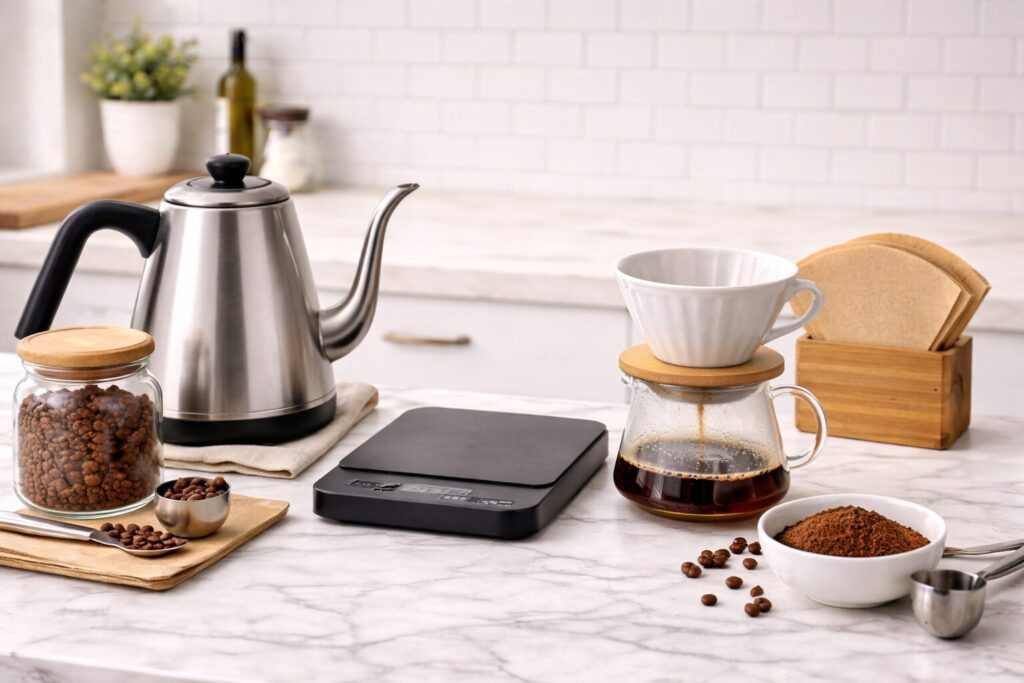
A “real” pour-over setup isn’t complicated. It’s just a few tools that work together: a burr grinder for consistent grounds, a scale to keep ratios repeatable, a gooseneck kettle for controlled pouring, and a dripper + filters that match your taste.
If you want a deeper breakdown of grind sizes by brew method, see our guide: Coffee Grind Sizes (Chart + Brewing Examples).
1) The Burr Grinder: The “Make or Break” Piece of the Setup
If pour-over coffee tastes sour, weak, or strangely bitter, the culprit is often the grind—not the beans. Pour-over needs a fairly narrow grind range to extract evenly. That’s why a burr grinder is the most important investment in your pour-over setup.
Why a burr grinder matters (and blade grinders don’t)
Burr grinders crush beans between two cutting surfaces to produce a more uniform particle size. Blade grinders chop randomly, creating a mix of dust and boulders. In pour-over, that leads to both over-extraction (bitter) and under-extraction (sour) in the same cup.
Manual vs electric burr grinders
Manual burr grinders are great if you want top-tier grind quality for the price, travel often, or don’t mind a bit of effort. Electric burr grinders are better if you brew daily and want a faster workflow (especially for multiple cups).
What to look for when buying a grinder for pour-over
- True burrs (conical or flat) with consistent grind distribution
- Dialed adjustment (you want small changes, not big jumps)
- Low retention (less old coffee stuck inside)
- Solid build (wobble and flex reduce consistency)
Not sure which type is best for you? Start here: Best Burr Grinders for Pour-Over (2026).
2) Coffee Scale + Timer: Your Shortcut to Consistency
Pour-over coffee is basically controlled extraction. If you want a cup that tastes the same on Monday and Thursday, you need to measure two things: dose (coffee) and yield (water). A scale makes that effortless.
Minimum scale features for pour-over
- 0.1g accuracy (so small dose changes are meaningful)
- Fast refresh rate (so you can pour by weight smoothly)
- Timer (brew time matters as much as ratio)
- Water resistance (because… mornings happen)
Want a simple starting point? Use this ratio: 1:16. Example: 20g coffee → 320g water. It’s a safe “middle ground” that works for most medium and light roasts.
3) Gooseneck Kettle: Control the Pour, Control the Cup
A gooseneck kettle gives you the ability to pour gently and evenly, which helps saturate the coffee bed without blasting channels through it. If you’ve ever had a pour-over that tasted thin and sharp even with good beans, uncontrolled pouring is a common reason.
Electric vs stovetop gooseneck kettles
- Electric kettles are easier for daily use: stable temperature, faster heating, less guesswork.
- Stovetop kettles are more affordable and durable, but you’ll want a thermometer (or strong temperature instincts).
Target water temperature
Most coffees brew best between 195–205°F (90–96°C). Light roasts generally like hotter water; darker roasts usually taste better a little cooler.
We break down top picks here: Best Gooseneck Kettles for Pour-Over (2026).
4) The Dripper: Cone vs Flat-Bottom (And What It Changes)
The dripper is where your “coffee personality” shows up. Different shapes change flow rate and extraction style. There isn’t one “best” dripper—there’s the best match for how you like coffee to taste.
Cone drippers (bright, clear, high-definition)
Cone drippers tend to emphasize clarity and acidity. If you like fruity notes, florals, and a lighter mouthfeel, cone-style brewers are usually the move.
Flat-bottom drippers (sweeter, rounder, more forgiving)
Flat-bottom drippers often produce a rounder cup with a bit more body and sweetness. They also tend to be more forgiving if your pouring isn’t perfect yet.
5) Filters: The Small Choice That Changes Flavor
Filters don’t get much attention, but they have a real effect on taste and texture.
- Paper filters: cleaner cup, brighter flavors, less oil
- Metal filters: more body, more oils, slightly less clarity
- Cloth filters: balanced cup, but higher maintenance
Always rinse paper filters with hot water before brewing. It removes paper taste and warms your brewer/server so temperature stays stable.
6) Water: The Hidden Upgrade Most People Skip
Here’s a boring truth that makes a huge difference: coffee is mostly water. If your tap water tastes “chlorine-y” or metallic, your pour-over will never taste as clean as it should—no matter how good your beans are.
At minimum, use filtered water. If you want to level up further, look for water that lands roughly in the 75–150 ppm range for total dissolved solids. Distilled water usually makes coffee taste flat and under-extracted.
How to Set Up Your Pour-Over Station (So It’s Actually Easy to Use)
A small setup tweak can make pour-over feel effortless instead of fussy. Here’s a layout that works:
- Keep the scale and dripper together (they’re used every brew)
- Store filters right next to your dripper
- Put your grinder where you can tap/brush grounds easily
- Keep a small towel nearby (water + coffee grounds is inevitable)
If your goal is speed, pre-rinse your filter while your kettle heats and weigh your beans during the heat-up time. That little habit makes pour-over feel surprisingly fast.
Simple Pour-Over Recipe (Reliable, Repeatable, Tastes Good)
This is the “daily driver” recipe I recommend when you’re learning. It’s forgiving and produces a balanced cup.
- Coffee: 20g
- Water: 320g (1:16 ratio)
- Grind: medium / medium-fine
- Water temp: 200°F (93°C)
- Total brew time: 2:45–3:30
Step-by-step
- Heat your water to 200°F (93°C).
- Rinse your filter, then discard the rinse water.
- Grind and add 20g coffee to the filter. Gently level the bed.
- Bloom: pour 50–60g water evenly, then wait 30–45 seconds.
- Pour up to 180g by 1:15 using slow circles.
- Finish the pour up to 320g by 2:00–2:15.
- Let it drain. Aim to finish around 3:00 (give or take 30 seconds).
Taste adjustments: If it’s sour/weak, grind a little finer. If it’s bitter/dry, grind a little coarser. Keep everything else the same and change one variable at a time.
Common Pour-Over Mistakes (And the Quick Fixes)
- Using pre-ground coffee: Switch to whole bean + burr grinder. This is the biggest upgrade.
- No scale: Start measuring. Consistency makes learning faster.
- Pouring too fast: Slow down. Aim for gentle circles and steady flow.
- Water too cool: Raise temp (especially for light roasts).
- Brew time way off: Adjust grind first, not the recipe.
If you’re stuck, our troubleshooting guide helps you diagnose flavor fast: Pour-Over Troubleshooting (Fix Sour, Bitter, Weak Coffee).
Recommended Next Reads on CoffeeGearHub
- Best Burr Grinders for Pour-Over (2026)
- Best Gooseneck Kettles for Pour-Over (2026)
- Best Pour-Over Coffee Makers (2026)
- Pour-Over Troubleshooting Guide
- Coffee Grind Sizes (Chart)
Final Take: Build It Once, Brew Better Every Day
A great pour-over setup isn’t about collecting gear—it’s about removing variables. With a solid burr grinder, a responsive scale, and a controlled pour, you’ll get coffee that tastes cleaner, sweeter, and more “intentional” than most café drip.
If you’re upgrading one piece today, start with the grinder. You’ll feel it in every cup.
FAQs
Do I really need a gooseneck kettle for pour-over coffee?
If you want consistent results, yes. A gooseneck kettle gives you precise control over how fast and where the water flows. That gentle, even pouring helps prevent channeling and leads to more balanced extraction. You can make pour-over coffee without one, but it’s harder to repeat great cups.
What grind size is best for pour-over coffee?
Start with a medium to medium-fine grind, similar to coarse sand. If your coffee tastes sour or weak, grind slightly finer. If it tastes bitter or drying, grind slightly coarser. Small adjustments make a big difference, so change only one thing at a time.
What coffee-to-water ratio should I use for pour-over?
A reliable starting point is a 1:16 ratio. For example, use 20 grams of coffee with 320 grams of water. If you prefer a stronger cup, try 1:15. For a lighter, more tea-like cup, try 1:17.
Why does my pour-over coffee taste bitter?
Bitterness usually means the coffee is over-extracted. This can happen if the grind is too fine, the water is too hot, or the brew time is too long. The easiest fix is to grind slightly coarser while keeping the rest of your recipe the same.
Why does my pour-over coffee taste sour?
Sourness usually points to under-extraction. Common causes include grinding too coarse, water that isn’t hot enough, or a brew that finishes too quickly. Try grinding a little finer first and see how the flavor changes.

