
Last Updated: March 2026 • 20–25 min read • Brewing Methods: Pour-Over, Drip, French Press & Espresso

Most people assume bad home coffee is a machine problem. It almost never is. After working through hundreds of home brewing troubleshooting cases, the pattern is consistent: coffee tastes sour, bitter, or flat because of grind size, inconsistent weighing, or stale beans — not because the brewer is inadequate. The good news is that all three of those problems are fixable without spending more money. This guide gives you a repeatable dialing-in workflow, explains exactly what sour and bitter mean and why they happen, and shows you what to change — and what to keep constant — for pour-over, drip, French press, and espresso.
✍️ Editorial note: This guide is researched and written by the editors at CoffeeGearHub.com using hands-on brewing testing, published brewing science, and established specialty-coffee community knowledge. Affiliate Disclosure: This post contains affiliate links. CoffeeGearHub.com participates in the Amazon Services LLC Associates Program. As an Amazon Associate, we earn from qualifying purchases at no extra cost to you. All product recommendations are editorially independent.
The 30-Second Answer
Dialing in coffee means adjusting your brewing variables so water extracts the right balance of flavour from your grounds. The fastest fix for almost any bad cup: if it tastes sour, grind finer. If it tastes bitter, grind coarser. Once it tastes balanced, use your coffee-to-water ratio to adjust strength. Change one thing at a time. Weigh your coffee and water. Use beans roasted within the last four weeks.
- Sour = under-extracted: grind finer to slow down flow and extract more flavour
- Bitter/dry = over-extracted: grind coarser to speed up flow and extract less
- Balanced but too weak/strong: adjust ratio after extraction is balanced
- Change one variable at a time — otherwise you cannot know what fixed it
- Weigh everything — inconsistent dose is the most common hidden cause of bad coffee
- Check your beans first — stale coffee (over 4–6 weeks old) tastes bad regardless of your grind
Who This Guide Is For — Jump to What You Need
☕ New to Dialing In
Start at What Dialing In Means and read through — the full workflow is written for you.
🔧 Coffee Tastes Off Right Now
Jump to the Troubleshooting Matrix for a direct symptom → cause → fix diagnosis.
🍵 Looking for Brew Method Targets
Jump to Dialing In by Brew Method for pour-over, drip, French press, and espresso specifics.
🛒 Need a Better Grinder
Jump to Grinder Recommendations for the picks that make dialing in actually work.
Table of Contents
☕ Coffee Lover Gift Guide
Looking for a thoughtful gift for a coffee enthusiast? Browse our curated Amazon gift guide featuring coffee gear, mugs, grinders, brewers, and accessories for different budgets.
Shop the Coffee Lover Gift GuideAs an Amazon Associate, I may earn from qualifying purchases.
What Does “Dialing In” Coffee Actually Mean?
Dialing in means adjusting your brewing variables so water extracts the right balance of acids, sugars, and bitter compounds from coffee grounds. When extraction is balanced, coffee tastes sweeter, clearer, and more structured — not sharp, hollow, or harsh. When it is off in either direction, the results are predictable and fixable.

The most important thing to understand about dialing in: extraction and strength are two different things. Extraction is the balance of flavours dissolved from the coffee — whether it tastes sour, balanced, or bitter. Strength is how concentrated the cup is — how much coffee flavour per unit of water. You fix extraction problems with grind size. You fix strength problems with ratio. Mixing these up is the most common reason home brewers spin their wheels for weeks without improvement.
The Extraction Spectrum: Sour → Balanced → Bitter
Extraction happens in stages. Hot water dissolves soluble compounds from coffee in a fixed sequence — acids first, then sugars and complex aromatics, then bitter polyphenols. Every dial-in decision is about landing in the middle of that sequence and staying there.
| Extraction Stage | Flavours Released | Too Much of This Tastes Like |
|---|---|---|
| Early (acids) | Citric, malic, acetic — brightness and fruit | Sour, sharp, thin, vinegar-like |
| Middle (sugars + aromatics) | Sweetness, complexity, body — the target | Balanced when correctly hit |
| Late (polyphenols) | Bitter chlorogenic acids, tannins | Harsh, dry, hollow, astringent finish |
Grind size is the primary lever that controls how quickly water moves through these stages. A finer grind slows water flow, giving it more time to extract — moving toward the middle and beyond. A coarser grind speeds flow, cutting extraction shorter. This is why grind size is always the first thing to adjust.
The Dial-In Variables: What to Change and When
1. Grind Size — Change This First, Almost Always

Grind size controls how quickly water can move through coffee and how much surface area gets extracted. It is the highest-impact variable in every brew method. If you need a visual benchmark for what different grind sizes look like, see our grind size guide.
| Grind Direction | Effect | Tastes Like | Fix |
|---|---|---|---|
| Too coarse | Fast flow → under-extraction | Sour, thin, weak | Grind finer by one step |
| Balanced | Right contact time → balanced extraction | Sweet, complex, clean | Record this setting |
| Too fine | Slow flow → over-extraction | Bitter, dry, harsh | Grind coarser by one step |
Grind consistency is why your grinder matters so much. A blade grinder chops coffee into uneven shards — some particles extract quickly (bitter), others barely at all (sour) — in the same brew simultaneously. No amount of grind size adjustment fixes this, because the problem is particle uniformity, not size. Consistent burr grinders make every other variable readable and adjustable. If you are troubleshooting and nothing works, your grinder is the most likely culprit — see the recommendations section below.
2. Coffee-to-Water Ratio — Fix Strength, Not Extraction
Ratio mainly controls strength — how concentrated the coffee tastes. It does not fix sour or bitter flavours. If your coffee tastes sour or bitter, that is an extraction problem and grind size is the fix. Only use ratio to adjust strength after the cup already tastes balanced. For a deeper look at ratios across every brew method, see our coffee brew ratio guide.
| Brew Method | Baseline Ratio | Too Strong → Weaken To | Too Weak → Strengthen To |
|---|---|---|---|
| Pour-over / Drip | 1:16 (20g coffee : 320g water) | 1:17 | 1:15 |
| French press | 1:15 (30g coffee : 450g water) | 1:16 | 1:14 |
| Espresso | 1:2 (18g in : 36g out) | 1:2.2 (stop at 40g) | 1:1.8 (stop at 32g) |
3. Brew Time — Use as a Diagnostic Signal, Not a Target
Brew time is best understood as feedback, not a goal. You do not need to hit a specific time for every brewer — but time helps you confirm that grind adjustments are moving in the right direction and that something unusual is happening in the brew.
- Very fast brew time + sour/weak taste: grind is too coarse or grounds are not being saturated evenly (check your pour pattern)
- Very slow brew time + bitter/dry taste: grind is too fine, clogging the filter, or you are over-agitating
- Normal brew time + off taste: look at beans (freshness, roast level) and water quality before changing grind
4. Temperature, Agitation, and Water Quality
If grind and ratio are reasonable but coffee still tastes “off,” these secondary variables usually explain why. Address them after grind, not instead of it.
- Water temperature: cooler water (under 195°F/90°C) can taste under-extracted, especially with light roasts. Hotter water increases bitterness risk, especially with dark roasts. Most home brewers do well at 195–205°F (90–96°C).
- Agitation: aggressive stirring or fast, turbulent pouring increases extraction. Too little agitation can leave the bed unevenly extracted, producing sour patches. For pour-over, a consistent, controlled pour matters more than people expect.
- Water chemistry: very hard water can flatten sweetness and add chalky bitterness. Very soft water can make coffee taste sharp or hollow. See our water quality guide if other variables are already dialled.
Beans and Freshness: The Hidden Variable That Breaks Dialing In
This section belongs before the workflow because stale beans make dialing in impossible. If your beans are too old, no grind setting will produce a good cup — and you will waste time and coffee chasing a problem that can only be solved by buying a fresh bag.
How to Know If Your Beans Are Fresh Enough
Look for a printed roast date on the bag — not a “best by” date, which tells you very little. Coffee is typically at its best within 2–4 weeks of roasting. After 6 weeks, it begins tasting noticeably flat. After three months, it will taste papery or cardboard-like regardless of how perfectly you brew it.
- No roast date on the bag? That is a red flag. Roasters who are confident in their freshness print the date. Supermarket coffee often omits roast dates because the coffee is already months old.
- No bloom? When you pour hot water on fresh coffee, CO₂ releases and the bed puffs up and bubbles. If you get no bloom at all, the coffee is likely stale — the CO₂ has already off-gassed during storage.
- Flat, papery, or oddly dull flavour despite correct grind? Buy a fresh bag from a local roaster or a roaster who ships with roast dates before continuing to troubleshoot.
How Roast Level Affects Dialing In
Roast level changes how coffee extracts, which means switching roast levels often requires re-dialing in as if you have a new coffee entirely.
| Roast Level | How It Extracts | Dial-In Tendency | Best Starting Point |
|---|---|---|---|
| Light roast | Dense, less soluble — extracts slowly | Needs finer grind and hotter water to avoid sourness | Fine grind end of your range; 200–205°F (93–96°C) |
| Medium roast | Balanced porosity — most forgiving | Wide extraction window; easiest to dial in | Middle of your grind range; 195–200°F (90–93°C) |
| Dark roast | Porous, soluble — extracts quickly | Goes bitter fast; often needs coarser grind and cooler water | Coarser grind; 190–195°F (88–90°C) to reduce bitterness |
⚠️ If you’re using pre-ground coffee: Pre-ground coffee cannot be adjusted for grind size — you are locked into whatever size the manufacturer chose, which may not match your brewer or your taste. Pre-ground coffee also stales within hours of grinding. You can make reasonable coffee with pre-ground, but you cannot properly dial in. A basic burr grinder is the most impactful upgrade for home brewing. See the recommendations below.
The Repeatable Dial-In Workflow

This five-step system works for every brew method. Follow it in order and change only one variable between brews. The goal is to make your adjustments readable — if two things change at once, you cannot know which one improved the cup.
Step 1: Lock Your Constants
Keep these fixed between every test brew. Changing any of these alongside grind size will make the results unreadable.
- Same coffee — same bag, same freshness window
- Same dose — coffee weight on a scale, not a scoop
- Same water weight — weighed, not measured by eye
- Same brewer and filter
- Same water temperature
- Same pour pattern or agitation (for manual methods)
Step 2: Start With a Baseline Ratio
- Pour-over / Drip: 1:16 (example: 20g coffee → 320g water)
- French press: 1:15 (example: 30g coffee → 450g water)
- Espresso: 18g in → 36g out (1:2)
Do not change the ratio until Step 5. These baselines work for the vast majority of coffees and palates — hold them constant while you work on extraction.
Step 3: Brew Once and Categorise the Taste
Do not chase tasting notes. Just decide which of these three buckets the cup falls into:
- Sour, sharp, or thin → under-extracted (go to Step 4a)
- Bitter, dry, or harsh → over-extracted (go to Step 4b)
- Balanced but too strong or weak → extraction is fine, strength needs adjusting (go to Step 5)
Step 4: Adjust Grind Size by One Step
- 4a — Sour: grind one step finer. Brew again. Taste.
- 4b — Bitter/dry: grind one step coarser. Brew again. Taste.
Keep adjusting grind in the same direction until the cup tastes balanced. If you overshoot into bitter while fixing sour, go back one step. For a visual reference on where you are in the grind range, see grind size explained.
Step 5: Once Balanced, Fine-Tune Strength With Ratio
- Too weak: use a slightly stronger ratio (example: 1:16 → 1:15). Keep grind the same.
- Too strong: use a slightly weaker ratio (example: 1:16 → 1:17). Keep grind the same.
When you land on a combination that tastes balanced and the right strength, record it: grind setting, dose, water weight, temperature, brewer, and the coffee you used. This becomes your starting point for that bag — and a useful reference when switching to similar coffees.
Dialing In by Brew Method

Pour-Over (V60, Kalita, Chemex)
- Baseline ratio: 1:16
- Typical total brew time: 2:30–3:45 (use taste to evaluate, not clock)
- Sour or weak: grind finer, or slow your pour to extend contact time
- Bitter or dry: grind coarser, or reduce pour agitation
☕ Don’t skip the bloom. Before your main pour, add approximately 2× the coffee weight in water (example: 40g water for 20g coffee) and wait 30–45 seconds. This pre-infusion releases CO₂ from the grounds, ensuring even saturation during the main pour. Skipping the bloom — especially with fresh coffee — can cause channeling and uneven extraction that makes sour patches even when the grind is correct.
Drip Coffee Maker
- Baseline ratio: 1:16
- Drip machines have fixed brew time and temperature — grind size is your primary and often only lever
- If coffee is consistently inconsistent despite grind adjustments, grind particle uniformity is usually the issue — see Best Coffee Grinders
- If your machine does not pre-wet the grounds before brewing, try a small manual bloom (open the brew basket briefly to add a splash of hot water to the grounds and wait 30 seconds before closing and starting the cycle)
French Press
- Baseline ratio: 1:15
- Steep time: 4–6 minutes (adjust by taste)
- Bitter or gritty: grind coarser and reduce stirring — French press amplifies over-extraction bitterness quickly
- Sour or weak: grind finer, or steep slightly longer before pressing
- French press is an immersion brewer — time replaces flow rate as the extraction lever. Grind size still matters first, but steep time is a useful secondary adjustment here in a way it is not for pour-over
Espresso
Espresso is the most sensitive brew method to grind changes — a single step on most grinders changes shot time by 3–8 seconds. An espresso-capable grinder makes dialing in dramatically easier. For machine and grinder recommendations at every budget, see Best Espresso Machines for Beginners and Best Espresso Grinders.
- Baseline recipe: 18g in → 36g out (1:2 ratio)
- Target time range: 25–30 seconds (use taste to evaluate — time is a guide, not the goal)
- Sour or thin: grind finer, or increase yield to 38–40g
- Bitter or dry: grind coarser, or reduce yield to 32–34g
- Shot too fast (under 20s): grind finer and check that distribution is even — channeling causes gushing shots regardless of grind
- Shot choking (barely drips): grind coarser, or reduce dose by 0.5g
Troubleshooting Matrix: When Something Tastes Off
Use the symptom that most closely matches your cup. Start with the first fix listed — change one variable, brew again, and re-evaluate before moving to the next fix. For every method, grind size comes first.
| Symptom | Most Likely Cause | First Fix | If Problem Persists |
|---|---|---|---|
| Sour, sharp, or thin | Under-extraction | Grind one step finer | Confirm water is hot enough; improve even saturation (slower pour, or bloom for 30s) |
| Bitter, dry, or harsh | Over-extraction | Grind one step coarser | Reduce agitation; if dark roast, try slightly cooler water; if sudden onset, clean all equipment before adjusting grind |
| Balanced but weak or watery | Strength issue — not extraction | Keep grind the same; strengthen ratio (1:16 → 1:15) | Verify dose is by weight, not volume scoop |
| Balanced but too strong | Strength issue — not extraction | Keep grind the same; weaken ratio (1:16 → 1:17) | — |
| Flat, dull, or papery | Stale beans | Check roast date — if over 6 weeks old, buy a fresh bag before troubleshooting further | Confirm grinder is producing consistent particles (blade grinders produce dull, uneven extractions) |
| Inconsistent cup to cup | Inconsistent dose or grind | Weigh dose and water every brew; note grind setting | Check that water temperature is consistent; purge grinder before each session if using an electric grinder |
| Odd harshness despite correct grind | Water chemistry or equipment contamination | Check water quality: water quality for coffee | Deep-clean brewer (backbasket, basket, shower screen for espresso; carafe and filter holder for drip) |
| Light roast still sour after going very fine | Water too cool for dense light-roast beans | Raise water temperature 2–3°C and re-test at same grind | Go finer still; light roasts have a narrow extraction window — more patience required |
| Dark roast immediately bitter | Extracting too fast at high temperature | Lower water temperature by 3–5°C | Go 1–2 steps coarser; dark roasts need less extraction than you think |
How to Know When You’re Dialed In
Many home brewers keep adjusting long after they have already reached a good cup — because they are not sure what “dialed in” actually feels like. Here is the clear endpoint to aim for:
✅ You’re Dialed In When:
- The cup has noticeable sweetness — not necessarily fruity, but not sharp or astringent
- There is no lingering harsh bitterness after you swallow
- There is no sharp sourness or metallic edge on the front of the tongue
- The finish is clean and pleasant — you want to take another sip
- The strength feels right for your taste — you are not wishing it was stronger or more dilute
When you hit this point: write down your grind setting, dose, water weight, water temperature, and the coffee you used. This is your dial-in record for this bag. When you open the next bag, start one step coarser or finer depending on whether it is a different roast level.
Grinder Recommendations: What Makes Dialing In Actually Work
A consistent burr grinder is the single most impactful upgrade for home brewing — and the reason most home brewers finally unlock good coffee after years of frustration. If you are using a blade grinder, no amount of dialing in will fully fix your results. If you are using a low-quality burr grinder, results will improve but remain inconsistent. Here are the two picks that work for the widest range of home brewers.
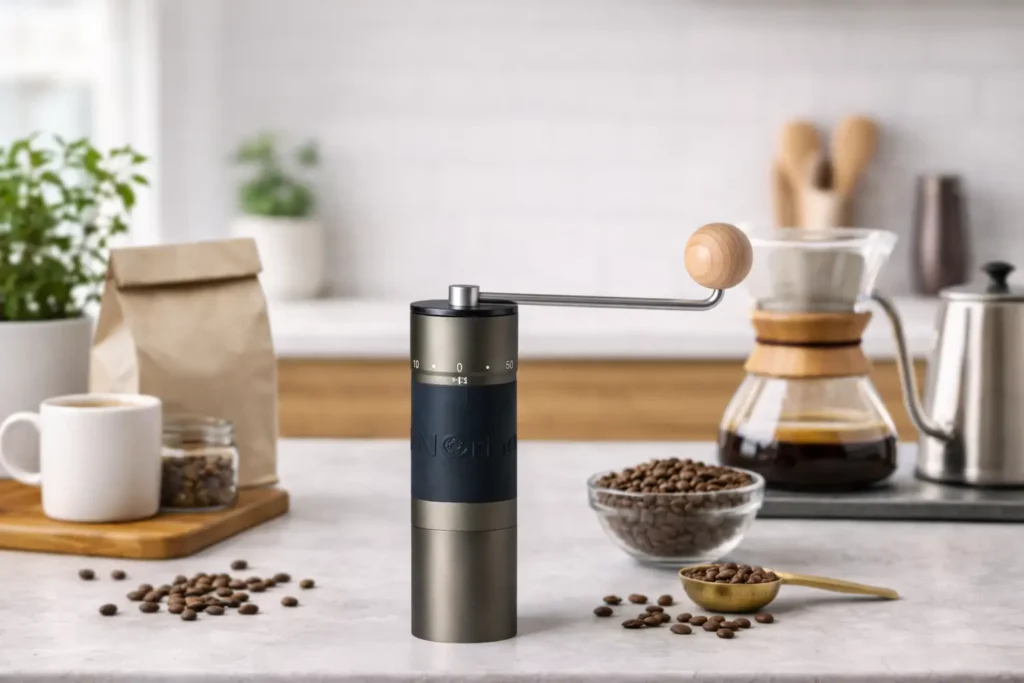
Best Manual Grinder for Any Brew Method: KINGrinder K6
The KINGrinder K6 is the manual grinder we recommend across almost every brew method on this site — pour-over, AeroPress, French press, and even light espresso use. It produces remarkably consistent particle distribution for its price point, has a wide adjustment range covering coarse to espresso-fine, and the stepped click system makes dial-in adjustments easy to replicate and record. For anyone who does not need an electric grinder or who wants a travel-capable option, the K6 offers burr quality that competes with grinders costing significantly more.
- Burrs: 48mm stainless steel conical burrs
- Range: Coarse through espresso-fine; 90 click positions
- Best for: Pour-over, AeroPress, French press, drip; light espresso capable
- Standout feature: Burr quality and consistency at this price is exceptional
Disclosure: CoffeeGearHub may earn from qualifying purchases.

Best Electric Grinder for Filter Coffee and Espresso: Baratza Encore ESP
The Baratza Encore ESP is the most commonly recommended first electric grinder — and the reason is repeatability. Its 40-step adjustment range extends into genuine espresso-fine territory (unlike the original Encore, which stops short), each click produces a clear, readable difference in extraction, and Baratza’s direct-sale replacement parts program means this grinder is a long-term purchase, not a throw-away. For anyone dialing in filter coffee daily who also wants the option to pull espresso shots, the Encore ESP covers the full range at an entry-to-mid price point.
- Burrs: 40mm conical steel burrs — engineered for espresso range
- Settings: 40 stepped positions; fine end reaches espresso territory
- Best for: Daily drip, pour-over, AeroPress; espresso with Breville Bambino or pressurised baskets
- Repair: Parts sold directly from Baratza — repairable for years
Disclosure: CoffeeGearHub may earn from qualifying purchases.
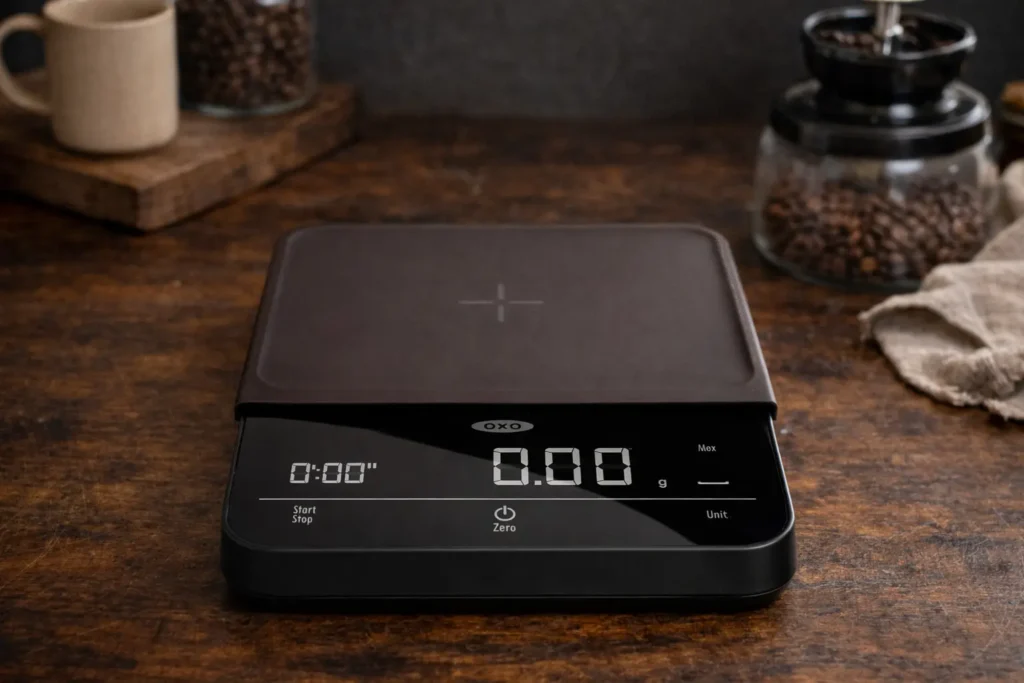
Non-Negotiable Accessory: A Digital Scale (0.1g Resolution)
If you are using a scoop to measure coffee, every brew is a different dose — and dose variation of even 0.5g changes extraction noticeably. A 0.1g resolution digital scale is the lowest-cost, highest-impact upgrade in home brewing. It is not optional if you want to actually dial in and repeat your results. Weigh your coffee, weigh your water. Do this consistently and most inconsistency problems vanish immediately.
- Resolution needed: 0.1g — kitchen scales with only 1g resolution are not precise enough
- Nice to have: built-in timer (useful for pour-over and espresso); flow-through design for pouring over a cup
- Budget options work: any 0.1g coffee scale from a reputable brand is sufficient for dialing in filter coffee
Disclosure: CoffeeGearHub may earn from qualifying purchases.
For a full comparison of grinders at every price point and brew method, see our Best Coffee Grinders buying guide. For the manual vs electric decision, see manual vs electric coffee grinders. For the burr vs blade question, see burr vs blade grinders.
FAQs: Dialing In Coffee at Home
Is dialing in coffee hard for beginners?
No. The process is straightforward when you change one variable at a time — usually grind size. Most beginners reach a balanced cup within 3–5 brews once they understand what sour vs bitter means and how grind size fixes it.
Should I change grind size or ratio first?
Always change grind size first. Grind size controls extraction — the balance between sour and bitter. Ratio only controls strength (how concentrated the coffee is). If you adjust ratio to fix sourness, you may get stronger sour coffee instead of balanced coffee.
How often do I need to dial in?
Any time you switch to a new bag of coffee, change roast levels, or notice the flavour shifting as beans age. Espresso requires more frequent micro-adjustments than filter coffee because it is far more sensitive to grind changes.
Why does my coffee taste different every day?
The most common cause is inconsistent dose — scooping by volume instead of weight introduces 0.5–1.5g variation per brew, which changes extraction noticeably. Standardise your weights first using a 0.1g scale, then evaluate water temperature and water quality if inconsistency continues.
Can I dial in coffee without a scale?
You can make reasonable coffee without a scale, but you cannot dial in systematically. Without weighing dose and water, every brew is slightly different, making it impossible to know whether a grind adjustment improved things or whether the dose just happened to be heavier. A basic 0.1g scale is the single highest-impact, lowest-cost upgrade for home brewing.
Why does my coffee still taste bad after adjusting the grind?
Three common causes: first, beans may be too stale — coffee older than 4–6 weeks tastes flat and papery regardless of grind. Second, your grinder may be producing inconsistent particles — blade grinders make dialing in very difficult or impossible. Third, water quality may be the issue — very hard or very soft water can produce flat sweetness or harsh bitterness that no grind change will fix.
Does water temperature affect dialing in?
Yes. Water temperature is a secondary extraction lever. Hotter water extracts faster and more aggressively — it can increase bitterness, especially with dark roasts. Cooler water extracts slower — it can taste sour or underdeveloped, especially with light roasts. For most home brewers, 195–205°F (90–96°C) covers the full range. Fix grind first, then consider temperature if problems persist.
What is the difference between extraction and strength?
Extraction is the balance of flavours dissolved from the coffee — whether it tastes sour (under-extracted), balanced, or bitter (over-extracted). Strength is how concentrated the coffee is — how much coffee flavour per unit of water. You can have a weak but balanced cup, or a strong but sour cup. Extraction is controlled by grind size; strength is controlled by coffee-to-water ratio.
Does roast level affect how I dial in?
Yes, significantly. Dark roasts are more porous and soluble — they extract quickly and can go bitter fast, so they often need a coarser grind and slightly cooler water. Light roasts are denser and less soluble — they need a finer grind and hotter water to fully extract. If you switch roast levels, expect to re-dial-in as if you have a completely new coffee.
How do I know when I’ve successfully dialed in my coffee?
Your coffee is dialed in when it tastes balanced — noticeable sweetness, a clean and pleasant finish, no sharp sourness, and no lingering harsh bitterness. When you reach this point, record your grind setting, dose, water weight, and temperature so you can repeat it reliably next time.
Continue Learning
GRINDERS & GEAR
Not sure which grinder to buy? Our full buying guide covers every option at every price point — with method-specific recommendations, manual vs electric comparisons, and a single pick for each type of home brewer.
☕
Written by the CoffeeGearHub Editorial Team
CoffeeGearHub is a specialty coffee equipment resource run by home brewers and coffee enthusiasts. Our guides are researched using hands-on brewing testing, published brewing science, SCA Brewing Standards, and established specialty-coffee community knowledge. We review and update our content regularly. About CoffeeGearHub →