
Manual vs Electric Coffee Grinders: Which Is Better for Home Brewing?
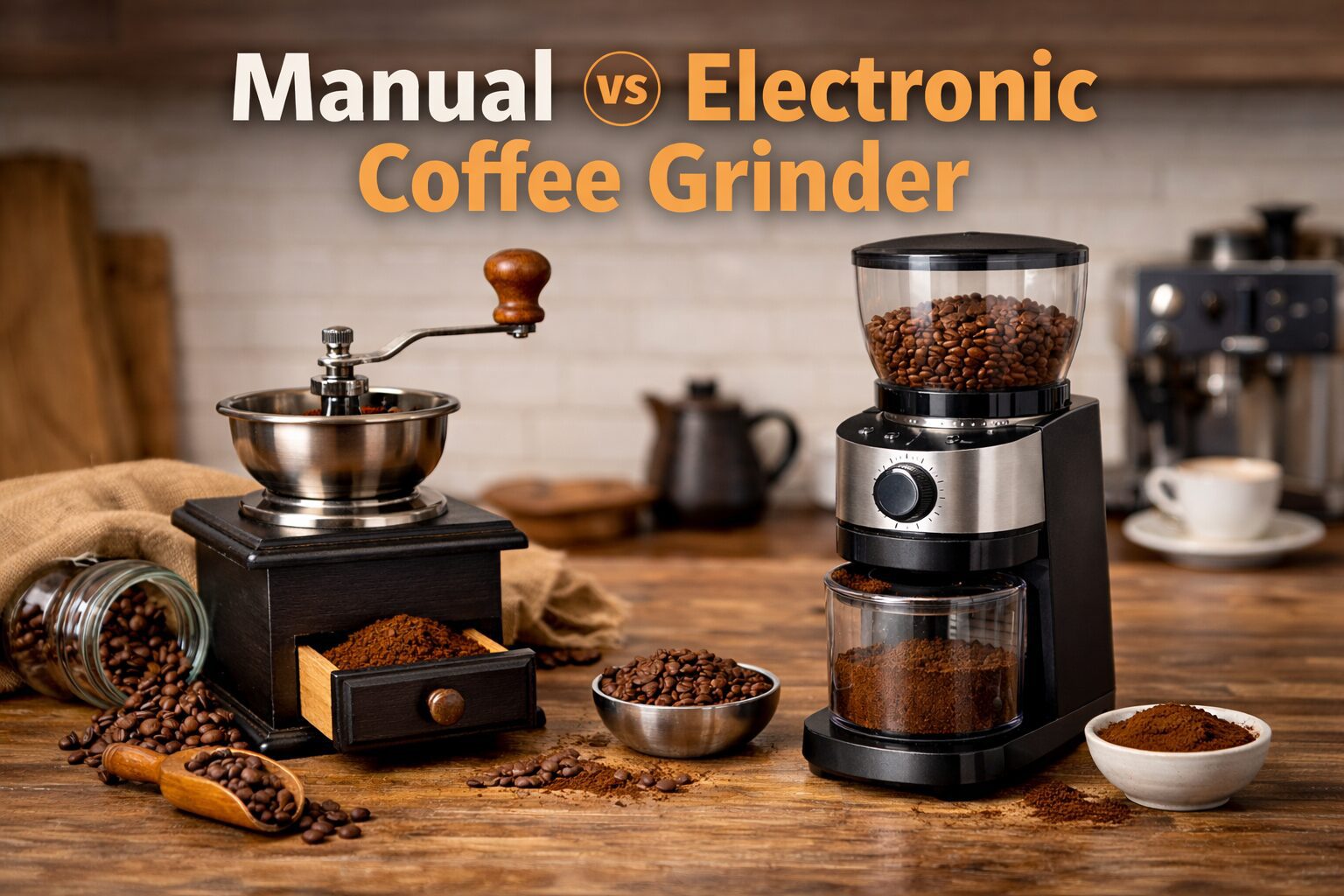
Editorial standards: this guide compares manual and electric grinders by grind consistency, adjustment range, workflow, noise, portability, maintenance, and value. Product guidance is based on specifications and use-case fit unless hands-on testing is explicitly stated.
At a glance
What this guide covers
This guide explains the practical trade-offs between manual and electric coffee grinders so you can choose based on brew method, volume, budget, portability, and how much effort you want in the daily workflow.
Editorial analysis
Workflow matters almost as much as grind quality
A good manual grinder can deliver excellent particle consistency for the money, especially for filter coffee, but the physical effort becomes more noticeable with larger doses or espresso-fine settings.
Electric grinders cost more for comparable burr quality, yet they make repeated daily brewing faster and easier. The better choice depends on how often you brew, how much coffee you grind at once, and whether portability or convenience matters more.
The 30-Second Answer
Choose a manual grinder when you want strong grind quality for the money, low noise, and portability; choose electric when speed and daily convenience matter more. Burr quality and adjustment range still matter more than the power source alone.
What Is a Manual Coffee Grinder?
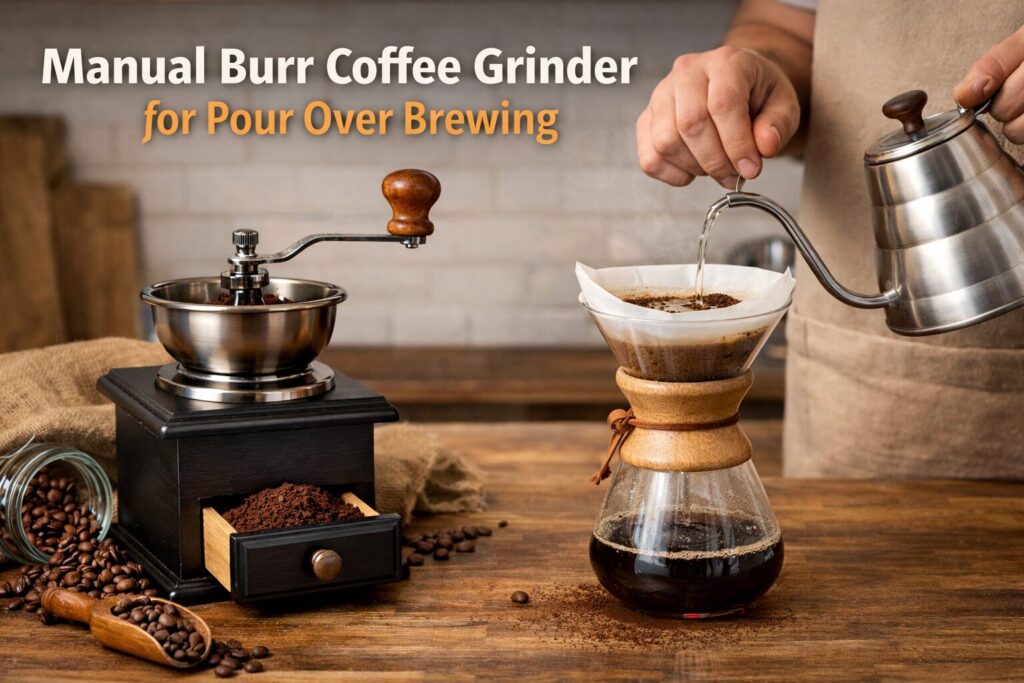
A manual coffee grinder — also called a hand grinder — uses hand-powered rotation to turn a pair of burrs that crush coffee beans into uniform particles. Quality manual grinders commonly use steel burrs and precise adjustment systems. Because they do not need a motor or dosing electronics, they can put more of the product design into the burr set, bearings, and adjustment mechanism while staying compact and quiet.
Modern manual grinders are no longer just travel tools. Many current models are built for daily pour-over, AeroPress, moka pot, and even espresso use. Their advantage is not automatic superiority over electric grinders; it is the ability to offer capable burrs and fine adjustment without charging for a motor, which can make them strong value when hand grinding fits your routine.
✅ Manual Grinder Strengths
- No electricity required — works anywhere
- Compact and travel-ready
- Excellent price-to-performance ratio
- Quiet — ideal for early mornings
- No motor noise and a compact, direct workflow
⚠️ Manual Grinder Limitations
- Slower — 30–90 seconds per dose
- Physically demanding for espresso doses
- Not ideal for high-volume brewing
- Espresso capability is model-dependent
Best brewing methods for manual grinders: Pour-over (V60, Kalita, Chemex), AeroPress, drip coffee, French press, moka pot, travel and small-kitchen setups.
What Is an Electric Coffee Grinder?
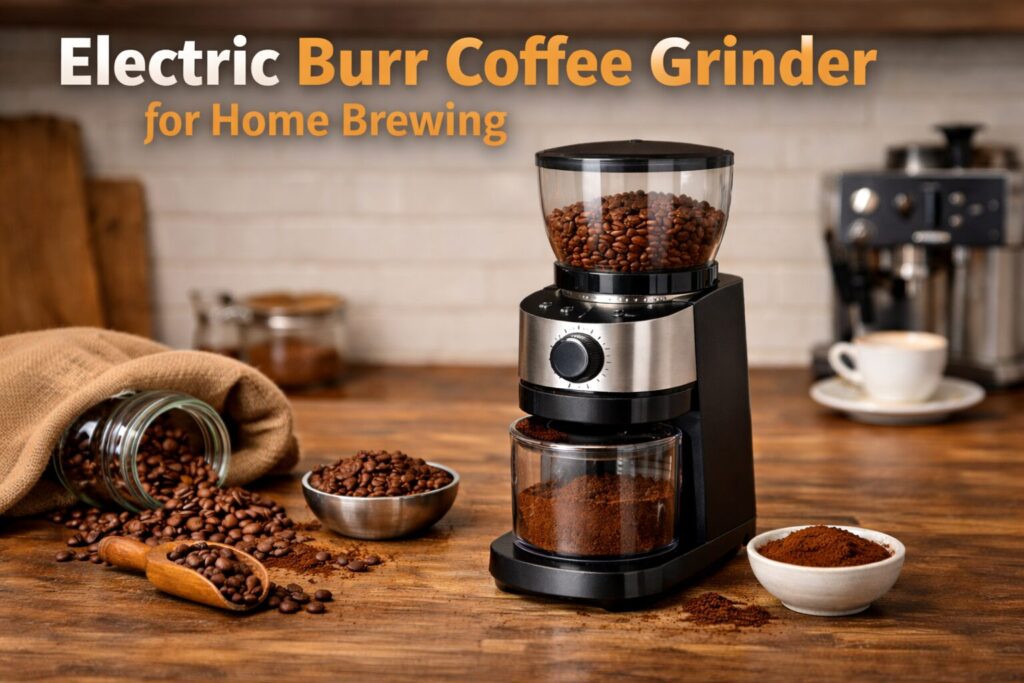
An electric coffee grinder uses a motor to spin burrs at a fixed RPM. The quality range is enormous — from a $30 blade grinder (which produces random-sized particles and uneven extraction) to a $2,000 single-dose espresso grinder with micro-step adjustment. What separates a good electric grinder from a bad one isn’t motor wattage: it’s burr alignment, burr geometry, adjustment precision, and retention (how much stale coffee remains trapped inside after grinding).
Electric grinders are non-negotiable for serious espresso workflows. The grind window for espresso is so narrow — often only a 1–2 second difference in pull time between too fine and too coarse — that dialing in by hand quickly becomes impractical. A motor-driven grinder with step-less or very fine click adjustment lets you make the micro-corrections espresso demands.
✅ Electric Grinder Strengths
- Fast — grinds a dose in 5–15 seconds
- Effortless daily use
- Best for espresso workflows
- Handles large volumes easily
- Consistent dose-to-dose repeatability
⚠️ Electric Grinder Limitations
- Higher cost for equivalent burr quality
- Larger counter footprint
- Louder — not ideal for quiet mornings
- More components = more maintenance
- Not portable
Best brewing methods for electric grinders: Espresso, daily drip, batch brewing for multiple cups, busy households, and any routine where speed and ease matter more than portability or grind quality per dollar.
Manual vs Electric Coffee Grinders: Side-by-Side Comparison
| Feature | Manual Grinder | Electric Grinder |
|---|---|---|
| Convenience | Low–Moderate | High |
| Speed | Slow (30–90 sec/dose) | Fast (5–15 sec/dose) |
| Noise | Very quiet | Moderate to loud |
| Portability | Excellent | Poor |
| Counter space | Minimal | Larger footprint |
| Grind consistency (same price tier) | ✅ Often better | ✅ Excellent (higher spend) |
| Espresso capability | ⚠️ Limited (model-dependent) | ✅ Best choice |
| Price-to-performance (filter coffee) | ✅ Very high | Varies widely |
| Maintenance | Simple — few components | More parts, motor care needed |
| Best for | Pour-over, AeroPress, travel | Espresso, batch brew, daily volume |
Why Grind Consistency Matters More Than You Think
The single most important factor in coffee quality isn’t your brewer, bean origin, or water temperature — it’s grind particle size distribution. Every particle in a dose of ground coffee extracts at a rate proportional to its surface area. Larger particles extract slowly. Smaller particles extract quickly. When a grind produces a wide spread of particle sizes — some very fine, some very coarse — different particles reach very different extraction levels in the same brew, and those extractions layer on top of each other in the cup.
The result: a cup that simultaneously tastes sour (from under-extracted coarse particles) and bitter (from over-extracted fines). No amount of brew technique fixes a fundamentally uneven grind. This is why burr geometry matters, not just having “any burr grinder.” Flat burrs, conical burrs, and hybrid designs each produce different particle size distributions — and the engineering quality of the burr set determines how tight that distribution is.
Burr RPM matters too. Higher rotation speeds generate friction heat, which accelerates the volatilization of aromatic compounds — the molecules responsible for the complex flavors you paid for in quality beans. Manual grinders rotate at roughly 1–3 RPM by hand, compared to 400–1,600+ RPM for most electric grinders. This slow rotation is one reason why high-quality hand grinders often produce cleaner, more aromatic cups than electric grinders at the same price point — less heat means more volatile aromatics survive the grind intact and reach your cup.
🔬 Key principle: A grinder’s job is to produce particles as uniform as possible. The more uniform the grind, the more control you have over extraction. Burr quality — not motor presence — is the primary driver of grind uniformity.
Grind Quality: Which Is Actually Better?
This is where the conventional wisdom gets complicated. The assumption that “electric = better” because it has a motor is wrong. What determines grind quality is the burr set — its geometry, hardness, alignment tolerance, and how the grinding chamber manages particle flow. A manual grinder with a precision-engineered steel burr set will produce a more consistent grind than an electric grinder with a cheap, poorly-aligned burr at the same price.
At equivalent burr quality, manual and electric grinders produce comparable grind distributions for filter coffee. The difference shows up most clearly in two places: fines generation and espresso precision.
Fines generation: Manual grinders rotating at low RPM generate slightly fewer ultra-fine particles than electric grinders with the same burr design. Fines are responsible for a significant portion of bitterness in filter brews — they extract very rapidly and contribute bitter compounds before coarser particles have time to develop sweetness. This gives well-designed hand grinders a subtle but real advantage for pour-over and AeroPress, where cup clarity is prioritized.
Espresso precision: Espresso requires not just fine grinding but micro-fine adjustment repeatability. When you change beans or notice your pull time shifting as a roast ages, you need to make adjustments as small as half a rotation. Hand grinders can achieve this, but the physical effort of grinding espresso doses (18–20g at fine settings) repeatedly makes electric grinders the practical choice for espresso-focused routines.
💡 Bottom line: Manual grinders produce slightly cleaner cups for filter coffee at equivalent price points. Electric grinders are necessary for practical espresso use. For everything in between, the gap is smaller than most people expect — and burr quality drives the outcome more than grinder type.
Brewing Method Compatibility
| Brewing Method | Manual Grinder | Electric Grinder | Notes |
|---|---|---|---|
| Pour-over (V60, Kalita, Chemex) | ✅ Excellent | ✅ Excellent | Manual slightly favored for cup clarity at same price tier |
| AeroPress | ✅ Excellent | ✅ Excellent | Manual ideal — compact, precise, low fines |
| Drip / batch brew | ✅ Good | ✅ Excellent | Electric wins for multi-cup convenience |
| French press | ✅ Excellent | ✅ Excellent | Coarse grind is easy on both types |
| Moka pot | ✅ Excellent | ✅ Excellent | Medium-fine is achievable on both |
| Espresso | ⚠️ Limited | ✅ Best choice | See espresso section below |
| Cold brew | ⚠️ Tiring | ✅ Better | Large coarse doses are physically demanding by hand |
For a full breakdown of grind sizes by method, see: Grind Size Explained.
Espresso Capability: Manual Precision vs Electric Convenience
Espresso is the most technically demanding brew method a grinder must serve. Electric grinders dominate espresso not just because of burr quality — it’s the combination of factors that espresso requires simultaneously:
- Very fine grind: Espresso needs particles in the 200–400 micron range — significantly finer than any filter brew method. Achieving this on a hand grinder is possible on premium models, but requires substantial physical effort per dose.
- Micro-adjustment repeatability: As beans age off-roast, you need to grind finer over days and weeks to maintain the same extraction. A quality espresso grinder makes these adjustments in tiny, reproducible increments. On a hand grinder, making a half-click adjustment and knowing exactly how far you’ve moved is harder under the fatigue of grinding an 18g dose.
- Dose consistency: Pulling multiple espresso shots in a row requires the same grind weight and setting each time. Electric grinders with timer-based dosing make this effortless. Doing it by hand, repeatedly, creates fatigue that introduces variables into the dose.
- Physical demand: Grinding 18–20g at espresso fineness takes significant hand and wrist effort. Doing this 2–4 times every morning quickly becomes a friction point that undermines consistency.
Espresso-focused manual grinders such as the 1Zpresso J-Ultra can provide the fine adjustment needed for serious espresso. The trade-off is workflow rather than capability: hand grinding adds physical effort, and that effort becomes more noticeable as shot volume rises. An espresso-capable electric grinder is often the more convenient fit for frequent daily use, while a capable manual grinder can suit lower-volume routines, quiet kitchens, or travel setups.
🔬 Espresso workflow rule: Choose manual or electric based on how much physical effort you are comfortable adding to each shot. A capable manual grinder can dial in espresso precisely, while electric becomes increasingly convenient as shot volume or household use rises.
Real-World Workflow Differences (What Most Guides Miss)
Specs and comparison tables only tell half the story. The most important question is: what does using each grinder actually feel like at 6:30am on a Tuesday? Lifestyle fits matter more than specifications.
Manual Grinder Reality
- Grinding 20–25g for filter takes 30–60 seconds
- Quiet enough not to wake the household
- Meditative morning ritual many brewers enjoy
- Works anywhere — no plug, no counter needed
- Less ideal when serving guests or batching 4+ cups
- Near-zero retention — no stale grounds between sessions
Electric Grinder Reality
- Full dose ground in 5–15 seconds
- Louder — noticeable in a quiet house
- Better for back-to-back shots and batch brewing
- Requires counter space and a power outlet
- Encourages repeatable, consistent daily workflow
- Hopper models retain 1–5g stale grounds — purge before use
Cost vs Performance: What Delivers Better Value?
Manual grinders often put more of the product cost into the burr set, bearings, and adjustment mechanism because there is no motor or dosing electronics to pay for. Electric grinders charge for convenience as well as grind hardware. That makes workflow and brew method more useful buying filters than temporary retail-price brackets.
| Buying priority | Likely fit | Why | Representative option |
|---|---|---|---|
| Lowest-cost route to burr grinding | Manual | No motor means more of the build can go toward burrs and adjustment | Entry steel-burr hand grinder |
| Multi-method value | Manual or entry electric | Choose between hands-on effort and push-button convenience | KINGrinder K6 / Baratza Encore |
| Daily filter convenience | Electric | Faster repeated doses and easier household use | Baratza Encore / Virtuoso+ |
| Filter plus entry-level espresso | Electric or espresso-capable manual | Adjustment resolution matters more than motor versus hand power | Baratza Encore ESP / 1Zpresso J-Ultra |
| Dedicated espresso workflow | Espresso-focused electric or manual | Prioritize fine adjustment, repeatability, and manageable retention | Sette 270 / J-Ultra / other espresso-focused models |
The practical value question is therefore not “how much should I spend?” but “which costs am I willing to trade for convenience?” A good manual grinder can deliver strong grind quality without paying for a motor; a well-chosen electric grinder earns its premium when speed, repeated doses, or household use matter. Check current merchant pricing when comparing specific models because retail prices change.
Recommended Grinders with Brew Method Settings
Here are the top recommendations in each category, with specific starting click settings for common brewing methods. Use these as a starting point and adjust by taste — every grinder, bean, and water combination will vary slightly.
🏆 Top Manual Pick: KINGrinder K6
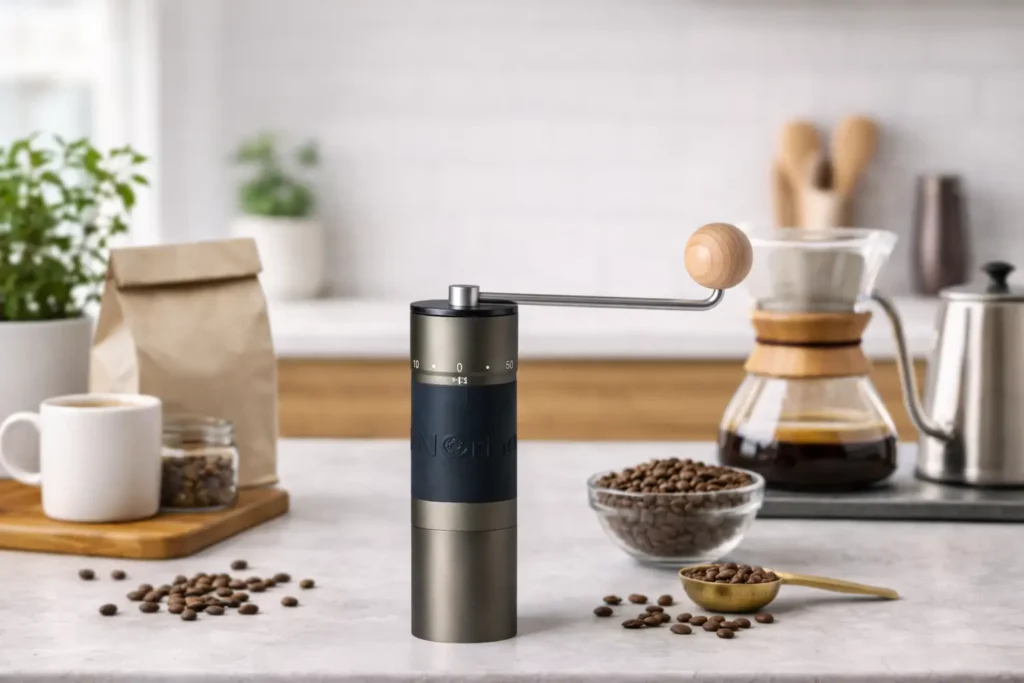
The K6 is a practical hand-grinder reference for AeroPress, pour-over, moka pot, and other filter methods. Its external click adjustment makes settings easy to record and revisit, while the broad grind range keeps it useful across multiple brewers. It can reach fine settings, but dedicated espresso users should prioritize the adjustment resolution and workflow they need for repeated dialing.
| Brew Method | Starting Setting | Notes |
|---|---|---|
| AeroPress (filter-style) | 3.0–3.5 rotations | Medium-fine; adjust ±4 clicks to taste |
| Pour-over (V60 / Chemex) | 3.5–4.0 rotations | Medium; aim for 3:00–3:30 min total brew |
| Kalita Wave / flat-bed drip | 4.0–4.5 rotations | Slightly coarser than V60 |
| French press | 5.0–6.0 rotations | Coarse; 4-minute steep |
| Moka pot | 2.0–2.5 rotations | Fine-sand texture; never tamp |
| Espresso (capable) | 0.5–1.5 rotations | Requires patience and careful pull timing |
Disclosure: CoffeeGearHub may earn from qualifying purchases.
🔌 Top Electric Pick for Filter Coffee: Baratza Encore
The Encore is the most-recommended entry-level electric burr grinder for filter coffee. Reliable conical burr, 40 click-step adjustments, and a straightforward workflow. Not designed for espresso — the adjustment range doesn’t go fine enough. For pour-over, drip, and French press with daily convenience, it’s the standard starting point.
| Brew Method | Starting Setting (of 40) | Notes |
|---|---|---|
| AeroPress (filter-style) | 7–10 | Adjust finer for shorter, concentrated brews |
| Pour-over (V60) | 12–16 | Target 3:00–3:30 total brew time |
| Flat-bottom / drip machine | 16–20 | Match to your machine’s basket and flow rate |
| French press | 24–28 | 4-minute steep; aim for clean pour, no muddy sediment |
☕ Top Electric Pick for Espresso: Baratza Encore ESP
The Encore ESP is the espresso-capable step up from the standard Encore. It uses 40mm M2 conical steel burrs and a 40-setting dual-range adjustment system: settings 1–20 provide higher-resolution espresso adjustment, while 21–40 cover filter methods. That makes it a useful electric option for households that want one grinder to span entry-level espresso and everyday filter brewing.
| Brew Method | Starting Zone | Notes |
|---|---|---|
| Espresso | Fine end of dial | Start mid-fine; target 25–30 sec pull as baseline |
| Moka pot | Lower-mid range | Slightly coarser than espresso; never tamp basket |
| AeroPress espresso-style | Lower-mid range | Ideal for concentrated AeroPress recipes |
For a full comparison of burr grinders across budgets, see: Best Burr Coffee Grinders. For espresso-specific recommendations, see: Best Burr Grinders for Espresso.
Common Buying Mistakes to Avoid
| Mistake | Why it matters | What to do instead |
|---|---|---|
| Buying a blade grinder to save money | Blade grinders chop randomly — uneven particle sizes mean uneven extraction regardless of technique | Any burr grinder, even a $40 manual, beats any blade grinder for cup quality |
| Assuming any burr grinder works for espresso | Espresso needs adjustment resolution that many filter-focused grinders don’t provide | Verify the grinder is explicitly espresso-capable before buying |
| Overpaying for motor wattage | Wattage affects speed, not grind quality. A 200W motor with poor burrs grinds worse than a 100W motor with precision burrs | Focus on burr quality, adjustment range, and retention specs |
| Underestimating grinding frequency | If you grind twice a day every day, a hand grinder becomes a friction point even if you love it on weekends | Be honest about your actual routine before committing |
| Choosing speed over consistency | An extra 30 seconds hand-grinding with a K6 outperforms a fast electric with cheap burrs | Prioritize burr quality and adjustment precision over grind time |
Troubleshooting Matrix: Grinder-Related Cup Problems
When something tastes off, the grinder is often the first place to look. Use this matrix to diagnose and fix the most common grind-related problems across both grinder types. Always adjust grind first — it’s the highest-impact variable — then work through heat and timing.
| Symptom | Most likely cause | Fix (in order) |
|---|---|---|
| Bitter + harsh | Grind too fine / over-extraction | Go 2–3 clicks coarser → shorten brew contact time → lower brew temp slightly |
| Sour + thin | Grind too coarse / under-extraction | Go 2–3 clicks finer → extend contact time → verify water temp is 90–96°C |
| Flat / no brightness | Stale beans, or stale retained grounds (electric hopper) | Use fresher beans → purge 2–4g before dose (electric) → clean burrs |
| Sour AND bitter simultaneously | Uneven grind — likely blade grinder or severely misaligned burrs | Upgrade to a quality burr grinder; clean and check alignment on existing |
| Inconsistent espresso pull times | Hopper retention causing dose variation, or beans aging off-roast | Weigh every dose → purge before pulling → adjust grind finer as roast ages |
| Grinding feels like hard work (manual) | Grind too fine, dense light-roast beans, or burrs need cleaning | Go 1–2 clicks coarser → clean burrs → for daily espresso, consider electric |
| Loud / vibrating (electric) | Loose hopper, loose mounting screws, or worn burrs | Check hopper seating → tighten screws → inspect burrs for wear |
Which Should You Choose?
The manual vs electric coffee grinder decision is fundamentally about your daily routine. Use this summary to identify which type matches how you actually brew.
Choose a Manual Coffee Grinder If:
- You brew pour-over, AeroPress, or drip most of the time
- You want the best grind quality your budget allows
- You travel frequently or have limited counter space
- You enjoy the ritual of hand-grinding as part of the brew
- You brew 1–2 cups per session, not batches
- Quiet mornings matter more than speed
- You want maximum value per dollar spent
Choose an Electric Coffee Grinder If:
- You pull espresso regularly (more than 1–2 shots per day)
- You make coffee for multiple people daily
- You batch brew — 4 or more cups per session
- Speed and convenience are non-negotiable
- Physical effort in the morning is a friction point
- You want consistent results without deliberate effort
- Counter space and portability are not concerns
For many home brewers, a manual grinder is the best first upgrade from a blade grinder — it costs less, teaches you how grind adjustment works, and produces noticeably better cups immediately. An electric grinder becomes the right call as your routine grows, your volume increases, or espresso enters the picture.
Frequently Asked Questions
Is a manual coffee grinder better than an electric one?
Neither is universally better. Manual grinders often deliver better grind quality for the price, while electric grinders are faster and more convenient for daily routines. The right choice depends on your brewing method, volume, and budget.
Can a manual grinder be used for espresso?
Some high-quality manual grinders can grind fine enough for espresso, but the process is slower and more physically demanding than using an espresso-capable electric grinder. For daily espresso use, electric is the practical choice.
Do electric grinders make better coffee?
Not necessarily. Coffee quality depends primarily on burr design, alignment, and adjustment precision — not whether the grinder is manual or electric. A quality hand grinder often outperforms a cheap electric grinder at the same price.
Which lasts longer: manual or electric grinders?
Manual grinders often last a long time because they have fewer components. Electric grinders can also last many years, but depend more on motor quality and maintenance.
Are manual grinders good for beginners?
Yes — manual grinders are an excellent beginner upgrade. They cost less than a comparable electric grinder, teach you how grind adjustment works, and produce consistently better results than a blade grinder.
How long does it take to grind coffee manually?
Grinding 20–25g of coffee for a filter brew typically takes 30–60 seconds on a quality manual grinder. Espresso doses (18–20g at a much finer grind) can take 90 seconds or more.
Can I use a manual grinder every day?
Absolutely. Many specialty coffee enthusiasts use a manual grinder daily for years without issue. Quality hand grinders like the KINGrinder K6 are built for regular use and produce excellent results every time.
Does grinder RPM affect coffee taste?
Yes — higher RPM generates more friction heat, which can accelerate volatile aroma loss and alter flavor. Manual grinders rotate slowly by nature, which is one reason they often produce slightly cleaner cups at equivalent burr quality.
What’s the best budget manual grinder for filter coffee?
The KINGrinder K6 is a useful manual reference for filter coffee because it combines an external click adjustment, a broad grind range, and a compact hand-powered workflow. Compare current pricing rather than assuming a fixed savings versus electric models.
Which grinder type is better for travel?
Manual grinders are often the easier travel choice because they need no outlet and pack compactly, but the best option still depends on luggage space, dose size, and how much hand grinding you want to do. They require no power, fit in a bag or luggage, and many are designed to hold the grounds inside the grinder body itself, making them ideal for hotel rooms, camping, and office use.
CoffeeGearHub product shortlist
Compare coffee grinders on CoffeeGearHub
Review current grinder pages and verified merchant offers in the CoffeeGearHub catalog before leaving the site.
Continue Learning
Grinder buying guides
Grind fundamentals
In this guide
- The 30-Second Answer
- What Is a Manual Coffee Grinder?
- What Is an Electric Coffee Grinder?
- Manual vs Electric Coffee Grinders: Side-by-Side Comparison
- Why Grind Consistency Matters More Than You Think
- Grind Quality: Which Is Actually Better?
- Brewing Method Compatibility
- Espresso Capability: Manual Precision vs Electric Convenience
- Real-World Workflow Differences (What Most Guides Miss)
- Cost vs Performance: What Delivers Better Value?
- Recommended Grinders with Brew Method Settings
- Common Buying Mistakes to Avoid
- Continue Learning