
Best Espresso Grinders (2026): Picks by Budget & Workflow
Editorial standards: this guide compares espresso grinders by adjustment precision, burr design, consistency, retention, workflow, dosing, and value. Product recommendations are based on published specifications and use-case fit unless hands-on testing is explicitly stated.
At a glance
What this guide covers
This guide compares espresso-focused grinders across budgets and explains why very fine adjustment control, consistency, and low-retention workflow matter more for espresso than they do for most filter brewing.
Editorial analysis
Espresso exposes grinder limitations quickly
Small changes in grind size can move an espresso shot from fast and sour to slow and bitter. That makes adjustment precision and repeatable dosing unusually important, especially when changing coffees or dialing in lighter roasts.
A grinder does not need every premium feature to make good espresso, but it does need a usable fine range and predictable adjustments. Workflow features should come after those fundamentals.
The 30-Second Answer
For espresso, prioritize fine adjustment control, consistent burr performance, repeatable dosing, and a workflow you can use every day. Those factors usually affect shot quality more than extra grinder features or cosmetic upgrades.
What Makes a Grinder Espresso-Capable (Without the Jargon)
Most burr grinders can grind “fine.” Espresso needs something stricter: fine + repeatable + adjustable in tiny steps. The difference between a 28-second balanced shot and a 14-second sour gush can be a grind change so small you barely feel it. The grinder must let you move slightly, not jump by a full increment that overshoots the target entirely.
These five specs separate a true espresso grinder from a general-purpose burr grinder used at its finest setting:
| Spec | Why it matters for espresso | What to look for |
|---|---|---|
| Adjustment precision | The #1 dial-in factor — controls how small a grind change you can make | Stepless, or espresso-specific micro-steps (<50µm per increment) |
| Grind consistency | Fewer fines and boulders = even water flow through the puck, fewer channeling problems | Bi-modal vs mono-modal burr design; higher burr quality = tighter distribution |
| Retention | Stale grounds in the chamber contaminate the dose and make adjustments less predictable | Lower retention makes grind changes easier to evaluate and reduces purge waste |
| Static / clumping | Clumpy grounds make distribution difficult, increasing channeling risk | WDT tool or RDT (Ross Droplet Technique) can solve most clumping — not a disqualifier |
| Daily usability | Noise, footprint, ease of cleaning — if it annoys you, you’ll stop optimizing | Consider kitchen setup: hopper vs single-dose, size, noise level |
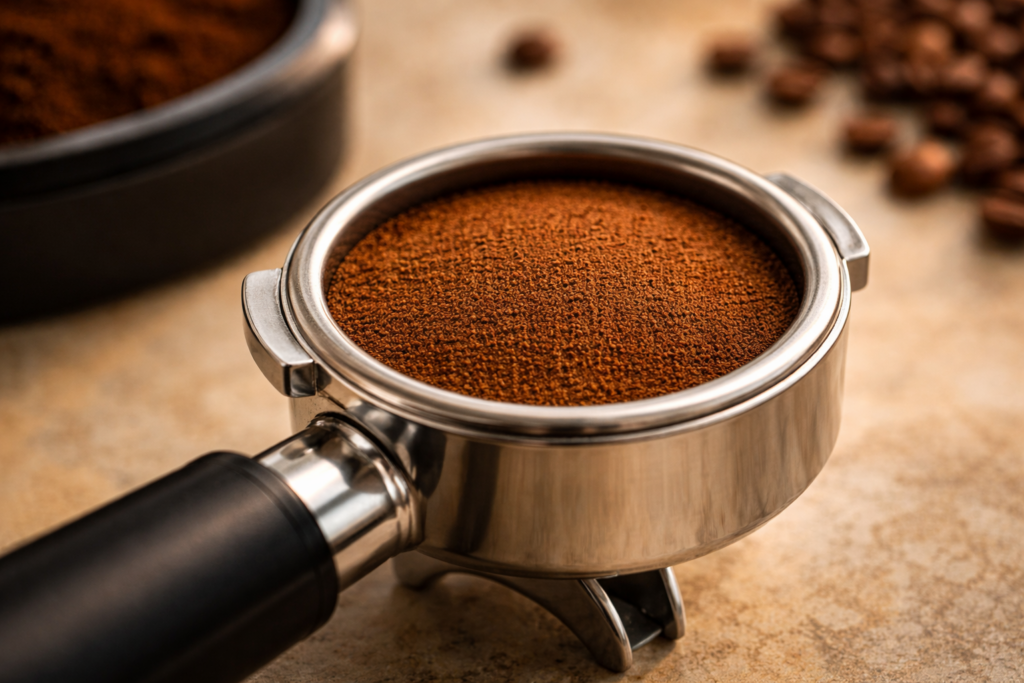
🔬 The grinder-first rule: Match grinder capability to the basket and workflow you actually use. A grinder with insufficient adjustment precision can make an otherwise capable espresso machine frustrating to dial in, while a suitable grinder helps you make smaller, repeatable corrections. Machine temperature and pressure still matter, so treat the grinder and machine as a system rather than using a fixed spending ratio.
Best Espresso Grinder Picks by Tier
Each tier below solves a different problem. Tier 1 is about getting real espresso control at an accessible price. Tier 2 adds adjustment refinement and workflow speed. Tier 3 is for daily enthusiasts who want fewer variables and smoother dialing over time. The manual section is for quiet, portable, or low-volume espresso use.
Tier 1: Best Budget Espresso Grinders
The goal at Tier 1 isn’t competition-level perfection — it’s repeatable home espresso you can improve over time. The critical feature is fine, espresso-relevant adjustment steps. Most general-purpose budget grinders fail here: they can reach “espresso fine” but can’t make the small corrections between “sour” and “balanced.” The two picks below solve that problem.
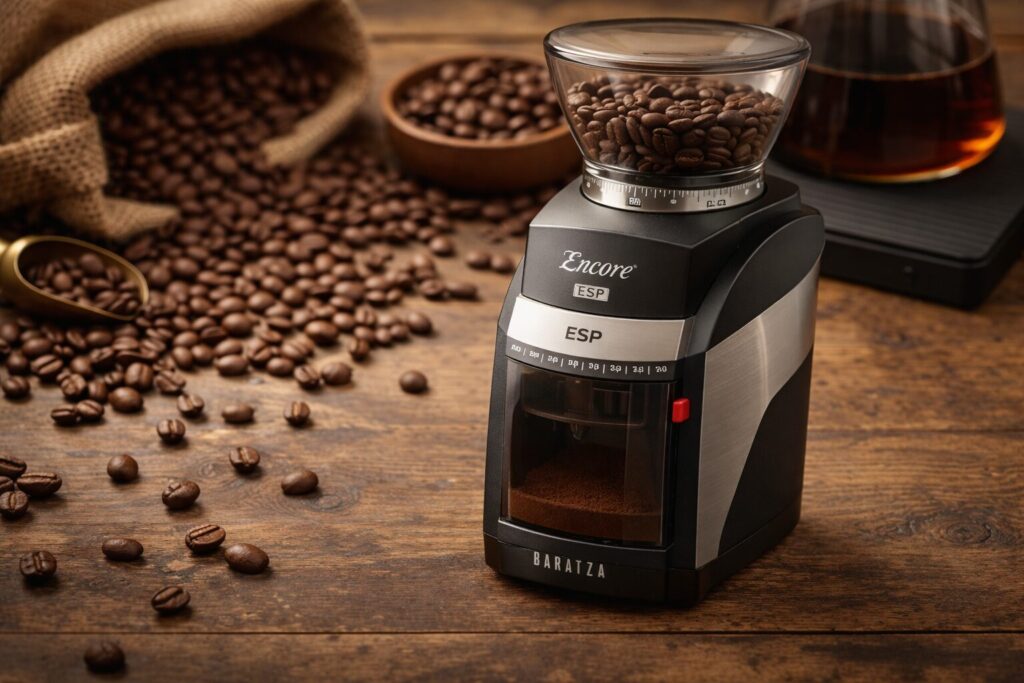
Baratza Encore ESP — Best Budget Espresso Grinder
Burrs: 40mm steel conical • Adjustment: Dual-range stepped adjustment; settings 1–20 high-resolution espresso, 21–40 filter • Workflow: Hopper-based • Noise level: Moderate. The Encore ESP earns its spot because it solves the core budget-grinder failure for espresso: too-large adjustment increments that force you to choose between “too fast” and “too slow” with nothing in between. Baratza’s dual-range adjustment system uses a shallower pitch through settings 1–20 for finer espresso changes, while settings 21–40 cover filter brewing. Baratza also publishes replacement parts and support resources, which strengthens the case for long-term ownership.
- Purpose-built espresso micro-steps — not a generic grinder forced into espresso range
- Baratza service + parts ecosystem — easy to repair vs. replace
- Easiest learning curve in the tier — a true beginner-friendly dial-in experience
- Trade-off: moderate noise, hopper workflow (not ideal for frequent bean-switching)
Best for: first espresso setup • learning to dial in • pressurized and non-pressurized baskets
Disclosure: CoffeeGearHub may earn from qualifying purchases.
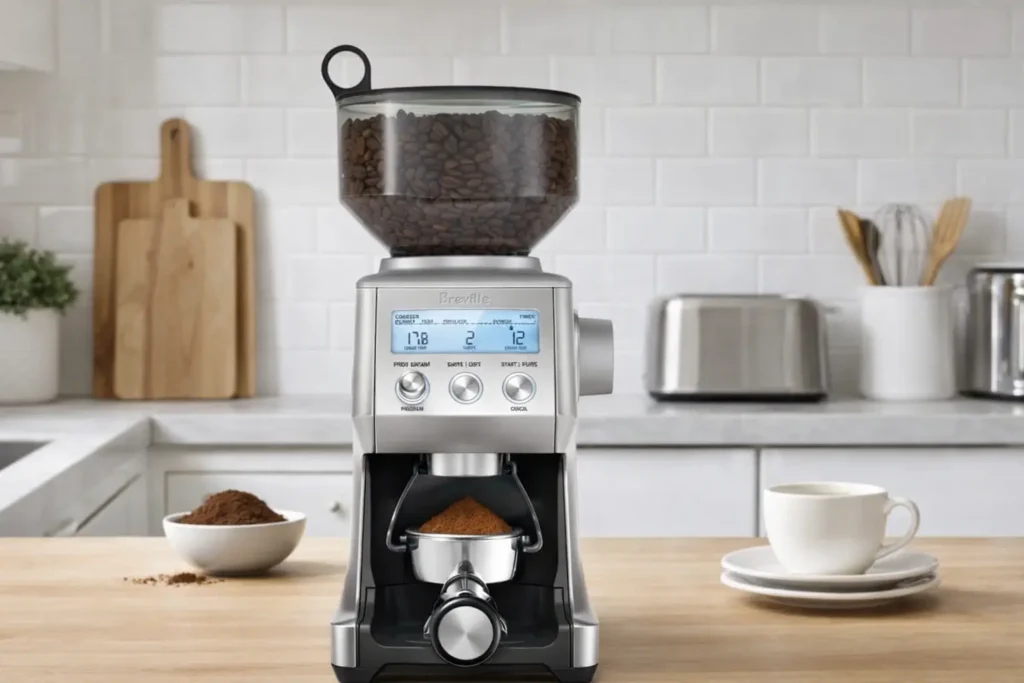
Breville Smart Grinder Pro — Best for Beginners on Milk Drinks
Burrs: 40mm stainless steel conical • Adjustment: 60 stepped positions, digital dose timer • Workflow: Hopper or portafilter cradle • Noise level: Moderate. The Smart Grinder Pro’s stepped system is less precise than the Encore ESP for pure espresso dialing — individual steps are larger and can make it harder to land exactly in the extraction sweet spot. Where it wins is convenience: the digital timer and portafilter cradle make workflow fast and clean, and it handles milk drinks well because cappuccinos and lattes are more forgiving of minor shot variation. If you’re mostly making milk-based drinks while you learn, this is the easier daily-driver at Tier 1.
- Digital dosing timer + portafilter cradle — fastest workflow in the tier
- 60 grind positions — wide range covering espresso through drip
- Forgiving for milk drinks — small shot differences can be less noticeable in milk-based drinks
- Trade-off: stepped increments are larger than ESP — harder to land exact espresso sweet spot
Best for: milk drinks • beginners wanting convenience • pressurized basket setups
Disclosure: CoffeeGearHub may earn from qualifying purchases.
💡 Tier 1 buying rule: If you use non-pressurized baskets, choose the Encore ESP. Its finer adjustment resolution makes dialing in significantly less frustrating. If you primarily make milk drinks with a pressurized basket while you’re learning, the Smart Grinder Pro’s workflow convenience is worth the adjustment trade-off.
Tier 2: Best Value Espresso Grinders
This is the sweet spot for most serious home espresso drinkers. The jump from Tier 1 to Tier 2 is meaningful: better adjustment systems, tighter grind consistency, and a workflow that makes the iterative dial-in process feel less like a guessing game. If you pull espresso daily and want to spend more time enjoying shots than troubleshooting them, this tier delivers.
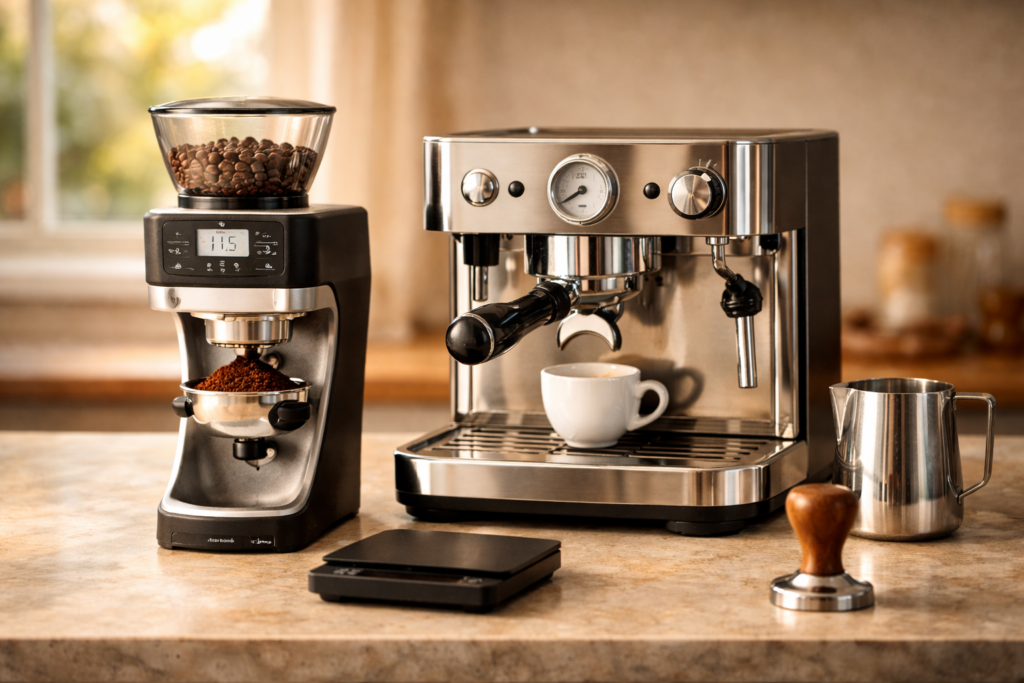
Baratza Sette 270 — Best for Fast Dialing
Burrs: 40mm conical steel • Adjustment: 30 macro steps + stepless micro ring • Workflow: No-chute, grounds-direct workflow designed for low retention • Noise level: Loud but short. The Sette 270 is uniquely designed around the dial-in workflow: macro adjustment gets you into the right zone fast, and the stepless micro ring lets you nudge from there without jumping past your target. The direct-to-portafilter design combined with very low retention means each adjustment you make is immediately testable — you’re not fighting stale grounds in the chamber when you change settings. The result is faster dialing with less wasted coffee.
- Macro + micro adjustment — get close fast, then fine-tune without overshooting
- Low-retention no-chute design — adjustments are immediately reflected in the next shot
- Grounds-direct design — minimal mess, clean portafilter workflow
- Trade-off: loud motor, polarizing aesthetic, not designed for filter coffee
Best for: daily espresso users • fast iterative dialing • non-pressurized baskets
Disclosure: CoffeeGearHub may earn from qualifying purchases.
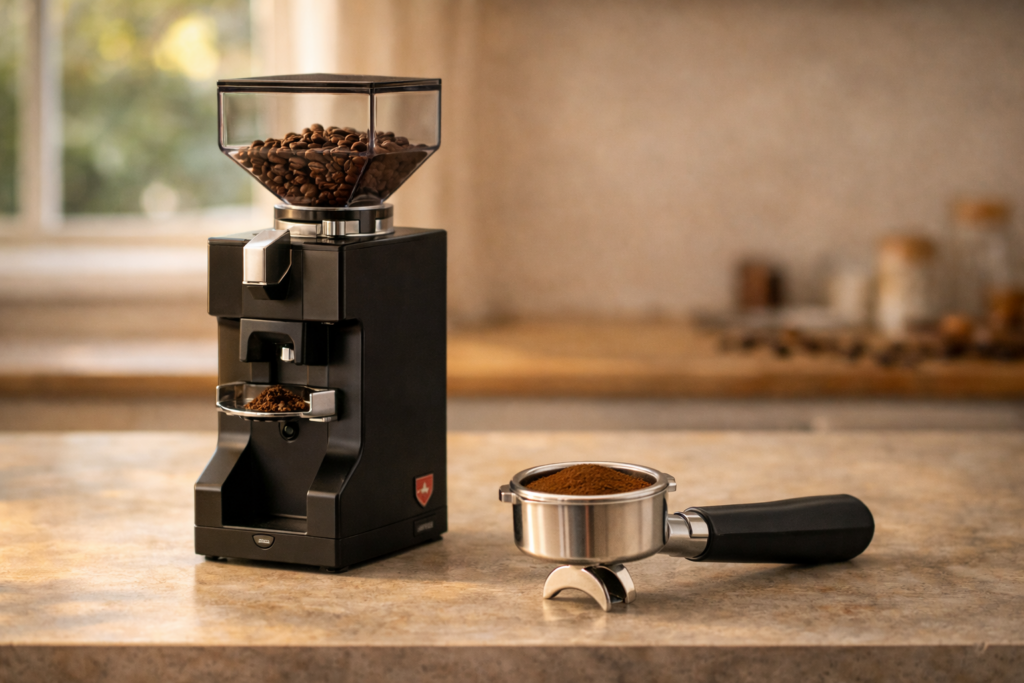
Eureka Mignon Manuale — Best Stepless Mid-Range
Burrs: 50mm flat steel • Adjustment: Stepless micrometric collar • Workflow: On-demand, portafilter cradle • Operation: Manual on-demand activation. The Mignon Manuale is Eureka’s straightforward on-demand espresso model. It uses 50mm hardened-steel flat burrs and Eureka’s stepless micrometric adjustment system, allowing very small grind changes without fixed click positions. The manual activation and compact body keep the workflow simple; this is an espresso-focused grinder rather than a feature-heavy timed-dosing model.
- Stepless micrometric adjustment — make sub-click changes that competition grinders offer
- 50mm flat burrs — suits traditional blends and lighter roasts equally
- Compact and quiet — fits smaller kitchens and apartments
- Trade-off: no numbered dial, so setting reproducibility requires marking/notation
Best for: traditional espresso dialing • small kitchens • quiet-priority households
Disclosure: CoffeeGearHub may earn from qualifying purchases.
💡 Tier 2 buying rule: If your priority is the fastest iterative dial-in workflow and you don’t switch beans often — choose the Sette 270. If you want the classic Italian stepless adjustment feel, or you want something quieter that also suits lighter-roast brewing styles — choose the Eureka Mignon Manuale.
Tier 3: Best Prosumer Espresso Grinders
Prosumer grinders are for people who treat espresso as a hobby — enthusiasts who pull espresso every day, dial in carefully, and notice when something changes. The improvement over Tier 2 is real but more subtle: smoother adjustment feel, higher burr consistency, lower long-term drift, and a build quality that holds up to years of heavy home use with no maintenance drama. The “why did it change today?” frustration gets significantly less common at this tier.
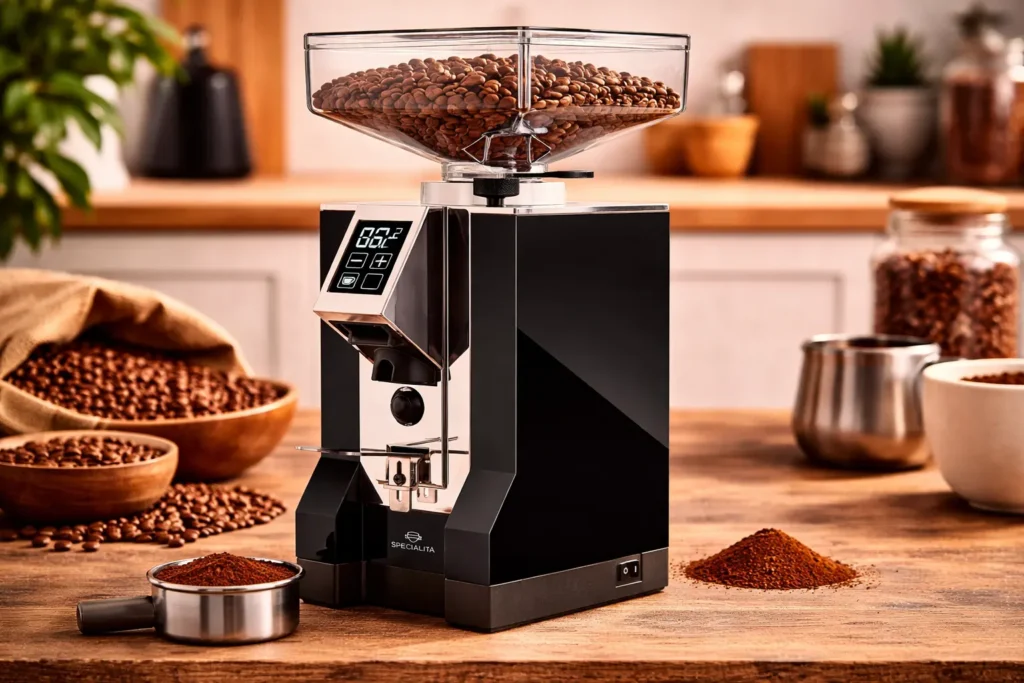
Eureka Mignon Specialita — Best Prosumer Pick
Burrs: 55mm flat steel • Adjustment: Stepless micrometric, programmable timed dosing • Workflow: On-demand, portafilter cradle, digital display • Noise level: Notably quiet for its burr size. The Specialita is widely regarded as the entry point to true prosumer performance. The jump from the Manuale to the Specialita buys you larger 55mm flat burrs (faster, more consistent grinding), a digital dosing timer for repeatable workflow, and a noticeably refined build quality. The noise level is remarkably low for a 55mm flat-burr design. If you want a grinder that matches a mid-range espresso machine like the Breville Barista Express or Rancilio Silvia Pro without the machine becoming the ceiling — this is the right pairing.
- 55mm flat burrs — higher throughput than smaller Mignon burr sets
- Digital dosing timer — repeatable dose without weighing every shot
- Whisper-quiet for flat-burr performance — apartment-friendly
- Trade-off: stepless with no numbered reference — mark your settings manually
Best for: daily serious espresso use • mid-to-high machine pairings • quiet households
Disclosure: CoffeeGearHub may earn from qualifying purchases.
🔬 What the prosumer tier actually buys you
The improvements from Tier 2 → Tier 3 are real but less dramatic than Tier 1 → Tier 2. What you’re paying for:
Larger burrs mean faster grinding, less heat per dose, and tighter particle distribution — especially at fine espresso settings where smaller burrs produce more fines.
Lower grind drift over time — serviceable burrs and adjustment hardware can support more consistent long-term use when maintained properly.
Better retention management — prosumer designs increasingly accommodate single-dose workflows with less purge waste between bean changes.
Who should buy at Tier 3: daily espresso brewers who pull 2+ shots per session, use non-pressurized baskets exclusively, are serious about dialing in, and want a more durable, serviceable grinder for long-term daily use.
Manual Espresso Grinders: The Quiet Value Play
Manual espresso grinders make sense in a specific scenario: you pull 1–2 shots at a time, you value quiet operation (no motor noise at 6am), and you want burr quality that rivals electric grinders at a fraction of the cost. The key requirement is identical to electric: fine enough adjustment steps to actually dial in espresso — which disqualifies most cheap hand grinders. The one pick below that genuinely meets the bar is the 1Zpresso J-Ultra.
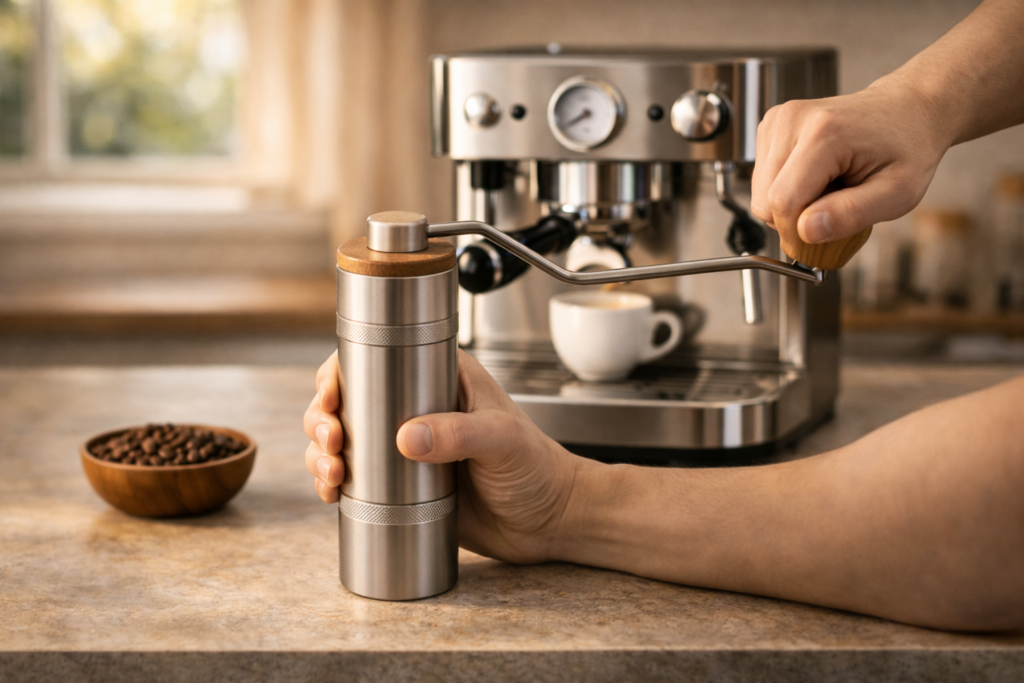
1Zpresso J-Ultra — Best Manual Espresso Grinder
Burrs: 48mm stainless steel conical • Adjustment: 100-click-per-rotation external dial, 8 microns per click • Capacity: 35–40g • Noise level: Near-silent. The J-Ultra is built specifically around espresso-style fine adjustment. Its external dial provides 100 clicks per rotation, with 8-micron burr movement per click according to 1Zpresso. The numbered dial makes settings easy to record and reproduce, while the 48mm coated burr and magnetic catch cup keep the workflow compact. It is a strong fit for low-volume espresso drinkers who value precision, quiet operation, and portability.
- 100-click-per-rotation external dial — finer espresso adjustment than most budget electric grinders
- Near-silent — genuinely apartment-friendly and morning-quiet
- Travel-capable — pairs with portable lever machines or manual espresso makers
- Trade-off: hand grinding adds effort and becomes less convenient as shot volume increases
Best for: 1–2 shots per session • quiet households • travel espresso setups
Disclosure: CoffeeGearHub may earn from qualifying purchases.
Tier Summary: All Picks at a Glance
Use this table to compare all six picks at once. Check current Amazon pricing at each link — prices change frequently.
| Grinder | Tier | Burr size | Adjustment | Best for |
|---|---|---|---|---|
| Baratza Encore ESP | Budget | 40mm conical | Espresso micro-steps | First setup, non-pressurized dialing |
| Breville Smart Grinder Pro | Budget | 40mm conical | 60 stepped positions | Milk drinks, beginner convenience |
| Baratza Sette 270 | Mid-range | 40mm conical | Macro + stepless micro | Fast dial-in, non-pressurized |
| Eureka Mignon Manuale | Mid-range | 50mm flat | Stepless micrometric | Stepless control, manual workflow |
| Eureka Mignon Specialita | Prosumer | 55mm flat | Stepless + digital timer | Daily serious use, premium pairings |
| 1Zpresso J-Ultra | Manual | 48mm conical | 100-click-per-rotation external dial | Silent espresso, 1–2 shots, travel |
How to Choose: Fast Decision Framework
Answer these three questions before buying. Each one eliminates large parts of the field and points you to the right tier and type.
Step 1 — Are you using pressurized or non-pressurized baskets?
Pressurized baskets build their own additional pressure via a small hole in the basket bottom, which makes extraction more forgiving of grind inconsistency. If you’re using a pressurized basket (common in beginner machines like the Breville Bambino), a Tier 1 grinder is adequate while you’re learning. Non-pressurized baskets expose every variable — grind particle size, distribution, dose weight — directly to the 9 bars of espresso pressure. With non-pressurized baskets, grinder quality matters significantly more, and adjustment precision becomes the top priority.
Step 2 — How many shots do you pull, and how often?
| Usage pattern | Recommended path |
|---|---|
| 1–2 shots a few times per week, value quiet operation | Manual: 1Zpresso J-Ultra |
| 1–2 shots daily, building your first setup | Tier 1: Baratza Encore ESP |
| 1–2 shots daily, primarily milk drinks | Tier 1: Breville Smart Grinder Pro |
| 2–4 shots daily, want fast dial-in workflow | Tier 2: Baratza Sette 270 |
| 2–4 shots daily, prefer traditional stepless adjustment | Tier 2: Eureka Mignon Manuale |
| 4+ shots daily, treating espresso as a hobby, long-term investment | Tier 3: Eureka Mignon Specialita |
Step 3 — Do you switch beans often?
If you stick to one espresso blend for weeks at a time, a hopper-style grinder such as the Encore ESP or Eureka Mignon Manuale can be simple and practical. If you rotate beans frequently, prioritize a low-retention workflow: Baratza’s no-chute Sette design is intended to reduce retained grounds, while manual grinders are naturally well suited to single-dose use. In either case, fewer retained grounds can make setting changes and bean swaps easier to evaluate.
🔬 The machine-matching rule: Do not underspecify the grinder relative to the espresso machine. A Breville Barista Express is best paired with at minimum a Tier 2 grinder. A La Marzocco Linea Mini shouldn’t be paired with a Tier 1 grinder — the machine’s capability will be the ceiling long before the machine itself is.
How to Dial In Espresso Grind
Dialing in is the iterative process of finding the grind setting that produces balanced, on-time shots with your specific coffee on your specific machine. The same process works regardless of which grinder you own — only the adjustment increment size changes.
- Set a baseline. Start at medium-fine — somewhere in the middle of the grinder’s espresso range. Load your dose (e.g., 18g), tamp evenly, and pull your first shot. Don’t judge taste yet — just observe timing and flow.
- Measure shot time. Time from first drop of espresso to your target yield (e.g., 36g out). A target range is 25–35 seconds for most espresso recipes. A shot finishing in 10 seconds is running too fast (grind too coarse). A shot taking 50+ seconds or choking entirely is too fine.
- Adjust grind only. Change grind by one small increment — finer if the shot ran too fast, coarser if it ran too slow. Keep dose, tamp pressure, yield, and water temperature constant between adjustments. Changing multiple variables simultaneously makes it impossible to know which one fixed the problem.
- Taste when timing is in range. Once shots are pulling in the 25–35 second window, start tasting. Sour and bright = still slightly under-extracted, go 1 click finer. Bitter, dry, or astringent = slightly over-extracted, go 1 click coarser. Balanced sweetness with clear flavors and a pleasant finish = you’re dialed in.
- Record your setting. Write down the grinder setting that produced your best shot. On numbered click systems (Encore ESP, 1Zpresso J-Ultra), record the exact number. On stepless grinders (Eureka Mignon Manuale, Specialita), mark the dial position with a fine-tipped marker or tape flag. This eliminates the need to re-dial from zero when you next make espresso with the same bean.
💡 New bean dialing tip: Every new bag of coffee will need a fresh dial-in — even from the same roaster and same blend. Roast date, bean density, and batch variation all affect the grind setting needed. Budget 3–5 “calibration shots” when you open a new bag. This is normal, not a sign that something is wrong.
Troubleshooting: Sour, Bitter, Channeling, Gushing
Espresso problems almost always trace back to grind, dose, or distribution — in that order. Work through grind first (it’s the highest-leverage fix), then check dose, then distribution technique. Only suspect the machine if all three are correct and shots are still inconsistent.
| Symptom | What it means | Fix — in this order |
|---|---|---|
| Sour, bright, watery — shot ran fast (<20 sec) | Under-extraction — water moved through too quickly | Grind finer by 1–2 increments → check dose is correct weight → check tamp is level |
| Bitter, dry, astringent — shot ran slow (>40 sec) | Over-extraction — water moved through too slowly | Grind coarser by 1–2 increments → check dose isn’t too heavy → reduce tamp pressure slightly |
| Shot gushes immediately (under 10 sec) | Severely under-extracted — massive channeling or grind far too coarse | Grind significantly finer → check basket is correct size for dose → check tamp seal at basket edge |
| Shot chokes entirely — machine strains, no flow | Grind too fine / dose too heavy / tamped too hard | Grind coarser → reduce dose by 1–2g → ease tamp pressure — never force a choked shot |
| Inconsistent shot times from day to day with the same setting | Retention in grinder mixing old and new grounds / bean freshness variation | Purge 2–3g before grinding your dose → use a low-retention workflow → check bean roast date |
| Shot splits unevenly — one side darker/faster than the other | Channeling from uneven distribution or tamping | Use WDT tool before tamping → ensure tamp is level (use a leveling tamper) → check basket for damage |
| Both sour and bitter simultaneously | Inconsistent particle size — either a blade grinder, worn burrs, or misaligned burrs | If using a blade grinder: upgrade immediately → if burr grinder: check burr alignment and wear |
| Metallic or rancid taste despite fresh beans | Coffee oil buildup in grinder chamber or exit chute | Run grinder cleaning tablets → brush burrs → clean exit chute — dark roasts accelerate buildup |
| Grind setting drifts during a session | Loose adjustment lock / heat expansion / vibration loosening stepless collar | Tighten adjustment lock nut → on stepless: mark position and check between shots |
FAQs: Best Espresso Grinders
Do I really need a burr grinder for espresso?
Yes. Espresso is the most grind-sensitive brew method. It needs fine, consistent particle size with the ability to make tiny, repeatable adjustments. Blade grinders produce wildly uneven particles that make espresso dialing impossible. Even a budget burr grinder dramatically outperforms any blade grinder for espresso.
What’s more important for espresso — the machine or the grinder?
The grinder, for most beginners. Espresso extraction is fast (25–35 seconds) and highly sensitive to grind particle size. The grinder controls how water flows through the puck. A capable grinder on a modest machine consistently produces better results than a premium machine paired with a weak grinder.
What is the difference between stepless and stepped grinder adjustment?
Stepped grinders click between fixed positions. Stepless grinders allow near-infinite adjustment between any two points. Espresso benefits from stepless or micro-stepped designs because the difference between a fast sour shot and a slow bitter shot can be a movement smaller than one full click on a stepped grinder.
Can one grinder handle both espresso and drip coffee?
Yes, but there are trade-offs. Switching from espresso-fine to drip-coarse and back means re-dialing every time — which wastes coffee and time. If you brew both methods regularly, choose an espresso grinder with a wide range and note your settings for each method. Some grinders with numbered adjustments make this much easier than stepless models.
Are manual grinders good enough for espresso?
Yes, if they have fine enough adjustment resolution. The 1Zpresso J-Ultra is the current espresso-focused manual model in this guide. Its external dial provides 100 clicks per rotation and 8-micron burr movement per click, giving it the fine adjustment resolution needed for espresso dialing. Manual espresso grinders are ideal for 1–2 shots at a time, quiet households, and travel setups.
What is the fastest way to fix sour or bitter espresso shots?
Change grind size first — it is the single highest-leverage variable. Sour shots (fast, under-extracted): grind finer by one small increment. Bitter shots (slow, over-extracted): grind coarser by one small increment. Keep dose and yield fixed between adjustments. Make one change at a time.
What is grinder retention and why does it matter for espresso?
Retention is the amount of ground coffee that stays inside the grinder after each dose — trapped in the burr chamber or exit chute. High retention means stale grounds from the previous session mix into your next dose, contaminating flavor and making grind adjustments less predictable. For espresso dialing, low retention (under 0.5g) makes adjustments more responsive because you’re testing your new grind setting, not a blend of old and new.
Should I use pressurized or non-pressurized baskets with a budget grinder?
Pressurized baskets are more forgiving of grind inconsistency and are a good match for budget grinders while you learn. Non-pressurized baskets expose every grind variable — channeling, inconsistent particle size, and imprecise dose — which makes a high-quality grinder with fine adjustment essential. If you’re using non-pressurized baskets, prioritize grinder quality above machine quality.
How important is burr size for an espresso grinder?
Burr size affects grinding speed and heat generation. Larger burrs (50mm+) grind faster and generate less frictional heat for a given dose — both desirable for daily espresso use. Smaller burrs (38–40mm) are slower and more common in compact or budget designs. For home use pulling 1–2 shots at a time, 40mm burrs are adequate. 50mm+ is preferable for daily heavy use.
How do I dial in espresso with a new grinder?
Start at a medium-fine setting as a baseline. Pull a shot at your target dose (e.g., 18g in) and target yield (e.g., 36g out) and time it. A target range is 25–35 seconds for the espresso yield. If it runs fast and tastes sour, grind finer. If it runs slow and tastes bitter, grind coarser. Change grind by one small increment at a time. Keep dose and yield constant.
How often should I clean my espresso grinder?
For a home espresso grinder used daily, brush the exit chute and grind chamber weekly. Run grinder cleaning tablets monthly to absorb oil buildup from dark espresso roasts. Deep-clean the burrs (disassemble, brush, inspect) every 3–6 months. Oil buildup from dark roasts causes rancid off-flavors and can cause the grinder to run slightly coarser over time.
How much should I spend on an espresso grinder?
Match grinder tier to machine tier. A better rule is to make sure the grinder offers the adjustment precision your basket and espresso workflow require. For beginners, the Baratza Encore ESP or Sette 270 are the practical starting points for true espresso dialing. Stepping up to the Eureka Mignon Specialita or equivalent prosumer tier delivers noticeably smoother dialing and build quality for serious daily use.
CoffeeGearHub product shortlist
Compare espresso grinders and machines
Review current CoffeeGearHub catalog pages and verified merchant offers before leaving the site.
Continue Learning
In this guide
- The 30-Second Answer
- What Makes a Grinder Espresso-Capable (Without the Jargon)
- Best Espresso Grinder Picks by Tier
- Tier 1: Best Budget Espresso Grinders
- Tier 2: Best Value Espresso Grinders
- Tier 3: Best Prosumer Espresso Grinders
- Manual Espresso Grinders: The Quiet Value Play
- Tier Summary: All Picks at a Glance
- How to Choose: Fast Decision Framework
- How to Dial In Espresso Grind
- Troubleshooting: Sour, Bitter, Channeling, Gushing
- FAQs: Best Espresso Grinders
- Continue Learning