
Last Updated: March 2026 • 18–22 min read • Complete Guide: Water Science + SCA Targets + Testing + Fixing + Brew-Method Guide + Remineralization + Descaling + Gear Picks + Troubleshooting
Getting water quality for better coffee right is the single most overlooked variable in home brewing — and the one that creates an invisible ceiling on every cup you make. Coffee is 98–99% water. Every aromatic compound, every acid, every sweetness molecule that ends up in your cup had to dissolve through the water to get there. If that water is chlorinated, too hard, too soft, or chemically inconsistent, those properties don’t just affect the water — they directly compete with coffee flavors, interfere with extraction, and produce taste artifacts that no amount of grind adjustment, ratio tweaking, or bean upgrading can fix. This guide covers exactly what good coffee water looks like, how to test what you have, how to fix it, and how requirements vary across every major brew method.
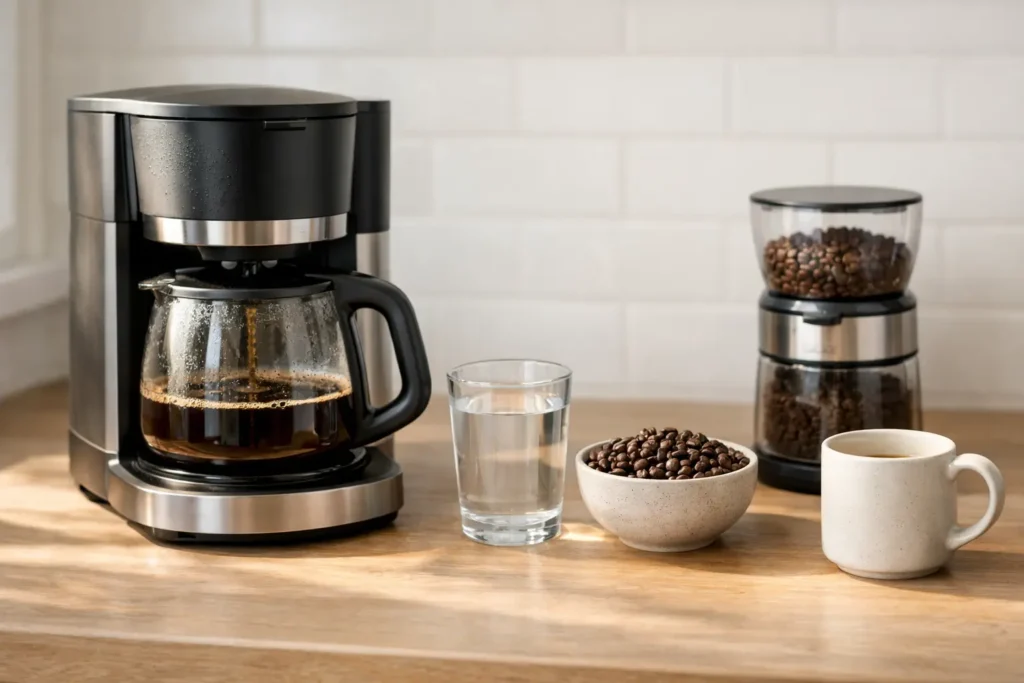
✍️ Editorial note: This guide is written by the editors at CoffeeGearHub using SCA water quality standards, published brewing science, and specialty coffee community knowledge. This guide focuses on practical home-brewing results — not lab chemistry. Affiliate Disclosure: CoffeeGearHub participates in the Amazon Services LLC Associates Program. As an Amazon Associate, we earn from qualifying purchases at no cost to you.
🛒 The four tools that fix almost every water quality problem. Jump straight to our top picks.
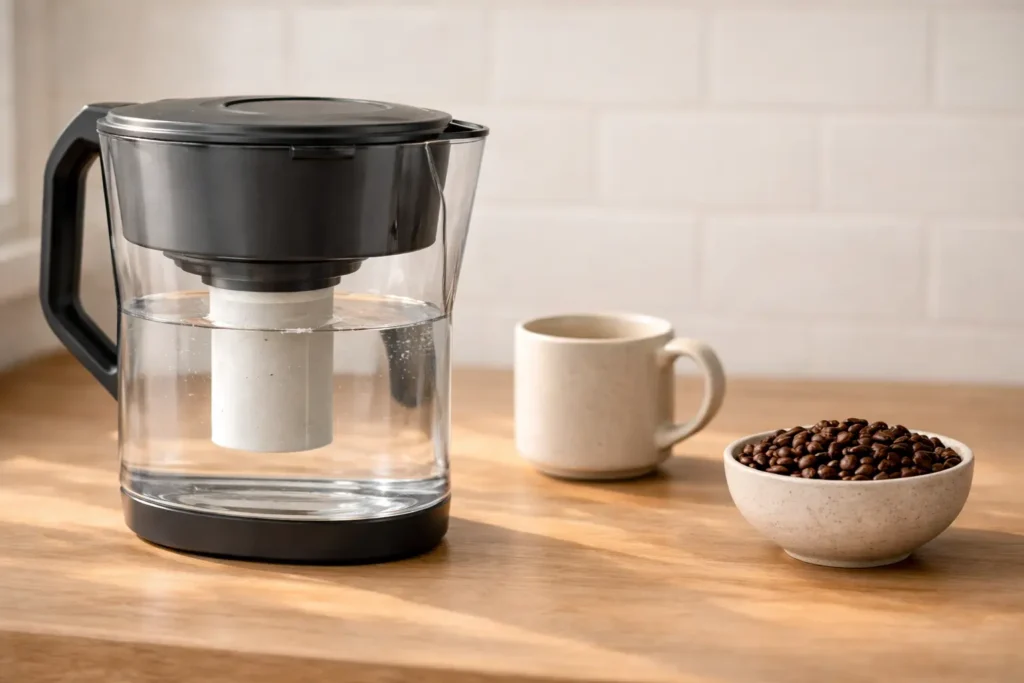
Filter Pitcher
#1 fix for most homes
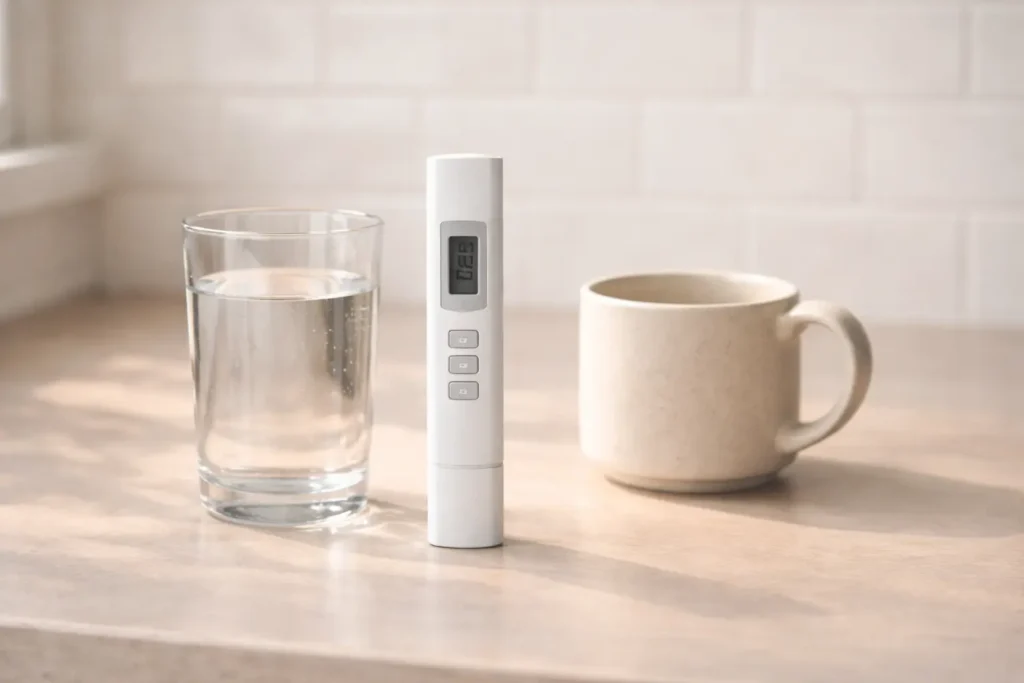
TDS Meter
Know your starting point
Third Wave Water
Perfect water from RO
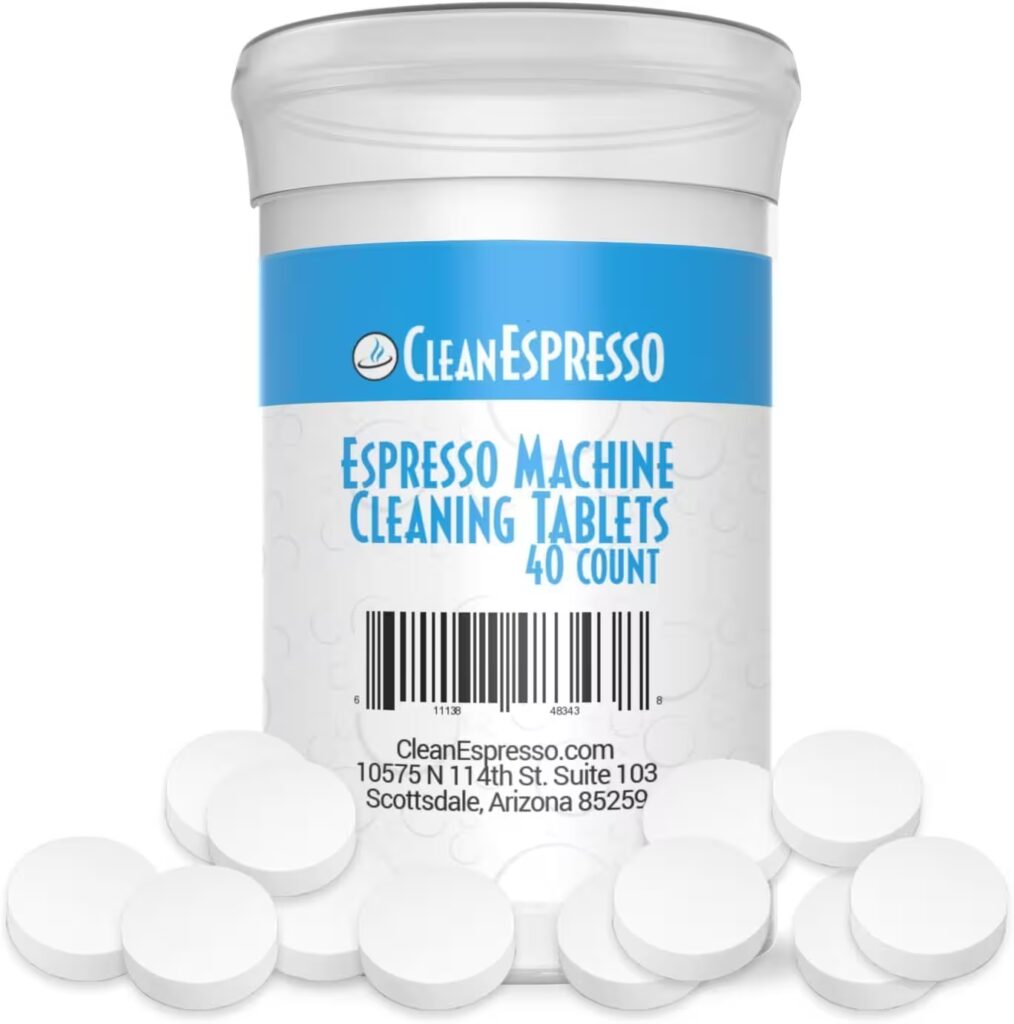
Descaler
Protect your machine
As an Amazon Associate, CoffeeGearHub earns from qualifying purchases. See full gear guide →
Water Quality for Coffee in 60 Seconds
Coffee is 98–99% water, which means water quality is not a finishing touch — it’s a prerequisite for every other variable to work. Three things control whether your water helps or hurts: chlorine (a flavor contaminant to remove), mineral hardness (needed for extraction, harmful in excess), and alkalinity (controls acid balance). Get these into the right range and every other improvement you make to grind, ratio, and technique compounds immediately.
- Chlorinated water: filter first — charcoal filtration removes it immediately
- Hard water (scale in kettle): hardness-reducing filter + regular descaling schedule
- Distilled / RO water: add mineral packets — pure water produces thin, sour, under-extracted coffee
- SCA target: 75–150 ppm TDS, 40–70 ppm hardness, 30–50 ppm alkalinity
- Espresso: strictest requirements — hard water scale kills machines and degrades shots faster than any other method
Jump to What You Need
💧 Water tastes bad or smells like chlorine
Go to Fix Your Water — charcoal filtration is the first and fastest fix, producing immediate flavor improvement with no other changes.
🔬 Not sure what’s wrong with your water
Start with Test Your Water — taste test + TDS meter + hardness strips covers 95% of diagnostic cases in under 5 minutes.
⚙️ Brewing espresso — concerned about scale
Jump to Water by Brew Method — espresso has the strictest water requirements and the highest cost of getting it wrong.
🧪 Using RO or distilled water
Go to Remineralization — pure water produces under-extracted, thin coffee and needs specific minerals added back.
Table of Contents
Why Water Quality Makes or Breaks Coffee
Brewed coffee is approximately 98–99% water by weight. The remaining 1–2% is dissolved solids — the coffee compounds that create flavor, aroma, body, and acidity. Every one of those compounds got into your cup by dissolving through the water. That extraction process is not passive: the water’s mineral content actively determines which compounds extract, how efficiently they extract, and how they interact once dissolved. Chlorine and chloramine from municipal treatment react with coffee compounds to produce chemical, papery off-flavors. Calcium and magnesium ions facilitate extraction by bonding with flavor acids and pulling them into solution. Carbonate alkalinity neutralizes acidity in the final cup — too much and the cup tastes flat, too little and it tastes sharp and harsh.
The practical consequence is that water quality creates an invisible ceiling on flavor quality that grind adjustments, ratio changes, and bean upgrades cannot break through. You can have perfectly fresh beans ground with a professional burr grinder at the ideal ratio — and if your water is heavily chlorinated or extremely hard, the cup will still taste worse than it should. Fixing water quality doesn’t just improve coffee — it makes every other improvement you make more effective.
🔬 The proof test — the most convincing experiment in home brewing: Keep your beans, grind setting, and ratio identical for 3 consecutive brews. Then change only the water source for the next 3 brews. This single-variable test isolates water quality more clearly than any other experiment a home brewer can run. The difference is usually unmistakable — often more dramatic than switching grinder or bean quality.
The Three Water Variables That Control Coffee Flavor
Good coffee water has three properties in balance. Understanding what each one does — specifically and independently — is the foundation of diagnosing and fixing your water.
Variable 1: Chlorine and Chloramine — Flavor Contaminants to Remove
Chlorine and chloramine are disinfectants used in municipal water treatment. Both are effective at killing pathogens. Both are bad for coffee. Chlorine reacts with naturally occurring organic compounds in water to form chlorophenols — compounds with a distinct medicinal, papery taste that mask sweetness and dull the finish. Chloramine (increasingly used by US water utilities because it’s more stable than chlorine) produces similar off-flavors but cannot be removed simply by letting water sit — it requires activated carbon filtration.
⚠️ Chloramine vs chlorine: Many city water systems have switched from chlorine to chloramine in the last decade. Chloramine does not evaporate when water sits overnight (a common folk remedy for chlorine). If your filtered tap water still tastes slightly chemical after sitting, your utility likely uses chloramine — a Brita-style activated carbon pitcher filter removes both effectively.
Variable 2: Hardness — Minerals That Both Help and Harm
Hardness refers to dissolved mineral ions — primarily magnesium (Mg²⁺) and calcium (Ca²⁺). Both are necessary for good coffee extraction. Neither is beneficial in excess.
Magnesium is the most effective mineral for coffee extraction. It selectively enhances the extraction of fruit acids, floral aromatics, and sweetness compounds — the flavors you most want to taste. Research on coffee extraction specifically identifies magnesium as the mineral that most improves cup quality at the right concentrations. Products like Third Wave Water are formulated around magnesium as the primary extraction mineral.
Calcium also facilitates extraction but less selectively than magnesium. It extracts a broader range of compounds including bitter ones. Calcium is also the primary cause of scale buildup: when hard, calcium-rich water is heated, calcium carbonate precipitates out of solution and deposits as white scale inside heating elements, boilers, and water pathways. Too little of either mineral and coffee tastes thin, sour, and hollow — the water simply can’t pull enough from the grounds. Too much and extraction goes too broad, harshness increases, and scale accumulates.
Variable 3: Alkalinity — the Acid Buffer
Alkalinity (measured as bicarbonate or carbonate content) determines how much acid the water can neutralize. Coffee is naturally acidic — fruity acidity is part of what makes great coffee taste bright and complex. Alkalinity controls how much of that acidity survives into the final cup.
High alkalinity neutralizes acidity during brewing, producing flat, dull, heavy cups where brightness and fruit notes are muted. Low alkalinity leaves acidity uncontrolled, producing sharp, harsh cups that feel aggressive rather than bright. The right alkalinity range allows natural fruit acids to come through clean and balanced — present but not harsh.
SCA Water Standards — What the Numbers Actually Mean
The Specialty Coffee Association publishes formal water quality standards as part of its coffee brewing guidelines. These are the numbers the specialty coffee industry uses. For home brewers, the practical goal is staying within the acceptable ranges — not hitting the exact targets, which would require lab-grade water treatment.
| Parameter | SCA Target | Acceptable Range | What happens outside range |
|---|---|---|---|
| TDS (Total Dissolved Solids) | 150 ppm | 75–250 ppm | Below 75: thin and sour. Above 250: chalky and harsh. |
| Hardness (Calcium + Magnesium) | 68 ppm as CaCO₃ | 17–85 ppm | Below 17: hollow extraction. Above 85: increased scale risk and bitterness. |
| Alkalinity (Bicarbonate) | 40 ppm as CaCO₃ | 20–75 ppm | Below 20: harsh and sharp. Above 75: flat and dull. |
| pH | 7.0 | 6.0–8.0 | Below 6: overly acidic. Above 8: flat and soapy. |
| Chlorine / Chloramine | 0 ppm | 0 ppm | Any level: papery, chemical, muted cups. |
| Sodium | <10 ppm | <30 ppm | Above 30: flat and salty-tasting. |
✅ Practical home-brewer interpretation: You don’t need to hit exact SCA targets. You’re trying to avoid extremes. The “good enough zone” for most home setups: TDS 75–150 ppm, hardness 40–70 ppm, alkalinity 30–50 ppm, no detectable chlorine. Filtered tap water in most US cities with average mineral content lands in or close to this range — which is why a basic charcoal pitcher filter solves the problem for most people.
How to Test Your Water (Taste First, Tools Second)
You’re looking for extremes. Most home tap water, even in cities with average mineral content, falls within an acceptable range for coffee once chlorine is removed. Testing confirms whether you have an extreme problem that requires a more targeted fix.
Step 1: Taste Test (Free, Immediate)
Fill a glass and taste your tap water alone. If it smells or tastes of chlorine, has a metallic character, or has any “off” quality, your coffee will carry that same character. A clean-tasting glass of water is the baseline requirement — if water doesn’t taste clean on its own, no coffee technique fixes what it does to the brew.
Step 2: Check for Scale Clues (Visual, Free)
Look at the inside of your kettle, the shower head, and faucet aerators. White or gray mineral deposits mean your water is hard enough to leave calcium carbonate behind when heated — the same thing is happening inside your coffee machine. No visible scale doesn’t guarantee soft water, but significant scale buildup is a reliable signal that hardness is in the range that affects both flavor and machine health.
Step 3: TDS Meter (Optional but Useful)
A TDS (Total Dissolved Solids) meter measures the total concentration of dissolved minerals in water in parts per million. It won’t tell you which minerals — just the total. Readings below 50 ppm suggest soft or RO-style water that may need remineralization. Readings above 200 ppm confirm mineral content high enough to affect flavor and scale buildup. Most average US tap water reads 100–200 ppm.
🔬 A TDS meter is the fastest way to quantify your starting point. Dip it in a glass of tap water and it reads in seconds — no chemistry knowledge required. Under 50 ppm: consider remineralization. 50–200 ppm: likely fine once chlorine is filtered. Over 200 ppm: consider hardness-reducing filtration or a dilution approach.
As an Amazon Associate, CoffeeGearHub earns from qualifying purchases.
Use TDS to track change, not to declare water “good.” A TDS reading is fast and repeatable, which makes it a useful warning light: if your usual water suddenly reads very differently, something changed and it is worth investigating. What it cannot tell you is which minerals changed. Hardness and alkalinity explain more about extraction behavior and scale risk than a single TDS number, so pair the meter with the test strips below when you are troubleshooting scale or protecting an espresso machine.
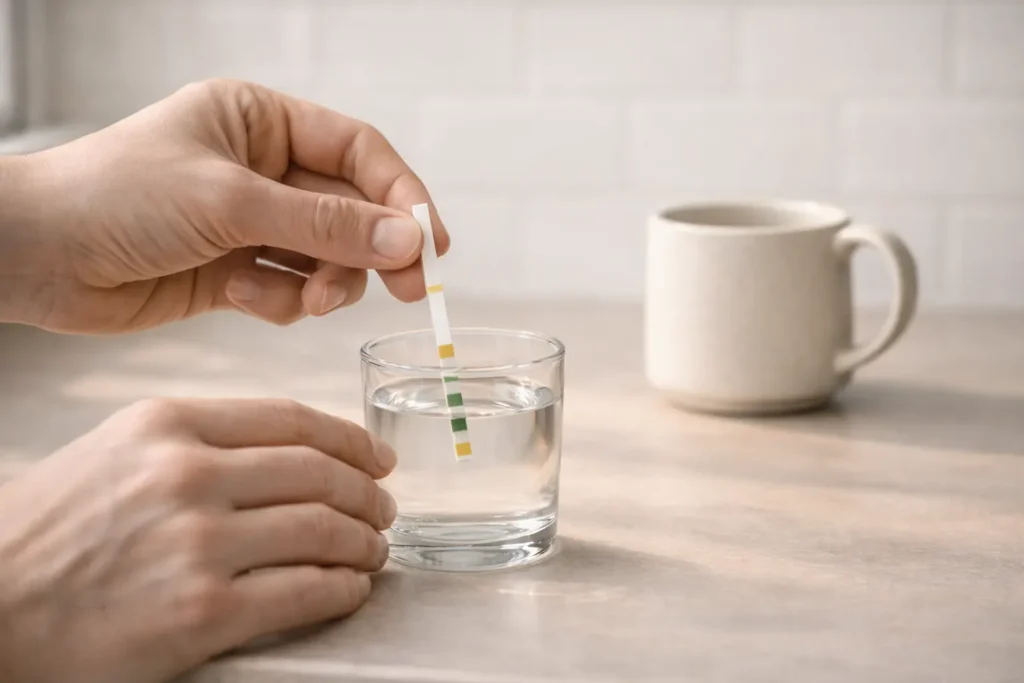
Step 4: Hardness and Alkalinity Test Strips (Optional)
Inexpensive aquarium or water test strips can measure hardness and alkalinity separately — giving you more diagnostic information than a TDS meter alone. These are particularly useful if your TDS reads in the 150–250 ppm range and you want to know whether the mineral content is mostly hardness (calcium/magnesium) or mostly alkalinity (bicarbonate). The fix for each is different.
Diagnose by Taste (Quick Grid)
| Coffee tastes like… | Water is likely… | Best first fix |
|---|---|---|
| Flat / muted even with fresh beans | Chlorinated or inconsistent source | Charcoal filter — use the same filtered source consistently |
| Harsh / chalky bitterness at finish | Very hard (high calcium/TDS) | Hardness-reducing filter + regular descaling |
| Thin and sour / hollow body | Too soft, RO, or distilled only | Remineralize with mineral packets |
| Sharp and aggressive acidity | Low alkalinity / too acidic | Spring water or add buffering via remineralization |
| Results vary day to day | Variable tap blending or inconsistent source | Filter water and use the same source every brew |
Fix Your Water — Pick the Right Path
Match the fix to your specific problem. Most home brewers only need one change to see a clear improvement. Start with the simplest fix that addresses your diagnosed issue before considering more complex solutions.
Option 1: Charcoal Filtration — the Fix for Most Homes
A charcoal (activated carbon) pitcher filter removes chlorine and chloramine, reduces some heavy metals, and often slightly reduces hardness. For the vast majority of home brewers with average municipal tap water, this single change produces an immediately noticeable improvement in coffee flavor — more sweetness, less papery character, cleaner finish. A Brita-style pitcher filter is the lowest-friction, highest-impact first step.
✅ Start here: a charcoal water filter pitcher is the single most impactful upgrade most home brewers can make. It removes chlorine and chloramine immediately, costs less than a bag of specialty beans, and makes a difference you can taste in the first cup.
As an Amazon Associate, CoffeeGearHub earns from qualifying purchases.
Option 2: Hardness-Reducing Filtration (for Very Hard Water)
If your water reads above 150–200 ppm TDS or you see significant scale, a standard charcoal filter will not reduce hardness enough. Filters specifically designed for hardness reduction use ion exchange resin to replace calcium and magnesium ions with sodium — effectively softening the water. Note that water softeners using sodium can push sodium content above 30 ppm, which slightly flattens coffee flavor. For espresso machines in particular, some hardness reduction is essential for machine longevity even if the flavor impact alone doesn’t justify it.
Option 3: Reverse Osmosis + Remineralization (for Maximum Control)
A reverse osmosis system removes virtually everything from water — producing near-zero TDS output that, used alone, produces thin, sour, under-extracted coffee. Combined with mineral packets to remineralize, RO water becomes the most controllable, consistent brewing water available. This is the approach used by many specialty cafés and serious home brewers who want complete control over their water chemistry. See the Remineralization section for product details.
Water Options Compared
| Water option | Best for | Pros | Cons | Cost |
|---|---|---|---|---|
| Charcoal-filtered tap ✓ Start here | Most drip and pour-over homes | Easy; affordable; immediate flavor improvement; removes chlorine and chloramine | Does not reduce hardness; may not be enough for very hard water | Low (pitcher + filter) |
| Hardness-reducing filter | Hard water areas with visible scale | Reduces scale risk significantly; protects espresso machines | Some sodium exchange; higher upfront cost than basic pitcher | Medium |
| Bottled spring water | Quick baseline test; travel | Sometimes consistent mineral profile; no filtration needed | Mineral content varies by brand; cost adds up for daily brewing | Medium to high ongoing |
| RO water only | Avoid as daily coffee water | Low scale risk; very clean | Thin, sour extraction without minerals; under-extracted flavor | Low per litre (after system cost) |
| RO + mineral packets | Maximum control; espresso dialling-in; specialty brewing | Fully controllable; consistent every brew; ideal mineral profile | Extra step per brew; requires RO system or distilled water source | Medium (packets add up) |
Water Requirements by Brew Method
Not all brew methods are equally sensitive to water quality. The differences are real, meaningful, and have practical consequences — particularly for espresso, where hard water causes machine damage as well as flavor degradation. Understanding how your specific method interacts with water quality helps you prioritise the right fix.
| Brew method | TDS sweet spot | Hardness tolerance | Scale risk | Primary concern |
|---|---|---|---|---|
| Drip (automatic) | 75–175 ppm | 40–85 ppm | Moderate — heating element and basket | Consistency: same filtered source every brew |
| Pour-over | 75–150 ppm | 40–70 ppm | Low — no internal machine to protect | Clarity: chlorine removal makes the biggest difference |
| Espresso | 75–125 ppm | 40–60 ppm ⚠ | High — boiler, group head, solenoid valve | Machine protection: hard water scale is the #1 cause of espresso machine failure |
| AeroPress | 75–200 ppm | 40–100 ppm | None — no heating element | Forgiving: immersion brewing compensates for minor mineral variation |
| French press | 75–200 ppm | 40–100 ppm | None — no internal components to protect | Most forgiving of all methods — focus on chlorine removal first |
| Moka pot | 75–150 ppm | 40–70 ppm | Moderate — pressurised chamber and valve | Chlorine removal + light descaling schedule |
Espresso — The Strictest Water Requirements
Espresso machines heat water to high temperatures inside enclosed metal components — boilers, heat exchangers, and group heads — and force it through coffee under 9 bars of pressure. This combination accelerates scale formation dramatically compared to drip or pour-over brewing. A thin layer of calcium carbonate scale on a heating element significantly reduces thermal efficiency. Scale in a group head restricts water flow and creates temperature instability. Scale in solenoid valves causes them to fail. Machine repairs from scale damage are frequently more expensive than years of preventative descaling.
For espresso, water hardness above 80 ppm is a machine health concern, not just a flavor concern. If you have hard water and an espresso machine, a hardness-reducing filter specific to espresso machines — or the RO + remineralization approach — is not optional maintenance. It is the difference between a machine that lasts a decade and one that needs expensive service every two years.
⚠️ Most espresso machine warranties include a clause allowing the manufacturer to void the warranty if scale damage is found. Regular descaling is not just a flavor recommendation — it is a warranty requirement and a machine longevity requirement. See the Descaling section for schedules and product recommendations.
Pour-Over — Clarity and Consistency
Pour-over brewing is sensitive to water quality at the flavor level but has no machine to protect. The primary concern is clarity — paper filters already produce a clean cup, and chlorinated water adds chemical character that competes with the clean, bright notes that make pour-over distinctive. A charcoal filter and a consistent water source are usually sufficient for excellent pour-over results. Water that tests in the 75–150 ppm TDS range will work well; above 200 ppm you may notice a slight heaviness or hardness to the finish.
Drip Coffee — Consistency Matters Most
Drip machines are moderately sensitive to water quality at both the flavor and machine levels. The heating element builds up scale over time, affecting brew temperature consistency. The basket and carafe accumulate oils and mineral residue that dull flavor if not cleaned regularly. For drip, the most important water practices are consistent filtration (same water source every day) and a regular descaling schedule — every 1–3 months in hard water areas, every 3–6 months with filtered water.
AeroPress and French Press — Most Forgiving
Both AeroPress and French press are immersion brewers with no internal components to protect from scale — making them the most forgiving brew methods for water quality. Full immersion brewing also partially compensates for mineral variation, since the longer contact time gives extraction more latitude. That said, heavily chlorinated water will still taste chemical through either method. Start with chlorine removal and work from there; you’re unlikely to need more sophisticated water treatment for these methods unless you’re actively dialling in competition recipes.
Remineralization — When Pure Water Isn’t Enough
If you use reverse osmosis or distilled water, you already know that extremely pure water produces thin, sour, under-extracted coffee. This is not a brewing technique problem — it’s a chemistry problem. Coffee needs specific minerals dissolved in the water to extract sweetness, body, and acidity correctly. Without them, the water simply can’t pull enough from the grounds. Remineralization means adding a precise, predetermined mineral blend to pure water to create an ideal extraction profile.
Check your machine before switching to pure water. Some coffee and espresso machines rely on water conductivity to sense water levels, and some manufacturers advise against untreated distilled or very low-mineral RO water. Read your machine’s manual before making either a routine choice — and if you use pure water, remineralize it with a documented recipe or a purpose-made product rather than adding minerals by guesswork.
The most practical remineralization approach for home brewers is mineral packets — pre-measured sachets containing the correct mineral blend that dissolve completely into a given volume of water. The two most widely used products in the specialty coffee community are Third Wave Water and Barista Hustle Water. Both are formulated specifically for coffee, with magnesium as the primary extraction mineral. Both produce water in the SCA target range without any calculation or measuring on your part.
🧪 Third Wave Water is the simplest remineralization solution for home brewers. One packet dissolves into one gallon of distilled or RO water, producing water that tests within SCA target ranges for TDS, hardness, and alkalinity. Available in Classic Profile (all-purpose), Espresso Profile (softer, lower hardness for machine protection), and Light Roast Profile (optimised for bright light-roast extraction). No measuring, no chemistry knowledge required.
As an Amazon Associate, CoffeeGearHub earns from qualifying purchases.
Which Profile to Choose
| Profile | Best for | Approximate TDS after mixing |
|---|---|---|
| Classic Profile | Drip, pour-over, AeroPress, French press — general filter coffee | ~150 ppm |
| Espresso Profile | Espresso machines — lower hardness reduces scale buildup | ~100–120 ppm |
| Light Roast Profile | Light roast single-origins — higher magnesium ratio for fruity extraction | ~120–140 ppm |
Note on DIY remineralization: An alternative to mineral packets is adding food-grade Epsom salt (magnesium sulfate) and baking soda (sodium bicarbonate) to distilled water in carefully measured amounts. This approach is popular in the specialty coffee community and works well, but requires precise measurement and some chemistry knowledge to get right. For most home brewers, mineral packets are the more practical starting point.
Descaling — the Long-Term Consequence of Hard Water
Scale (calcium carbonate deposits) forms whenever hard water is heated. In coffee machines, every brew cycle deposits a tiny amount of scale on heating elements, in boilers, and through water pathways. Over months, these invisible deposits accumulate into a meaningful layer that has real, measurable consequences for flavor and machine function.
Scale on a heating element reduces its efficiency — the element has to work harder to reach target temperature, resulting in inconsistent brew temperature across a session. Scale in water pathways restricts flow, affecting brew time and extraction rate. Scale in espresso machine boilers and group heads causes pressure instability, flow restriction, and eventually component failure. Beyond machine health, scale also contributes mineral compounds to the brew water that push flavor toward chalky bitterness — a flavor degradation that is gradual and easy to normalise until a descaled machine reveals how much flavor was being masked.
Recommended Descaling Schedule
| Machine type | Hard water area (>150 ppm TDS) | Average / filtered water | Soft water or RO (<75 ppm TDS) |
|---|---|---|---|
| Espresso machine | Every 1–2 months | Every 2–3 months | Every 3–4 months |
| Automatic drip machine | Every 1–3 months | Every 3–4 months | Every 4–6 months |
| Electric kettle | Every 1–2 months | Every 2–4 months | Every 4–6 months |
| Moka pot | Every 2–3 months | Every 3–6 months | Every 6 months |
⚠️ Regular descaling is the single most neglected maintenance task in home coffee brewing — and the one with the biggest long-term consequence. A quality descaling tablet or liquid used on a regular schedule is significantly cheaper than any espresso machine or drip machine repair. If your machine has an indicator light, don’t ignore it — it’s measuring actual brew cycles against a scale buildup model.
As an Amazon Associate, CoffeeGearHub earns from qualifying purchases.
For a step-by-step descaling process for espresso machines, see How to Descale an Espresso Machine.
Gear Picks: What CoffeeGearHub Recommends for Water Quality
Disclosure: CoffeeGearHub may earn a commission on qualifying purchases through affiliate links on this page, at no cost to you. CoffeeGearHub.com participates in the Amazon Services LLC Associates Program. As an Amazon Associate, we earn from qualifying purchases.
🛒 New to Amazon? Try Prime free for fast, free shipping on every pick in this guide — or try Audible free if you’d rather listen while your coffee brews.
🛒 New to Amazon? Try Prime free for fast, free shipping on every pick in this guide — or try Audible free if you’d rather listen while your coffee brews.
🏆 Best First Upgrade: Water Filter Pitcher
Best for: anyone using municipal tap water who wants an immediate, measurable improvement in coffee flavor
A charcoal filter pitcher is the highest-impact, lowest-friction water upgrade for home coffee brewing. It removes chlorine and chloramine — the two most common flavor contaminants in municipal water — while retaining the mineral content needed for good extraction. The difference is usually tasted in the first cup: more sweetness, less papery character, cleaner finish. Keep a filled pitcher in the fridge and use it as your only water source for brewing to also eliminate day-to-day inconsistency from variable tap quality.
- What it removes: chlorine, chloramine, some heavy metals, some sediment
- What it keeps: calcium, magnesium, and other minerals needed for extraction
- Limitation: does not significantly reduce hardness — if your TDS is above 200 ppm, consider a hardness-specific filter as well
Disclosure: CoffeeGearHub may earn from qualifying purchases.
Know Your Starting Point: Digital TDS Meter
A TDS meter gives you an immediate, objective reading of total dissolved solids in your water — the number that tells you whether you’re in the ideal extraction range (75–150 ppm), too soft (below 50 ppm), or too mineral-heavy (above 200 ppm). Dip the probe, read the number in seconds. No chemistry knowledge required. Particularly useful for verifying that your filter is actually working — measuring tap water before and after filtration shows you exactly what the filter removed.
- Measures: total dissolved solids in ppm (parts per million)
- Also useful for: checking that RO + mineral packets produced the target TDS; verifying filter effectiveness over time
- Limitation: measures total solids, not which minerals — pair with test strips for a complete picture
Disclosure: CoffeeGearHub may earn from qualifying purchases.
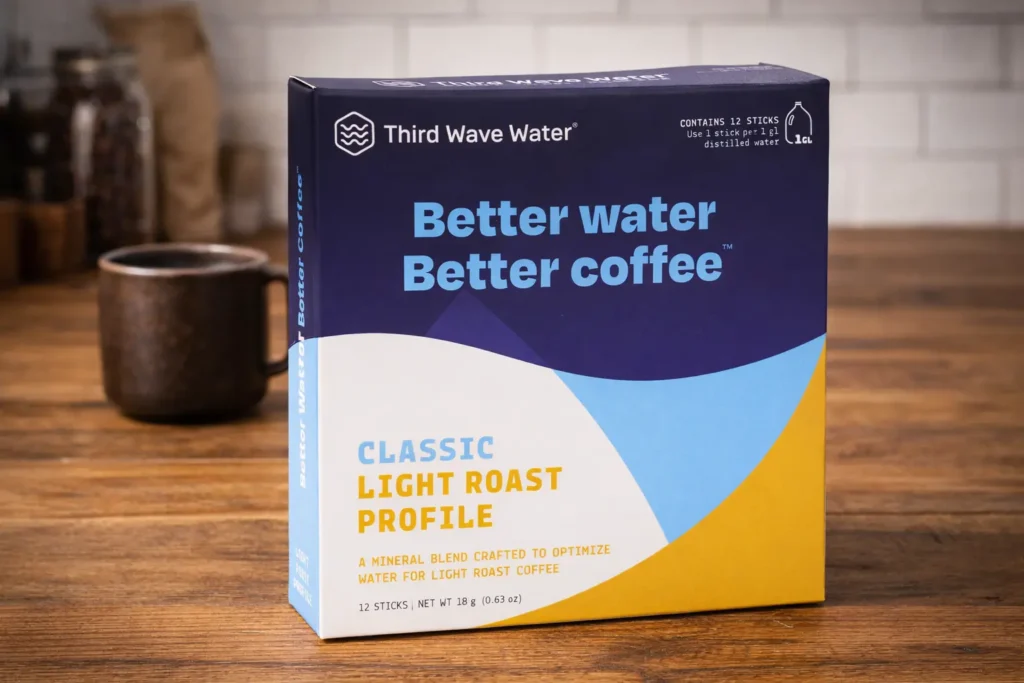
Maximum Control: Third Wave Water Mineral Packets
Third Wave Water is the most popular remineralization product in the specialty coffee community. Pre-measured mineral packets dissolve into one gallon of distilled or RO water, producing water that hits SCA target ranges for TDS, hardness, and alkalinity without any calculation. The Espresso Profile is specifically formulated with lower hardness to reduce scale formation inside espresso machine boilers and group heads. The Classic Profile covers drip, pour-over, AeroPress, and French press. The Light Roast Profile is optimised for higher magnesium content to enhance bright, fruit-forward extraction from lighter roasts.
- Who needs it: brewers using RO or distilled water; espresso brewers in hard water areas who want to control scale precisely
- Three profiles: Classic (all-purpose), Espresso (machine-safe), Light Roast (high-magnesium for bright extraction)
- How to use: one packet per gallon of distilled or RO water; stir until fully dissolved
Disclosure: CoffeeGearHub may earn from qualifying purchases.
Protect Your Machine: Descaler and Coffee Equipment Cleaner
Regular descaling is the most neglected maintenance task in home coffee brewing and the one with the most significant long-term consequences. A quality descaling agent dissolves calcium carbonate deposits from heating elements, boilers, and internal water pathways — restoring brew temperature consistency, water flow, and removing the subtle mineral bitterness that scale contributes to the cup over time. Use a descaler specifically formulated for coffee machines rather than household vinegar, which can leave residue and doesn’t dissolve scale as effectively at the concentrations typically used.
- What it removes: calcium carbonate scale deposits from all internal components
- Compatible with: drip coffee makers, espresso machines, kettles, moka pots
- How often: follow the schedule in the table above based on your water hardness
Disclosure: CoffeeGearHub may earn from qualifying purchases.
Troubleshooting Matrix: Water Problems Diagnosed
Find your symptom in the first column. Apply fixes in order — the first fix resolves the problem in the majority of cases. Change one variable at a time to confirm what actually improved the cup.
| Symptom | Water cause | Fix — in order |
|---|---|---|
| Flat / muted / papery even with fresh beans | Chlorinated or chloraminated water | Start with a charcoal filter pitcher — removes both chlorine and chloramine immediately. This single fix resolves the majority of “flat coffee” complaints. |
| Harsh chalky bitterness at finish (grind is correct) | Very hard water (high TDS, high calcium) | Measure TDS with a TDS meter to confirm. Above 200 ppm: switch to hardness-reducing filtration or RO + mineral packets. |
| Thin, hollow, sour body (not a grind problem) | Water too soft, RO, or distilled only | Add Third Wave Water mineral packets to RO or distilled water. One packet per gallon restores the mineral profile needed for full extraction. |
| Sharp, aggressive acidity — not bright, just harsh | Low alkalinity / very acidic water | Try spring water (Volvic is well-regarded) or RO + remineralization to add bicarbonate buffering. Hardness test strips confirm alkalinity level. |
| Coffee tastes different every day at the same recipe | Variable tap water quality or seasonal municipal changes | Filter water consistently with a pitcher and use filtered water as your only brewing source. Municipal water chemistry changes seasonally in many cities — consistent filtration removes this variable. |
| Coffee gradually getting worse over weeks | Scale building up inside machine | Run a descaling cycle immediately. This is the most common cause of gradual flavor degradation that brewers mistake for bean quality issues. |
| Machine running slowly / taking longer to brew | Scale blocking water pathways | Descale immediately with a coffee machine descaler. Restricted flow is a more advanced stage of scale buildup — run two descaling cycles if the first doesn’t fully restore flow. |
| Espresso machine temperature instability / inconsistent shots | Scale on heating element or inside boiler | Descale urgently — temperature instability is a sign of significant scale accumulation on heating elements. Prevent recurrence by switching to RO + Espresso Profile mineral packets. |
Final Takeaway
Water quality is the prerequisite that makes everything else in coffee work better. A charcoal filter pitcher removes the most common flavor contaminants in municipal water for less than the cost of a specialty bag of beans. A TDS meter tells you exactly where your water sits relative to SCA targets in seconds. Third Wave Water mineral packets give you complete control over water chemistry if you use RO or distilled water. A regular descaling schedule protects your machine investment and prevents the gradual flavor degradation that accumulates invisibly with every brew cycle.
Fix water first. Then upgrade your grinder. Then dial in grind size and ratio. Every other improvement you make compounds faster and more reliably once water quality is no longer the invisible ceiling holding everything back. Pair this guide with How to Dial In Coffee and Drip Coffee Ratio to build a complete brewing system where every variable is working with you instead of against you.
FAQs: Water Quality for Better Coffee
Does water quality really make a difference in coffee?
Yes — significantly. Brewed coffee is 98–99% water. Every flavor compound in the cup dissolved through that water during extraction. Chlorine produces papery off-flavors. Extreme hardness adds mineral bitterness and builds scale. Very soft water under-extracts, producing thin and sour cups. Great beans and perfect grind technique will underperform in bad water every time.
What is the best water to use for coffee at home?
For most home brewers, filtered tap water is the best practical choice — it removes chlorine and chloramine while retaining the minerals needed for good extraction. A charcoal filter pitcher handles this immediately and costs less than a specialty bag of coffee beans.
What TDS level is best for coffee?
The SCA recommends 150 ppm TDS as the target, with 75–250 ppm as the acceptable range. For practical home brewing, 75–150 ppm is the sweet spot — enough mineral content for balanced extraction without the scale risk of higher concentrations. A TDS meter tells you exactly where your water sits in seconds.
Can I use distilled or reverse osmosis water for coffee?
Not by itself. Distilled and RO water contain virtually no minerals, which means extraction is incomplete — producing thin, sour, hollow cups. If you use an RO system, add mineral packets like Third Wave Water to restore the specific mineral profile needed for balanced extraction. One packet per gallon of RO water is all it takes.
How do I know if my water is too hard for coffee?
Visual evidence: white scale deposits in your kettle, on faucet aerators, or inside your coffee machine. Measurement: a TDS meter reading above 200 ppm, or hardness test strips showing above 100 ppm hardness. Both the flavor (chalky bitterness) and machine health (scale damage) become meaningful concerns above 150 ppm hardness.
Does hard water damage my coffee machine?
Yes. Calcium carbonate scale from hard water deposits on heating elements, inside boilers, and through water pathways. This reduces heating efficiency, restricts water flow, causes temperature instability, and shortens machine life. For espresso machines in particular, many warranties are voided by scale damage. A regular descaling schedule is not optional maintenance — it’s the difference between a machine that lasts a decade and one that needs expensive repair within two years.
How often should I descale my coffee machine?
In hard water areas (above 150 ppm TDS): every 1–2 months for espresso machines, every 1–3 months for drip machines. With filtered or average water: every 2–3 months for espresso, every 3–4 months for drip. With RO or very soft water: every 3–4 months for espresso, every 4–6 months for drip. Don’t ignore your machine’s indicator light — and use a coffee-specific descaler rather than vinegar for best results.
Is bottled spring water good for coffee?
It depends on the brand’s mineral profile. Volvic is frequently cited in the specialty coffee community as close to ideal (around 130 ppm TDS with a good magnesium-to-calcium balance). Evian is too hard for most brewing. Dasani and Aquafina are filtered municipal water with no advantage over good filtered tap water. For daily brewing, a filter pitcher is more economical and equally effective.
What is remineralization and do I need it?
Remineralization means adding specific minerals back to ultra-pure water (RO or distilled) to create an ideal coffee brewing profile. You need it if you use RO or distilled water — without remineralization, that water will produce thin, sour, under-extracted coffee. Third Wave Water mineral packets are the simplest solution: one packet per gallon, dissolved completely, produces water in the SCA target range immediately.
Should I fix my water before upgrading my grinder?
Fix water first. A charcoal filter pitcher costs a fraction of any grinder upgrade and removes a flavor ceiling that no grinder can compensate for. Once water quality is consistent, every improvement you make to grind, ratio, and technique is amplified rather than muted. When you’re ready for the grinder upgrade, a burr grinder on filtered water will outperform a blade grinder on unfiltered water every single time.
Continue Building Your Brew System
FIX YOUR BREW VARIABLES
Water quality sorted — now ready to dial in grind and ratio? The complete dial-in guide covers every brew method with starting recipes, troubleshooting tables, and the gear that makes every adjustment repeatable. It’s the logical next step once water is no longer the limiting variable.
💧
Written by the CoffeeGearHub Editorial Team
CoffeeGearHub is a specialty coffee equipment and brewing resource written by home brewers and coffee enthusiasts. Our guides use SCA water quality standards, published brewing science, and practical brewing guidance across drip, pour-over, espresso, and immersion methods. We update our content regularly as products and standards evolve. About CoffeeGearHub →