
Last Updated: March 2026 • 30–40 min read • Cornerstone Guide: Cold Brew Bean Selection + Roast Science + Grind Settings + Ratio System + Troubleshooting
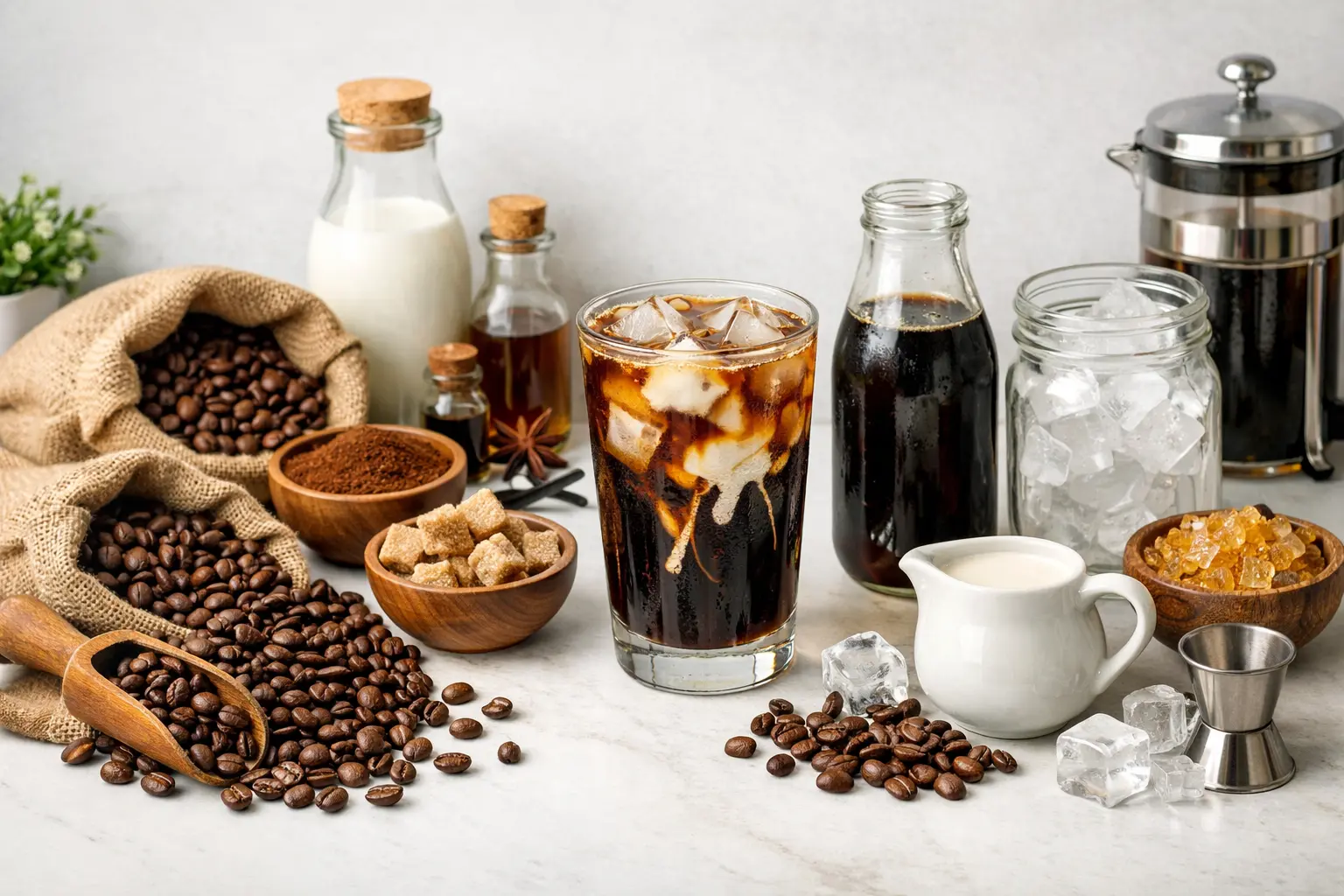
The best coffee beans for cold brew are not the most expensive, the most exotic, or the darkest on the shelf. Cold brew is a fundamentally different extraction process from any hot brewing method — cold water over 12–18 hours pulls flavor compounds in a different order, at a different rate, and with a different final profile than hot water over 3–4 minutes. Beans that are extraordinary in a V60 can taste flat and underdeveloped in cold brew. Beans that taste harsh in a hot drip machine can taste smooth, sweet, and rich when steeped cold. Understanding why this happens — and which bean characteristics cold water actually rewards — is the difference between great cold brew every time and a batch that turns out wrong with no obvious reason. This complete CoffeeGearHub guide covers everything: what cold extraction actually does to flavor, how to match roast level and origin to your cold brew style, the full grind and ratio system with KINGrinder K6 click references, our verified top picks across every cold brew use case, and a troubleshooting matrix for every common cold brew problem.
✍️ Editorial note: This guide is researched and written by the editors at CoffeeGearHub.com using published brewing science, SCA Brewing Standards, cold extraction research, and established specialty-coffee community knowledge. All product links are affiliate links — we may earn a commission at no cost to you. Affiliate Disclosure: CoffeeGearHub.com participates in the Amazon Services LLC Associates Program. As an Amazon Associate, we earn from qualifying purchases.
🛒 New to Amazon? Try Prime free for fast, free shipping on every pick in this guide — or try Audible free if you’d rather listen while your coffee brews.
🛒 New to Amazon? Try Prime free for fast, free shipping on every pick in this guide — or try Audible free if you’d rather listen while your coffee brews.
The 30-Second Answer
For most cold brew drinkers, a medium roast with chocolate and caramel notes is the correct starting point — it is sweet, forgiving to extract, and produces a smooth cup whether you drink it black over ice or diluted with milk. If you primarily make iced lattes or cream-based drinks, move toward medium-dark. If you want complex, bright cold brew, try a medium-light Ethiopian or Colombian with a tighter ratio and longer steep. The bean matters — but grind size and ratio matter equally. Extra-coarse grind, 1:8 ratio for ready-to-drink or 1:4 for concentrate, and 12–18 hours in the refrigerator is the repeatable baseline that makes any quality medium roast taste excellent.
- Best Overall (Black Cold Brew): Bizzy Organic Smooth & Sweet — medium roast, sweet and clean, beginner-proof
- Best Bold / Low-Acid: Stone Street Cold Brew (Colombian) — dark roast, smooth, strong, and designed specifically for cold extraction
- Best for Iced Lattes: Lavazza Super Crema — medium-dark blend, creamy concentrate base that holds up through milk
- Best Specialty-Style: Stumptown Hair Bender — medium roast, complex without being challenging, excellent black over ice
- Best Value: Kicking Horse (medium roast) — organic, rich chocolate and brown sugar, competitive price per batch
- What to avoid: Any blade-ground or pre-ground drip coffee — the medium grind is too fine for cold brew, producing bitter, muddy concentrate that no steep-time adjustment can fix
Who This Guide Is For — Jump to What You Need
☕ First Cold Brew Batch
Start with Why Bean Choice Matters in Cold Brew, then jump to Top Picks for the fastest decision.
🧊 Style Matcher
Jump to Roast by Cold Brew Style — black, iced latte, or concentrate system all covered.
🔧 Troubleshooter
Jump directly to the Troubleshooting Matrix — bitter, weak, muddy, sour, and flat fixes all in one place.
📐 Dialler
See the Grind & Ratio Reference Table for K6 click settings, steep times, and ratio recommendations by roast and style.
Table of Contents
Why Bean Choice Matters More in Cold Brew Than in Most Hot Methods
Cold brew is often described as forgiving — and it is, in one sense: the long, slow extraction is more tolerant of minor grind inconsistencies and timing variations than a 3-minute pour-over. But cold brew is profoundly unforgiving of the wrong bean. This is because cold water extraction is selective in ways that hot water is not. Hot water at 90–96°C extracts a broad spectrum of flavor compounds rapidly — acids, sugars, aromatics, and bitter phenolics all in a few minutes. Cold water over 12–18 hours extracts that same spectrum more slowly and less completely, but with one critical difference: it preferentially extracts sweetness, body, and lower-volatility compounds while leaving some of the brighter, high-volatility aromatics behind. This means cold brew amplifies the characteristics of the underlying bean that hot water would extract along with everything else — sweetness, chocolate, nuttiness, and body become more prominent; delicate floral notes and bright acidity become less so.
The practical implication for bean selection: choose beans whose most prominent characteristics are the ones cold extraction amplifies — and avoid beans whose primary value is high-volatility aromatics that cold water cannot fully access. Ethiopian light roast with jasmine and bergamot notes tastes extraordinary in a V60 because hot water extracts those volatiles at their peak. In cold brew, those same notes are muted and what remains is a thinner, less complex cup than a medium roast Colombian would produce at the same parameters. For more on how extraction temperature affects flavor compounds, see our Coffee Extraction Science guide.
🔬 The freshness factor in cold brew: Cold brew hides some freshness flaws better than hot methods — the long steep can extract reasonable body from beans that are 4–6 weeks post-roast when a V60 with the same beans would taste flat. However, very stale beans still produce flat, musty cold brew that no ratio or steep-time adjustment can rescue. Buy beans with a roast date on the bag and aim for under 4 weeks from roast for best results. For cold brew concentrate you plan to drink over 7 days, fresher beans also mean the concentrate stays better-tasting for longer in the refrigerator.
What Cold Extraction Actually Does to Coffee Flavor
Understanding the mechanism behind cold extraction is not academic — it directly explains which bean characteristics to look for and which to deprioritise when buying for cold brew. Three principles govern cold brew flavor in ways that differ meaningfully from hot brewing.
- Cold water extracts sweetness and body compounds efficiently but aromatic volatiles poorly. The sweetness-producing compounds in coffee — residual sucrose, caramelisation products, melanoidins from the Maillard reaction — are relatively temperature-stable and extract well in cold water over long contact times. The volatile aromatic esters and ketones responsible for floral and citrus notes in light roasts have low boiling points and high volatility — they require hot water and rapid extraction to reach their full expression. Cold brew is therefore structurally better at showcasing sweetness, body, and chocolate than brightness, florals, or citrus complexity. This is why medium roast beans with chocolate and caramel notes produce better cold brew than light roast beans with floral and citrus notes in most home setups.
- Cold water extracts fewer bitter compounds, but long steep time compensates if grind is too fine. At cold temperatures, bitter phenolic compounds extract more slowly than at hot temperatures — this is the primary reason cold brew tastes less bitter than equivalently strong hot coffee. However, this advantage is offset if grind is too fine: fine particles have high surface area and extract quickly even in cold water. After 14+ hours, a medium-ground cold brew has extracted significant bitterness despite the temperature advantage. This is why cold brew requires extra-coarse grind — it uses time as the extraction driver, and needs lower surface area to avoid the bitterness window.
- Cold extraction amplifies whatever the bean’s dominant flavor compounds are. A sweet, chocolatey bean produces sweeter, more chocolatey cold brew than it does drip coffee, because hot brewing extracts a broader mix of compounds that dilutes the primary flavor direction. Cold brew is a more concentrated expression of a bean’s core profile. This is good news for beans with strong, pleasant core characteristics — and it is why over-roasted, ashy, or flat beans produce cold brew that tastes worse than the same beans in drip, not better.
Best Roast Level for Cold Brew: Complete Comparison
Roast level is the single most important bean selection variable for cold brew. Each roast level produces a distinctly different cold brew profile — and each has a specific use case where it outperforms the others. Use this table to match your preferred cold brew style to the correct roast before selecting a specific bean.
| Roast level | Cold brew flavor profile | Body | Sweetness | Bitterness risk | Best cold brew use case | Extraction difficulty |
|---|---|---|---|---|---|---|
| Light roast | Bright, tea-like, subtle fruit — more delicate than in hot brew | Light to medium | Moderate — floral sweetness | Low | Bright, complex black cold brew for experienced drinkers; specialty-style | High — needs tighter ratio and longer steep to avoid thin, under-extracted result |
| Medium roast | Smooth, sweet, chocolate and caramel — amplified by cold extraction | Medium | High — the sweet spot for cold brew | Low to moderate | Best overall choice — black cold brew, batch brewing, concentrate, any serve style | Low — the most forgiving roast for cold brew parameters |
| Medium-dark roast | Richer body, bittersweet chocolate, low acidity — strong and smooth | Medium to full | Moderate — bittersweet balance | Moderate — keep grind very coarse | Iced lattes, cream and sugar cold brew, concentrate that survives dilution | Moderate — steep time control is important |
| Dark roast | Bold, full-bodied, low-acid, smoky and bittersweet | Full | Low — sucrose mostly spent during roasting | High if over-extracted — steep time is critical | Milk-heavy iced lattes, sweetened cold brew, maximum cold brew boldness | Moderate-high — steep no more than 14 hours; grind must be very coarse |
⚠️ The dark roast cold brew warning: Dark roast beans have oily surfaces — the surface lipids that migrate to the bean during high-temperature roasting. During a 12–18 hour cold steep, those oils continue to release into the cold brew. When beans are fresh (under 3 weeks from roast), this is a positive contribution to body and mouthfeel. When beans are stale (4+ weeks), rancid surface oils produce a flat, musty, slightly rancid flavor in cold brew that is worse than the same staleness in hot brew. Dark roast cold brew requires fresher beans than medium roast cold brew — not older ones.
Which Roast for Each Cold Brew Style
Cold brew is not one drink — it is a method that produces different results depending on how you serve it. The roast level that works best for black cold brew over ice is different from the roast that performs best as an iced latte base. Use this table to match your serving style to the correct roast before buying.
| Cold brew style | Recommended roast | Why it works | Ratio | K6 grind (clicks) | Steep time |
|---|---|---|---|---|---|
| Black over ice (ready-to-drink) | Medium | Sweetness and body shine without milk to mask complexity; medium roast’s caramel and chocolate notes are at peak expression in cold extraction | 1:8 | 82–90 clicks | 14–18 hrs fridge |
| Iced latte (concentrate + milk) | Medium-dark to dark | Bold body and bittersweet notes survive dilution in milk; a medium roast base disappears in oat milk or cream | 1:4 concentrate, dilute 1:1 | 78–86 clicks | 12–16 hrs fridge |
| Sweetened cold brew (sugar or syrup) | Medium to medium-dark | Sweetener adds to existing caramel notes of medium roast; medium-dark adds darker body that contrasts sweetener pleasantly | 1:6 to 1:8 | 80–88 clicks | 12–16 hrs fridge |
| Specialty / bright cold brew | Light to medium-light | For experienced drinkers wanting complexity — requires tighter ratio and longer steep; Ethiopian or Kenyan origins in light roast produce unique bright cold brew | 1:6 | 74–82 clicks | 18–24 hrs fridge |
| Batch brew (large quantities) | Medium | Medium roast is most batch-consistent — produces the same profile across multiple brewing sessions without the steep-time sensitivity of dark roast | 1:8 | 82–90 clicks | 14–18 hrs fridge |
| Cold brew + cream / alcohol | Dark to medium-dark | Cream and liqueurs need a bold coffee foundation to be noticeable — medium roast disappears; dark roast holds its character through rich additions | 1:4 concentrate | 78–84 clicks | 12–14 hrs fridge |
Best Coffee Origins for Cold Brew
Origin affects cold brew flavor in the same way it affects hot brew — it determines the base flavor potential of the bean before roasting. In cold brew, where extraction is more selective, origin character that aligns with cold water’s strengths is amplified; origin character that depends on hot extraction is reduced. Use this guide to understand why certain origins consistently produce better cold brew than others.
| Origin | Base profile | Cold brew result | Best roast for cold brew | Best cold brew style |
|---|---|---|---|---|
| Brazil (natural) | Chocolate, nuts, low acidity, heavy body | Excellent — heavy body and chocolate notes amplified by cold extraction; one of the most naturally cold-brew-suited origins | Medium to medium-dark | Black cold brew, iced lattes, concentrate |
| Colombia (washed) | Caramel, mild chocolate, gentle fruit, balanced | Very good — balanced sweetness makes it the most universally reliable single-origin for cold brew; forgiving across a range of steep times | Medium | All cold brew styles; best all-rounder |
| Guatemala (washed) | Toffee, brown spice, apple, medium body | Good — toffee notes come through clearly; slightly more interesting than generic blends at medium roast | Medium | Black cold brew, sweetened cold brew |
| Sumatra (wet-hulled) | Earthy, cedar, tobacco, low acidity, full body | Excellent for bold cold brew — earthy depth amplified by cold; smooth rather than sharp; popular for concentrate | Medium-dark to dark | Bold black cold brew, concentrate, iced lattes |
| Ethiopia (washed) | Floral, jasmine, citrus, bergamot | Challenging — cold extraction mutes the high-volatility aromatics that make Ethiopian washed special; produces a thin, less complex result unless ratio is tightened significantly | Light to medium-light (tight ratio) | Specialty bright cold brew only — not recommended for beginners |
| Kenya (washed) | Blackcurrant, grapefruit, high acidity | Difficult — Kenya’s defining characteristics (bright acid, high aromatics) are the ones cold extraction suppresses most | Medium-light only | Not recommended for cold brew; better in pour-over |
Full Comparison Table: Best Coffee Beans for Cold Brew
This table compares all top picks across the variables that matter for cold brew. Use it alongside the individual product reviews below to find the right bean for your specific cold brew style and budget.
| Bean | Roast | Origin / type | Cold brew flavor | Best for | K6 start (clicks) | Watch-out |
|---|---|---|---|---|---|---|
| Bizzy Organic Smooth & Sweet | Medium | Blend — Colombia/Peru/Nicaragua | Caramel, brown sugar, clean sweetness | Best overall black cold brew; beginners | 82–90 | Buy whole bean for best control |
| Stone Street Cold Brew (Colombian) | Dark | Colombia | Bold, smooth, low-acid, chocolate | Bold black cold brew + milk drinks | 78–84 | Over-steeping pushes bitterness — 14 hrs max |
| Stumptown Hair Bender | Medium | Blend — Latin America + East Africa | Sweet dark chocolate, subtle bright lift | Complex black cold brew; specialty-style | 82–88 | Requires coarse burr grind for best clarity |
| Lavazza Super Crema | Medium-dark (espresso-leaning) | Blend — Brazil + S. America + Robusta | Creamy, hazelnut, nutty sweetness | Iced latte concentrate; milk-based cold brew | 78–86 | Heavy body — can feel thick black without dilution |
| Kicking Horse (medium roast) | Medium | Blend — ethical sourcing, organic | Chocolate, brown sugar, smooth | Value-conscious batch cold brew | 82–90 | Multiple roast options — pick medium specifically |
| Starbucks Pike Place | Medium | Blend — Latin America | Cocoa, mild caramel, clean finish | Reliable everyday household batch brew | 82–88 | Widely available but freshness varies at retail |
| Peet’s Major Dickason’s | Dark | Multi-origin blend | Robust, full-bodied, bold | Milk-heavy cold brew drinks; bold fans | 78–84 | Heavy black without milk; steep time matters |
| Death Wish Coffee | Dark / Medium-dark | Blend — Arabica + Robusta | High-intensity, bold, dark chocolate | Maximum-caffeine concentrate batches | 78–84 | Not ideal if bitter-sensitive; controlled steep essential |
Best Coffee Beans for Cold Brew: Our Top Picks
These picks represent the best bean at each cold brew use case — verified by cold extraction performance, community reputation, and alignment with how each bean is actually used. All product links use the CoffeeGearHub Amazon Associates tag. Grind settings reference the KINGrinder K6 from zero (burrs touching).
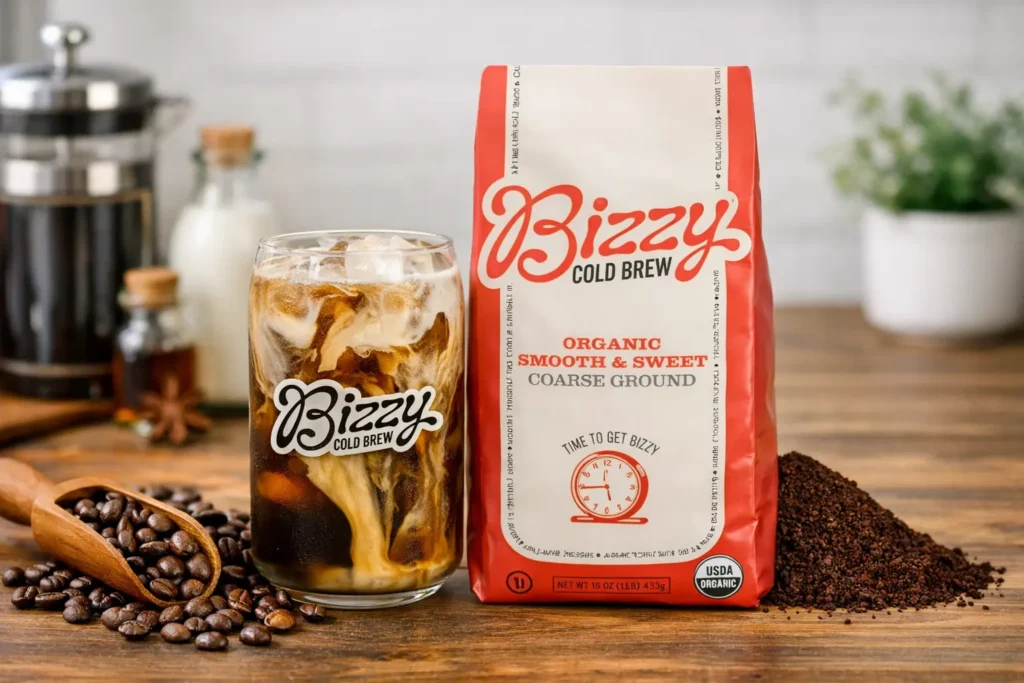
Best Overall (Black Cold Brew): Bizzy Organic “Smooth & Sweet”
Bizzy Organic Smooth & Sweet is the most consistently recommended cold brew bean for home brewers who want a dependable result without extensive parameter adjustment — and there is a clear reason why. The medium roast blend from Colombia, Peru, and Nicaragua is designed explicitly around cold extraction: the roast level, blend composition, and target flavor profile (caramel sweetness, brown sugar, clean finish) all align with what cold water amplifies naturally. There is no sourness from over-bright origins, no bitterness from a roast that is too dark, and no muddiness from beans ground incorrectly. It is available in both whole bean (recommended) and coarse ground for cold brew, which removes the grind setup barrier for first-time cold brew makers. If you are making cold brew for the first time or want a zero-complexity weekly batch bean, this is the correct starting point.
- Roast: Medium — explicit cold brew target profile
- Flavor direction: Caramel, brown sugar, clean sweetness — minimal bitterness
- K6 starting point: 82–90 clicks for standard cold brew; 78–84 clicks for concentrate
- Ratio: 1:8 for ready-to-drink (black over ice); 1:4 for concentrate
- Steep time: 14–18 hours in the refrigerator
- Best for: Black cold brew, first-time brewers, batch brewing, any serving style
Disclosure: CoffeeGearHub may earn from qualifying purchases.
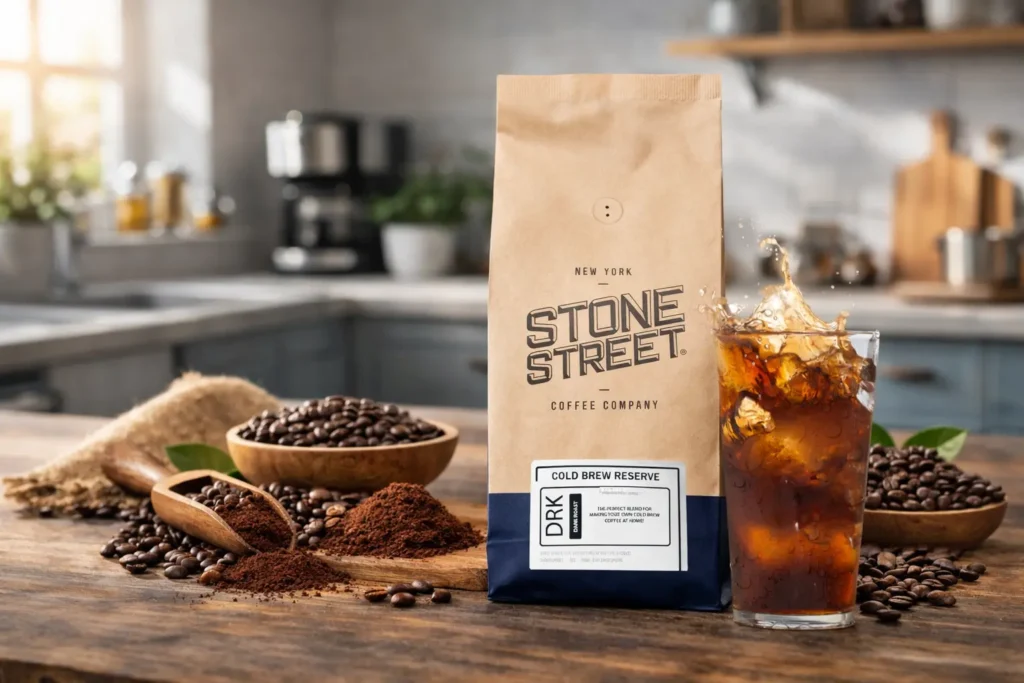
Best Bold / Low-Acid: Stone Street Cold Brew Coffee (Colombian)
Stone Street is one of the most popular purpose-built cold brew coffee options on Amazon — and it earns that position through a specific and well-considered combination of choices. Colombian dark roast produces a profile that matches cold water extraction’s natural tendencies almost exactly: low acidity (the roasting process has already degraded most organic acids), heavy body, smooth chocolate and dark fruit notes, and the boldness that survives both cold dilution and ice. It is sold in both whole bean and coarse ground formats, and the coarse ground is actually ground correctly for cold brew — unlike general-purpose pre-ground coffee, which is far too fine. The primary caution is steep time: dark roast beans extract bitter phenolics faster than medium roast even in cold water, and a steep beyond 14–16 hours pushes the cup from bold-and-smooth into bitter-and-harsh. Use the refrigerator, not room temperature, and taste-test at 12 hours before leaving it to 16.
- Roast: Dark — Colombian single-origin profile
- Flavor direction: Bold, smooth chocolate, low acidity, full body
- K6 starting point: 78–84 clicks — grind coarser than you would for medium roast cold brew
- Ratio: 1:8 ready-to-drink; 1:4 concentrate for iced lattes
- Steep time: 12–14 hours in the refrigerator — do not exceed 16 hours
- Best for: Bold black cold brew, cold brew concentrate, milk-based cold brew drinks
Disclosure: CoffeeGearHub may earn from qualifying purchases.
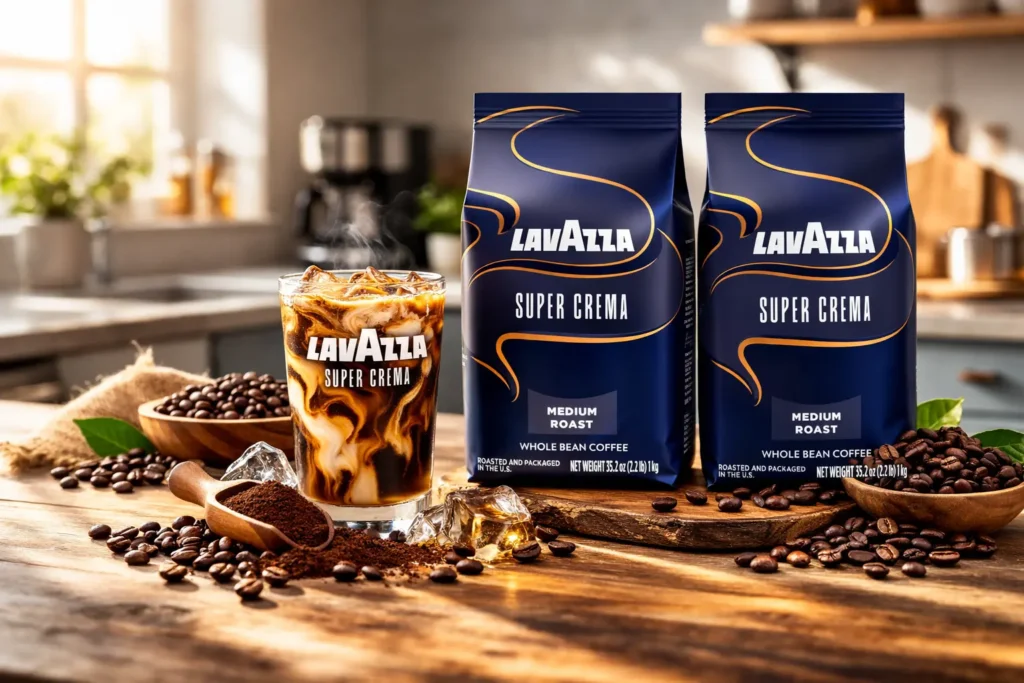
Best for Iced Lattes (Concentrate): Lavazza Super Crema
Lavazza Super Crema is best known as an espresso blend — but it makes an outstanding cold brew concentrate base for milk-based drinks, and the reason is the same characteristic that makes it popular for espresso: the blend’s medium-dark roast depth, Robusta component, and hazelnut-nutty sweetness produce a body-rich concentrate that does not disappear when diluted with oat milk, cream, or regular milk. This is the fundamental problem with using medium roast cold brew in iced lattes — the chocolate and caramel notes that taste excellent black become indistinguishable from the dairy when diluted. Lavazza Super Crema’s denser, more assertive profile survives that dilution while remaining sweet and smooth rather than harsh. Brew as a 1:4 concentrate, dilute 1:1 with milk of choice, and serve over ice — the result is a café-quality iced latte at home without an espresso machine.
- Roast: Medium-dark (espresso blend — Arabica + Robusta)
- Flavor direction: Creamy, hazelnut, nutty sweetness, dried fruit — bold enough to survive milk dilution
- K6 starting point: 78–86 clicks for cold brew concentrate
- Ratio: 1:4 concentrate — dilute 1:1 with milk before serving
- Steep time: 12–16 hours in the refrigerator
- Best for: Iced lattes, oat milk cold brew, sweetened concentrate drinks
Disclosure: CoffeeGearHub may earn from qualifying purchases.
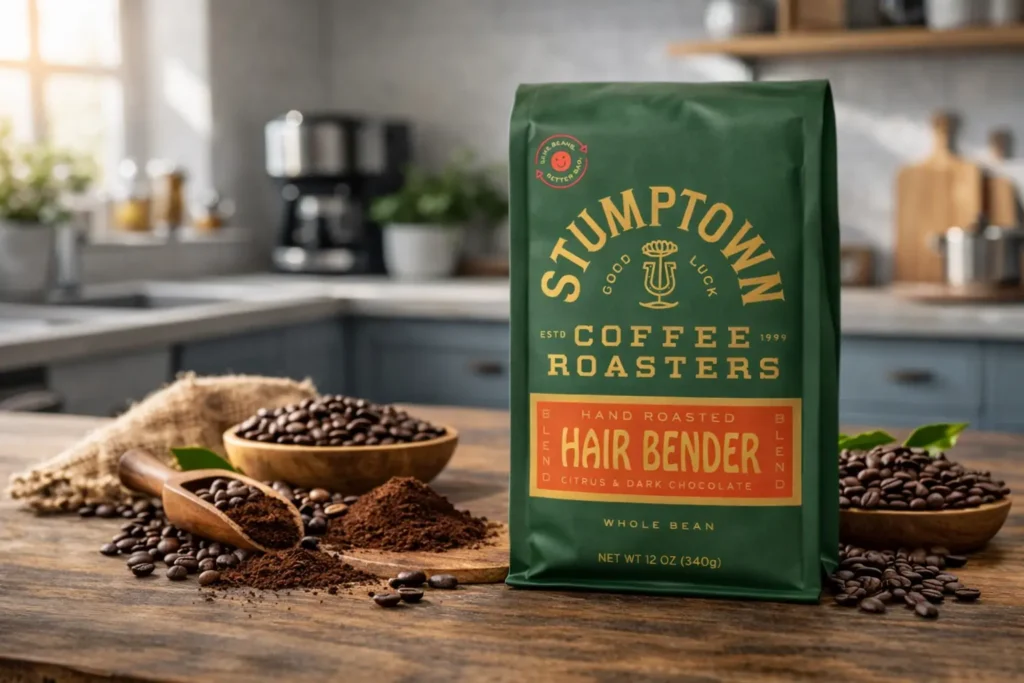
Best Specialty-Style: Stumptown Hair Bender
Stumptown Hair Bender occupies an unusual position in the cold brew lineup — it is a medium roast with enough origin complexity (Latin America plus East Africa) to produce a cold brew that is sweet and smooth but also distinctly more interesting than a standard caramel blend. Cold extraction softens the East Africa component’s acidity while preserving the subtle bright lift it contributes to the overall profile — the result is dark chocolate, a hint of citrus, and a finish that tastes like something specific rather than generic cold brew. It is the correct choice for home brewers who have mastered the basics of cold brew with a medium roast blend and want to explore what cold brew can taste like at a higher flavor complexity level. Requires whole bean and a quality burr grinder — pre-ground Hair Bender does not produce the same clarity, because grind consistency matters proportionally more for complex beans where you are trying to access specific flavor notes.
- Roast: Medium — Latin America + East Africa blend
- Flavor direction: Dark chocolate, subtle bright lift, caramel sweetness — more complex than standard cold brew blends
- K6 starting point: 82–88 clicks for standard cold brew; whole bean essential
- Ratio: 1:8 ready-to-drink for best complexity expression
- Steep time: 14–18 hours in the refrigerator
- Best for: Specialty-style black cold brew; Encore or K6 users wanting more complexity
Disclosure: CoffeeGearHub may earn from qualifying purchases.
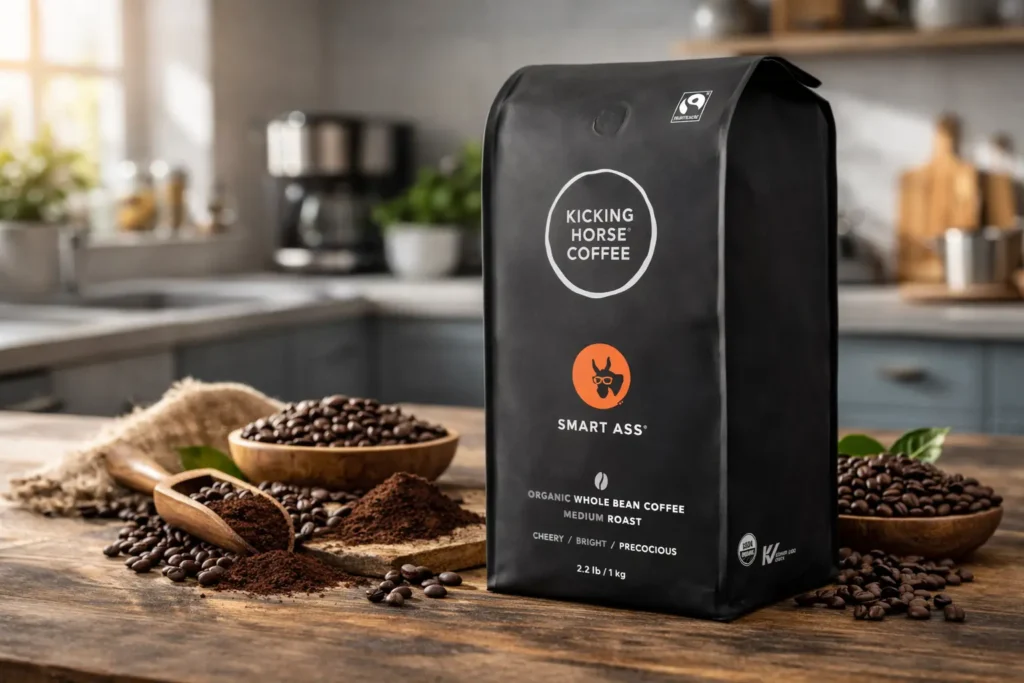
Best Value: Kicking Horse Coffee (Medium Roast)
Kicking Horse is available in multiple roast levels — the medium roast is the correct choice specifically for cold brew. The rich chocolate and brown sugar notes that define the Kicking Horse medium profile are in the sweet spot for cold extraction: they are body-forward rather than brightness-forward, and they produce a consistently smooth, sweet cold brew without requiring precise steep-time control. The organic certification, fair-trade sourcing, and competitive price-per-gram make it a strong candidate for home brewers who brew cold brew regularly and want a large-bag option that does not compromise quality. When buying multiple roast levels, compare by cup colour as well as label — the Kicking Horse medium is distinctly lighter than their dark roasts and produces a noticeably different cold brew profile. Buy the medium for black cold brew and batch brewing; go darker only if you primarily drink iced lattes with milk.
- Roast: Medium — organic, fair-trade blend
- Flavor direction: Chocolate, brown sugar, smooth body
- K6 starting point: 82–90 clicks for cold brew
- Ratio: 1:8 ready-to-drink; 1:6 for a stronger everyday batch
- Steep time: 14–18 hours in the refrigerator
- Best for: Regular batch cold brew, organic buyers, value-per-batch priority
Disclosure: CoffeeGearHub may earn from qualifying purchases.
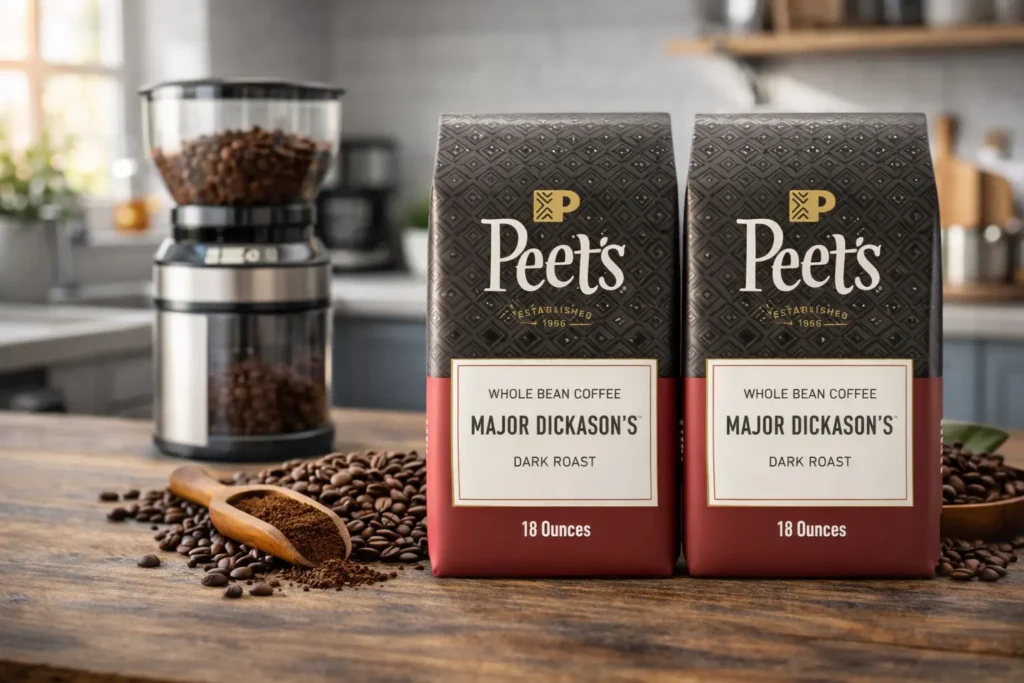
Best Dark Roast for Milk Drinks: Peet’s Major Dickason’s Blend
Peet’s Major Dickason’s Blend is the correct answer for home cold brew drinkers who primarily consume iced lattes, cold brew with cream, or sweetened cold brew where a bold coffee backbone is needed. Dark roast cold brew has a specific advantage in milk-based drinks that medium roast does not: the heavy body and bold, robust character persist through the diluting effect of milk, cream, and ice in a way that lighter profiles do not. A well-made Major Dickason’s cold brew concentrate produces an iced latte that tastes decisively like coffee — not like milk with a coffee flavour hint. The caution is the same as all dark roast cold brew: steep time is the primary bitterness control. At 12–14 hours in the refrigerator the result is smooth and bold; at 20+ hours it tastes harsh and over-extracted regardless of the initial bean quality.
- Roast: Dark — multi-origin blend
- Flavor direction: Robust, full-bodied, bold — designed to survive milk dilution
- K6 starting point: 78–84 clicks — grind very coarse to control bitterness
- Ratio: 1:4 concentrate for iced lattes; dilute 1:1 with milk
- Steep time: 12–14 hours maximum in the refrigerator
- Best for: Iced lattes, cream-based cold brew, sweetened cold brew drinks; bold fans
Disclosure: CoffeeGearHub may earn from qualifying purchases.
Whole Bean vs Pre-Ground for Cold Brew
The whole bean vs pre-ground question matters more for cold brew than for any other brew method — and the reason is grind size. Cold brew’s 12–18 hour steep requires an extra-coarse grind that standard pre-ground coffee does not match. Most grocery-store pre-ground coffee is ground at medium — appropriate for drip machines — which is far too fine for cold brew. At medium grind, cold brew’s long contact time over-extracts bitter compounds regardless of steep time management, producing a harsh, muddy concentrate that no recipe adjustment fully fixes.
| Whole bean (burr-ground before brewing) | Pre-ground (standard grocery) | Pre-ground (cold brew specific) | |
|---|---|---|---|
| Grind size control | Full control — set to extra-coarse (K6: 80–90 clicks) for clean cold brew | None — medium grind is too fine; produces bitter, muddy cold brew | Adequate — coarse-ground cold brew products are generally ground correctly |
| Clarity of final brew | Highest — consistent coarse particles extract cleanly, leave less sediment | Lowest — fines in medium-ground coffee cloud the concentrate and increase bitterness | Moderate — coarser than standard pre-ground but not as consistent as fresh burr-ground |
| Bitterness risk | Low — coarse grind + cold water = controlled extraction | High — cannot be fixed by shortening steep time once fines are present | Low to moderate — correct grind but freshness varies |
| Freshness | Highest — ground immediately before brewing | Low — ground days to weeks before use; aromatics already oxidised | Variable — check roast date on bag |
| Convenience | Requires grinder — 2 minutes to grind a batch dose | None required — measure and steep immediately | None required — measure and steep immediately |
| Best for | Anyone with a burr grinder — produces the cleanest, best-tasting cold brew | Not recommended for cold brew — grind is wrong for the method | Acceptable shortcut — Bizzy Organic coarse ground or Stone Street coarse ground are correctly ground for cold brew |
🔬 The grinder upgrade for cold brew: If you currently use pre-ground coffee and your cold brew is consistently bitter or muddy, the single highest-ROI fix is a burr grinder set to extra-coarse — not a different bean or a longer or shorter steep. The KINGrinder K6 at 80–90 clicks produces the correct particle size for cold brew at a price point below most dedicated cold brew equipment. For a full grinder guide, see Best Coffee Grinders for Home Brewing.
Grind Size and Ratio Reference System for Cold Brew
Cold brew has three variables that interact to determine extraction quality: grind size, coffee-to-water ratio, and steep time. These are not independent — changing one requires adjusting the others to maintain the same extraction level. Use this table as your complete cold brew parameter reference. All K6 settings measured from zero (burrs touching).
| Cold brew style | Roast | K6 clicks | Ratio (by weight) | Steep time (fridge) | Steep time (room temp) | Serve method | Flavor target |
|---|---|---|---|---|---|---|---|
| Ready-to-drink (medium roast) | Medium | 82–90 clicks | 1:8 | 14–18 hrs | 10–14 hrs | Over ice as-is | Smooth, sweet, balanced |
| Ready-to-drink (dark roast) | Dark | 80–86 clicks | 1:8 | 12–14 hrs | 8–12 hrs | Over ice as-is | Bold, smooth, low-acid |
| Concentrate (for lattes) | Medium-dark to dark | 78–84 clicks | 1:4 | 12–16 hrs | 10–12 hrs | Dilute 1:1 with milk | Creamy, bold, survives dilution |
| Concentrate (general) | Medium | 80–88 clicks | 1:4–1:6 | 14–18 hrs | 10–14 hrs | Dilute 1:1 with water or milk | Flexible — adjust dilution at serving |
| Light roast / specialty | Light to medium-light | 74–82 clicks | 1:6 | 18–24 hrs | 14–18 hrs | Over ice, black | Bright, tea-like, delicate fruit |
| Strong batch (high caffeine) | Medium-dark | 78–84 clicks | 1:5–1:6 | 14–16 hrs | 10–12 hrs | Over ice with ice allowance | Bold, smooth, high concentration |
Dial-In Guide: How to Adjust Your Cold Brew When It’s Off
Cold brew dial-in follows the same principle as any coffee dial-in: change one variable at a time and taste the result before changing anything else. The three cold brew levers — grind size, ratio, and steep time — each affect the cup in predictable ways.
The Cold Brew Dial-In Rule
- Start at the recommended K6 click for your roast and style from the table above
- Steep using the standard ratio and time for your roast level
- Taste the cold brew undiluted over ice — identify the primary off-note
- Adjust grind first: 4–6 clicks coarser if bitter; 4–6 clicks finer if sour or weak
- If grind is already correct, adjust steep time: shorter if bitter, longer if weak
- If strength is wrong but flavour is balanced, adjust ratio — tighter (less water) for stronger, looser (more water) for lighter
- Never change grind, steep time, and ratio simultaneously — you will have no useful information about which change worked
Taste → Adjustment Order
- Bitter / harsh: grind 5 clicks coarser → reduce steep time 2 hrs → check beans are not too dark or too stale
- Sour / thin / acidic: grind 4 clicks finer → extend steep 2 hrs → switch to medium from light roast
- Weak / watery: increase dose (tighten ratio to 1:6) → extend steep 2 hrs → do not go finer first — that causes bitterness
- Muddy / gritty: grind 6+ clicks coarser → paper-filter after straining → check grinder for fines production
- Flat / no aroma: buy fresh beans (roast date under 4 weeks) — no parameter fix works on stale coffee
- Good flavour but too strong: dilute more at serve — do not change ratio before understanding your dilution preference
Troubleshooting Matrix: Cold Brew Symptoms → Causes → Fixes
Every common cold brew problem traces back to one of three variables: grind size, steep time, or bean freshness. Identify your symptom and follow the fix order before changing your bean or recipe.
| Symptom | Most likely cause | Fix (in order) |
|---|---|---|
| Cold brew is bitter regardless of steep time | Grind too fine — fines over-extract over the long contact time even in cold water | Grind 6–8 clicks coarser → filter through paper after straining → ensure no blade grinder was used at any point |
| Cold brew tastes sour or sharp | Under-extraction — grind too coarse, steep too short, or light roast at standard parameters | Grind 4 clicks finer → extend steep 2–3 hours → for light roast, tighten ratio to 1:6 and steep 18–24 hours |
| Cold brew is weak and watery | Under-extraction or too-high ratio — too much water relative to coffee, or steep too short | Increase dose (use 1:6 instead of 1:8) → extend steep 2 hours → serve with less ice (ice dilutes further) — do not grind finer as the first fix |
| Cold brew is muddy and gritty | Grind too fine; fines passing through filter; or blade grinder used | Grind 8+ clicks coarser → double-filter: strain through mesh first, then through paper filter → switch to burr grinder — blade grinders cannot be fixed for cold brew |
| Cold brew tastes flat with no aroma | Stale beans — aromatic volatiles oxidised before purchase or during storage | Check roast date — if over 5 weeks from roast, buy fresh beans; store beans airtight at room temperature between batches; no steep-time adjustment rescues stale coffee |
| Cold brew concentrate turns sour after 3–4 days in the fridge | Oxidation — concentrate stored in container with too much headspace; or beans were very fresh (still outgassing CO2) | Store in glass with tight seal and minimal headspace → make smaller batches more frequently → rest fresh-roasted beans 5–7 days before brewing cold brew |
| Dark roast cold brew is harsh but not bitter | Steep too long — over-extracted phenolics without the clean bitterness of fine grind | Reduce steep time by 2 hours → taste at 12 hours before extending → refrigerator steeps are more forgiving than room-temperature steeps at equivalent times |
| Cold brew tastes fine but is too strong to drink straight | Concentrated correctly — this is the intended result for a 1:4 ratio | Dilute 1:1 with cold water or milk before serving → serve over ice with allowance for further dilution from melting → do not change ratio; dilution at serve is correct practice |
| Each batch tastes different despite same recipe | Inconsistent grind (blade grinder) or variable steep temperature (room temp vs fridge) | Switch to burr grinder — blade grinders produce random particle distribution on every grind → always steep in the refrigerator for reproducible results |
| Cold brew has oily film on the surface | Dark roast surface oils releasing during steep — accelerated if beans are stale or oily | Normal in dark roast cold brew when fresh — paper-filter after straining removes surface oil; if rancid-tasting, beans are too old; use beans within 3 weeks of roast date for dark roast cold brew |
Storage: Keeping Your Beans and Concentrate Fresh
Cold brew storage has two components: the beans before brewing and the concentrate after brewing. Both degrade faster than most home brewers expect, and both degradation paths affect the final cup in ways that are often misattributed to the wrong variable.
Storing Whole Beans Before Brewing
- Store in an airtight, opaque container at room temperature — not in the refrigerator, which introduces moisture
- Keep away from heat sources, direct light, and humidity — all three accelerate oxidation
- Buy 250g every 2–3 weeks rather than 1kg every 6 weeks — smaller, fresher quantities produce better cold brew batches
- For dark roast specifically: use beans within 3 weeks of roast date — oily surface beans stale faster than light or medium roast
- Check roast date before every purchase — “best by” dates tell you nothing about freshness
Storing Cold Brew Concentrate
- Store strained concentrate in a sealed glass container in the refrigerator — airtight lid, minimal headspace
- Drink within 7 days for best flavor — 10 days is the outer limit before flavor degradation becomes noticeable
- Do not store unstrained cold brew with grounds still present — steep continues and bitter compounds accumulate
- Never store cold brew in plastic for extended periods — plastic imparts off-flavours within 3–5 days
- Make smaller batches (750ml–1L) more frequently rather than large batches consumed over two weeks
For a complete bean storage guide including airtight canisters, the freezing method for long-term storage, and the myths about refrigerating beans, see our Coffee Bean Storage Guide.
Cold Brew Bean Buying Checklist
Use this checklist before purchasing any coffee for cold brew. The most common cold brew disappointments trace directly back to one or two of these items being skipped at the buying stage.
| Question | What to look for | Red flag |
|---|---|---|
| What is my primary cold brew serving style? | Black over ice → medium roast; iced latte → medium-dark to dark; sweetened → medium; specialty bright → light roast at tighter ratio | Buying “the strongest” or “the darkest” regardless of how you drink cold brew |
| Is there a roast date on the bag? | Yes — roast date under 4 weeks for most cold brew; under 3 weeks for dark roast specifically | No roast date, only a “best by” date — no way to assess freshness for a method where stale beans cause flat concentrate |
| Do I have a burr grinder set to extra-coarse? | Yes — KINGrinder K6 at 80–90 clicks; Baratza Encore at setting 32–38; any quality burr grinder at the coarsest available setting | Planning to use a blade grinder or standard pre-ground drip coffee — medium grind in cold brew produces bitter, muddy concentrate that cannot be fixed by recipe adjustment |
| Is the origin suited to cold brew? | Brazil, Colombia, Guatemala, Sumatra — all cold-brew-friendly origins; blends of these origins are the safest choice | Buying Ethiopian washed or Kenyan specifically for cold brew — their high-volatility aromatics are suppressed by cold extraction |
| Am I buying whole bean? | Yes — whole bean ground immediately before brewing at extra-coarse is the correct approach; if buying pre-ground, verify it is specifically labeled “coarse ground for cold brew” | Standard grocery-store pre-ground in any brand — it is medium ground, wrong for cold brew |
| How much am I buying relative to batch frequency? | 250g makes approximately 3–4 standard batches (1:8 ratio, 1L per batch); buy quantities you will use within 3–4 weeks of roast date | Buying 1kg of dark roast because it is “better value” — the second half of the bag will be stale before you reach it |
Final Takeaway: The Best Coffee Beans for Your Cold Brew Setup
The best coffee beans for cold brew are the ones that align with what cold water extraction actually does well — amplifying sweetness, body, and chocolate-caramel character while suppressing the high-volatility aromatics that define light roast hot brew. For most home cold brew drinkers, that means a medium roast from Brazil, Colombia, or a blend of cold-brew-optimised origins, ground extra-coarse on a burr grinder, steeped 14–18 hours in the refrigerator at a 1:8 ratio. Bizzy Organic Smooth & Sweet is the correct starting point for the widest range of home brewers. Stone Street Colombian is the correct choice for bold, low-acid cold brew that tastes like a serious cup. Lavazza Super Crema is the correct choice when your primary goal is an iced latte concentrate that survives milk dilution. From any of these starting points, grind and ratio adjustments — not bean switches — are the primary tools for dialling in your specific preference. Get the grind extra-coarse, use fresh beans with a roast date on the bag, and steep in the refrigerator for the correct time for your roast level. Cold brew is one of the most consistent and repeatable home brewing methods when those three variables are correct — and one of the most frustrating when they are not.
FAQs: Best Coffee Beans for Cold Brew
What roast level is best for cold brew coffee?
Medium roast is the safest and most consistently rewarding choice for cold brew — it produces sweetness, chocolate, and caramel notes that cold water extraction amplifies naturally. Medium-dark and dark roasts work well for milk-based cold brew drinks. Light roast cold brew is possible but requires a tighter ratio (1:6 instead of 1:8) and a longer steep to avoid a thin, under-extracted result.
What is the best grind size for cold brew coffee?
Extra-coarse grind is the correct starting point — roughly the texture of raw turbinado sugar. On the KINGrinder K6, start at 80-90 clicks from zero. Too fine causes over-extraction, bitterness, and filter clogging. Too coarse produces weak, under-extracted concentrate. Use a burr grinder — blade-ground coffee produces fines that make cold brew muddy and bitter regardless of steep time.
What coffee-to-water ratio should I use for cold brew?
For cold brew concentrate, use 1:4 by weight — 200g coffee to 800g water — then dilute 1:1 with water or milk before serving. For ready-to-drink cold brew, use 1:8 — 125g coffee to 1,000g water. The concentrate method gives more flexibility: you can adjust dilution at serving time based on how strong you want the cup.
How long should cold brew steep?
In the refrigerator, 12-18 hours is the standard window — long enough to extract sweetness and body without over-extracting bitter compounds. At room temperature, 10-14 hours is typically sufficient. Do not exceed 24 hours for room-temperature steep. Cold fridge steeps are more forgiving of slight over-time than room-temperature steeps.
Can I use light roast for cold brew?
Yes, but with adjusted parameters. For light roast cold brew, use a tighter ratio (1:6 by weight), steep for 18-24 hours in the refrigerator, and grind slightly finer than you would for medium roast. The result — when dialled in — is a tea-like, bright, fruit-forward concentrate unlike anything medium or dark roast cold brew produces. Not recommended as a starting point for beginners.
Why is my cold brew bitter?
Cold brew bitterness has three common causes: grind too fine, steep time too long (especially at room temperature), or stale dark roast beans with rancid surface oils. Fix in order: grind coarser, reduce steep time by 2-3 hours, and check roast date. Never squeeze the filter when straining — squeezing forces bitter fines through.
Why is my cold brew weak and watery?
Weak cold brew is almost always under-extraction: too coarse a grind, too short a steep, or too high a ratio. Fix in order: increase dose (1:6 instead of 1:8), extend steep time by 2-3 hours, or grind 5-8 clicks finer on your K6. Account for dilution from ice when serving — brewing at 1:6 and serving over ice produces effective strength similar to 1:8 after melting.
Is whole bean or pre-ground better for cold brew?
Whole bean ground immediately before brewing at extra-coarse is always better. Most pre-ground coffee is medium grind — too fine for cold brew and produces bitter, muddy results. If using pre-ground, buy coarse-ground coffee specifically labeled for cold brew (such as Bizzy Organic coarse ground or Stone Street coarse ground).
How long does cold brew concentrate keep in the fridge?
Cold brew concentrate keeps for 7-10 days in a sealed glass container in the refrigerator. Ready-to-drink cold brew keeps for 5-7 days. Flavor degrades noticeably after day 7. Make smaller batches more frequently — 750ml to 1L every 5-7 days is better than 2L every two weeks.
Do expensive single-origin beans taste better in cold brew than blends?
Not necessarily. Cold water extraction mutes the high-volatility aromatics that make expensive Ethiopian single-origins worth their price in pour-over. Medium-priced medium roast blends from Brazil and Colombia with chocolate and caramel notes often produce better cold brew than expensive single-origins at the same parameters. Save single-origins for pour-over and AeroPress where hot water accesses their full aromatic potential.
Continue Learning
COLD BREW CLUSTER
Have your beans but not sure about the brew process? Our complete cold brew guide covers equipment, ratios, step-by-step method, and how to make both ready-to-drink and concentrate from any of the beans in this guide.
☕
Written by the CoffeeGearHub Editorial Team
CoffeeGearHub is a specialty coffee equipment resource produced by the CoffeeGearHub Editorial Team. Our guides are researched using published brewing science, SCA standards, cold extraction research, and established specialty-coffee community knowledge. We review and update our home brewing content regularly. About CoffeeGearHub →
Related CoffeeGearHub guide: Robusta coffee brewing guide