
Last Updated: March 2026 • 18–22 min read • Full Guide: Standard + Inverted Method • Grind Settings • Brew Ratios • Latte Recipes • Troubleshooting Matrix • Gear Recommendations
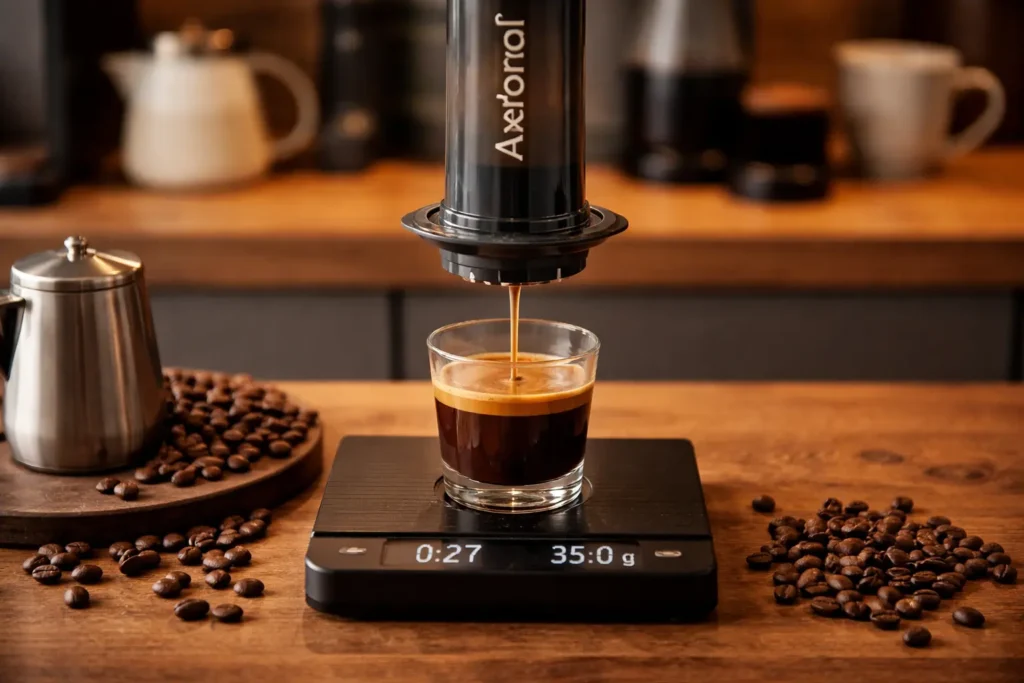
✍️ Affiliate Disclosure: This guide is researched and written by the editors at CoffeeGearHub.com using published brewing specifications, extraction science, and hands-on testing experience. Recommendations reflect research consensus and our own brewing results. All product links are affiliate links — we may earn a commission at no cost to you. Full disclosure policy →
The 30-Second Answer
The AeroPress won’t produce true espresso — it doesn’t have the 9 bars of pressure that real espresso requires. But with the right grind, ratio, and technique, it produces a rich, concentrated coffee that is functionally indistinguishable from espresso in lattes, cappuccinos, and iced drinks. The difference on paper is academic; the result in your cup is excellent.
- Target recipe: 18–20g coffee → 60ml water at 205°F → ~50ml concentrate
- Grind setting: Fine — table salt texture; KINGrinder K6 at 10–12 clicks
- Press time: Slow and steady over 20–30 seconds, stop at first hiss
- Method: Standard works great; inverted gives fuller body and more brew control
- Best use: Lattes, iced lattes, cappuccinos, Americanos — anything that calls for an espresso base
Who This Guide Is For
☕ AeroPress owners
Already have the brewer, want to unlock its full potential. Start at the master recipe.
🥛 Latte & cappuccino drinkers
No espresso machine, but want real milk drinks at home. Go to latte recipes.
🔬 Technique obsessives
Want to understand the science and dial in a repeatable process. Read extraction science.
🛒 Shopping for gear
Deciding what to buy before you start. Jump to gear recommendations.
Table of Contents
What Is AeroPress Espresso Concentrate?
Before we get into recipes, one term needs to be settled: the AeroPress does not make espresso. True espresso is defined by the extraction pressure — typically 9 bars sustained through finely ground coffee — which produces a specific emulsification of oils, dissolved solids, and suspended particles that no hand-powered device can replicate.
What the AeroPress does make, using a fine grind and a greatly reduced water volume, is an espresso-style concentrate: a small-volume, highly saturated brew with espresso’s intensity, body, and low bitterness. The TDS (total dissolved solids) is similar. The volume is similar. And in a latte or iced drink, the behavioral difference between true espresso and AeroPress concentrate is undetectable to most drinkers — including experienced ones.
This distinction matters for one reason: if you understand what the AeroPress is actually doing, you’ll brew it better. You’re not trying to replicate pressure extraction — you’re using fine grind, high dose, and low water volume to maximize concentration and intensity within the limits of immersion brewing. That’s a different goal, and it has its own optimal parameters.
✅ The practical bottom line: AeroPress espresso concentrate works beautifully in lattes, cappuccinos, Americanos, and iced drinks. For straight shots compared side-by-side with machine espresso, the differences are detectable. For everything else, it’s an excellent substitute that costs a fraction of the price of an espresso machine.
Extraction Science: Why AeroPress Concentrate Works
Understanding what’s happening during an AeroPress concentrate brew explains why each variable in the recipe matters — and makes troubleshooting much faster when something tastes off.
Grind Size Controls Extraction Rate
A finer grind dramatically increases the surface area of coffee exposed to water. More surface area = faster extraction of soluble compounds. For concentrate, we want a high TDS (total dissolved solids) in a small water volume, and fine grind is the primary lever that makes that possible without extending brew time to impractical lengths.
The risk with fine grind is over-extraction — once you’ve extracted the desirable compounds (acids, sugars, fruity and caramel notes), continued extraction pulls bitter tannins and astringent phenolic compounds. The 20–30 second press time and the bloom-first technique exist specifically to prevent this.
The Bloom Releases CO₂
Fresh coffee beans off-gas CO₂ — a byproduct of the roasting process that continues for days to weeks. When you pour hot water over fresh grounds, CO₂ escapes rapidly, which can create uneven extraction channels if you skip the bloom step. The 20–30 second bloom — a small amount of water just covering the grounds — lets CO₂ escape before the main brew, resulting in more even saturation and a more consistent extract.
For espresso concentrate specifically, where you’re using a higher dose in a small chamber, a thorough bloom stir is important. Dry pockets of coffee in the center of the puck will under-extract; over-wet edges over-extract. Stir during bloom to saturate evenly.
Water Temperature Affects Compound Solubility
Higher water temperature dissolves a broader spectrum of compounds from coffee. Acids, sugars, lipids, and bitter compounds all have different solubility thresholds. For concentrate, where we want maximum flavor intensity in minimum water volume, 195–205°F (91–96°C) is the optimal range — hot enough to dissolve desirable compounds quickly, cool enough to suppress excessive bitter extraction.
If you’re using a lighter roast, lean toward the higher end (202–205°F). For darker roasts, the lower end (195–200°F) prevents adding more bitterness to already bold beans. Both work well in the AeroPress — the plastic-and-rubber construction actually maintains heat efficiently over a short brew time.
🔬 The pressure question: The AeroPress generates roughly 0.35–0.75 bars of manual pressure during pressing — far below the 9 bars of a real espresso machine. This is enough to push water through a fine coffee bed faster than gravity alone, but not enough to create true emulsification. That’s why AeroPress concentrate lacks genuine crema and won’t produce the same mouthfeel as machine espresso when consumed straight. In a milk drink, this distinction vanishes.
Gear You Need
AeroPress espresso concentrate requires only four pieces of equipment — and the AeroPress itself is the most forgiving of the four. The grinder is where most of the quality difference between a great and a mediocre concentrate comes from.
The AeroPress: All Three Models Compared
Aerobie makes three current AeroPress models. They all brew identically — the chamber geometry, filter system, and plunger mechanics are the same. What differs is build material, size, and included accessories.
AeroPress Original — The Standard
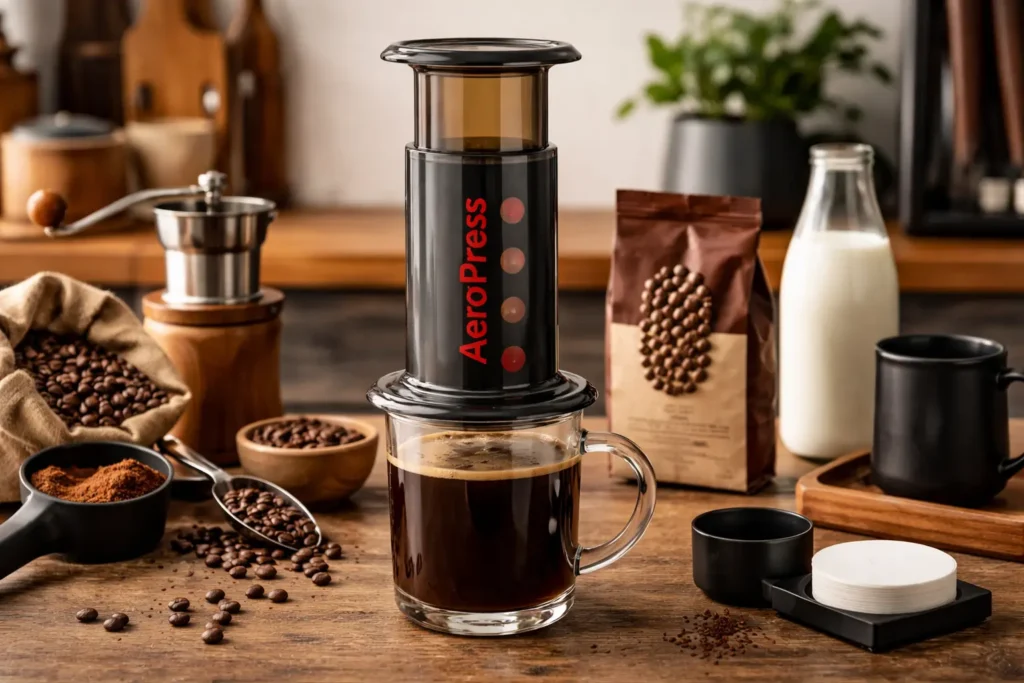
Best for: Most home brewers who want the full AeroPress experience at the best price. The definitive recommendation for espresso concentrate at home.
The AeroPress Original is the one that started the cult following — and for good reason. The classic black chamber, rubber plunger, and plastic filter cap combination is durable, easy to clean, and produces exceptional concentrate. It brews up to 10oz (though for concentrate you’ll use far less) and comes with 350 paper filters, a funnel, stirrer, scoop, and filter holder.
For espresso concentrate specifically, nothing about the original design limits you. The chamber fits 18–20g of fine coffee comfortably, the filter cap seals securely, and the plunger travel is smooth even with higher-resistance fine grinds. This is the right choice for 90% of people reading this guide.
- ✅ Full chamber capacity for 18–20g concentrate dose
- ✅ Includes 350 paper filters, stirrer, scoop, and funnel
- ✅ Polypropylene plastic — BPA-free, durable, dishwasher safe
- ✅ Best price of the three models
- ⚠️ Opaque chamber — you can’t watch the brew
Capacity: Up to 10oz | Filters: 350 paper included | Material: BPA-free polypropylene | Best for: Espresso concentrate, everyday home brewing
Affiliate link — we earn a small commission at no extra cost to you. Price subject to change — always check Amazon for the current price. Full disclosure.
AeroPress Clear — Best for Dialing In
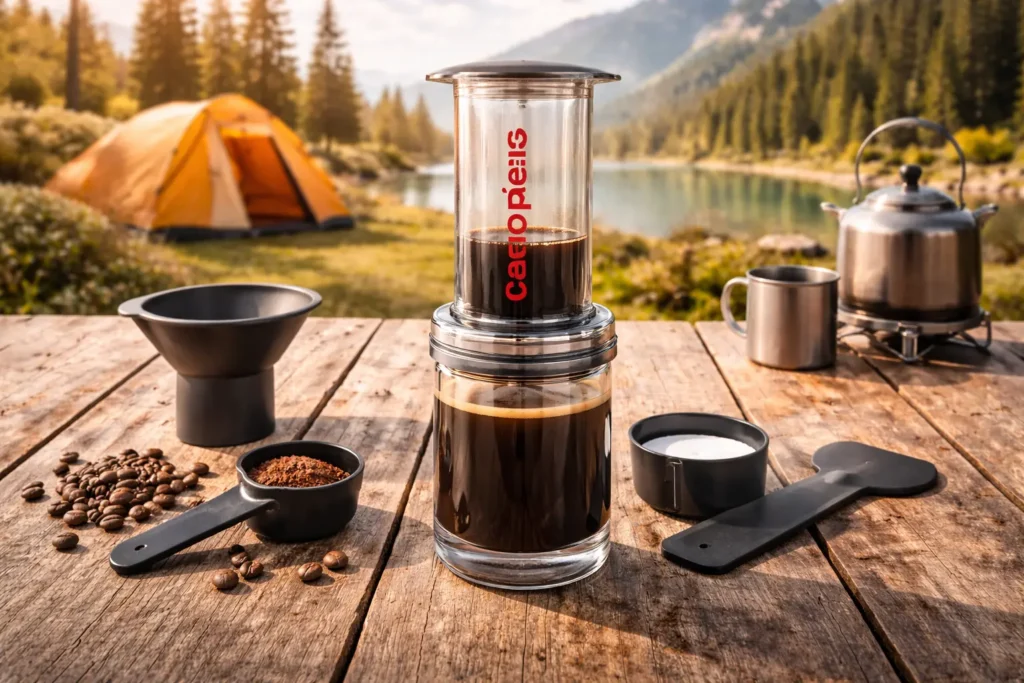
Best for: Brewers who want to watch their extraction, monitor saturation, and dial in a recipe precisely by eye as well as by timer.
The AeroPress Clear swaps the classic black casing for a fully transparent Tritan plastic build — functionally identical to the Original in every way, but with a clear chamber that lets you watch the bloom, see coffee saturation, and observe the plunger travel during pressing. For brewers who are actively dialing in their concentrate recipe, this real-time visual feedback is genuinely useful.
The Tritan material is more scratch-resistant than older AeroPress generations and handles high temperatures well. It includes the same accessories as the Original. At a modest price premium over the Original, it’s a worthwhile upgrade for anyone who enjoys the process side of brewing, not just the result.
- ✅ Transparent chamber — watch extraction in real time
- ✅ Tritan plastic — scratch-resistant, no plastic odor
- ✅ Identical brew performance to the Original
- ⚠️ Modest price premium over Original for aesthetic/visual benefit only
Capacity: Up to 10oz | Material: Tritan (clear, scratch-resistant) | Best for: Recipe development, visual learners
Affiliate link — we earn a small commission at no extra cost to you. Price subject to change — always check Amazon for the current price. Full disclosure.
AeroPress Go — Best for Travel
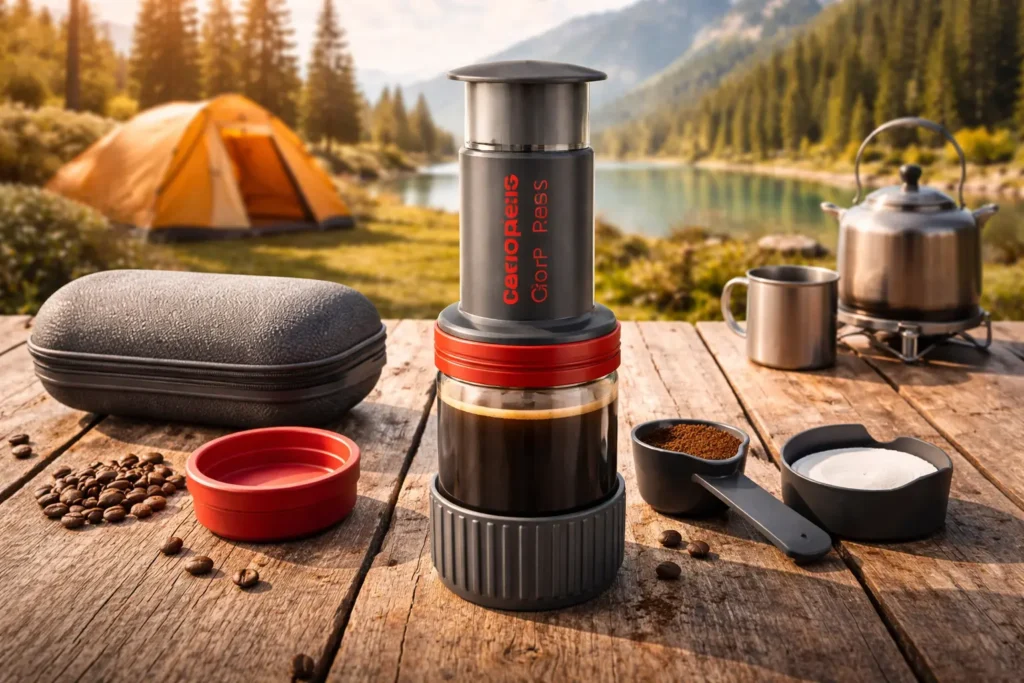
Best for: Travelers, campers, hotel stays, or anyone who wants AeroPress concentrate quality on the road without carrying extra gear.
The AeroPress Go is a smaller, travel-optimized version that includes a mug with a lid — the entire brewer stores inside the mug for packing. The chamber is slightly narrower than the Original and maxes out at 8oz, which is slightly limiting for espresso concentrate where you want a full 18–20g dose in the chamber alongside water. You can still brew a solid concentrate; the chamber just feels fuller during brewing.
It brews identically to the Original and Clear — same filter size, same press mechanics, same output quality. The included travel mug doubles as a drinking vessel and storage container. For home use, the Original is a better choice. For travel, the Go is the obvious answer.
- ✅ Includes travel mug — brew directly into it, pack everything inside
- ✅ Compact and lightweight — designed for bags and backpacks
- ✅ 350 micro-filters included
- ⚠️ Smaller chamber — tighter fit for full 18–20g concentrate dose
- ⚠️ Not the best choice as a dedicated home brewer
Capacity: Up to 8oz | Includes: Travel mug with lid, 350 micro-filters | Best for: Travel, camping, hotels
Affiliate link — we earn a small commission at no extra cost to you. Price subject to change — always check Amazon for the current price. Full disclosure.
The Grinder: The Most Important Variable in Your Cup
If there is one thing that separates mediocre AeroPress concentrate from genuinely excellent concentrate, it is the grinder. A blade grinder produces inconsistent particle sizes — very fine dust mixed with coarser chunks — which extracts at different rates, producing a concentrate that is simultaneously bitter (over-extracted fines) and sour (under-extracted chunks). A burr grinder, which crushes beans between two abrasive surfaces at a consistent gap width, produces uniform particle sizes. Uniform particles extract uniformly. Uniform extraction = better flavor.
KINGrinder K6 — Best Manual Grinder for AeroPress Concentrate
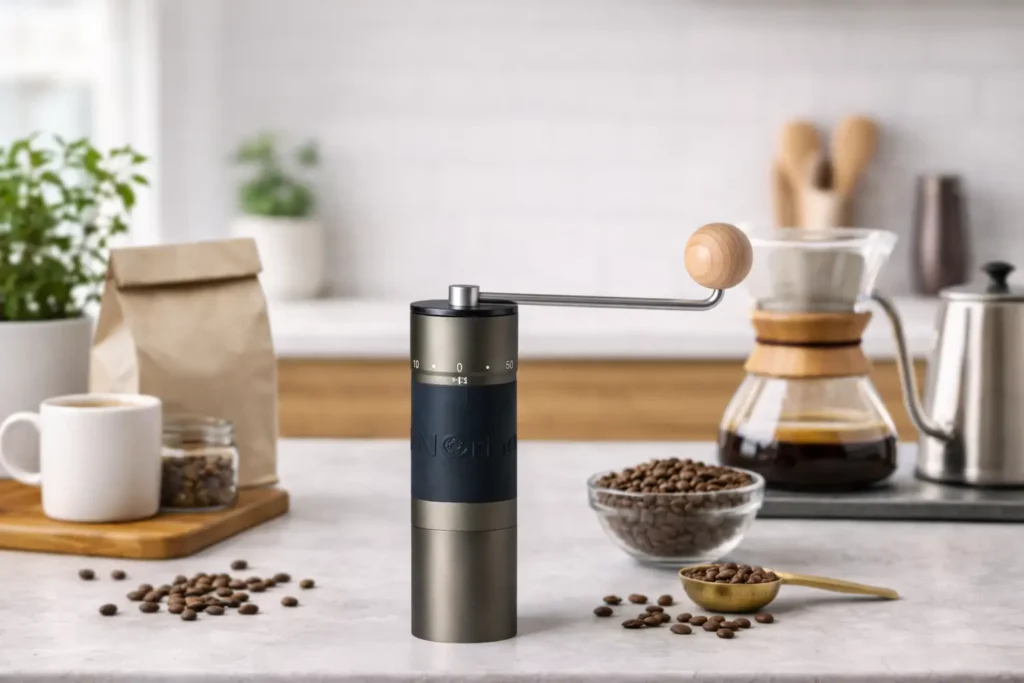
Best for: Home brewers who want exceptional grind quality at a fraction of the price of electric burr grinders — and the K6 is genuinely competitive with grinders costing three times as much.
The KINGrinder K6 has become the standard manual grinder recommendation across specialty coffee forums and home brewing communities for good reason: its 48mm stainless steel conical burr set produces exceptionally uniform particle sizes across the full grind range — from coarse filter coffee down to the fine setting needed for AeroPress espresso concentrate.
For AeroPress concentrate, the K6’s precision adjustment system is particularly valuable. The numbered click setting lets you dial in a specific, reproducible grind every time — no guessing whether today’s grind matches yesterday’s. Grind time for an 18g dose at fine settings is approximately 45–60 seconds, which is negligible. The aluminum and stainless construction feels solid and the catch cup seals cleanly.
⚙️ K6 Click Settings for AeroPress Concentrate: Start at 11 clicks from zero as your baseline. If your concentrate tastes bitter or press resistance is very high, move to 12–13 clicks (coarser). If it tastes weak or watery, move to 9–10 clicks (finer). Most brewers find their sweet spot at 10–12 clicks for espresso-style concentrate.
- ✅ 48mm stainless conical burrs — exceptional uniformity at this price point
- ✅ Numbered click adjustment — fully reproducible grind settings
- ✅ Handles the full range from filter to fine espresso
- ✅ Aluminum and stainless build — premium feel at a mid-range price
- ⚠️ Manual grinding — 45–60 seconds for an 18g dose
- ⚠️ Not ideal for grinding more than 20g at a time
Burr size: 48mm conical stainless steel | Adjustment: Numbered click system | Grind range: Coarse to fine espresso | AeroPress concentrate setting: 10–12 clicks
Affiliate link — we earn a small commission at no extra cost to you. Price subject to change — always check Amazon for the current price. Full disclosure.
A Good Scale: Non-Negotiable for Consistent Concentrate
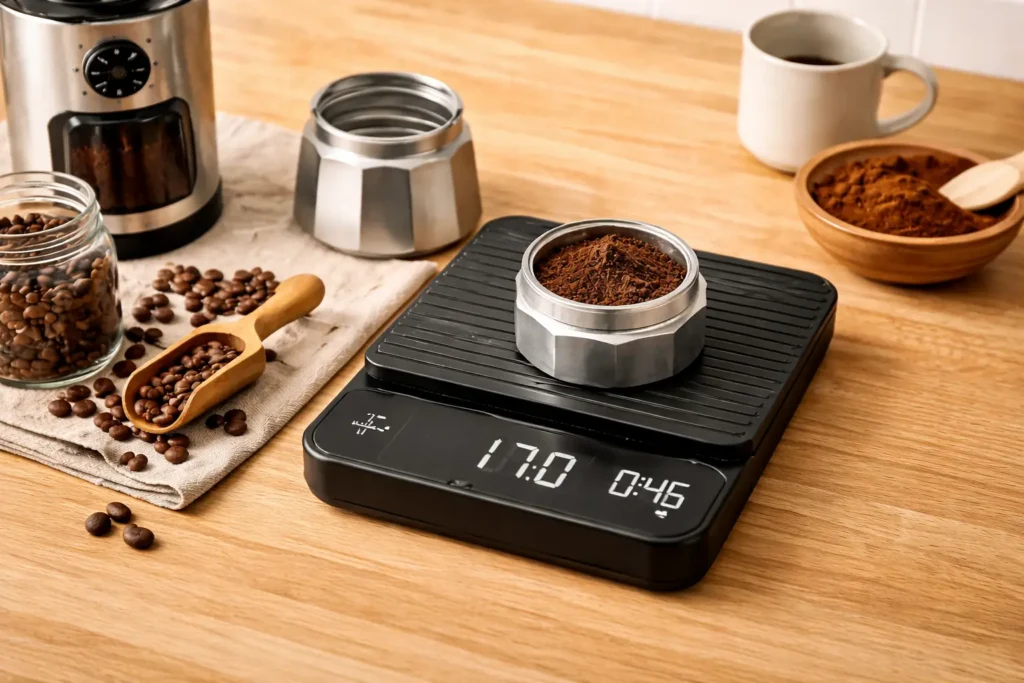
Best for: Anyone who wants consistent concentrate every single morning. A scale removes the biggest source of recipe drift — inconsistent dosing.
The Timemore Black Mirror is the gold standard in affordable coffee scales: 0.1g precision, a built-in timer, USB-C charging, and a clean, readable display with a responsive tare button. It’s fast enough to track pour rates during brewing and accurate enough to resolve the 1–2g differences that meaningfully affect concentrate strength.
You can brew AeroPress concentrate without a scale — but you’ll find it significantly harder to reproduce a great result consistently. The scoop provided with AeroPress introduces too much variability at the fine grind settings used for concentrate. One gram of extra coffee or 5ml of extra water changes the character of the output. A scale removes all of that variability immediately.
- ✅ 0.1g precision — accurate enough for any coffee application
- ✅ Built-in timer — no separate timer needed during brewing
- ✅ USB-C charging with good battery life
- ✅ Slim profile fits neatly under the AeroPress
- ⚠️ Not waterproof — spills need quick attention
Precision: 0.1g | Timer: Built-in | Charging: USB-C | Max weight: 2kg
Affiliate link — we earn a small commission at no extra cost to you. Price subject to change — always check Amazon for the current price. Full disclosure.
Grind Size Guide for AeroPress Espresso Concentrate
Grind size is the variable with the highest impact on concentrate quality. Use this reference chart to find your starting point, then adjust based on taste and press resistance.
| Grind Description | Visual Reference | K6 Clicks (from zero) | Result in Cup | Use This If… |
|---|---|---|---|---|
| Very fine | Powdered sugar | 6–8 clicks | Very slow press, high resistance, likely bitter | Only if you’re using coarser dose or shorter steep |
| Fine (target) | Table salt / fine sea salt | 10–12 clicks ✅ | Rich, intense, good body — correct for concentrate | Starting point for all concentrate recipes |
| Medium-fine | Coarse salt | 14–16 clicks | Lighter body, less intense, slightly sour | If 10–12 clicks produces too much bitterness |
| Medium | Sand | 18–22 clicks | Thin, watery, more like strong coffee than concentrate | Not suitable for espresso concentrate |
💡 Dialing in your grind: Start at 11 clicks on the K6. If press resistance is so high it’s uncomfortable, go to 12–13 clicks. If the concentrate tastes weak or sour, drop to 10 clicks. Always adjust by one click at a time and hold every other variable constant. Most brewers find their permanent setting within 3–4 brews.
Brew Ratio Chart
Espresso concentrate ratio is coffee weight to total water weight. These are the proven ranges for AeroPress concentrate, from a more restrained everyday shot to a full double-strength concentrate for strong lattes.
| Recipe Name | Coffee | Water | Ratio | Yield | Best For |
|---|---|---|---|---|---|
| Lighter concentrate | 15g | 60ml | 1:4 | ~50ml | Solo drinkers, gentle concentration, cortado-style |
| Standard concentrate ✅ | 18g | 60ml | 1:3.3 | ~50ml | Everyday lattes and cappuccinos — best starting point |
| Strong concentrate | 20g | 55ml | 1:2.75 | ~45ml | Large lattes (8–10oz milk), iced lattes that need to stand up to ice dilution |
| Double shot equivalent | 20g | 70ml | 1:3.5 | ~60ml | Two small drinks, sharing, larger milk ratios |
📐 A note on yield: You will always lose some water to absorption by the coffee grounds — typically 2–3ml per gram of coffee. An 18g dose absorbs approximately 35–40ml, so 60ml in produces roughly 20–25ml of liquid concentrate plus the absorbed amount. Add more water if you want a larger yield without changing intensity. Use these numbers as starting points, not exact targets.
Master Recipe: Standard Method AeroPress Espresso Concentrate
This is the go-to recipe for most brewers — reliable, easy to reproduce, and excellent for lattes and cappuccinos. The standard (non-inverted) method is simpler to learn and produces a clean, bright concentrate with good body.
Recipe: Standard AeroPress Espresso Concentrate
AT A GLANCE
☕ Dose: 18g coffee
💧 Water: 60ml at 205°F
⏱️ Total time: ~2 minutes
⚙️ Grind: Fine (K6: 11 clicks)
📐 Ratio: 1:3.3
🫙 Yield: ~45–50ml concentrate
- Heat your water to 205°F (96°C). If you don’t have a thermometer, bring to boil and wait 30 seconds.
- Grind 18g of coffee fine — table salt texture. KINGrinder K6: 11 clicks from zero.
- Rinse the paper filter in the filter cap with hot water, then discard the rinse water. This removes paper taste and preheats the cap.
- Assemble AeroPress in standard position — filter cap on, sitting on your mug.
- Add coffee to the chamber. Tap gently to level the bed.
- Start your timer. Bloom: Pour 40ml of water over the grounds. Stir thoroughly — 8–10 seconds — to saturate every particle. Wait until the 0:30 mark.
- At 0:30, pour remaining water to reach 60ml total. Stir once more.
- At 1:00, begin pressing. Apply slow, steady, downward pressure. The full press should take 20–30 seconds. Stop at the first hiss of air — don’t press through it.
- Total time at finish: 1:20–1:30. Your concentrate is ready.
Inverted Method: More Body, More Control
The inverted method flips the AeroPress upside-down during brewing so the plunger is on the bottom, sealing the chamber. This prevents any dripping through the filter during steep, which gives you complete control over contact time and produces a fuller-bodied concentrate with more intensity. The technique looks more dramatic than it is — after a few brews it becomes second nature.
Recipe: Inverted AeroPress Espresso Concentrate
AT A GLANCE
☕ Dose: 18–20g coffee
💧 Water: 60–70ml at 200°F
⏱️ Total time: ~2:30
⚙️ Grind: Fine (K6: 11–12 clicks)
🫙 Yield: ~50–60ml
🏆 Result: Fuller body, more intense
- Flip the AeroPress upside-down — plunger inserted just 1–2cm into the chamber, opening facing up. Set it on a stable surface.
- Add 18–20g of fine-ground coffee into the inverted chamber.
- Bloom: Pour 40ml of 200°F water, stir 8 seconds, wait until 0:30.
- Pour remaining water to 60–70ml total. Stir once.
- Steep for 1:00–1:30 total from first pour. Longer steep = more body and intensity.
- Attach the rinsed filter cap firmly. Place your mug on top of the AeroPress.
- In one confident movement, flip the entire assembly so the mug is now on the bottom and the AeroPress is above it. The filter cap is now at the bottom, ready to press through.
- Press slowly and steadily over 20–30 seconds. Stop at first hiss.
🔬 Standard vs Inverted — when to use which: Standard method produces a slightly brighter, cleaner concentrate with less risk of spill during the flip. Inverted gives you a fuller, richer body and complete contact time control. If you’re making lattes, either works beautifully. If you want the concentrate to stand up in a 10oz drink with a lot of milk, the inverted method’s extra body helps. New to AeroPress? Start standard and move to inverted once you’re comfortable with the brewer.
Using Your Concentrate: Lattes, Cappuccinos, and Iced Drinks
Once you have ~50ml of AeroPress concentrate, you have the base for any espresso drink. Here’s how to build each one.
| Drink | Concentrate | Milk | Milk Texture | Method |
|---|---|---|---|---|
| Latte | 50ml | 4–5oz | Lightly steamed / frothed — silky, minimal foam | Pour warm or frothed milk over concentrate. Stir gently. |
| Cappuccino | 50ml | 3oz | Equal parts foam and steamed — airy, thick | Froth milk to stiff foam. Spoon foam over concentrate. Dust with cocoa. |
| Flat white | 50ml | 3oz | Microfoam — very silky, no visible bubbles | Use a steam wand or quality frother. Pour over concentrate at an angle. |
| Iced latte | 50ml | 5–6oz cold milk | Cold — no frothing needed | Add ice to glass, pour concentrate, add cold milk. Stir. |
| Americano | 50ml | — | — | Top concentrate with 4–5oz hot water. Add to mug before pressing for best crema retention. |
| Cortado | 50ml | 2oz steamed milk | Lightly steamed, minimal foam | Equal parts concentrate and warm milk. Serve in small glass. |
| Iced batch concentrate | 2–3x recipe | Varies | Cold | Brew, refrigerate up to 5 days. Pull as needed over ice. |
💡 Milk temperature tip: For lattes at home without a steam wand, heat milk in a small saucepan to 150°F (65°C) — hot to touch but not scalding. Then use a handheld frother for 15–20 seconds to introduce texture. This produces a serviceable approximation of steamed milk that works well with AeroPress concentrate. For better results, a dedicated milk frother or Aeroccino makes a meaningful difference.
Troubleshooting Matrix
AeroPress concentrate problems almost always trace back to one of four variables: grind, dose, temperature, or press technique. Use this matrix to identify and fix the issue without rebuilding your whole recipe from scratch.
| Problem | Likely Cause | Fix |
|---|---|---|
| Concentrate tastes bitter or harsh | Grind too fine, water too hot, press too slow, or steep too long | Coarsen grind 1–2 clicks; reduce water temp to 195–200°F; reduce steep time by 15 seconds; press in 20 seconds, not 40 |
| Concentrate tastes sour or thin | Grind too coarse, water too cool, or under-extracted | Fine the grind 1–2 clicks; raise water temp to 202–205°F; extend steep time to 1:30 before pressing |
| Press resistance is very high (nearly impossible to push) | Grind too fine, too much coffee dose, or uneven grounds distribution | Coarsen grind to 12–13 clicks; reduce dose to 16g; stir grounds to level them before pressing |
| Concentrate is too weak / watery | Grind too coarse, dose too low, or too much water used | Fine the grind 1–2 clicks; increase dose to 20g; reduce water to 55ml |
| Concentrate has no body | Standard method + coarse grind — not enough dissolved solids | Switch to inverted method; fine the grind; extend steep to 1:30 |
| Coffee drips through filter cap during inverted method flip | Filter cap not fully tightened or filter not sealed flat | Ensure cap is screwed on firmly; re-rinse and re-seat the filter flat before attaching cap; flip more quickly |
| Concentrate tastes papery | Paper filter not rinsed before brewing | Always pre-rinse filter with hot water and discard rinse water before adding coffee |
| Inconsistent results day to day | Grind size variation, inconsistent water weight, or water temperature variation | Use a scale for both coffee and water; use a temperature-controlled kettle; zero out K6 and re-set click count each time |
| Latte tastes weak even with concentrate | Too much milk for the concentrate volume, or concentrate not strong enough | Reduce milk to 4oz; increase dose to 20g; or reduce water to 55ml for stronger concentrate |
| AeroPress leaks during press | Rubber seal worn or not fully inserted | Replace the rubber plunger seal (available separately); ensure plunger is inserted straight and parallel before pressing |
Practical Decision Guide: Which Setup Is Right for You?
| Your situation | Recommended Setup | Why |
|---|---|---|
| You want to start immediately with what you have | Any AeroPress + blade grinder + tablespoon measure | Works — results will be inconsistent but drinkable. Upgrade to burr grinder when ready. |
| Best concentrate quality, lowest total budget | AeroPress Original + KINGrinder K6 + Timemore scale | This combination produces genuinely excellent concentrate at a fraction of espresso machine cost |
| You travel frequently and want espresso on the road | AeroPress Go + KINGrinder K6 | Everything packs into the travel mug; K6 is lightweight and compact enough for a bag |
| You want to dial in your recipe precisely by sight | AeroPress Clear + KINGrinder K6 + Timemore scale | Clear chamber lets you watch bloom, saturation, and press — useful during recipe development |
| You primarily want lattes and cappuccinos at home | AeroPress Original + KINGrinder K6 + Aeroccino or handheld frother | Concentrate handles the espresso base; dedicated frother handles milk — better than any all-in-one approach at this price |
| You already own an AeroPress and want better consistency | Add KINGrinder K6 + Timemore scale | The two highest-impact upgrades are always grinder and dose accuracy — both deliver immediately |
| You want to make iced lattes in batch | AeroPress Original + any burr grinder + refrigerator container | Brew 3x recipe, refrigerate up to 5 days, pull over ice as needed — the most convenient morning routine possible |
FAQs: AeroPress Espresso Concentrate
Can the AeroPress actually make espresso?
Not technically. True espresso requires 9 bars of sustained extraction pressure. The AeroPress generates roughly 0.35–0.75 bars of manual pressure. What it does produce — using a fine grind and low water volume — is a rich, concentrated coffee that closely mimics espresso’s body and intensity. Specialty coffee professionals call this ‘espresso-style concentrate.’ In lattes, cappuccinos, and iced drinks, the difference from machine espresso is undetectable to most drinkers. Straight shot comparisons side-by-side reveal differences in crema and mouthfeel.
What grind size should I use for AeroPress espresso concentrate?
Use a fine grind — similar in texture to table salt or fine sea salt. Too fine and you’ll get over-extraction (bitter concentrate) and very high press resistance. Too coarse and the concentrate will be thin and sour. On the KINGrinder K6, start at 11 clicks from zero and adjust from there — coarser (12–13 clicks) if the concentrate is bitter or pressing is very difficult; finer (9–10 clicks) if the concentrate tastes weak or sour.
What ratio should I use for AeroPress espresso concentrate?
The standard starting point is 18g of coffee to 60ml of water (approximately 1:3.3). This produces roughly 45–50ml of concentrate. For a stronger, more intense concentrate for large lattes, use 20g to 55ml (1:2.75). For a milder concentrate, use 15g to 60ml (1:4). Always weigh both coffee and water — scoops and eyeballing are too imprecise at these small volumes.
Which AeroPress model is best for espresso concentrate?
All three current AeroPress models — Original, Clear, and Go — produce identical concentrate. The Original is the best value and most practical for home use. The Clear adds a transparent body for visual feedback during brewing, which is useful when dialing in a recipe. The Go is the travel model with a smaller chamber that still handles the concentrate recipe but feels tighter at an 18–20g dose. For home espresso concentrate use, the Original is the default recommendation.
Can I use AeroPress concentrate to make lattes?
Yes — AeroPress concentrate is one of the best ways to make lattes without an espresso machine. Brew 45–60ml of concentrate using a fine grind and 60ml of water, then add 4–5oz of steamed or frothed milk on top. The concentrate has enough intensity and body to stand up to milk without becoming watery. For best milk texture, use a handheld frother, Aeroccino, or steam wand.
Standard or inverted method for AeroPress espresso concentrate?
Both work well. The standard method is simpler, safer (no flip), and produces a slightly cleaner, brighter concentrate. The inverted method allows complete control over contact time with no dripping through the filter during steep, producing a fuller-bodied, more intense concentrate. For new AeroPress users, start with standard. Once you’re comfortable with the brewer, try inverted — most experienced concentrate brewers prefer it for the added body and control.
How much coffee do I use for AeroPress espresso concentrate?
Use 18–20g per serving. This is higher than a standard AeroPress recipe (which typically uses 11–15g) because the goal is maximum concentration in a small water volume. Always weigh with a scale — volume measurements (scoops) vary significantly with grind size and are not reliable enough for a tight recipe like espresso concentrate.
Does AeroPress espresso concentrate have crema?
Sometimes, but not reliably or consistently. AeroPress can produce a small foam layer on concentrate, particularly with freshly roasted beans. This is CO2 outgassing from fresh coffee — not the pressurized emulsification that creates true espresso crema. It dissipates quickly and doesn’t contribute the same flavor and texture as machine crema. Using very fresh beans (7–21 days post-roast) and the inverted method maximizes whatever foam does appear.
How long should I press the AeroPress for espresso concentrate?
Press slowly and steadily over 20–30 seconds. Faster pressing forces water through too quickly and under-extracts. Stop pressing the moment you hear the first hiss of air — this signals you’ve pushed through all the liquid and are now forcing air through the puck, which adds bitterness. Total brew time from first water contact to end of press should be approximately 1:20–1:30 for the standard method and up to 2:30 for the inverted method.
Can I make iced lattes with AeroPress concentrate?
Yes — AeroPress concentrate is excellent for iced lattes. Brew your concentrate and pour it directly over a glass of ice; the small water volume means minimal dilution even over a full ice load. Add 5–6oz of cold milk and stir. Alternatively, brew a triple batch and refrigerate the concentrate for up to 5 days — pull a shot over ice each morning without any brewing. AeroPress concentrate holds up very well refrigerated and doesn’t develop the harsh off-flavors that longer cold-brew methods sometimes produce.
Next Reads
MORE AEROPRESS GUIDES
GRINDERS & GEAR
Curious how AeroPress concentrate compares to what a Moka pot produces? Our full comparison covers extraction method, flavor profile, ease of use, and which is better as an espresso substitute for lattes and milk drinks.
☕
Written by the CoffeeGearHub Editorial Team
CoffeeGearHub is a specialty coffee equipment resource run by home brewers and coffee enthusiasts. Our guides are researched using published brewing science, equipment manufacturer specifications, and hands-on testing across a wide range of brewing methods. We review and update our pillar content regularly. About CoffeeGearHub →