
Last Updated: March 2026 • 30–40 min read • Cornerstone Guide: French Press Brew Guide — Complete Ratio, Grind, Recipe, and Dial-In System
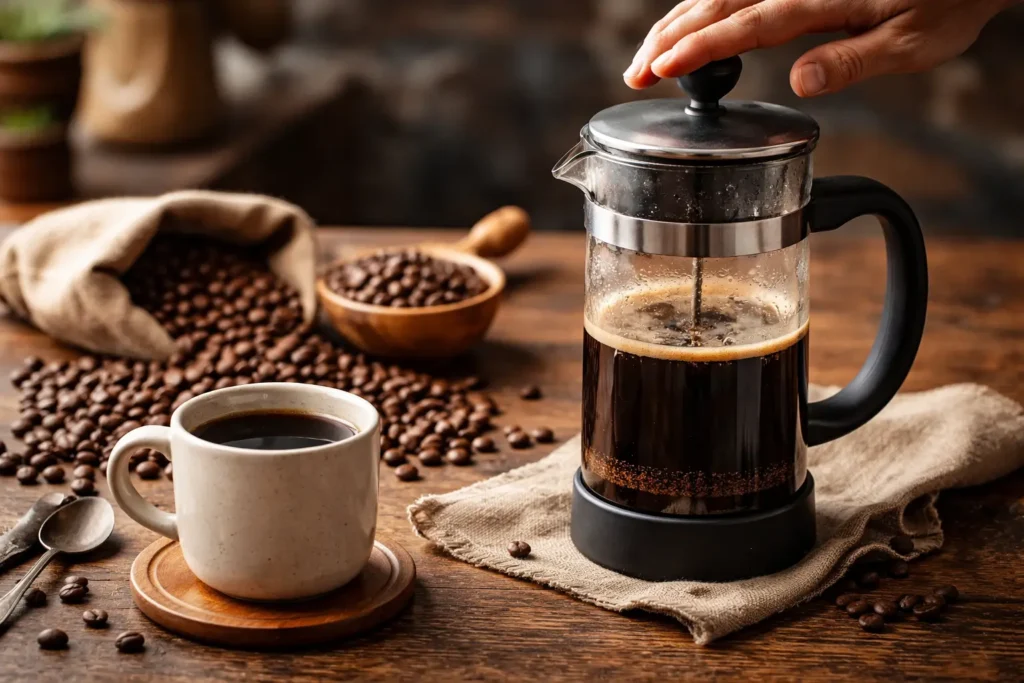
This French press brew guide is all you need. The French press is the most direct way to brew coffee at home — and one of the most misunderstood. It requires only hot water, coarsely ground coffee, and four minutes. It produces a cup that no paper-filter method can replicate: rich, full-bodied, oil-forward, texturally heavy coffee with a depth of flavour that makes it the daily ritual of choice for millions of home brewers worldwide. The problem is that most people brew French press incorrectly — the wrong grind, the wrong ratio, the wrong steep time, or the most common mistake of all: leaving the coffee sitting on the grounds after pressing. The result is bitter, muddy, or weak coffee that makes people abandon the method entirely. This complete CoffeeGearHub brew guide covers every variable that determines the quality of your French press cup: the mechanics of the method, the correct ratio, grind size, water temperature, step-by-step brew process, how to choose the right coffee, and a complete dial-in system so you can fix any problem and refine your cup until it is exactly what you want.
✍️ Editorial note: This guide is researched and written by the editors at CoffeeGearHub.com using published brewing science, SCA brewing standards, grinder manufacturer specifications, and established specialty-coffee community knowledge. Recommendations reflect research consensus and community reputation. All product links are affiliate links — we may earn a commission at no cost to you.
The 30-Second Answer
French press brews best at a 1:15 ratio (30g coffee to 450ml water), coarse grind (K6: 68–72 clicks for medium roast), 93°C water, and a 4-minute steep. Bloom for 30 seconds with a small pour first, then add remaining water, place lid on with plunger raised, and press slowly at 4 minutes. Pour all coffee immediately — do not leave it on the grounds. That is the complete recipe. Everything in this guide teaches you why each step matters and how to adjust when your cup is not where you want it.
- Ratio: 1:15 standard (1g coffee per 15ml water) — adjust ±2g for strength preference
- Grind: Coarse — K6 clicks 65–80 depending on roast level
- Water temp: 93°C (about 30–45 seconds off a full boil)
- Steep time: 4 minutes for medium roast; 4.5–5 min for light; 3.5 min for dark
- Best press: Bodum Chambord — the benchmark home French press
- Best grinder: KINGrinder K6 — covers every French press grind setting precisely
Who This Guide Is For — Jump to What You Need
☕ Complete Beginner
Start with What Makes French Press Different, then go straight to Step-by-Step Brew Instructions. Everything you need is there.
⚙️ Upgrading Your Setup
Jump to Gear Recommendations and Grind Size — the two biggest variables in French press quality, and where most setups fall short.
🔬 Dialling In Your Cup
Go directly to Ratio, Grind Size, and Troubleshooting Matrix. One variable at a time gets you to your ideal cup.
🌱 Choosing Your Coffee
See Choosing Your Coffee and Bean Type Reference Table to match your roast and origin to the French press method.
Table of Contents
What Makes French Press Different: The Brew Mechanics
Understanding how French press works mechanically explains every other decision in this guide — why grind size matters so much, why you must pour immediately after pressing, and why the cup tastes the way it does. French press is fundamentally different from every paper-filter method, and treating it like a drip machine produces disappointing results.
Full Immersion Brewing
French press is a full immersion brew method. Unlike pour-over or drip where water passes through coffee once and drains away, French press submerges all the grounds in hot water for the entire brew period. Extraction happens through diffusion — dissolved compounds migrate from the high-concentration grounds into the surrounding water continuously until you press and separate them. This long, direct contact is what produces the method’s characteristic full body and depth. It also means that if you leave pressed coffee sitting on the grounds, extraction continues past your intended endpoint and bitterness compounds accumulate rapidly.
The Metal Filter Difference
The most consequential difference between French press and every paper-filter method is the metal mesh filter. Paper filters absorb coffee’s natural oils — the lipid compounds cafestol and kahweol that give coffee its body, mouthfeel, and textural richness — and trap them before they reach the cup. The French press metal mesh passes these oils directly into every sip. This is not a flaw; it is the defining characteristic of the method. The heavy body, the tactile weight on the tongue, the way French press holds up under milk — all of it traces back to the metal filter. The trade-off: some fine particles also pass through, producing the small amount of sediment that is normal and expected in a French press cup.
🔬 Why coarse grind is non-negotiable: The metal mesh filter has openings large enough to pass fine coffee particles into the cup. If you grind too fine, you get excessive sediment, a muddy texture, and rapid over-extraction — because fine particles have enormous surface area and release bitter compounds faster than coarse grounds. Coarse grind controls sediment, slows extraction to the correct rate for a 4-minute steep, and allows the plunger to press without resistance. Every other brew method is more forgiving of grind size errors; French press is not. A consistent burr grinder is not optional here — it is the most important piece of equipment in your setup.
What You Need: Gear Checklist and Recommendations
French press is one of the most accessible home brew setups available — the equipment list is short, the total investment is modest, and nothing requires electrical power or maintenance beyond occasional cleaning. The most important purchase decision is not the French press itself; it is the grinder. Everything else is secondary to grind quality.
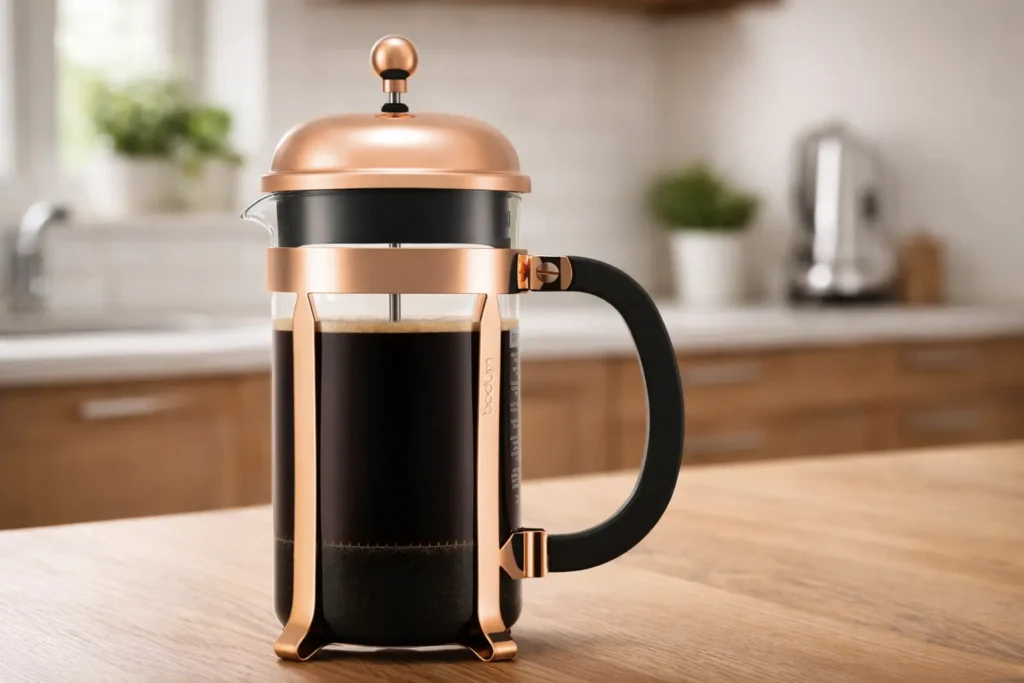
Best French Press: Bodum Chambord
The Bodum Chambord is the benchmark home French press — the design that has defined the category for decades, and the one every other French press is measured against. Its stainless steel frame, borosilicate glass beaker, and three-part stainless mesh plunger assembly produce consistent, clean-pressing results at every brew volume. The three-layer mesh filter is tight enough to significantly reduce fine particle passage without restricting oil extraction — you get the full French press body without excessive grit. The borosilicate glass handles thermal shock, is dishwasher safe, and has none of the plastic off-flavour risk of cheaper alternatives. For most home brewers, the 1L size is the correct choice: large enough for two to three full cups per brew, small enough for a single brewer’s daily use. The 350ml option works for strict single-cup brewers; the 1.5L for households brewing for three or more people regularly.
- Sizes: 350ml (1 cup), 500ml (2 cups), 1L (3–4 cups), 1.5L (5–6 cups)
- Filter: Three-part stainless mesh — minimal sediment, full oil extraction
- Body: Borosilicate glass — dishwasher safe, thermal shock resistant
- Best for: everyday home French press, multiple cups, cold brew
- Brew starting point: 30g coffee / 450ml water (1:15) / 93°C / 4 min steep / K6: 68–72 clicks
Disclosure: CoffeeGearHub may earn from qualifying purchases.
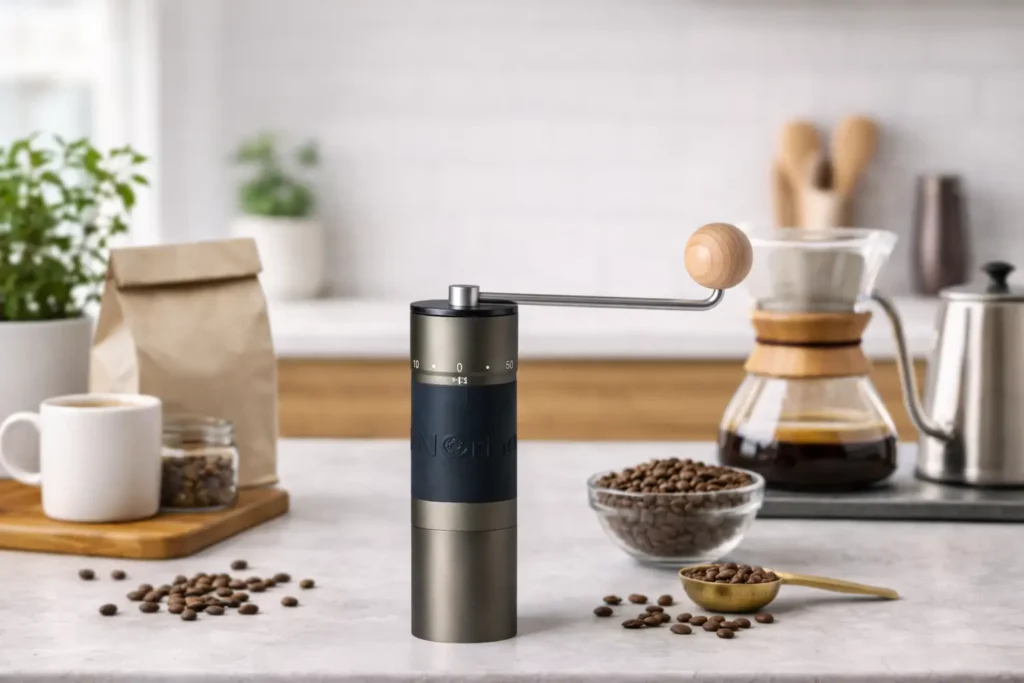
Best Grinder for French Press: KINGrinder K6
The KINGrinder K6 is the CoffeeGearHub standard manual grinder recommendation — and for French press specifically, its coarse-range performance sets it apart from most competitors at the same price. The 100-click adjustment system provides meaningful, reproducible grind steps across the coarse range that French press demands (clicks 65–80), and the 48mm stainless conical burrs produce consistent particle distribution at those settings without the spike of fines that causes muddy cups and excessive sediment. Unlike many burr grinders that excel at espresso-range settings but become inconsistent at coarse, the K6 maintains distribution quality throughout its full range. The all-metal body handles heavy daily doses without degradation, the magnetic catch cup makes loading grounds clean and fast, and the 100-click system doubles as a reliable reference: if you switch methods or beans, you always know exactly where to set for French press.
- French press range: K6 clicks 65–80 — coarse to very coarse immersion grind
- ASIN: B09W9Q7GNK
- Burrs: 48mm stainless conical — consistent distribution at all settings
- Why it matters: blade grinders are incompatible with French press — their uneven output causes simultaneous over- and under-extraction that no recipe adjustment can fix
Disclosure: CoffeeGearHub may earn from qualifying purchases.
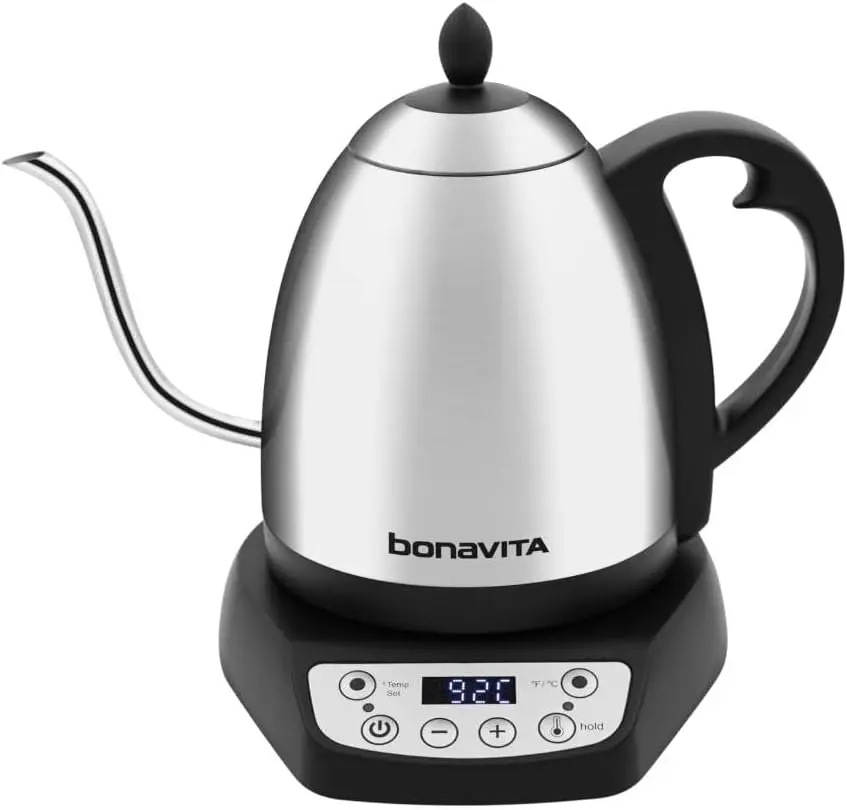
Recommended Kettle: Bonavita 1L Variable Temperature Gooseneck Kettle
A standard kettle works fine for French press — unlike pour-over, you do not need a gooseneck spout to control the pour precisely. But a kettle with variable temperature control eliminates one of the most common French press variables: guessing how long off-boil to let water sit before pouring. The Bonavita 1L Variable Temperature Gooseneck Kettle is the most practical temperature-control kettle at its price point — six preset temperatures (from 60°C to 100°C) cover every brew method in your setup, and the 60-minute Hold mode keeps your target temperature stable until you are ready to pour. For French press, set it to 93°C (200°F) for medium roast and the kettle does the rest. The gooseneck spout provides precise pour control for the bloom stage and is equally useful if you brew pour-over. If you already own a standard kettle, use it — the temperature matters more than the spout shape for French press. If you are buying new, the Bonavita’s temperature control and Hold mode pay for themselves in daily consistency.
- Key feature: 60-minute Hold mode maintains target temperature until you pour
- Temperature presets: 6 settings from 60°C to 100°C — covers French press, pour-over, AeroPress, and green tea in one kettle
- French press temp setting: 93°C (200°F) for medium roast; 96°C (205°F) for light roast
- Capacity: 1L — sufficient for a full 1L French press brew in one fill
- Alternative: Any kettle works — boil and wait 30–45 seconds to reach 93°C without a temperature-control model
Disclosure: CoffeeGearHub may earn from qualifying purchases.
Complete French Press Gear Checklist
| Item | Required? | Notes |
|---|---|---|
| French press | ✅ Essential | Bodum Chambord 1L is the recommended starting point for most brewers |
| Burr grinder | ✅ Essential | KINGrinder K6 is the recommended manual option; blade grinders are incompatible |
| Digital scale (0.1g accuracy) | ✅ Essential | Measuring by weight is non-negotiable for consistent results; any kitchen scale works |
| Kettle | ✅ Essential | Standard kettle works; temperature-control kettle eliminates the guesswork |
| Timer | ✅ Essential | Phone timer works perfectly; no dedicated hardware needed |
| Thermometer | ⚠️ Optional | Useful for learning water temperature; not required once you know your kettle’s off-boil timing |
| Serving vessel | ⚠️ Recommended | Decant immediately after pressing to stop extraction; any mug or carafe works |
Choosing Your Coffee: Roast, Origin, and Freshness
French press is a body-forward, oil-forward brew method. It amplifies richness, chocolate, caramel, and dried fruit notes, and suppresses the high-frequency brightness that paper-filter methods like pour-over express best. This makes some bean types genuinely better suited to French press than others — not because the beans are better or worse, but because they match what the method does well. Choosing the right coffee is as impactful as any brewing variable.
Roast Level
Medium to medium-dark roasts are the optimal range for French press. They produce the most balanced cup in a metal-filter immersion method: enough sweetness and body without the thin, tea-like character that light roasts can produce, and without the one-dimensional bitterness of a very dark roast that has lost its nuanced flavour during development. That said, all roast levels can be brewed in a French press with adjusted parameters — light roasts need a finer grind, higher temperature, and longer steep; dark roasts need a coarser grind, lower temperature, and shorter steep.
Origin and Processing
Natural-processed and honey-processed beans perform exceptionally well in French press. The metal filter passes the fruit esters and fermentation compounds that make naturally processed Ethiopians, Brazilians, and Indonesians distinctive — blueberry, dried cherry, dark chocolate, brown sugar — without the filtering-away of complexity that paper methods cause. Washed process single-origins can be excellent in French press, but their brightness and clarity are somewhat muted compared to how they perform in a pour-over; the body they gain from the metal filter can compensate if they are medium roast with good base sweetness.
Freshness
Buy whole bean and grind immediately before brewing. Ground coffee begins losing volatile aromatic compounds within 15–30 minutes of grinding. The complexity, brightness, and distinctiveness of your coffee — the qualities that justify spending on specialty beans — degrade rapidly once the protective cell structure of the bean is broken. A bag of whole beans stays at peak quality for 2–4 weeks from the roast date when stored in an airtight container away from heat and light. Pre-ground coffee labelled for French press is a usable fallback; buy it fresh and use it within two weeks of opening.

Recommended Coffee: Peet’s Coffee Major Dickason’s Blend
Peet’s Major Dickason’s Blend is one of the most consistently recommended coffees for French press among specialty coffee home brewers — and for good reason. Its multi-origin dark-medium blend is specifically designed for full-immersion brewing: rich, complex, and balanced with notes of dark chocolate, dried cherry, and brown sugar. The blend’s body holds up through the metal filter with authority, producing the kind of deeply satisfying cup that is the whole point of French press. For brewers new to the method who want a reference-quality coffee to calibrate their recipe against, Major Dickason’s is the standard recommendation. Available whole bean in multiple sizes. Peet’s links use our CJ Affiliate relationship.
- Roast: Dark-medium blend — optimised for immersion brewing
- Tasting notes: Dark chocolate, dried cherry, brown sugar, full body
- Best for: everyday French press, milk drinks, cold brew
- Brew starting point: K6: 70–74 clicks / 1:14 ratio / 92°C / 3.5–4 min steep
Disclosure: CoffeeGearHub may earn from qualifying purchases.
For a complete breakdown of the best coffees for French press across roast levels and origins, see our full Best Coffee Beans for French Press guide →
Bean Type Reference: French Press Performance by Coffee Type
| Bean type | French press performance | K6 starting point | Adjust |
|---|---|---|---|
| Medium roast blend | Excellent — balanced, forgiving, wide extraction window | 68–72 clicks | Standard parameters; easiest to dial in |
| Medium-dark blend | Excellent — rich, chocolate-forward, full body | 70–76 clicks | Lower temp to 92°C; watch for bitterness |
| Dark roast | Good — bittersweet, intense; narrow window before over-extraction | 74–82 clicks | 90–92°C; shorten steep to 3.5 min; 1:13 ratio |
| Light roast washed | Moderate — acidity and clarity somewhat muted by metal filter | 62–68 clicks | 95–96°C; 4.5–5 min steep; 1:15–1:16 ratio |
| Natural Ethiopian | Exceptional — fruit esters amplified powerfully through metal filter | 65–70 clicks | 92–93°C; avoid over-extracting the fermentation notes |
| Brazilian / Indonesian | Excellent — earthy, nutty, chocolate-forward; built for immersion | 68–74 clicks | Standard parameters; very forgiving method for these origins |
| Honey process medium | Excellent — balanced sweetness and body; most versatile everyday bean | 66–72 clicks | Standard parameters; consistent results across roasters |
The French Press Brew Guide Ratio
Ratio — the amount of coffee relative to water — is the primary control for brew strength. It is the first adjustment to make when your cup is too strong or too weak, and it is the variable you should dial in before adjusting grind, temperature, or steep time. Always measure by weight in grams, not by tablespoons or scoops: coffee density varies significantly between roasts and origins, making volume measurements unreliable for consistent results.
Standard French Press Ratio: 1:15
The SCA’s Golden Cup standard targets a brew ratio in the 1:15–1:18 range for most filter coffee methods. For French press, 1:15 (1g coffee per 15ml water) is the ideal starting point — it produces a balanced cup with full body and appropriate strength for most medium and medium-dark roasts. Adjust toward 1:13 or 1:14 for a stronger cup; toward 1:16 or 1:17 for a milder cup. Note that French press body and richness come from oils, not just concentration — even a 1:16 French press cup will feel richer and heavier than a 1:15 drip or pour-over cup.
| French press size | Water volume | Coffee dose (1:15) | Coffee dose (1:13 — strong) | Coffee dose (1:17 — mild) | Approximate cups yield |
|---|---|---|---|---|---|
| 350ml (small) | 300ml | 20g | 23g | 18g | 1 standard cup |
| 500ml (medium) | 420ml | 28g | 32g | 25g | 1–2 cups |
| 1L (standard) | 850ml | 57g | 65g | 50g | 3–4 cups |
| 1.5L (large) | 1300ml | 87g | 100g | 76g | 5–6 cups |
🔬 Note on brew volume vs press capacity: The table above shows brew water volume, not total press capacity. A 1L Bodum Chambord holds approximately 1L including the head space above the grounds — use 850–900ml water to leave appropriate room below the mesh filter. Always leave at least 2–3cm of clearance between the water surface and the top of the beaker so the filter sits properly when you press.
Grind Size: The Most Important Variable in French Press
Grind size has a greater impact on French press cup quality than any other variable — more than ratio, more than temperature, more than steep time. Get this right first. Every other adjustment you make is limited by grind quality.
What Coarse Grind Looks and Feels Like
The target grind for French press is coarse — the particles should visually resemble coarse sea salt or rough, uneven breadcrumbs. Individual particles should be large enough to see clearly; there should be minimal dust or powder at the bottom of your grind catch. When you rub a pinch of ground coffee between your fingers, you should feel gritty texture, not silky smoothness. If the grind looks and feels like fine sand or powder, it is too fine for French press.
Why Grind Size Matters So Much for French Press
French press extracts differently from pour-over because there is no continuous fresh water flowing through the grounds — the same water sits in contact with the coffee for the full steep duration. Fine particles have dramatically more surface area than coarse particles and release all their soluble compounds rapidly — resulting in over-extraction of bitter, astringent compounds before you even press. Coarse particles extract more slowly and evenly over the 4-minute window, producing the balance of sweetness, body, and low bitterness that French press is known for. Fines also clog the metal mesh filter, creating back pressure during pressing and pushing more particles into the cup.
KINGrinder K6 Grind Settings for French Press
| Roast level | K6 clicks | Ratio | Water temp | Steep time | Expected result |
|---|---|---|---|---|---|
| Light roast | 62–68 | 1:15 to 1:16 | 95–96°C | 4.5–5 min | Bright, complex, lighter body — origin-forward with tea-like texture |
| Medium roast | 68–72 | 1:15 | 93°C | 4 min | Balanced, full-bodied, caramel and nut — the classic French press cup |
| Medium-dark roast | 70–76 | 1:14 to 1:15 | 92°C | 4 min | Chocolate, brown sugar, heavy mouthfeel — rich and satisfying |
| Dark roast | 74–82 | 1:13 to 1:14 | 90–92°C | 3.5–4 min | Bittersweet, intense, bold — traditional strong press character |
| Cold brew | 78–88 | 1:8 to 1:10 | Cold water | 12–16 hrs (fridge) | Sweet, smooth concentrate — dilute 1:1 over ice before serving |
⚠️ Blade grinder warning: A blade grinder — the propeller-style device that chops coffee — is incompatible with French press. It produces an inconsistent mixture of dust-fine particles and coarse chunks in every grind. The fines over-extract and become bitter; the chunks under-extract and taste sour and weak. Both problems happen simultaneously, producing a cup that tastes muddy, harsh, and confused regardless of your recipe. No grind time adjustment, no sifting, no recipe change fixes this. A burr grinder like the K6 is the single highest-impact upgrade you can make to your French press setup.
Water Temperature
Water temperature affects how quickly soluble compounds extract from coffee grounds. Too hot, and bitter and harsh compounds extract before the coffee’s sweetness and complexity have fully developed; too cool, and under-extraction produces a flat, sour, thin cup. The SCA’s brewing water temperature recommendation of 91–96°C applies to French press — with specific targets varying by roast level.
| Roast level | Target temperature | Off-boil timing (approximate) | Why |
|---|---|---|---|
| Light roast | 95–96°C | 10–15 seconds | Denser cellular structure requires higher temperature for full extraction |
| Medium roast | 93°C | 30–45 seconds | Standard sweet spot — balanced extraction across all compounds |
| Medium-dark roast | 92°C | 45–60 seconds | Slightly lower temp reduces risk of extracting harsh roast-development bitterness |
| Dark roast | 90–92°C | 60–90 seconds | Fragile compounds in dark roasts extract bitter rapidly; lower temp moderates this |
If you do not have a thermometer and are not using a temperature-control kettle, the simplest reliable approach: boil water, remove from heat, and wait 30–45 seconds before pouring for medium roast. This consistently reaches 92–94°C in most kettles at room temperature. For light roast, pour almost immediately. For dark roast, wait 60–90 seconds or longer.
Step-by-Step French Press Brew Instructions
This is the complete standard recipe for a 1L Bodum Chambord with medium roast coffee at 1:15 ratio. Every step is explained so you understand what it accomplishes — not just what to do, but why. See our French Press Coffee Ratio guide
Standard Recipe: Medium Roast, 1L Chambord
- Coffee: 30g whole bean (medium roast)
- Water: 450ml at 93°C
- Ratio: 1:15
- Grind: Coarse — K6 clicks 68–72
- Total brew time: approximately 8 minutes
- Preheat the French press. Pour boiling water into the empty beaker, let it sit 30 seconds, then discard. This prevents the cold glass from pulling temperature out of your brew water during the steep. A cold beaker can drop your water temperature by 5–8°C before extraction even begins.
- Measure and grind. Weigh 30g of whole bean coffee. Grind at K6 68–72 clicks — coarse, resembling rough sea salt. Grind immediately before brewing; do not pre-grind.
- Add grounds to the press. Pour the ground coffee into the preheated (and now emptied) beaker. Zero your scale with the press on it — this allows you to weigh water directly as you pour.
- Bloom pour — 0:00. Start your timer. Pour 60ml of 93°C water evenly over all the grounds — just enough to saturate them completely. You may see the grounds swell slightly or release gas bubbles; this is CO2 degassing from fresh beans. Stir once gently with a chopstick or long spoon to ensure all grounds are wet. Wait 30 seconds.
- Main pour — 0:30. Pour the remaining 390ml of water in a slow, even spiral from outside to centre. Aim to complete the pour by approximately 1:00. Do not rush — a gentler pour means less agitation of the grounds, which reduces sediment in the final cup.
- Place lid, steep — 1:00. Place the lid on the French press with the plunger pulled all the way up. This creates a partial vacuum that helps maintain temperature without extracting more coffee. Set your timer for 3 more minutes (total steep: 4 minutes from the first pour). Leave it entirely alone — no stirring, no peeking.
- Press — 4:00. At 4 minutes, apply slow and steady downward pressure to the plunger. The press should take 20–30 seconds from top to bottom — slow, controlled, even. If you feel strong resistance before the plunger is halfway down, stop and pull back slightly; your grind may be too fine, or grounds may have migrated into the filter. Do not force it. If the plunger drops with almost no resistance, your grind is likely too coarse.
- Pour immediately. The moment the press is complete, pour all the brewed coffee into a serving vessel — a thermal carafe, a large mug, or any separate container. Do not leave coffee in the press. The grounds on the bottom continue extracting even after pressing, and within 5–10 minutes the coffee left in contact with them will become noticeably more bitter. This is the single most common mistake in French press brewing.
✅ Quick reference card: Preheat → Grind → Add grounds → 0:00 bloom (60ml, stir) → 0:30 main pour (390ml) → Lid on, plunger raised → 4:00 press slowly → Pour all immediately. That is the complete recipe in one sentence.
Steep Time Variations
Four minutes is the standard steep time for medium roast French press — but it is not a universal rule. Roast level, grind size, and water temperature interact to determine how quickly extraction reaches its optimal endpoint. The table below shows how steep time adjusts for different scenarios and what to expect from each.
| Steep time | Best for | Expected flavour impact | When to use |
|---|---|---|---|
| 3 to 3.5 minutes | Dark roast; very finely ground medium roast | Reduced extraction — less bitterness, more sweetness, slightly thinner body | If your dark roast cup is too bitter at 4 minutes; try 3.5 min first |
| 4 minutes (standard) | Medium roast; honey process; medium-dark | Balanced — full body, caramel sweetness, low bitterness | The default starting point for most beans and brewers |
| 4.5 minutes | Light roast; very fresh beans with high CO2 | Fuller extraction — more complexity, slightly more body from dense light-roast beans | Light roast consistently tastes flat or underdeveloped at 4 minutes |
| 5 minutes | Light roast at high altitude; coarsely ground light roast | Maximum immersion extraction for light roast — risk of astringency if grind is wrong | Only for light roast where 4.5 min is still flat; adjust grind before adding more time |
🔬 Always pour immediately regardless of steep time. The steep time determines when you press. What happens after pressing is equally important: extraction does not stop at the press — the grounds sitting on the bottom of the beaker continue to interact with the liquid above them. A cup brewed perfectly to 4 minutes and left in the press for 10 minutes tastes significantly more bitter than one decanted immediately. If you are not serving all the coffee at once, pour all of it into a thermal carafe first.
Advanced Tips: Getting More From Your French Press
Once your standard recipe is dialled in — ratio, grind, temperature, and steep time all producing a cup you enjoy — these techniques can take your French press brewing further.
The Hoffmann No-Press Method
James Hoffmann’s 2021 French press technique argues that pressing is optional — and in some cases counterproductive. The method: grind slightly finer than usual, add water, steep for 4 minutes, then allow the surface crust (the floating grounds) to break up and sink for another 4–5 minutes without touching the press. Pour carefully without disturbing the settled grounds. The result is a cleaner cup than standard French press with less sediment, because you are decanting rather than pushing grounds through the filter. The main drawback is that the total brew time roughly doubles. Try it with medium roast beans on a weekend when time is not a constraint — many home brewers find it produces the best cup their French press is capable of.
Cold Brew in a French Press
French press is one of the best home cold brew setups for volume and simplicity. Use K6 clicks 78–88 (very coarse), a 1:8 ratio (e.g. 60g coffee to 480ml cold filtered water), stir well to combine all grounds, and place the lid on with plunger raised. Steep in the refrigerator for 12–16 hours. Press slowly, pour the concentrate into a separate container, and discard or compost grounds. Serve diluted 1:1 with cold water or milk over ice. The resulting concentrate keeps refrigerated for up to 10 days. For more detail, see our full French Press Cold Brew Guide →
Adjusting for Altitude
Water boils at lower temperatures at high altitude — approximately 95°C at 1,500m above sea level and 90°C at 3,000m. This means your “boiling water” is significantly cooler than at sea level, producing under-extraction in standard French press recipes. If you are brewing at altitude and your coffee consistently tastes flat, sour, or thin even with correct grind and ratio, compensate by using water at full boil (rather than waiting off-boil) and extending steep time by 30–60 seconds. A temperature-control kettle set to 93°C removes altitude as a variable entirely.
Cleaning Between Brews for Flavour Clarity
Coffee oils that accumulate in the French press mesh filter over days and weeks turn rancid — and rancid oil contributes a stale, musty, off-flavour to every brew that passes through it. A quick rinse after each brew maintains surface cleanliness; a full disassembly and soap wash once or twice a week keeps the mesh clean at the particle level. Monthly, soak the disassembled plunger assembly in warm water with a small amount of Cafiza or baking soda for 15 minutes to break down accumulated oil. See our full French Press Cleaning Guide → for the complete step-by-step process.
French Press vs Other Brew Methods
Understanding how French press compares to other methods helps you decide whether French press is the right primary method for your setup, and which other brewers complement it well.
| Method | Cup character vs French press | Cleanup | Versatility | Best if you… |
|---|---|---|---|---|
| AeroPress | Cleaner, brighter, less body (paper filter); closer with metal filter | Much easier — under 30 seconds | Higher — espresso-style, iced, cold brew, filter-style | Want fast cleanup and recipe variety; travel frequently |
| Pour-over (V60, Chemex) | Cleaner, brighter, lighter — paper filter strips oils and body | Moderate — discard filter, rinse vessel | Lower — one brew style; no immersion option | Want maximum clarity and origin brightness from light roasts |
| Drip machine | Paper filter removes oils; typically lighter and less textured | Easy — discard filter, wipe carafe | Low for manual control; high for automation | Want hands-free brewing for multiple cups; don’t want to measure |
| Moka pot | More concentrated, more intense, closer to espresso | Moderate — disassemble, rinse three parts | Moderate — stovetop only; no cold brew | Want espresso-adjacent intensity without an espresso machine |
For a complete side-by-side comparison with the AeroPress specifically — including grind reference tables, cleanup comparison, and travel analysis — see our full French Press vs AeroPress comparison guide →
Troubleshooting Matrix: French Press Problems and Fixes
Identify your symptom below. Adjust one variable at a time — changing multiple things simultaneously makes it impossible to know what worked. Always write down what you changed and the result so you can repeat or refine it.
| Symptom | Most likely cause | Fix (in priority order) |
|---|---|---|
| Bitter / harsh / astringent | Over-extraction — grind too fine, steep too long, water too hot, or left on grounds after pressing | 1. Grind 3–5 clicks coarser on K6 → 2. Shorten steep by 30s → 3. Lower water temp by 2°C → 4. Pour all coffee immediately after pressing |
| Sour / sharp / thin | Under-extraction — grind too coarse, steep too short, water too cool | 1. Grind 3–4 clicks finer → 2. Extend steep by 30s → 3. Raise water temp by 2°C → 4. Check dose is correct |
| Weak / watery | Too much water relative to coffee (ratio too high), or under-extraction | 1. Increase dose by 3–5g → 2. Grind 3 clicks finer → 3. Extend steep by 30s |
| Too strong / overwhelming | Too much coffee relative to water (ratio too low) | 1. Reduce dose by 3–5g → 2. Try 1:16 or 1:17 ratio → 3. Grind 2–3 clicks coarser |
| Muddy / gritty / excessive sediment | Grind too fine for metal mesh; blade grinder producing excess fines; pressing too fast | 1. Grind 5+ clicks coarser → 2. Press more slowly and evenly → 3. Upgrade to burr grinder if using blade grinder |
| Flat / hollow / no aroma | Stale beans — aromatic volatile compounds depleted | Buy fresh beans with a roast date visible on the bag; no grind or recipe fix compensates for stale coffee |
| Coffee cools too quickly | Glass beaker losing heat fast; cold ambient temperature | 1. Preheat beaker thoroughly before brewing → 2. Pour into insulated mug or thermal carafe immediately after pressing |
| Strong resistance when pressing | Grind too fine, grounds packed too tightly, or grounds migrated into filter area | 1. Stop and pull plunger back slightly → 2. Apply slow, gentle pressure at an angle → 3. Grind coarser next brew → 4. Ensure plunger is centred |
| Plunger drops with no resistance | Grind too coarse — water flowing through grounds without resistance | Grind 5+ clicks finer next brew; confirm grind is actually coarse and not medium-coarse |
| Fermented / boozy / overpowering natural notes | Over-extraction of fermentation esters in natural-process beans | 1. Shorten steep by 30–45s → 2. Grind 3 clicks coarser → 3. Lower water temp by 2°C |
| Coffee tastes like plastic or rubber | Rancid oil buildup in plunger assembly; cheap plastic French press off-gassing | Deep-clean the plunger assembly (Cafiza soak); consider upgrading to glass or stainless French press |
| Grounds floating to top after pouring water | Normal and expected — fresh beans with high CO2 float during bloom | Not a problem — stir once gently at 30s bloom to resubmerge floating grounds |
FAQs: French Press Brew Guide
What is the best coffee-to-water ratio for French press?
The standard French press ratio is 1:15 — 1g of coffee per 15ml of water. For a typical 450ml brew, this means 30g of coffee. For a stronger cup, use 1:13 or 1:14. For a milder cup, use 1:16 or 1:17. Ratio is the fastest and most reliable way to adjust brew strength — always measure by weight, not by volume, for consistent results.
How coarse should I grind for French press?
French press requires a coarse grind — the particles should resemble coarse sea salt or rough breadcrumbs. On the KINGrinder K6, this is approximately clicks 65–80 depending on roast level. A grind that is too fine will produce bitter, muddy coffee and excessive sediment; too coarse will produce weak, sour, underdeveloped coffee. A consistent burr grinder is essential — blade grinders are incompatible with French press because they produce uneven particle sizes that cause simultaneous over- and under-extraction.
How long should I steep French press coffee?
The standard steep time is 4 minutes for medium roast coffee at 93°C. Light roasts benefit from 4.5–5 minutes at a slightly higher temperature to compensate for their denser cell structure. Dark roasts can be shortened to 3.5 minutes to avoid over-extraction. After pressing, always pour all the coffee immediately — leaving it on the grounds continues extraction and produces bitterness within minutes.
Can I use pre-ground coffee in a French press?
You can use pre-ground coffee in a French press, but quality suffers significantly. Ground coffee degasses and loses volatile aromatic compounds within 15–30 minutes of grinding. If you must use pre-ground, buy a coarse-ground option specifically labelled for French press or cold brew, and use it within 2–3 weeks of the bag’s open date. For the best cup, grind whole beans immediately before each brew.
Why is my French press coffee bitter?
Bitterness in French press coffee is almost always caused by over-extraction. The most common causes in order of likelihood: grind too fine, steep time too long, water temperature too high, or leaving coffee on the grounds after pressing. Fix in this order: grind 3–5 clicks coarser on the K6, shorten steep by 30 seconds, lower water temperature by 2°C, and pour all coffee immediately after pressing.
Why is my French press coffee weak?
Weak or watery French press coffee is caused by under-extraction or too much water relative to coffee. Fix in this order: increase your dose by 3–5g (most immediate fix), grind 3–4 clicks finer, extend steep by 30 seconds, or raise water temperature by 2°C. Also verify you are measuring coffee by weight — a tablespoon of coffee varies significantly in mass depending on grind size and roast level.
Should I stir French press coffee while it steeps?
Stir only at the bloom stage (at 30 seconds) to ensure all grounds are fully saturated. Do not stir during the main 4-minute steep — agitation accelerates extraction unevenly and can cause fine particles to cloud the brew. If you consistently get too much sediment in your cup, reducing stirring and pressing more slowly often helps significantly.
Can I make cold brew in a French press?
Yes — French press is one of the best home cold brew setups available for volume and simplicity. Use K6 clicks 78–88 (very coarse), a 1:8 coffee-to-water ratio, stir thoroughly to combine, and steep in the refrigerator for 12–16 hours. Press slowly, pour the concentrate into a separate container, and dilute 1:1 with cold water or milk over ice when serving. The concentrate keeps refrigerated for up to 10 days.
How do I clean a French press?
After brewing, discard or compost the grounds (a silicone spatula helps). Rinse the beaker with warm water. Disassemble the plunger assembly and rinse all parts separately. Wash with mild dish soap at least twice a week — the metal mesh accumulates coffee oils that turn rancid over time and add off-flavour to every cup. Monthly, soak the disassembled plunger in a solution of warm water and a small amount of Cafiza or baking soda for 15 minutes to break down oil buildup. See our full French Press Cleaning Guide for the complete process.
Does French press coffee have more caffeine than drip?
French press and drip coffee are comparable in caffeine content at equivalent brew volumes and ratios — caffeine extraction efficiency is high in both methods. The perception that French press is stronger comes from its heavier body, oil content, and richer mouthfeel — not significantly higher caffeine. If you want more caffeine, increase your dose (more coffee per volume of water) rather than switching methods.
Continue Learning
FRENCH PRESS DEEP DIVES
Comparing French press with the AeroPress? Our head-to-head guide covers every dimension — brew mechanism, flavour, cleanup, portability, and cost — with the same K6 grind reference tables and gear picks used in this article.
☕
Written by the CoffeeGearHub Editorial Team
CoffeeGearHub is a specialty coffee equipment resource produced by the CoffeeGearHub Editorial Team. Our guides are researched using published brewing science, SCA standards, grinder manufacturer specifications, and established specialty-coffee community knowledge. We review and update our pillar content regularly. About CoffeeGearHub →