
Best Coffee Beans for French Press (2026): Roast-by-Roast Guide + Buyer’s Picks
Editorial standards: this guide compares French-press beans by roast level, freshness, body, acidity, processing style, and how well the coffee suits immersion brewing. Recommendations are based on published product information and brew-method fit unless hands-on tasting is explicitly stated.
At a glance
What this guide covers
Choose beans for French press by the cup profile you want—cleaner and brighter, balanced and sweet, or heavier and darker—then adjust grind, ratio, temperature, and steep time around the roast.
Editorial analysis
French press amplifies body, oils, and roast character
Because a metal filter allows more oils and fine particles into the cup than paper filtration, French press tends to emphasize body and texture. That makes bean choice more obvious—not less important.
Medium and medium-dark coffees are forgiving starting points, while lighter roasts benefit from hotter water and more careful grind control. Freshness still matters regardless of roast.
The 30-Second Answer
Start with a medium or medium-dark whole bean if you want the easiest path to a rich, balanced French press. Lavazza Super Crema is a forgiving everyday reference; Stumptown Hair Bender is the better comparison if you want a brighter specialty-style cup.
Compare current options
Start with these representative choices
These two coffees show the clearest starting split between a fuller everyday profile and a more complex specialty-style French press.
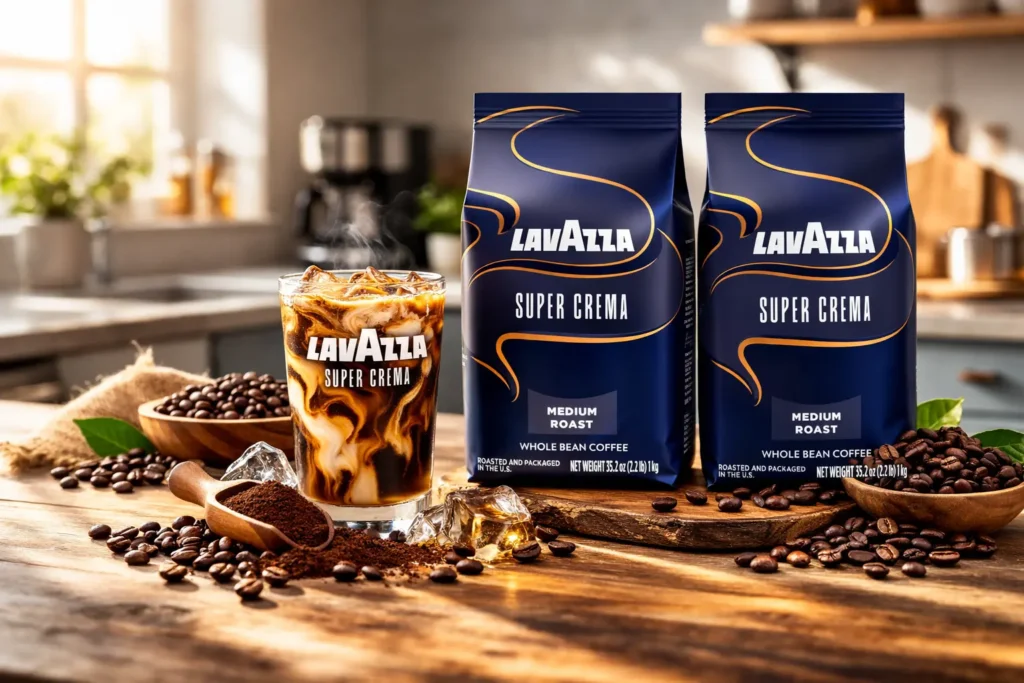
Lavazza Super Crema — Full-Bodied Everyday Choice
A medium-dark blend that emphasizes body, sweetness, and a lower-acidity profile through the French press metal filter.
Best starting point if: it is an approachable reference for drinkers who want a rich daily cup without a demanding dial-in.
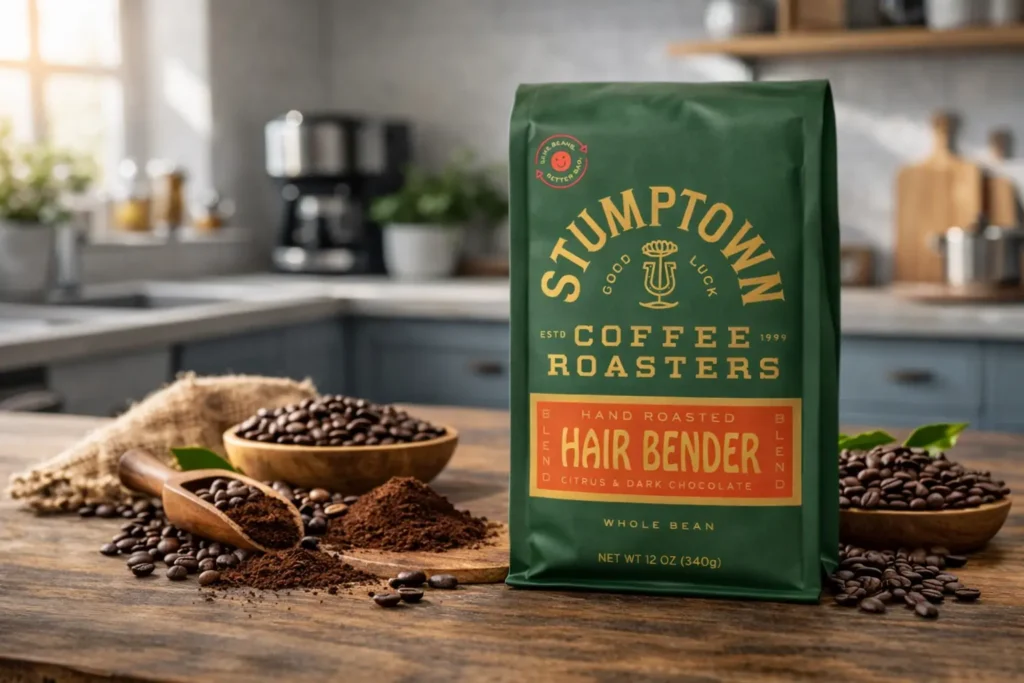
Stumptown Hair Bender — Specialty-Style Choice
A medium-light blend that brings more fruit, acidity, and origin character while still retaining French-press body.
Best starting point if: it suits brewers who want more complexity and are willing to control temperature and grind more carefully.
Affiliate disclosure: Amazon links may earn CoffeeGearHub a commission at no additional cost to you. Prices, sellers, bundles, and availability can change.
Fresh coffee delivery
Want beans delivered on a schedule?
Coffee subscriptions can be useful when freshness and repeat ordering matter more than hunting for a new bag each time. CoffeeGearHub now compares verified recurring-delivery options by brewing style, variety and current merchant offer. Browse verified coffee subscriptions →
What Makes a Good French Press Bean? The Four Variables That Matter
French press is the most direct expression of a coffee bean in liquid form. Unlike espresso, which uses pressure and a paper-free basket but still disciplines extraction with precise grind calibration, or pour-over and drip, which use paper filters that absorb oils and strip body — French press does almost nothing to moderate the bean’s character. The metal filter passes oils, volatile aromatics, fine particles, and everything that defines the coffee’s flavour directly into your cup. That transparency is both French press’s greatest strength and its most unforgiving quality: every variable in the bean — roast level, freshness, processing, density — registers in the cup without softening.
Four variables determine whether a bean excels in French press: roast level, freshness, processing method, and whether it is a blend or single origin. Understanding what each contributes tells you exactly what to prioritise — and why some coffees that perform brilliantly as pour-over produce disappointing French press results from the same bag.
| Variable | Why it matters for French press | What to look for | Common mistake |
|---|---|---|---|
| Roast level | Determines body, solubility, extraction speed in immersion, and flavour profile | Medium to medium-dark for most setups; light roast works well with longer steep and higher temp | Using very dark supermarket beans that over-extract into harsh, bitter, muddy coffee |
| Freshness (roast date) | Aromatic volatiles and sweetness peak between 7–30 days post-roast; staling produces flat, papery cups | Buy bags with a visible roast date; French press is more forgiving than espresso but still freshness-dependent | Buying beans with a best-before date only — can be months or years post-roast |
| Processing method | Natural = heavy body, fruity sweetness, ideal for French press’s oil-preserving metal filter; Washed = clean, bright, lower body | Natural or honey process for full-bodied, complex French press; washed for cleaner, brighter cups | Using a high-acid washed light roast and wondering why French press tastes sharp and thin |
| Blend vs single origin | Blends offer everyday consistency; single origins express terroir powerfully through the unfiltered metal screen | Beginners: start with blends. Experienced: French press is one of the best methods for exploring single-origin naturals | Starting with a delicate washed single origin before understanding how French press amplifies body over clarity |
The metal filter difference: Paper-filter methods (pour-over, drip) absorb coffee oils — specifically cafestol and kahweol, the diterpenes responsible for French press’s distinctive body and mouthfeel. French press retains all of these, which is why the best French press beans are specifically those whose character shows up in the oil fraction: natural-processed beans, full-bodied medium-dark roasts, and single-origin coffees with strong terroir expression. A bean that produces a delicate, transparent pour-over may produce a flat, unremarkable French press. The opposite is equally true.
French Press Roast Level — Master Reference Table
Roast level is the single most important variable in French press bean selection because it determines body, extraction speed in immersion, and how the flavour profile develops over a 4-minute steep. Unlike espresso, where grind adjustment is the primary dial-in tool, French press gives you fewer variables to work with — roast level, grind coarseness, steep time, and water temperature. Getting roast level right narrows the range of everything else. Use this table as your starting reference before selecting any specific bean.
| Roast level | Water temp | Steep time | Grind (K6 clicks) | Ratio | Flavour profile | Best for |
|---|---|---|---|---|---|---|
| Light roast ☀️ | 93–96°C | 4.5–5 min | 128–134 clicks | 1:14 to 1:15 | Fruit, floral, bright acidity, tea-like — light body | Experienced brewers who want complexity and origin clarity |
| Medium-light roast | 93–95°C | 4–4.5 min | 132–139 clicks | 1:15 | Stone fruit, milk chocolate, balanced acidity, medium body | Third-wave exploration; specialty single origins |
| Medium roast 🌤 | 92–94°C | 4 min | 134–144 clicks | 1:15 | Caramel, nuts, mild citrus, round full body — universal sweet spot | Most French press setups — forgiving, versatile, consistent |
| Medium-dark roast | 91–93°C | 4 min | 142–150 clicks | 1:14 to 1:15 | Dark chocolate, brown sugar, low acidity, heavy body | Everyday drinkers; especially good with milk |
| Dark roast 🌑 | 90–92°C | 3.5–4 min | 146–154 clicks | 1:13 to 1:14 | Roasted nuts, bittersweet chocolate, smoky, very low acidity | Traditional strong French press; short steep essential to avoid bitterness |
🔬 K6 click reference: All KINGrinder K6 click settings in this guide are measured from zero (burrs touching). French press is the coarsest end of the K6’s practical range — clicks 128–154 covers the full French press spectrum from medium-coarse to very coarse. These are starting points; individual grinders, bean densities, and freshness vary. Adjust 3–5 clicks at a time for French press — the changes are less dramatic than for espresso but still meaningful. A too-fine French press grind is the single most common cause of muddy, over-extracted coffee.
Best Coffee Beans for French Press: Our Top Picks
These five picks represent the best French press beans across every category and budget — from the reliably excellent everyday medium-dark blend to the complex specialty single-origin natural. Each includes full brew parameters, flavour notes, and a clear explanation of who will get the most from it. All recommendations are for whole bean; pre-ground coffee is almost always too fine for French press and too stale for good flavour. Grind coarse, weigh your dose and water, and use these as your starting parameters before adjusting to taste.
Best Overall: Lavazza Super Crema Whole Bean
Lavazza Super Crema is the easiest recommendation for French press because it delivers everything the method rewards: full body, rich sweetness, low acidity, and an oil-forward flavour profile that comes alive through the metal filter. The 60% Arabica / 40% Robusta blend was engineered for Italian espresso, but that same composition — high lipid content, heavy body, dark chocolate and hazelnut sweetness — makes it exceptional for French press, where those oils pass directly into the cup unimpeded. It dials in quickly, produces an exceptionally rich, full-bodied brew, and performs consistently whether you are making a standard four-minute press or a strong concentrate for an iced coffee. For anyone starting out with French press and wanting immediate, satisfying results, Super Crema is the answer.
- Roast: Medium-dark — hazelnut, brown sugar, dried fruit, smooth bittersweet finish
- Blend: 60% Arabica (Central America, Brazil) + 40% Robusta — rich body, thick mouthfeel
- Brew starting point: 30g coffee / 450ml water (1:15) / 93°C / 4 min steep / K6: 144–148 clicks
- Best for: everyday French press, strong morning cups, cold brew, milk-based drinks
- Note: sold in vacuum-sealed bags — check for a roast date; freshness varies by retailer
Disclosure: CoffeeGearHub may earn from qualifying purchases.
Best Specialty / Complex Cup: Stumptown Hair Bender
Stumptown Hair Bender is arguably the best argument for French press as a specialty brewing method. The multi-origin medium-light blend — typically incorporating Latin America for structure, East Africa for brightness, and Indonesia for body — produces a cup in French press that no paper-filter method can replicate: all the fruit-forward complexity of the East African component passes through the metal filter without losing the Indonesian body that would normally require a longer immersion. The result is a layered, textured, genuinely complex cup — bright citrus on the open, chocolate and caramel through the mid, and a clean, extended finish that lingers. Stumptown roast-dates every bag and ships to order. This is the bean to choose when you want French press to be something more than your morning caffeine delivery.
- Roast: Medium-light — dark chocolate, caramel, citrus zest, stone fruit
- Blend: Multi-origin Latin America + East Africa + Indonesia — layered, complex
- Brew starting point: 30g coffee / 450ml water (1:15) / 94–95°C / 4.5 min steep / K6: 132–138 clicks
- Best for: experienced home brewers, black French press, specialty exploration
- Note: use 94–95°C water — this roast level benefits from higher temperature than medium-dark; roast-dated
Disclosure: CoffeeGearHub may earn from qualifying purchases.
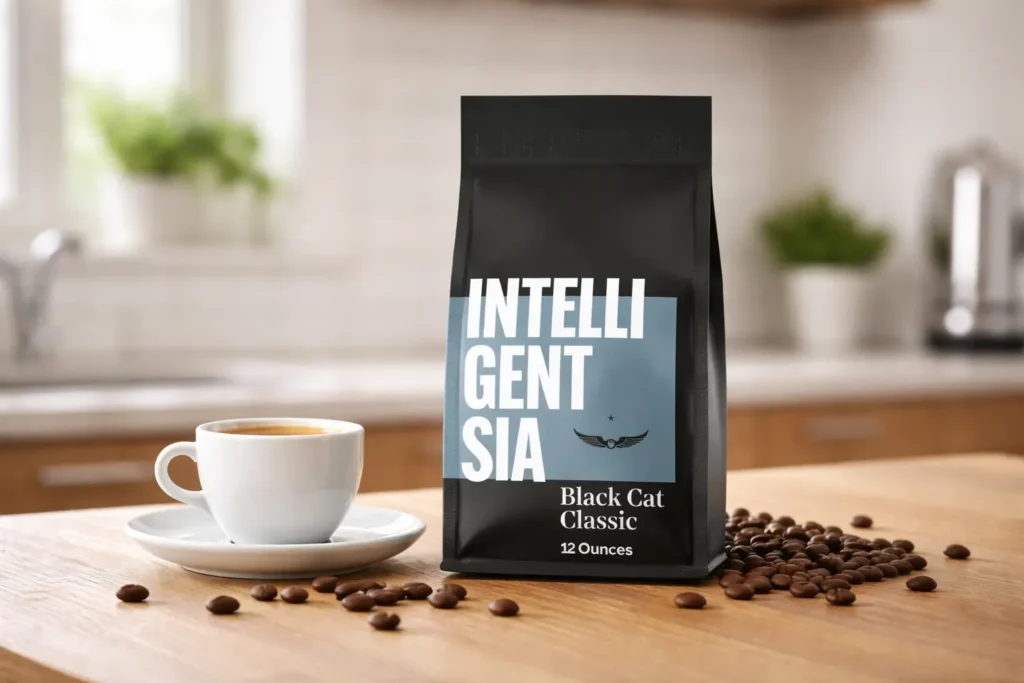
Best for Beginners: Intelligentsia Black Cat Classic
Intelligentsia designed Black Cat Classic for machine-independent consistency — and that same wide extraction window makes it one of the most forgiving French press beans available. The medium roast Brazilian and Central American blend provides sweetness, body, and low acidity without demanding precise water temperature or strict steep timing. Steep it three and a half minutes or four and a half and you get a good cup either way. This is rare in coffee: most beans punish technique variation; Black Cat Classic absorbs it. For anyone who has just bought their first French press and wants cups that taste genuinely good before they’ve mastered ratio, grind, and timing, this is the bean to start with. Every bag ships with a roast date.
- Roast: Medium — milk chocolate, almond, brown sugar, mild fruit sweetness
- Blend: Brazil + Central America Arabica — wide extraction window, beginner-forgiving
- Brew starting point: 30g coffee / 450ml water (1:15) / 93°C / 4 min steep / K6: 138–143 clicks
- Best for: beginners, forgiving steep timing, everyday drinking, milk drinks
- Note: roast-dated; best used 10–25 days off-roast for French press
Disclosure: CoffeeGearHub may earn from qualifying purchases.
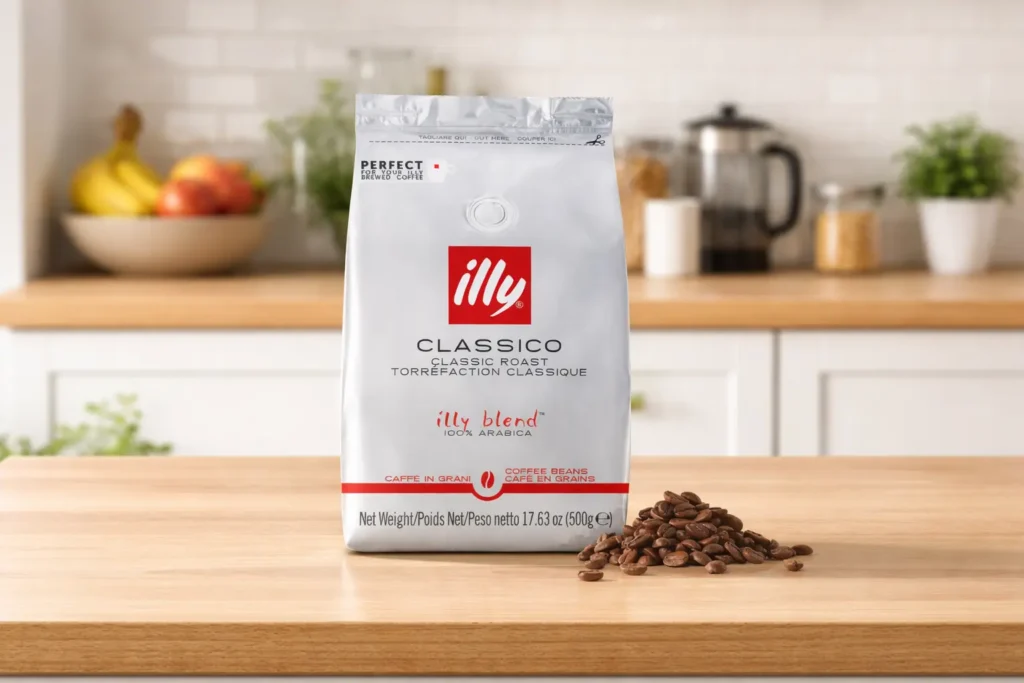
Best Dark Roast French Press: Illy Classico Whole Bean
Illy Classico represents the Italian espresso tradition in bean form — a smooth, low-acid, bittersweet dark-leaning roast whose nine-arabica-origin blend retains sweetness and complexity that most supermarket dark roasts lose entirely. In French press, Illy Classico produces a full-bodied, deeply aromatic cup: dark chocolate, caramel, dried fruit, and a smooth finish that doesn’t tip into harsh phenolic bitterness the way lesser dark roasts do. The critical variable is steep time — keep it under four minutes and use slightly cooler water (90–92°C) to stay in the sweet spot between rich extraction and bitterness. Illy’s pressurised nitrogen-flushed can preserves freshness significantly better than a standard bag, making it one of the only non-roast-dated coffees worth buying for home use.
- Roast: Medium (dark by specialty standards) — dark chocolate, caramel, dried fruit, low acidity
- Blend: 9-origin 100% Arabica — Italian-tradition house blend; pressurised freshness can
- Brew starting point: 30g coffee / 420ml water (1:14) / 91°C / 3.5–4 min steep / K6: 147–151 clicks
- Best for: traditional strong French press, milk drinks, classic dark roast drinkers
- Note: pressurised can = extended shelf stability; open cans within 2 weeks once unsealed
Disclosure: CoffeeGearHub may earn from qualifying purchases.
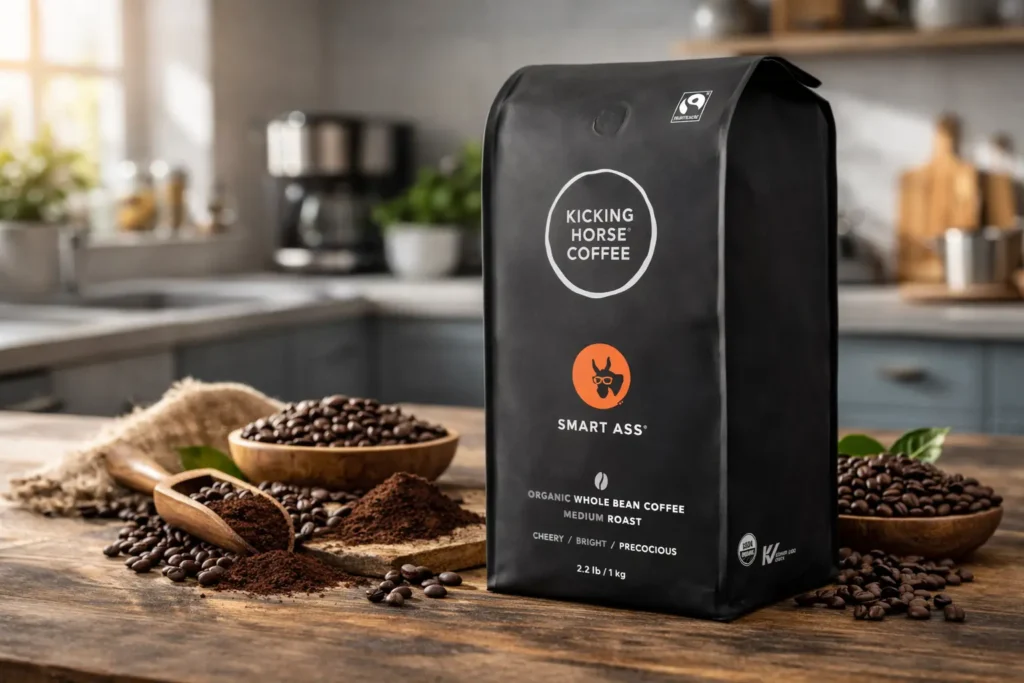
Best Budget French Press Bean: Kicking Horse Cliff Hanger
Kicking Horse Cliff Hanger punches well above its price point in French press — the Fairtrade, organic sourcing certification filters out the lowest-quality commodity lots, and the medium-dark roast profile is exactly the body-forward, low-acid character that French press rewards. At this price, the competition is mostly pre-ground supermarket coffee with no roast date and months of staleness baked in. Cliff Hanger, by contrast, is a whole bean product with a roast date and genuine cocoa, molasses, and dark fruit flavour that holds up through a four-minute immersion without tipping into bitterness. For anyone building a home French press setup on a budget, or looking for a high-turnover everyday bean, this is the starting point.
- Roast: Medium-dark — cocoa, molasses, dark fruit, smooth clean finish
- Blend: Fairtrade certified Arabica, multi-origin — approachable, reliable, full body
- Brew starting point: 30g coffee / 420ml water (1:14) / 92°C / 4 min steep / K6: 144–149 clicks
- Best for: budget home setup, high-volume daily drinking, milk-based drinks
- Note: widely available at grocery stores — always check the roast date when buying in-store
Disclosure: CoffeeGearHub may earn from qualifying purchases.
Roast Level Deep Dives: Light, Medium, and Dark French Press
Each roast level interacts with French press immersion brewing differently. Understanding how roast affects extraction speed, oil content, and flavour progression over a 4-minute steep explains why the brew parameters differ, what symptoms to expect when your steep is off, and how to correct them — before you change your bean.
☀️ Light Roast French Press
Light roast in French press is a more nuanced experience than the same bean brewed as pour-over. The metal filter preserves oils that would otherwise be stripped by paper, adding body to what is naturally a light-bodied roast — but the dense cell structure and high acidity still require careful parameter management. Higher water temperature and longer steep time are essential: light roast beans resist extraction in cold or short steeps, producing a watery, sour cup that doesn’t represent the bean’s quality.
Parameters: 93–96°C, 4.5–5 min, 1:14 to 1:15 ratio, coarse-medium grind (K6: 128–134 clicks)
- Signs of under-extraction: sharp sourness, watery body, pale colour
- Signs of over-extraction: bitterness overrides acidity, astringent finish, dark muddy brew
- Fix weak/sour: raise temp 1–2°C + extend steep 30s + grind 3 clicks finer
- Fix bitter: grind 3–4 clicks coarser + shorten steep 30s
🌤 Medium Roast French Press
Medium roast is the universal French press sweet spot for the same reason it is for most brew methods: cell structure is sufficiently broken down for clean immersion extraction, oils are abundant without being dominant, and the balance between acidity, sweetness, and bitterness sits in the widest window of any roast level. A standard 4-minute steep at 93°C with a 1:15 ratio produces a consistently excellent cup with minimal adjustment required. Medium roast is also the most forgiving of grind variation — a few clicks coarser or finer produces noticeable but manageable flavour shifts rather than dramatic failures.
Parameters: 92–94°C, 4 min, 1:15 ratio, coarse grind (K6: 134–144 clicks)
- Signs of under-extraction: sour, thin, hollow body, watery cup
- Signs of over-extraction: drying bitterness, muddy, dark sediment in cup
- Fix sour: grind 3 clicks finer + extend steep 20–30s
- Fix bitter: grind 3 clicks coarser + reduce steep 20–30s
🌑 Dark Roast French Press
Dark roast beans are porous and extract quickly in immersion — which means the four-minute standard steep that works perfectly for medium roast will over-extract a dark roast into bitterness and harshness. The traditional approach to dark roast French press involves slightly lower water temperature, slightly shorter steep time, and a very coarse grind to slow extraction and avoid the harsh phenolic and ash notes that dominate over-extracted dark roast. Brewed correctly, a quality dark roast French press is rich, full-bodied, bittersweet, and deeply aromatic — a genuinely different and legitimate experience.
Parameters: 90–92°C, 3.5–4 min, 1:13 to 1:14 ratio, very coarse grind (K6: 146–154 clicks)
- Signs of under-extraction: flat, lifeless, thin — rare with dark roast
- Signs of over-extraction: ashy, harsh, dry, bitter — extremely common at medium-roast parameters
- Fix bitter: grind 4–5 clicks coarser + reduce steep by 30s + drop temp 2°C
- Fix flat: grind 3–5 clicks finer only — do not raise temperature
🔬 Roast and oil science: Roasting progressively breaks down the bean’s cell walls, releasing CO2 and moisture and converting green coffee’s lipid structures into the aromatic compounds — caramelisation products, Maillard reaction browning compounds, and volatile esters — that define roast character. Darker roasts produce more porous beans with greater surface area and faster extraction. In French press specifically, roast level also determines how much of the diterpene oils (cafestol and kahweol) are available to pass through the metal filter. Darker, more porous roasts release these oils faster, producing heavier body and higher lipid content — which is why dark roast French press has a richer, heavier mouthfeel than the same bean made as pour-over with a paper filter.
Single Origin vs Blends for French Press: Which Is Right for You?
French press is arguably the best method in the home coffee toolkit for exploring single-origin coffees. The metal filter preserves the oils that carry origin-specific flavour compounds, while the extended immersion gives those compounds full time to dissolve into the cup. A natural-processed Ethiopian single origin in a French press produces a cup that tastes genuinely different from any other coffee you have ever had — jammy, fruit-forward, complex, and aromatic in ways that filter coffee can only approximate. That said, the same transparency that makes single origins exciting in French press also makes blends more consistent and reliable for everyday use.
| Espresso Blends (in French Press) | Single Origin French Press | |
|---|---|---|
| Flavour profile | Engineered balance — designed to taste good across a range of brew variables | Origin-forward — expressive, distinctive, can be polarising |
| Consistency | High — blend components offset seasonal variation in any single origin | Lower — flavour changes each harvest; crop year and processing matter |
| Dial-in difficulty | Low — wider sweet spot, more forgiving of imprecise grind or steep time | Moderate — narrow sweet spot for peak flavour; grind and steep time changes produce noticeable shifts |
| Best origin types | N/A — blends by design | Natural Ethiopian, Brazilian natural, Colombian honey — all exceptional in French press |
| Metal filter benefit | Good — oils add body and sweetness to already full-bodied blends | Excellent — origin oils preserved fully; terroir character comes through with maximum intensity |
| Recommended for | Beginners, daily drinkers, milk-based drinks, anyone wanting consistent results | Experienced brewers, black French press, specialty exploration, weekend brewing |
Processing Method: How Washed, Natural, and Honey Affect French Press
Processing method is especially consequential for French press because the metal filter passes everything the bean’s cherry-derived compounds produce — fruit sugars, fermentation esters, and all the oils that paper-filtered methods strip away. The difference between a washed and natural processed bean in French press is more dramatic than in almost any other brew method. Understanding what each process produces helps you match the bean’s character to what you want in the cup.
Washed (Wet Process)
Cherry pulp removed before drying; bean ferments in contact with water. Result: clean, bright, transparent flavour with pronounced acidity and origin clarity. The bean’s intrinsic terroir character comes through without fruit-pulp influence. In French press, washed beans produce a cleaner, brighter cup than naturals — but the metal filter still preserves more body than a paper-filtered washed coffee would.
- French press character: bright, clean, pronounced acidity, origin clarity
- Body: light to medium — improved vs pour-over but still lighter than natural
- Best for: complex black French press; origin exploration; high-clarity light roasts
- Milk drinks: lighter body can get diluted under milk — use a stronger ratio (1:13)
Natural (Dry Process)
Cherry dries whole around the bean — fruit sugars ferment directly into the bean. Result: heavy body, intense fruit character (blueberry, strawberry, tropical), lower acidity, exceptional sweetness. Natural processed beans are the highest-reward category for French press — the method’s oil-preserving metal filter amplifies every quality that natural processing develops. A natural Ethiopian in a French press is one of the most distinctive cups in home coffee.
- French press character: fruity, syrupy, complex — maximum body and sweetness
- Body: very full — the heaviest, most texturally distinct French press cup
- Best for: black French press; milk drinks (holds up exceptionally); weekend specialty brewing
- Caution: over-steeping produces fermented, boozy, or vinegary off-notes quickly
Honey (Pulped Natural)
Pulp removed but varying amounts of mucilage left on the bean during drying. Result: a middle ground between washed clarity and natural sweetness — round, sweet, moderate acidity, full body. Honey processed beans are perhaps the most consistently satisfying French press option for everyday drinking, balancing enough complexity for black coffee enjoyment with enough body and sweetness to work well under milk.
- French press character: balanced, sweet, approachable complexity, solid body
- Body: medium-full — the most consistent everyday French press option
- Best for: everyday French press; versatile across black and milk drinks
- Note: most consistent single-origin option for French press beginners
Freshness and Roast Date: The Most Overlooked Variable in French Press
French press is more forgiving of bean age than espresso — immersion brewing at lower pressure means CO2 degassing is less disruptive to extraction, and the longer steep time compensates for some loss of aromatic volatiles. But freshness still matters enormously in French press, because the method’s transparency amplifies whatever the bean offers — including the flat, hollow, cardboard character of stale coffee. Understanding the freshness curve tells you when to brew and when to pass on a bag without a roast date.
| Days post-roast | CO2 level | French press performance | What you’ll taste |
|---|---|---|---|
| 0–5 days | Very high | Acceptable — better than espresso at this stage, but still inconsistent | Aggressive CO2 bloom disrupts steep; slightly hollow body; can taste grassy or herbal |
| 5–10 days | Elevated | Good — improving quickly | Aromatic complexity beginning to open; body building; noticeable bloom on pour |
| 10–30 days | Optimal | Peak performance | Maximum sweetness, aromatic depth, body, and crema — the target brewing window |
| 30–45 days | Declining | Good — minor staling beginning | Still excellent for everyday brewing; mild reduction in aromatic complexity and sweetness |
| 45–70 days | Low | Acceptable — noticeable staling | Flatter cup, reduced sweetness, slight cardboard at the finish — noticeable vs fresh |
| 70+ days | Depleted | Poor — stale | Flat, hollow, papery, muddy — no amount of grind or steep adjustment will improve this |
⚠️ Freshness red flags: Any bag without a roast date (only a best-before date) is almost certainly more than 60 days off-roast at time of purchase. Supermarket grocery store coffee without a one-way degassing valve on the bag was typically packed after the coffee had already partially staled. Neither is automatically disqualifying at the dark-roast end of the spectrum — Illy’s pressurised nitrogen can is the principal exception — but in all other cases, a visible roast date is the single most reliable indicator of bean quality. Order directly from specialty roasters when possible: most ship within 1–3 days of roasting, which means your beans arrive at the 3–5 day mark and hit peak window during your first week of use.
Arabica vs Robusta for French Press
The Arabica vs Robusta question plays out differently in French press than in espresso. Without the pressure-driven extraction that forces Robusta’s oils and crema-producing compounds into the cup rapidly, the qualities Robusta adds to an espresso blend — thick persistent crema, extreme body intensity — are less pronounced in immersion brewing. That said, Robusta’s higher lipid content and caffeine concentration still contribute meaningfully to French press body and intensity, which is why some traditional Italian French press blends include a small Robusta percentage. Most specialty home brewers use 100% Arabica for French press.
| 100% Arabica | Arabica + Robusta Blend | 100% Robusta | |
|---|---|---|---|
| Body in French press | Light to very full depending on roast/origin/processing | Full to very heavy — elevated lipid content amplified by metal filter | Extremely heavy, thick, almost syrupy — harsh flavour |
| Flavour | Complex, sweet, fruit/nut/chocolate range — highly origin-dependent | Rounded intensity; less acidity; robust body | Earthy, rubbery, harsh — not recommended for home use |
| Caffeine | ~1.2–1.5% caffeine by weight | ~1.5–2% depending on Robusta % | ~2.7% caffeine — very significantly stronger |
| Best for | Specialty French press, complex black coffee, single origin exploration | Traditional strong French press, morning cup, milk drinks | Not recommended for home French press |
| Recommended % | 100% | 80–90% Arabica / 10–20% Robusta is typical for blends like Lavazza Super Crema | Avoid |
Extraction Science: How Immersion Brewing Works — and What Your Bean Choice Changes
French press is an immersion brew method — ground coffee steeps in contact with water for a fixed period, and extraction happens through diffusion rather than pressure or flow. This is fundamentally different from espresso (pressure-driven) or pour-over (gravity flow), and it means the extraction variables that matter most are different. Understanding the science of immersion extraction explains why French press responds differently to roast level and processing than other methods — and why some troubleshooting advice for espresso or pour-over fails completely when applied to French press.
- Diffusion drives extraction — not pressure or flow rate: In immersion brewing, dissolved compounds move from areas of high concentration (the ground coffee) to low concentration (the water) through diffusion. This is slower and more uniform than pressure-driven extraction, which is why French press is more forgiving of grind variation than espresso. Coarse grind slows diffusion by reducing surface area; fine grind accelerates it. The coarse grind for French press is not a stylistic preference — it is a calibration choice to match the 4-minute steep time to the rate at which compounds dissolve at the target temperature.
- The metal filter changes which compounds reach your cup: Unlike paper-filter methods (pour-over, drip, AeroPress with paper), French press passes all coffee oils into the cup — specifically cafestol and kahweol, the diterpene lipids that create French press’s characteristic heavy body and mouthfeel. These compounds dissolve into oil droplets suspended in the brew. This is why bean choice for French press should weight oil content (roast level and natural processing) more heavily than for paper-filter methods — and why the same beans brewed as pour-over will taste lighter, brighter, and less full-bodied than in French press.
- Extraction continues after plunging if you leave coffee on the grounds: Plunging the French press compresses the grounds but does not stop extraction — dissolved compounds continue to diffuse through the brew liquid as long as it remains in contact with the compressed puck. If you pour immediately after plunging, this is negligible. If you leave a French press pot sitting for 10–15 minutes after plunging, the brew will continue to extract and become noticeably more bitter. Always pour into a separate carafe or cups immediately after plunging.
🔬 Why weight-based ratios beat scoops for French press: The standard advice to use “two tablespoons per six ounces of water” is a widely propagated recipe that ignores the dramatic variation in coffee density between roast levels. A tablespoon of a light-roasted, dense bean weighs significantly more than the same volume of a porous dark roast. The density difference between a light roast and a dark roast can be 15–20% — meaning a tablespoon-based recipe that works perfectly for one bean will be dramatically weaker or stronger for another. Weighing in grams (coffee) and millilitres (water) removes this variable entirely. Always weigh. A 1:15 ratio is 1g of coffee per 15ml of water — a 350ml press uses 23g of coffee, a 600ml press uses 40g.
Brew Guide: The Standard French Press Recipe + How to Adjust It
The French press brew method is simpler to execute than espresso or pour-over, but it still rewards a methodical approach. These parameters represent the SCA-informed starting baseline — adjust one variable at a time based on your results, and write down what works. Once you have found the correct grind setting for a given bean, the same setting will reproduce consistently with the same steep time and ratio.
Standard Baseline Recipe
- Dose: 30g coffee (weighed)
- Water: 450ml just off-boil (93°C)
- Ratio: 1:15 (1g coffee per 15ml water)
- Grind: K6 at 139–144 clicks (medium roast starting point)
- Bloom: Pour 60ml, stir, wait 30s
- Full pour: Add remaining 390ml; place lid (plunger up)
- Steep: 4 minutes total (including bloom)
- Plunge: Slowly over 20–30 seconds; pour immediately
Taste the result. Adjust only one variable before the next brew.
Taste → Adjustment Order
- Cup tastes sour / watery: grind 3–4 clicks finer → re-brew
- Cup tastes bitter / harsh: grind 3–4 clicks coarser → re-brew
- Grind adjusted but still sour: extend steep 30s + raise temp 1–2°C
- Grind adjusted but still bitter: shorten steep 30s + lower temp 1–2°C
- Balanced but too weak: increase dose by 3g; do not change water amount
- Balanced but too strong: reduce dose by 3g; do not change water amount
- Too much sediment in cup: grind 3–5 clicks coarser; improve plunge technique
Rule: one variable per brew. Always. Write everything down.
French Press Grind Settings: KINGrinder K6 Reference
The KINGrinder K6’s 60-clicks-per-rotation adjustment system gives you fine enough control for French press calibration — 3–5 click changes at the coarse range (clicks 128–157) produce meaningful, reproducible changes in extraction and cup clarity. The table below covers the full French press spectrum organised by roast level and brew style, from a medium-coarse specialty light roast to a very coarse dark roast concentrate for milk drinks.
| French press style | Roast | K6 clicks | Steep time | Ratio | Flavour target |
|---|---|---|---|---|---|
| Specialty light roast | Light | 128–134 | 4.5–5 min | 1:14 to 1:15 | Bright, complex, fruit-forward, tea-like — maximum origin clarity |
| Medium roast standard | Medium | 134–144 | 4 min | 1:15 | Balanced — caramel, nut, round body, mild sweetness |
| Medium-dark everyday | Medium-dark | 142–150 | 4 min | 1:14 to 1:15 | Chocolate, brown sugar, full body, low acidity |
| Dark roast traditional | Dark | 146–154 | 3.5–4 min | 1:13 to 1:14 | Bittersweet, rich, heavy — traditional strong French press |
| Milk drink concentrate | Medium / Medium-dark | 130–136 | 4.5 min | 1:10 to 1:12 | Intense, full-bodied base that holds up under steamed milk |
| Cold brew French press | Medium-dark / Dark | 148–158 | 12–16 hrs cold | 1:8 to 1:10 | Sweet, heavy, cold-brew character — serve over ice diluted 1:1 |
| Coarse / clarity-focused | Any | 148–157 | 4.5–5 min | 1:15 | Lower sediment, cleaner cup — less body but clearer flavour |
⚠️ K6 French press note: French press is the coarsest end of the K6’s practical range, and at these settings the grinder requires minimal effort — 18–30g grinds in under 60 seconds at clicks 134–152. The grind quality at French press settings is excellent for a burr grinder in this price class: particle size distribution is consistent enough to produce clean, controlled extraction without the excess fines that cheaper blade grinders produce. If your French press tastes muddy or gritty despite a coarse setting, check the burr alignment rather than adjusting coarser — a well-aligned K6 at 142–147 clicks produces notably cleaner cups than most grocery-store pre-ground coffee.
Best Beans by Cup Style and Strength Preference
Not all French press drinkers want the same cup. The rich, full-bodied 4-minute classic press is the standard, but the method is versatile — it produces an excellent cold brew concentrate, a strong milk-drink base, and everything in between. The bean characteristics that make a transcendent black single-origin press may overwhelm under milk; the body-forward blend that makes a perfect cappuccino base can taste one-dimensional in a clean black cup. Match the bean to the cup.
| Cup style | Best roast | Best processing | Recommended beans | Why |
|---|---|---|---|---|
| Black French press (classic) | Medium to medium-dark | Natural or honey | Lavazza Super Crema, Intelligentsia Black Cat | Full body, sweetness, and depth translate directly into a satisfying black cup |
| Specialty black press | Light to medium-light | Washed or honey | Stumptown Hair Bender | Complexity, origin clarity, and fruit notes shine through the metal filter |
| Strong / dark cup | Dark | Any | Illy Classico, Kicking Horse Cliff Hanger | Dark roast with short steep at coarse grind delivers intensity without bitterness |
| Milk-based drinks (latte/cappuccino base) | Medium-dark | Natural | Lavazza Super Crema, Kicking Horse Cliff Hanger | Robusta component + natural processing produces enough body and intensity to stand up to milk |
| Cold brew (French press method) | Medium-dark to dark | Natural | Kicking Horse Cliff Hanger, Lavazza Super Crema | Sweetness and body survive cold extraction and dilution; high-acid beans become too sharp cold |
| Weekend specialty exploration | Light to medium-light single origin | Natural Ethiopian or Colombian honey | Stumptown Hair Bender or local specialty roaster natural | French press is the best method for exploring what natural-process oils taste like unfiltered |
Troubleshooting Matrix: French Press Bean + Brew Symptoms → Fixes
Identify your symptom below. Confirm whether the cause is bean-related or technique-related before changing your beans — most French press problems are grind, steep time, temperature, or freshness issues that a different bean won’t fix.
| Symptom | Most likely cause | Fix (in order) |
|---|---|---|
| Always bitter regardless of grind | Beans too dark for your steep time/temperature, or beans too stale | Lower temp 2°C → shorten steep 30s → grind 4 clicks coarser → check roast date (discard if 70+ days) |
| Always sour / watery regardless of grind | Grind too coarse, steep too short, or light roast with too-low temperature | Grind 4 clicks finer → extend steep 30s → raise temp 2°C (especially for light roast) |
| Flat / hollow / no aroma | Stale beans — aromatic volatiles depleted | Buy fresh beans with a roast date — no other fix for this |
| Muddy / gritty / heavy sediment in cup | Grind too fine for French press, or grinder producing too many fines | Grind 5+ clicks coarser → improve plunge technique (slow, even pressure) → consider upgrading to a quality burr grinder |
| Bitter AND muddy in same cup | Grind too fine + steep too long — double over-extraction | Grind significantly coarser (5–8 clicks) + shorten steep by 1 minute → re-brew |
| Thin body despite correct ratio | Grind too coarse (insufficient extraction), or washed light roast in French press | Grind 4 clicks finer → increase dose by 3g (ratio 1:13) → try a medium-dark or natural-processed bean for body |
| Good first brew, worse subsequent brews from same bag | Bean freshness declining — bag exposed to air after opening | Store beans in an airtight container away from light and heat — not the fridge; use within 3–4 weeks of opening |
| Natural/fruity bean tastes boozy, fermented, or vinegary | Over-extraction of fermentation esters — steep too long or grind too fine | Shorten steep 30–45s → grind 3 clicks coarser → lower temp 1–2°C for natural-processed beans |
| Light roast under-extracts no matter what | Water temperature too low for dense light roast cell structure | Raise to 95–96°C → extend steep to 5 min → grind 3 clicks finer → check thermometer accuracy |
| Correct parameters but cup changed between bags of same bean | Different crop year / seasonal variation in same blend SKU | Regrind 3–5 clicks finer or coarser and re-brew — seasonal lots vary in density; use same parameters as starting point and adjust |
Where to Buy French Press Beans: Supermarket vs Specialty Roaster
Where you buy your French press beans affects freshness almost as much as which beans you choose. The supply chain between roasting and your grinder can add weeks or months to a bag’s age before it reaches you. Understanding the difference between supermarket, online retail, and direct-from-roaster purchases helps you get the freshest possible coffee at each price tier.
Direct from Roaster
The freshest possible beans — most specialty roasters ship within 48 hours of roasting. Roast date is always visible. Costs more per bag but you get full flavour potential. The clear recommendation for any light or medium roast single origin.
- ✅ Maximum freshness — arrives at peak window
- ✅ Roast date always present
- ❌ Higher cost; 2–3 day delivery wait
Amazon / Online Retail
Freshness varies significantly by seller — Amazon-fulfilled stock of high-turnover brands (Lavazza, Illy) can be very fresh; third-party marketplace sellers are less reliable. Always check product listings for a roast date before ordering. Best for established blends with high sell-through rates.
- ✅ Convenient; competitive pricing on major brands
- ⚠️ Freshness variable — always verify roast dates
- ❌ Specialty roasters rarely sell direct on Amazon
Supermarket
Acceptable for high-turnover Italian blends (Lavazza, Illy, Kicking Horse) that move quickly enough to stay reasonably fresh. Fine for medium-dark and dark roast French press where 30–45 day freshness is less critical. Avoid bags without a roast date for specialty or light roast use.
- ✅ Immediate availability; lowest price
- ⚠️ Freshness often unknown; roast date may be absent
- ❌ Very limited specialty single-origin selection
Essential Gear: Grinder and French Press Recommendations
Even the best French press beans underperform in the wrong equipment. The two most important pieces of gear for home French press are a consistent coarse-capable burr grinder and a well-built French press with a tight-fitting metal filter. Here are our core recommendations for each.
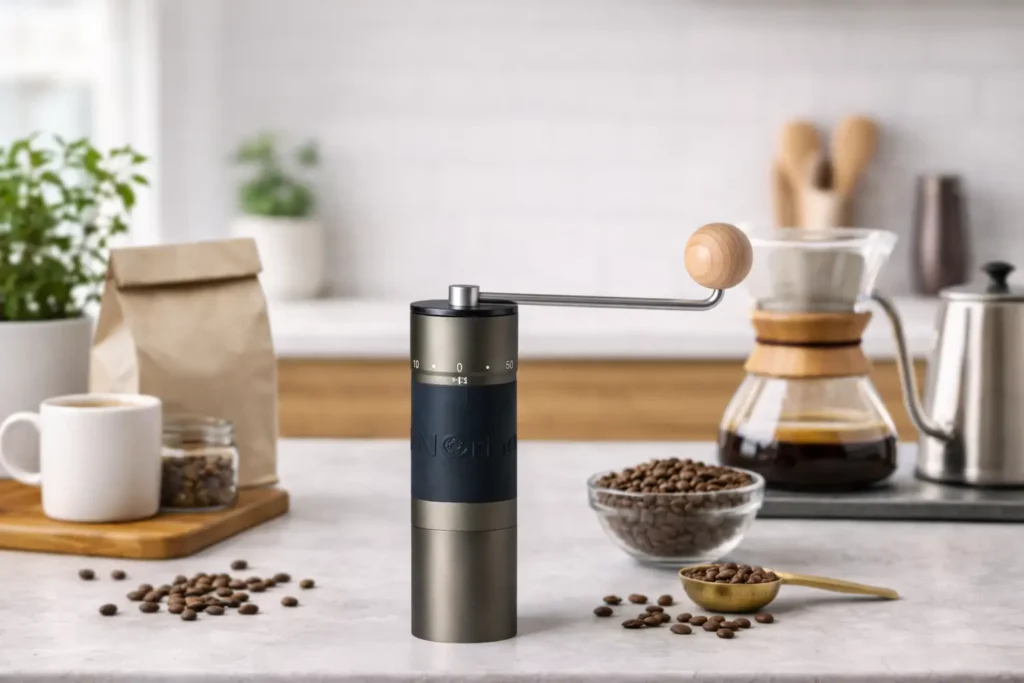
Best Manual Grinder for French Press: KINGrinder K6
The K6 is our standard manual grinder recommendation across all CoffeeGearHub brewing content — and for French press specifically it is exceptionally well-suited. At the coarse settings used for French press (clicks 128–157), the K6 requires minimal effort — a 30g dose grinds in under 60 seconds — and produces a consistent coarse particle size with low fines generation that translates directly into cleaner, better-extracted cups. The 60-clicks-per-rotation adjustment system gives you precise, reproducible control: a 5-click change at French press settings produces a meaningful but measured change in extraction, making it easy to fine-tune your recipe without overshooting. For anyone who wants excellent French press without the cost or counter space of an electric grinder, the K6 is the tool.
- 60 clicks per rotation (about 16 microns per click) — 5-click changes at French press range produce clean, readable extraction shifts
- 48mm stainless conical burrs — low fines at coarse settings means cleaner, less muddy French press
- All-metal body — durable for daily 30–40g French press doses
Disclosure: CoffeeGearHub may earn from qualifying purchases.
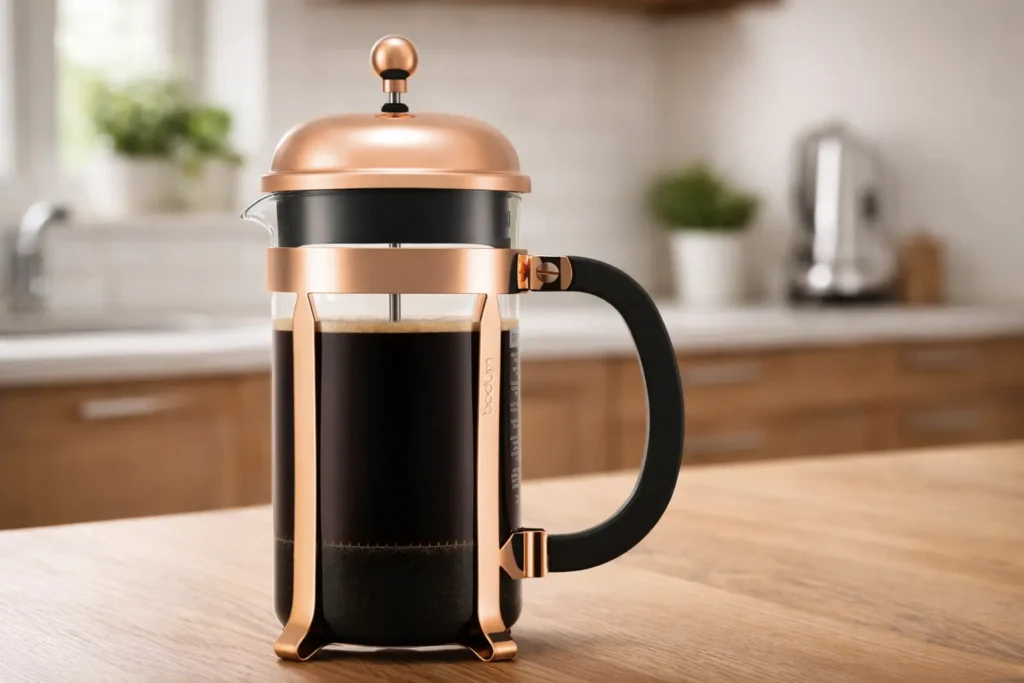
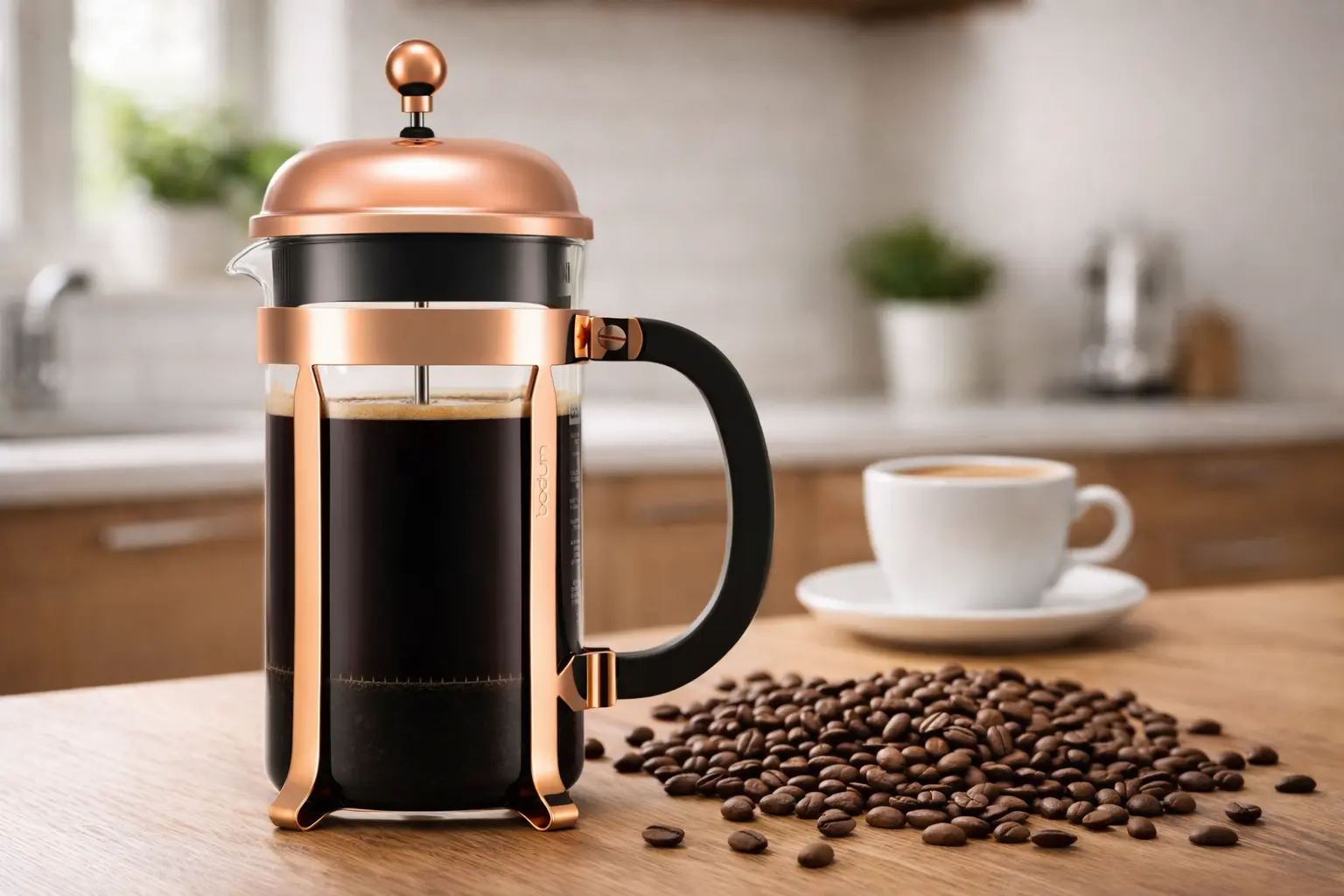
Best French Press: Bodum Chambord
The Bodum Chambord is the benchmark French press for home use — the design that every other French press is measured against. Its stainless steel frame, borosilicate glass beaker, and three-part stainless mesh filter assembly produce a well-filtered, consistently clean cup at any brew volume. The tight mesh filter reduces sediment passage without impeding oil extraction — meaning you get the full body and mouthfeel of French press without excessive grit in the cup. Available in 350ml, 500ml, 1L, and 1.5L sizes. For most home users, the 1L is the optimal choice — large enough for two generous cups or one very large serving, small enough that grounds don’t compress too deeply or steep unevenly. The Chambord is also exceptionally easy to clean, which matters for a daily-use device.
- Three-part stainless mesh filter — low sediment without sacrificing body or oil extraction
- Borosilicate glass beaker — thermal shock resistant; dishwasher safe
- Multiple sizes: 350ml, 500ml, 1L, 1.5L — choose based on how many cups you brew per session
Disclosure: CoffeeGearHub may earn from qualifying purchases.
⚠️ Important: The Bodum Chambord Amazon link above needs to be updated with the verified affiliate ASIN for your Amazon Associates tag (coffeegearhub-20) before publishing. Bodum Chambord 1L is ASIN B00008XDR8 — replace the link with https://amzn.to/[your-shortlink]?tag=coffeegearhub-20 or use the correct shortened affiliate link from your Associates dashboard.
Quick Reference: French Press Bean Cheat Sheet
Bookmark this table for your brew station. All parameters are starting points — adjust grind first (3–5 clicks at a time), then steep time, then temperature. Ratio adjustments come last.
| Bean | Roast | Temp | Dose | Water | Steep | K6 clicks | If sour → | If bitter → |
|---|---|---|---|---|---|---|---|---|
| Lavazza Super Crema | Med-dark | 92–93°C | 30g | 450ml | 4 min | 144–148 | Finer 3 clicks | Coarser 3 clicks + −1°C |
| Stumptown Hair Bender | Med-light | 94–95°C | 30g | 450ml | 4.5 min | 132–138 | Finer 3 clicks + raise temp | Coarser 3 clicks + shorten steep |
| Intelligentsia Black Cat | Medium | 93°C | 30g | 450ml | 4 min | 138–143 | Finer 3 clicks | Coarser 3 clicks |
| Illy Classico | Medium (dark) | 91°C | 30g | 420ml | 3.5–4 min | 147–151 | Finer 3 clicks + extend steep | Coarser + −2°C + shorten steep |
| Kicking Horse Cliff Hanger | Med-dark | 92°C | 30g | 420ml | 4 min | 144–149 | Finer 3 clicks | Coarser 3 clicks + −1°C |
Final Takeaway
Roast level first, freshness second, processing method third. A medium to medium-dark whole bean with a roast date between 10 and 30 days old will outperform any stale “premium” blend in a vacuum-sealed supermarket brick, every time. Start with Lavazza Super Crema or Intelligentsia Black Cat if you’re new to French press — both are forgiving of technique variation and produce consistently excellent cups across a wide range of brew parameters. Once you can reliably produce a balanced 4-minute press, explore natural-processed single origins: French press is the best method in the home toolkit for experiencing what unfiltered origin oils taste like in the cup. Weigh your coffee and water. Grind coarse and consistently. Pour immediately after plunging. Your beans are the foundation — give them the grinder and freshness they deserve and French press will reward you with some of the most satisfying coffee a home setup can produce.
FAQs: Best Coffee Beans for French Press
What are the best coffee beans for French press?
What roast is best for French press coffee?
What grind size is best for French press?
How much coffee do I use for French press?
How long should you steep French press coffee?
Can you use any coffee beans for French press?
Are natural processed beans better for French press?
Why does my French press coffee taste bitter?
Why does my French press coffee taste weak or watery?
Should I use single-origin or blend beans for French press?
Reference check
Sources and Verification
Coffee blends, origins, roast profiles, and retail availability can change. Check the current roaster listing and roast date on the bag before buying.
- Current brand and roaster product information for the coffees discussed in this guide.
- Specialty coffee references for immersion brewing, grind size, water temperature, and extraction fundamentals.
CoffeeGearHub product shortlist
Compare related CoffeeGearHub product pages
Use these supporting gear pages to compare specifications and current verified merchant offers before leaving the site.
Continue Learning
French press fundamentals
Compare methods and coffee
In this guide
- The 30-Second Answer
- What Makes a Good French Press Bean? The Four Variables That Matter
- French Press Roast Level — Master Reference Table
- Best Coffee Beans for French Press: Our Top Picks
- Roast Level Deep Dives: Light, Medium, and Dark French Press
- Single Origin vs Blends for French Press: Which Is Right for You?
- Processing Method: How Washed, Natural, and Honey Affect French Press
- Freshness and Roast Date: The Most Overlooked Variable in French Press
- Arabica vs Robusta for French Press
- Extraction Science: How Immersion Brewing Works — and What Your Bean Choice Changes
- Brew Guide: The Standard French Press Recipe + How to Adjust It
- French Press Grind Settings: KINGrinder K6 Reference
- Best Beans by Cup Style and Strength Preference
- Troubleshooting Matrix: French Press Bean + Brew Symptoms → Fixes
- Where to Buy French Press Beans: Supermarket vs Specialty Roaster
- Essential Gear: Grinder and French Press Recommendations
- Quick Reference: French Press Bean Cheat Sheet
- Final Takeaway
- FAQs: Best Coffee Beans for French Press
- Sources and Verification
- Continue Learning