Last Updated: March 2026 • 30–35 min read • Cornerstone Guide: French Press Ratio Science + Dial-In System + Cup-Size Calculator + Gear Picks
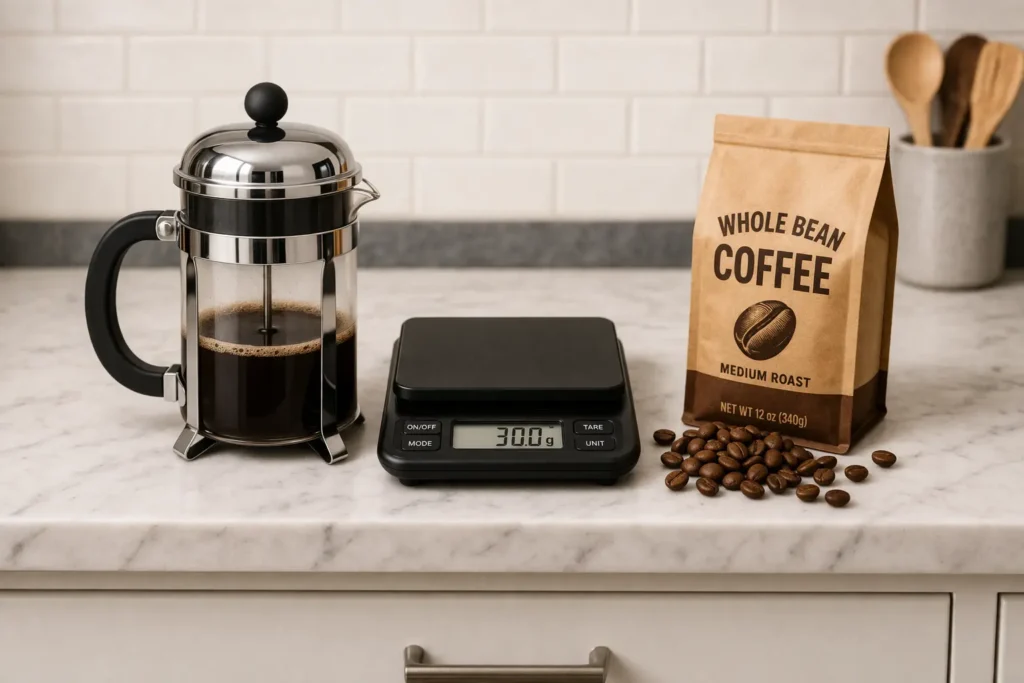

The French press coffee ratio — the relationship between how much coffee you use and how much water you add — is the single biggest variable that determines whether your French press produces a rich, full-bodied cup or a weak, flat, or muddy one. Most people brewing French press at home use too little coffee, the wrong grind size, or both, and then wonder why their cup never quite tastes like the cafe version. The fix is simple: the right ratio, the right grind, and a scale to keep both consistent. This complete guide covers the correct ratio for every French press size and preference level, how to calculate your exact dose for any brew volume, why grind size and ratio interact in ways that matter, a dial-in system that finds your perfect cup in 2–3 brews, and the specific gear picks that make consistency easy and automatic.
✍️ Editorial note: This guide is researched and written by the editors at CoffeeGearHub.com using published brewing science, SCA Brewing Standards, and established specialty-coffee community knowledge. All product links are affiliate links — we may earn a commission at no cost to you. Affiliate Disclosure: CoffeeGearHub.com participates in the Amazon Services LLC Associates Program. As an Amazon Associate, we earn from qualifying purchases.
The 30-Second Answer
Start at 1:13 — 1 gram of coffee for every 13 grams of water. For a standard 2-cup French press (350ml), that is 27g of coffee. For a full 8-cup press (1 litre), that is 77g. Use a coarse grind, steep for 4 minutes at 93–96°C, and press slowly. If the cup is too strong, move to 1:15. If it is too weak, move to 1:12. Keep grind size and steep time fixed while you adjust ratio — one variable per brew.
- Sweet spot: 1:13 — full body, rich flavour, the French press target zone
- Lighter preference: 1:15 — brighter, cleaner, more clarity in the cup
- Stronger preference: 1:11 to 1:12 — bold, intense; excellent base for milk drinks
- Grind: coarse — sea salt texture; never fine or medium-fine
- Steep time: 4 minutes; decant immediately after pressing
- Always weigh — tablespoon measurements vary by up to 40% depending on roast level and density
Jump to What You Need
☕ Just need the numbers
Go straight to the Cup Size Calculator and the Ratio Reference Table.
☕ Coffee tastes weak or bitter
Jump to the Troubleshooting Matrix — every symptom mapped to the specific fix.
🔧 Want to dial in properly
See the Dial-In System for the 2–3 brew process that locks in your perfect ratio.
🛒 Need better gear
Jump to Gear Picks — French press, grinder, and scale recommendations at every level.
Table of Contents
Why Ratio Matters More Than Any Other French Press Variable
French press is an immersion brewer — the coffee sits in direct contact with all the water for the entire steep time. This makes ratio the most immediately impactful variable in the cup, more so than for flow-through methods like pour over or drip. In a drip machine, the water passes through the grounds progressively; a slightly off ratio produces a slightly off cup. In a French press, every gram of coffee is in contact with every gram of water from the first second to the last — the ratio sets the cup’s fundamental concentration before anything else, and changing it by even 2–3 grams produces a clearly noticeable difference in body, strength, and flavour.
This is why French press is simultaneously forgiving and demanding. Forgiving because the method handles a wide range of ratios without failing — you can brew at 1:10 for a bold concentrate or at 1:17 for a gentle, light cup and both are technically valid. Demanding because within that range, small changes produce big effects, and many home brewers land somewhere in the middle that produces a flat, mediocre cup simply because they never deliberately chose a ratio at all. The most common French press problem is not bad technique — it is inconsistent, unmeasured dosing that produces a different cup every morning from the same beans.
⚠️ Common mistake: adjusting steep time to fix strength problems. If your French press is too weak, use more coffee (lower the ratio). If it is too strong, use less coffee (raise the ratio). Steep time fixes extraction issues — sourness and under-development — not strength. Using a longer steep to make weak coffee stronger produces bitter, over-extracted coffee at the same weak ratio. Fix the ratio first.
The French Press We Recommend
Before ratios can make a difference, you need a French press with a consistent, well-sealing plunger and a filter that performs predictably at coarse grind settings. The Bodum Chambord is the CoffeeGearHub standard recommendation — it has been the benchmark for home French press brewing for decades and the one against which all other designs are measured.
Disclosure: CoffeeGearHub may earn a commission on qualifying purchases through affiliate links on this page, at no cost to you. Our recommendations are editorially independent.
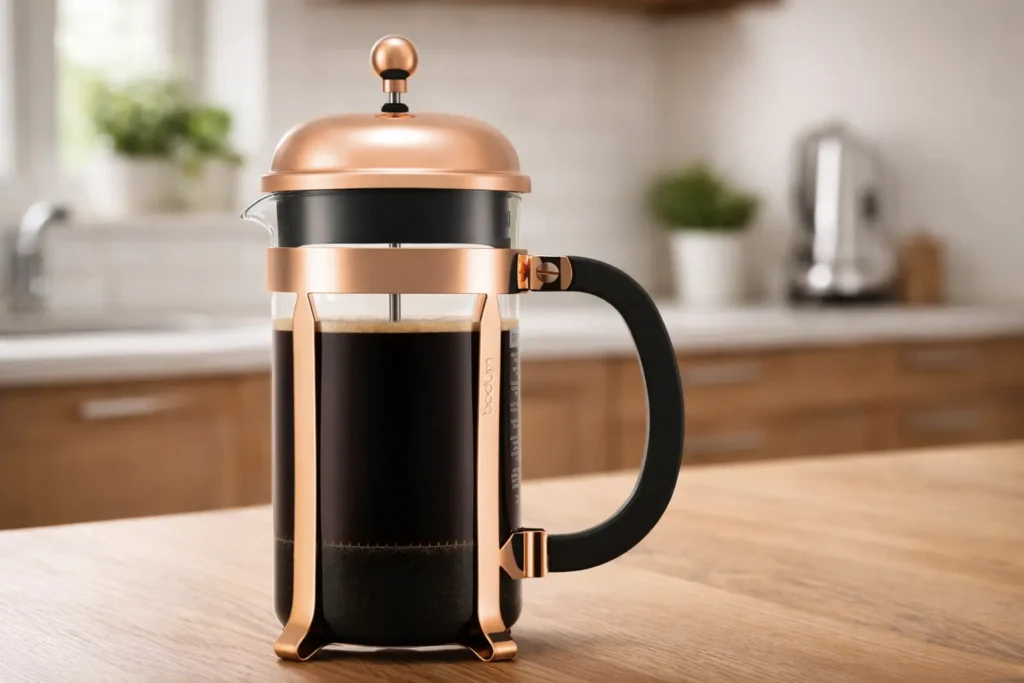
CoffeeGearHub Standard Pick: Bodum Chambord French Press
The Bodum Chambord is the French press that every ratio guide and brewing tutorial benchmarks against — and for good reason. The stainless steel frame and heat-resistant borosilicate glass handle temperature consistently, the three-part stainless filter produces the clean plunge action that immersion brewing requires, and the tight lid-to-carafe seal keeps heat in during the 4-minute steep. Available in 3-cup (350ml), 4-cup (500ml), 8-cup (1L), and 12-cup (1.5L) sizes — every size in the cup size calculator below is calibrated for the Chambord.
- Available sizes: 3-cup (350ml), 4-cup (500ml), 8-cup (1L), 12-cup (1.5L)
- Filter: three-part stainless mesh — consistent plunge; allows body-producing oils through
- Why it matters for ratio: consistent filter resistance means your 4-minute steep produces the same result every time — no variable plunge pressure distorting your recipe
- Best for: everyday home French press brewing; the correct choice at any ratio from 1:10 to 1:17
Disclosure: CoffeeGearHub may earn from qualifying purchases.
The French Press Ratio Formula
French press ratio uses the same calculation as every other brewing method: coffee in grams divided by water in grams. All the maths reduces to one formula — memorise it and you can calculate any recipe on the fly for any size brewer.
Water (g) = Coffee (g) × Ratio number
Coffee (g) = Water (g) ÷ Ratio number
Example 1: You are brewing 500ml (500g water) in a 4-cup press at 1:13. Coffee needed = 500 ÷ 13 = 38.5g (round to 39g).
Example 2: You have 30g of coffee and want to brew at 1:15. Water = 30 × 15 = 450g.
🔬 Why grams and not millilitres? Water density is approximately 1g/ml at brewing temperatures, so grams and millilitres are effectively interchangeable for water. Using grams for both coffee and water means one scale measures everything — no separate measuring jug needed. Always tare (zero) your scale before adding water to the press.
French Press Ratio Reference: From Light to Strong
These are calibrated starting points for the French press’s immersion brewing mechanism. French press ratios sit lower (more coffee per ml of water) than pour over and drip ratios because the metal filter retains oils and body-producing compounds that paper filters remove — the same ratio that produces a balanced pour over produces a thin, watery French press.
| Ratio | Style | Coffee per 300g water | Body and strength | Best for | Risk if wrong |
|---|---|---|---|---|---|
| 1:10 to 1:11 | Bold concentrate | 27–30g | Very intense, syrupy, full body — almost espresso-style thickness | Milk-based drinks; cold brew-style concentrate; drinkers who add significant milk or cream | Overwhelming without milk; easy to over-extract at fine grinds |
| 1:12 | Strong | 25g | Heavy body, deep flavour, low acidity, rich finish | Dark roast; anyone who finds standard coffee too light; winter mornings | Can feel oppressive with light or medium roast at low temperature |
| 1:13 ✓ | Standard sweet spot | 23g | Full body, balanced richness, clean finish — the French press target zone | Most people, most roast levels — the correct starting point for any new setup | Minimal — this is the calibrated sweet spot |
| 1:14 | Medium | 21g | Good body, moderate strength, slightly more clarity than 1:13 | Medium roast single-origins; anyone who finds 1:13 slightly too heavy | Approaches the lighter end for dark roast |
| 1:15 | Light-medium | 20g | Clear, bright, lighter body — shows origin character more than body | Light roast; slow mornings; drinkers who prefer clarity over richness | Can taste thin or hollow with very dark roast or blade-ground coffee |
| 1:16 to 1:17 | Light | 18–19g | Delicate, high clarity, low body — approaches filter coffee territory | Very light roast; experienced palates chasing specific flavour notes | Easily tastes watery if grind is even slightly too coarse |
Cup Size Calculator: Exact Doses for Every French Press
Use this table to find your exact coffee dose for any French press size and preferred ratio. All water volumes allow for a small headspace — do not fill to the absolute brim of the press. Coffee dose in grams; round to the nearest gram.
| French press size | Brew water | 1:11 (strong) | 1:12 | 1:13 ✓ | 1:14 | 1:15 (lighter) |
|---|---|---|---|---|---|---|
| 1-cup / 230ml | 200g | 18g | 17g | 15g | 14g | 13g |
| 3-cup / 350ml | 300g | 27g | 25g | 23g | 21g | 20g |
| 4-cup / 500ml | 450g | 41g | 38g | 35g | 32g | 30g |
| 6-cup / 800ml | 700g | 64g | 58g | 54g | 50g | 47g |
| 8-cup / 1,000ml | 900g | 82g | 75g | 69g | 64g | 60g |
| 12-cup / 1,500ml | 1,350g | 123g | 113g | 104g | 96g | 90g |
🔬 Why the brew water is less than the press capacity: The coffee grounds absorb approximately 2g of water per gram of coffee during steeping — a 23g dose absorbs roughly 46g of water that never reaches your cup. The water column in the table accounts for this absorption and a small headspace below the filter frame. Using less water than full capacity also prevents overflow when the plunger displaces volume during pressing.
How Grind Size Interacts with Ratio — and Why Your Grinder Matters
Grind size and ratio are the two variables that work together to produce your French press cup — and they cannot be set independently without understanding how each affects the other. French press requires a coarse grind (the texture of coarse sea salt or coarse kosher salt) for a specific reason: the metal mesh filter does not remove fine particles the way paper filters do. If you grind too fine, those fine particles pass straight through the mesh into your cup, over-extract during the steep producing bitterness and astringency, and settle as muddy sediment at the bottom of every mug.
A coarse grind at the correct ratio extracts at the right rate across the 4-minute steep — reaching the sweet spot of the extraction curve (sweetness and body) without entering the harsh, bitter late-extraction phase. A fine grind at the same ratio extracts too fast and too much, producing a cup that is simultaneously bitter from over-extraction and muddy from fine particle contamination. A blade grinder produces exactly this problem regardless of how carefully you time the grind — the random mix of powder-fine dust and coarse chunks that a blade grinder creates makes consistent French press brewing almost impossible at any ratio.
| Grind size | Effect at 1:13 / 4-minute steep | What you taste | Fix |
|---|---|---|---|
| Too fine (medium or finer) | Over-extracts rapidly; fine particles pass through mesh filter | Bitter, muddy, astringent; heavy sediment in cup | Grind significantly coarser — must be coarse salt texture |
| Slightly too fine | Over-extracts in the last minute of steep | Slightly bitter finish; minor sediment | Grind 2–3 steps coarser on your grinder |
| Correct coarse grind ✓ | Extracts evenly across 4 minutes; particles too large to pass mesh | Rich body, balanced sweetness, clean finish; minimal sediment | No change — this is the target |
| Too coarse | Under-extracts; water passes through grounds without full dissolution | Weak, sour, hollow; almost no body or sweetness | Grind slightly finer; or extend steep to 5 minutes |
🚫 Blade grinders cannot produce consistent French press results. A blade grinder spins blades through beans at random, producing a chaotic mix of dust and chunks. In a French press, the fine dust over-extracts and passes through the filter into your cup; the large chunks barely extract at all. No ratio adjustment fixes this — the grind inconsistency contaminates every cup regardless of how precisely you dose. A burr grinder at a coarse setting produces consistent large particles that extract evenly and stay above the mesh filter where they belong.
These are the grinder picks that produce the correct coarse particle size for French press at any of the ratios in this guide — consistently, brew after brew.
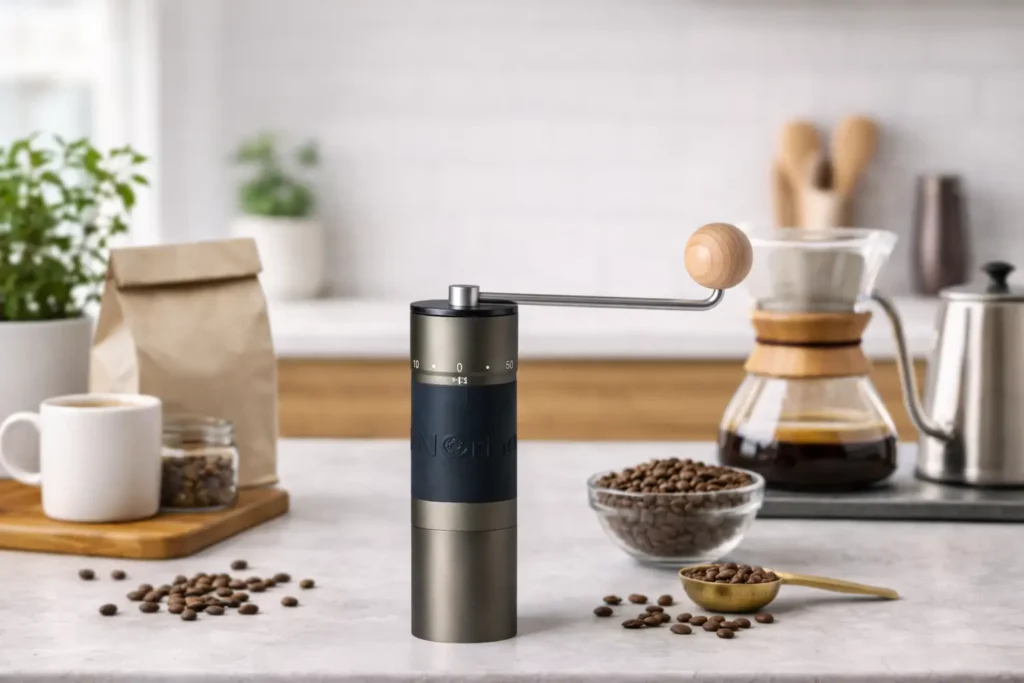
Best Manual Grinder for French Press: KINGrinder K6
The KINGrinder K6 is the CoffeeGearHub standard recommendation for French press — and the grinder that makes the ratios in this guide reproducible. At French press coarse settings (clicks 65–80 from zero), the 48mm stainless conical burrs produce large, consistent particles with minimal dust — exactly what the metal French press filter needs to produce a clean, body-rich cup without sediment. The 100-click adjustment system means a 2–3 click change at coarse settings produces a readable, meaningful difference in your cup. At French press coarse settings, grinding a full 8-cup dose (69g at 1:13) takes about 3 minutes.
- French press setting: 65–80 clicks from zero (coarse) — adjust within this range by roast level
- Why it works: 48mm conical burrs produce consistent coarse particles with low fines — minimal sediment in the cup
- Also covers: pour over (35–55 clicks), drip (32–42 clicks), AeroPress (20–30 clicks)
- Best for: solo to couple daily French press; anyone who wants one grinder for all non-espresso methods
Disclosure: CoffeeGearHub may earn from qualifying purchases.
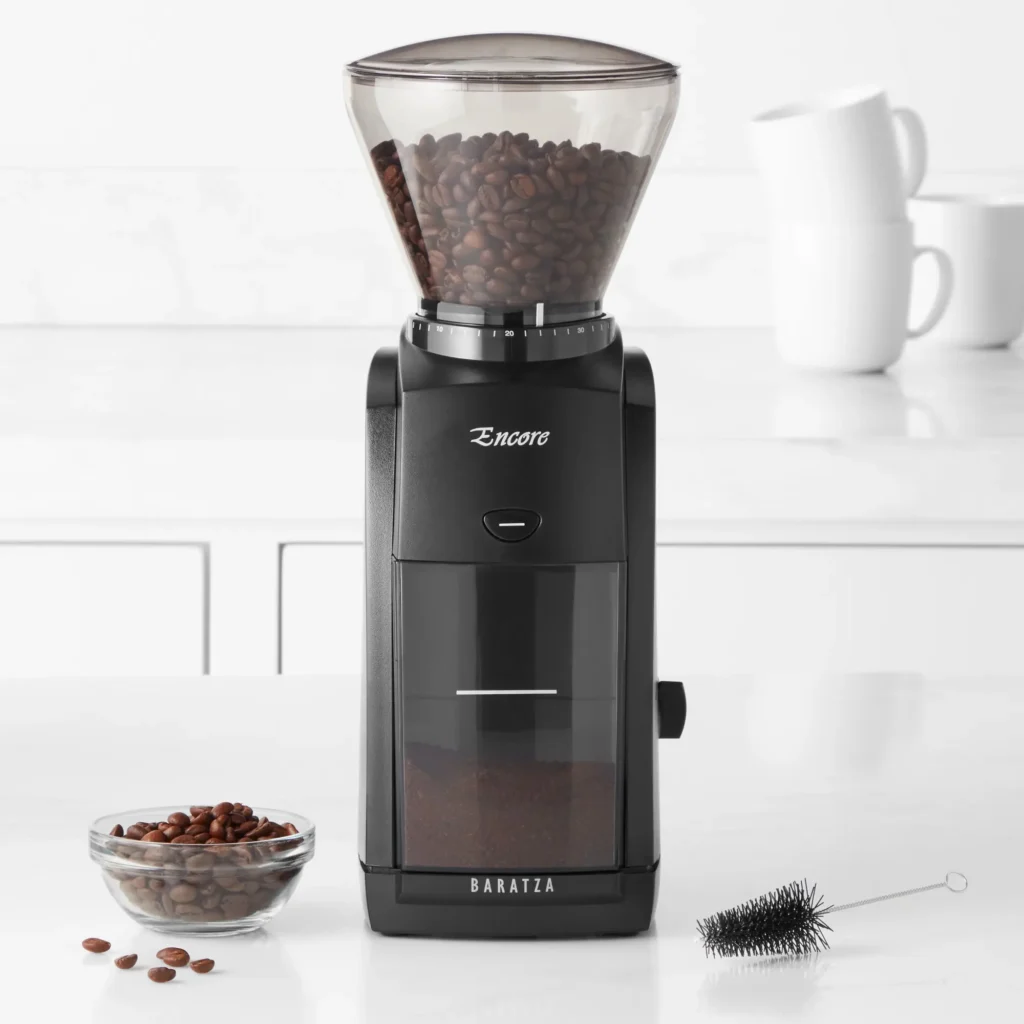
Best Electric Grinder for French Press: Baratza Encore
For households grinding larger French press doses daily — 69g for an 8-cup press or 104g for a 12-cup press — hand grinding is practical but time-consuming. The Baratza Encore is the standard entry-level electric recommendation for French press: 40-step adjustment with a coarse range (settings 28–38) that produces consistent, clean coarse particles suitable for every French press size and ratio in this guide. Baratza’s repair program makes it a genuinely long-term investment — replacement burrs and parts are sold separately and the grinder is designed to be fixed, not replaced.
- French press setting: Steps 28–38 (coarse range)
- Key advantage: electric convenience for large doses; Baratza repair program
- Also covers: pour over (steps 12–22), drip (steps 15–24)
- Best for: daily French press households grinding 50g+ per session
Disclosure: CoffeeGearHub may earn from qualifying purchases.
How Roast Level Changes Your French Press Ratio
Roast level changes the physical and chemical properties of the bean — density, porosity, solubility — and this directly affects how a given ratio performs in the cup. A 1:13 ratio that produces a perfectly balanced medium roast French press produces an over-extracted, bitter dark roast and an under-extracted, sour light roast from the same setup. Use this as your starting adjustment when you change roast levels.
☀️ Light Roast
- Dense, less soluble — extracts slowly
- Use lower ratio: 1:12 to 1:13
- Grind slightly finer within the coarse range
- Steep: 4 minutes; extend to 4:30 if still sour
- Temperature: 95–97°C
🌤 Medium Roast
- Balanced solubility — the reference roast
- Use standard ratio: 1:13 starting point
- Grind at baseline coarse
- Steep: 4 minutes exactly
- Temperature: 93–96°C
🌑 Dark Roast
- Porous, highly soluble — extracts fast
- Use higher ratio: 1:14 to 1:15
- Grind slightly coarser within the coarse range
- Steep: 3:30 to 4 minutes; not longer
- Temperature: 90–93°C
Steep Time and the Ratio Connection
Steep time and ratio are related but separate controls — and confusing them is the most common cause of French press frustration. Steep time controls how far along the extraction curve your coffee travels; ratio controls how concentrated the result is. They interact, but they fix different problems.
| Steep time | What changes | What stays the same | Use when |
|---|---|---|---|
| 3 minutes | Slightly less extraction — brighter, less developed body | Concentration (ratio) | Very fine coarse grind; dark roast prone to bitterness; first brew with an unfamiliar bean |
| 4 minutes ✓ | Target extraction — sweet spot for coarse grind | Concentration (ratio) | Standard starting point for all ratios and roast levels |
| 5 minutes | More extraction — more body but risks bitterness at finer coarse grinds | Concentration (ratio) | Very coarse grind; weak result at 4 minutes; cold water recovery |
⚠️ Decant immediately after pressing. Pressing the plunger does not stop extraction — if you leave brewed French press coffee sitting on the grounds in the press, extraction continues and the cup becomes progressively more bitter. Always decant the entire brew into a separate preheated vessel immediately after pressing. This is one of the most overlooked causes of bitter French press coffee.
Why Grams Beat Tablespoons Every Time
A tablespoon of light-roast whole beans weighs approximately 5–6g. The same tablespoon filled with pre-ground dark roast can weigh 7–9g. That is a 40–50% dose variation from the same measuring spoon — enough to shift your effective French press ratio by 3–4 full points. Every cup brewed with a spoon rather than a scale is brewed at a different ratio regardless of how carefully you count your scoops. This is why French press coffee is so inconsistent for most home brewers: not because the method is inconsistent, but because the measurement system is.
Weighing both coffee and water on a kitchen scale takes fewer than 15 seconds per brew. The payoff is that every cup from the same bag of beans at the same ratio tastes the same — and when you change beans, you know your ratio is held constant and any difference in the cup is the bean itself, not a dose variation.
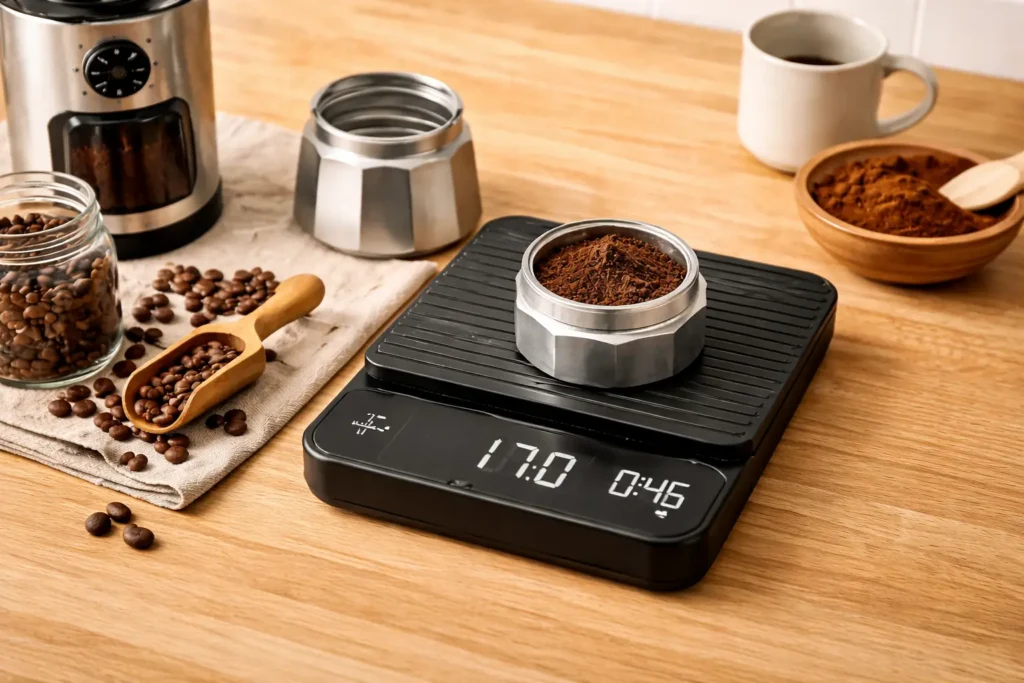
Best Scale for French Press Ratio: OXO Brew Precision Scale with Timer
The OXO Brew Precision Scale is the most beginner-friendly scale for French press ratio work — one-button operation, an auto-start timer that triggers when liquid hits the platform, and a large display that is easy to read beside the press. For French press specifically, the large platform accommodates any press size including a full 1L Chambord, and the 1g resolution is accurate enough for every ratio from 1:11 to 1:17. If you are switching from tablespoons to grams for the first time, this is the scale that makes that transition effortless.
- Resolution: 1g — accurate enough for all French press ratios
- Platform: large enough to hold any French press size directly on the scale
- Timer: auto-starts when water hits — tracks your 4-minute steep without a separate timer
- Best for: first-time scale users; anyone upgrading from tablespoon measurement
⚠️ Verify ASIN before publishing. Disclosure: CoffeeGearHub may earn from qualifying purchases.
The Dial-In System: Find Your Perfect French Press Ratio in 2–3 Brews
Dialling in your French press ratio is the same systematic process as dialling in any brewing method — fix your starting parameters, taste the result, identify whether the problem is strength (ratio) or extraction (grind), and change one variable per brew. Most home brewers land on their locked recipe within three brews of a new bag of beans.
The Baseline Brew
- Set ratio: 1:13 (use the cup size calculator above for your press size)
- Set grind: coarse — sea salt texture on a burr grinder
- Preheat the press with hot water; discard before brewing
- Add grounds, pour water at 93–96°C, stir gently to saturate all grounds
- Place lid (plunger up), steep 4 minutes exactly
- Press slowly (20–30 seconds), decant entire brew immediately into a preheated vessel
- Taste and log three things: strength (weak/balanced/strong), extraction (sour/balanced/bitter), finish (clean/muddy/drying)
Taste → Adjustment Order
- Balanced but too weak: lower ratio — try 1:12 next brew (more coffee, same water)
- Balanced but too strong: raise ratio — try 1:14 or 1:15 next brew (less coffee)
- Sour or sharp despite correct strength: grind slightly finer or extend steep to 4:30
- Bitter or drying despite correct strength: grind slightly coarser or reduce steep to 3:30
- Muddy with sediment: grind is too fine — grind significantly coarser
- Flat and muted: check roast date (use within 35 days); filter tap water
Rule: change one variable per brew. Stop when the cup is balanced, strength is right, and the finish is clean.
Recipe Playbooks: Three Ratio-Specific French Press Recipes
Playbook #1 — Classic Full Body
- Press size: 8-cup / 1L
- Coffee: 69g
- Water: 900g
- Ratio: 1:13 ✓
- Grind: coarse (sea salt)
- Temperature: 94°C
- Steep: 4 minutes; decant immediately
Too strong: try 1:14 (64g coffee). Too weak: try 1:12 (75g coffee).
Playbook #2 — Solo Bright Cup
- Press size: 3-cup / 350ml
- Coffee: 20g
- Water: 300g
- Ratio: 1:15
- Grind: coarse-medium (one step finer than classic)
- Temperature: 96°C
- Steep: 4 minutes; decant immediately
Best for light roast single-origins. Sour: try 1:14 (21g coffee) or extend steep 30 seconds.
Playbook #3 — Bold Milk Drink Base
- Press size: 3-cup / 350ml
- Coffee: 30g
- Water: 300g
- Ratio: 1:10
- Grind: coarse
- Temperature: 93°C
- Steep: 4 minutes; pour over frothed milk or ice
Intense, syrupy base for milk-based drinks. Too harsh: raise to 1:12 or reduce steep to 3:30.
For Travel and Outdoor Brewing
The same ratios in this guide apply to travel French presses — the brewing physics are identical. The difference is insulation: a thermal French press maintains brew temperature during steeping without any external heat source, and the sealed double-wall body protects against breakage in transit.
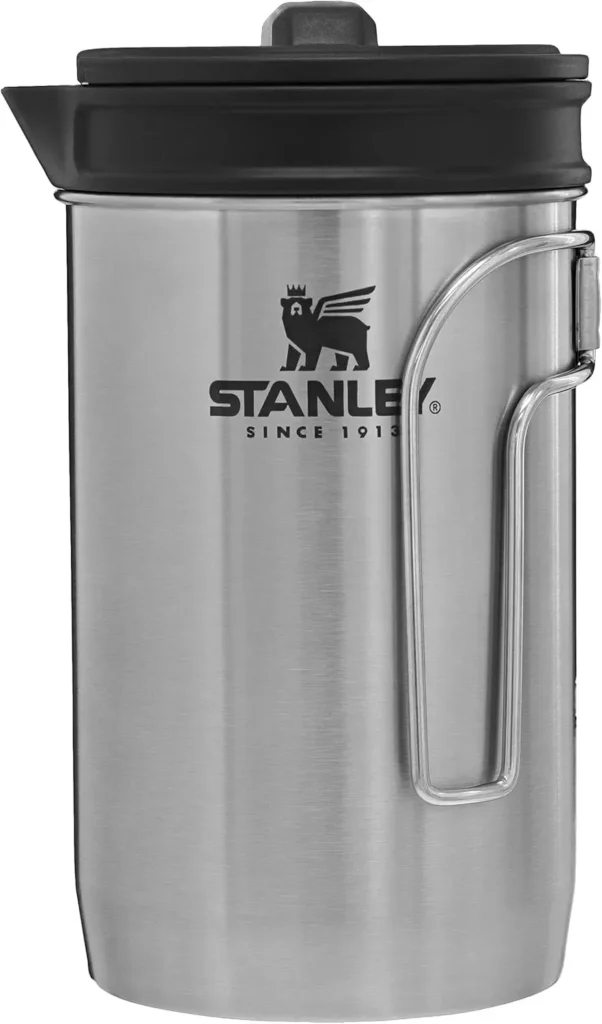
Best Travel French Press: Stanley Adventure All-In-One
The Stanley Adventure is the most durable French press available — stainless steel construction throughout, 18/8 food-grade steel with vacuum insulation that keeps brewed coffee hot for hours after pressing, and an all-in-one design where the press and drinking vessel are a single unit. For the bold milk drink base recipe above (Playbook #3), the Stanley is particularly well-suited: the insulated walls keep the concentrate hot while you prepare your milk, and the sealed design prevents spills during outdoor use or commuting.
- Insulation: vacuum double-wall — keeps coffee hot for 3+ hours post-brewing
- Construction: 18/8 stainless throughout — no glass to break
- Capacity: 1.0L — use the 8-cup calculator row above for ratios
- Best for: travel, camping, commuting; any setting where the Chambord’s glass is impractical
Disclosure: CoffeeGearHub may earn from qualifying purchases.
Troubleshooting Matrix: French Press Symptoms → Causes → Fixes
Identify your symptom first. Confirm whether it is a ratio (strength/concentration) problem or a grind/extraction problem — then apply fixes in the order listed. Change one variable per brew.
| Symptom | Most likely cause | Fix — in order |
|---|---|---|
| Weak and watery despite correct steep time | Ratio too high (not enough coffee per ml water); or grind too coarse | Lower ratio — add 5g coffee, keep water same → confirm grind is coarse not very coarse |
| Too strong and overwhelming | Ratio too low (too much coffee per ml water) | Raise ratio — reduce dose by 5g, keep water same → try 1:14 or 1:15 |
| Bitter and harsh finish | Grind too fine; steep too long; dark roast at low ratio | Grind significantly coarser → reduce steep to 3:30 → for dark roast raise ratio to 1:14–1:15 |
| Muddy with heavy sediment in cup | Grind too fine — particles passing through metal mesh filter | Grind much coarser — must be true sea salt texture; do not use medium or medium-fine grind in French press |
| Sour, sharp, or hollow | Under-extraction — grind too coarse; steep too short; water too cool | Grind slightly finer within coarse range → extend steep to 4:30 → raise water temperature to 95–97°C |
| Sour AND bitter simultaneously | Inconsistent grind from blade grinder — fine dust over-extracts, large chunks under-extract | Switch to a burr grinder — no ratio adjustment fixes blade grinder inconsistency |
| Good first cup, bitter or flat from second cup | Coffee left in press after brewing continues extracting | Decant entire brew immediately after pressing; never leave French press coffee on the grounds |
| Flat and muted despite correct ratio and grind | Stale beans or poor water quality | Check roast date — use within 35 days; switch to filtered water; no ratio or grind adjustment fixes stale beans |
| Different strength every brew at same ratio | Volume-measuring by tablespoon rather than weighing | Weigh every dose on a kitchen scale — tablespoon measurements vary by up to 40% with roast level and grind size |
Gear Picks: Everything You Need for Ratio-Accurate French Press
The three categories of gear that determine whether your French press ratio system actually works — the press itself, the grinder that produces the right coarse particle size, and the scale that makes every dose consistent. All picks already featured in this guide are summarised here for easy reference.
| Category | Pick | Why it matters for ratio | Link |
|---|---|---|---|
| French press (home) | Bodum Chambord | Consistent filter mechanism; available in every size matching the cup calculator above | Check on Amazon → |
| French press (travel) | Stanley Adventure All-In-One | Vacuum insulation maintains brew temperature; no glass to break in transit | Check on Amazon → |
| Manual grinder | KINGrinder K6 | 100-click system; 48mm burrs produce consistent coarse particles with low fines | Check on Amazon → |
| Electric grinder | Baratza Encore | 40-step coarse range; repairable long-term; handles large French press doses without hand-cranking | Check on Amazon → |
| Scale | OXO Brew Precision Scale | Large platform for any press size; auto-start timer; 1g resolution for all French press ratios | Check on Amazon → |
Disclosure: CoffeeGearHub may earn from qualifying purchases on all links above.
Quick Reference Cheat Sheet
Bookmark this section or pin it above your brew station. All ratios are starting points — adjust by ±1 for roast level and personal preference. Grind must be coarse (sea salt texture) for all ratios to produce the expected result.
| French press size | 1:13 (standard) — coffee / water | 1:15 (lighter) — coffee / water | Temperature | Steep time |
|---|---|---|---|---|
| 3-cup (350ml) | 23g / 300g | 20g / 300g | 93–96°C | 4 min |
| 4-cup (500ml) | 35g / 450g | 30g / 450g | 93–96°C | 4 min |
| 8-cup (1L) | 69g / 900g | 60g / 900g | 93–96°C | 4 min |
| 12-cup (1.5L) | 104g / 1,350g | 90g / 1,350g | 93–96°C | 4 min |
| Roast adjustments: Light roast → use lower ratio end + 95–97°C. Dark roast → use higher ratio end + 90–93°C. Decant immediately after pressing in all cases. | ||||
Final Takeaway
1:13 is your baseline. A coarse grind is non-negotiable. Decant immediately after pressing. Weigh everything. If the cup is too weak, add more coffee — do not extend the steep. If the cup is too bitter or muddy, grind coarser — do not reduce the dose first. Those two rules resolve the vast majority of French press ratio problems in the next brew. Lock your ratio once it is right, write it down with the bean name and roast level, and start the next bag with that number as a reference point. Consistent French press coffee is simple — it just requires consistent inputs.
FAQs: French Press Coffee Ratio
What is the best coffee-to-water ratio for French press?
The best starting ratio for French press is 1:13 — 1 gram of coffee for every 13 grams of water. This produces a full-bodied, rich cup that exploits the French press’s immersion brewing strength without becoming muddy or overwhelming. For a lighter, brighter cup start at 1:15. For an intense, concentrate-style result for milk drinks, try 1:10. Always weigh both coffee and water in grams for consistent results.
How much coffee do I use for a 1 litre French press?
For a 1 litre French press at the standard 1:13 ratio, use 69g of coffee to 900g of water. At a 1:15 ratio, use 60g of coffee to 900g of water. The brew water is slightly less than the press capacity because grounds absorb approximately 2g of water per gram of coffee during steeping.
How many tablespoons of coffee for a French press?
A rough guide: use 2 rounded tablespoons (approximately 12–14g) per 200ml of water. However, tablespoon measurements are unreliable because coffee density varies significantly with roast level and grind size. For consistent results, weigh your coffee on a kitchen scale and target 1g per 13ml of water.
Why does my French press coffee taste weak?
Weak French press coffee almost always means ratio too high (too little coffee per ml of water), grind too coarse so the coffee under-extracts, or water temperature too low. Fix in order: first check your dose is at least 1g per 13ml of water; second confirm your grind is coarse but not fluffy — sea salt texture; third use water at 93–96°C not lukewarm water.
Why does my French press coffee taste bitter or muddy?
Bitter French press coffee usually means ratio too low, steep time too long, or grind too fine. If your grind is too fine, particles pass through the metal filter and over-extract — you will also notice significant sediment. Fix by grinding coarser first, then reduce steep time from 4 minutes to 3:30, then raise your ratio slightly if still too intense. A consistent burr grinder eliminates most French press bitterness problems.
Does the grind size affect French press ratio?
Yes — grind size and ratio interact in French press brewing. A coarser grind extracts more slowly, meaning a 4-minute steep at a coarse grind produces less extraction than the same time at a medium grind. The correct French press grind (coarse, like sea salt) is important for the recommended ratios to produce the expected result. If you grind finer than recommended, your standard ratio will over-extract and taste bitter.
What size French press should I buy?
Match your French press size to how many cups you typically brew at once. A 350ml (3-cup) press is ideal for solo brewing — one large cup per brew. A 500ml (4-cup) press is the most practical for 1–2 people. An 8-cup (1 litre) press suits households brewing for 3–4 people or anyone who wants a full carafe. The Bodum Chambord is the CoffeeGearHub standard recommendation at every size.
Can I use pre-ground coffee in a French press?
Yes — but pre-ground coffee is almost always ground at the wrong size for French press. Most commercial pre-ground coffee is ground for drip machines, which means it is too fine for French press immersion brewing. Too-fine grounds pass through the metal press filter, over-extract during the steep, and produce a muddy, bitter cup. For best French press results, buy whole beans and grind immediately before brewing at a coarse setting.
How long should I steep French press coffee?
The standard French press steep time is 4 minutes at a coarse grind. Shorter steep (3 minutes) is appropriate for very coarse grinds or light roasts. Never steep for more than 6 minutes. After pressing, decant immediately into a separate vessel — leaving brewed coffee in contact with the grounds continues extraction and produces bitterness within minutes.
What is the best French press to buy?
The Bodum Chambord is the CoffeeGearHub standard French press recommendation — consistent plunger mechanism, borosilicate glass, available in every size from 3-cup to 12-cup. For travel or outdoor use, the Stanley Adventure French Press is the most durable option — stainless construction with vacuum insulation. For single-cup brewing with less sediment, the Espro P3 includes a micro-filter that significantly reduces sediment compared to standard French press.
Continue Learning
FRENCH PRESS GUIDES
Want to apply these ratios across every brewing method? The complete brew ratio guide covers the correct ratio for every brewing method — pour over, drip, AeroPress, cold brew, and espresso — with a unified dial-in framework and a full cheat sheet.
☕
Written by the CoffeeGearHub Editorial Team
CoffeeGearHub is a specialty coffee equipment resource run by home brewers and coffee enthusiasts. Our guides are researched using published brewing science, SCA standards, grinder manufacturer specifications, and established specialty-coffee community knowledge. We review and update our pillar content regularly. About CoffeeGearHub →