
Best French Press Coffee Makers
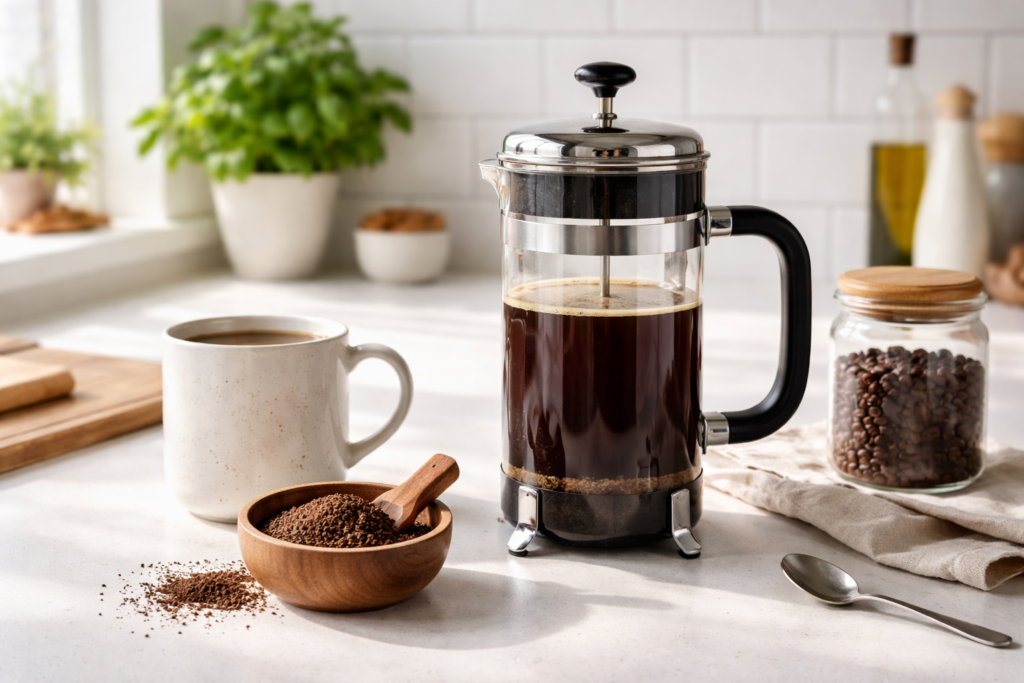
Editorial standards: material, filtration, capacity, heat retention, cleaning and workflow are compared separately from recipe variables.
At a glance
What this buying guide covers
Glass vs stainless presses, filtration, size, current reference picks, brewing and grind guidance, troubleshooting and cleaning.
Editorial analysis
The press changes workflow more than extraction theory
The meaningful buying differences are vessel material, heat retention, filter design, capacity, durability and sediment control.
The 30-Second Answer
Choose glass for visibility, stainless for durability and heat retention, and finer filtration if sediment bothers you. Then dial the brew by taste rather than one fixed steep time or grind setting.
French Press 101: How It Works and Why It Tastes Different
A French press — also called a press pot or cafetière — uses immersion brewing: ground coffee steeps directly in hot water for a fixed period, then a metal mesh plunger separates the grounds from the brewed coffee by pressing them to the bottom of the beaker. There is no paper filter, no pump, and no electricity required. The entire brew system is the press itself, your grinder, hot water, and a timer.
What makes French press taste different from drip or pour-over is the metal mesh filter. Paper filters in drip and pour-over machines absorb coffee oils — specifically cafestol and kahweol, the lipid compounds responsible for body and mouthfeel. The French press metal filter retains all of these oils, passing them directly into the cup. The result is a brew that is richer, heavier, and more texturally complex than paper-filtered coffee. That full-bodied character is French press’s defining quality — and the reason the method has remained one of the most popular home brewing formats worldwide despite producing no objectively “cleaner” cup than other methods. For a full comparison of brew methods, see our Best Coffee Makers for Everyday Brewing guide.
🔬 The oil difference: Paper filtration removes cafestol and kahweol — the diterpene lipids that give French press its characteristic heavy mouthfeel. French press retains all of these. This is also why French press is the only home brew method where bean processing method (natural vs washed) and roast level have a dramatically different effect on the cup — the oils that carry those characteristics pass through the metal filter unimpeded. The best French press beans are covered in our companion guide: Best Coffee Beans for French Press.
What Makes a Great French Press: 5 Variables That Actually Matter
The French press market is crowded with presses at every price point from under $20 to over $200. Most of them will produce drinkable coffee. What separates the genuinely excellent presses from the rest is a combination of five factors — none of which are about brand name or aesthetics. Understanding what each factor contributes tells you exactly what to prioritise, and what to ignore, when evaluating any press.
| Factor | Why it matters | What to look for | What to avoid |
|---|---|---|---|
| Filter quality | Determines how much sediment (fines) reaches your cup; a tighter mesh reduces grit without sacrificing oil extraction | Multi-layer stainless mesh; tight weave with minimal gaps at the edge; snug fit against the beaker wall | Single-layer mesh; plastic mesh frame; press that leaves a large gap at the beaker edge |
| Material (glass vs stainless) | Affects durability, heat retention, and how long your coffee stays drinkable before cooling | Borosilicate glass for visibility and value; double-wall stainless steel for heat retention and durability | Single-wall stainless (no insulation benefit); thin-walled glass that isn’t borosilicate (thermal shock risk) |
| Beaker-to-lid seal quality | A loose lid lets heat escape rapidly; a tight lid maintains steep temperature throughout the brew cycle | Snug-fitting lid with minimal air gap; stainless lid ring that holds the beaker securely | Loose-fitting plastic lid; lid that rattles or requires force to keep in place |
| Plunger rod and spring mechanism | A sturdy, straight plunger rod presses evenly; a flimsy or off-centre rod produces uneven compression and filter bypass | Solid stainless plunger rod; spring mechanism that keeps mesh flat and level against the beaker bottom | Thin or hollow plastic plunger rod; wobbly filter that tilts during pressing |
| Size (volume) | Always brew a full press for consistent extraction — choose a press matched to how many cups you actually make per session | 350ml for one person; 600ml–1L for two; 1L–1.5L for three or more | Buying the largest available “just in case” — partial-fill brews produce weak, uneven extraction |
French Press Style: Quick-Comparison by Use Case
Use this table to match a French press style to your routine before reviewing the individual product picks below. Each style solves a different problem — the right choice depends on how you brew, not how much you spend.
| Best For | Recommended Style | Why It Works | Trade-Off | Budget Range |
|---|---|---|---|---|
| Beginners & first press | Classic glass (e.g. Bodum Chambord) | Best value, iconic design, easy to use and clean, widely available parts | More fragile; loses heat faster than insulated | $30–$60 |
| Daily driver, busy kitchen | Stainless steel (e.g. Frieling) | Durable, dent-resistant, best heat retention of any style | Higher upfront cost; can’t see the brew | $70–$120 |
| Slow sippers / long mornings | Double-wall insulated | Keeps coffee hot for 60–90 minutes without continued heating | Heavier; pricier; more to clean | $50–$100 |
| Sediment-sensitive drinkers | Dual micro-filter (e.g. Espro Press) | Dramatically reduces fines in cup while preserving full-bodied oil extraction | More parts to disassemble and clean; higher price | $80–$130 |
| Travel, camping, office | Compact shatter-resistant (stainless or tritan) | No electricity, no fragile glass, packs light, works anywhere | Smaller batch size; less convenient for home daily use | $25–$60 |
Best French Press Coffee Makers: Current Reference Picks
These three models represent different ownership priorities rather than one universal winner.
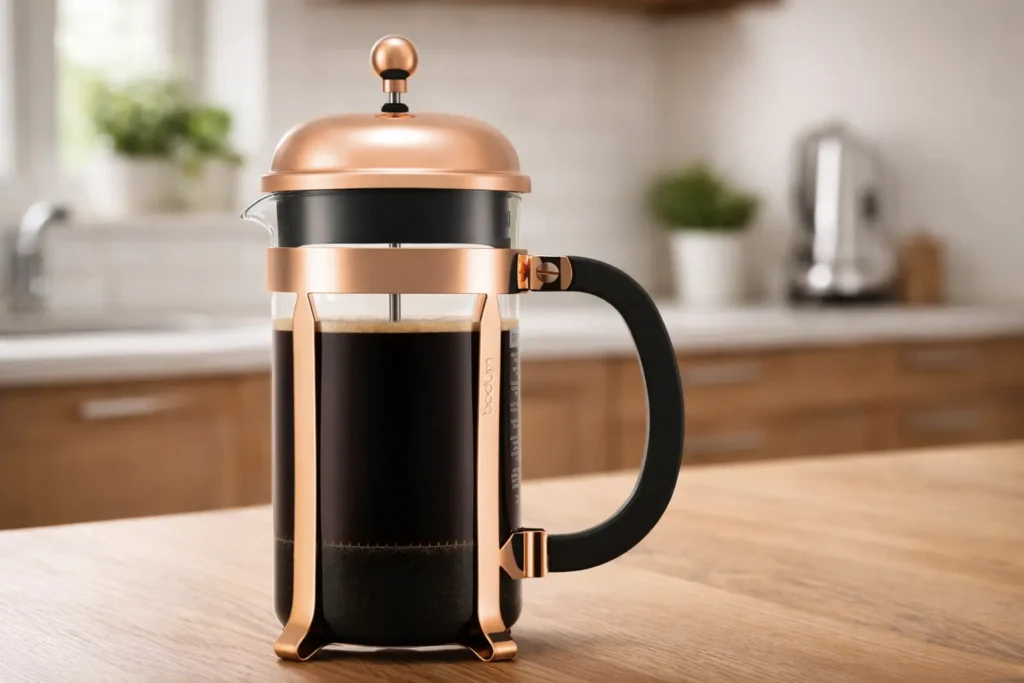
Bodum Chambord — traditional glass press
Traditional glass construction for users who value visible brewing and a familiar mesh-filter workflow.
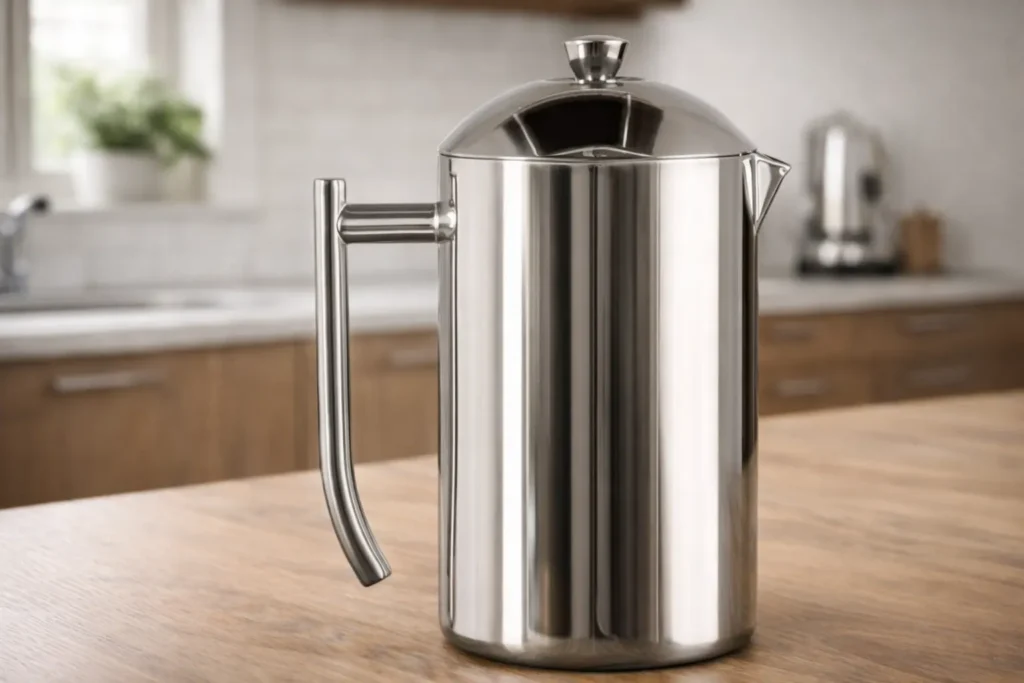
Frieling Double Wall — durability and heat retention
Double-wall stainless construction for users who prioritize durability and keeping coffee hotter longer.
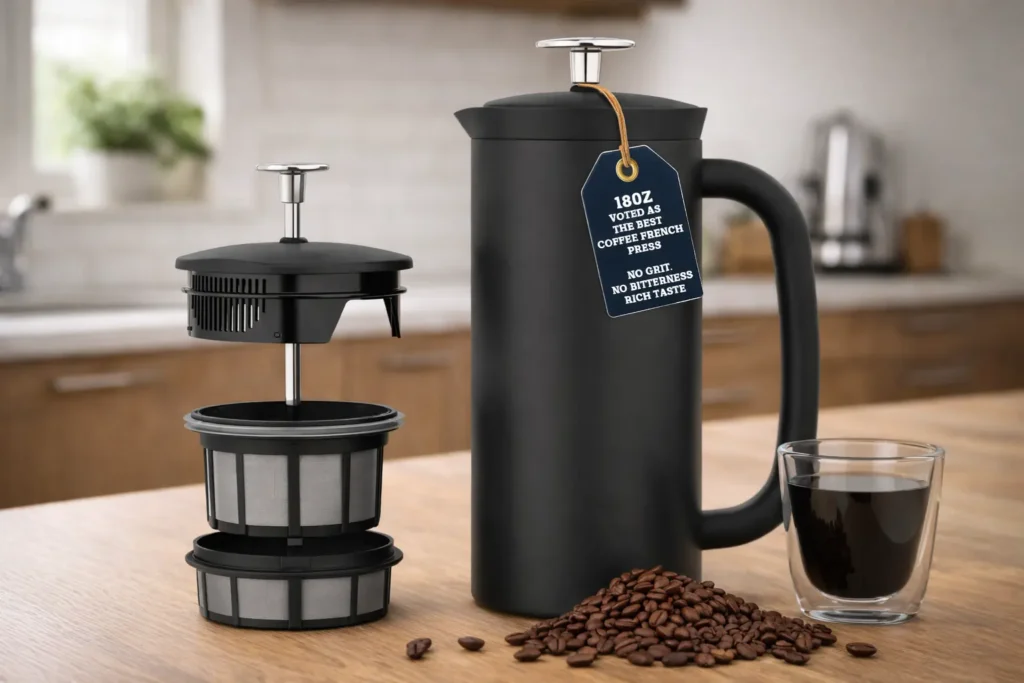
Espro Press P7 — lower-sediment filtration
A finer multi-stage filtration approach for people who like immersion body but want less sediment.
Compare current options
Start with these representative choices
These two models show the main French-press buying decision: traditional glass visibility versus insulated stainless durability and heat retention.
Traditional Glass — Bodum Chambord
Classic borosilicate-glass construction with visible brewing and a familiar mesh-filter workflow.
Start here if: you value simplicity, brew visibility, and replaceable glass components.
Insulated Stainless — Frieling Double Wall
Double-wall stainless construction for greater durability and slower heat loss.
Start here if: you want a long-life daily press and tend to sip coffee over a longer period.
Affiliate disclosure: Amazon links may earn CoffeeGearHub a commission at no additional cost to you.
Glass vs Stainless Steel French Press: Full Comparison
The material choice in a French press is more consequential than it appears. Glass and stainless steel behave differently across every variable that affects the daily use experience — durability, heat retention, ease of cleaning, and the visual experience of watching a brew develop. Neither is objectively superior: each solves a different set of problems. Here is a complete side-by-side to help you choose.
| Glass (Borosilicate) | Single-Wall Stainless | Double-Wall Stainless | |
|---|---|---|---|
| Durability | Fragile — drops and thermal shock are the primary failure mode; replacement beakers available for most quality brands | Very durable — dent-resistant, no shatter risk; lasts indefinitely with normal use | Extremely durable — same as single-wall but with additional insulating gap that absorbs minor impacts |
| Heat retention | Poor — coffee cools 10–15°C in the first 15 minutes | Moderate — better than glass but no insulation; coffee cools 5–8°C in 15 minutes | Excellent — maintains temperature for 60–90 minutes at room temp; negligible heat loss in first 30 min |
| Visibility of brew | Full visibility — you can see colour, clarity, and crust development during steep | None | None |
| Weight | Light — glass beaker + metal frame is the lightest standard configuration | Moderate — solid stainless construction adds weight | Heaviest — double-wall adds significant mass; some models are notably heavy |
| Ease of cleaning | Easiest — glass beakers dishwasher safe; visual inspection confirms cleanliness | Moderate — dishwasher safe but harder to confirm interior cleanliness | Moderate — same as single-wall; interior harder to inspect |
| Price range | $25–$70 for quality options (Bodum Chambord) | $40–$80 | $70–$150 (Frieling, Espro P7) |
| Best for | Home use, anyone who prefers watching the brew, budget-conscious buyers | Light travel, outdoor use, anyone who’s broken a glass press | Daily driver, slow sippers, offices, anyone who wants hot coffee available for an extended window |
Filter Quality and Sediment: What the Mesh Design Actually Does
The filter is the most under-discussed performance variable in French press selection. Most buyers focus on material and price — but two presses at the same price with different filter designs can produce dramatically different cups. Understanding what the mesh actually does, and what the failure modes are, tells you exactly what to look for.
French press sediment comes from two sources: fine coffee particles (fines) that are small enough to pass through the mesh weave, and edge bypass — fines that travel around the outside edge of the filter where it doesn’t press flush against the beaker wall. Standard single-mesh presses reduce fines throughput but rarely eliminate edge bypass entirely. Multi-layer mesh presses (like the Frieling five-layer system) add filtration layers that catch more fines. Espro-style dual micro-filter systems add a second concentric filter that seals against the beaker wall, eliminating edge bypass entirely — the most effective sediment reduction approach currently available in a French press form factor.
| Filter type | How it works | Sediment level | Body / oil extraction | Best example |
|---|---|---|---|---|
| Single stainless mesh | One layer of woven stainless steel; standard on most entry-level presses | Moderate — noticeable fines and occasional grit | Full — all oils pass freely | Generic imports, older Bodums |
| Three-part stainless assembly | Mesh + cross plate + lid plate; tighter overall assembly reduces edge gaps | Low-moderate — significant improvement over single mesh | Full — oil extraction unaffected | Bodum Chambord |
| Five-layer micro-mesh | Multiple layers of increasingly fine mesh; catches fines that bypass outer layers | Low — noticeably cleaner than three-part assemblies | Full — micro-mesh is fine enough for fines but oils pass freely | Frieling Double Wall |
| Dual concentric micro-filter | Two concentric filters that press against beaker wall — eliminates edge bypass entirely | Very low — the cleanest French press cup available without paper filtration | Full — Espro’s engineering specifically preserves oil extraction | Espro Press P7 |
⚠️ Important: No French press filter eliminates sediment entirely — some fine particles will always reach the cup. If you want zero sediment, a paper-filtered method (AeroPress with paper filter, pour-over, drip) is the correct tool. The Espro Press produces the cleanest French press cup available, but it is still measurably more sediment-laden than paper filtration. The goal of a quality French press filter is to minimise fines while preserving the oil extraction that defines the method’s character — not to replicate paper filtration.
French Press Size Guide: Buy for Your Normal Batch
Choose capacity around what you normally brew, and compare actual milliliters or fluid ounces rather than manufacturer cup labels. You do not have to fill every press to maximum capacity.
Travel and Camping French Press Options
French press is one of the best travel brew methods available — no electricity, no paper filters to carry, no moving parts to break. A compact shatter-resistant press produces the same full-bodied cup as a home press and fits in a carry-on or camping kit. The two primary considerations for travel presses are material (shatter-resistant, not glass) and size (small enough to pack, large enough for one or two cups).
✅ Travel Press: What to Look For
- Shatter-resistant material — stainless steel or Tritan plastic body; no borosilicate glass
- Compact form factor — ideally the plunger disassembles for packing flat
- 350ml–500ml capacity — enough for one or two cups without bulk
- Tight-fitting lid — essential for travel to prevent spillage; double as a pour-shield
- Wide-mouth opening — makes filling with a camp stove kettle easier
❌ Travel Press: What to Avoid
- Glass beakers — even borosilicate glass breaks under pack pressure or drops
- Cheap plastic mesh — degrades with repeated use, produces plastic taste
- Very large presses for travel — a 1L press is awkward to fill from a camp kettle or hotel kettle
- Presses with many small parts — extra pieces get lost in transit; simpler assemblies are more reliable
- Presses without a locking lid — spillage risk during transport is significant without a secure lid seal
Extraction Science: How Immersion Brewing Works — and Why Your Press Choice Matters
French press is an immersion brew method — ground coffee steeps in contact with water for a fixed period, and extraction happens through diffusion. This is mechanically different from espresso (pressure-driven) or pour-over (gravity flow through a paper filter), and those differences explain why the same grind size, water temperature, and ratio that works for espresso fails completely in a French press, and vice versa.
- Diffusion drives extraction, not pressure or flow rate. In immersion brewing, dissolved compounds move from areas of high concentration (the ground coffee) to low concentration (the water) through diffusion. This is slower and more uniform than pressure-driven extraction, which is why French press is more forgiving of minor grind variation than espresso. Coarse grind slows diffusion by reducing surface area; fine grind accelerates it. The coarse grind for French press is not a stylistic preference — it is a calibration choice to match the 4-minute steep time to the rate at which compounds dissolve at the target temperature.
- The metal filter changes which compounds reach your cup. Unlike paper-filter methods (pour-over, drip, AeroPress with paper), French press passes all coffee oils into the cup — specifically the diterpene lipids that create French press’s characteristic body and mouthfeel. This is why press material and filter quality interact with bean choice: a lower-quality filter that passes more fines produces over-extraction symptoms (bitterness, muddy texture) even at the same grind setting as a higher-quality filter on the same bean. Your press is part of the extraction system, not just the vessel.
- Extraction continues after plunging if you leave coffee on the grounds. Plunging the French press compresses the grounds but does not stop extraction — dissolved compounds continue to diffuse through the brew liquid as long as it remains in contact with the compressed puck. Pour immediately after plunging. Leaving a French press sitting for 10–15 minutes post-plunge produces a progressively more bitter cup regardless of how well-dialled the initial steep was. If you brew more than you can drink in one pour, use a separate carafe.
🔬 Why weight-based ratios beat scoops: The common advice — “two tablespoons per six ounces” — ignores the density difference between roast levels. A tablespoon of dense light roast weighs significantly more than the same volume of porous dark roast. The density difference can be 15–20%, meaning a scoop-based recipe that works for one bean will be dramatically weaker or stronger for another. Always weigh in grams (coffee) and millilitres (water). A 1:15 ratio is 1g coffee per 15ml water — a 350ml press uses 23g, a 1L press uses 67g. A kitchen scale accurate to 1g costs under $15 and is the highest-ROI upgrade in any French press setup.
French Press Brew Guide: Start With a Baseline, Then Taste
A moderate filter-coffee ratio, coarse-to-medium-coarse grind, and several minutes of immersion are useful starting directions. Four minutes is a common reference, not a universal rule.
- Ratio: adjust for preferred strength.
- Grind: finer if weak or hollow; coarser if harsh or very silty.
- Temperature: use roast and roaster guidance as a starting point.
- Steep: adjust by taste after the core recipe is repeatable.
KINGrinder K6: Use Clicks as Your Own Reference
Do not treat a published click number as universal. Burr zero, calibration, coffee, dose, steep time, and desired body all affect the useful French press setting. Record the setting that works on your grinder.
Grinder Example: KINGrinder K6
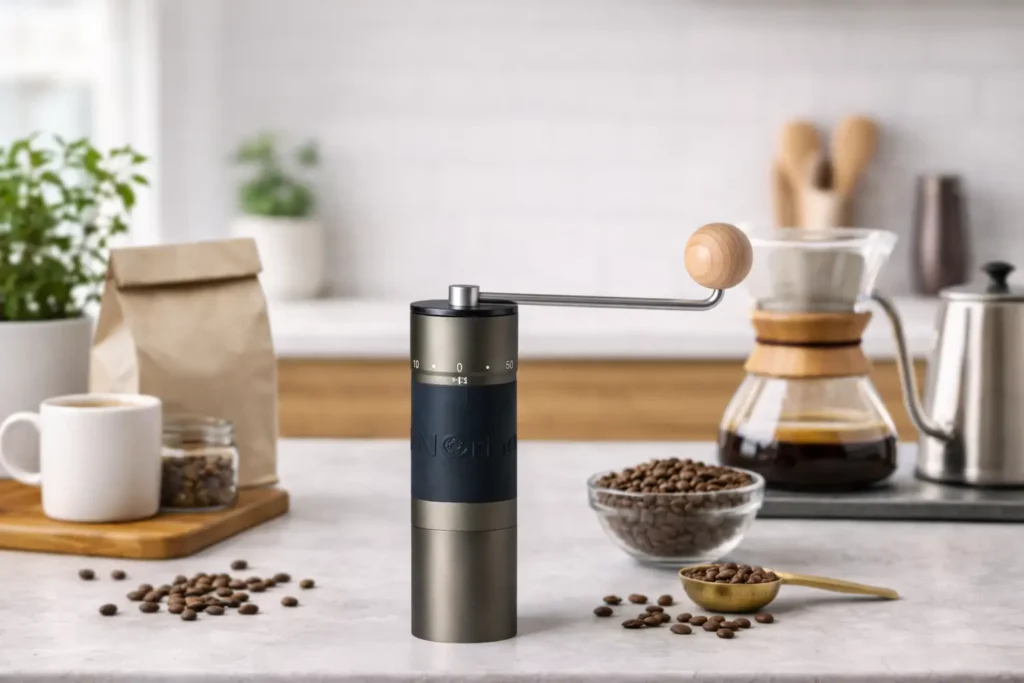
KINGrinder K6 — manual multi-method option
Its external adjustment makes it easy to move among immersion and filter settings. Prioritize repeatability rather than one magic click count.
Troubleshooting French Press Coffee
| Symptom | Check first | Useful experiment |
|---|---|---|
| Weak / watery | Ratio, grind, steep time | Strengthen ratio or try slightly finer |
| Sour / hollow | Grind, contact, temperature | Try finer or extend contact |
| Bitter / drying | Grind, agitation, roast, temperature | Try coarser, less agitation, or slightly cooler water |
| Too much sediment | Fines, filter, plunge speed | Use a more consistent coarse grind and press slowly |
| Hard to plunge | Grind too fine or filter clogged | Stop forcing it; use a coarser grind next brew |
Cleaning and Maintenance
Remove grounds and rinse the beaker and filter after each use. Deep-clean and disassemble the filter when oils or fines build up, following the manufacturer’s instructions rather than a fixed weekly calendar.
French Press Buying Checklist
- Material: glass for visibility; stainless for durability and heat retention.
- Filtration: standard mesh for traditional body; finer systems for less sediment.
- Capacity: size for your normal batch using actual volume.
- Cleaning: easy filter disassembly and replacement parts.
Final Takeaway
The best French press is the one whose material, filtration, capacity, and cleaning workflow fit how you brew. Recipe variables still matter more than the logo on the vessel.
FAQs: Best French Press Coffee Makers
What type is best?
What size should I buy?
What grind size?
How long should it steep?
How do I reduce sediment?
How often should I clean it?
CoffeeGearHub shortlist
Build the French press setup
Continue Learning
French press brewing
In this guide
- The 30-Second Answer
- French Press 101: How It Works and Why It Tastes Different
- What Makes a Great French Press: 5 Variables That Actually Matter
- French Press Style: Quick-Comparison by Use Case
- Best French Press Coffee Makers: Current Reference Picks
- Glass vs Stainless Steel French Press: Full Comparison
- Filter Quality and Sediment: What the Mesh Design Actually Does
- French Press Size Guide: Buy for Your Normal Batch
- Travel and Camping French Press Options
- Extraction Science: How Immersion Brewing Works — and Why Your Press Choice Matters
- French Press Brew Guide: Start With a Baseline, Then Taste
- KINGrinder K6: Use Clicks as Your Own Reference
- Grinder Example: KINGrinder K6
- Troubleshooting French Press Coffee
- Cleaning and Maintenance
- French Press Buying Checklist
- Final Takeaway
- FAQs: Best French Press Coffee Makers
- Continue Learning