
French Press Brew Guide
Editorial standards: this guide separates repeatable brewing variables from preferences. Product examples are chosen for workflow relevance; CoffeeGearHub does not claim hands-on testing where it has not occurred.
At a glance
French press rewards control of four simple variables
Start around a 1:15 coffee-to-water ratio, use a genuinely coarse and consistent grind, keep water near the low-90s °C for a medium roast, and treat four minutes as a baseline rather than a rule carved in stone.
The biggest quality gains usually come from a burr grinder, weighing coffee and water, and decanting immediately after the plunge so extraction does not continue in the press.
Editorial analysis
Use the recipe as a baseline, then adjust one variable at a time
French press is forgiving because immersion evens out the brew, but that does not mean every recipe tastes the same. Grind distribution, ratio, roast level, steep time, and water temperature still change body, bitterness, clarity, and sweetness.
The useful workflow is to lock three variables and change one. That makes a bitter, weak, muddy, or hollow cup diagnosable instead of turning every brew into a new experiment.
The 30-Second Answer
Use roughly 30g coffee to 450ml water, a coarse burr-ground texture, about 93°C water, and a four-minute steep as your starting point. Press slowly and pour the entire brew out immediately. If the cup is bitter or muddy, go coarser or shorten contact time. If it is weak or hollow, go slightly finer or increase the dose.
Compare the core setup
Start with these representative choices
These two examples represent the two purchases that most directly affect a French press workflow: the press itself and a grinder that can produce repeatable coarse particles.
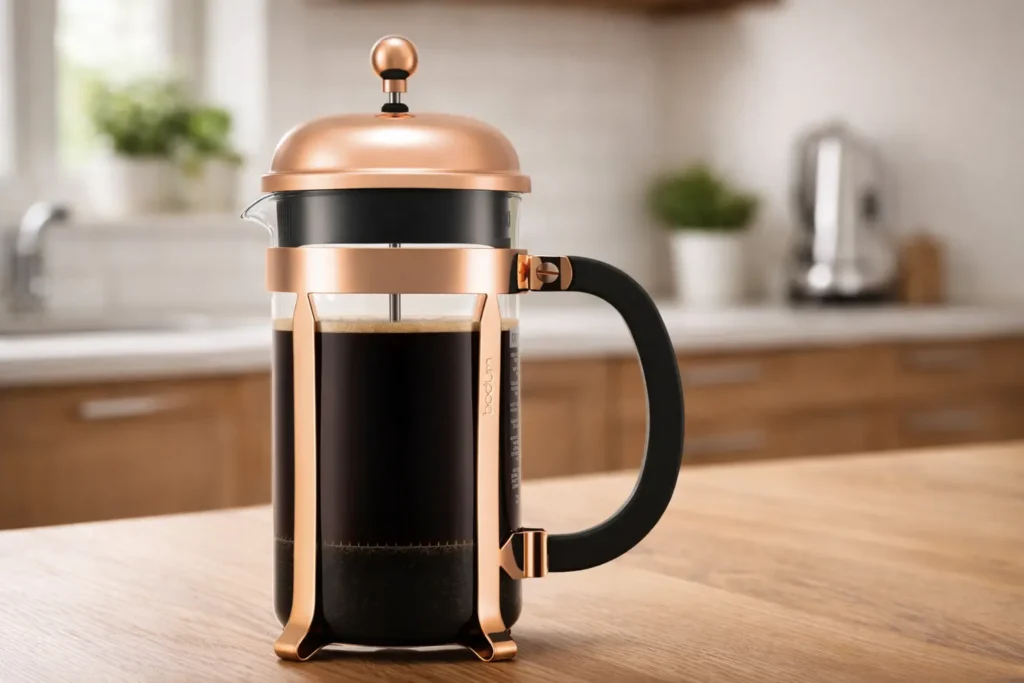
Bodum Chambord — French press reference
A straightforward glass-and-steel press that represents the classic French press workflow without adding unnecessary complexity.
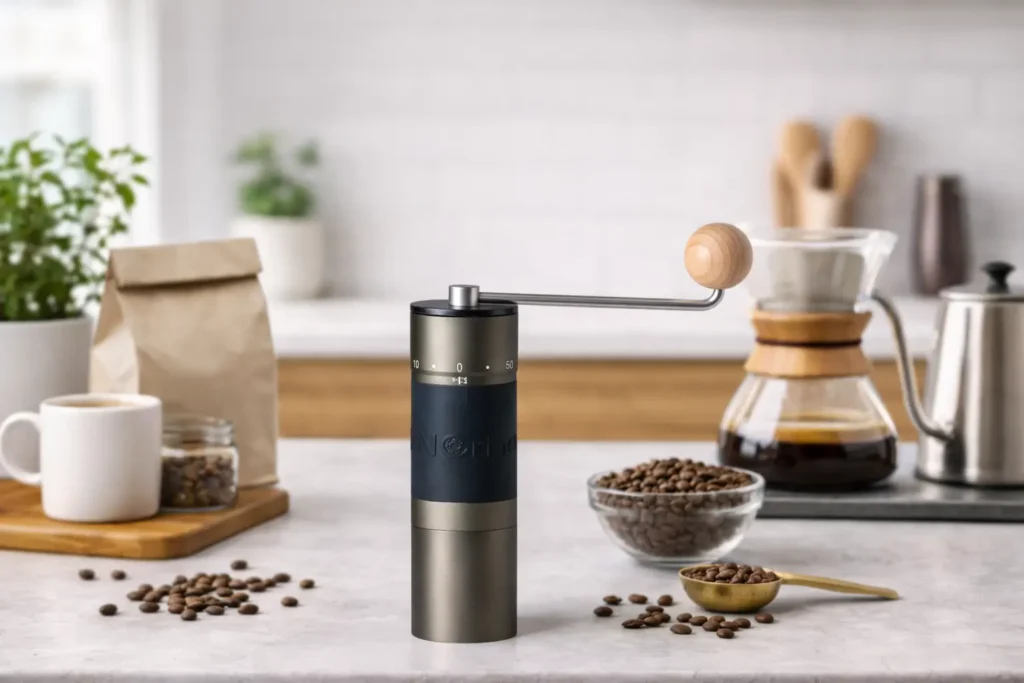
KINGrinder K6 — coarse-grind control
A useful reference for repeatable French press grind adjustment and a major step up from blade-ground coffee.
Affiliate disclosure: Amazon links may earn CoffeeGearHub a commission at no additional cost to you. Prices and availability can change.
What Makes French Press Different: The Brew Mechanics
Understanding how French press works mechanically explains every other decision in this guide — why grind size matters so much, why you must pour immediately after pressing, and why the cup tastes the way it does. French press is fundamentally different from every paper-filter method, and treating it like a drip machine produces disappointing results.
Full Immersion Brewing
French press is a full-immersion brew method. All of the grounds stay in hot water for the full brew instead of seeing a one-way flow of fresh water. Soluble compounds move from the coffee into the surrounding water until you separate the brew from the grounds.
That long contact creates the method’s characteristic body and depth. It also means extraction continues if brewed coffee is left sitting on the grounds after pressing. Decant the finished brew promptly if you want the flavor to stay stable.
The Metal Filter Difference
The metal mesh filter is one of the biggest differences between French press and paper-filter brewing. Paper traps much of the coffee oil and many fine particles. A French press lets more of those oils pass into the cup, which gives the brew its heavier body and fuller mouthfeel.
The trade-off is a small amount of sediment. That is normal for the method. A good coarse grind and a slow plunge keep it from becoming excessive.
🔬 Why coarse grind matters: the metal mesh is open enough to let very fine coffee particles pass into the cup. A grind that is too fine creates more sediment and extracts faster than a four-minute immersion brew usually needs.
A coarse, consistent grind slows extraction and reduces resistance when you plunge. It also keeps more particles above the filter. For French press, grind consistency matters more than chasing one exact visual texture.
What You Need: Gear Checklist and Recommendations
French press is one of the most accessible home brew setups available. The equipment list is short, the total investment is modest, and nothing requires electrical power or maintenance beyond occasional cleaning. The most important purchase decision is not the French press itself; it is the grinder. Everything else is secondary to grind quality.
Bodum Chambord — benchmark everyday French press
The familiar glass-and-steel design is a practical reference point for home French press brewing. The 1L size works well for two to three generous cups and the metal mesh keeps the full-bodied character that defines the method.
KINGrinder K6 — repeatable coarse-grind control
The K6 gives French press brewers a broad, repeatable coarse range without the uneven particle spread associated with blade grinders. Use click counts as a starting reference, then adjust by taste and plunge resistance.
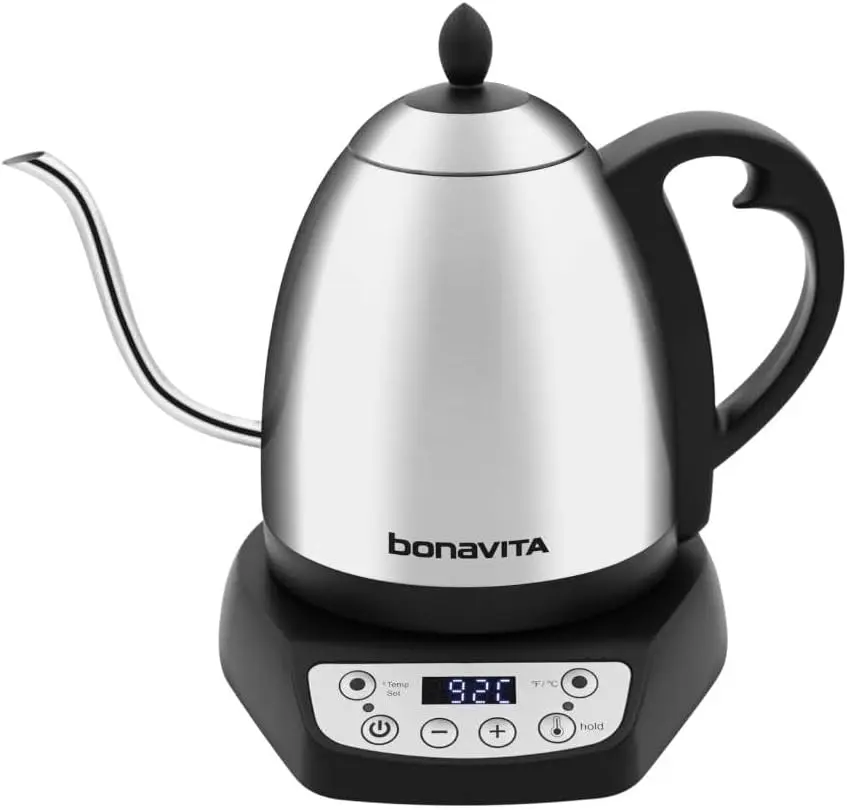
Bonavita 1L variable-temperature kettle — temperature consistency
French press does not require a gooseneck spout, but temperature control removes guesswork. A variable-temperature kettle is most useful when you regularly switch between roast levels or brew methods.
Complete French Press Gear Checklist
| Item | Required? | Notes |
|---|---|---|
| French press | ✅ Essential | Bodum Chambord 1L is the recommended starting point for most brewers |
| Burr grinder | ✅ Essential | KINGrinder K6 is the recommended manual option; blade grinders are incompatible |
| Digital scale (0.1g accuracy) | ✅ Essential | Measuring by weight is non-negotiable for consistent results; any kitchen scale works |
| Kettle | ✅ Essential | Standard kettle works; temperature-control kettle eliminates the guesswork |
| Timer | ✅ Essential | Phone timer works perfectly; no dedicated hardware needed |
| Thermometer | ⚠️ Optional | Useful for learning water temperature; not required once you know your kettle’s off-boil timing |
| Serving vessel | ⚠️ Recommended | Decant immediately after pressing to stop extraction; any mug or carafe works |
Choosing Your Coffee: Roast, Origin, and Freshness
French press is a body-forward, oil-forward brew method. It amplifies richness, chocolate, caramel, and dried fruit notes, and suppresses the high-frequency brightness that paper-filter methods like pour-over express best. This makes some bean types genuinely better suited to French press than others — not because the beans are better or worse. But Because they match what the method does well. Choosing the right coffee is as impactful as any brewing variable.
Roast Level
Medium and medium-dark roasts are forgiving starting points for French press. They usually offer both sweetness and body. Light roasts can work well too, but they often need more extraction. Dark roasts usually need less.
As a practical rule, move slightly finer, hotter, or longer for a light roast. Move slightly coarser, cooler, or shorter for a dark roast. Make one adjustment at a time so you can tell what changed the cup.
Origin and Processing
Natural-processed and honey-processed beans perform exceptionally well in French press. The metal filter passes the fruit esters and fermentation compounds that make naturally processed Ethiopians, Brazilians, and Indonesians distinctive — blueberry, dried cherry, dark chocolate, brown sugar — without the filtering-away of complexity that paper methods cause. Washed process single-origins can be excellent in French press, but their brightness and clarity are somewhat muted compared to how they perform in a pour-over. The body they gain from the metal filter can compensate if they are medium roast with good base sweetness.
Freshness
Buy whole bean and grind immediately before brewing. Ground coffee begins losing volatile aromatic compounds within 15–30 minutes of grinding. The complexity, brightness, and distinctiveness of your coffee. The qualities that justify spending on specialty beans — degrade rapidly once the protective cell structure of the bean is broken. A bag of whole beans stays at peak quality for 2–4 weeks from the roast date when stored in an airtight container away from heat and light. Pre-ground coffee labelled for French press is a usable fallback; buy it fresh and use it within two weeks of opening.

Peet’s Major Dickason’s Blend — full-bodied reference coffee
A dark, body-forward blend is useful when you want to hear what French press does best: weight, chocolate-toned depth, and retained oils. The link uses CoffeeGearHub’s CJ affiliate relationship.
For a complete breakdown of the best coffees for French press across roast levels and origins, see our full Best Coffee Beans for French Press guide →
Bean Type Reference: French Press Performance by Coffee Type
| Bean type | French press performance | K6 starting point | Adjust |
|---|---|---|---|
| Medium roast blend | Excellent — balanced, forgiving, wide extraction window | 139–144 clicks | Standard parameters; easiest to dial in |
| Medium-dark blend | Excellent — rich, chocolate-forward, full body | 142–148 clicks | Lower temp to 92°C; watch for bitterness |
| Dark roast | Good — bittersweet, intense; narrow window before over-extraction | 146–154 clicks | 90–92°C; shorten steep to 3.5 min; 1:13 ratio |
| Light roast washed | Moderate — acidity and clarity somewhat muted by metal filter | 130–139 clicks | 95–96°C; 4.5–5 min steep; 1:15–1:16 ratio |
| Natural Ethiopian | Exceptional — fruit esters amplified powerfully through metal filter | 134–142 clicks | 92–93°C; avoid over-extracting the fermentation notes |
| Brazilian / Indonesian | Excellent — earthy, nutty, chocolate-forward; built for immersion | 139–146 clicks | Standard parameters; very forgiving method for these origins |
| Honey process medium | Excellent — balanced sweetness and body; most versatile everyday bean | 136–144 clicks | Standard parameters; consistent results across roasters |
The French Press Brew Guide Ratio
Ratio — the amount of coffee relative to water — is the primary control for brew strength. It is the first adjustment to make when your cup is too strong or too weak, and it is the variable you should dial in before adjusting grind, temperature, or steep time. Always measure by weight in grams, not by tablespoons or scoops: coffee density varies significantly between roasts and origins, making volume measurements unreliable for consistent results.
Standard French Press Ratio: 1:15
The SCA Golden Cup framework places many filter-coffee recipes in roughly the 1:15–1:18 range. For French press, 1:15 is a practical starting point for many medium and medium-dark roasts.
Move toward 1:13 or 1:14 for a stronger cup. Move toward 1:16 or 1:17 for a lighter one. French press can still feel richer than paper-filter coffee at the same ratio because more oils remain in the brew.
| French press size | Water volume | Coffee dose (1:15) | Coffee dose (1:13 — strong) | Coffee dose (1:17 — mild) | Approximate cups yield |
|---|---|---|---|---|---|
| 350ml (small) | 300ml | 20g | 23g | 18g | 1 standard cup |
| 500ml (medium) | 420ml | 28g | 32g | 25g | 1–2 cups |
| 1L (standard) | 850ml | 57g | 65g | 50g | 3–4 cups |
| 1.5L (large) | 1300ml | 87g | 100g | 76g | 5–6 cups |
🔬 Note on brew volume vs press capacity: The table above shows brew water volume, not total press capacity. A 1L Bodum Chambord holds approximately 1L including the head space above the grounds — use 850–900ml water to leave appropriate room below the mesh filter. Always leave at least 2–3cm of clearance between the water surface and the top of the beaker so the filter sits properly when you press.
Grind Size: The Most Important Variable in French Press
Grind size has a greater impact on French press cup quality than any other variable — more than ratio, more than temperature, more than steep time. Get this right first. Every other adjustment you make is limited by grind quality.
What Coarse Grind Looks and Feels Like
The target grind for French press is coarse — the particles should visually resemble coarse sea salt or rough, uneven breadcrumbs. Individual particles should be large enough to see clearly; there should be minimal dust or powder at the bottom of your grind catch. When you rub a pinch of ground coffee between your fingers, you should feel gritty texture, not silky smoothness. If the grind looks and feels like fine sand or powder, it is too fine for French press.
Why Grind Size Matters So Much for French Press
French press extraction happens in still water rather than a continuous stream of fresh water. Fine particles expose more surface area, so they give up soluble compounds quickly. Coarse particles extract more slowly over the full steep.
That is why a coarse grind fits the method. It gives sweetness and body time to develop without pushing the brew as quickly toward bitterness. It also reduces fines that can clog the mesh and increase plunge resistance.
KINGrinder K6 Grind Settings for French Press
| Roast level | K6 clicks | Ratio | Water temp | Steep time | Expected result |
|---|---|---|---|---|---|
| Light roast | 130–139 | 1:15 to 1:16 | 95–96°C | 4.5–5 min | Bright, complex, lighter body — origin-forward with tea-like texture |
| Medium roast | 139–144 | 1:15 | 93°C | 4 min | Balanced, full-bodied, caramel and nut — the classic French press cup |
| Medium-dark roast | 142–148 | 1:14 to 1:15 | 92°C | 4 min | Chocolate, brown sugar, heavy mouthfeel — rich and satisfying |
| Dark roast | 146–154 | 1:13 to 1:14 | 90–92°C | 3.5–4 min | Bittersweet, intense, bold — traditional strong press character |
| Cold brew | 148–158 | 1:8 to 1:10 | Cold water | 12–16 hrs (fridge) | Sweet, smooth concentrate — dilute 1:1 over ice before serving |
⚠️ Blade grinder warning: A blade grinder — the propeller-style device that chops coffee — is incompatible with French press. It produces an inconsistent mixture of dust-fine particles and coarse chunks in every grind. The fines over-extract and become bitter; the chunks under-extract and taste sour and weak. Both problems happen simultaneously, producing a cup that tastes muddy, harsh, and confused regardless of your recipe. No grind time adjustment, no sifting, no recipe change fixes this. A burr grinder like the K6 is the single highest-impact upgrade you can make to your French press setup.
Water Temperature
Water temperature affects how quickly soluble compounds extract from coffee grounds. Too hot, and bitter and harsh compounds extract before the coffee’s sweetness and complexity have fully developed. Too cool, and under-extraction produces a flat, sour, thin cup. The SCA’s brewing water temperature recommendation of 91–96°C applies to French press — with specific targets varying by roast level.
| Roast level | Target temperature | Off-boil timing (approximate) | Why |
|---|---|---|---|
| Light roast | 95–96°C | 10–15 seconds | Denser cellular structure requires higher temperature for full extraction |
| Medium roast | 93°C | 30–45 seconds | Standard sweet spot — balanced extraction across all compounds |
| Medium-dark roast | 92°C | 45–60 seconds | Slightly lower temp reduces risk of extracting harsh roast-development bitterness |
| Dark roast | 90–92°C | 60–90 seconds | Fragile compounds in dark roasts extract bitter rapidly; lower temp moderates this |
If you do not have a thermometer and are not using a temperature-control kettle, the simplest reliable approach: boil water, remove from heat, and wait 30–45 seconds before pouring for medium roast. This consistently reaches 92–94°C in most kettles at room temperature. For light roast, pour almost immediately. For dark roast, wait 60–90 seconds or longer.
Step-by-Step French Press Brew Instructions
This is the complete standard recipe for a 1L Bodum Chambord with medium roast coffee at 1:15 ratio. Every step is explained so you understand what it accomplishes — not just what to do, but why. See our French Press Coffee Ratio guide
Standard Recipe: Medium Roast, 1L Chambord
- Coffee: 30g whole bean (medium roast)
- Water: 450ml at 93°C
- Ratio: 1:15
- Grind: Coarse — K6 clicks 68–72
- Total brew time: approximately 8 minutes
- Preheat the French press. Pour boiling water into the empty beaker, let it sit 30 seconds, then discard. This prevents the cold glass from pulling temperature out of your brew water during the steep. A cold beaker can drop your water temperature by 5–8°C before extraction even begins.
- Measure and grind. Weigh 30g of whole bean coffee. Grind at K6 139–144 clicks — coarse, resembling rough sea salt. Grind immediately before brewing; do not pre-grind.
- Add grounds to the press. Pour the ground coffee into the preheated (and now emptied) beaker. Zero your scale with the press on it — this allows you to weigh water directly as you pour.
- Bloom pour — 0:00. Start your timer. Pour 60ml of 93°C water evenly over all the grounds — just enough to saturate them completely. You may see the grounds swell slightly or release gas bubbles; this is CO2 degassing from fresh beans. Stir once gently with a chopstick or long spoon to ensure all grounds are wet. Wait 30 seconds.
- Main pour — 0:30. Pour the remaining 390ml of water in a slow, even spiral from outside to centre. Aim to complete the pour by approximately 1:00. Do not rush — a gentler pour means less agitation of the grounds, which reduces sediment in the final cup.
- Place lid, steep — 1:00. Place the lid on the French press with the plunger pulled all the way up. This creates a partial vacuum that helps maintain temperature without extracting more coffee. Set your timer for 3 more minutes (total steep: 4 minutes from the first pour). Leave it entirely alone — no stirring, no peeking.
- Press — 4:00. At 4 minutes, apply slow and steady downward pressure to the plunger. The press should take 20–30 seconds from top to bottom — slow, controlled, even. If you feel strong resistance before the plunger is halfway down, stop and pull back slightly; your grind may be too fine, or grounds may have migrated into the filter. Do not force it. If the plunger drops with almost no resistance, your grind is likely too coarse.
- Pour immediately. The moment the press is complete, pour all the brewed coffee into a serving vessel — a thermal carafe, a large mug, or any separate container. Do not leave coffee in the press. The grounds on the bottom continue extracting even after pressing, and within 5–10 minutes the coffee left in contact with them will become noticeably more bitter. This is the single most common mistake in French press brewing.
✅ Quick reference card: Preheat → Grind → Add grounds → 0:00 bloom (60ml, stir) → 0:30 main pour (390ml) → Lid on, plunger raised → 4:00 press slowly → Pour all immediately. That is the complete recipe in one sentence.
Steep Time Variations
Four minutes is the standard steep time for medium roast French press — but it is not a universal rule. Roast level, grind size, and water temperature interact to determine how quickly extraction reaches its optimal endpoint. The table below shows how steep time adjusts for different scenarios and what to expect from each.
| Steep time | Best for | Expected flavour impact | When to use |
|---|---|---|---|
| 3 to 3.5 minutes | Dark roast; very finely ground medium roast | Reduced extraction — less bitterness, more sweetness, slightly thinner body | If your dark roast cup is too bitter at 4 minutes; try 3.5 min first |
| 4 minutes (standard) | Medium roast; honey process; medium-dark | Balanced — full body, caramel sweetness, low bitterness | The default starting point for most beans and brewers |
| 4.5 minutes | Light roast; very fresh beans with high CO2 | Fuller extraction — more complexity, slightly more body from dense light-roast beans | Light roast consistently tastes flat or underdeveloped at 4 minutes |
| 5 minutes | Light roast at high altitude; coarsely ground light roast | Maximum immersion extraction for light roast — risk of astringency if grind is wrong | Only for light roast where 4.5 min is still flat; adjust grind before adding more time |
🔬 Always pour immediately regardless of steep time. The steep time determines when you press. What happens after pressing is equally important: extraction does not stop at the press. The grounds sitting on the bottom of the beaker continue to interact with the liquid above them. A cup brewed perfectly to 4 minutes and left in the press for 10 minutes tastes significantly more bitter than one decanted immediately. If you are not serving all the coffee at once, pour all of it into a thermal carafe first.
Advanced Tips: Getting More From Your French Press
Once your standard recipe is dialled in — ratio, grind, temperature, and steep time all producing a cup you enjoy — these techniques can take your French press brewing further.
The Hoffmann No-Press Method
A popular no-press French press technique associated with James Hoffmann uses a slightly finer grind and a longer total brew. Steep for about four minutes, break the floating crust, then let the grounds settle for several more minutes without plunging.
Pour carefully so the settled grounds stay at the bottom. The method can produce a cleaner cup with less sediment, but it takes longer than a standard French press recipe. It is a useful experiment when you want more clarity from the brewer.
Cold Brew in a French Press
French press is one of the best home cold brew setups for volume and simplicity. Use K6 clicks 148–158 (very coarse), a 1:8 ratio (e.g. 60g coffee to 480ml cold filtered water), stir well to combine all grounds, and place the lid on with plunger raised. Steep in the refrigerator for 12–16 hours. Press slowly, pour the concentrate into a separate container, and discard or compost grounds. Serve diluted 1:1 with cold water or milk over ice. The resulting concentrate keeps refrigerated for up to 10 days. For more detail, see our full French Press Cold Brew Guide →
Adjusting for Altitude
Water boils at a lower temperature as elevation increases. That can leave a standard French press recipe cooler than expected and may reduce extraction.
If coffee at altitude tastes persistently sour, thin, or flat, try brewing with water immediately after it reaches a boil and extend the steep by 30–60 seconds. Change one variable at a time and use taste as the final check.
Cleaning Between Brews for Flavour Clarity
Coffee oils build up in a French press mesh filter over time. If they are not removed, they can add stale or musty flavors to later brews.
Rinse the press after every use and wash the filter assembly with soap once or twice a week. A deeper monthly soak with an appropriate coffee-equipment cleaner can help remove stubborn oil residue. See our full French Press Cleaning Guide → for the complete process.
French Press vs Other Brew Methods
Understanding how French press compares to other methods helps you decide whether French press is the right primary method for your setup, and which other brewers complement it well.
| Method | Cup character vs French press | Cleanup | Versatility | Best if you… |
|---|---|---|---|---|
| AeroPress | Cleaner, brighter, less body (paper filter); closer with metal filter | Much easier — under 30 seconds | Higher — espresso-style, iced, cold brew, filter-style | Want fast cleanup and recipe variety; travel frequently |
| Pour-over (V60, Chemex) | Cleaner, brighter, lighter — paper filter strips oils and body | Moderate — discard filter, rinse vessel | Lower — one brew style; no immersion option | Want maximum clarity and origin brightness from light roasts |
| Drip machine | Paper filter removes oils; typically lighter and less textured | Easy — discard filter, wipe carafe | Low for manual control; high for automation | Want hands-free brewing for multiple cups; don’t want to measure |
| Moka pot | More concentrated, more intense, closer to espresso | Moderate — disassemble, rinse three parts | Moderate — stovetop only; no cold brew | Want espresso-adjacent intensity without an espresso machine |
For a complete side-by-side comparison with the AeroPress specifically — including grind reference tables, cleanup comparison, and travel analysis — see our full French Press vs AeroPress comparison guide →
Troubleshooting Matrix: French Press Problems and Fixes
Identify your symptom below. Adjust one variable at a time — changing multiple things simultaneously makes it impossible to know what worked. Always write down what you changed and the result so you can repeat or refine it.
| Symptom | Most likely cause | Fix (in priority order) |
|---|---|---|
| Bitter / harsh / astringent | Over-extraction — grind too fine, steep too long, water too hot, or left on grounds after pressing | 1. Grind 3–5 clicks coarser on K6 → 2. Shorten steep by 30s → 3. Lower water temp by 2°C → 4. Pour all coffee immediately after pressing |
| Sour / sharp / thin | Under-extraction — grind too coarse, steep too short, water too cool | 1. Grind 3–4 clicks finer → 2. Extend steep by 30s → 3. Raise water temp by 2°C → 4. Check dose is correct |
| Weak / watery | Too much water relative to coffee (ratio too high), or under-extraction | 1. Increase dose by 3–5g → 2. Grind 3 clicks finer → 3. Extend steep by 30s |
| Too strong / overwhelming | Too much coffee relative to water (ratio too low) | 1. Reduce dose by 3–5g → 2. Try 1:16 or 1:17 ratio → 3. Grind 3–5 clicks coarser |
| Muddy / gritty / excessive sediment | Grind too fine for metal mesh; blade grinder producing excess fines; pressing too fast | 1. Grind 5+ clicks coarser → 2. Press more slowly and evenly → 3. Upgrade to burr grinder if using blade grinder |
| Flat / hollow / no aroma | Stale beans — aromatic volatile compounds depleted | Buy fresh beans with a roast date visible on the bag; no grind or recipe fix compensates for stale coffee |
| Coffee cools too quickly | Glass beaker losing heat fast; cold ambient temperature | 1. Preheat beaker thoroughly before brewing → 2. Pour into insulated mug or thermal carafe immediately after pressing |
| Strong resistance when pressing | Grind too fine, grounds packed too tightly, or grounds migrated into filter area | 1. Stop and pull plunger back slightly → 2. Apply slow, gentle pressure at an angle → 3. Grind coarser next brew → 4. Ensure plunger is centred |
| Plunger drops with no resistance | Grind too coarse — water flowing through grounds without resistance | Grind 5+ clicks finer next brew; confirm grind is actually coarse and not medium-coarse |
| Fermented / boozy / overpowering natural notes | Over-extraction of fermentation esters in natural-process beans | 1. Shorten steep by 30–45s → 2. Grind 3 clicks coarser → 3. Lower water temp by 2°C |
| Coffee tastes like plastic or rubber | Rancid oil buildup in plunger assembly; cheap plastic French press off-gassing | Deep-clean the plunger assembly (Cafiza soak); consider upgrading to glass or stainless French press |
| Grounds floating to top after pouring water | Normal and expected — fresh beans with high CO2 float during bloom | Not a problem — stir once gently at 30s bloom to resubmerge floating grounds |
FAQs: French Press Brew Guide
What is the best coffee-to-water ratio for French press?
The standard French press ratio is 1:15 — 1g of coffee per 15ml of water. For a typical 450ml brew, this means 30g of coffee. For a stronger cup, use 1:13 or 1:14. For a milder cup, use 1:16 or 1:17. Ratio is the fastest and most reliable way to adjust brew strength — always measure by weight, not by volume, for consistent results.
How coarse should I grind for French press?
French press requires a coarse grind — the particles should resemble coarse sea salt or rough breadcrumbs. On the KINGrinder K6, this is approximately clicks 134–152 depending on roast level. A grind that is too fine will produce bitter, muddy coffee and excessive sediment; too coarse will produce weak, sour, underdeveloped coffee. A consistent burr grinder is essential — blade grinders are incompatible with French press because they produce uneven particle sizes that cause simultaneous over- and under-extraction.
How long should I steep French press coffee?
The standard steep time is 4 minutes for medium roast coffee at 93°C. Light roasts benefit from 4.5–5 minutes at a slightly higher temperature to compensate for their denser cell structure. Dark roasts can be shortened to 3.5 minutes to avoid over-extraction. After pressing, always pour all the coffee immediately — leaving it on the grounds continues extraction and produces bitterness within minutes.
Can I use pre-ground coffee in a French press?
You can use pre-ground coffee in a French press, but quality suffers significantly. Ground coffee degasses and loses volatile aromatic compounds within 15–30 minutes of grinding. If you must use pre-ground, buy a coarse-ground option specifically labelled for French press or cold brew, and use it within 2–3 weeks of the bag’s open date. For the best cup, grind whole beans immediately before each brew.
Why is my French press coffee bitter?
Bitterness in French press coffee is almost always caused by over-extraction. The most common causes in order of likelihood: grind too fine, steep time too long, water temperature too high, or leaving coffee on the grounds after pressing. Fix in this order: grind 3–5 clicks coarser on the K6, shorten steep by 30 seconds, lower water temperature by 2°C, and pour all coffee immediately after pressing.
Why is my French press coffee weak?
Weak or watery French press coffee is caused by under-extraction or too much water relative to coffee. Fix in this order: increase your dose by 3–5g (most immediate fix), grind 3–4 clicks finer, extend steep by 30 seconds, or raise water temperature by 2°C. Also verify you are measuring coffee by weight — a tablespoon of coffee varies significantly in mass depending on grind size and roast level.
Should I stir French press coffee while it steeps?
Stir only at the bloom stage (at 30 seconds) to ensure all grounds are fully saturated. Do not stir during the main 4-minute steep — agitation accelerates extraction unevenly and can cause fine particles to cloud the brew. If you consistently get too much sediment in your cup, reducing stirring and pressing more slowly often helps significantly.
Can I make cold brew in a French press?
Yes — French press is one of the best home cold brew setups available for volume and simplicity. Use K6 clicks 148–158 (very coarse), a 1:8 coffee-to-water ratio, stir thoroughly to combine, and steep in the refrigerator for 12–16 hours. Press slowly, pour the concentrate into a separate container, and dilute 1:1 with cold water or milk over ice when serving. The concentrate keeps refrigerated for up to 10 days.
How do I clean a French press?
After brewing, discard or compost the grounds (a silicone spatula helps). Rinse the beaker with warm water. Disassemble the plunger assembly and rinse all parts separately. Wash with mild dish soap at least twice a week — the metal mesh accumulates coffee oils that turn rancid over time and add off-flavour to every cup. Monthly, soak the disassembled plunger in a solution of warm water and a small amount of Cafiza or baking soda for 15 minutes to break down oil buildup. See our full French Press Cleaning Guide for the complete process.
Does French press coffee have more caffeine than drip?
French press and drip coffee are comparable in caffeine content at equivalent brew volumes and ratios — caffeine extraction efficiency is high in both methods. The perception that French press is stronger comes from its heavier body, oil content, and richer mouthfeel — not significantly higher caffeine. If you want more caffeine, increase your dose (more coffee per volume of water) rather than switching methods.
CoffeeGearHub product shortlist
Keep the French press setup together
Use these CoffeeGearHub pages to compare the press, grinder, and ratio before leaving the site.