
AeroPress vs Drip Coffee
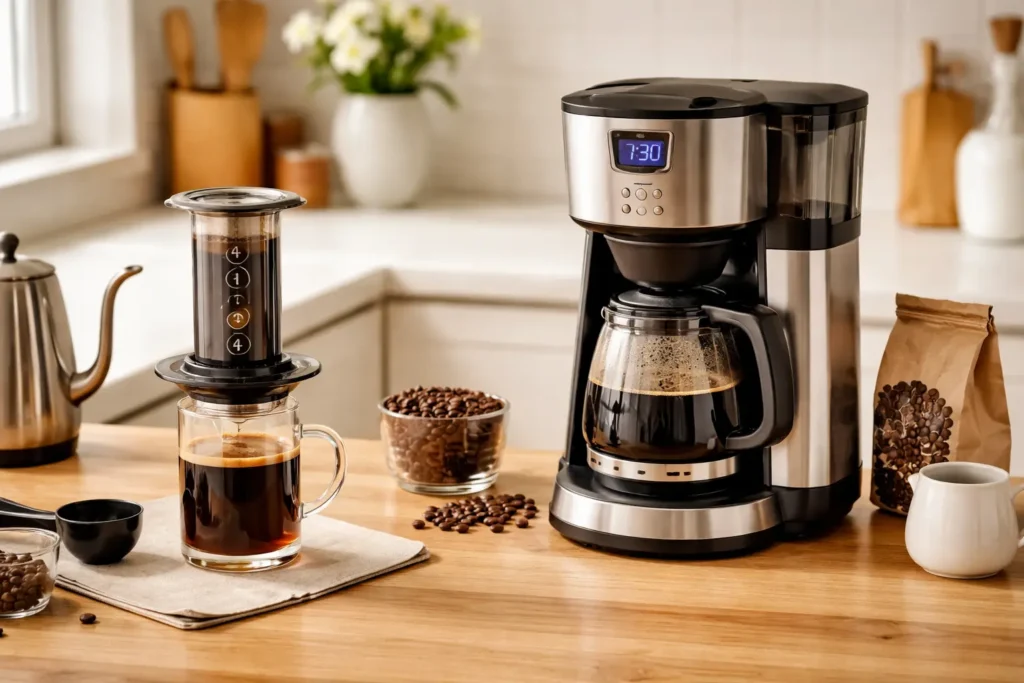
Editorial standards: this guide focuses on repeatable brewing variables, practical ownership, and clearly labeled product examples. Recommendations are separated from technique so the article remains useful even if you already own the equipment.
At a glance
AeroPress is a single-cup tool; drip is a batch-brewing system
AeroPress gives you more direct control over a small brew and is easy to clean or travel with. Drip wins when you want several cups with almost no active attention.
Cup quality depends heavily on grinder quality and coffee freshness in both methods. Drip also depends more on the engineering of the machine.
Editorial analysis
The workflow matters as much as the flavor
AeroPress can deliver a clean, concentrated cup from inexpensive hardware because you control the water and timing yourself.
Drip shifts that control into the machine. A well-designed brewer can be very consistent, but a weak machine can limit temperature and saturation.
The 30-Second Answer
Choose AeroPress for one or two cups, portability, fast cleanup, and direct control. Choose drip for larger batches and hands-off brewing. If both needs are common, owning both can make sense.
Start with the highest-impact options
Start with these representative choices
These examples make the equipment side of the guide concrete while keeping the main article focused on brewing decisions.
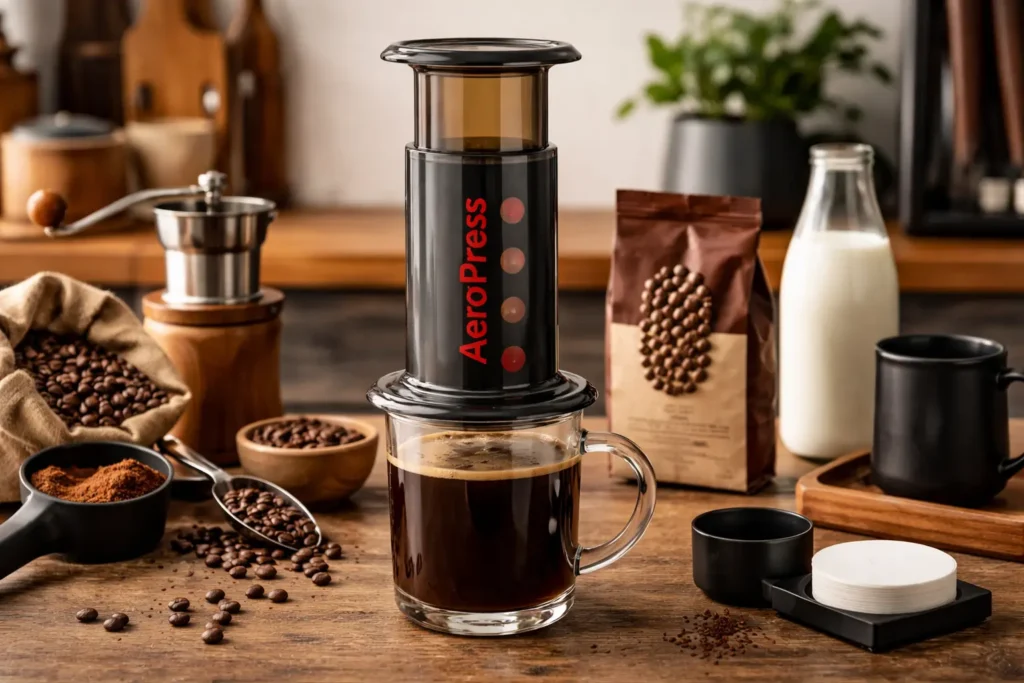
AeroPress Original — single-cup reference
A compact manual brewer for fast, flexible single-cup coffee.
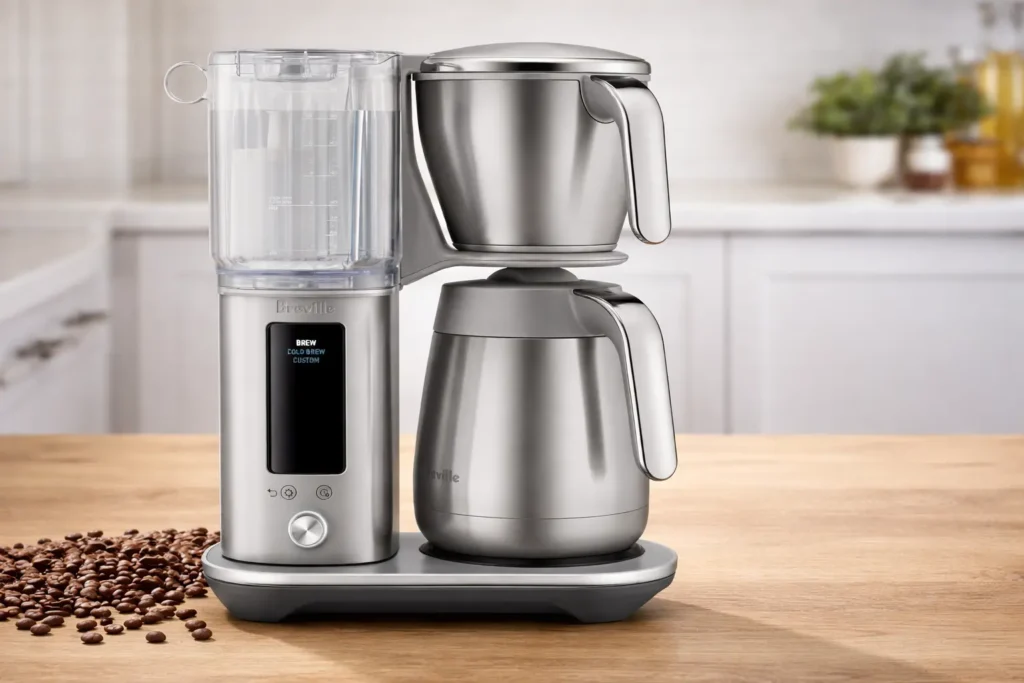
Breville Precision Brewer — drip reference
A programmable automatic brewer representing the volume and convenience side of the comparison.
Affiliate disclosure: Amazon links may earn CoffeeGearHub a commission at no additional cost to you. Prices and availability can change.
How Each Method Works: The Key Differences
AeroPress and drip coffee both use hot water and a paper filter. But The mechanism that moves water through the coffee grounds is fundamentally different — and that difference explains almost everything about why the two methods taste and behave differently.
☕ AeroPress
AeroPress is a hybrid brewer — part immersion (the coffee steeps in water), part pressure (a plunger forces water through a filter at the end). Coffee grounds and hot water steep together for 60–120 seconds, then the brewer is pressed manually, forcing the liquid through a microfilter. The result is a concentrated, clean, full-bodied single serving. The immersion phase produces even saturation of all grounds; the pressure phase produces faster, more complete extraction of the target compounds.
- Mechanism: immersion steep + manual pressure press
- Pressure: ~0.5–1 bar (hand pressure)
- Filter: paper microfilter (or reusable metal)
- Contact time: 60–120 seconds steep + 20–30s press
- Volume per brew: 200–350ml (single serving)
- Temperature control: manual — fully adjustable
- Active involvement: 2–3 minutes of hands-on brewing
🫗 Drip Coffee Maker
Drip coffee makers are gravity-fed percolation brewers — heated water drips from a showerhead down through a basket of grounds, passing through a paper or mesh filter into a carafe below. Water contacts the grounds for 4–6 minutes as it percolates through. The brew cycle is automated: add water, add grounds, press start. Most machines include a warming plate that maintains carafe temperature after brewing. Quality varies enormously by machine — cheap models can’t achieve proper brew temperature or uniform saturation, while SCA-certified machines rival pour-over quality.
- Mechanism: gravity-fed percolation through a fixed filter basket
- Pressure: gravity only (no pump pressure)
- Filter: paper basket filter or permanent mesh
- Contact time: 4–6 minutes (gravity-controlled)
- Volume per brew: 750ml–1.8L (4–12 cups)
- Temperature control: fixed (machine-controlled; varies by model)
- Active involvement: 60 seconds setup; fully hands-off brewing
🔬 Why the mechanism matters: AeroPress begins with a short immersion phase, so all of the grounds are wet before the brew is pressed through the filter.
Drip coffee is different: water moves through the bed progressively. That can be excellent when the machine distributes water evenly, but poor saturation in a cheap machine can create uneven extraction.
AeroPress vs Drip Coffee: Full Head-to-Head Comparison
This table covers every practical dimension of the comparison. Use it as a fast reference before diving into the detailed sections below for any category where you need the full picture.
| Category | AeroPress | Drip Coffee Maker | Winner |
|---|---|---|---|
| Brew quality ceiling | Extremely high — rivals expensive pour-over brewers | High on SCA-certified machines; mediocre on budget models | 🏆 AeroPress (at comparable price points) |
| Flavour control | Full control: temperature, grind, ratio, steep time, press speed | Limited: grind and ratio only; temp and flow rate are machine-fixed | 🏆 AeroPress |
| Volume per brew | 200–350ml (single serving) | 750ml–1.8L (4–12 cups) | 🏆 Drip (multi-cup households) |
| Brew time (hands-on) | 2–3 minutes active involvement | 60 seconds setup; 5–8 minutes unattended | 🏆 Drip (for passive mornings) |
| Upfront cost | Very affordable — among the lowest-cost quality brewing devices available | Wide range — entry-level to premium; quality scales significantly with price | 🏆 AeroPress |
| Ongoing filter cost | Very low — 350 microfilters per pack, or eliminate cost entirely with a reusable metal filter | Low — basket filters are inexpensive and widely available | 🏆 AeroPress (especially with metal filter) |
| Grind flexibility | Medium-fine to fine; adjustable across 4+ recipe styles | Medium only — fixed by machine’s flow rate | 🏆 AeroPress |
| Ease of use (beginner) | Easy — 7-step process, 2-minute learning curve | Very easy — fill and press start | 🏆 Drip (lowest barrier) |
| Clean-up time | Under 60 seconds — eject puck, rinse chamber | 2–5 minutes — discard filter, rinse basket and carafe | 🏆 AeroPress |
| Portability | Excellent — 250g, no electricity required | Poor — mains power, heavy, fragile | 🏆 AeroPress |
| Versatility (recipes) | Standard, inverted, concentrate, cold brew, iced — 5+ styles | One recipe: standard drip. Some models offer brew strength settings | 🏆 AeroPress |
| Programmability | None — manual only | Most models: programmable timer for auto-start | 🏆 Drip |
| Keep-warm function | None — brews one cup at a time, served immediately | Most models: warming plate or thermal carafe | 🏆 Drip |
| Consistency shot-to-shot | High once dialled in — same variables every brew | High — machine-controlled variables remove human error | Tie |
| Best for travel | Exceptional — carry-on friendly, no electricity needed | Not suitable for travel | 🏆 AeroPress |
| Durability | Virtually indestructible — BPA-free plastic, no glass | Variable — carafe is fragile; heating element degrades over time | 🏆 AeroPress |
Brew Quality and Flavour: What the Science Says
Brew quality is where the AeroPress consistently outperforms drip coffee makers at the same price point — but the gap narrows significantly as drip machine quality increases. Understanding why requires understanding what each method does to extraction chemistry.
Why AeroPress Coffee Tastes Different from Drip
AeroPress flavor comes from three things working together: immersion, a fine filter, and gentle pressure. The immersion phase gives the grounds even contact before the press begins.
Paper filtration removes much of the sediment and oil, while the short press finishes the brew quickly. The result is often cleaner and more concentrated than standard automatic drip.
The practical result: AeroPress coffee at a standard 1:14 ratio is noticeably fuller in body, more aromatic, and more flavour-complex than coffee from a budget drip machine using the same beans and grind. Against a quality SCA-certified drip machine that achieves proper 92–94°C brew temperature and uniform saturation, the gap closes — both methods produce outstanding coffee, and the difference becomes a matter of preference (AeroPress’s slightly denser body vs drip’s slightly more delicate clarity) rather than a quality hierarchy.
The Drip Machine Quality Problem
Water temperature is a major variable in drip coffee quality. Many inexpensive machines struggle to hold an appropriate brewing temperature, which can leave the cup thin or sour.
AeroPress lets you control water temperature with the kettle. That is one reason a simple manual brewer can outperform a poorly designed automatic machine even when the same coffee is used.
🔬 The SCA temperature standard: The Specialty Coffee Association certifies drip machines that consistently reach 92–96°C at the brew head — a threshold most budget machines fail to reach. SCA-certified machines (Breville Precision Brewer, OXO Brew, Technivorm Moccamaster) produce a noticeably superior cup to non-certified machines from the same beans. If you’re buying a drip machine, SCA certification is the single most important specification to check. If your current drip machine produces sour, flat, or thin coffee that grind adjustment doesn’t fix, temperature is almost certainly the cause.
Brew Quality by Price Tier: Honest Assessment
| Budget level | AeroPress quality | Drip machine quality | Verdict |
|---|---|---|---|
| Entry level (device only) | Excellent — AeroPress + any kettle = full quality ceiling unlocked regardless of budget | Poor to fair — entry-level machines typically under-temperature with uneven saturation | AeroPress wins by a wide margin |
| Mid-range | Excellent — the AeroPress itself stays the same; additional budget goes toward a better grinder | Good — mid-range machines approach proper brew temperature; still variable by brand | AeroPress wins; invest any additional budget into a burr grinder |
| Upper mid-range | Excellent — pair AeroPress with a quality burr grinder for maximum cup quality | Very good — SCA-certified machines at this tier (Breville Precision Brewer) rival pour-over quality | Comparable — flavour preference determines choice at this level |
| Premium | AeroPress remains the same device — additional spend goes entirely to grinder, with diminishing returns beyond a certain point | Outstanding — Technivorm Moccamaster and Fellow Opus tier; genuine specialty-level drip | Tie — both produce exceptional coffee; choice is lifestyle, not quality |
Convenience and Ease of Use: The Honest Trade-off
Convenience means different things depending on the household. Drip wins when you want to load a machine, press start, and walk away.
AeroPress requires active participation, but the process is short. For a single cup, the total elapsed time can still be competitive once you include a drip machine’s full brew cycle.
| Convenience factor | AeroPress | Drip Coffee Maker |
|---|---|---|
| Morning setup time | Grind (60–90s) + boil water (3–4 min) + brew (90s) + press (30s) = ~6 min total | Fill reservoir + add grounds + press start = 60 seconds; then 5–7 min unattended brewing |
| Active attention required | Yes — must stay present for the full 2-minute brew cycle | No — set it and walk away; machine handles everything |
| Programmable start | No — manual only | Yes — most machines: program auto-start the night before |
| Multiple cups at once | No — one serving per press; multiple presses for multiple people | Yes — 4–12 cups per cycle depending on machine |
| Keep-warm capability | None — serve immediately or coffee cools | Warming plate (most models) or thermal carafe (better models) |
| Learning curve | Gentle — most beginners brew a good cup within 5 minutes of reading the method | Minimal — fill, load, start; no technique required |
| Grind requirement | Burr grinder strongly recommended for quality ceiling | Pre-ground works — less grind-sensitive than AeroPress |
Drip offers passive convenience. AeroPress offers active efficiency.
If you need several cups with no attention, drip has the advantage. If you want one quick cup and do not mind two minutes of hands-on brewing, AeroPress can feel just as convenient.
Cost Comparison: Upfront, Ongoing, and Total Cost of Ownership
Cost comparisons between brewing methods are often incomplete because they ignore ongoing filter costs, replacement costs, and the grinder investment that maximises each method’s quality. Here is the full picture across both methods over a 3-year ownership horizon.
| Cost item | AeroPress | Drip Coffee Maker | Notes |
|---|---|---|---|
| Device cost | Very affordable — among the most accessible quality brewing devices available | Wide range — entry-level to premium; quality scales significantly with price | Drip machine cost range is enormous; an SCA-certified machine costs considerably more than a budget model |
| Paper filters (1 year) | Very low ongoing cost — large packs of AeroPress microfilters are inexpensive | Low ongoing cost — basket filters are inexpensive and sold everywhere | Comparable ongoing cost; both are minimal relative to bean spend |
| Reusable filter option | Yes — stainless metal disk filter available; eliminates paper cost entirely with a one-time purchase | Some machines include permanent mesh basket; most still recommend paper for best cup clarity | AeroPress metal filter changes cup character (more body, less clarity) — a preference choice |
| Grinder investment (optimal) | Burr grinder strongly recommended — KINGrinder K6 is our pick for AeroPress and drip | Burr grinder improves drip quality but pre-ground works adequately | If you own one grinder, it serves both methods — not a per-method cost |
| Replacement cost (3–5 years) | Very low — rubber plunger seal is the only wear item; device itself rarely fails | Medium — heating elements degrade over time; budget machines may need full replacement in 3–5 years | Premium drip machines (Moccamaster-tier) last 10+ years; entry-level machines do not |
| Total cost of ownership | Low — the device cost is fixed and low; ongoing spend is filters and beans only | Variable — a premium machine costs more upfront but lasts longer; budget machines are cheap to buy and expensive to replace | AeroPress delivers the best quality-per-spend ratio of any brewing device available |
| Value per cup quality | Exceptional — maximum quality at minimum spend | Variable — entirely depends on which machine you buy | An affordable AeroPress with a good burr grinder rivals setups costing several times more |
🔬 The quality-per-spend reality: The AeroPress produces coffee that competes with drip machines costing several times more. The reason is that the AeroPress’s quality ceiling is determined by your grinder and your beans — not by the brewing device itself. An AeroPress paired with a KINGrinder K6 and fresh beans produces a cup that most people cannot distinguish from a premium drip machine setup in a blind taste test. The inverse is not true: even the most expensive drip machine cannot overcome the limitation of a blade grinder or stale beans.
Grind Requirements: What Each Method Needs and Why
Both AeroPress and drip coffee require a burr grinder to reach their quality ceiling — but AeroPress is more sensitive to grind size and consistency than drip, and the two methods require different grind settings from the same grinder. Understanding these differences matters if you’re using both methods from the same grinder (or deciding whether a single grinder can serve both).
| Grind factor | AeroPress | Drip Coffee Maker |
|---|---|---|
| Target grind size | Medium-fine to fine — K6: 20–30 clicks for standard; 15–20 clicks for concentrate | Medium — K6: 30–42 clicks; coarser than AeroPress |
| Sensitivity to grind consistency | High — inconsistent grind produces under- and over-extracted compounds in the same cup | Moderate — longer contact time buffers against minor particle inconsistency |
| Can pre-ground work? | Yes, but limits quality significantly — pre-ground espresso or filter grind varies; use pre-ground filter grind (not espresso) for AeroPress | Yes — pre-ground medium roast works adequately in most drip machines |
| Blade grinder result | Poor — uneven particles cause channelling-like uneven extraction and unpredictable cups | Mediocre — better than AeroPress blade result but still noticeably inferior to burr |
| Burr grinder required? | Strongly recommended — the single biggest quality lever after beans | Recommended but not essential — pre-ground is more workable for drip |
| K6 setting for this method | 20–30 clicks (standard AeroPress); 15–20 (concentrate) | 30–42 clicks |
⚠️ Using one grinder for both methods: If you own a KINGrinder K6 (or any wide-range burr grinder), you can use the same grinder for both AeroPress and drip — simply adjust the click setting between methods. For AeroPress, set to 22–28 clicks (medium-fine). For drip, set to 32–40 clicks (medium). The 10-click difference produces meaningfully different particle sizes optimised for each method’s contact time. Always dial back toward your usual setting between brews and purge a small amount of grounds to flush the retained grinds from the previous setting.
Beans: Can You Use the Same Coffee for Both Methods?
Yes — the same whole bean coffee can produce excellent results in both AeroPress and a quality drip machine. The key difference is not the bean but the grind setting and the recipe parameters for each method. That said, each method has a flavour character that rewards certain bean types more than others.
| Bean characteristic | AeroPress performance | Drip performance | Shared or method-specific? |
|---|---|---|---|
| Light roast single origin | Excellent — short extraction preserves delicate florals and fruit at 88–92°C | Good on SCA machines — requires proper 93–96°C brew temp; poor on budget machines | AeroPress more reliable for light roast across machine tiers |
| Medium roast blend | Excellent — the most versatile roast for all AeroPress recipes | Excellent — medium roast is drip’s native sweet spot; balanced, crowd-pleasing | Shared — medium roast performs well in both methods |
| Medium-dark roast | Very good — lower temperature (78–83°C) produces chocolate-forward cup without harshness | Very good — medium-dark suits drip’s longer contact time; smooth, low-acid everyday cup | Shared — both methods handle medium-dark well |
| Dark roast | Works best for concentrate recipe at lower temperature — standard recipe can go bitter | Good — drip’s fixed temperature (if correct) handles dark roast better than AeroPress at standard temp | Drip slightly more forgiving for dark roast at standard recipe |
| Natural process beans | Outstanding — fruit sweetness comes through with exceptional clarity | Good — natural process character survives drip’s longer contact time well | AeroPress reveals natural process character more vividly |
| Freshness requirement | 7–28 days post-roast optimal | 7–35 days post-roast — slightly more tolerant of slightly older beans | Both require fresh, roast-dated beans; drip marginally more forgiving of age |
The One Bean Rule That Applies to Both
Fresh coffee benefits both methods more than most equipment tweaks. Buy whole beans with a visible roast date when possible and grind shortly before brewing.
Neither an AeroPress nor an expensive drip machine can restore aroma that has already faded from stale beans.
Versatility: Recipes, Styles, and Brew Range
AeroPress is one of the most versatile single-device brewing tools ever made. Drip coffee makers are not versatile — they make drip coffee. This is not a criticism; versatility is not a requirement for a great brewing tool, and many home brewers want exactly one reliably excellent method rather than a device that does five things. But if you’re choosing between the two methods for your first or only brewing device, the versatility gap matters.
| Recipe / brew style | AeroPress | Drip Machine |
|---|---|---|
| Standard filter coffee | ✅ Excellent | ✅ Excellent (on quality machines) |
| Inverted / immersion brew | ✅ — produces cleaner, fuller-bodied cup than standard | ❌ Not possible |
| Espresso-style concentrate | ✅ — fine grind + 1:5 ratio produces intense, latte-ready shot | ❌ Not possible — gravity cannot produce concentrate |
| Iced coffee (hot brew over ice) | ✅ — brew at 1:8 ratio directly over ice for flash-chilled | ⚠️ Some machines support iced coffee mode; most don’t optimise for it |
| Cold brew | ✅ — overnight room-temp steep produces smooth, low-acid cold brew | ❌ Not designed for cold brew |
| Temperature control per roast | ✅ — fully adjustable: 75°C (dark) to 92°C (light) | ❌ Machine-fixed; adjustable only on premium models |
| Ratio control | ✅ — any ratio from 1:5 (concentrate) to 1:18 (lungo-style) | ⚠️ Limited — some machines offer strength settings but not full ratio control |
| Single cup | ✅ — native single-serving method | ⚠️ Most machines brew best at 6–10 cup volumes; partial carafes often under-extract |
Clean-Up and Maintenance
Clean-up is one of AeroPress’s most underrated advantages — and maintenance is one of drip’s most underrated ongoing commitments. If you’ve ever discovered a forgotten carafe full of cold coffee or scaled-up internal tubing on a drip machine that’s been running for two years without a descale, you understand why this category matters in practice.
AeroPress Clean-Up
AeroPress cleanup is unusually fast. Eject the spent puck, rinse the chamber and plunger, and the brewer is ready for the next cup.
There is no carafe, warming plate, or internal water path to maintain. A deeper wash from time to time is still useful, but daily cleanup is minimal.
- Daily clean-up: under 60 seconds
- Deep clean: dishwasher-safe (top rack)
- Descaling: not required — no internal heating element in contact with water
- Wear items: rubber plunger seal (replace every 1–2 years — inexpensive replacement part)
Drip Machine Clean-Up
Drip cleanup is also simple day to day: discard the filter, rinse the basket, and wash the carafe.
The difference is long-term maintenance. Drip machines need periodic descaling because mineral buildup can affect the heating system and internal tubing.
- Daily clean-up: 2–5 minutes (basket + carafe)
- Carafe: hand wash or dishwasher depending on model
- Descaling: every 1–3 months — required for heating element longevity
- Warming plate: wipe regularly to prevent coffee stain buildup
Portability and Travel
Portability is one of the AeroPress’s defining advantages and one of the reasons it has such a devoted following among frequent travellers, outdoor enthusiasts, and anyone who wants great coffee away from home. The case for AeroPress as a travel brewer is essentially without counterargument. A drip machine simply cannot be what an AeroPress is in a travel context.
| Travel scenario | AeroPress | Drip Coffee Maker |
|---|---|---|
| Hotel room | ✅ — works with any hot water source (kettle, tap hot water, room service) | ❌ — requires counter space, power cord, and most hotels prohibit personal appliances |
| Camping / outdoors | ✅ — heats water over any fire or camping stove; no electricity required | ❌ — requires mains electricity |
| Office / desk | ✅ — fits in a desk drawer; uses office hot water or kettle | ❌ — too large for personal desk use |
| Carry-on luggage | ✅ — 250g, fits in any bag, TSA-friendly | ❌ — too heavy and fragile to pack |
| Road trip / van life | ✅ — pairs perfectly with a camping kettle or stove-top pot | ❌ — requires electrical hookup |
| Weight | ~230g (AeroPress Go: 190g including travel mug) | 1.5–3.5kg depending on machine |
| Durability in transit | Near indestructible — BPA-free polypropylene plastic, no glass components | Fragile — glass carafe and internal components vulnerable to impact |
✈️ The complete travel coffee kit: AeroPress Go (includes travel mug/lid) + KINGrinder K6 (hand grinder, 100 click precision) + a small bag of fresh whole bean coffee = cafe-quality coffee anywhere in the world with no electricity required. Total weight under 550g. This combination is the gold standard travel coffee setup for anyone who doesn’t want to depend on hotel pod machines or airport filter coffee.
Which Is Right for You? A Scenario-by-Scenario Guide
The best way to make the AeroPress vs drip decision is to match the method to your actual daily brewing context — not to an abstract quality hierarchy. Both methods make excellent coffee when used well. Here is an honest scenario-by-scenario breakdown.
| Your situation | Recommended method | Why |
|---|---|---|
| Solo drinker, 1–2 cups per morning, quality-focused | 🏆 AeroPress | Native single-serving method; maximum quality at lowest cost; 2-minute brew suits solo morning routines |
| Couple brewing 2–4 cups daily, both quality and convenience matter | AeroPress (or own both) | Two AeroPress brews takes 5 minutes total; quality superiority over budget drip; consider a quality drip machine if one partner wants hands-off |
| Family of 4+ brewing 6–10 cups every morning | 🏆 Drip machine | AeroPress cannot match drip volume; a quality drip machine (Breville Precision Brewer) produces outstanding multi-cup results |
| Office / workplace setting (10+ cups per day) | 🏆 Drip machine | Volume, programmability, and minimal supervision requirements make drip the only practical choice at office scale |
| Beginner wanting best cup quality on a tight budget | 🏆 AeroPress | An affordable AeroPress outperforms budget drip machines on cup quality — invest any additional budget in the K6 grinder rather than a more expensive machine |
| Frequent traveller who wants quality coffee everywhere | 🏆 AeroPress | No competition — AeroPress + hand grinder is the only travel-capable quality coffee setup |
| “I want to press a button and walk away” | 🏆 Drip machine | AeroPress requires your presence; drip machine is genuinely hands-off once started |
| Coffee enthusiast wanting to explore different brew styles | 🏆 AeroPress | 5+ recipe styles (standard, inverted, concentrate, cold brew, iced) from one device; drip offers one recipe |
| Someone already owns a drip machine — is upgrading worth it? | AeroPress as addition | The AeroPress is a low-cost, low-risk addition — keep the drip machine for high-volume mornings, use AeroPress for your personal best-cup daily brew |
| Wants espresso-style drinks without an espresso machine | 🏆 AeroPress | AeroPress concentrate with a fine grind produces a workable espresso substitute for lattes and flat whites; drip cannot produce concentrate |
| Values programmable auto-start above all else | 🏆 Drip machine | The ability to set up the machine the night before and wake up to brewed coffee is a drip machine exclusive |
The Case for Owning Both
Many home brewers own both because the methods solve different problems. A drip machine handles a larger weekday batch, while AeroPress is useful for a single cup, travel, or experimenting with a different coffee.
They overlap, but neither fully replaces the other if you value both volume and manual control.
Our Gear Picks: AeroPress, Drip Machine, and Grinder
These are our equipment recommendations across both methods for AeroPress and drip coffee. All picks are based on the quality-per-spend principle: the best possible cup quality available, not the most feature-loaded device. Full specs, recipe parameters, and honest notes for each pick are below.
Disclosure: CoffeeGearHub may earn a commission on qualifying purchases through affiliate links on this page, at no cost to you. Our recommendations are editorially independent.
AeroPress Original — flexible single-cup brewer
The standard AeroPress is compact, quick to clean, and flexible enough for multiple recipe styles.
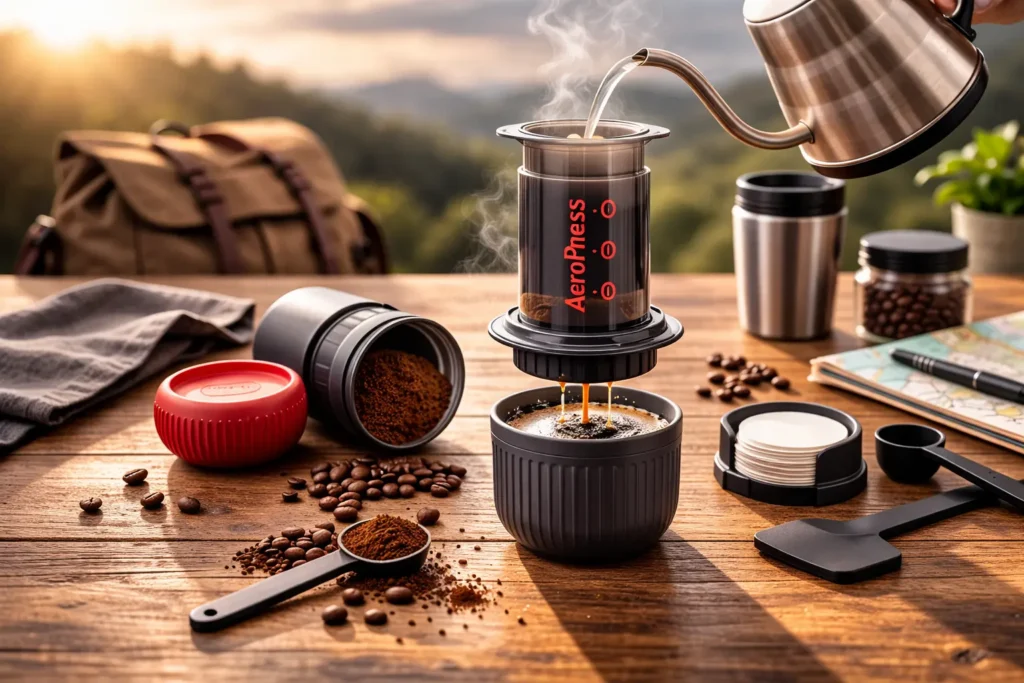
AeroPress Go — travel-focused option
A smaller package for people who want the AeroPress workflow away from home.
Breville Precision Brewer — batch convenience reference
A programmable drip brewer for households that need reliable volume with minimal active attention.
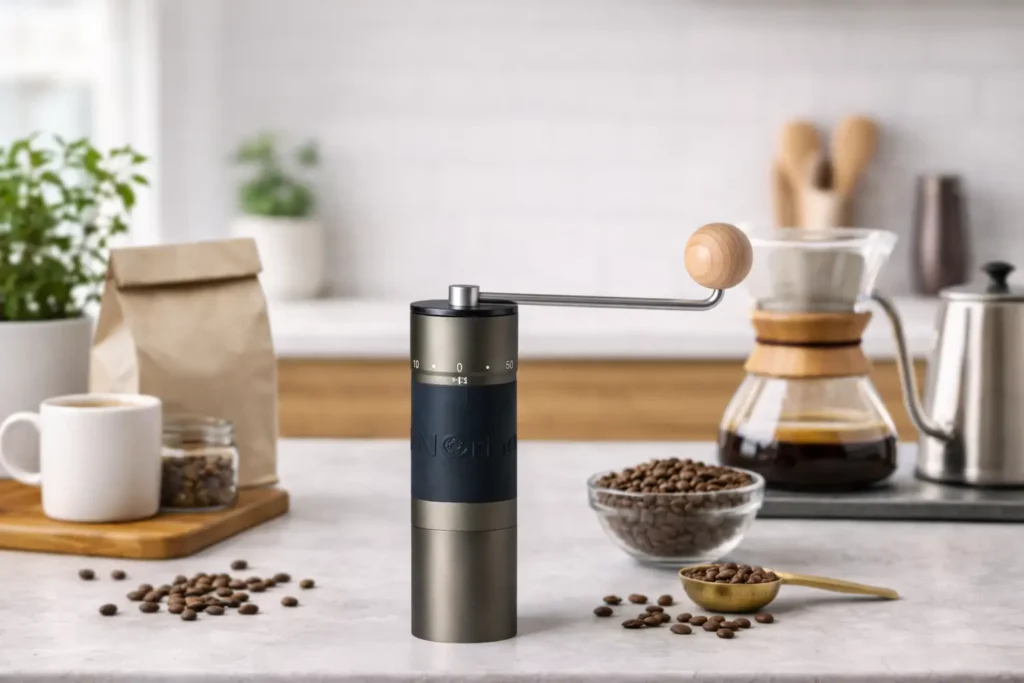
KINGrinder K6 — one grinder for both methods
The K6 spans the medium-fine AeroPress range and the medium drip range, making it practical for a two-brewer setup.
Troubleshooting: Common Problems with Each Method and How to Fix Them
The most common problems in both AeroPress and drip coffee are caused by the same root issues: grind size, temperature, freshness, and ratio. This matrix maps the most frequent symptoms to their most likely causes and fixes for each method.
| Symptom | Method | Most likely cause | Fix — in order |
|---|---|---|---|
| Sour, thin, hollow | AeroPress | Under-extraction — grind too coarse, temp too low, or steep too short | Grind 2–3 clicks finer → raise temp 3–5°C → extend steep 20–30s |
| Sour, thin, hollow | Drip | Machine temperature too low (very common in budget machines) or grind too coarse | Check machine temp (SCA-certified machines reach 92°C+) → grind 3–4 clicks finer → increase dose slightly |
| Bitter, harsh, dry finish | AeroPress | Over-extraction — grind too fine, temp too high, or steep too long | Grind 2–3 clicks coarser → lower temp 3–5°C → reduce steep time 20s |
| Bitter, harsh, dry finish | Drip | Grind too fine, dose too high, or stale beans (dark roast) | Grind 3–4 clicks coarser → reduce dose slightly → check roast date on beans |
| Flat, no sweetness, papery | Both | Stale beans — aromatic compounds depleted | Buy fresh beans with a roast date — no recipe fix for stale beans |
| Too much resistance pressing | AeroPress | Grind too fine, or dose too high for the water volume used | Grind 3 clicks coarser → reduce dose 1g → press more slowly |
| No resistance pressing — watery cup | AeroPress | Grind too coarse, or filter not seated correctly | Grind 3 clicks finer → reseat filter cap firmly → check filter for tears |
| Coffee too weak / dilute | AeroPress | Ratio too dilute or grind too coarse | Increase dose to 17–18g → reduce water to 200ml → grind 2 clicks finer |
| Coffee too weak / dilute | Drip | Ratio too dilute, grind too coarse, or insufficient grounds for volume brewed | Increase dose (standard: 60g per litre) → grind slightly finer → ensure machine distributes water evenly across grounds |
| Drip coffee tastes fine but always flat/lifeless | Drip | Machine brewing below 92°C — cannot be fixed without a better machine | Upgrade to SCA-certified machine (Breville Precision Brewer, OXO Brew) — or switch to AeroPress where temperature is fully controllable |
| Grounds in the cup | AeroPress | Filter not seated, or pressing too hard too fast | Pre-wet filter before brewing → reseat filter cap → press slowly and steadily, stop before hissing air reaches filter |
| Drip machine taking much longer than usual to brew | Drip | Mineral scale buildup in heating element and tubing — temperature also dropping | Descale the machine immediately (white vinegar or commercial descaler) — run 2–3 clean water cycles after |
Final Takeaway
AeroPress and drip are tools for different jobs. Choose AeroPress when you mainly brew one or two cups and want direct control over the result.
Choose drip when you need a larger batch with minimal attention. If both situations are common in your home, owning both can be practical rather than redundant.
FAQs: AeroPress vs Drip Coffee
Is AeroPress better than drip coffee?
AeroPress produces a more nuanced, complex, and consistently higher-quality cup than most drip machines at comparable price points. It extracts more evenly, allows complete control over every brew variable, and is significantly more forgiving of grind inconsistency than espresso. However, drip coffee makers win on convenience and volume: they brew hands-off and produce multiple cups simultaneously, which makes them the better choice for households brewing 4+ cups at a time or anyone who values push-button simplicity over brew quality optimisation.
Can AeroPress replace a drip coffee maker?
AeroPress can replace a drip coffee maker for one to two cups at a time — it matches or exceeds drip quality while taking up a fraction of the counter space. Where it cannot replace drip is volume: an AeroPress brews a single serving (roughly 250–350ml) per press cycle, which makes it impractical for households brewing 6–12 cups simultaneously. For solo drinkers or couples, AeroPress is a complete drip replacement. For families or offices, it is a complementary brewing method, not a substitute.
Does AeroPress make stronger coffee than drip?
AeroPress produces a more concentrated, fuller-bodied cup than standard drip coffee at the same coffee-to-water ratio — primarily because the mild pressure assists extraction and the paper filter retains fewer oils than a standard flat-bottom drip filter. At a standard 1:14 ratio, AeroPress coffee is noticeably stronger and richer than drip. For espresso-style concentrate, a 1:5 to 1:8 AeroPress ratio produces intensity that far exceeds any drip machine.
What grind size is best for AeroPress vs drip coffee?
AeroPress typically uses a medium-fine grind (KINGrinder K6: 20–30 clicks from zero) for a 1–2 minute steep — finer than drip but coarser than espresso. Drip coffee makers use a medium grind (K6: 30–40 clicks) to match the longer gravity-fed brew cycle of 4–6 minutes. Using drip-grind coffee in an AeroPress produces a weak, under-extracted cup; using AeroPress-grind coffee in a drip machine produces a slow, over-extracted, bitter result. A burr grinder that spans both ranges — like the KINGrinder K6 — is essential if you’re using both methods.
Is AeroPress good for beginners?
AeroPress is one of the best brewing methods for beginners — more forgiving than pour-over and far less technically demanding than espresso. The brewing process takes under 2 minutes, the learning curve is gentle (most beginners produce a satisfying cup on the first attempt), and the method is nearly impossible to break or damage. The one investment beginners need to make is a consistent burr grinder — the AeroPress’s quality ceiling is determined almost entirely by grind consistency and bean freshness.
How long does AeroPress take vs drip?
A standard AeroPress brew takes 2–3 minutes from start to finish including grinding, water heating, steeping (60–90 seconds), and pressing. Clean-up takes under 60 seconds — eject the puck, rinse the chamber. A drip coffee maker takes 4–8 minutes to brew depending on volume and machine, but requires minimal active time — you add water, grounds, and press start. The drip machine wins on active hands-off time; the AeroPress wins on total cup-in-hand time for a single serving when you’re heating water simultaneously.
Which is cheaper — AeroPress or drip coffee?
AeroPress has a significantly lower upfront cost than any capable drip coffee maker — quality drip machines that achieve proper SCA-certified brew temperature carry a meaningful price premium. The ongoing cost of AeroPress paper filters is minimal, and reusable metal filters eliminate filter costs entirely. Total cost of ownership favours AeroPress for single-serving brewing by a meaningful margin. A drip machine’s higher upfront cost is justified only when volume (4+ cups) and automation are required.
Can I use the same coffee beans in an AeroPress and a drip machine?
Yes — the same whole bean coffee can be used in both methods, but you need to grind at different settings for each. AeroPress requires a medium-fine grind (K6: 20–28 clicks); drip requires a medium grind (K6: 30–40 clicks). Medium roast whole beans perform well in both methods. A burr grinder with a wide adjustment range — like the KINGrinder K6 — allows you to dial in the correct grind for each method from the same bag of beans.
Does AeroPress make less waste than drip coffee?
AeroPress generates less waste than drip in most configurations. The spent coffee puck pops out in a single compact disc — compostable and minimal. Standard AeroPress paper filters are small and thin (much less material than basket or cone filters). Switching to a reusable metal AeroPress filter eliminates paper filter waste entirely. For eco-conscious brewers, AeroPress with a reusable filter is the clear winner over drip, and significantly better than pod-based drip machines.
Which is better for travel — AeroPress or drip?
AeroPress is decisively better for travel. It weighs under 250g, fits in a carry-on bag, requires no electricity (just hot water from any source), is virtually indestructible, and produces cafe-quality coffee in a hotel room, campsite, or office kitchen. Drip machines require a power source, counter space, a water reservoir, and are generally too large and fragile for travel. For travellers, the AeroPress paired with a hand grinder like the KINGrinder K6 is the complete portable coffee setup.
CoffeeGearHub product shortlist
Keep improving the setup
Use these CoffeeGearHub guides for the next buying or brewing step.
Continue Learning
Explore AeroPress
Explore drip coffee
In this guide
- The 30-Second Answer
- How Each Method Works
- AeroPress vs Drip Coffee
- Brew Quality and Flavour
- Convenience and Ease of Use
- Cost Comparison
- Grind Requirements
- Beans
- Versatility
- Clean-Up and Maintenance
- Portability and Travel
- Which Is Right for You? A Scenario-by-Scenario Guide
- Our Gear Picks
- Troubleshooting
- Final Takeaway
- FAQs
- Continue Learning