
Last Updated: March 2026 • 22–28 min read • Complete Guide: Buying Guide + Temperature Science + Roast-Level Reference + Gear Picks + Troubleshooting
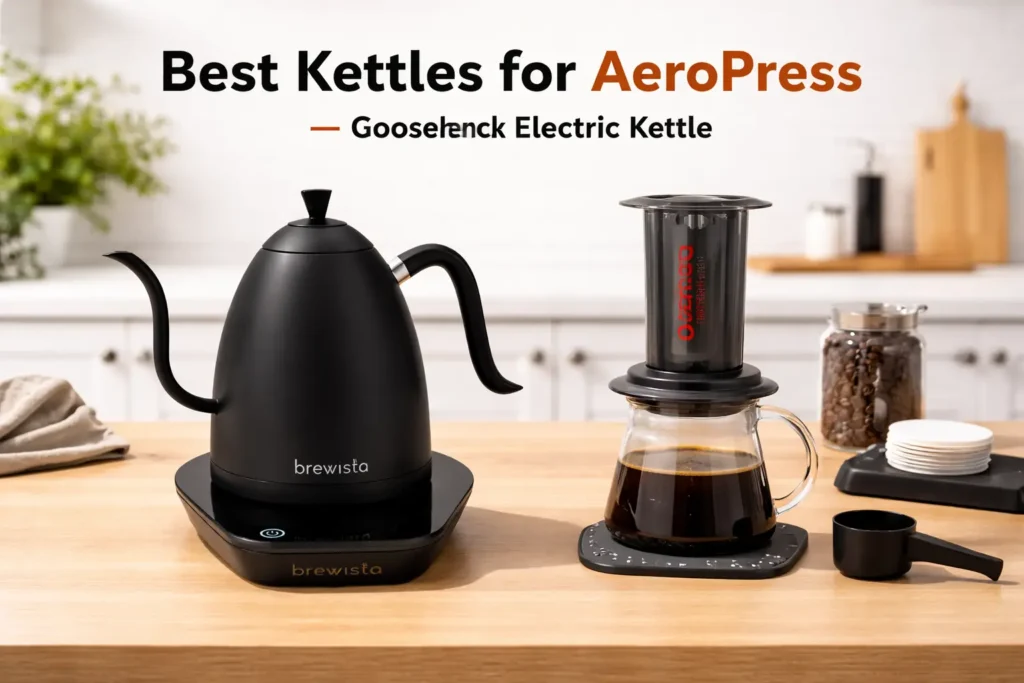
The AeroPress is fast, forgiving, and capable of producing exceptional coffee across an enormous range of recipes. But every recipe — from the original Aerobie method to World AeroPress Championship competition brews — depends on one variable that the AeroPress itself has no control over: the temperature of the water going in. The kettle you use determines whether that temperature is precise, guesswork, or somewhere in between.
This guide covers everything: what temperature actually does to AeroPress extraction, which kettle features matter and which do not, a temperature reference for every roast level and recipe style, complete gear picks with Amazon links, and the troubleshooting matrix for every temperature and kettle problem AeroPress brewers encounter.
✍️ Editorial note: This guide is researched and written by the editors at CoffeeGearHub.com using manufacturer specifications, published brewing science, recognized specialty-coffee standards, and established community knowledge. Product links are affiliate links — we may earn a commission at no cost to you. Affiliate Disclosure: CoffeeGearHub.com participates in the Amazon Services LLC Associates Program. As an Amazon Associate, we earn from qualifying purchases.
🛒 New to Amazon? Try Prime free for fast, free shipping on every pick in this guide — or try Audible free if you’d rather listen while your coffee brews.
🛒 Already know what you need? Jump straight to our top picks.
Fellow Stagg EKG
Best overall
Bonavita 1L
Best value
Hario V60 Buono
Best stovetop
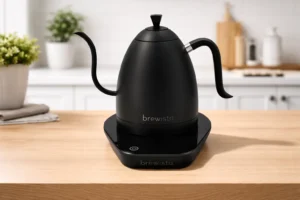
Brewista Artisan
Best precision
As an Amazon Associate, CoffeeGearHub earns from qualifying purchases. See full gear guide with all picks →
The 30-Second Answer
The best kettle for AeroPress is one with accurate variable temperature control — gooseneck spout is a bonus, not a requirement. AeroPress does not need a precision pour the way pour over does, but water temperature directly determines extraction quality across every recipe. Start with a variable temperature electric kettle in the 0.9L to 1L range. Set 185°F for medium roasts, 195–205°F for light roasts, and 175–185°F for dark roasts. The kettle does not change the recipe — it makes the recipe repeatable.
- Most important feature: variable temperature with ±2°F or better accuracy — eliminates temperature guesswork permanently
- Gooseneck spout: useful for AeroPress, essential if you also brew pour over
- Hold function: keeps water at target while you grind and prep — eliminates the race against cooling
- Light roasts: 195–205°F — higher temperature to extract from denser beans
- Medium roasts: 185–200°F — the most forgiving temperature range
- Dark roasts: 175–190°F — lower temperature to prevent harsh over-extraction
Jump to What You Need
☕ Just want a recommendation
Go to Gear Picks or the Full Comparison Table.
🌡️ Dialing in your brew
See the AeroPress Temperature Guide and Roast-Level Reference.
🔧 Deciding on features
Read What to Look For and Gooseneck vs Standard.
⚠️ Something tastes wrong
Jump straight to the Troubleshooting Matrix.
Table of Contents
Why the Kettle Matters for AeroPress
The AeroPress is one of the most versatile and forgiving brewers ever made. It is fast, portable, and capable of producing everything from a clean, bright single-origin cup to a rich, concentrated espresso-style shot. Specialty coffee competitors have used it to explore an extraordinary range of grind sizes, ratios, steep times, and agitation techniques. But across all of those variables, one factor consistently determines whether those techniques work: water temperature.
🔬 The science of extraction temperature: Hot water dissolves soluble compounds from coffee at different rates depending on temperature. At lower temperatures, acids and some sugars extract first — which is why under-temperature brews taste sharp and sour. At higher temperatures, more compounds extract more quickly, including bitter chlorogenic acid degradation products that become prominent above 205°F. Every degree between 175°F and 205°F produces a measurably different cup from the same AeroPress recipe, grind, and ratio. Temperature is not a secondary variable — it is a primary one.
This is the reason the kettle matters as much as it does. A kettle that simply boils water and delivers it at 212°F leaves you working around a fundamental limitation every time you brew — cooling, timing, guessing. A quality variable temperature kettle removes that limitation entirely. You set your target, the kettle holds it, and you can focus on everything else the AeroPress gives you control over.
There is also one important distinction between AeroPress and pour over that affects which kettle features you should prioritize. Pour over brewing depends on a precise, controlled pour — the flow rate, pattern, and speed of the water directly affects how evenly the grounds are saturated and how the extraction develops. AeroPress does not. You are filling a chamber, not drawing water through a bed. This means a gooseneck spout, while useful, is not the critical purchase it is for pour over. For AeroPress, accurate temperature control is the non-negotiable feature. Everything else is secondary.
What to Look For: The Features That Actually Matter
Not every premium kettle feature earns its price for AeroPress brewing specifically. Understanding which features matter — and which are more relevant to pour over — helps you make a smarter purchase at any budget.
Temperature Accuracy: The Most Important Specification
Temperature accuracy is the single feature that separates a useful AeroPress kettle from a great one. Most specialty coffee recipes call for temperatures between 175°F and 205°F, and a difference of even 10°F changes the character of the cup noticeably — especially with light roasts, where the extraction window for bright, complex flavors is relatively narrow. Look for a kettle that holds your set temperature within ±2°F. That is the threshold that separates quality variable temperature kettles from budget models that approximate but do not actually deliver.
⚠️ The most common AeroPress temperature mistake: Adjusting grind size and temperature simultaneously when a brew tastes wrong. Change one variable at a time. If your brew time and recipe parameters are correct but the cup is sour, raise temperature by 5°F and brew again before touching anything else. If it is flat and bitter, lower temperature by 5°F. One variable per brew.
🌡️ Temperature guesswork is the enemy of consistent AeroPress. The Fellow Stagg EKG sets water to the exact degree with ±1°F accuracy, holds it for 60 minutes while you grind and prep, and its counterbalanced gooseneck makes filling the AeroPress chamber effortless. It eliminates the two biggest variables — temperature and pour control — in one purchase and doubles as the best pour over kettle you can buy.
As an Amazon Associate, CoffeeGearHub earns from qualifying purchases.
Hold Function: More Useful Than It Sounds
A hold function — which maintains your set temperature for 30 to 60 minutes after reaching it — matters more in practice than most buyers anticipate. AeroPress brewing is fast, but the prep sequence is not: you still need to measure and grind your beans, seat the AeroPress, and set up your cup. Without a hold function, a kettle that reaches 185°F starts losing that temperature immediately. By the time you are ready to pour, you may be brewing at 177°F or 174°F without realizing it. A 60-minute hold removes that problem entirely. For morning routines especially, it is one of the most practically useful features in the category.
Capacity
The AeroPress chamber holds approximately 250ml to 300ml of water per brew, so a dedicated AeroPress setup does not require a large kettle. A 0.6L to 1L capacity handles one or two back-to-back AeroPress servings without refilling, at a size and weight that heat up quickly and feel comfortable to handle. If you also use the kettle for pour over, tea, or brewing for multiple people simultaneously, a 1L to 1.2L range is the better compromise.
Display and Interface
A clear digital display showing your set temperature — and ideally the current water temperature as it heats — is more useful than it sounds during a morning routine. Analog dials look attractive but are imprecise; some models rated for “variable temperature” use a dial that only roughly corresponds to actual water temperature. A digital LED or OLED display with degree-by-degree adjustability is the most reliable interface for the kind of intentional temperature targeting that makes AeroPress brewing consistent.
Gooseneck vs Standard Spout for AeroPress
One of the most common questions from AeroPress brewers choosing a kettle is whether a gooseneck spout is worth the extra cost and the narrower market of options. The answer depends almost entirely on whether you brew — or plan to brew — any pour over alongside your AeroPress.
| Kettle type | AeroPress performance | Pour over performance | Best for |
|---|---|---|---|
| Gooseneck electric (variable temp) | Excellent — easy to control fill into AeroPress opening; any recipe volume is manageable | Excellent — designed for precision pour control | Brewers who use AeroPress and pour over, or want one premium kettle for everything |
| Standard spout electric (variable temp) | Very good — fills the AeroPress chamber easily; temperature accuracy is what matters most | Acceptable but imprecise — flow rate harder to control | Dedicated AeroPress brewers who prioritize temperature over pour precision |
| Gooseneck stovetop | Good — excellent pour control; no built-in temperature readout | Good — pairs well with an external thermometer | Brewers who prefer flame control and already own a reliable thermometer |
| Standard electric (boil only) | Functional but limiting — must wait for water to cool to target; requires external thermometer | Not recommended | Absolute budget constraints only |
The short version: for pure AeroPress use, temperature control matters more than spout shape. But since most quality variable temperature kettles in the specialty coffee market happen to be gooseneck designs, choosing a gooseneck gets you into the best pool of options at every price point — and future-proofs the kettle for any brew method you add later.
🔥 Prefer stovetop? The Hario V60 Buono is the benchmark. The iconic stainless steel gooseneck that introduced precision pour to a generation of home brewers. No built-in thermometer — pair it with a fast-read thermometer like the Thermapen to get accurate temperature targeting without electronics. Simple, durable, and no components to fail.
As an Amazon Associate, CoffeeGearHub earns from qualifying purchases.
Variable Temperature Kettles Explained
A variable temperature kettle is an electric kettle that allows you to set a specific target temperature rather than just boiling water and stopping. The heating element runs until the water reaches your chosen temperature, then turns off. If the kettle includes a hold function, it cycles on and off to maintain that temperature for a set period without continuing to boil or cool.
For AeroPress, the practical benefit is significant. You can set 185°F for a medium roast first thing in the morning, press start, grind your beans, seat the AeroPress, and pour at exactly the right temperature without any guesswork. The AeroPress already brews in under two minutes — removing temperature guesswork from the workflow makes the entire sequence faster and more repeatable without changing anything else about your recipe.
🔬 What “variable temperature” actually means on a label: Some budget kettles marketed as variable temperature use a dial that only roughly corresponds to actual output temperature — they may be consistently off by 5°F to 15°F from the set point. Look for reviews that test measured output temperature against the claimed set point. A kettle that says 185°F but delivers 174°F consistently is not a variable temperature kettle in any meaningful sense. The picks in this guide are selected in part because their temperature accuracy has been independently documented.
💰 Want proven variable temperature accuracy without premium pricing? The Bonavita 1L Gooseneck has been the default recommendation in specialty coffee communities for years because it delivers reliable ±2°F accuracy, a 60-minute hold function, and a proper gooseneck spout at a price that makes sense as a first quality kettle. It is not exciting — it simply works, consistently.
As an Amazon Associate, CoffeeGearHub earns from qualifying purchases.
AeroPress Water Temperature Guide
Water temperature is one of the most powerful and consistently underused variables in AeroPress brewing. The AeroPress gives you control over steep time, pressure, agitation, grind, and ratio — but temperature shapes the extraction that all of those variables are working within. Get the temperature wrong and no amount of technique adjustment fully compensates.
Temperature Ranges by Brewing Style
| Brewing style | Temperature (°F) | Temperature (°C) | What it produces | Start here if |
|---|---|---|---|---|
| Original Aerobie / beginner | 175°F – 185°F | 79°C – 85°C | Smooth, low-acid, easy-drinking cup; forgiving and consistent | New to AeroPress; prefer low-acid coffee; brewing dark roasts |
| Standard specialty | 185°F – 200°F | 85°C – 93°C | Bright, balanced extraction; works across roast levels | Most medium roasts; everyday brewing; trying a new bean |
| WAC-style / competition | 195°F – 205°F | 90°C – 96°C | High extraction, complex, expressive; best with fresh light roasts | Light roast specialty beans; following championship recipes |
| AeroPress concentrate | 195°F – 205°F | 90°C – 96°C | Dense, intense, low-volume; espresso-adjacent character | Diluting with water or milk; espresso-style drinks |
| Inverted method | Match roast level above | Match roast level above | Longer steep time — temperature selection is same as standard | Extended steep recipes; slurry-style brewing |
🔬 Temperature and grind work together. Lowering temperature slows extraction and requires a finer grind to compensate. Raising temperature speeds extraction and may require a coarser grind to prevent over-extraction. When following a recipe from a different source, start by matching the stated temperature exactly before adjusting anything else — a recipe optimized at 185°F will taste different brewed at 200°F even at the same grind setting.
Roast-Level Temperature and Recipe Reference
Roast level changes the physical structure of the bean — density, porosity, and solubility — in ways that directly affect how a given temperature performs in AeroPress. A temperature that produces an excellent medium roast cup will frequently produce a flat, underextracted result from a light roast, or a harsh, over-extracted result from a dark roast. Use this table as your starting calibration reference when brewing a new coffee for the first time.
| Roast level | Bean characteristics | Starting temperature | Grind vs medium roast | Common problem | Fix |
|---|---|---|---|---|---|
| Light roast ☀️ | Dense, hard, slow to extract | 195°F – 205°F (90°C – 96°C) | 1–2 steps finer | Persistently sour and thin despite correct recipe | Raise temperature to 200°F minimum; check beans are at least 7 days post-roast |
| Medium roast 🌤 ✓ | Balanced solubility — the calibration reference | 185°F – 200°F (85°C – 93°C) | Baseline | Most forgiving roast level — fewer problems | Start at 190°F and adjust by 5°F increments based on taste |
| Medium-dark roast | More porous than medium; extracts faster | 182°F – 195°F (83°C – 90°C) | 1–2 steps coarser | Bitterness arriving early in steep | Reduce temperature before adjusting steep time |
| Dark roast 🌑 | Highly porous, brittle, very soluble | 175°F – 185°F (79°C – 85°C) | 2–3 steps coarser | Harsh, ashy bitterness; heavy body | Lower temperature significantly; shorten steep time |
| Very fresh beans (under 7 days) | High CO2, inconsistent extraction | Standard for roast level | Often 1 step coarser than at 10–14 days | Inconsistent results brew to brew | Rest beans 5–10 days; bloom longer before pressing |
| Old beans (40+ days post-roast) | Stale; CO2 depleted | Standard for roast level | Often 1 step finer | Flat, hollow, joyless cup | No temperature adjustment recovers stale coffee; buy fresh beans |
Gear Picks: Best Kettles for AeroPress (2026)
The kettles below are selected based on documented temperature accuracy, build quality, usability in an AeroPress workflow, and their reputation within the specialty coffee community. Each represents a clear choice within its category.
Disclosure: CoffeeGearHub may earn a commission on qualifying purchases through affiliate links on this page, at no cost to you. Our recommendations are editorially independent. CoffeeGearHub.com participates in the Amazon Services LLC Associates Program. As an Amazon Associate, we earn from qualifying purchases.
🛒 New to Amazon? Try Prime free for fast, free shipping on every pick in this guide — or try Audible free if you’d rather listen while your coffee brews.
Best Overall: Fellow Stagg EKG
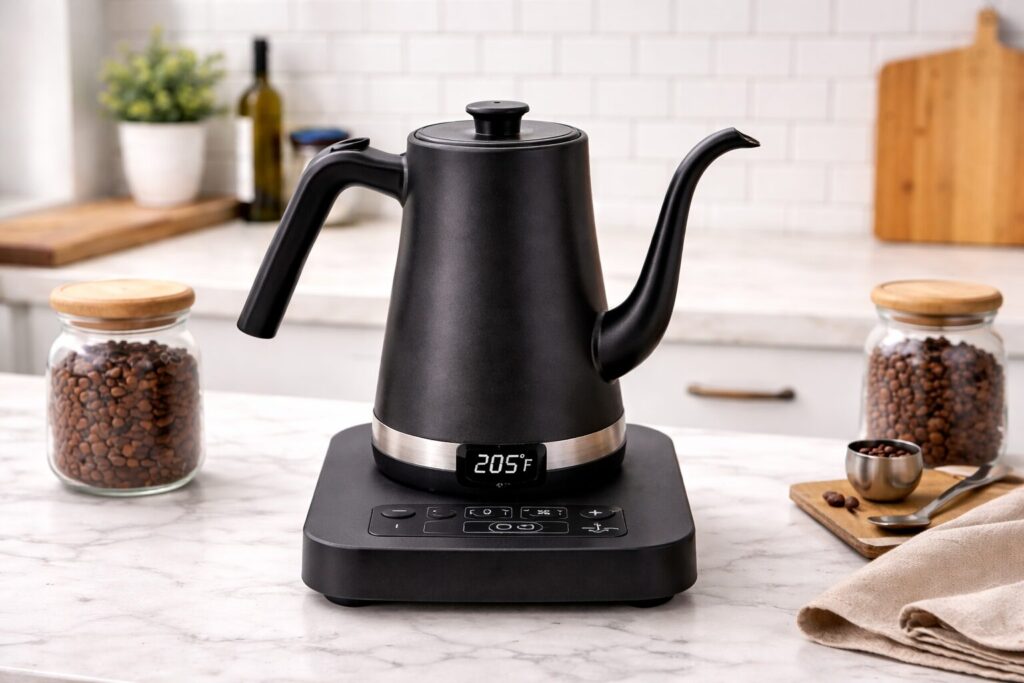
🏆 Best Kettle for AeroPress: Fellow Stagg EKG
Best for: anyone who wants the most accurate variable temperature and the most controllable pour available in an electric gooseneck kettle — AeroPress and pour over
The Fellow Stagg EKG is the CoffeeGearHub standard recommendation for AeroPress brewing. Its ±1°F temperature accuracy means the temperature you set is the temperature in the cup. The 60-minute hold mode keeps water at your target while you grind and prep, removing any race between heating and preparation. The counterbalanced gooseneck handle makes filling the AeroPress chamber natural at any fill speed. The built-in stopwatch tracks steep time from the same device, which removes the need for a separate phone timer during the brew.
- Temperature range: 135–212°F in 1°F increments — covers every AeroPress recipe ever published
- Accuracy: ±1°F — the tightest accuracy available in a consumer kettle
- Hold function: 60 minutes — water stays at target while you grind, measure, and set up
- Capacity: 0.9L standard / 1.2L Plus — the 0.9L is ideal for AeroPress; choose 1.2L if you also pour over
- Built-in stopwatch: tracks steep time without a separate timer
Disclosure: CoffeeGearHub may earn from qualifying purchases.
Best Value: Bonavita 1L Variable Temperature Gooseneck
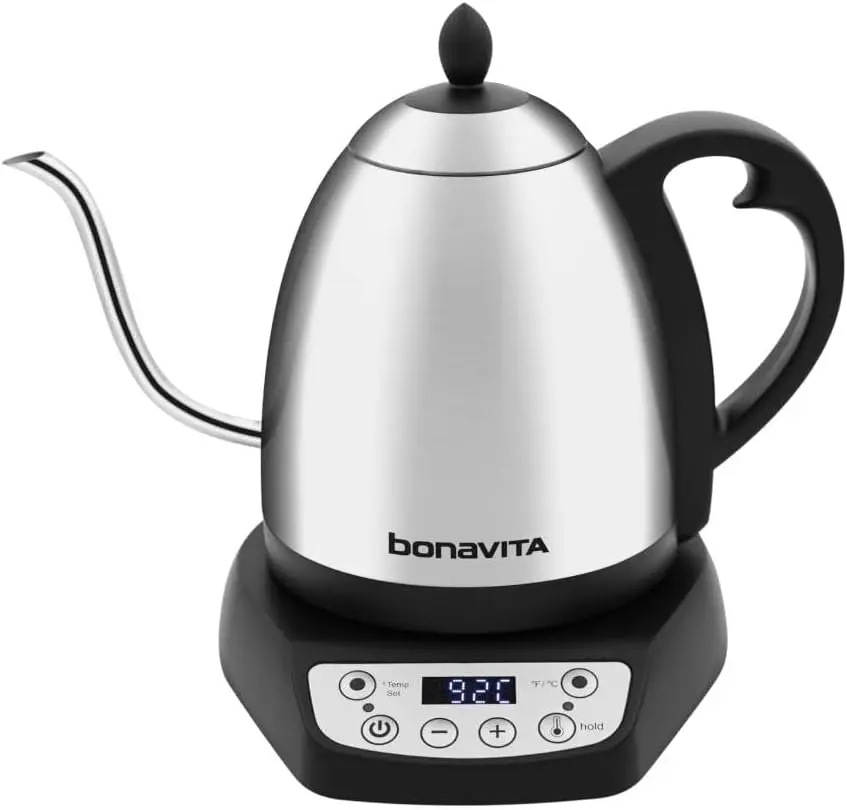
Best Value for AeroPress: Bonavita 1L Gooseneck
The Bonavita 1L Variable Temperature Gooseneck Kettle is the workhorse recommendation for brewers who want accurate variable temperature and a real gooseneck spout without spending at the premium tier. It has been the default recommendation across specialty coffee communities for years because it consistently delivers what it promises: reliable ±2°F accuracy, a 60-minute keep-warm function, and a functional gooseneck pour. It is not the most exciting kettle on this list — it is simply the most trustworthy purchase at its price point.
- Temperature range: 140–212°F — covers all AeroPress recipe temperatures
- Accuracy: ±2°F — sufficient for consistent, repeatable AeroPress brewing
- Hold function: 60 minutes — same hold duration as the Fellow Stagg
- Capacity: 1.0L — handles AeroPress and pour over without refilling
Disclosure: CoffeeGearHub may earn from qualifying purchases.
Best Mid-Range: OXO Brew Adjustable Temperature Kettle
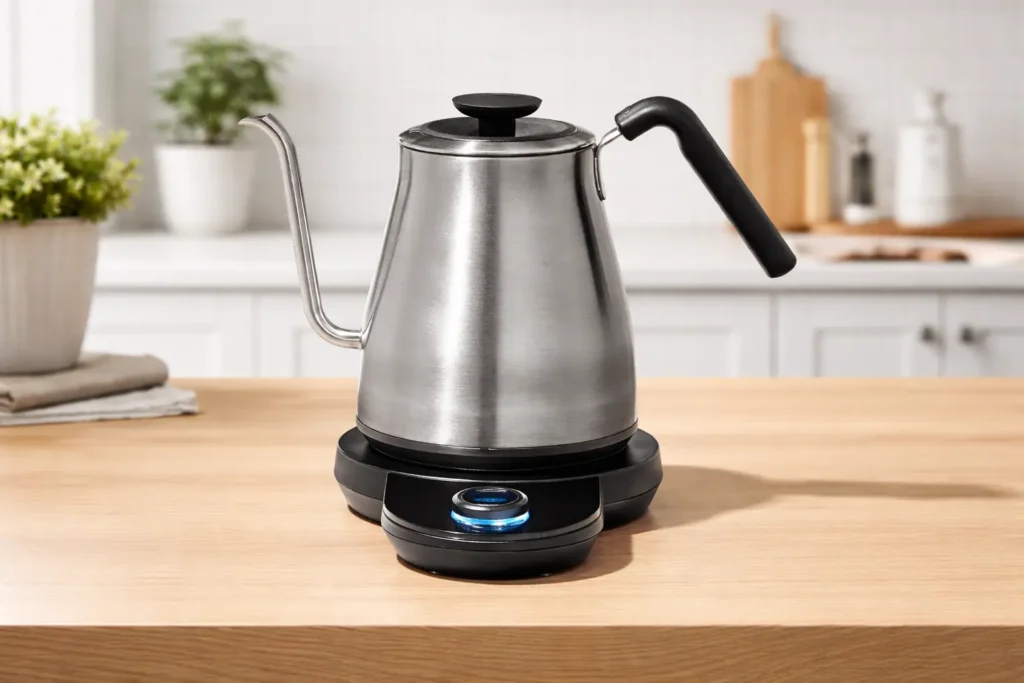
Best Display and Interface: OXO Brew Kettle
The OXO Brew Adjustable Temperature Kettle is the strongest mid-range option for AeroPress brewers who switch temperatures frequently between roast levels and want the clearest possible readout. Its large backlit LCD displays both set temperature and current water temperature simultaneously — a feature that lets you watch the water climb in real time and catch it at exactly the right point. Degree-by-degree temperature control without presets makes recipe-to-recipe adjustment fast and precise.
- Display: large backlit LCD showing set and current temperature simultaneously — clearest display in this price range
- Control: degree-by-degree adjustment without preset limitations
- Hold function: 30 minutes — shorter than Fellow or Bonavita
- Capacity: 1.0L
Disclosure: CoffeeGearHub may earn from qualifying purchases.
Best Stovetop: Hario V60 Buono
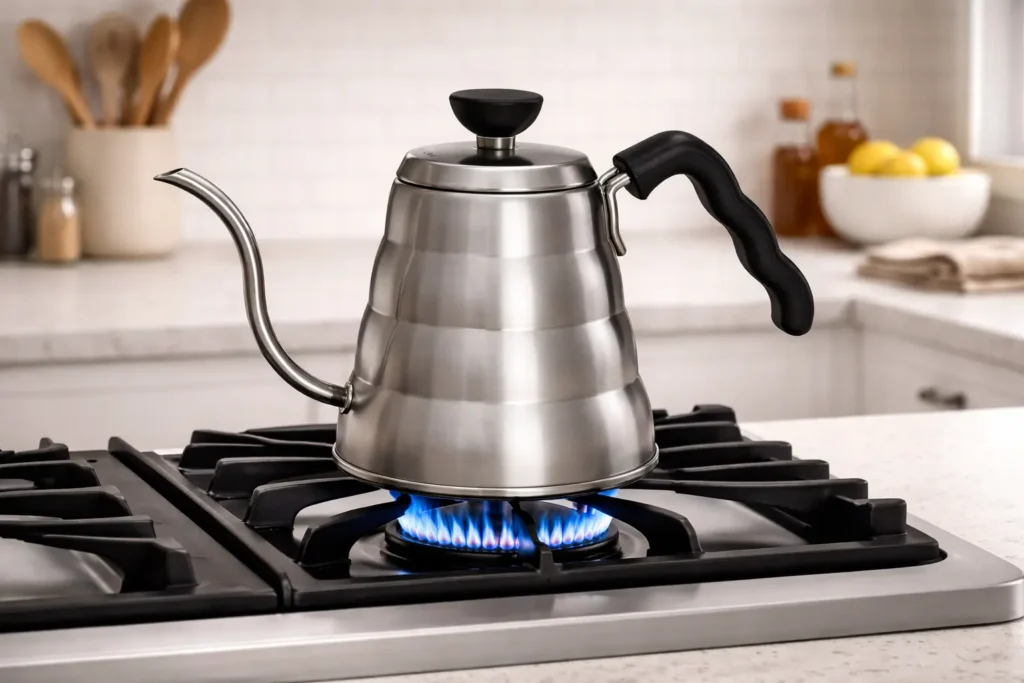
Best Stovetop Option: Hario V60 Buono
The Hario V60 Buono is the benchmark stovetop gooseneck kettle — the design that defined precision pour for a generation of home brewers. It has no built-in temperature readout, which means you pair it with a fast-read thermometer for accurate temperature targeting. For AeroPress brewers who prefer flame control, already own a reliable thermometer, or want a minimal electronic-free setup, the Buono is a durable, timeless choice. Available in stainless steel and matte black; both are induction-compatible with an appropriate adapter.
- Type: stovetop — gas, electric, and induction (adapter required for induction)
- Temperature control: external thermometer required — pairs well with a Thermapen or similar instant-read
- Capacity: 1.2L — largest capacity on this list; handles multi-cup pour over sessions easily
- Best for: stovetop-preference brewers who own a thermometer and value simplicity over digital convenience
Disclosure: CoffeeGearHub may earn from qualifying purchases.
Best Rising Pick: Timemore Fish Smart
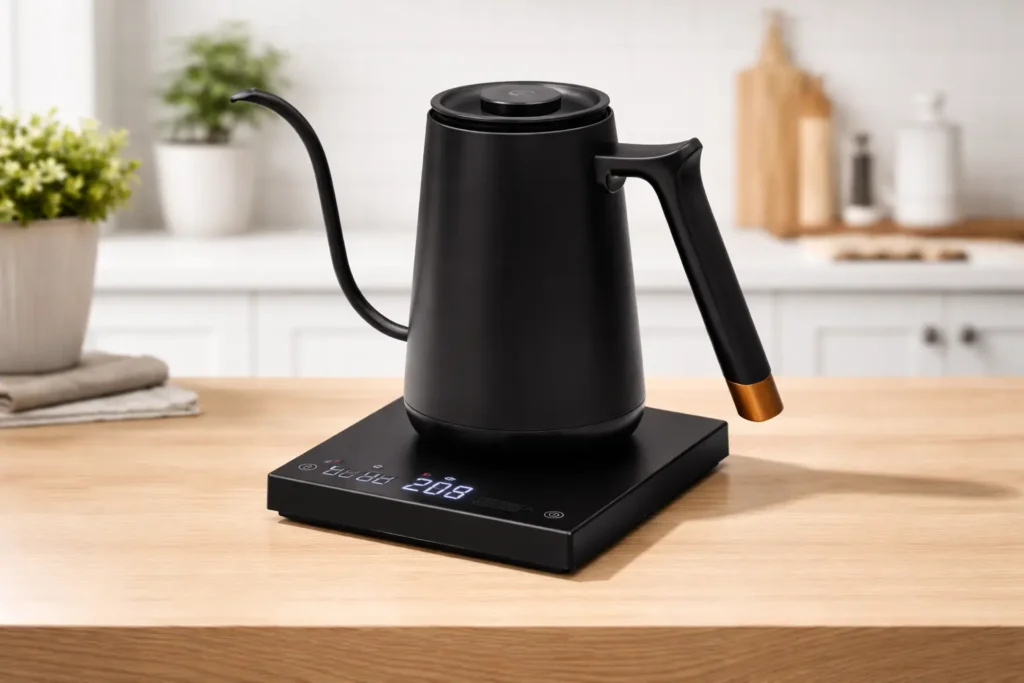
Best Rising Pick: Timemore Fish Smart
The Timemore Fish Smart is a fast-rising alternative to the Fellow Stagg from a brand that earned deep trust in specialty coffee through its grinder lineup. The OLED display shows real-time water temperature as it heats — a genuinely useful feature that lets you watch the temperature climb and stop it at exactly the right point without guessing. Compact 0.8L capacity is ideal for a dedicated single-serve AeroPress setup where size and heat-up time matter.
- Display: OLED real-time temperature readout as the water heats — the clearest live-temperature display on this list
- Accuracy: ±1°C — comparable to the Fellow Stagg
- Capacity: 0.8L — ideal for single-serve AeroPress; may require refilling for pour over
- Best for: Timemore ecosystem users; brewers who want a visually distinctive alternative to Fellow
Disclosure: CoffeeGearHub may earn from qualifying purchases.
Best for Power Users: Brewista Artisan
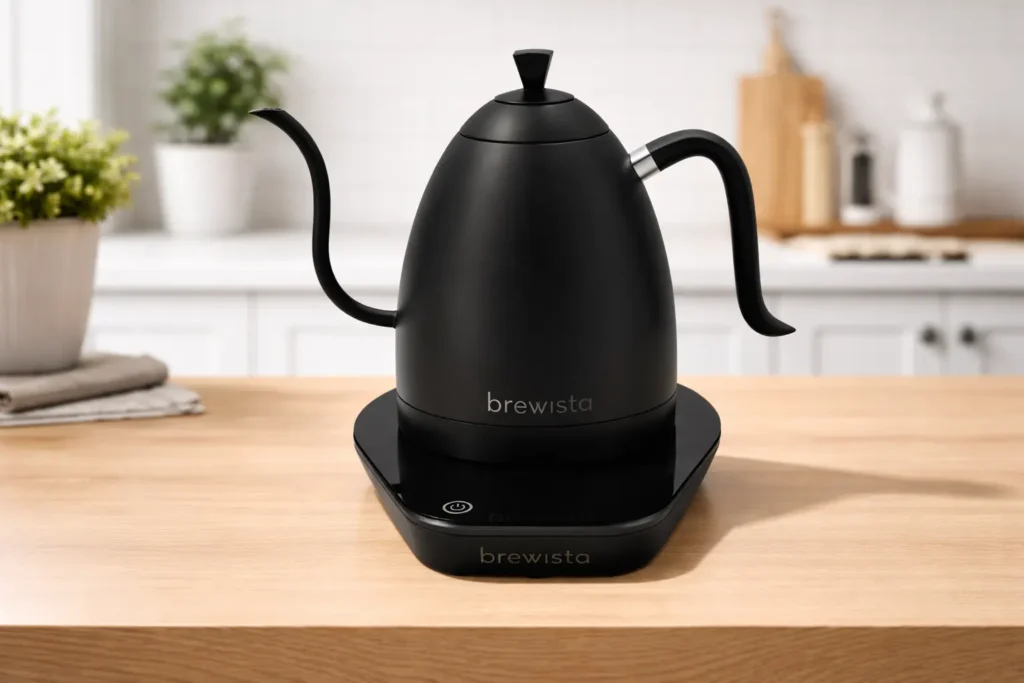
Best Precision: Brewista Artisan Gooseneck
The Brewista Artisan is the choice for brewers who care about the tightest possible temperature accuracy and are frustrated by the ±2°F tolerance of mid-tier options. Its ±0.5°C accuracy is among the most precise available on the consumer market — the same level used in specialty coffee shop brew bars. The wide temperature range starting at 104°F makes it the most versatile kettle on this list for cold-bloom techniques, tea, and any recipe requiring temperatures well below the standard brewing range.
- Accuracy: ±0.5°C — the highest precision on this list; used in specialty café settings
- Temperature range: 104°F – 212°F (40°C – 100°C) — the widest range available
- Hold function: 60 minutes at professional precision
- Best for: serious home baristas who treat temperature as a primary variable in their recipes
Disclosure: CoffeeGearHub may earn from qualifying purchases.
Full Comparison Table
Every kettle on this list at a glance. Use this table to narrow down your choice based on the features that matter most for your AeroPress setup and budget.
| Kettle | Type | Capacity | Temp range | Accuracy | Hold | Display | Best for |
|---|---|---|---|---|---|---|---|
| Fellow Stagg EKG | Electric gooseneck | 0.9L / 1.2L | 135°F–212°F | ±1°F | 60 min | Analog dial + LED | Best overall; AeroPress + pour over |
| Bonavita 1L | Electric gooseneck | 1.0L | 140°F–212°F | ±2°F | 60 min | Digital LED | Best value; first quality kettle |
| OXO Brew | Electric gooseneck | 1.0L | 140°F–212°F | ±2°F | 30 min | Large backlit LCD | Best display; multi-user households |
| Hario V60 Buono | Stovetop gooseneck | 1.2L | Thermometer required | Thermometer-dependent | Flame control | None | Stovetop preference; minimalist |
| Timemore Fish Smart | Electric gooseneck | 0.8L | 140°F–212°F | ±1°C | 5–60 min | OLED real-time | Compact; design-forward; live temp |
| Brewista Artisan | Electric gooseneck | 1.0L | 104°F–212°F | ±0.5°C | 60 min | Digital LCD | Highest precision; power users |
Budget vs Premium: How to Think About the Trade-Off
The most common question when choosing an AeroPress kettle is whether spending significantly more produces meaningfully better coffee. The answer depends entirely on what is currently limiting your setup.
For a brewer who is currently boiling water in a standard kettle and guessing at temperature, upgrading to any quality variable temperature kettle — including the Bonavita — produces an immediate and noticeable improvement in repeatability. The jump from “approximately hot” to “exactly 185°F” is the largest single improvement available to most AeroPress setups. That improvement is available at the Bonavita’s price point.
The difference between the Bonavita and the Fellow Stagg is narrower in practice. The Stagg’s ±1°F accuracy versus the Bonavita’s ±2°F accuracy is real but not transformative for most recipes. The premium buys you better build quality, a more refined pour experience, a stopwatch built into the base, and the confidence that comes with using the most widely trusted kettle in specialty coffee. For brewers who also make pour over, the Stagg’s pour control is meaningfully better. For dedicated AeroPress brewers, the Bonavita closes the gap significantly.
Quick Decision Guide
| Your situation | Best pick | Why |
|---|---|---|
| First variable temperature kettle, AeroPress only | Bonavita 1L | Proven accuracy, 60-minute hold, gooseneck spout — covers everything needed at the best value |
| AeroPress + pour over daily; one kettle for everything | Fellow Stagg EKG | ±1°F accuracy, 60-minute hold, built-in stopwatch, best pour control available |
| Want the clearest display; switch temperatures frequently | OXO Brew | Large backlit LCD shows set and current temp simultaneously; degree-by-degree adjustment |
| Prefer stovetop; already own a thermometer | Hario V60 Buono | Timeless, durable, no electronics — pairs perfectly with an instant-read thermometer |
| Want something distinctive from Fellow at similar quality | Timemore Fish Smart | Real-time OLED, comparable precision, compact for single-serve AeroPress |
| Most precise kettle available; temperature is a serious variable | Brewista Artisan | ±0.5°C — professional-grade accuracy used in specialty café brew bars |
Troubleshooting Matrix: Every AeroPress Temperature Problem Diagnosed
Identify your symptom in the first column. Apply fixes in the order listed — the first fix resolves the problem in the majority of cases. Change one variable per brew throughout the process.
| Symptom | Likely cause | Fix — in order |
|---|---|---|
| Sour, sharp taste on a correct recipe | Water temperature too low for roast level; under-extraction | Raise temperature by 5°F → taste → repeat in 5°F increments until sourness resolves; confirm grind size is not too coarse simultaneously |
| Bitter, harsh, dry aftertaste | Water temperature too high for roast level; over-extraction | Lower temperature by 5°F → taste → repeat in 5°F increments; for dark roasts try 175°F–185°F range before changing anything else |
| Flat, thin, joyless cup despite correct temperature | Beans too stale; or ratio too dilute | Check roast date — if 40+ days, buy fresh beans first → if beans are fresh, increase dose or reduce water yield → confirm grind is not too coarse |
| Inconsistent results brew to brew at same settings | Kettle temperature inaccuracy; or kettle not reaching set point | Test kettle with an instant-read thermometer against your set point → if off by more than 5°F consistently, compensate by setting 5°F higher or lower, or upgrade kettle |
| Coffee tastes correct first brew, wrong second brew | Kettle temperature drifting between brews; no hold function | Use a kettle with a hold function → if using Hario Buono or similar, re-check temperature before every brew with a thermometer |
| Light roast persistently sour despite high temperature | Beans under 7 days post-roast; or grind too coarse; or steep time too short | Rest beans 7–14 days post-roast → grind 1–2 steps finer → extend steep time by 15–30 seconds → confirm temperature is reaching 200°F minimum |
| Dark roast bitter and harsh despite low temperature | Temperature still too high; or steep time too long; or grind too fine | Lower to 175°F → shorten steep time by 15 seconds → grind 1–2 steps coarser; very dark roasts perform better with shorter, cooler extractions |
| Vinegar or chemical taste from kettle | New kettle not flushed; or mineral scale; or internal residue | Run two full cycles of plain water through the kettle and discard before first coffee use → if persisting, descale with citric acid solution and rinse twice |
| Kettle reaches correct temperature but water is wrong temp at cup | AeroPress or cup not preheated; heat loss during transfer | Preheat the AeroPress cap, plunger, and cup with hot water before brewing → discard preheat water → brew immediately after preheating |
| Kettle consistently undershoots set temperature | Budget kettle with inaccurate temperature control | Test with instant-read thermometer and establish actual offset → set kettle 5°F above target to compensate → upgrade to a kettle with documented ±2°F or better accuracy |
FAQs: Best Kettles for AeroPress
Do you need a gooseneck kettle for AeroPress?
No. A gooseneck kettle is not strictly required for AeroPress — unlike pour over, AeroPress does not depend on a controlled pour pattern. A standard electric kettle with accurate variable temperature control works well. That said, most quality variable temperature kettles are gooseneck designs, so choosing one gives you access to the best options at every price point and future-proofs the kettle if you ever add pour over.
What temperature should water be for AeroPress?
Most AeroPress recipes call for water between 175°F and 205°F (79°C to 96°C). The original Aerobie recipe recommends 175°F to 185°F for a smooth, low-acid cup. Specialty and World AeroPress Championship recipes typically use 195°F to 205°F for more complex extraction from light roasts. Your ideal temperature depends on roast level, grind size, and target flavor profile.
What size kettle is best for AeroPress?
For AeroPress alone, a 0.6L to 1L kettle is sufficient — the chamber holds about 250ml to 300ml per brew. If you also make pour over or brew multiple cups, a 1L to 1.2L range is more practical without the added weight and heat-up time of a larger model.
Is a variable temperature kettle worth it for AeroPress?
Yes. Water temperature is one of the most powerful variables in AeroPress extraction, and a variable temperature kettle is the single most impactful upgrade for brewers still using a boil-only kettle. It makes your best brews repeatable and your recipe adjustments intentional rather than accidental.
Can you use a regular electric kettle for AeroPress?
Yes. A standard boil-only kettle works for AeroPress — boil and cool to your target temperature. The limitation is that without temperature control you must guess or use a separate thermometer, which slows the workflow and makes consistent repeatability harder to achieve.
What is the best budget kettle for AeroPress?
The Bonavita 1L Variable Temperature Gooseneck Kettle is the best value option. It offers reliable ±2°F accuracy, a 60-minute hold function, and a real gooseneck spout at a price well below the premium tier. It has been the default recommendation in specialty coffee communities for years for good reason.
Does the Fellow Stagg EKG work with AeroPress?
Yes, and it is the top recommendation for AeroPress on this list. Its ±1°F accuracy and 60-minute hold function make it ideal for repeating recipes precisely. It also includes a built-in stopwatch for tracking steep time, which removes the need for a separate timer during the AeroPress brew.
How does water temperature affect AeroPress flavor?
Temperature is one of the most powerful extraction variables in AeroPress. Higher temperatures extract more compounds more quickly — producing more complexity and brightness from light roasts but risking harsh over-extraction in dark roasts. Lower temperatures slow extraction and reduce acidity, producing a smoother, sweeter cup that is particularly forgiving with medium and dark roasts. Adjusting temperature is often the fastest fix for a cup that tastes too sharp, too flat, too bitter, or too thin.
Should I use Celsius or Fahrenheit for AeroPress recipes?
Either works — consistency is what matters. Most World AeroPress Championship recipes are published in Celsius; many popular English-language recipes use Fahrenheit. Match your kettle’s display to the units used in the recipe you are following. Mixing units mid-recipe is one of the most common sources of temperature errors.
Can the same kettle be used for AeroPress and pour over?
Yes, and this is one of the strongest reasons to choose a gooseneck variable temperature electric kettle. A quality gooseneck handles both methods equally well — the precision spout is essential for pour over and still useful for AeroPress, and variable temperature control matters for both. One good kettle that covers both methods is more cost-effective than buying separately.
Why does my AeroPress coffee taste different every morning at the same recipe?
Inconsistent results at the same recipe settings are almost always caused by inconsistent water temperature. If your kettle has no hold function, temperature drops between heating and pouring. If your kettle has inaccurate temperature control, it may be delivering different actual temperatures each session. Test your kettle with an instant-read thermometer to confirm whether the set point matches the actual output temperature.
Continue Learning
💡 New to Amazon? Try Prime free for fast shipping on picks like these.
AEROPRESS GUIDES
KETTLE AND BREWING GUIDES
Got your kettle — now ready to dial in the full AeroPress recipe? The CoffeeGearHub AeroPress Brew Guide covers grind settings, ratios, steep times, inverted vs standard methods, and troubleshooting for every flavor problem across every roast level.
☕
Written by the CoffeeGearHub Editorial Team
CoffeeGearHub is a specialty coffee equipment resource produced by the CoffeeGearHub Editorial Team. Our guides are researched using manufacturer specifications, World AeroPress Championship recipe analysis, SCA brewing standards, and established specialty coffee community knowledge. We review and update our pillar content regularly. About CoffeeGearHub →
Compare current CoffeeGearHub product pages
Use these stable CoffeeGearHub product pages to compare specifications and current verified merchant offers before leaving the site.