Last Updated: March 2026 • 35–45 min read • Cornerstone Guide: French Press vs AeroPress — Complete Method Comparison, Gear Picks + Brew Science
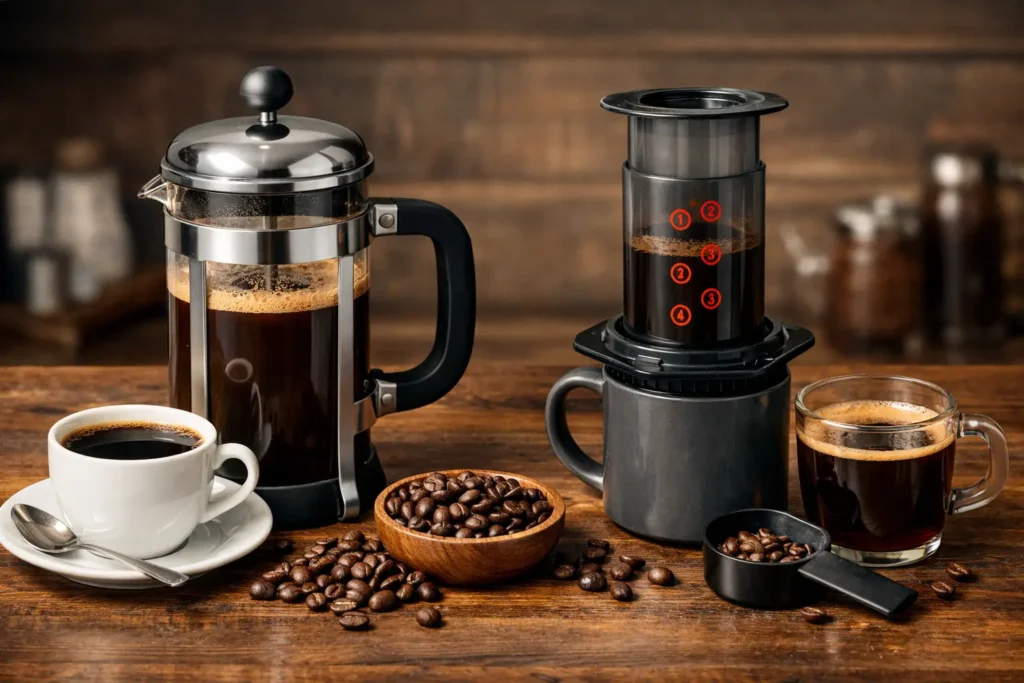
The French press vs AeroPress comparison is one of the most common decisions in home coffee — two manual brew methods at a similar price point, both requiring only hot water and a grinder, both producing outstanding coffee. But they are fundamentally different tools that produce fundamentally different cups. French press is an immersion brewer that passes oils directly into the cup through a metal mesh filter, producing a rich, heavy, full-bodied coffee that no paper-filter method can replicate. AeroPress is a hybrid pressure-and-immersion device that brews fast, brews concentrated, and adapts to almost any recipe a home brewer can imagine. Choosing between them is not about which is better — it is about which produces the cup you want, fits your kitchen, and works with your daily routine. This complete CoffeeGearHub guide breaks down every comparison axis that matters: brew mechanism, flavour profile, ease of use, cleanup, versatility, portability, cost, and the gear each method requires — so you can make the right choice, or decide (like many home brewers do) to own both.
✍️ Editorial note: This guide is researched and written by the editors at CoffeeGearHub.com using published brewing science, SCA brewing standards, grinder manufacturer specifications, and established specialty-coffee community knowledge. Recommendations reflect research consensus and community reputation. All product links are affiliate links — we may earn a commission at no cost to you.
The 30-Second Answer
French press and AeroPress are both excellent — but they are the right tool for different jobs. French press wins for rich, full-bodied, oil-forward black coffee; for anyone who brews multiple cups at once; and for drinkers who want a simple, low-technique routine. AeroPress wins for fast, clean, concentrated coffee; for travel and small spaces; for experimenting with recipes; and for anyone who prioritises easy cleanup. The majority of serious home brewers eventually own both. If you can only own one: choose French press for body and simplicity; choose AeroPress for versatility and speed.
- Choose French Press if: you drink full-bodied black coffee daily, brew multiple cups, or want the lowest-technique reliable setup
- Choose AeroPress if: you travel frequently, want fast cleanup, love experimenting, or drink espresso-style concentrated coffee
- Best AeroPress: AeroPress Original — the benchmark device that started the category
- Best for Travel: AeroPress Go — compact, complete, virtually indestructible
- Best French Press: Bodum Chambord — the benchmark glass French press for home use
Who This Guide Is For — Jump to What You Need
☕ New to Manual Brewing
Start with How Each Method Works, then read Which Is Right for You to make your decision.
🧳 Travel Brewer
Jump straight to Portability Comparison and Top Picks — the AeroPress Go section is built for you.
🔬 Flavour First
Go to Flavour Comparison and Head-to-Head Table to understand exactly what each method produces in the cup.
🔧 Already Own One
See Versatility and Grind Settings to get the most from your existing brewer before buying the other.
Table of Contents
How French Press and AeroPress Work: The Mechanics
Understanding the brew mechanism of each method is the foundation of every comparison that follows — flavour differences, cleanup differences, and grind requirements all trace directly back to how each device extracts coffee. They share the fact that both are manual, both use hot water, and both require a grinder. Beyond that, they work in fundamentally different ways.
How French Press Works
French press is a full immersion brew method. Coarsely ground coffee steeps in direct contact with hot water for approximately four minutes. Extraction happens through diffusion — dissolved compounds migrate from the high-concentration coffee grounds into the lower-concentration water over time. When steeping is complete, a metal mesh plunger is pressed down to separate the grounds from the liquid. The critical characteristic: the metal mesh filter passes oils, fine particles, and all the lipid compounds (cafestol and kahweol) directly into the cup. Nothing is absorbed by paper — everything the bean offers ends up in the glass.
- Brew mechanism: Full immersion / diffusion
- Filter type: Metal mesh — passes all oils into cup
- Grind required: Coarse (K6: 65–80 clicks)
- Standard brew time: 4 minutes
- Typical ratio: 1:15 (1g coffee per 15ml water)
- Cup result: Full-bodied, oil-rich, heavy mouthfeel, traditional coffee character
How AeroPress Works
AeroPress is a hybrid immersion and pressure brew method. Ground coffee steeps briefly in a cylindrical chamber, then the brewer manually pushes a rubber plunger through the chamber, forcing the brew through a filter (paper or metal) under gentle pressure — approximately 0.35–0.75 bar, far less than espresso’s 9 bar but significantly more than gravity-flow methods. The combination of short steep, fine-to-medium grind, and gentle pressure produces a concentrated, clean brew that can be drunk as-is or diluted with hot water to any strength. The paper filter (standard) removes virtually all oils; the optional metal filter passes oils similarly to French press.
- Brew mechanism: Immersion + manual pressure
- Filter type: Paper (standard, removes oils) or metal (passes oils)
- Grind required: Medium-fine to medium (K6: 20–35 clicks); varies by recipe
- Standard brew time: 1–2 minutes total
- Typical ratio: 1:6 to 1:12 (concentrated) — dilute to taste
- Cup result: Concentrated, clean, bright — espresso-adjacent or filter-adjacent depending on recipe
🔬 The filter science: The most consequential mechanical difference between French press and AeroPress is the filter. French press’s metal mesh passes cafestol and kahweol — the diterpene lipids responsible for coffee’s heavy body and mouthfeel — directly into every cup. AeroPress with a paper filter absorbs these entirely, producing a cleaner but lighter cup. AeroPress with a metal filter behaves more like French press. The SCA’s research at sca.coffee/research/coffee-standards covers the impact of filtration on brew chemistry in detail. The key takeaway: if you use AeroPress with paper filters, you are not drinking French-press-style coffee — you are drinking a different category of cup, regardless of recipe.
French Press vs AeroPress: Head-to-Head Comparison Table
This table covers every practical comparison axis. Use it as a quick-reference decision tool before reading the detailed breakdowns that follow.
| Category | French Press | AeroPress | Winner |
|---|---|---|---|
| Brew mechanism | Full immersion, diffusion, metal mesh filter | Immersion + manual pressure, paper or metal filter | Tie — different, not better/worse |
| Cup character | Full body, oil-rich, heavy mouthfeel, traditional | Concentrated, clean, bright — espresso-adjacent or filter-adjacent | Depends on preference |
| Brew time | 4–5 minutes | 1–2 minutes | AeroPress ✓ |
| Ease of use | Simple — minimal variables for a good cup | Slightly higher learning curve; repays experimentation | French Press (slightly) ✓ |
| Cleanup | 2–4 minutes — disassemble, rinse, scoop grounds | Under 30 seconds — eject puck, rinse seal | AeroPress ✓✓ (significant win) |
| Capacity per brew | Up to 1.5L (12–15 cups) — scales easily | Up to 300ml per press (1–2 cups) — AeroPress XL: 500ml | French Press ✓ (for multiple cups) |
| Portability / travel | Poor — glass body, bulky, breakable | Excellent — compact, durable, indestructible | AeroPress ✓✓ (clear win) |
| Versatility | Standard press, cold brew, concentrate | Espresso-style, filter-style, cold brew, recipes — near-unlimited variation | AeroPress ✓✓ |
| Grind requirement | Coarse only — narrow tolerance | Medium-fine to medium — wide grind range | AeroPress ✓ (more forgiving) |
| Sediment in cup | Always some sediment — inherent to metal filter | Zero (paper filter) or minimal (metal filter) | AeroPress ✓ |
| Coffee oils in cup | All oils pass through — maximum body | No oils (paper) or all oils (metal filter) | French Press ✓ (for body and richness) |
| Device cost | $30–50 (Bodum Chambord 1L) | $35–55 depending on model | Tie |
| Ongoing cost | None — reusable metal filter | Low — paper filters ~$10/350 pack (or use metal) | French Press ✓ (slightly) |
| Durability | Glass body fragile; stainless models more durable | BPA-free plastic — virtually indestructible | AeroPress ✓ |
| Best for beginners | Simpler technique, fewer decisions | More feedback, faster to correct errors | Tie — different strengths |
Flavour Comparison: What French Press and AeroPress Actually Produce in the Cup
The flavour difference between French press and AeroPress is not a matter of quality — both methods produce outstanding coffee when brewed correctly. It is a matter of character: they produce different types of coffee from the same bean. Understanding what each method does to flavour helps you decide which cup you actually want, and explains why a bean you love in one method might disappoint you in the other.
French Press Flavour Profile
French press is the most direct expression of a coffee bean in liquid form. The metal filter passes everything — oils, aromatic compounds, fine particles — into the cup without absorption or stripping. The result is a dense, texturally heavy, mouthfeel-forward cup: dark chocolate, caramel, nuts, dried fruit. Acidity is suppressed by the oil content and immersion time. The cup has weight you can feel on your tongue. When you add milk, French press holds up under it — the body carries through steamed or cold milk without disappearing the way lighter-filter-coffee can.
The trade-off: French press is less capable of expressing delicate flavour clarity. A high-acid washed light roast that tastes bright and complex as a Chemex pour-over will taste heavier, more muted, and less differentiated in French press — the oil content crowds out the high-frequency aromatic notes that make washed single-origins distinctive. French press is a bass-forward method; for treble, look to AeroPress or pour-over.
- Body: Heavy, full, texturally rich — maximum mouthfeel
- Acidity: Low to moderate — suppressed by oils and immersion
- Clarity: Lower — oils and fine particles reduce transparency
- Sweetness: Moderate to high — caramel and chocolate-forward
- Sediment: Always present — part of the French press character
- Best bean type: Medium-dark, natural processed, full-bodied blends
AeroPress Flavour Profile
AeroPress with a paper filter produces a clean, bright, concentrated brew with significantly more clarity than French press — closer in character to a short filter coffee or a long espresso than to a traditional press cup. The paper filter removes virtually all oils, which strips body but unveils high-frequency aromatic notes: fruit acidity, floral complexity, clean sweetness. Light roast single-origins that taste muted in French press come alive in AeroPress — the clarity the paper filter provides is exactly what delicate washed beans need to express their origin character.
AeroPress with a metal filter moves the result toward French press territory — oils pass through, body increases, clarity decreases. This gives the AeroPress a unique flexibility: you can tune the filter choice to get a cup that is closer to filter, closer to French press, or somewhere in between. For a truly French-press-style cup, nothing replaces an actual French press — but AeroPress with metal filter is the closest approximation available in a portable, fast-cleanup device.
- Body: Light-medium (paper filter) to medium-full (metal filter)
- Acidity: Moderate to bright — expressed clearly through paper filtration
- Clarity: High (paper) to moderate (metal) — clean, transparent cup
- Sweetness: High — short brew time locks in sweetness before bitterness extracts
- Sediment: Zero (paper) to minimal (metal)
- Best bean type: Light to medium roast, washed or honey process, single origins
| Flavour dimension | French Press | AeroPress (paper) | AeroPress (metal filter) |
|---|---|---|---|
| Body / mouthfeel | ★★★★★ — maximum | ★★☆☆☆ — light-medium | ★★★★☆ — approaching French press |
| Acidity expression | ★★☆☆☆ — suppressed | ★★★★★ — fully expressed | ★★★☆☆ — moderate |
| Flavour clarity | ★★☆☆☆ — oils obscure delicate notes | ★★★★★ — transparent, origin-forward | ★★★☆☆ — balanced |
| Sweetness | ★★★★☆ — caramel/chocolate range | ★★★★★ — fruit/floral sweetness prominent | ★★★★☆ — combined |
| Oil content in cup | ★★★★★ — all oils present | ★☆☆☆☆ — oils removed by paper | ★★★★☆ — most oils present |
| Sediment level | Moderate — always present | None | Minimal |
| Best roast level | Medium to dark | Light to medium | Medium to medium-dark |
Ease of Use: Brew Routine Comparison
Both methods are simple relative to espresso — neither requires a machine, pressure calibration, or portafilter technique. But they differ meaningfully in how much attention the brew process demands, how quickly you get feedback when something goes wrong, and how many variables you need to manage to get a consistent cup every day.
French Press Brew Routine
- Boil water (1–2 min)
- Weigh and grind coffee coarsely (60–90 sec)
- Add grounds to press, pour water to bloom (30s)
- Add remaining water, place lid, steep 4 minutes
- Press slowly (20–30 sec), pour immediately
Total active time: ~3 minutes. Total elapsed time: ~7–8 minutes. Technique variables: grind size, ratio, temperature, steep time. French press is extremely consistent once dialled in — the four-minute steep is forgiving of 30-second deviations in either direction for medium roast. The routine is low-attention: set a timer and walk away.
AeroPress Brew Routine
- Boil water (1–2 min)
- Rinse paper filter, place cap on chamber
- Weigh and grind coffee to medium-fine (60–90 sec)
- Add grounds, pour water to weight, stir (30s)
- Steep 1–2 minutes (recipe-dependent)
- Press slowly over 30–45 seconds; stop at first hiss
- Dilute concentrate with hot water to taste (optional)
Total active time: ~4 minutes. Total elapsed time: ~5–6 minutes. Technique variables: grind size, ratio, steep time, water temperature, stir intensity, press speed. AeroPress is slightly more technique-sensitive than French press — especially for beginners — but errors correct faster because the brew cycle is shorter.
Cleanup and Maintenance: The Practical Day-to-Day Reality
Cleanup is one of the most underrated factors in the French press vs AeroPress decision — because it affects whether you actually use your brewer every day. The best coffee equipment is the equipment you use consistently, and cleanup friction that feels trivial on day one becomes a genuine deterrent over months of daily brewing.
| Cleanup step | French Press | AeroPress |
|---|---|---|
| Remove grounds | Scoop wet grounds from glass beaker — sticky, messy, requires a spoon or spatula | Eject entire grounds puck into bin with one push of the plunger — clean, dry, instant |
| Clean filter | Disassemble 3-part plunger assembly; rinse mesh filter; reassemble — coffee oils accumulate in mesh over time | Rinse paper filter cap under tap (5 sec); rubber seal self-cleans during ejection stroke |
| Clean vessel | Rinse glass beaker — grounds cling to walls; occasional soap wash needed | Rinse plastic chamber — nothing sticks; dishwasher safe |
| Total cleanup time | 2–4 minutes | Under 30 seconds |
| Deep clean frequency | Weekly — mesh filter requires soak to remove oil buildup | Monthly — occasional full disassembly; minimal oil accumulation |
| Travel cleanup | Requires sink access, rinsing facilities | Grounds go in any bin; quick wipe is sufficient |
⚠️ The French press cleanup reality: French press cleanup is not difficult — but it is the most common reason people stop using their French press consistently. Wet grounds stuck to glass walls, a three-part mesh filter that traps coffee oils, and the awkward step of scooping grounds into a compost bin add up to a routine that feels fine on weekends and irritating at 6:30am on a Tuesday. If fast weekday cleanup matters to you, AeroPress solves this completely. If you brew on weekends or enjoy the ritual, French press cleanup is a non-issue.
Versatility: Brew Styles Each Method Supports
AeroPress is the most versatile manual brew device in home coffee — the number of legitimate, meaningfully different recipes it supports is not matched by any other single brewer. French press is less versatile but optimised for what it does: producing excellent traditional black coffee and cold brew concentrate at scale. Understanding the full recipe range of each method helps you decide whether versatility is a priority for your setup.
| Brew style | French Press | AeroPress | Notes |
|---|---|---|---|
| Standard black coffee | ✅ Excellent — the method’s primary use case | ✅ Excellent — dilute concentrate with hot water (Americano-style) | Different character: French press is richer/heavier; AeroPress is cleaner/brighter |
| Espresso-style concentrate | ⚠️ Possible but limited — 1:10 ratio, medium-coarse grind; lacks pressure | ✅ Excellent — the most popular AeroPress use case; short steep, fine grind, full press | AeroPress concentrate is not true espresso but produces a usable espresso substitute |
| Latte / cappuccino base | ✅ Good — French press at 1:12–1:13 ratio produces strong enough base for milk | ✅ Excellent — AeroPress concentrate is ideal for milk drinks | Both work; AeroPress concentrate is richer under milk |
| Cold brew | ✅ Excellent — coarse grind, 1:8 ratio, 12–16 hrs cold steep; presses cleanly | ✅ Good — room temp or cold, 1–2 hrs; produces concentrate faster than French press | French press scales better for volume; AeroPress faster for small batches |
| Iced coffee | ⚠️ Possible — brew hot at 1:12, pour over ice | ✅ Excellent — “Japanese iced AeroPress”: brew directly over ice for flash-chilled clarity | AeroPress iced is one of its signature techniques — produces exceptional clarity over ice |
| Multiple cups at once | ✅ Excellent — 1L Chambord makes 4–5 cups in one brew | ⚠️ Limited — standard: 1–2 cups per press; AeroPress XL: 2–3 cups | French press is dramatically better for group brewing |
| Travel / hotel brewing | ❌ Poor — glass body, bulky, not TSA-friendly | ✅ Exceptional — AeroPress Go fits in carry-on; full setup under 280g | AeroPress is the standard choice for specialty coffee travellers |
| Recipe experimentation | ⚠️ Limited variation range within fixed immersion format | ✅ Near-unlimited — inverted, standard, bypass, Nordic, espresso-style, filter-style | AeroPress has an annual World AeroPress Championship — the variety is genuine and rewarding |
Portability and Travel: A Clear Category Win
Portability is the one comparison category where there is no close contest. AeroPress was designed to travel — its cylindrical form factor, plastic construction, and self-contained storage system make it one of the few coffee devices that genuinely belongs in a backpack or carry-on. French press was designed for the kitchen counter, and that is where it performs best.
| French Press (Bodum Chambord 1L) | AeroPress Original | AeroPress Go | |
|---|---|---|---|
| Weight (brewer only) | ~900g | ~430g | ~280g (including travel mug) |
| Packed dimensions | ~24cm tall × 12cm wide (protruding handle) | ~25cm tall × 9cm cylinder | ~12cm tall × 9cm cylinder (in mug) |
| Breakability | High — borosilicate glass breaks on hard drops | Low — BPA-free polypropylene, impact-resistant | Very low — same material, smaller form factor |
| TSA / carry-on | Not recommended — glass, bulky | Yes — fits in any bag, no restrictions | Yes — the most travel-friendly coffee setup available |
| Hotel room brewing | Impractical — requires counter space, bin access for grounds, rinsing | Excellent — eject grounds in bin, quick wipe, done | Excellent — the Go mug doubles as drinking vessel |
| Camping / outdoors | Not suitable | Good — lightweight, no fragile components | Excellent — the standard choice for specialty coffee camping |
Which Is Right for You? The Decision Framework
The best brewer is the one that matches your actual daily coffee life — not the one with the most impressive technical specifications or the most World Championship wins. Use this framework to make the right choice for your situation.
Choose French Press if…
- You drink traditional full-bodied black coffee and want maximum body and richness in every cup
- You regularly brew for two or more people — French press scales to 4–5 cups per brew without any extra effort
- You want the simplest possible morning routine — four minutes, no dilution step, no filter rinsing, no recipe to follow
- You prefer medium-dark or dark roast beans and want the oil content to come through in the cup
- You plan to make cold brew regularly — French press is the best home cold brew setup for volume
- You are not bothered by 2–3 minutes of daily cleanup
Choose AeroPress if…
- You travel frequently and want to make excellent coffee in hotel rooms, campsites, or airports
- You drink one cup at a time and want it as fast as possible — AeroPress brews in under two minutes
- Cleanup time genuinely matters to you — AeroPress is under 30 seconds, every time
- You enjoy experimenting with different recipes and brew styles — AeroPress rewards exploration
- You prefer light to medium roast single-origin beans and want clarity and brightness in the cup
- You want one brewer that can make an espresso-style concentrate, a filter-style coffee, an iced coffee, and a milk-drink base — all with the same device
Own Both if…
You are a home coffee enthusiast who wants the full range of what manual brewing can produce. French press and AeroPress are complementary, not redundant — together they cover every brew style, every occasion, and every roast level. French press for weekday mornings, weekend multiple-cup brewing, and traditional black coffee. AeroPress for travel, single-cup experimentation, iced coffee, and light-roast exploration. Together they cost less than a mid-range automatic drip machine and produce better coffee than any of them. The majority of serious home brewers reach this conclusion within a year of owning one or the other.
Top Picks: AeroPress and French Press Gear Recommendations
These are the specific devices we recommend for each method — selected for build quality, brew performance, value, and how well they suit the typical home brewer at each category. All product links use the CoffeeGearHub Amazon Associates affiliate tag. Prices are not listed as they vary by retailer and date — always check current pricing at the product link.
Best AeroPress Overall: AeroPress Original
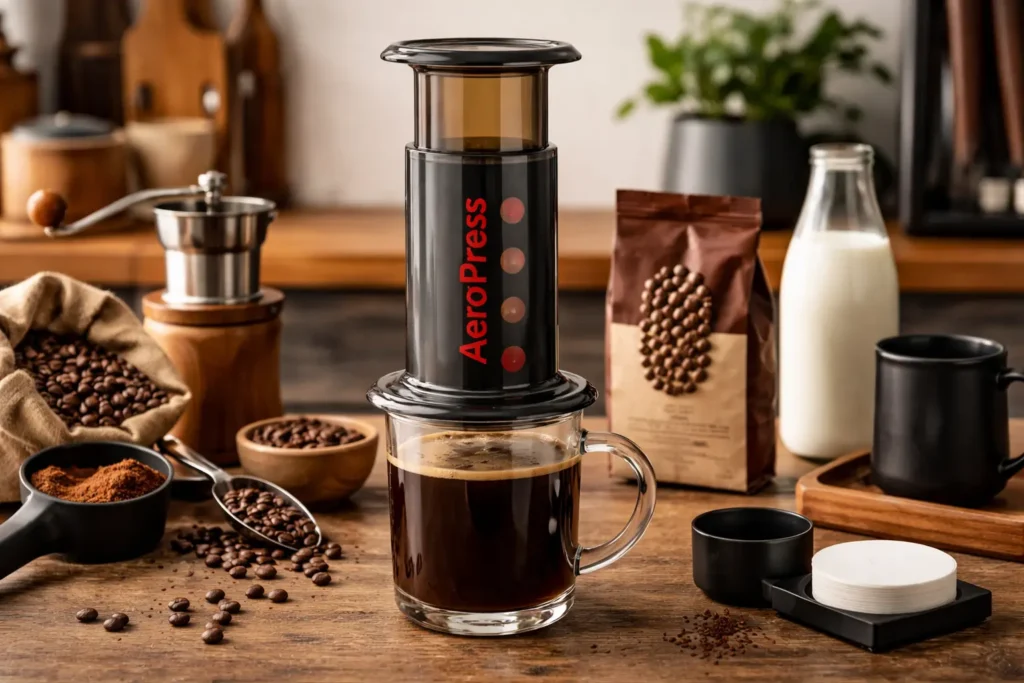
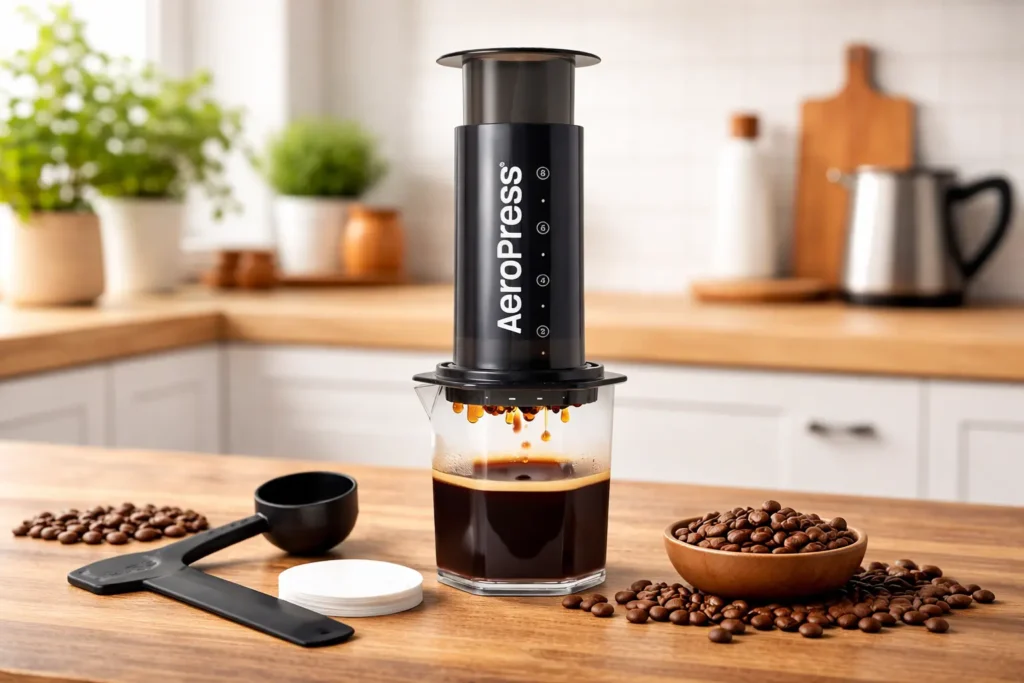
The AeroPress Original is the benchmark device that defined the category — and after multiple iterations and 15+ years in homes worldwide, it remains the best all-round AeroPress for home brewing. The standard cylindrical chamber brews up to 240ml of concentrate per press, includes 350 paper micro-filters, a stirrer, scoop, and funnel, and stores all accessories inside the chamber for compact organisation. For home brewing where travel portability is not the primary concern, the Original’s larger capacity and slightly wider chamber make it marginally easier to work with than the Go — especially for inverted brewing and recipes with longer steep times. The BPA-free polypropylene body is dishwasher safe and essentially indestructible.
- Capacity: Up to 240ml concentrate per press (dilute to 350–500ml per serving)
- Includes: 350 micro-filters, stirrer, scoop, funnel — everything needed to start brewing
- Best for: home brewing, espresso-style concentrates, cold brew, recipe experimentation
- Brew starting point: 18g coffee / 200ml water (1:11) / 92°C / 1.5 min steep / K6: 25–30 clicks
- Note: compatible with all AeroPress accessories including Fellow Prismo and reusable metal filters
Disclosure: CoffeeGearHub may earn from qualifying purchases.
⚠️ Amazon link note: The AeroPress Original Amazon shortlink above is a placeholder. Replace with your verified affiliate shortlink from the Amazon Associates dashboard using ASIN B0047Y76R6 (AeroPress Original) tagged with coffeegearhub-20 before publishing.
Best AeroPress for Travel: AeroPress Go
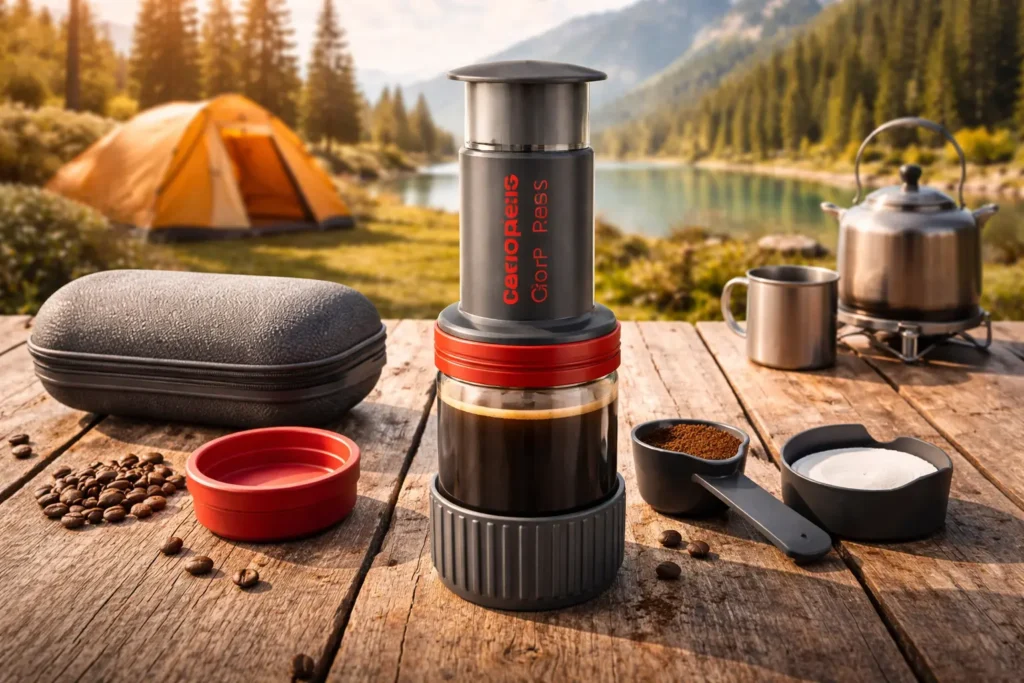
The AeroPress Go is the definitive travel coffee setup — the entire brewer, 350 micro-filters, stirrer, and scoop pack inside a 300ml travel mug that fits in any carry-on, day pack, or jacket pocket. At 280g total weight, the Go is the lightest full-capability coffee setup available for travel. The mug doubles as the brew vessel for standard brewing, reducing the equipment count to a single unit. Capacity is slightly reduced compared to the Original (up to 240ml concentrate, but the mug limits total brew volume), which is a non-issue for solo travel brewing. The Go produces identical cup quality to the Original — same chamber dimensions, same filter size, same pressure physics. If you travel with coffee equipment regularly, the AeroPress Go is the most practical purchase in this entire guide.
- Capacity: 240ml concentrate; 300ml travel mug — optimal for 1 cup per session
- Weight packed: 280g total — lighter than any other full-capability travel setup
- Best for: travel, hotel rooms, camping, office, any situation where space and cleanup matter
- Brew starting point: 18g coffee / 200ml water / 92°C / 1.5 min steep / K6: 25–30 clicks
- Note: mug is not insulated — brew directly into your insulated cup for hot retention on long journeys
Disclosure: CoffeeGearHub may earn from qualifying purchases.
⚠️ Amazon link note: The AeroPress Go Amazon shortlink above is a placeholder. Replace with your verified affiliate shortlink using ASIN B07YVL8SF3 (AeroPress Go) tagged with coffeegearhub-20 before publishing.
Best AeroPress for Multiple Cups: AeroPress XL
The AeroPress XL addresses the Original’s most significant limitation: single-cup capacity. The XL’s larger chamber brews up to 500ml per press — enough for two generous cups or one very large serving — using the same filter mechanism and brew physics as the Original. It is the AeroPress for households where two people drink coffee at the same time, or for anyone who wants a large cup without running a second press. The XL is noticeably larger than the Original or Go and is not a travel device — but at home, the increased capacity makes it the most practical AeroPress for multi-cup households who want the AeroPress’s speed and cleanup advantages over French press’s scale advantage.
- Capacity: Up to 500ml per press — 2 cups or 1 very large serving
- Best for: couples, large single servings, home users who want AeroPress speed with French-press-scale capacity
- Brew starting point: 32g coffee / 350ml water (1:11) / 92°C / 1.5 min steep / K6: 25–30 clicks
- Note: uses the same filter size as Original; XL-specific filters also available
Disclosure: CoffeeGearHub may earn from qualifying purchases.
⚠️ Amazon link note: The AeroPress XL Amazon shortlink above is a placeholder. Replace with your verified affiliate shortlink using the correct AeroPress XL ASIN tagged with coffeegearhub-20 before publishing. Verify current ASIN in the Amazon Associates dashboard — the XL launched in late 2023 and may have multiple SKUs.
Best French Press: Bodum Chambord
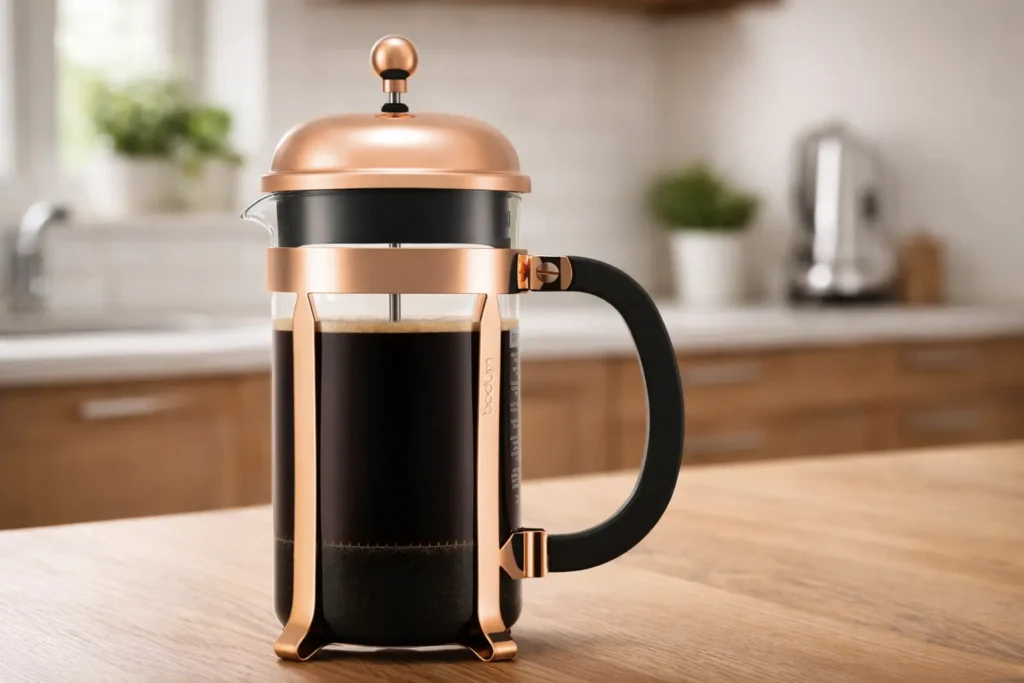
The Bodum Chambord is the benchmark French press for home use — the design that every other French press is compared against, and for good reason. Its stainless steel frame, borosilicate glass beaker, and three-part stainless mesh filter assembly produce a well-filtered, consistently clean cup at any brew volume. The tight mesh filter reduces sediment passage without impeding oil extraction — you get the full body and mouthfeel of French press without excessive grit. For anyone adding French press to their setup, the Chambord 1L is the optimal starting choice: large enough for two to three full cups, small enough for a single drinker’s daily brew. The borosilicate glass handles thermal shock and is dishwasher safe. After decades in production, the Chambord remains the most reliable and best-performing French press at its price point.
- Sizes available: 350ml (1–2 cups), 500ml (2 cups), 1L (3–4 cups), 1.5L (5–6 cups)
- Filter: Three-part stainless mesh — minimal sediment, full oil extraction
- Best for: everyday home French press, multiple cups, cold brew, full-bodied black coffee
- Brew starting point: 30g coffee / 450ml water (1:15) / 93°C / 4 min steep / K6: 68–72 clicks
- Note: recommend the 1L for most home setups; 350ml for single daily cups only
Disclosure: CoffeeGearHub may earn from qualifying purchases.
Best Grinder for Both Methods: KINGrinder K6
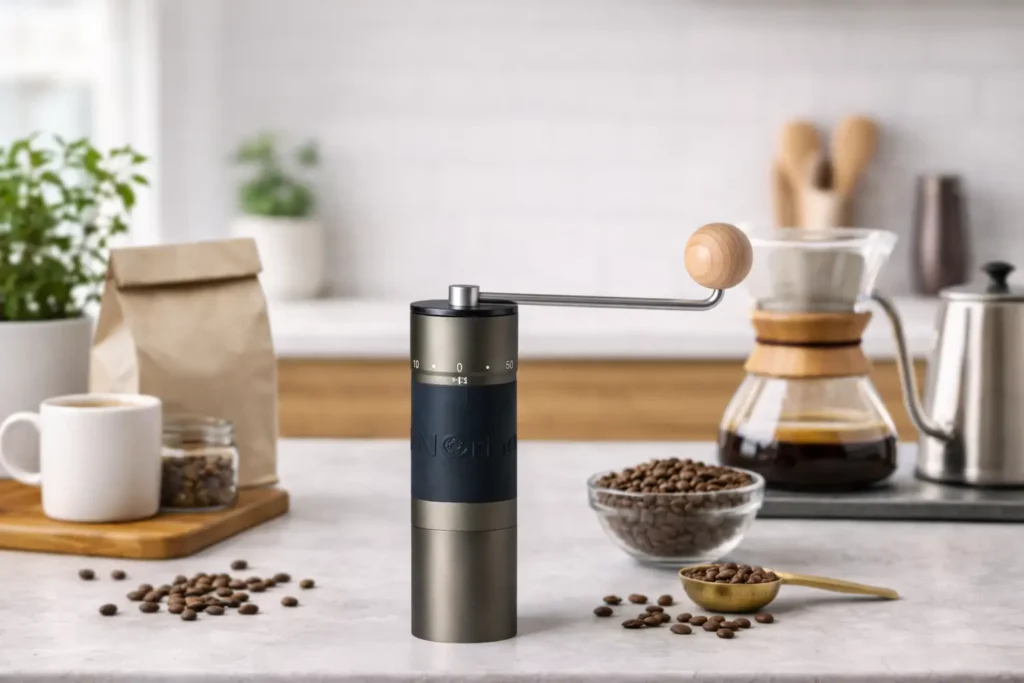
The KINGrinder K6 is the CoffeeGearHub standard manual grinder recommendation — and for this comparison it is uniquely relevant because it covers the complete grind range required by both French press and AeroPress in a single device. French press requires the K6’s coarsest settings (clicks 65–80); AeroPress espresso-style requires its finest (clicks 10–15); standard AeroPress sits at the medium range (clicks 20–35). The 100-click adjustment system means a 5-click change produces a meaningful, reproducible shift in extraction at any point in that range. If you own both a French press and an AeroPress, the K6’s range means you are never switching between grinders — just adjusting clicks. The 48mm stainless conical burrs produce consistent particle distribution at all settings, and the all-metal body handles daily doses at both fine espresso-style and very coarse French press ranges without degradation.
- French press range: K6 clicks 65–80 — coarse to very coarse immersion grind
- AeroPress range: K6 clicks 10–35 — espresso-style to standard filter AeroPress
- 100-click system: fine enough adjustment for meaningful recipe changes in both methods
- 48mm conical burrs: consistent particle distribution at all settings across the full range
Disclosure: CoffeeGearHub may earn from qualifying purchases.
Grind Settings: KINGrinder K6 Reference for Both Methods
Grind size is the most important variable in both French press and AeroPress brewing — and it is where the two methods diverge most dramatically. French press uses one of the coarsest grinds in home coffee; AeroPress spans a wider range than almost any other method. The table below provides complete K6 click references for both methods across every brew style.
| Brew style | Method | K6 clicks | Ratio | Steep time | Temp | Cup character |
|---|---|---|---|---|---|---|
| Standard AeroPress | AeroPress | 25–30 | 1:11 to 1:12 | 1.5 min | 92°C | Concentrated, clean, sweet — dilute 1:1 with hot water to taste |
| AeroPress espresso-style | AeroPress | 10–15 | 1:6 | 30–45 sec | 93–95°C | Dense concentrate — for milk drinks or straight as a short |
| AeroPress filter-style | AeroPress | 30–38 | 1:15 | 2–3 min | 90–92°C | Filter-adjacent — bright, light-bodied, high clarity |
| AeroPress inverted long steep | AeroPress | 28–35 | 1:12 | 2–4 min | 92°C | Full-bodied AeroPress — closer to French press character |
| AeroPress iced (flash chilled) | AeroPress | 20–25 | 1:6 (onto ice) | 1 min | 95°C | Cold, clean, bright — exceptional iced coffee |
| French press medium roast | French Press | 65–72 | 1:15 | 4 min | 93°C | Balanced, full-bodied, caramel and nut |
| French press medium-dark | French Press | 70–78 | 1:14 to 1:15 | 4 min | 92°C | Chocolate, brown sugar, heavy mouthfeel |
| French press dark roast | French Press | 74–82 | 1:13 to 1:14 | 3.5–4 min | 90–92°C | Bittersweet, rich, traditional strong press |
| French press light roast | French Press | 60–65 | 1:14 to 1:15 | 4.5–5 min | 93–96°C | Bright, complex, origin-forward, tea-like body |
| French press cold brew | French Press | 78–88 | 1:8 to 1:10 | 12–16 hrs cold | Cold water | Sweet, concentrated — serve diluted 1:1 over ice |
🔬 K6 range summary: The KINGrinder K6 covers clicks 0 (finest) through 100 (coarsest). AeroPress uses roughly the bottom third of this range (clicks 10–38); French press uses the top third (clicks 60–88). The two methods do not overlap — which means you always know exactly where to set the grinder for each brew. The middle range (clicks 38–60) covers pour-over and drip methods. If you own all three brewing methods, the K6’s full range handles every one of them without compromise.
Brew Guides: Standard Recipes for Both Methods
Standard French Press Recipe
- Boil water; allow to cool 30 seconds off-boil (target: 93°C)
- Weigh 30g coffee; grind at K6 68–72 clicks (medium roast starting point)
- Add grounds to press; pour 60ml water to bloom; stir once; wait 30 seconds
- Pour remaining 390ml water; place lid with plunger raised; start 4-minute timer
- At 4 minutes: press slowly and evenly over 20–30 seconds
- Pour all brew immediately — do not leave on grounds
Adjust one variable at a time: sour → grind finer; bitter → grind coarser; weak → add 3g dose; strong → reduce dose 3g.
Standard AeroPress Recipe
- Rinse paper filter; attach filter cap to chamber; set on mug or server
- Boil water; cool to 92°C (30–60 seconds off boil for medium roast)
- Weigh 18g coffee; grind at K6 25–30 clicks (medium-fine)
- Add grounds to chamber; pour 200ml water over 20–30 seconds; stir 5 times
- Place plunger in chamber (creates vacuum seal); steep 1.5 minutes
- Press slowly over 30–45 seconds; stop at first hiss of air
- Dilute concentrate with 150–200ml hot water; taste and adjust
Adjust one variable at a time: sour → grind finer or extend steep; bitter → grind coarser or shorten steep; weak → reduce dilution water.
Best Beans for French Press vs AeroPress
The same bean can perform very differently in French press and AeroPress — not because one method is superior, but because they amplify different aspects of the bean’s character. Use this table to match your beans to your method, or to understand why a bean you love in one setup disappoints in the other.
| Bean type | French Press performance | AeroPress performance | Recommended for |
|---|---|---|---|
| Medium-dark blend (e.g. Lavazza Super Crema) | Excellent — full body, oil-forward, rich mouthfeel | Good — produces dense concentrate; best with metal filter | French Press primary; AeroPress milk drinks |
| Medium roast blend (e.g. Intelligentsia Black Cat) | Excellent — wide extraction window, beginner-forgiving | Excellent — balanced sweetness and body at standard recipe | Both methods equally |
| Light roast washed single origin | Moderate — acidity suppressed; delicate notes muted by oils | Excellent — paper filter reveals full origin clarity and acidity | AeroPress strongly preferred |
| Natural processed Ethiopian | Exceptional — fruit character amplified powerfully through metal filter | Good — fruit character present but somewhat muted by paper filter; use metal filter for best results | French Press primary; AeroPress with metal filter |
| Dark roast (e.g. Illy Classico) | Good — requires lower temp, short steep, very coarse grind | Good — fast extraction; espresso-style at 10–12 clicks; dilute generously | Both methods with adjusted parameters |
| Honey process medium (e.g. Colombian honey) | Excellent — balanced sweetness and body; the most consistent everyday French press bean type | Excellent — balanced clarity and sweetness; works well at standard AeroPress recipe | Both methods equally — the most versatile bean type |
Cost Comparison: What Each Setup Actually Costs
Neither French press nor AeroPress is expensive — both are among the most affordable quality coffee setups available. But the full cost of a home brewing setup goes beyond the device itself: a quality burr grinder and digital scale are required for both methods, and these represent the majority of the investment regardless of which brewer you choose.
| Component | French Press setup | AeroPress setup | Notes |
|---|---|---|---|
| Brewer | Bodum Chambord 1L: check current price | AeroPress Original: check current price | Both are similarly priced; AeroPress Go and XL vary |
| Grinder | KINGrinder K6: check current price | KINGrinder K6: same grinder for both methods | Grinder is shared cost if you own both brewers |
| Scale | Required — cannot brew accurately without one | Required — cannot brew accurately without one | Any 0.1g kitchen scale works; $15–30 |
| Ongoing filter cost | None — reusable metal mesh filter included | Paper filters: ~$10 per 350-pack; or $15–30 one-time for reusable metal filter | Negligible ongoing cost for AeroPress paper filters |
| Total setup (brewer + K6 + scale) | Varies — check current prices at links above | Varies — check current prices at links above | Total is comparable for both setups; grinder is the dominant cost |
🔬 The grinder is where to invest: The quality of your grinder has a larger impact on cup quality than the choice of brewer, for both French press and AeroPress. A cheap blade grinder produces uneven particles — large chunks and fine powder in the same grind — that cause simultaneous under- and over-extraction regardless of your technique. A consistent burr grinder like the K6 gives you uniform particle size, which is the prerequisite for any brew method to work correctly. If you are allocating a budget between a better brewer or a better grinder, choose the grinder every time. A K6 and a $20 French press outperforms a $150 French press and a blade grinder — without exception.
Troubleshooting Matrix: French Press and AeroPress Problems → Fixes
Identify your symptom below. Most problems with both methods trace to grind size, steep time, water temperature, or bean freshness — not the device itself. Adjust one variable before the next brew and write down what changes.
| Symptom | Method | Most likely cause | Fix (in order) |
|---|---|---|---|
| Bitter — too harsh | French Press | Grind too fine, steep too long, or water too hot | Grind 3–5 clicks coarser → shorten steep 30s → lower temp 1–2°C → pour immediately after pressing |
| Bitter — too harsh | AeroPress | Grind too fine, steep too long, or over-pressing past first hiss | Grind 3–4 clicks coarser → shorten steep 20s → stop press at first hiss → lower temp 1°C |
| Sour / sharp / watery | French Press | Grind too coarse, steep too short, or water too cold (especially light roast) | Grind 3–4 clicks finer → extend steep 30s → raise temp 2°C for light roast |
| Sour / sharp | AeroPress | Grind too coarse, water too cold, or steep too short | Grind 3–4 clicks finer → raise temp 2°C → extend steep 20–30s |
| Flat / no aroma / hollow | Both | Stale beans — aromatic volatiles depleted | Buy fresh beans with a roast date — no grind or technique fix for stale coffee |
| Muddy / gritty / heavy sediment | French Press | Grind too fine for metal mesh, or grinder producing excessive fines | Grind 5+ clicks coarser → improve plunge technique (slow, even pressure) → consider burr grinder upgrade |
| Thin body / weak mouthfeel | French Press | Grind too coarse, ratio too dilute, or washed light roast with low oil content | Grind 4 clicks finer → increase dose by 3g → try medium-dark or natural processed bean for more body |
| AeroPress concentrate too strong | AeroPress | Too little dilution water added, or grind too fine (over-extraction) | Add more hot water after pressing → grind 2–3 clicks coarser for balanced concentration |
| AeroPress concentrate too weak | AeroPress | Too much dilution, or under-extraction (coarse grind + short steep) | Reduce dilution water → grind 2–3 clicks finer → extend steep 20–30s |
| Coffee cools too quickly | French Press | Glass beaker loses heat rapidly, especially in cold ambient temperature | Pre-heat press with hot water before brewing → pour into an insulated mug immediately after pressing |
| AeroPress leaks during pressing | AeroPress | Rubber seal worn or dirty; filter cap not fully secured | Clean rubber seal thoroughly; replace seal if cracked (replacement seals available); tighten filter cap fully |
| Natural bean tastes fermented / boozy | Both | Over-extraction of fermentation esters — steep too long or grind too fine | Shorten steep 30–45s → grind 3 clicks coarser → lower temp 1–2°C for natural-processed beans |
FAQs: French Press vs AeroPress
Is French press or AeroPress better for beginners?
Both are beginner-friendly, but they favour different types of beginners. French press is simpler in concept — coarse grind, add water, wait four minutes, press — with fewer technique variables. AeroPress has a slightly higher learning curve because grind, steep time, pressure, and filter choice all interact, but it is also more forgiving of individual errors and corrects faster. If you want simplicity, start with French press. If you want faster feedback, experimentation, and a single versatile device, AeroPress is the better beginner tool.
Does AeroPress make better coffee than French press?
Neither method makes objectively better coffee — they produce fundamentally different cups. AeroPress makes a concentrated, clean, bright brew that is closer in character to a short espresso or a clean filter coffee depending on technique. French press makes a full-bodied, oil-rich, texturally heavy cup that is unmatched for traditional rich black coffee or a milk-drink base. Which is better depends entirely on what flavour profile you prefer. Most serious home brewers own both.
Can AeroPress replace a French press?
AeroPress can replicate many French press use cases — strong black coffee, cold brew-style concentrate, milk-drink bases — but it cannot fully replace the distinctive full-bodied, oil-rich character of a French press cup. The paper filter in a standard AeroPress setup removes most coffee oils, producing a cleaner but lighter cup. Using a metal AeroPress filter closes some of that gap. If you can only own one device, AeroPress is the more versatile choice. If you drink primarily traditional black coffee with heavy body, French press is irreplaceable.
Which is easier to clean — French press or AeroPress?
AeroPress is significantly easier to clean. The used puck of coffee ejects in a single push directly into a bin, and the rubber seal scrapes the chamber clean in the same motion. The entire device rinses in under 30 seconds. French press cleanup requires disassembling the plunger assembly, scooping out wet grounds, rinsing the beaker, and cleaning the multi-part mesh filter — a 2–4 minute process that most users find tedious. Cleanup alone is one of the most common reasons people switch from French press to AeroPress.
Which is better for travel — French press or AeroPress?
AeroPress is dramatically better for travel. The AeroPress Go model packs into a mug small enough for a carry-on or day pack, weighs 280g, and is virtually indestructible — it can be dropped, packed under clothes, or thrown into a bag without risk. French press is generally glass-bodied, bulky relative to brew yield, and requires separate cleanup facilities. Travel is one of the clearest category wins for AeroPress in the French press vs AeroPress comparison.
What grind size do I use for AeroPress vs French press?
French press requires a coarse grind — approximately 65–80 clicks on the KINGrinder K6 depending on roast level. AeroPress uses a much wider grind range depending on recipe: standard recipes use medium to medium-fine (20–35 clicks on K6); espresso-style AeroPress uses fine (10–15 clicks); inverted long-steep recipes can use medium-coarse (35–45 clicks). Having a grinder with fine adjustment control matters more for AeroPress than French press because the shorter brew time makes AeroPress significantly more sensitive to grind size changes.
Is AeroPress coffee stronger than French press?
AeroPress brew is typically stronger by concentration — standard AeroPress recipes use a 1:6 to 1:12 coffee-to-water ratio, producing a concentrated shot that is diluted before drinking or drunk as is. French press typically uses a 1:15 ratio, producing a full-strength cup at a lower concentration. However, French press coffee feels stronger due to its heavy body, oils, and mouthfeel — even though a measured AeroPress concentrate is technically higher concentration. For caffeine content, both methods are comparable at equivalent brew volumes.
Can you make cold brew in an AeroPress or French press?
Both methods can make cold brew, but they work differently. French press cold brew is the more traditional approach: use a very coarse grind, a 1:8 ratio, and steep in cold water for 12–16 hours in the refrigerator, then press and serve over ice. AeroPress cold brew uses a fine-medium grind with cold water for a shorter steep, or room temperature brewing with ice placed under the chamber to chill the brew as it drips through. AeroPress produces cold brew concentrate faster; French press produces larger volumes more easily.
Which method produces less sediment — AeroPress or French press?
AeroPress with a paper filter produces virtually zero sediment — the fine paper filter prevents any particles from passing through. AeroPress with a metal filter produces a small amount of sediment, similar to espresso. French press always produces some sediment — this is an inherent characteristic of the method, not a fault. The metal mesh filter cannot prevent all fine particles from passing through, and the last few sips of a French press cup typically contain visible grounds. If sediment is a priority concern, AeroPress with paper filters is the clear choice.
How much do AeroPress and French press cost?
The AeroPress Original, AeroPress Go, and AeroPress XL are all comparably priced to a quality French press like the Bodum Chambord. Neither device is expensive relative to other coffee equipment. Both require a quality burr grinder (the most significant cost in any home setup) and a digital scale. The AeroPress includes its own carrying case and accessories; French press requires no additional accessories to brew. Total setup costs are comparable — check current prices at the product links in this guide.
Continue Learning
FRENCH PRESS GUIDES
Comparing more brew methods? Our pour-over comparison guide covers V60, Chemex, and Kalita Wave side-by-side — with the same format, grind settings, and gear picks used in this article.
☕
Written by the CoffeeGearHub Editorial Team
CoffeeGearHub is a specialty coffee equipment resource run by home brewers and coffee enthusiasts. Our guides are researched using published brewing science, SCA standards, grinder manufacturer specifications, and established specialty-coffee community knowledge. We review and update our pillar content regularly. About CoffeeGearHub →