
Last Updated: March 2026 • 30–40 min read • Cornerstone Guide: Gooseneck Kettle Buyer’s Guide + Temperature Science + Flow Rate + Top Picks
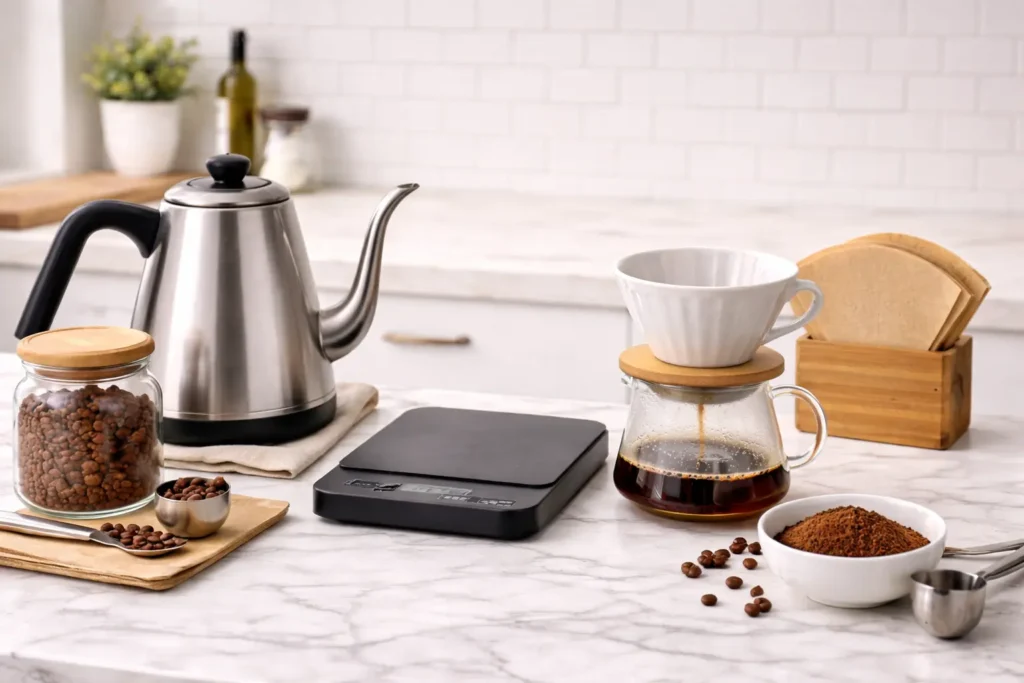
The best gooseneck kettle is the most consequential piece of gear in a pour-over setup — not because it makes the coffee, but because it determines whether you can control how the coffee is made. Pour-over brewing is a precision water-delivery exercise: the difference between a flat, muddy extraction and a clean, layered cup often comes down to whether you can pour 30 grams of water in a slow, even spiral over a 45-second bloom, then follow with a controlled main pour that saturates the bed without disturbing it. A standard kettle’s wide, fast-flowing spout makes that impossible. A well-engineered gooseneck kettle with a counterbalanced handle makes it repeatable. Add variable temperature control — so you’re not guessing whether your water is at 93°C or 99°C — and you’ve removed the two largest uncontrolled variables in pour-over brewing at once. This complete CoffeeGearHub guide covers everything you need to choose the right gooseneck kettle for your setup: what separates a great kettle from a mediocre one, how electric and stovetop designs compare, our verified top picks across every category and budget, and the full temperature and pour framework that makes any quality kettle perform at its best.
✍️ Editorial note: This guide is researched and written by the editors at CoffeeGearHub.com using published brewing science, SCA brewing standards, manufacturer specifications, and established specialty-coffee community knowledge. Recommendations reflect research consensus and community reputation. All product links are affiliate links — we may earn a commission at no cost to you. Affiliate Disclosure: CoffeeGearHub.com participates in the Amazon Services LLC Associates Program. As an Amazon Associate, we earn from qualifying purchases.
🛒 New to Amazon? Try Prime free for fast, free shipping on every pick in this guide — or try Audible free if you’d rather listen while your coffee brews.
🛒 New to Amazon? Try Prime free for fast, free shipping on every pick in this guide — or try Audible free if you’d rather listen while your coffee brews.
The 30-Second Answer
For most pour-over brewers, the Fellow Stagg EKG is the best gooseneck kettle to buy — precise variable temperature control from 40–100°C, a counterbalanced weighted handle that makes flow control effortless, and a 60-minute hold mode that keeps water at your target temperature while you grind and prep. If budget is the primary constraint, the Bonavita 1.0L Variable Temperature Kettle delivers reliable temperature precision for significantly less. If you already have a hob setup and don’t want an electric appliance on the counter, the Hario V60 Buono is the stovetop standard — the pour-over community’s default manual recommendation for decades. The kettle matters less than you think if you’re already using a thermometer — but the right electric kettle eliminates an entire variable from your morning brew and makes consistent extraction genuinely repeatable, session after session.
- Best Overall Electric: Fellow Stagg EKG — variable temperature, weighted handle, 60-min hold
- Best Budget Electric: Bonavita 1.0L Variable Temperature Kettle — reliable temp precision, honest value
- Best Stovetop / Manual: Hario V60 Buono Drip Kettle — the community standard, proven spout geometry
- Best Premium / Pro: Fellow Stagg EKG Pro — Bluetooth connectivity, PID precision, barista-grade finish
- Best Grinder Pairing: KINGrinder K6 — the standard CoffeeGearHub manual grinder recommendation for pour-over
Who This Guide Is For — Jump to What You Need
☕ First Gooseneck Kettle
Start with What Makes a Great Kettle, then jump to Top Picks.
🌡️ Temperature Dialler
Go to the Temperature Guide for target temps by brew method, roast level, and adjustment order.
🔧 Troubleshooter
Jump to the Troubleshooting Matrix — flat cup, uneven extraction, stalling blooms, and scale build-up all covered.
⚡ Electric vs Stovetop Decider
Jump to Electric vs Stovetop for a full side-by-side comparison to pick the right type for your setup.
Table of Contents
- Gooseneck kettle 101: how it works and why spout shape matters
- What makes a great gooseneck kettle: 5 variables that matter
- Kettle style quick-comparison by use case
- Top picks: best gooseneck kettles by category
- Electric vs stovetop: full comparison
- Variable temperature control: what it does and why it matters
- Size guide: which kettle volume is right for you
- Flow rate and handle design: the underrated performance variable
Gooseneck Kettle 101: How It Works and Why Spout Shape Matters
A gooseneck kettle is defined by the shape of its spout — a long, curved neck that rises from the base of the kettle before arcing forward toward the tip. This geometry does one specific thing extremely well: it slows and narrows the water flow exiting the spout, giving the brewer precise control over pour rate, direction, and volume in a way that a standard kettle’s short, wide spout cannot replicate. For pour-over coffee brewing — which is fundamentally a water-delivery exercise requiring slow, controlled, targeted pours over a paper or metal filter bed — this control is not a refinement. It is the functional prerequisite.
When you pour water through a V60 or Chemex, you are managing two things simultaneously: where the water lands on the coffee bed, and how fast it saturates the grounds. A slow circular pour (the “spiral”) ensures even saturation from the centre outward. A fast, uncontrolled pour from a standard kettle floods the bed unevenly, creates channels, and produces extraction that is simultaneously over-extracted in some areas and under-extracted in others. The gooseneck spout makes the difference between a textbook pour and a random one. For a complete overview of pour-over equipment and method, see our Best Pour-Over Coffee Makers guide.
🔬 The flow physics: The gooseneck’s long curved neck creates a controlled pressure drop between the water reservoir and the spout tip. The water must travel upward through the neck before descending through the arc — gravity and the column of water above the tip determine maximum flow rate at any tilt angle. A wider tilt increases flow; a shallower tilt reduces it to a near-drip. This is why handle design and balance point matter so much: a poorly balanced kettle forces you to over-tilt to maintain pour direction, which simultaneously increases flow rate beyond the level you want. The best kettles make the handle the primary control surface.
What Makes a Great Gooseneck Kettle: 5 Variables That Actually Matter
The gooseneck kettle market spans from $25 stovetop models to $250+ connected electric kettles. Most of them will pour water. What separates the genuinely excellent kettles from the rest is a combination of five factors — none of which are about brand name or finish colour. Understanding what each contributes tells you exactly what to prioritise when evaluating any kettle, and what marketing language to ignore.
| Factor | Why it matters | What to look for | What to avoid |
|---|---|---|---|
| Spout geometry | Determines pour control — the arc and tip diameter set your minimum achievable flow rate and pour precision | Long, curved neck with a narrow tip; spout exit angled slightly downward for natural pour direction | Short neck with wide tip; spout angled too far upward (forces over-tilting to pour) |
| Handle balance | A counterbalanced handle makes flow modulation effortless — heavy-tipped spouts require constant correction | Handle weight positioned to balance the spout; grip angle that allows natural wrist rotation without strain | Handle positioned too high or too far back; flimsy handle that flexes under pour weight |
| Temperature control | Determines how accurately and repeatably you hit your target brew temperature; uncontrolled temp is a major extraction variable | Electric: variable temperature control (1°C increments ideally) + hold mode; stovetop: compatible with a probe thermometer | Electric kettle with only preset temperature buttons; stovetop kettle with no thermometer compatibility |
| Material and interior | Affects flavour neutrality, durability, and heat retention between pours | All-stainless interior with no plastic in the water path; double-wall design for heat retention on electric models | Exposed plastic lid interior that drips condensation into the water; thin single-wall that cools rapidly between pours |
| Capacity | Always have enough water for your full brew in one fill; refilling mid-pour disrupts temperature and flow consistency | Match to your typical brew volume: 600–800ml for single-cup V60; 1.0L for Chemex or two-cup brewing | Buying minimum capacity “just in case” — small kettles run dry mid-pour; overfilling reduces control |
Gooseneck Kettle Style: Quick-Comparison by Use Case
Use this table to match a kettle style to your routine before reviewing the individual product picks below. The right choice depends on how you brew and what variables you most want to control — not on how much you spend.
| Best For | Recommended Style | Why It Works | Trade-Off | Budget Range |
|---|---|---|---|---|
| Beginners and first kettle | Electric variable temperature (e.g. Bonavita) | Removes temperature guesswork; automatic shut-off; approachable price | Requires counter space and outlet; less tactile than stovetop | $35–$60 |
| Daily pour-over driver | Premium electric (e.g. Fellow Stagg EKG) | Best flow control, 60-min hold mode, PID temperature accuracy | Higher upfront cost; takes counter space | $90–$120 |
| Stovetop / minimal setup | Stovetop gooseneck (e.g. Hario Buono) | No electricity needed, no base unit to store, compatible with any thermometer | Requires separate thermometer; more manual temperature management | $25–$55 |
| Precision / pro home bar | Connected electric (e.g. Fellow Stagg EKG Pro) | Bluetooth app control, PID precision to ±0.5°C, brew-mode presets | Highest price; app dependency for advanced features | $150–$200 |
| Travel, camping, or office | Compact stovetop or portable electric | Lightweight, low profile, works on any heat source; portable electric works on 12V | Smaller capacity; electric travel versions are slower to heat | $20–$50 |
Best Gooseneck Kettles: Our Top Picks
These picks represent the best gooseneck kettle at each category — verified by consistent community reputation, temperature precision, and alignment with how each style is actually used in a home pour-over setup. All product links use the CoffeeGearHub Amazon Associates tag.
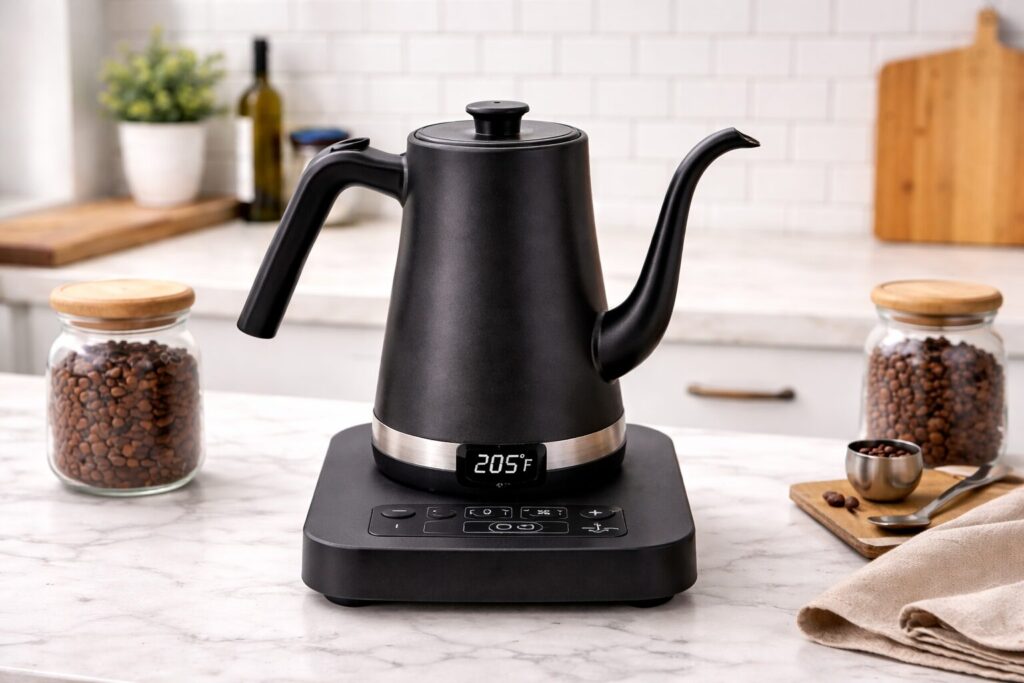
Best Overall Electric: Fellow Stagg EKG Gooseneck Kettle
The Fellow Stagg EKG is the benchmark electric gooseneck kettle — the design every serious home pour-over brewer reaches for, and for good reason. The variable temperature range (40–100°C in 1°C increments) covers every brew method from cold bloom to French press, the counterbalanced weighted handle is the best-in-class pour control mechanism available at this price, and the 60-minute hold mode means your water is ready at the exact temperature you need it, whether you reach for the kettle immediately after it beeps or ten minutes later. The PID controller holds temperature to ±0.5°C — meaningfully more accurate than competing electric kettles that advertise variable temperature but overshoot by 3–5°C at certain settings. The 0.9L capacity is sufficient for a full Chemex or two-cup V60 session without refilling. If you make one equipment upgrade to your pour-over setup this year, it is this kettle.
- Temperature range: 40–100°C in 1°C increments; PID-controlled to ±0.5°C accuracy
- Hold mode: 60 minutes at set temperature — essential for variable-schedule morning brewing
- Capacity: 0.9L (900ml) — sufficient for Chemex or two-cup V60 without refilling
- Handle: Counterbalanced weighted handle — the best flow-control mechanism at this price point
- Best for: daily pour-over, AeroPress, V60, Chemex, anyone upgrading from a standard kettle
Disclosure: CoffeeGearHub may earn from qualifying purchases.
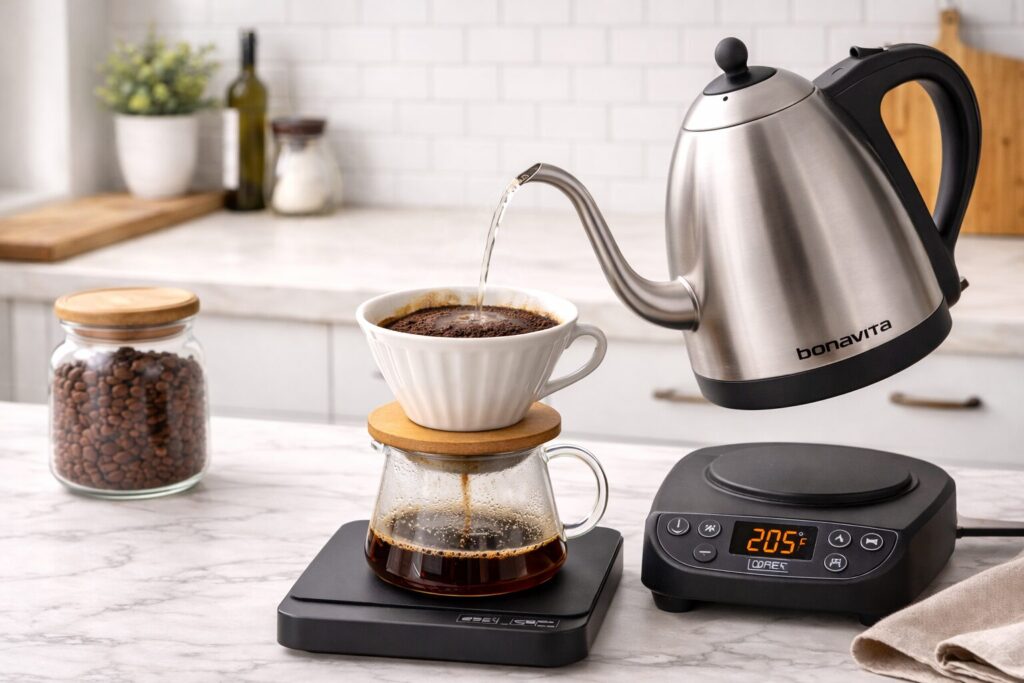
Best Budget Electric: Bonavita 1.0L Variable Temperature Gooseneck Kettle
The Bonavita Variable Temperature Kettle is the most defensible budget electric gooseneck recommendation for pour-over brewers who want temperature control without the Fellow Stagg EKG price tag. It heats 1.0L to any of six preset temperatures (60°C, 70°C, 80°C, 85°C, 90°C, 100°C) plus a free-select mode, holds temperature for 30 minutes, and uses a simple one-button interface that requires no learning curve. The spout geometry is well-executed for a kettle at this price: the neck is long enough and the arc tight enough to produce a controlled pour for V60 and Chemex. It is not as ergonomically refined as the Fellow Stagg EKG — the handle balance is standard rather than counterweighted — but for brewers who primarily want consistent temperature without spending over $100, it is the correct answer. The 1.0L capacity also makes it practical for larger brews and carafes.
- Temperature control: 6 presets (60–100°C) + free select; 30-minute hold mode
- Capacity: 1.0L — best-in-class capacity at budget price; good for Chemex and larger brews
- Spout: Practical gooseneck arc — adequate pour control for V60 and Chemex; not as refined as Fellow
- Interface: Single-button simplicity — no app, no menus, no learning curve
- Best for: budget-conscious brewers, beginners, anyone who wants reliable temperature at an honest price
Disclosure: CoffeeGearHub may earn from qualifying purchases.
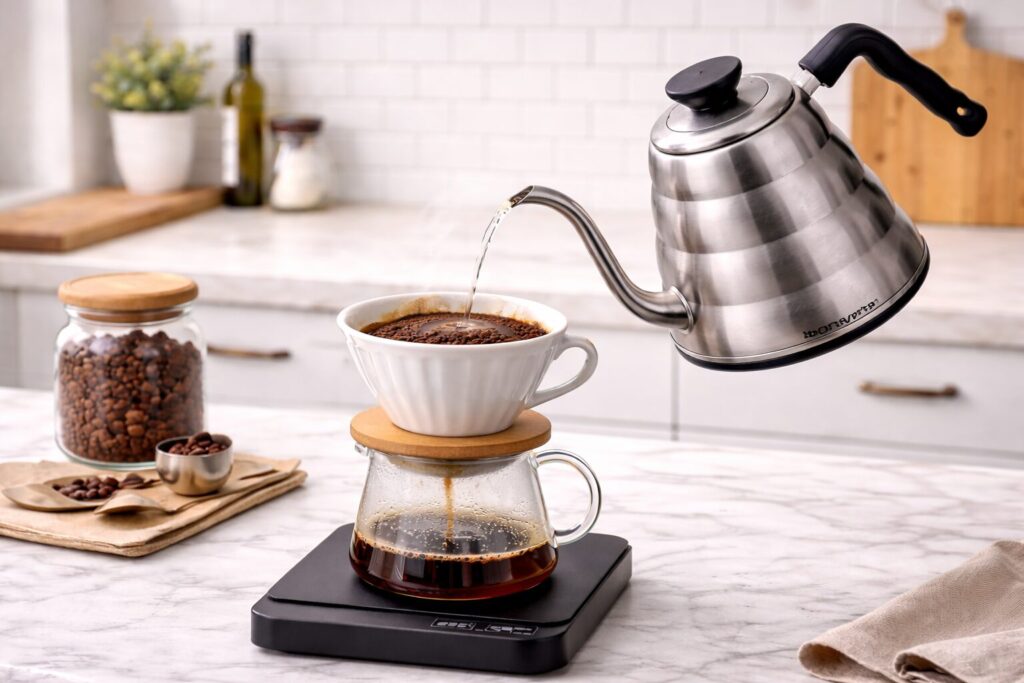
Best Stovetop / Manual: Hario V60 Buono Drip Kettle
The Hario V60 Buono is the stovetop gooseneck standard — used in specialty cafés and home bars worldwide, and the reference against which most stovetop competitors are measured. The spout geometry is the defining quality: it produces one of the most controllable pours available at any price, with a naturally slow flow rate at low tilt angles that makes the 45-second bloom pour genuinely easy even for new brewers. The 1.2L stainless steel body is durable and visually clean, and the handle stays cool during heating. There is no temperature control built in — you need a probe thermometer or an infrared thermometer to hit your target accurately — but the pour performance makes it the correct choice for brewers who prefer no electric appliance on the counter or who travel with their brewing kit. Note: the standard Buono is gas and electric hob compatible; the metal version (Buono Metal / IH) is required for induction.
- Type: Stovetop — gas, electric, and ceramic hob compatible (IH version for induction)
- Spout: The benchmark pour-over spout geometry — slow, precise, effortlessly controllable at low flow
- Capacity: 1.2L — largest standard stovetop option; sufficient for full Chemex brews
- Temperature control: None — requires separate probe thermometer (under $15) for precise targeting
- Best for: stovetop brewers, minimalists, travel setups, anyone who already owns a thermometer
Disclosure: CoffeeGearHub may earn from qualifying purchases.
Best Premium / Pro: Fellow Stagg EKG Pro
The Fellow Stagg EKG Pro is the professional-grade upgrade for brewers who want Bluetooth app control, storable temperature presets, and the tightest PID accuracy available in a consumer gooseneck kettle. The Bluetooth integration via the Fellow app allows you to set temperatures, name and save presets for different brew methods (V60 light roast at 95°C, Chemex medium at 93°C, AeroPress dark at 90°C), and monitor heating progress from across the room — a minor convenience that becomes genuinely useful when you’re grinding while the kettle heats. The PID controller holds ±0.5°C throughout the hold period with no temperature creep, and the 1.0L matte-stainless body has the same counterbalanced weighted handle as the standard EKG. The Pro is not a necessary upgrade from the standard EKG if you don’t use the app — the pour performance and temperature precision are identical. It is the right buy for brewers who want a complete connected home-brewing system where everything from grind to pour is tracked and repeatable.
- Temperature control: PID to ±0.5°C; Bluetooth app with named presets per brew method
- Hold mode: 60 minutes; can be extended via app
- Capacity: 1.0L — same as standard EKG
- App integration: Fellow app — temperature presets, brew timers, heating profiles
- Best for: serious home baristas, connected brew setups, anyone who wants named temperature presets per method
Disclosure: CoffeeGearHub may earn from qualifying purchases.
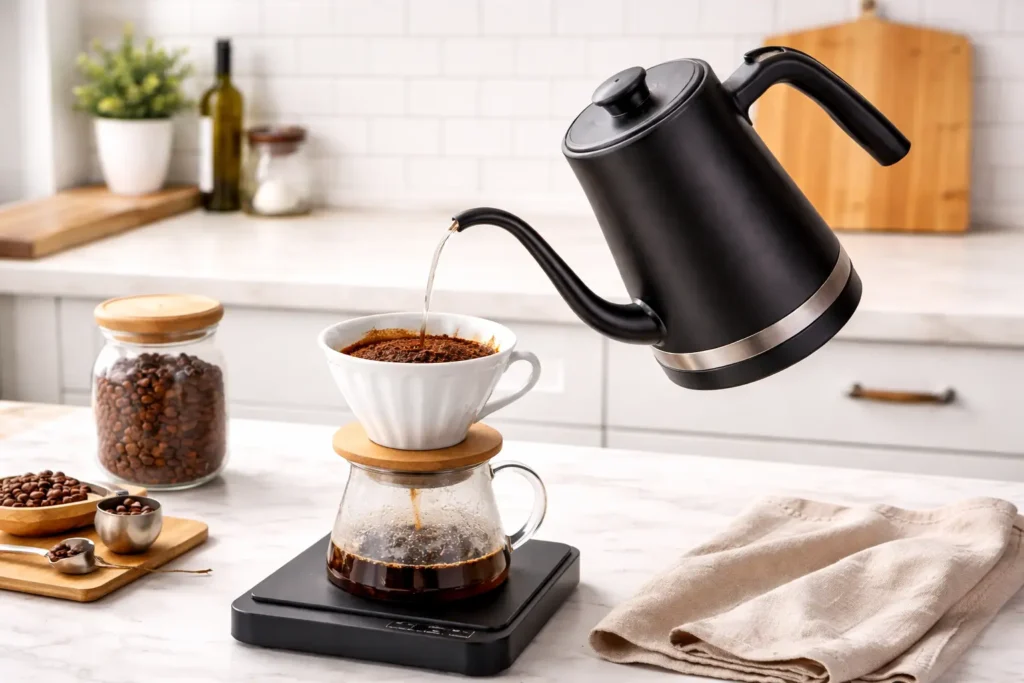
Electric vs Stovetop Gooseneck Kettle: Full Comparison
The choice between electric and stovetop is the most consequential decision in kettle selection — more so than brand, more so than price. Electric kettles deliver built-in temperature control and convenience; stovetop kettles deliver simplicity, portability, and a lower total price. Neither is universally superior. Here is the complete comparison across every variable that affects the daily brewing experience.
| Electric (Variable Temperature) | Stovetop (Manual) | |
|---|---|---|
| Temperature control | Built-in — set exact temperature in 1°C increments; holds at set temp for 30–60 min; no thermometer required | None built-in — requires a separate probe or infrared thermometer to hit target temperature accurately |
| Convenience | High — fill, set temperature, press start; kettle is ready when you are, regardless of the gap between heating and brewing | Moderate — requires hob monitoring, thermometer checking, and a brief off-heat rest to reach target below boiling |
| Pour control | Depends on the model — premium electric (Fellow Stagg EKG) matches or beats stovetop; budget electric often has inferior spout geometry | Generally excellent — Hario Buono’s spout geometry is the industry standard; no heating element to add base weight |
| Counter space | Requires permanent base unit — approximately 20cm × 15cm footprint | None — sits on hob when in use; stores in a cabinet |
| Portability | Limited — requires 240V outlet (or 120V in US); not suitable for camping or travel without power | Full — works on any heat source including camping stove, portable butane, and induction (model-dependent) |
| Heat-up time | Faster — electric element heats 1.0L in 3–5 minutes at 1500W; faster than most stovetop setups | Variable — depends on hob type and kettle size; gas is fast; electric hob is slower |
| Upfront cost | Higher — budget electric starts around $35–$50; quality electric (Fellow EKG) $90–$120 | Lower — Hario Buono from $30; no additional base or electrical component to replace |
| Longevity | Moderate — electric element and control board can fail; most electric kettles last 3–6 years with regular use | High — a quality stovetop kettle can last indefinitely with no electronics to degrade |
| Best for | Daily home pour-over, consistent morning routine, anyone who brews more than 3×/week | Minimalists, travellers, stovetop-only kitchens, secondary brewing kits |
Variable Temperature Control: What It Does and Why It Matters for Coffee
Variable temperature is the defining feature that separates a specialist pour-over kettle from a general-purpose one — and for serious home brewers, it is not a luxury. It is the most direct tool for correcting extraction problems without changing your grind or recipe. Here is what variable temperature control actually enables at each stage of the brew process.
| What variable temp enables | Why it matters in practice |
|---|---|
| Roast-matched temperature selection | Light roasts need 94–96°C to extract fully; dark roasts need 88–92°C to avoid harsh bitterness. The same temperature for all roasts produces systematically under- or over-extracted cups for anything outside the middle range. |
| Repeatable extraction from bean to bean | When you switch beans, you can nail the target temperature without measuring — the kettle holds it. This makes adapting your recipe to a new bag methodical rather than guesswork. |
| AeroPress and cold-bloom techniques | AeroPress inverted recipes often use 70–80°C for a fruit-forward cup; cold bloom pour-over starts at 93°C with a brief 15°C drop; none of this is possible without variable temp. |
| Hold mode for asynchronous brewing | The kettle reaches target temperature, then holds it for 30–60 minutes. If you’re grinding, weighing, or preheating your dripper during that window, the water is still at the right temperature when you’re ready — no reheating, no guessing. |
| Diagnosing and fixing extraction problems | If your pour-over tastes sour despite correct grind: raise temp 2°C. If it tastes bitter despite correct grind: lower temp 2°C. This diagnostic adjustment is only repeatable if you know and can control your exact water temperature. |
Gooseneck Kettle Size Guide: Which Capacity Is Right for You
Kettle capacity is a practical decision based on your typical brew volume, not a preference. The critical rule: always have enough water in the kettle to complete your full brew without refilling. Refilling mid-pour introduces a temperature drop (the new water is cooler), disrupts your pour rhythm, and is the most common cause of uneven extraction in otherwise well-executed brews. Choose your kettle size by working backwards from how much water your largest typical brew requires.
| Kettle size | Best for | Typical brew volume covered | Notes |
|---|---|---|---|
| 600ml | Single-cup V60 or AeroPress, solo brewers | Single V60 (up to 350ml brew water) + headspace | Lightest and easiest to manoeuvre; fills quickly; will run short on Chemex or two-cup brews |
| 800ml | One to two cups; V60 and Kalita Wave | Standard V60 (500ml) or double AeroPress | The sweet spot for most solo brewers; easy to control at 70% fill |
| 1.0L | Two cups; Chemex 3-cup; the most versatile size | Full Chemex 3-cup (700ml brew water) + preheat waste | The CoffeeGearHub standard recommendation — large enough for any single-serve method, manageable weight at full fill |
| 1.2L–1.5L | Chemex 6-cup, batch brewing, or sharing | Chemex 6-cup (1.0L+ brew water) with preheat allowance | Heavier at full fill — harder to control flow with a full 1.5L kettle; only buy this size if you regularly brew 4+ cups |
Flow Rate and Handle Design: The Most Underrated Performance Variable
Most kettle reviews lead with temperature precision and price. The variable that actually separates a great daily pour-over kettle from a frustrating one is flow rate control — specifically, how much effort it takes to maintain a thin, consistent stream during the 45-second bloom pour. This is determined by the interplay of three design variables that most buyers never read about.
✅ Good Flow Control Design
- Counterbalanced handle: weight distribution that lets the kettle rest at a shallow tilt angle without active effort — flow stays slow without fighting gravity
- Narrow spout tip: reduces maximum flow rate at any given tilt; makes achieving a thread-like drip easier
- High spout exit point: spout exits the body high up — creates a longer neck arc that smooths turbulence before the tip
- Ergonomic grip angle: handle angled so a natural wrist position corresponds to a slow pour, not a fast one
❌ Poor Flow Control Design
- Heavy base (electric element): base-heavy kettles require significant tilt before any water flows — once it starts, flow is already too fast to stop without lifting the kettle entirely
- Wide spout tip: too much water exits per degree of tilt; fine bloom control becomes impossible without constant micro-adjustments
- Low spout exit point: short neck arc produces turbulent, pulsing flow at low tilt; stream breaks up rather than flowing smoothly
- Upward-angled spout exit: natural pour direction becomes a high arc that splashes rather than a targeted trickle
Extraction Science: Why Water Temperature Directly Affects Your Cup
Water temperature is not just a recipe parameter — it is a direct dial on extraction rate. Understanding the mechanism explains why a variable temperature kettle improves coffee quality in a way that no other single piece of equipment can replicate, and why hitting the right temperature for your roast level matters as much as grind size.
- Temperature controls how fast compounds dissolve. Coffee solubility is temperature-dependent: higher water temperature accelerates the dissolution of all extractable compounds — both the desirable ones (acids, sugars, aromatics) and the undesirable ones (bitter phenolics, harsh tannins). Brewing at 96°C extracts bitter compounds significantly faster than brewing at 93°C with the same grind, ratio, and pour time. For light roasts — which are denser and less soluble — the higher temperature is necessary to reach adequate extraction yield. For dark roasts — which are already highly soluble — the same temperature over-extracts the bitter compounds that light roasting has not yet fully developed. Temperature is the primary adjustment lever for roast-specific extraction optimisation.
- Temperature affects the bloom phase disproportionately. The 30–45 second bloom — where you saturate the coffee bed with approximately 2× the coffee weight in water — is the most temperature-sensitive phase of pour-over brewing. During bloom, CO₂ trapped in the grounds is released, expanding the bed and preparing the grounds for even extraction. Higher temperature (94–96°C) accelerates degassing; lower temperature (88–90°C) slows it. A kettle that drops from 95°C to 88°C between filling and the start of bloom — a common outcome with uninsulated electric or stovetop kettles without hold mode — undermines bloom quality before the brew has even started. This is the practical case for hold mode: not convenience, but temperature stability through the full pour cycle.
- Pour-over amplifies temperature variation more than other methods. In French press or AeroPress, temperature variation is partially buffered by the large volume of water and the closed brew environment. In pour-over, the thin, open bed loses heat rapidly — the filter, the dripper, and the air all act as heat sinks. A 2°C temperature drop at the spout can translate to a 4–5°C drop at the coffee bed by the time the last pour completes. This is why pour-over brewers specifically benefit from a variable temperature kettle that holds its target temperature for the full pour duration — not just until the first pour begins.
🔬 Preheat everything: The kettle is not the only heat sink. Your dripper (V60, Chemex, or Kalita Wave) and your server or mug absorb heat from the first pour immediately. Always preheat your dripper and serving vessel with a rinse of hot water before you begin the brew. A ceramic V60 rinsed with just-off-boil water can be 15–20°C warmer than a cold one — that difference affects the first 30 seconds of bloom disproportionately. Preheat water from your kettle before adding grounds, then discard it, then brew. This is a zero-cost variable that most brewers skip.
Temperature Guide: Target Temps by Brew Method and Roast Level
Use this table as your starting reference for temperature selection. Adjust 1–2°C at a time based on taste — sour or underdeveloped suggests raising temperature; harsh or bitter suggests lowering it. All temperatures are at the kettle spout; allow for 1–2°C heat loss during the pour and at the coffee bed. Grind settings reference the KINGrinder K6 from zero (burrs touching).
| Brew method | Roast | Target temp (kettle) | K6 grind setting | Flavour target | Temp adjustment signal |
|---|---|---|---|---|---|
| V60 / Kalita Wave | Light | 94–96°C | 28–34 clicks | Bright, fruit-forward, high clarity — maximum origin expression | Sour / thin → raise 1–2°C; Bitter → lower 1–2°C |
| V60 / Kalita Wave | Medium | 92–94°C | 26–32 clicks | Balanced caramel, stone fruit, round body | Standard starting point for most specialty pour-over |
| V60 / Kalita Wave | Dark | 88–92°C | 24–30 clicks | Bittersweet chocolate, low acidity, heavy body | Bitter → drop to 88°C; Flat → raise to 92°C |
| Chemex | Light–Medium | 93–95°C | 32–38 clicks | Clean, crisp, wine-like — Chemex filter removes more oils than V60 | Chemex paper is thicker — grind slightly coarser vs V60 at same roast |
| AeroPress (standard) | Medium–Dark | 88–93°C | 18–26 clicks | Full body, low acidity, espresso-adjacent at 1:6 ratio | See AeroPress temperature guide for full recipe matrix |
| AeroPress (light roast / fruit-forward) | Light | 78–85°C | 22–28 clicks | Delicate, fruit-led, tea-like — low temp preserves volatile aromatics | Under-developed → raise 3°C; Astringent → lower 3°C |
| French Press | Medium–Dark | 92–94°C | 68–78 clicks | Full body, oil-rich, bold — immersion method is less temperature-sensitive than pour-over | See full French press temperature guide |
| Cold Bloom Pour-Over | Light–Medium | 95°C bloom / 85°C main | 28–34 clicks | Vibrant, complex — bloom at high temp for degassing, main pour at lower temp for clarity | Requires variable temp kettle; switch temp between bloom and main pour |
🔬 K6 pour-over grind note: All click settings measured from zero (burrs touching). Pour-over settings sit in the medium-fine to medium range on the K6 (clicks 22–38 depending on method and roast) — significantly finer than French press settings (clicks 60–85). At these settings, a 20g dose grinds in under 45 seconds. The K6 produces low fines at pour-over settings, which is particularly important for V60 and Chemex: excessive fines at medium settings clog the filter and cause stalling — a slower-than-expected draw-down that continues to extract as the water sits in the bed. If your V60 stalls consistently, grind 2–3 clicks coarser before adjusting temperature.
Best Grinder for Pour-Over: KINGrinder K6
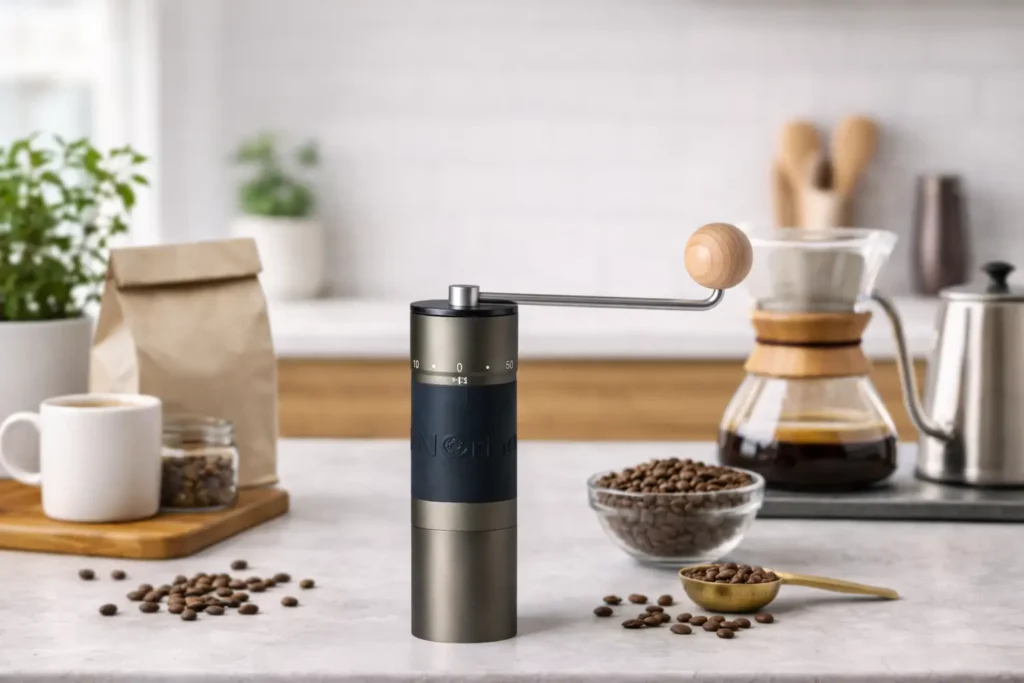
KINGrinder K6 — The Standard CoffeeGearHub Pour-Over Grinder
A precise, consistent burr grinder is the prerequisite for the kettle’s temperature work to matter. Even a perfect 93°C pour through a Fellow Stagg EKG produces mediocre results if the grind is uneven — particle size distribution determines extraction rate more than temperature at the medium-fine settings pour-over requires. The KINGrinder K6 is the CoffeeGearHub standard manual grinder recommendation across all brewing content, and for pour-over specifically, its 100-click adjustment system is ideally suited to the fine-resolution dial-in that V60 and Chemex recipes require. The 48mm stainless conical burrs produce low fines at the 24–38 click range used for most pour-over, which is critical for avoiding filter stalling and achieving clean, predictable draw-down. A 5-click adjustment at pour-over settings produces a readable extraction shift — enough to move from sour to balanced in one brew, which makes the K6 one of the best dial-in tools available at its price.
- 100-click adjustment: 5-click steps at pour-over settings produce clean, measurable extraction changes — ideal for V60 dial-in
- 48mm stainless conical burrs: low fines at medium-fine settings — reduces filter stalling on V60 and Chemex
- Pour-over starting point: V60 medium roast: 26–32 clicks; Chemex medium roast: 32–38 clicks; see full temperature table above for all methods
- All-metal body: durable for daily 18–22g pour-over doses; no plastic components in the grinding path
Disclosure: CoffeeGearHub may earn from qualifying purchases.
For a full comparison of grinder types and how they affect pour-over quality, see our companion guides: Burr vs Blade Grinders and Manual vs Electric Coffee Grinders.
Troubleshooting Matrix: Gooseneck Kettle Symptoms → Causes → Fixes
Identify your symptom below. Most pour-over problems that seem to be kettle or temperature issues are actually grind problems — but this matrix covers both, plus mechanical issues specific to gooseneck kettles. Confirm the cause before replacing equipment.
| Symptom | Most likely cause | Fix (in order) |
|---|---|---|
| Sour / underdeveloped pour-over despite correct steep time | Water temperature too low; grind too coarse; light roast at medium temperature | Raise kettle temperature 2°C → if still sour, grind 3 clicks finer → for light roasts, target 95–96°C not 93°C |
| Bitter / harsh pour-over at correct grind | Water temperature too high; grind too fine; dark roast at standard temp | Lower kettle temperature 2°C → check for over-fine grind → for dark roasts target 88–91°C not 93°C |
| V60 or Chemex draw-down stalls mid-brew | Grind too fine; fines clogging the paper filter; pouring too aggressively during bloom | Grind 3 clicks coarser → pour bloom more gently (aim for 2g/s max) → check filter is seated flat with no folds |
| Cup is flat and lacks aroma despite correct temperature | Stale beans — CO₂ depleted; degassing complete; aromatic volatiles lost | Buy fresher beans (roast date visible on bag, under 3 weeks old ideally); no temperature fix for stale coffee |
| Inconsistent cups from same bean and recipe | Kettle temperature dropping between pours (no hold mode / heat loss); or variable pour speed | Use hold mode on electric kettle; preheat dripper thoroughly; practise pour speed with a scale and stopwatch |
| Kettle overshoots target temperature on electric model | PID overshoot common on budget electric kettles; heating element doesn’t cut off precisely | Set target 2°C below desired brew temperature and let it stabilise during hold mode; or upgrade to PID-controlled model (Fellow EKG) |
| Pour streams inconsistently — surges or drips unevenly | Air bubble in spout neck; fill level too low (air entering the spout); or kettle overfilled | Fill kettle to 60–80% of capacity for optimal pour control; tilt slowly and smoothly rather than jerking; start pour before the spout fully inverts |
| Scale build-up causing reduced heating efficiency or off-taste | Hard water mineral deposits on heating element or interior walls | Descale with 50/50 white vinegar and water: fill, heat to boil, soak 30 minutes, discard, rinse twice; repeat monthly in hard-water areas |
| Electric kettle turns off before reaching target temperature | Safety auto-shutoff triggered by steam sensor; or base contact issue | Ensure kettle is seated fully on base; clean base contacts with dry cloth; check that the lid is fully closed (steam sensor triggers on steam escape) |
| Good first cup, noticeably worse second cup from same session | Kettle temperature has dropped in hold mode (some budget models lose 3–5°C over time); or dripper cooled between pours | Check hold temperature on display before second pour; reheat to target if needed; preheat dripper again between consecutive brews |
Cleaning and Descaling: Keeping Your Gooseneck Kettle Performing
A gooseneck kettle’s interior is exposed to mineral-rich tap water at high temperature in every use — scale accumulates faster than most users expect. Mineral scale insulates the heating element, reduces efficiency, can break off in fragments that end up in your cup, and introduces a metallic off-taste. A clean kettle tastes completely neutral; a scaled kettle does not. The cleaning routine is simple and takes under 5 minutes when performed regularly.
After Every Use
- Empty the kettle completely — do not leave water sitting in it between sessions
- Leave the lid open to allow the interior to air-dry fully
- Wipe the exterior with a dry cloth to prevent water spots on stainless finishes
- Electric base: wipe connector contacts with a dry cloth only — never wet
Monthly (or Sooner in Hard-Water Areas)
- Fill kettle 50/50 with white vinegar and water; heat to boil; soak for 20–30 minutes; discard
- Rinse twice with fresh water; heat a full kettle of plain water to boil and discard before next brew
- Clean the spout interior with a thin bottle brush — scale accumulates in the narrow neck section
- Alternative to vinegar: citric acid solution (1 tsp per 500ml water) — dissolves scale effectively with less residual odour
⚠️ Filtered water note: Using filtered or soft water significantly reduces scale build-up and extends descaling intervals. Brita or other carbon-filter jugs reduce chlorine and mineral content enough to meaningfully slow scale accumulation — and filtered water produces noticeably cleaner-tasting pour-over coffee by removing chloramine compounds that interfere with coffee aroma. The investment in a filter jug pays off faster in scale prevention and cup quality combined than in either benefit alone.
Gooseneck Kettle Buying Checklist
Use this checklist before purchasing any gooseneck kettle — it covers the questions that most buyers don’t ask until after they’ve bought the wrong one.
| Question | What to look for | Red flag |
|---|---|---|
| Electric or stovetop? | Electric if you brew 3×/week or more and want temperature repeatability; stovetop if you prefer minimal appliances or travel with your kit | Stovetop with no thermometer in the house — you cannot hit consistent temperatures by guessing |
| Does it have variable temperature or just presets? | Variable (1°C increments) is strongly preferred; preset models limit your ability to fine-tune for roast level | Electric kettle with only boil + keep-warm; no temperature selection |
| Is the spout geometry actually pour-over grade? | Long neck, narrow tip, downward-angled exit — check for community reviews mentioning pour control specifically | Short, stubby gooseneck that can’t produce a thin stream below 5g/s |
| What capacity do I need? | Match to your brew method: 800ml for single-cup V60; 1.0L for Chemex or two-cup; 1.2L+ for batch | Buying minimum capacity — running out of water mid-pour disrupts the entire brew |
| Is the handle balance appropriate? | Counterbalanced or ergonomic handle angle — test in-store or look for reviews mentioning pour control ergonomics | Handle set too far back or too high, requiring significant tilt before water flows |
| Are there plastic components in the water path? | All-stainless interior preferred; stainless lid or glass lid — avoid exposed plastic interior lid surfaces | Plastic interior lid that drips condensation back into the water; visible plastic lining |
| Do I have a burr grinder to pair with it? | A consistent burr grinder (K6 or equivalent) is required for the kettle’s temperature precision to translate to cup quality | Planning to use pre-ground or blade-ground coffee — temperature precision cannot compensate for inconsistent grind |
Final Takeaway
The best gooseneck kettle is the one that removes temperature and pour control as variables from your morning routine — not the most expensive, not the most feature-rich, and not the one with the most impressive spec sheet. For most home pour-over brewers, the Fellow Stagg EKG is the correct answer: variable temperature precision, a counterbalanced handle that makes pour control genuinely effortless, and 60-minute hold mode that keeps your setup ready regardless of how your morning unfolds. For budget-conscious brewers, the Bonavita 1.0L Variable Temperature Kettle delivers reliable temperature control at a price that makes the upgrade from a standard kettle an easy decision. For stovetop minimalists, the Hario V60 Buono remains the community standard for good reason — the spout geometry is among the best available at any price. Pair any of these with a KINGrinder K6 at the correct click setting for your roast and brew method, use freshly roasted whole beans, and a well-executed pour is no longer a skill challenge — it is a repeatable process.
FAQs: Best Gooseneck Kettles
What is the best gooseneck kettle for pour-over coffee?
The Fellow Stagg EKG is the best gooseneck kettle for most pour-over brewers — precise variable temperature control (40–100°C), exceptional flow rate from a weighted handle, and a counterbalanced spout that makes controlling a slow, steady pour genuinely easy. For budget-conscious brewers, the Bonavita 1.0L Variable Temperature Kettle delivers reliable temperature precision at a significantly lower price. For stovetop users who don’t want an electric appliance, the Hario V60 Buono is the standard recommendation.
Do I really need a gooseneck kettle for pour-over?
Yes — for pour-over methods (V60, Chemex, Kalita Wave), a gooseneck kettle is not optional. The narrow, curved spout is the only practical way to control the thin, slow, precise stream of water that even saturation requires. A standard kettle’s wide spout pours too fast and too imprecisely to achieve the uniform bloom and spiral pour that defines pour-over extraction. For methods like French press or AeroPress, a gooseneck kettle is not required but still improves temperature repeatability.
What temperature should I use for pour-over coffee?
For most medium roast pour-over: 93–94°C. Light roasts: 94–96°C (higher temperature to extract more evenly from denser, less soluble beans). Medium-dark roasts: 91–93°C. Dark roasts: 88–92°C. Never brew above 96°C — water that close to boiling extracts bitter compounds too aggressively. Never brew below 85°C — under-temperature produces sour, flat, under-extracted cups. A variable temperature kettle removes the guesswork from this entirely.
What is the difference between electric and stovetop gooseneck kettles?
Electric gooseneck kettles heat the water internally, often with variable temperature control and a hold function that maintains your set temperature for 30–60 minutes. Stovetop gooseneck kettles are heated on a hob and require a separate thermometer to hit your target temperature accurately. Electric kettles are more convenient and more precise; stovetop kettles are less expensive upfront and require no counter space or outlet. For serious pour-over brewing, the variable temperature hold function on electric kettles is a meaningful advantage.
How important is flow rate control in a gooseneck kettle?
Flow rate is the primary functional difference between gooseneck kettles — not just the spout shape. A well-engineered gooseneck kettle allows you to tilt the handle at different angles to produce a threadlike 2–4g/s trickle for bloom saturation or a controlled 6–8g/s stream for the main pour. The kettle’s balance point (handle weight distribution vs spout weight) determines how effortlessly you can modulate flow. The Fellow Stagg EKG’s counterbalanced weighted handle makes flow control noticeably easier than most competitors.
What size gooseneck kettle should I buy?
For single-cup pour-over (V60, Kalita Wave): 600ml–800ml is sufficient and easier to manoeuvre. For larger brewers (Chemex, Hario Switch) or anyone who brews multiple cups: 1.0–1.2L. For carafes or batch brewing: 1.2–1.5L. Important: do not fill a gooseneck kettle more than 80% of capacity — an overfull kettle is harder to control and increases spill risk during pouring. A 1.0L kettle filled to 800ml is the most practical all-round choice.
Can I use a gooseneck kettle on an induction hob?
Only if the kettle is specifically induction-compatible — not all stovetop gooseneck kettles are. Induction hobs require ferromagnetic base material (18/10 stainless or a clad induction base). The Hario V60 Buono Metal is induction-compatible. The classic Hario Buono in its original form is not. Always check the manufacturer’s compatibility listing before purchasing a stovetop kettle if you use induction. All electric gooseneck kettles are powered independently and are not affected by hob type.
Does kettle material affect coffee taste?
With quality kettles, no — stainless steel interiors are flavour-neutral when clean. The only material concern is plastic components in contact with hot water. Avoid kettles with exposed plastic interiors or lids that drip condensation back in from plastic surfaces. All-stainless or stainless-with-glass-lid kettles are the safest choice. The Fellow Stagg EKG uses a fully stainless interior with no plastic in the water path. Any off-taste from a new stainless kettle disappears after 2–3 rinse cycles.
What is a temperature hold function and do I need it?
A temperature hold function keeps the water at your set temperature for a defined period (typically 30–60 minutes) after reaching target temp. For brewers who preheat, grind, and then brew with a brief gap between steps, hold mode prevents needing to reheat or adjust temperature between sessions. For the Fellow Stagg EKG, hold mode lasts 60 minutes. It is a meaningful quality-of-life upgrade for anyone who brews on a variable morning schedule where the kettle is ready before the brewer is.
How do you clean a gooseneck kettle?
Rinse with warm water after every use and leave the lid off to air-dry — water left sitting in a sealed kettle develops mineral scale and off-odours. Descale every 4–8 weeks (more frequently in hard-water areas) by filling the kettle with a 1:1 mixture of white vinegar and water, heating to boil, leaving to soak for 20–30 minutes, then discarding and rinsing thoroughly twice. Electric kettle bases should be wiped clean with a damp cloth only — never submerged. The spout interior can be cleaned with a thin bottle brush.
Continue Learning
POUR-OVER CLUSTER
Now that you have the right kettle, which pour-over dripper should you use? Our companion guide covers the V60, Chemex, and Kalita Wave side-by-side — with full K6 grind settings, brew ratios, and a clear recommendation for each skill level.
☕
Written by the CoffeeGearHub Editorial Team
CoffeeGearHub is a specialty coffee equipment resource run by home brewers and coffee enthusiasts. Our guides are researched using published brewing science, SCA standards, grinder manufacturer specifications, and established specialty-coffee community knowledge. We review and update our pillar content regularly. About CoffeeGearHub →