
Last Updated: March 2026 • 45–55 min read • Cornerstone Guide: Home Espresso Setup + Dial-In System + Equipment Picks + Milk Steaming
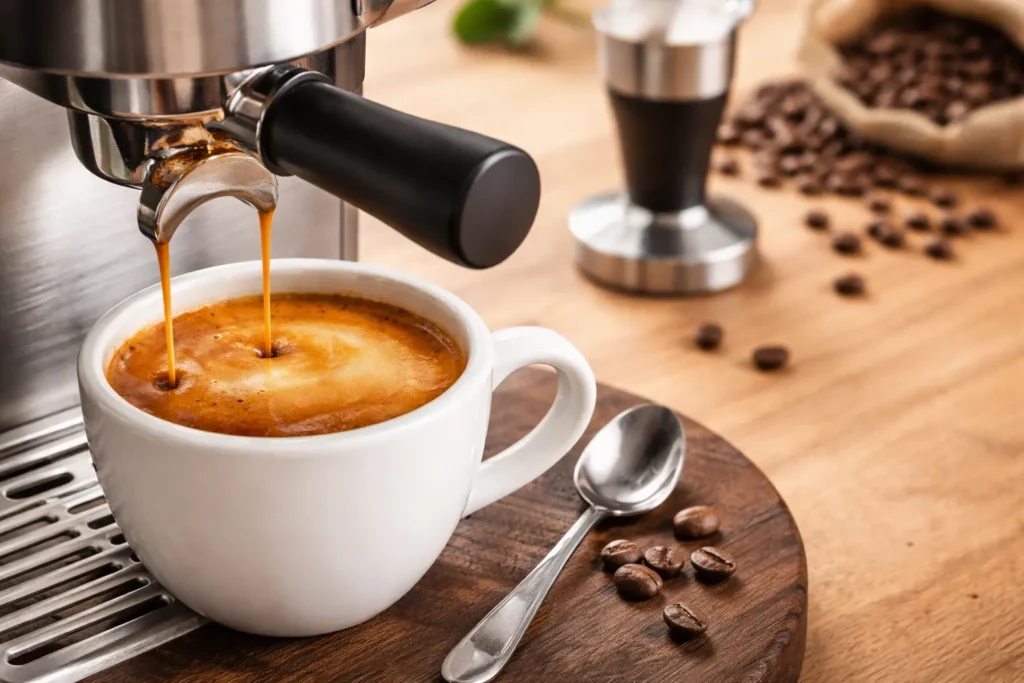
This espresso brew guide covers everything you need to pull consistently excellent shots at home — from machine selection and grinder setup to dose, yield, extraction time, and the step-by-step dial-in system that turns frustrating, inconsistent shots into a repeatable recipe. Espresso is the most technically demanding method in home coffee: nine bars of pressure, a grind calibrated to the second, a dose and yield weighed to the gram, and a machine at full operating temperature before the first shot is pulled. When every variable is correct, home espresso is extraordinary — concentrated, complex, and the foundation for every milk-based drink in specialty coffee. When one variable is wrong, no amount of adjustment to the others will fix it. This complete CoffeeGearHub espresso brew guide explains exactly what to do, in what order, at any budget.
✍️ Editorial note: This guide is researched and written by the editors at CoffeeGearHub.com using manufacturer specifications, published brewing science, recognized specialty-coffee standards, and established community knowledge. Product links are affiliate links — we may earn a commission at no cost to you. Affiliate Disclosure: CoffeeGearHub.com participates in the Amazon Services LLC Associates Program. As an Amazon Associate, we earn from qualifying purchases.
🛒 New to Amazon? Try Prime free for fast, free shipping on every pick in this guide — or try Audible free if you’d rather listen while your coffee brews.
The 30-Second Answer
Great home espresso comes down to four things: a machine that reaches stable brew temperature, a burr grinder that can hit espresso-fine settings consistently, an 18g dose pulled to 36g yield in 25–30 seconds, and a willingness to adjust grind one click at a time until the shot tastes balanced. The machine and grinder are the foundation — no technique fixes bad equipment, and no expensive machine compensates for a blade grinder. Once the equipment is right, the dial-in system in this guide will get you to a balanced, repeatable espresso in three to five pulls. From there, milk steaming, recipe variation, and single-origin exploration are all available to you. Start with an 18g dose and a 1:2 ratio. Taste everything. Adjust grind first — always grind first.
- Best Beginner Machine: Breville Bambino Plus — compact, fast heat-up, auto milk steaming, pressure profiling-ready
- Best All-in-One: Breville Barista Express — built-in conical burr grinder, full semi-auto control, no separate grinder needed
- Best Budget Machine: De’Longhi Dedica Arte — slim 15cm width, excellent entry price, pressurised and non-pressurised basket options
- Best Manual Grinder for Espresso: KINGrinder K6 — 100-click adjustment, 10–22 click espresso range, all-metal build
- Essential Accessory: Digital kitchen scale (0.1g precision) — non-negotiable for consistent espresso
Who This Guide Is For — Jump to What You Need
☕ Complete Beginner
Start with Espresso Fundamentals, then jump to Equipment Picks and the Step-by-Step Brew Guide.
🔧 Troubleshooter
Jump straight to the Troubleshooting Matrix — sour, bitter, channelling, no crema, and weak shot fixes all there.
🥛 Milk Drinks
See Milk Steaming + Latte Art for frothing technique, temperature targets, and drink recipes.
🔬 Extraction Nerd
Read Extraction Science and Variables Reference Table for the full technical picture.
Table of Contents
- Espresso fundamentals: what the method actually is
- Variables master reference table
- Equipment overview: what you need and why
- Top equipment picks by category and budget
- Step-by-step espresso brew guide
- Dial-in guide: the 5-shot system
- Grind settings: K6 espresso reference
- Extraction science: pressure brewing explained
Espresso Brew Guide Fundamentals: What the Method Actually Is
Espresso is not a bean, a roast level, or a flavour profile — it is a brew method defined by pressure. Specifically, espresso is coffee brewed by forcing hot water at approximately 9 bars of pressure through a compact bed of finely ground coffee in 25–30 seconds, producing a concentrated, emulsified beverage with a characteristic layer of crema on top. Every other coffee method uses gravity, immersion, or negative pressure (vacuum siphon); only espresso uses positive pump pressure as the driving extraction force. That pressure is what makes espresso both uniquely complex — the emulsification of oils into the crema produces flavour compounds no other method generates — and uniquely unforgiving. Pressure amplifies every flaw in the grind, distribution, and tamp. A one-click error in grind setting that barely registers in a French press changes an espresso extraction time by 3–5 seconds and the flavour dramatically.
Understanding what espresso actually is — a pressure-driven emulsification, not just “strong coffee” — is the foundation for understanding why every variable in the brew process matters. The six variables that determine espresso quality are: grind size, dose weight, yield weight, extraction time, water temperature, and distribution and tamping consistency. Grind is the primary dial-in tool. Everything else follows from it.
| Variable | What it controls | Target (standard double) | Primary dial-in order |
|---|---|---|---|
| Grind size | Extraction rate — finer = more resistance = slower flow = more extraction | Fine enough for 25–30s extraction at 1:2 ratio | 1st — always adjust grind before anything else |
| Dose (coffee in) | Bed depth and density in the basket — affects resistance and flavour intensity | 18g (double) / 7–9g (single) | 2nd — once grind is dialled, adjust dose ±0.5g |
| Yield (espresso out) | Concentration and balance — more yield = more dilute, less intense | 36g (1:2 ratio double) | 3rd — change yield to adjust concentration |
| Extraction time | Diagnostic indicator of grind correctness — not an independent variable | 25–30 seconds from pump start | Outcome — read time, taste to confirm |
| Water temperature | Extraction efficiency — higher temp = more extraction of all compounds | 90–96°C at group head (93°C default) | 4th — adjust for roast level if machine allows |
| Distribution / tamp | Evenness of extraction across the puck — prevents channelling | Level tamp, even distribution, no gaps | Consistency — improve technique, not a dial |
⚠️ The most important rule in espresso: Change one variable per session. Every pull. Always. Changing grind and dose simultaneously makes it impossible to know which change improved or worsened the shot. Experienced home baristas follow this discipline rigorously. It feels slow at first; it produces a correctly dialled shot in 3–5 pulls rather than 15–20.
Espresso Variables: Master Reference Table
Use this table as a quick reference for standard parameters across roast levels and espresso styles. All parameters assume a 58mm portafilter, standard 9-bar pump pressure, and a double basket. Adjust from these baselines one variable at a time.
| Espresso style | Dose | Yield | Ratio | Time | Temp | K6 clicks | Flavour profile |
|---|---|---|---|---|---|---|---|
| Standard double ☕ | 18g | 36g | 1:2 | 25–30s | 93°C | 14–18 | Balanced — sweetness, acidity, bitterness in harmony |
| Ristretto (restricted) | 18g | 27g | 1:1.5 | 20–25s | 93°C | 12–16 | Intense, syrupy, sweet — less bitter; ideal for milk drinks |
| Lungo (long) | 18g | 54g | 1:3 | 35–45s | 91°C | 16–20 | Less concentrated, more tea-like, higher bitter risk |
| Light roast espresso | 18g | 36–40g | 1:2 to 1:2.2 | 28–35s | 94–96°C | 10–16 | Fruit-forward, bright, complex — longer time needed for dense beans |
| Dark roast espresso | 18g | 34–36g | 1:1.9 to 1:2 | 22–27s | 90–92°C | 16–22 | Bittersweet, chocolatey, heavy — short time prevents ash notes |
| Single shot (small basket) | 7–9g | 14–18g | 1:2 | 25–30s | 93°C | 14–18 | Identical ratio target — just smaller volume |
🔬 K6 click reference: KINGrinder K6 espresso settings (10–22 clicks from zero) are at the finest end of the grinder’s range. At these settings, the K6 requires significantly more effort to grind than at French press settings — a 18g espresso dose takes 3–5 minutes of manual grinding. Grind time is not a problem; the challenge with the K6 at espresso range is burr alignment and grind uniformity, which affects shot consistency. The K6 is a capable entry-level espresso grinder. For serious daily espresso, a dedicated electric espresso grinder — see our Best Espresso Grinders guide — provides faster, more consistent results. All K6 click values in this guide are measured from zero (burrs touching).
Equipment Overview: What You Need and Why
Espresso demands more equipment than any other home brew method — but the investment is well-defined. There are four essential items and several useful accessories. Understanding what each one does (and which can be compromised without sacrificing quality) helps you build a setup matched to your budget and goals, rather than spending money on the wrong things first.
| Equipment | Why it matters | Can you compromise? | Minimum spec |
|---|---|---|---|
| Espresso machine | Provides 9 bar pump pressure, stable brew temperature, and steam for milk | Partially — budget machines with pressurised baskets are valid starting points | 15-bar pump; thermoblock or boiler; portafilter with non-pressurised basket option |
| Burr grinder | Consistent fine grind is non-negotiable — blade grinders make espresso impossible | No — this is the most critical piece after the machine | Conical or flat burr with espresso-fine capability; stepless or fine-stepped adjustment |
| Digital scale (0.1g) | Weighing dose (in) and yield (out) is the foundation of reproducible espresso | No — this is the cheapest and most impactful accessory | 0.1g precision; fast response; fits under portafilter |
| Tamper | Compresses the coffee bed for even water distribution and consistent resistance | Partially — a calibrated tamper (30lb click) improves consistency | Correctly sized for your basket (58mm for most home machines) |
| Distribution tool / WDT | Levels and loosens the ground coffee before tamping to prevent channelling | Yes — finger levelling works; WDT noticeably improves consistency | Any fine-needle WDT tool or dedicated distributor |
| Shot glass / spouted pitcher | Allows you to see the shot flow and check colour for extraction diagnosis | Yes — any heat-safe container works for shot catching | Any clear shot glass; a small pitcher for yield weighing under the portafilter |
Best Home Espresso Equipment: Our Top Picks
These picks represent the best home espresso equipment across every budget and use case — from the most approachable entry-level semi-automatic to the all-in-one machine-plus-grinder combo that eliminates the biggest single friction point for new espresso enthusiasts. All affiliate links are to Amazon; verify ASINs and apply your Associates tag before publishing as noted in the yellow callout under the gear section.
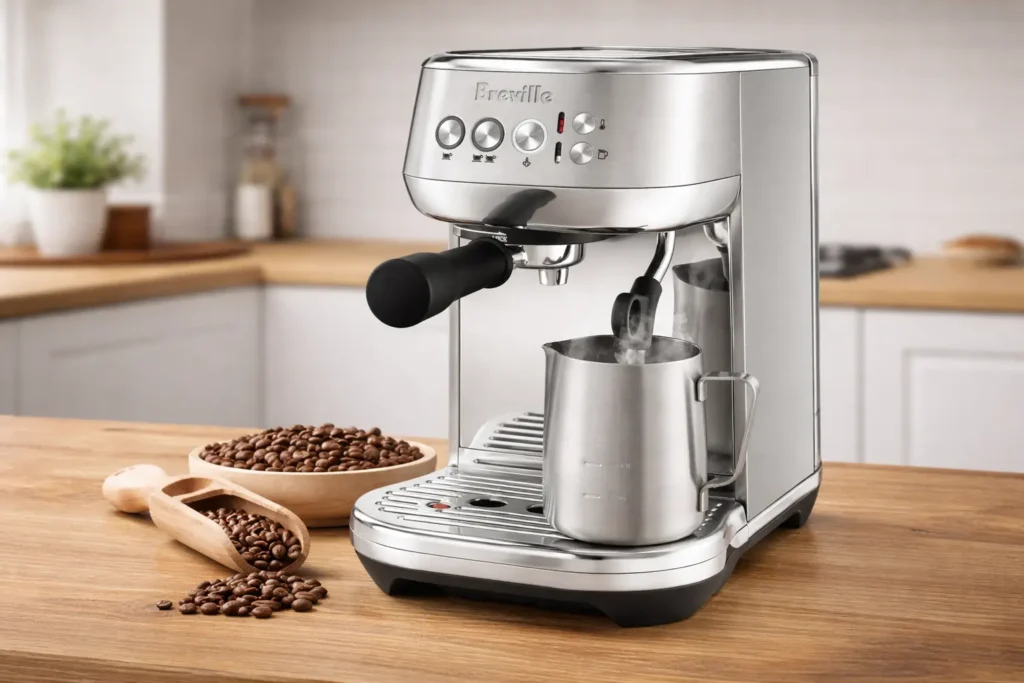
Best Beginner Machine: Breville Bambino Plus
The Breville Bambino Plus is the most thoughtfully designed entry-level semi-automatic espresso machine available — and the right recommendation for almost every home espresso beginner. Its thermojet heating system reaches operating temperature in three seconds (not the 20 minutes most machines require), the auto-steam wand delivers hands-free microfoam at a set temperature, and the 54mm portafilter uses a non-pressurised basket that lets you taste and correct actual extraction rather than having the pressurised filter paper over your grind deficiencies. The digital temperature control (adjustable in 2°C steps: 88/90/92/94/96°C) lets you match brew temperature to roast level — a feature many machines costing significantly more don’t offer. For anyone who wants to learn genuine espresso craft without a 15-minute warm-up ritual, the Bambino Plus is the machine to start with.
- Portafilter: 54mm — note: requires 54mm tamper and accessories, not the 58mm standard
- Boiler: Thermojet — 3-second heat-up; consistent brew temp; no 20-minute warm-up
- Steam: Auto-steam wand with temperature sensor — hands-free microfoam for lattes and cappuccinos
- Temperature control: 5 settings (88–96°C) — match temp to roast level
- Best for: beginners, small kitchens, daily latte/cappuccino drinkers, those upgrading from pod machines
Disclosure: CoffeeGearHub may earn from qualifying purchases.
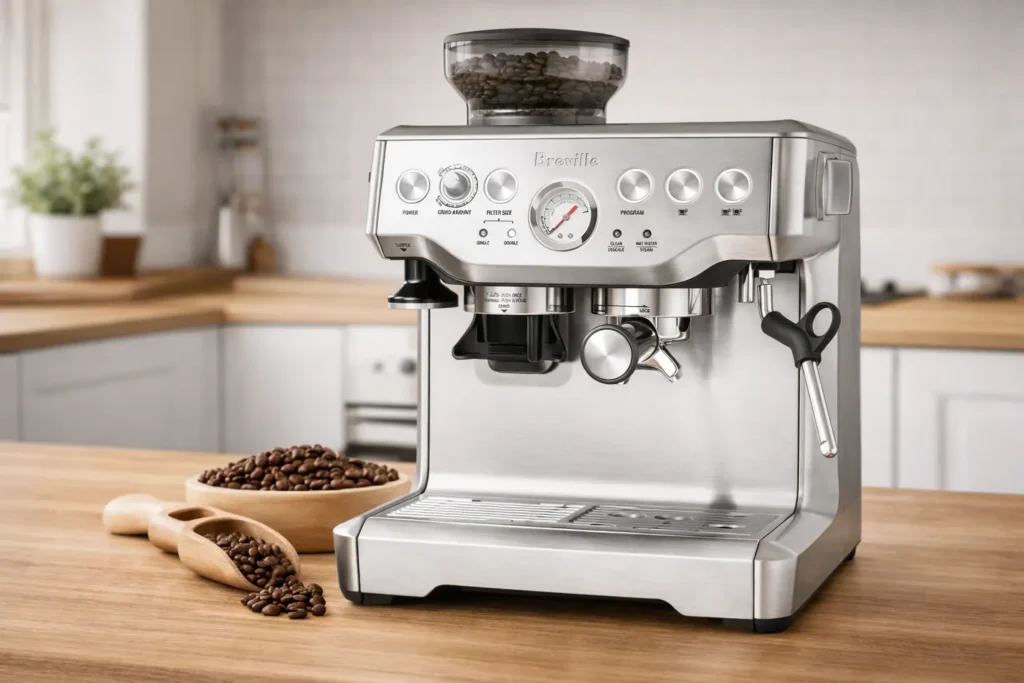
Best All-in-One: Breville Barista Express
The Breville Barista Express solves the most common friction point in home espresso: the separate grinder. Its built-in conical burr grinder — adjustable through 16 grind settings with a stepped collar — is calibrated specifically for the machine’s 58mm portafilter and 9-bar pump, which means the grind-to-shot relationship is tighter than it would be with any external grinder setup. The Barista Express includes a full 58mm portafilter with single and double non-pressurised baskets, a manual steam wand, and a PID-controlled thermocoil boiler that produces stable brew temperatures without a 20-minute warm-up. The result is a machine that genuinely consolidates two of the four essential espresso purchases into one. The grind adjustment is stepped rather than stepless, which limits fine-tuning precision versus a dedicated grinder — but for anyone who wants everything in one box and excellent daily espresso, the Barista Express is the most complete home espresso solution at its price point.
- Portafilter: 58mm — standard size; wider accessory and upgrade ecosystem
- Grinder: Built-in conical burr, 16 stepped settings — calibrated for the machine’s portafilter
- Boiler: Thermocoil with PID — stable brew temperature; no separate temperature adjustment
- Steam: Manual steam wand — full control over milk texture and temperature
- Best for: anyone who wants machine + grinder in one; serious home espresso without managing two devices
Disclosure: CoffeeGearHub may earn from qualifying purchases.
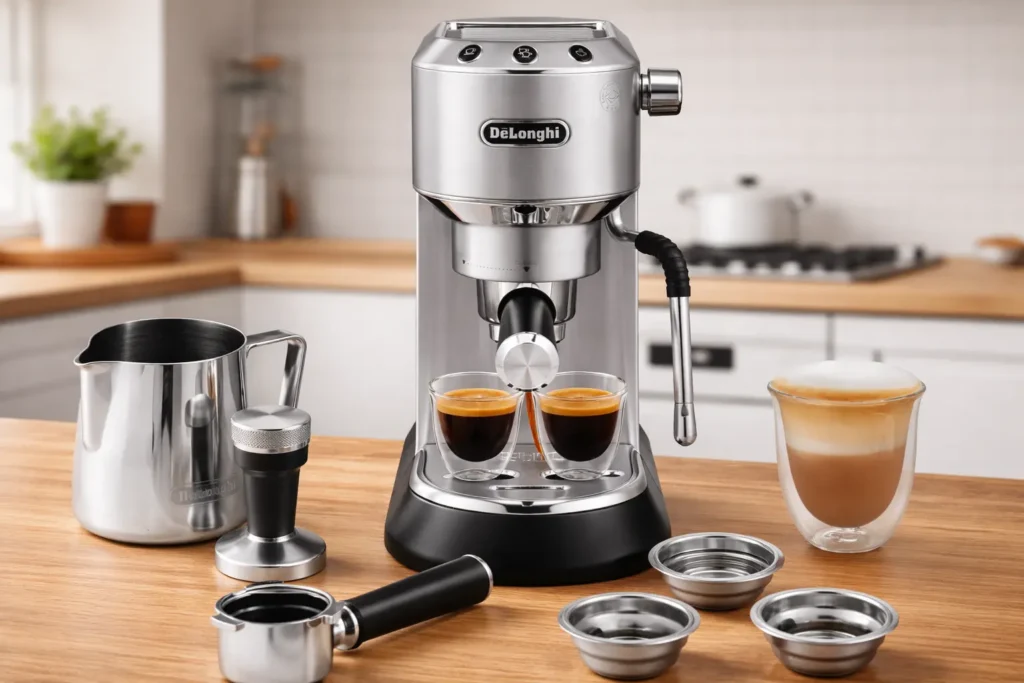
Best Budget Machine: De’Longhi Dedica Arte EC885
The De’Longhi Dedica Arte is 15cm wide — slimmer than a cereal box — and one of the few budget semi-automatic espresso machines that ships with both a pressurised basket (forgiving for beginners) and a non-pressurised single-wall basket (essential for real espresso dial-in). That combination makes it the only entry-level machine on this list that grows with you: start with the pressurised basket while learning distribution and tamp technique, switch to the non-pressurised basket once you have a consistent grinder setup, and dial in actual espresso from that point on. The Dedica Arte also includes a manual steam wand with a panarello adapter for easy frothing. At its price point, it outperforms every competitor that ships only with pressurised baskets. The 15-bar Italian pump delivers adequate pressure, and the compact stainless design holds up to daily use. For anyone building their first espresso setup on a tight budget, this is the starting point.
- Portafilter: 51mm — note: smaller than standard 58mm; requires 51mm accessories
- Baskets: Includes pressurised AND non-pressurised baskets — the most important budget machine feature
- Footprint: 15cm wide — the narrowest home espresso machine available; ideal for small kitchens
- Steam: Manual steam wand + panarello adapter — solid for lattes and cappuccinos
- Best for: budget-conscious beginners, small kitchens, first espresso machine purchase
Disclosure: CoffeeGearHub may earn from qualifying purchases.
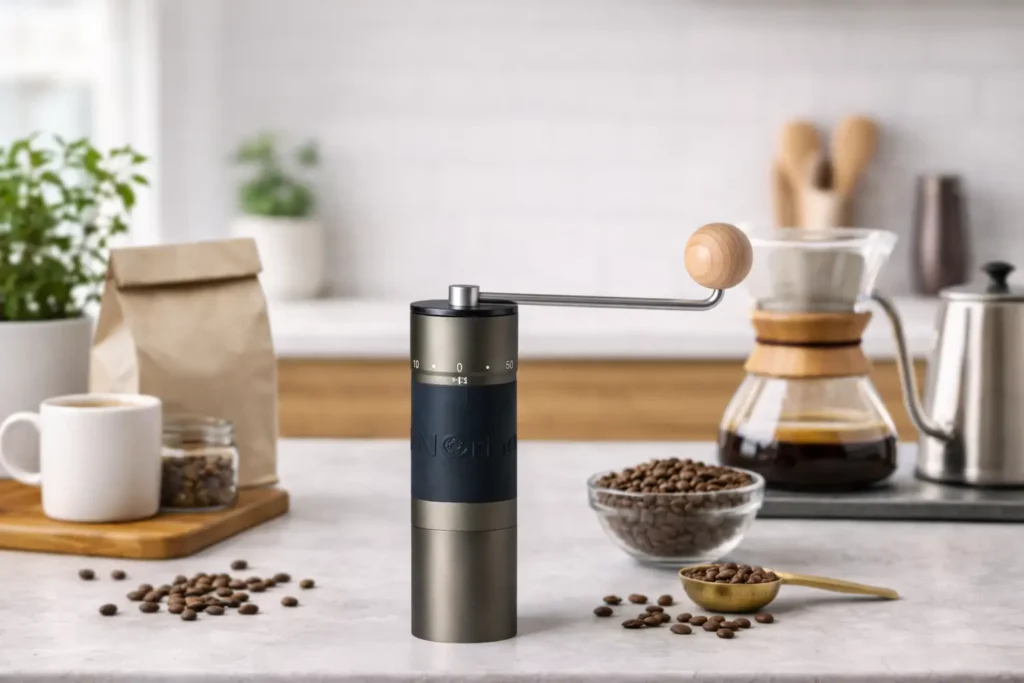
Best Manual Grinder for Espresso: KINGrinder K6
The KINGrinder K6’s 100-click adjustment range extends to the fine end required for espresso — clicks 10–22 from zero cover the full home espresso spectrum from medium-light to dark roast. The 48mm stainless conical burrs produce a consistent fine grind with lower fines generation than most manual grinders in this price class, and the 100-click resolution gives you 1–2 click precision at espresso range, where each click moves extraction time by approximately 3–5 seconds. For a home barista who pulls one to two shots per day and is willing to spend 3–4 minutes grinding, the K6 is a genuinely capable espresso grinder — not a compromise. Its limitations versus a dedicated electric espresso grinder are throughput speed and the small amount of additional effort required to maintain perfectly consistent burr pressure during fine grinding. For anyone already using the K6 for French press or pour-over, it requires only a recalibration to the fine end of the range to serve equally well for espresso. For dedicated daily espresso at higher volumes, see our full Best Espresso Grinders roundup.
- Espresso range: 10–22 clicks — covers light, medium, and dark roast espresso
- Adjustment: 100 clicks total — 1–2 click changes at espresso range = 3–5 second extraction shift
- Grind time: 18g at espresso fineness = approximately 3–4 minutes manual grinding
- Best for: budget espresso setups; travel espresso; pairing with a budget machine before upgrading grinder
Disclosure: CoffeeGearHub may earn from qualifying purchases.
⚠️ Before publishing — affiliate links to verify: The Breville Bambino Plus, Barista Express, and De’Longhi Dedica Arte shortlinks above are placeholders. Replace each [BAMBINO-SHORTLINK], [BARISTA-EXPRESS-SHORTLINK], and [DEDICA-SHORTLINK] with verified Amazon Associates shortlinks using tag coffeegearhub-20 from your Associates dashboard before publishing. The KINGrinder K6 link (amzn.to/3Pak0ST) is the verified site-standard shortlink and requires no change. Also replace all wp-image-XXXX placeholder IDs with actual WordPress media library IDs once images are uploaded.
Step-by-Step Espresso Brew Guide
Follow these steps in order every time. Consistency of process is what makes espresso reproducible — skipping the warm-up, rushing the distribution, or forgetting to tare the scale before the shot starts produces variable results that make dial-in impossible. Once this sequence becomes habit, pulling a dialled shot takes under five minutes start to finish.
Pre-Shot Prep
- Machine warm-up: Turn on 15–20 minutes before first shot (or 3 min for thermojet machines like the Bambino Plus). Lock empty portafilter in during warm-up.
- Flush the group head: Run 2–3 seconds of water through the group head (no portafilter) to bring it to temperature and flush stale water.
- Weigh your dose: Weigh 18g of whole beans for a standard double. Grind immediately before pulling — pre-ground coffee goes stale within minutes at espresso fineness.
- Grind into portafilter: Grind directly into the portafilter basket or a dosing cup. Aim to catch all grounds without spillage.
Distribution and Tamp
- Distribute: Use a WDT tool (thin needles) or your fingertip to level and loosen the grounds in the basket, breaking up any clumps. Aim for a flat, even surface before tamping.
- Tamp: Place the tamper flat on the grounds, apply firm downward pressure — approximately 15–20kg. Keep your wrist straight. The tamp must be perfectly level. A tilted tamp creates uneven density and channels.
- Polish (optional): A light twist at the end of the tamp smooths the puck surface. Do not apply additional downward pressure during the polish.
- Wipe the basket rim: Remove any loose grounds from the rim of the basket with your finger before locking in — rim grounds prevent a proper seal and cause leaks.
The Pull
- Set up your scale: Place your cup on the scale under the portafilter. Tare to zero. Lock the portafilter into the group head immediately — don’t let it sit.
- Start the shot and timer simultaneously: Start the pump and start your timer at the same moment. Watch the first drops — they should appear at 5–8 seconds in.
- Stop at target yield: Stop the pump when the scale reads 36g (for 18g in, 1:2 ratio). Note the total time. A correctly dialled shot stops between 25–30 seconds.
- Taste immediately: Sip within 30 seconds of pulling. Taste for balance — sweetness, acidity, bitterness should be integrated, not one dominant note. Record your grind setting, dose, yield, and time.
The 5-Shot Dial-In System
Dialling in espresso is the process of finding the grind setting, dose, and yield combination that produces a balanced shot with your specific machine, beans, and target recipe. Every new bag of beans requires a dial-in — even the same beans from the same roaster change between crop years and freshness levels. This five-shot system gets you to a dialled shot in a single session by changing only one variable per pull and recording the result of each.
Shots 1–2: Establish the extraction window
Set your grinder to a starting point — for a new bag, start at click 16 (K6) for a medium roast. Pull an 18g dose to 36g yield and record the time.
- Shot finishes under 20s: Grind 2 clicks finer → pull shot 2
- Shot takes over 35s or barely flows: Grind 2 clicks coarser → pull shot 2
- Shot is between 22–32 seconds: You are in the extraction window — proceed to taste evaluation
Shots 3–4: Taste and refine
Once the shot lands in the extraction window (22–32s), taste it. Now you are using flavour, not time.
- Tastes sour, thin, sharp: Grind 1 click finer
- Tastes bitter, harsh, dry: Grind 1 click coarser
- Tastes balanced but weak: Keep grind, increase dose 0.5g
- Tastes balanced but too intense: Keep grind, increase yield to 38–40g
Shot 5: Confirm and record
Pull the same shot again at your refined settings — no changes. This confirms the recipe is repeatable, not a one-shot fluke caused by technique variation.
- Record: grind setting, dose, yield, time, temperature setting
- Write the roast and bag information alongside the recipe
- This is your baseline for the bag — expect minor drift as beans age; adjust 1 click finer each week
🔬 Why beans get coarser as they age: Freshly roasted beans are densely packed with CO2 that makes them resist extraction. As beans degas over the first 5–14 days, the cell structure becomes less rigid and extracts more easily at the same grind setting — meaning a shot that takes 25s at day 7 may take 22s at day 21 from the same setting. A one-click finer adjustment per week is a useful rule of thumb for maintaining consistent extraction time from a single bag. This is also why shots from new bags may taste slightly gassy or hollow in the first 3–5 days — the CO2 release disrupts extraction and produces inconsistent shots. Allow medium-dark roast beans 5–7 days off-roast minimum; light roasts can be used from day 7–10.
Grind Settings for Espresso: KINGrinder K6 Reference
The K6’s espresso range (clicks 10–22 from zero) covers the full spectrum from dense light-roast single origin to a porous dark commercial blend. At these settings, each click change is significant — 1–2 clicks alters extraction time by 3–5 seconds. The table below provides starting points by roast and espresso style. All settings assume an 18g dose, 36g yield, standard 9-bar pump pressure, and the correct water temperature for the roast level. Adjust from these baselines based on your first pull results.
| Espresso style | Roast | K6 clicks | Time target | Temp | Ratio | If sour → | If bitter → |
|---|---|---|---|---|---|---|---|
| Standard double | Medium | 14–18 | 25–30s | 93°C | 1:2 | Finer 2 clicks | Coarser 2 clicks |
| Light roast espresso | Light | 10–15 | 28–35s | 94–96°C | 1:2 to 1:2.2 | Finer 1 click + raise temp 1°C | Coarser 1 click |
| Medium-dark blend | Medium-dark | 16–20 | 24–28s | 92–93°C | 1:2 | Finer 1–2 clicks | Coarser 2 clicks + lower temp |
| Dark roast espresso | Dark | 18–22 | 22–26s | 90–92°C | 1:1.9 to 1:2 | Finer 1 click + extend yield 2g | Coarser 2 clicks + lower temp 1°C |
| Ristretto | Medium-dark | 12–16 | 20–25s | 93°C | 1:1.5 | Finer 1 click | Coarser 1 click + increase yield 2g |
⚠️ K6 espresso note: The K6 does not have a dedicated espresso alignment mechanism — at clicks 10–22, minor burr wobble can contribute to slightly elevated fines. This is normal and not a defect; it is characteristic of a manual hand grinder at fine settings. The practical effect is a shot that occasionally runs slightly faster than expected at a given setting. If you notice inconsistency between pulls at the same grind setting, ensure you are applying consistent downward pressure during grinding and that the burr retention ring is fully seated. For more information on choosing a dedicated electric espresso grinder, see our Best Espresso Grinders Guide.
Extraction Science: Why Pressure Brewing Is Different
Espresso extraction operates on fundamentally different physics than any other brew method in home coffee. Understanding these three principles explains why espresso responds to adjustments differently than French press or pour-over — and why techniques that improve one method actively harm the other.
- Pressure drives extraction, not diffusion: In immersion and filter methods, extraction happens through diffusion — dissolved compounds move from high to low concentration zones over several minutes. Espresso uses 9 bars of pump pressure to force water through the coffee bed in under 30 seconds, extracting soluble compounds at a rate impossible through diffusion alone. This means espresso is extremely sensitive to flow resistance — a one-click grind change that creates or eliminates 3 seconds of resistance has a major flavour impact. In French press, the same change barely registers.
- Emulsification creates crema — and carries flavour: Under 9-bar pressure, water becomes supersaturated with CO2 from the coffee. When this pressurised brew exits the portafilter, the CO2 forms a stable emulsion with coffee oils — the crema layer on top of a correctly pulled shot. Crema is not just an aesthetic indicator of freshness; it carries aromatic volatile compounds and fat-soluble flavour molecules that no other brew method extracts. This is why espresso-based drinks taste fundamentally different from brewed coffee — not just more concentrated, but differently constituted at the chemical level.
- Channelling is the primary enemy of even extraction: If water under pressure finds a gap in the coffee puck — caused by uneven distribution, a tilted tamp, a cracked bed, or a too-coarse grind — it will exploit that path of least resistance exclusively, bypassing the rest of the puck. The result is simultaneous over-extraction (along the channel) and under-extraction (everywhere else) in the same shot. Visually, channelling shows as a thin dark jet mid-shot, or wildly uneven flow from a bottomless portafilter. The fix is always distribution and tamping technique first, grind adjustment second.
Roast Level and Bean Selection for Espresso
Any coffee bean can be brewed as espresso — but different roast levels and processing methods produce dramatically different results under 9 bars of pressure. Understanding how roast interacts with espresso extraction helps you match your machine and dial-in approach to the beans you are using. For a full exploration of the best coffee beans for espresso, see our dedicated Best Coffee Beans for Espresso guide.
| Roast level | Espresso character | Key variables | Common problems | Best for |
|---|---|---|---|---|
| Light roast ☀️ | Bright, fruit-forward, complex — unusual and polarising espresso; high acidity | Higher temp (94–96°C); longer time (28–35s); finer grind; higher yield (1:2.2) | Under-extraction (sourness) is the primary risk; dense beans resist extraction | Experienced home baristas exploring Third Wave espresso |
| Medium roast 🌤 | Balanced — chocolate, caramel, fruit, moderate acidity, round body | Standard parameters — 93°C, 25–30s, 1:2 | Most forgiving roast level; wide sweet spot for both grind and temperature | Everyday espresso and milk drinks; beginners after first dial-in |
| Medium-dark roast | Rich, chocolate-heavy, low acidity, full body — classic espresso character | 92–93°C; 24–28s; slightly coarser than medium | Over-extraction into bitterness if grind too fine; dark roast extracts fast | Traditional espresso; lattes and cappuccinos; everyday high-volume use |
| Dark roast 🌑 | Bittersweet, heavy body, earthy/smoky — minimal acidity or fruit character | 90–92°C; 22–26s; relatively coarse for espresso; short time essential | Ash/harsh bitterness from over-extraction is very common; low margin for error | Traditional Italian espresso style; strong milk drinks |
⚠️ Freshness for espresso: Espresso is far more sensitive to bean freshness than any other brew method. The SCA espresso brewing window is 7–30 days post-roast for most medium and medium-dark roasts — pulling a shot from a bag roasted more than 45 days ago will produce a flat, crema-poor, hollow result regardless of grind accuracy. Always look for a roast date, never a best-before date. For espresso, freshness is not a preference; it is a prerequisite. Beans roasted fewer than 5 days ago may also pull inconsistently due to high CO2 — allow at least 5–7 days off-roast for medium-dark espresso beans before dialling in.
Milk Steaming: Technique, Temperature, and Microfoam
Properly steamed milk transforms an espresso into a latte, cappuccino, or flat white — the drinks that make most home espresso setups worthwhile. Milk steaming is a learnable skill that typically takes two to four weeks of daily practice to reach consistent latte-art-ready microfoam. The physics are straightforward: you are simultaneously heating the milk and incorporating just enough air to create a smooth, velvety texture rather than a layer of large bubbles.
Manual Steam Wand Technique
- Purge the wand: Before steaming, open the steam valve for 1–2 seconds to expel condensed water. Never steam with water in the wand — it dilutes the milk.
- Fill the pitcher: Fill a stainless frothing pitcher to the bottom of the spout — approximately 150ml for a single drink. Cold milk froths best; refrigerator-cold is ideal.
- Submerge and angle: Submerge the wand tip 1–2cm below the surface, angled slightly off-centre to create a gentle rotational motion in the milk.
- Aeration (stretch): Open the steam valve fully. Lower the pitcher slightly so the wand tip is at the milk surface — you should hear a light hissing/tearing sound. This incorporates air. Do this for the first 2–3 seconds only.
- Texturing (heating): Raise the pitcher so the tip is 2–3cm below the surface. The milk should spin in a tight vortex. Hold until the pitcher reaches 60–65°C (uncomfortably hot to touch but not burning).
- Purge and wipe: Close the valve, remove the wand, and purge again immediately. Wipe with a clean damp cloth.
Temperature and Texture Targets
| Drink | Milk temp | Texture | Notes |
|---|---|---|---|
| Latte | 60–65°C | Silky microfoam — no large bubbles; pourable | Highest milk volume; thinnest foam layer |
| Cappuccino | 60–65°C | Thick, dry foam; equal thirds espresso/milk/foam | More air incorporated during stretch |
| Flat white | 55–60°C | Very fine microfoam; thinner than latte | Less milk than latte; served smaller (150ml) |
| Cortado | 55–60°C | Minimal foam; nearly equal espresso and milk | Served in a small glass |
| Macchiato | 60–65°C | Small dot of foam on espresso | Very small milk volume — 1–2 tablespoons |
Espresso Drink Recipes
| Drink | Espresso | Other ingredients | Total volume | Notes |
|---|---|---|---|---|
| Espresso (double) | 18g in / 36g out | None | ~36ml | Serve within 60 seconds; sip immediately |
| Americano | Double shot (36g) | 120–150ml hot water | ~180ml | Add espresso over hot water — not water over espresso — to preserve crema |
| Latte | Double shot (36g) | 150–180ml steamed milk + thin microfoam | ~220ml | 2:1 milk to espresso ratio; ideal for medium-dark roasts |
| Cappuccino | Double shot (36g) | 60ml steamed milk + 60ml thick foam | ~180ml | Equal thirds; drier foam than latte |
| Flat white | Double ristretto (18g/27g) | 90ml steamed milk + fine microfoam | ~120ml | Smaller than latte; ristretto base for more intensity relative to milk volume |
| Cortado | Double shot (36g) | 36ml steamed milk (equal parts) | ~72ml | Served in a small glass; 1:1 ratio cuts acidity without diluting espresso character |
| Espresso tonic | Double shot (36g), cooled | 150ml chilled tonic water over ice | ~200ml | Pour tonic first, add espresso gently over a spoon to layer |
| Iced latte | Double shot (36g) | 150ml cold milk over ice | ~220ml | Use a ristretto for stronger flavour against ice dilution; medium-dark roast recommended |
Troubleshooting Matrix: Espresso Symptoms → Causes → Fixes
Identify your symptom below. Address causes in the order listed — most espresso problems have one primary cause, and fixing it correctly avoids the cascade of compensatory adjustments that characterise poorly dialled espresso. Always confirm a fix with a taste, not just an extraction time.
| Symptom | Most likely cause | Fix (in order) |
|---|---|---|
| Shot pulls too fast (under 20s) | Grind too coarse; dose too low; insufficient tamp pressure | Grind 2 clicks finer → confirm dose is 18g → apply firm, level tamp → re-pull |
| Shot pulls too slow or barely flows (over 35s) | Grind too fine; dose too high; channelling from uneven distribution | Grind 2 clicks coarser → check dose (reduce 0.5g if over 18.5g) → re-pull |
| Sour / sharp / thin | Under-extraction — grind too coarse, temp too low, or beans too fresh | Grind 1–2 clicks finer → if still sour, raise temperature 1°C → if beans under 5 days off-roast, wait |
| Bitter / harsh / dry | Over-extraction — grind too fine, too long, temp too high, or dark roast over-steeped | Grind 1–2 clicks coarser → lower temperature 1°C (especially for dark roast) → shorten yield by 2g |
| Sour AND bitter in same shot | Channelling — uneven extraction across the puck | Improve distribution (use WDT tool) → ensure tamp is level → grind slightly finer to reduce gap risk |
| No crema or pale thin crema | Stale beans; too-dark roast; water temperature too low | Check roast date — if 30+ days, this is the cause; use fresher beans. If beans are fresh, raise temperature 1–2°C |
| Crema disappears immediately | Beans too old; water too hot; very dark roast; over-extraction | Fresher beans are the primary fix; reduce temp slightly if beans are fresh |
| Shot spurts / jets mid-pull | Channelling — water found a preferential path through the puck | Redistribute more evenly before tamping; use WDT; grind slightly finer to create a more cohesive puck |
| Espresso sprays from portafilter sides | Grounds on basket rim; damaged portafilter gasket; basket over-filled | Wipe rim clean before locking in; check gasket for wear; reduce dose 0.5g |
| Correct parameters but weaker-tasting than usual | Beans ageing — same bag but 1–2 weeks older | Grind 1 click finer (beans extracting slightly faster now); optionally increase dose 0.5g |
| Machine takes much longer to heat up recently | Scale buildup on heating element or group head | Run a full descale cycle — see machine manual; descale every 2–3 months with filtered water |
Machine Buying Guide: What to Look for at Each Budget
The espresso machine market spans a huge price range — from sub-$100 machines that technically produce espresso to commercial-grade home machines. Understanding what each tier delivers helps you buy once at the right level rather than upgrading twice. Here is what the price steps actually buy you in terms of espresso quality and usability.
| Budget tier | What you get | Key limitation | Recommended pick | Best for |
|---|---|---|---|---|
| Entry (~$150–$200) | 15-bar pump; basic thermoblock; pressurised basket standard | Pressurised basket masks grind errors but prevents true dial-in; limited temperature stability | De’Longhi Dedica Arte (includes non-pressurised basket) | First machine; pod-machine upgrade; space-constrained kitchens |
| Mid-range (~$350–$500) | Thermojet or PID boiler; non-pressurised baskets; digital controls; fast heat-up | No pressure profiling; steam and brew can’t run simultaneously on most thermoblock machines | Breville Bambino Plus | Serious home espresso beginners; daily milk drinks; anyone wanting real dial-in capability |
| All-in-One (~$600–$750) | Built-in conical burr grinder + full semi-auto machine; 58mm portafilter; PID boiler | Built-in grinder limits upgrade path; stepped grind adjustment less precise than dedicated grinder | Breville Barista Express | Anyone who wants machine + grinder in one box; home baristas who don’t want to manage two devices |
| Prosumer (~$900+) | E61 group head; dual boiler or heat exchanger; pressure profiling; plumb-in option | Higher maintenance; longer warm-up; requires quality separate grinder ($300+) | Breville Dual Boiler / Lelit Mara X / Rocket Appartamento | Experienced home baristas who want commercial-level espresso; daily high-volume use |
🔬 The grinder is always the higher priority investment: A $350 machine paired with a $250 dedicated espresso grinder will produce significantly better espresso than a $600 machine paired with a cheap grinder or pre-ground coffee. If your budget forces a trade-off between machine quality and grinder quality, invest more in the grinder. The machine provides pressure and temperature; the grinder provides consistency — and consistency is what makes espresso repeatable. The most common home espresso upgrade path is: budget machine + K6 → mid-range machine + K6 → mid-range machine + dedicated electric grinder → the machine becomes the limiting factor at that point.
Quick Reference: Espresso Cheat Sheet
Bookmark this table for your brew station. Standard double shot parameters for the five most common home espresso scenarios — adjust grind first, one click at a time, and taste every shot.
| Scenario | Dose | Yield | Time | Temp | K6 clicks | If sour → | If bitter → |
|---|---|---|---|---|---|---|---|
| Medium roast standard double | 18g | 36g | 25–30s | 93°C | 14–18 | Finer 2 clicks | Coarser 2 clicks |
| Light roast single origin | 18g | 38–40g | 28–35s | 95°C | 10–15 | Finer 1 click + raise temp | Coarser 1 click |
| Dark roast traditional | 18g | 34–36g | 22–26s | 91°C | 18–22 | Finer 1 click + extend yield | Coarser 2 clicks + lower temp |
| Ristretto (milk drink base) | 18g | 27g | 20–25s | 93°C | 12–16 | Finer 1 click | Coarser 1–2 clicks |
| Lungo | 18g | 54g | 35–45s | 91°C | 16–20 | Finer 1 click | Coarser 2 clicks + lower temp |
Final Takeaway
Espresso rewards patience and discipline. The investment is real — in equipment, in time, and in beans sacrificed to the dial-in process. But the return is a cup that no café can replicate at home through any other method: concentrated, complex, aromatic, and exactly tuned to your taste. Start with the right machine and a quality burr grinder. Weigh everything. Adjust only one variable per session. Follow the five-shot dial-in system until you have a recipe that reproduces. Once you are pulling consistently balanced shots, milk steaming becomes the next skill — and then the full espresso drink menu opens up. The Breville Bambino Plus and Barista Express are the right starting points for most home setups. The KINGrinder K6 covers manual grinding. A digital scale is the cheapest most impactful accessory in your entire setup. Get those four things right and excellent espresso at home is consistently achievable.
FAQs: Espresso Brew Guide
What is the correct dose for a home espresso shot?
The standard home espresso dose is 18g of ground coffee for a double shot, targeting 36g of liquid espresso out (a 1:2 ratio) in 25–30 seconds. Single shots use 7–9g in a smaller basket. Most home machines are calibrated for a 58mm portafilter with an 18–20g double basket. Always weigh your dose — scooping by volume introduces significant inconsistency because grind density varies dramatically with roast level and grind coarseness.
What grind size is best for espresso?
Espresso requires the finest grind of any common brew method — fine enough to create resistance against 9 bars of pump pressure and produce a 25–30 second extraction. On the KINGrinder K6, espresso falls in the 10–22 click range depending on roast level, bean density, and machine pressure. The grind is always the primary dial-in variable: if your shot pulls in under 20 seconds, grind finer; if it takes over 35 seconds or barely flows, grind coarser. One or two clicks at espresso range changes extraction time by 3–5 seconds.
What is the ideal espresso extraction time?
The SCA target for a correctly dialled espresso is 25–30 seconds total extraction time from the moment the pump starts, for a 1:2 dose-to-yield ratio (18g in / 36g out). First drops should appear at 5–8 seconds. A shot finishing in under 20 seconds is under-extracted (grind too coarse or dose too low); a shot taking over 35 seconds is over-extracted or partially channelling (grind too fine or dose too high). Extraction time is a diagnostic indicator, not a target in itself — always taste and adjust based on flavour, not time alone.
What is the correct espresso brew ratio?
The standard specialty espresso brew ratio is 1:2 — 1g of ground coffee for every 2g of liquid espresso. For an 18g dose, the target yield is 36g out. Ristretto shots use a 1:1.5 ratio (18g in / 27g out) for more concentrated, syrupy espresso. Lungo shots use a 1:3 ratio (18g in / 54g out) for a more dilute, less intense cup. Always weigh yield with a digital scale — volume-based dosing is unreliable because espresso crema volume varies significantly with freshness, roast level, and extraction pressure.
Why does my espresso taste sour?
Sour espresso is almost always under-extraction. The most common causes are: grind too coarse, dose too low, water temperature too low, or beans too fresh (under 5 days off-roast). Fix by grinding 1–2 clicks finer first. If still sour, increase dose by 0.5g. If using very fresh beans, allow 5–7 more days off-roast before dialling in. Under-extracted espresso tastes sharp, thin, and acidic — it should not be confused with the pleasant fruit brightness of a correctly extracted lighter roast.
Why does my espresso taste bitter?
Bitter espresso is almost always over-extraction. The most common causes are: grind too fine, dose too high, water temperature too high, or extraction time too long. Fix by grinding 1–2 clicks coarser first. If still bitter, reduce dose by 0.5g. Also check for channelling — visible jets of dark espresso mid-shot indicate uneven extraction. A burnt, ash-like bitterness with no sweetness is also a sign of beans that are too dark or too stale for espresso.
What water temperature should I use for espresso?
The SCA standard espresso water temperature is 90–96°C at the group head, with 93°C as the widely accepted sweet spot for medium roast espresso. Lighter roasts benefit from slightly higher temperatures (94–96°C) to extract the denser cell structure fully. Darker roasts extract better at slightly lower temperatures (90–92°C) to avoid over-extracting the highly soluble dark-roast compounds. Most home machines cannot adjust temperature precisely — this is one of the key capabilities of machines like the Breville Bambino Plus, which allows temperature adjustment in 2°C steps.
Do I need a separate grinder for espresso?
A dedicated burr grinder is the single most important piece of espresso equipment after the machine itself. Blade grinders produce inconsistent particle sizes that make espresso impossible to dial in reliably. Pressurised portafilters on budget machines partially compensate for inconsistent grinds — but they also prevent you from tasting or correcting actual extraction issues. For serious espresso, a stepless or fine-stepped burr grinder with consistent particle size distribution at espresso range is essential. The KINGrinder K6 can produce espresso-fine grinds at 10–22 clicks, making it a valid entry-level option.
What is channelling in espresso and how do I fix it?
Channelling occurs when water under pressure finds a path of least resistance through the coffee puck rather than flowing evenly through the entire bed. The result is simultaneously under-extracted and over-extracted coffee — bitter, hollow, and inconsistent. Channels form from uneven distribution before tamping, a tilted tamp, a cracked puck (grind too coarse), or excessive dose volume for the basket. Fix by using a WDT tool before tamping, ensuring your tamp is perfectly level, and checking that your grind is fine enough to form a cohesive puck.
How long should I run the machine before pulling the first shot?
Most home semi-automatic espresso machines require 15–20 minutes of warm-up time before pulling the first shot. The group head, portafilter, and internal boiler all need to reach stable operating temperature — pulling a shot before full warm-up produces a cold, under-extracted shot even if every other parameter is correct. Lock the portafilter in during warm-up to bring it to temperature. Run a blank shot (water only) immediately before your first pull to flush stale water and bring the group head to thermal equilibrium. Thermojet machines like the Breville Bambino Plus reach temperature in approximately 3 seconds but still benefit from a group-head flush.
Continue Learning
ESPRESSO CLUSTER
Using the same beans for AeroPress? Our AeroPress Espresso Concentrate guide covers the closest no-machine espresso alternative — with grind settings, ratios, and a direct taste comparison to pulled shots.
☕
Written by the CoffeeGearHub Editorial Team
CoffeeGearHub is a specialty coffee equipment resource produced by the CoffeeGearHub Editorial Team. Our guides are researched using published brewing science, SCA standards, grinder manufacturer specifications, and established specialty-coffee community knowledge. We review and update our pillar content regularly. About CoffeeGearHub →