Last Updated: March 2026 • 20–25 min read • Complete Guide: Dripper Science + Flavor Differences + Recipes + Product Picks + Troubleshooting Matrix

Flat bottom vs cone pour over? The choice between a flat-bottom and cone pour-over dripper is the most common question in home pour-over brewing — and it matters more than most people expect. Both produce excellent coffee. But they behave differently at a physics level, they respond differently to imperfect technique, and they tend to produce different flavor profiles even with the same beans, water, and grinder. This guide covers the real difference between how they work, which produces better results for your skill level and daily routine, simple repeatable recipes for each, the exact gear you need, and a complete troubleshooting matrix for every pour-over problem that traces back to dripper or grind.
✍️ Editorial note: This guide is researched and written by the editors at CoffeeGearHub.com using published brewing science and established specialty-coffee community knowledge. All product links are affiliate links — we may earn a commission at no cost to you. Affiliate Disclosure: CoffeeGearHub.com participates in the Amazon Services LLC Associates Program. As an Amazon Associate, we earn from qualifying purchases.
The 30-Second Answer
Cone drippers (like the Hario V60) reward precision and produce high-clarity, “sparkly” cups — but they’re sensitive to grind consistency and pouring technique. Flat-bottom drippers (like the Kalita Wave) are more forgiving and more consistent day-to-day, producing a rounder, sweeter cup with less fuss. If mornings are rushed, your grinder is entry-level, or you’re new to pour-over, start with the Kalita. If you enjoy dialing in and want to extract everything a high-quality single-origin bean has to offer, learn the V60.
- Best for beginners and daily consistency: Kalita Wave 185 — more forgiving, sweeter, fewer bad cups
- Best for clarity and single-origin exploration: Hario V60 02 — higher ceiling when technique is solid
- Your grinder matters more than the dripper: inconsistent cups usually trace to grind, not technique
- Fast fix: Sour/weak → grind slightly finer. Bitter/drying → grind slightly coarser
- Essential for both: a kitchen scale, a gooseneck kettle, and a quality burr grinder — in that order
Quick-Pick Comparison Table
Not sure which to buy? Use this table to find the right dripper for your setup in under 30 seconds. Every pick links directly to Amazon. Detailed reviews and recipes follow below.
Disclosure: CoffeeGearHub may earn a commission on qualifying purchases. All links use the coffeegearhub-20 Associates tag.
| Our Pick | Best For | Dripper Type | Key Advantage | Trade-Off | Link |
|---|---|---|---|---|---|
| 🏆 Hario V60 02 | Clarity seekers, single-origin fans, brewers who enjoy technique | Cone | Higher flavor ceiling; maximum extraction clarity when dialed in | Technique-sensitive — rewards skill, punishes inconsistency | Check Price → |
| ⚖️ Kalita Wave 185 | Beginners, daily brewers, anyone who wants consistent results with less effort | Flat-bottom | More forgiving; consistent sweetness; fewer bad cups | Slightly lower flavor ceiling at expert level | Check Price → |
| ⚖️ Digital Scale (with Timer) | Anyone serious about pour-over — essential for both drippers | Accessory | Eliminates dose and ratio guesswork; single most impactful accessory purchase | None — this is not optional if you want repeatable results | Check Price → |
Jump to What You Need
☕ Ready to buy
Use the Quick-Pick Table above or go straight to Product Picks for full reviews with buy links.
🔬 Want to understand the difference
Start with The Real Difference — the physics of coffee bed shape and flow resistance explained plainly.
🔧 Fixing bad pour-over cups
Jump to the Troubleshooting Matrix — every bitter, sour, and weak result mapped to its cause and fix.
📋 Recipes + grind settings
See Simple Recipes for exact V60 and Kalita step-by-step brews, or go to Who Should Buy What for the final verdict.
Table of Contents
The Real Difference Between Flat-Bottom and Cone Drippers
Both are pour-over brewers. Both use paper filters, hot water, and ground coffee. The difference is coffee bed shape and flow resistance — and those two variables drive everything else: extraction rate, flavor profile, sensitivity to technique, and how much a bad pour matters.
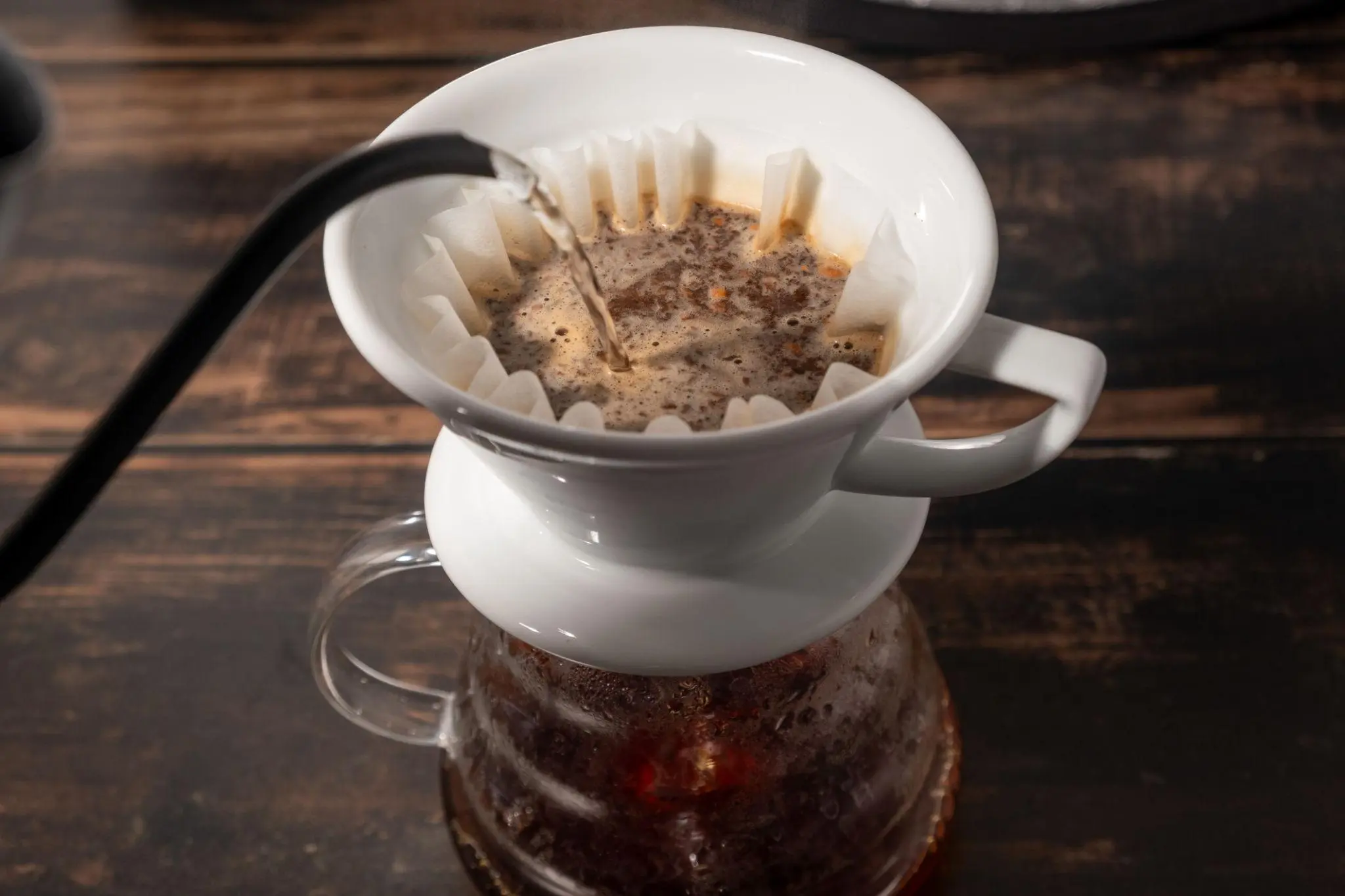
In a cone dripper, water concentrates through a single large opening at the bottom of a deep, narrow coffee bed. The shape funnels everything through a small exit point — which means the path the water takes through the coffee is strongly influenced by how you pour. Pour too fast, and water channels straight down without full contact. Pour in uneven patterns, and some grounds extract more than others. The cone amplifies every input, good and bad.
In a flat-bottom dripper, the coffee bed is shallower and wider, and water exits through multiple small holes rather than one large opening. This geometry distributes flow more evenly across the bed and provides more resistance to fast drainage. Small pour inconsistencies get absorbed into the system before they reach the cup. The flat-bottom is naturally self-correcting in a way the cone is not.
Cone Dripper (V60 style)
- Deep, narrow coffee bed concentrates flow through one large exit opening
- Technique-driven: pour speed, pattern, and timing all affect the cup significantly
- Higher ceiling, lower floor: best cups are outstanding; off days are noticeably off
- Rewards: consistent grinders, gooseneck control, and deliberate technique refinement
Flat-Bottom Dripper (Kalita style)
- Shallow, wide coffee bed encourages even water distribution across the full surface
- Restricted multi-hole exit slows drainage and smooths out technique errors
- More consistent day-to-day, especially with entry-level grinders or rushed mornings
- Rewards: anyone who wants quality daily coffee without a long learning curve
Flavor Differences: What You’ll Actually Taste
These are tendencies, not guarantees — bean quality and grinder consistency can override dripper-driven flavor patterns. But they’re consistent enough to be useful when choosing a dripper that matches your preferences.
| What you care about | V60 (cone) | Kalita Wave (flat-bottom) |
|---|---|---|
| Clarity / flavor separation | Often higher — distinct notes more identifiable | Moderate — flavors more integrated and blended |
| Sweetness | High when fully dialed in; lower when off-recipe | Consistently high — easier to land reliably |
| Acidity character | Brighter, sharper — especially for light roasts | Smoother, rounder — more approachable acidity |
| Body | Lighter to medium — clean, tea-like at best | Medium, slightly fuller — more substantial mouthfeel |
| Consistency brew-to-brew | Skill and grinder dependent — varies more | More consistent — technique variation absorbed |
| Best bean type | High-quality light-roast single origins — rewards complexity | Any roast level — especially forgiving with medium and dark |
Which One Is More Forgiving?
The Kalita Wave is more forgiving in almost every practical sense. Its restricted multi-hole base slows flow enough that small pour errors — a slightly uneven spiral, a brief pause, a momentary speed change — don’t produce measurable extraction problems. The flatter bed also reduces channeling, which is the single biggest source of V60 inconsistency.
The V60’s sensitivity is not a flaw — it’s a feature for brewers who enjoy learning. When you pour correctly and your grind is dialed, the V60 produces cups that are noticeably more expressive and “alive” than anything the Kalita produces. But it takes longer to get there, and the floor is lower on off-days.
🚫 If your cups keep swinging between sour and bitter — the dripper is not the problem. Inconsistency that dramatic almost always traces to grind particle distribution, not pouring technique. An inconsistent grinder produces dust and chunks in the same dose: the dust over-extracts (bitter) and the chunks under-extract (sour), and both arrive in the cup simultaneously. No dripper swap, recipe adjustment, or pour technique fixes this. The fix is a quality burr grinder at the correct medium-fine setting.
☕ Inconsistent results? Grind size is the most likely cause. Use the full chart as your diagnostic baseline.
Simple, Repeatable Recipes (V60 and Kalita)
These recipes are intentionally simple — designed to produce reliable, good results from your first brew rather than showcase exotic technique. Once you’re producing consistent cups with these, you can experiment with pulse-pour variations, higher ratios, and temperature adjustments.
V60 “Daily Driver” Recipe
- Coffee: 20g
- Water: 300g (ratio 1:15)
- Grind: Medium-fine. K6: approximately 35–48 clicks from zero depending on roast
- Water temp: 200–205°F (93–96°C) for light/medium; 195–200°F (90–93°C) for medium-dark/dark
- Target total time: 2:45–3:15
Steps:
- Rinse filter thoroughly with hot water. Preheat dripper and server. Discard rinse water.
- Bloom: Pour 50g in a steady spiral. Wait 45 seconds. Grounds should dome and bubble — this is CO₂ degassing.
- Pour to 180g by 1:30. Use a controlled spiral from centre outward. Avoid pouring directly on the filter walls.
- Pour to 300g by 2:15. Gentle, consistent flow — keep the bed agitated but not churning.
- Let draw down fully. Target completion by 3:00–3:15. If draining fast (under 2:30), grind finer next time. If stalling (over 3:45), grind coarser.
Adjust by taste: Sour/weak → grind 2–3 clicks finer. Bitter/drying → grind 2–3 clicks coarser.
Kalita Wave “Reliable Sweetness” Recipe
- Coffee: 20g
- Water: 320g (ratio 1:16)
- Grind: Medium. K6: approximately 40–55 clicks from zero depending on roast
- Water temp: 198–203°F (92–95°C) for light/medium; 193–198°F (89–92°C) for dark
- Target total time: 2:45–3:30
Steps:
- Rinse wave filter thoroughly — Kalita wave filters benefit more from rinsing than most; paper taste is more noticeable if skipped. Preheat and discard rinse water.
- Bloom: Pour 60g in a steady spiral. Wait 45 seconds.
- Pour to 200g by 1:30. Steady spiral — the Kalita is forgiving of pour speed variation, but a consistent spiral still produces better even saturation.
- Pour to 320g by 2:15. Gentle, consistent flow.
- Let draw down fully. Target completion by 3:15–3:30. Kalita draws down slightly slower than V60 — this is normal.
Adjust by taste: Sour/weak → grind a touch finer. Bitter/drying → grind a touch coarser.
🔬 Why V60 uses 1:15 and Kalita uses 1:16: The Kalita’s restricted drainage slows total brew time. A slightly higher water ratio compensates for this — keeping extraction balanced at the longer contact time without over-concentrating the cup. If you prefer a bolder Kalita, move to 1:15. For a brighter, lighter V60, try 1:16. Both are starting points, not rules.
What to Buy: Product Picks for Both Drippers
You don’t need a complicated setup. You need a consistent grinder, a scale, the right dripper with its correct filters, and a gooseneck kettle. These are the CoffeeGearHub recommended picks at each position.
Disclosure: CoffeeGearHub may earn a commission on qualifying purchases through affiliate links on this page. CoffeeGearHub.com participates in the Amazon Services LLC Associates Program. As an Amazon Associate, we earn from qualifying purchases. Our editorial recommendations are independent of any commercial relationship.
🏆 CoffeeGearHub Pick — Best Cone Dripper for Pour-Over

Hario V60 02 — Best Cone Pour-Over Dripper
The Hario V60 is the most widely used cone dripper in specialty coffee — and for good reason. The 02 size is the sweet spot for most home brewers, handling single large cups and small two-cup batches (15–32g coffee) without compromise. The single large spiral drainage hole produces the fastest, most technique-responsive flow of any pour-over dripper, which is why it has both the highest flavor ceiling and the sharpest learning curve. When technique is consistent — steady spiral pours, a good gooseneck kettle, and a quality burr grinder at medium-fine — the V60 produces clean, bright, expressive cups that no flat-bottom dripper matches for clarity. The plastic 02 version is the CoffeeGearHub recommendation over ceramic or glass: it’s cheap, performs identically after preheating, and survives years of daily use without breaking.
- Size: 02 — the best all-around size for 1–2 cups (15–32g dose)
- Material: Plastic — identical performance to ceramic after preheating; more durable and far cheaper
- Filters: Use genuine Hario V60 filters only — off-brand filters change drawdown speed and extraction noticeably
- Best for: Clarity seekers; single-origin light roast exploration; brewers who enjoy learning technique
Disclosure: CoffeeGearHub may earn from qualifying purchases.
⚖️ Best for Beginners and Daily Consistency — Flat-Bottom Pick

Kalita Wave 185 — Best Flat-Bottom Dripper for Daily Brewing
The Kalita Wave 185 is the most recommended flat-bottom dripper for home brewers — the first choice when you want great pour-over coffee without the learning curve of the V60. Its triple-hole flat base creates the resistance that self-corrects small pour inconsistencies, and the wide flat filter surface ensures even water distribution across the full coffee bed. The result is reliably sweet, balanced cups even when your morning is rushed or your technique is imperfect. The 185 size matches the 02 V60 for capacity (1–2 cups per brew) and is the most versatile home option. Stainless steel is the most durable material; ceramic is also excellent. Wave filters matter: stock up when you find them, as they’re less widely stocked than V60 filters and off-brand wave filters significantly degrade performance.
- Size: 185 — best all-around for 1–2 cups; handles 15–32g doses cleanly
- Material: Stainless steel is the most durable; ceramic is excellent; avoid budget plastic versions with poorly drilled holes
- Filters: Genuine Kalita wave filters are essential — the crimped flat design is critical to the dripper’s performance; off-brands compromise it significantly
- Best for: Beginners; daily household brewers; anyone who wants repeatable results with minimal fuss
Disclosure: CoffeeGearHub may earn from qualifying purchases.
⚖️ Essential Accessory — Most Impactful Buy After Your Dripper
Digital Coffee Scale (with Timer) — Essential for Both Drippers
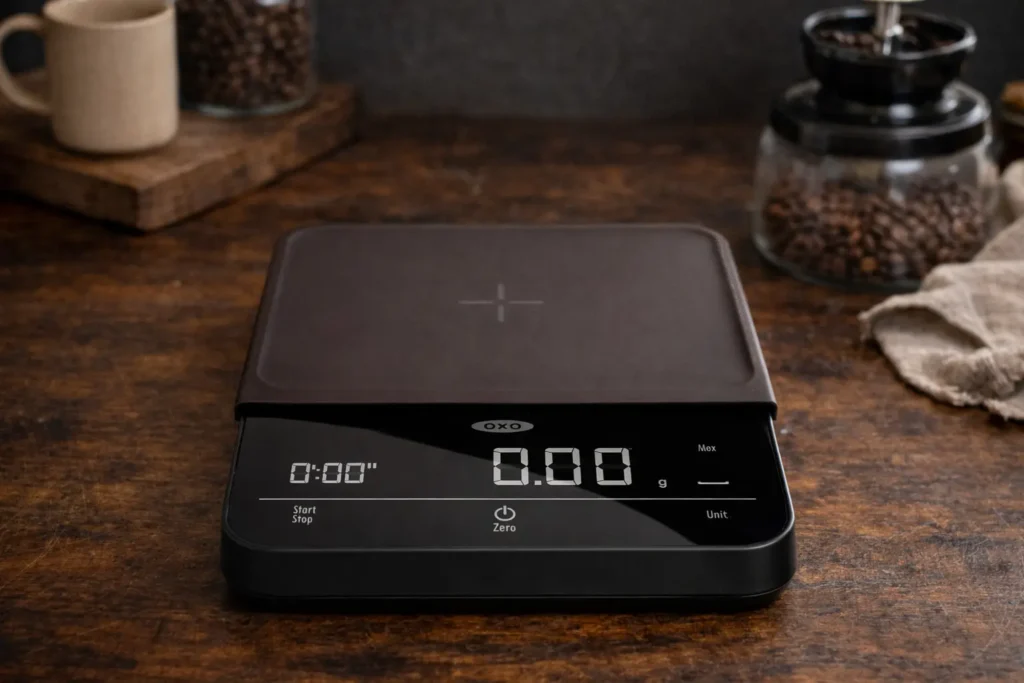
A kitchen scale with a built-in timer is the single most impactful accessory purchase in pour-over — more impactful than upgrading from one dripper to another. Without a scale, dose variation of 3–5g between sessions is common, producing extraction swings of 15–20% that show up clearly in the cup as strength and flavor inconsistency. With a scale, every variable reduces to one at a time. You’ll find and fix grind problems faster, confirm a recipe is working or not, and produce consistent cups from session one. The built-in timer matters because pour timing is how you control extraction phase by phase — without it, you’re guessing at the single most controllable variable in the brew.
- Resolution needed: 0.1g minimum for pour-over (1g resolution is not sufficient)
- Built-in timer: essential — not a luxury feature; controls extraction phase timing directly
- Water resistance: useful but not required; avoid placing directly under kettle pour path
- Best for: Anyone brewing pour-over seriously — this is not optional equipment for repeatable results
Disclosure: CoffeeGearHub may earn from qualifying purchases.
🫖 Essential Equipment — Especially for V60
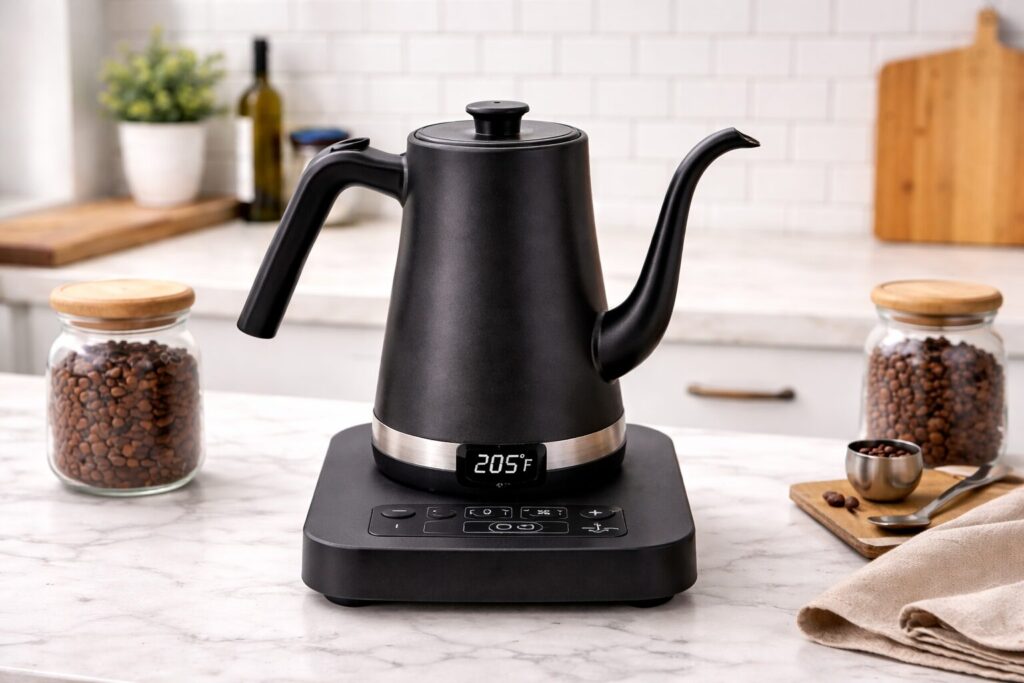
Electric Gooseneck Kettle — Precise Flow Control for Both Drippers
A gooseneck kettle is not optional for V60 brewing and is strongly recommended for Kalita brewing. The narrow, curved spout is what gives you the controlled, predictable flow that prevents channeling and over-agitation in the coffee bed. Standard kettle spouts produce turbulent, inconsistent flow that makes the pour the single biggest source of extraction variation — more than grind size, more than ratio, more than water temperature. An electric gooseneck with a built-in temperature hold eliminates both the pour-control problem and the water temperature variable in a single purchase. If budget requires choosing between stovetop and electric, electric is meaningfully better — holding temperature to within 1–2°F removes a variable that stovetop cannot control.
- Gooseneck spout: the shape that enables controlled pour — not interchangeable with standard kettle spouts
- Temperature control: electric with built-in hold is strongly preferred over stovetop for consistency
- Capacity: 600–800ml is the practical sweet spot for 1–2 cup sessions; 1L for larger batches
- Best for: Anyone brewing V60 (essential); strongly recommended for Kalita Wave
Disclosure: CoffeeGearHub may earn from qualifying purchases.
🔬 CoffeeGearHub Grinder Standard — Best Manual Grinder for Pour-Over
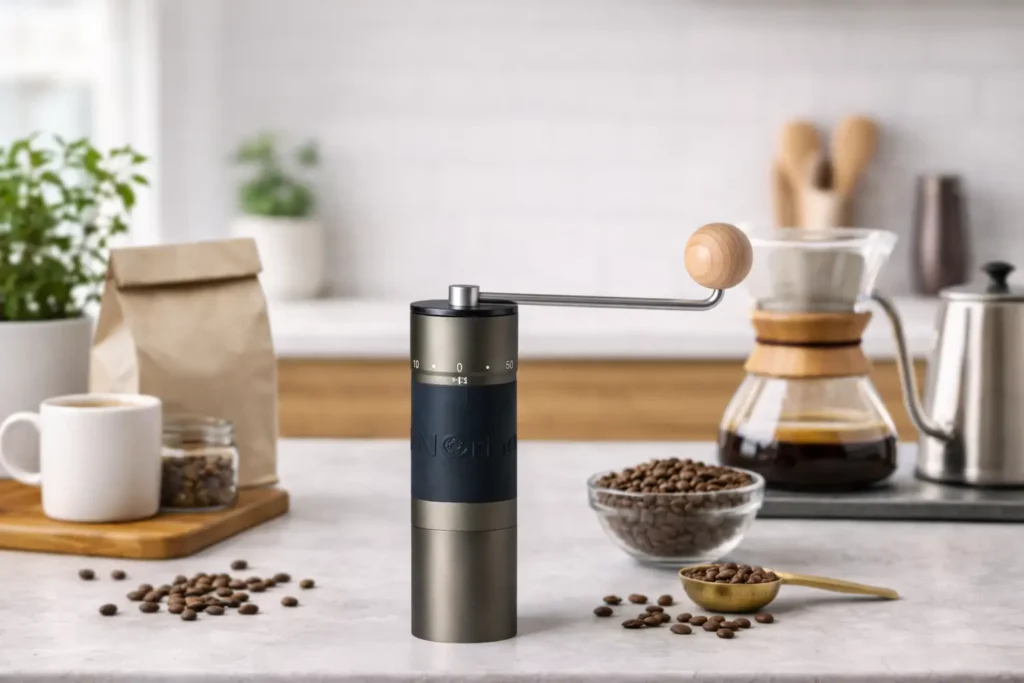
KINGrinder K6 — Best Manual Grinder for V60 and Kalita
The KINGrinder K6 is the CoffeeGearHub standard recommendation for all non-espresso brewing — and it’s the grinder referenced throughout this guide’s grind settings. For pour-over specifically, its 100-click adjustment system gives you genuine dial-in precision in the medium-fine range: each click produces a measurable change in drawdown speed and flavor. At V60 medium-fine settings (approximately 35–50 clicks), the 48mm stainless conical burrs produce consistent particles with low fines output — exactly what a cone dripper needs to avoid channeling and produce clean extraction. For the Kalita, medium settings (40–55 clicks) produce the reliable, even saturation that makes the flat-bottom’s sweetness character most pronounced. A single solo cup dose (18–22g) grinds in under 75 seconds at pour-over settings — entirely practical as a daily habit.
- V60 setting (medium-fine): approximately 35–50 clicks from zero, adjusted by roast level
- Kalita setting (medium): approximately 40–55 clicks from zero, adjusted by roast level
- Also covers: French press (65–80 clicks), AeroPress (20–30 clicks), drip (32–42 clicks)
- Best for: Solo to couple daily pour-over; anyone who wants one grinder for all non-espresso methods; travel
Disclosure: CoffeeGearHub may earn from qualifying purchases. ASIN: B09W9Q7GNK
☕ New to pour-over? See the full beginner gear guide for every item in the right purchase order.
Troubleshooting Matrix: Pour-Over Problems → Causes → Fixes
Change one variable at a time. Re-brew. Taste. Repeat. Most pour-over problems are grind problems — confirm that first before adjusting anything else. The table below covers both drippers; notes where the fix differs by dripper type.
| Symptom | Most likely cause | Fix — in order | Dripper note |
|---|---|---|---|
| Sour / sharp / thin body | Under-extraction — grind too coarse, water too cool, or brew time too short | Grind 2–3 clicks finer first → confirm water temp is 200°F+ for light roast → if brew time is under 2:30, also slow your pour | More common with V60 due to faster natural drawdown |
| Bitter / harsh / drying finish | Over-extraction — grind too fine, water too hot, or brew time too long | Grind 2–3 clicks coarser first → confirm water temp is not above 205°F → if brew stalling, grind coarser before adjusting anything else | More common with Kalita if grind is too fine for the restricted exit |
| Weak / watery / hollow | Under-dosed, grind too coarse, or too high a water ratio | Confirm dose at 1:15 ratio → grind 2–3 clicks finer → if already correct, check beans are not stale | Both drippers equally affected by dose errors |
| Simultaneously bitter AND weak | Blade grinder or severely worn burrs producing mixed particle sizes — cannot be fixed by any recipe change | Replace with a quality burr grinder — this symptom combination is the blade grinder signature and cannot be fixed otherwise | Both drippers; no dripper change helps |
| Brew drains too fast (under 2:15 total) | Grind too coarse — water passing through before extracting | Grind 3–4 clicks finer → confirm dose is correct and filter is seated properly | More pronounced with V60; Kalita’s resistance partially compensates |
| Brew stalls or takes over 4:30 | Grind too fine — basket clogging; or fines migrating into filter | Grind 3–4 clicks coarser → check filter is sealed against dripper walls with no gaps → if V60, confirm you’re not over-agitating during pours | Kalita more prone to stalling if grind is too fine due to restricted exit |
| Channeling — uneven or fast drains on one side | Uneven pour saturating one section of the coffee bed more than others | Use a slow, steady spiral starting at centre and moving outward → consider a brief Rao spin (swirl the slurry once immediately after bloom) → grind slightly finer to slow flow and give even saturation more time | More common with V60; Kalita’s flat bed and restricted exit reduce channeling significantly |
| Flat / bland / no clarity | Stale beans, water too cool, or grind too coarse for the roast level | Check bean roast date (pour-over benefits most from beans roasted within 2–3 weeks) → raise water temp 2–3°F → grind slightly finer | More noticeable with V60 where clarity is the primary advantage |
| Paper / cardboard taste | Filter not properly rinsed before brewing | Rinse filter thoroughly with freshly boiled water before adding grounds — discard all rinse water and re-preheat dripper if needed | More noticeable with Kalita wave filters, which are thicker |
| Inconsistent cup-to-cup at same settings | Dose variation from volume scooping, or grinder producing inconsistent output session to session | Weigh every dose on a kitchen scale → confirm grinder setting hasn’t shifted → if using a blade grinder: replace it — inconsistency is the mechanism, not a setting problem | Both drippers — scale is non-negotiable for consistency |
🔧 Still getting inconsistent results? Use the full pour-over troubleshooting guide for a step-by-step diagnosis.
Who Should Buy What?
| If you are… | Choose this | Why |
|---|---|---|
| New to pour-over | Kalita Wave 185 | More consistent results while you build technique. Fewer “bad cups” early on means faster learning and better enjoyment. |
| Chasing clarity, brightness, or single-origin character | V60 02 | Higher flavor “ceiling” when technique is dialed. Light-roast single origins express more through a cone than a flat-bottom. |
| Using an entry-level grinder | Kalita Wave 185 | More forgiving of imperfect grind distribution. Grind inconsistency is smoothed out by the restricted exit — it doesn’t disappear, but it’s less punishing. |
| Brewing on rushed mornings or for multiple people | Kalita Wave 185 | Technique variation matters less. You’ll get consistent, good cups even when you’re not fully present during the brew. |
| You enjoy technique exploration and dialing | V60 02 | Responds immediately and noticeably to small technique changes. Every variable you understand improves the cup — enjoyable if you like the process. |
| You already own one and want to compare | Buy the other | V60 and Kalita are inexpensive enough that owning both is accessible. Tasting both with the same beans on the same day is the best way to understand the real flavor difference. |
| You want a deeper three-way comparison | See the full comparison | V60 vs Chemex vs Kalita Wave (Deep Comparison) |
FAQs: Flat Bottom vs Cone Pour Over
Is a flat-bottom dripper easier than a V60?
Usually, yes. Flat-bottom drippers like the Kalita Wave are more forgiving because the flatter coffee bed and restricted multi-hole exit smooth out small pouring inconsistencies. The V60 responds more strongly to pour technique and grind variation — which means a higher potential ceiling but also more variable results on off days.
Which dripper tastes better: V60 or Kalita Wave?
Neither is universally better. The V60 often delivers higher clarity and brighter acidity when technique is dialed in — especially with light-roast single origins. The Kalita more consistently produces sweetness and balance with less effort. Your grinder and bean quality matter more than which dripper you choose.
What grind size should I use for V60 vs Kalita?
Start medium-fine for V60 and medium for Kalita. On the KINGrinder K6: V60 is approximately 35–50 clicks from zero; Kalita is approximately 40–55 clicks. If coffee tastes sour or weak, grind slightly finer. If it tastes bitter or drying, grind slightly coarser. Use the Coffee Grind Sizes chart as your baseline: https://www.coffeegearhub.com/coffee-grind-sizes/.
Why does my V60 taste sour or bitter so often?
Most often: grind inconsistency, uneven pouring, or incorrect brew time. Sour usually means under-extraction — grind 2–3 clicks finer. Bitter usually means over-extraction — grind 2–3 clicks coarser. If it swings between both in the same session, the grinder is the problem, not the recipe. For a step-by-step diagnosis, use the Pour-Over Troubleshooting guide: https://www.coffeegearhub.com/pour-over-troubleshooting/.
Do I need a gooseneck kettle for V60 or Kalita?
It helps a lot for both, especially V60. A gooseneck kettle gives you precise flow control that reduces channeling and over-agitation in the coffee bed. For the V60, controlled pouring is a major part of technique. For the Kalita, it matters less — but still produces more consistent results than a standard kettle. See our full gooseneck kettle guide: https://www.coffeegearhub.com/best-gooseneck-kettles/.
If I only buy one dripper, which should it be?
For most people, the Kalita Wave 185 is the safer first dripper — more consistent results while you build technique. If you’re excited to learn technique and want to chase clarity and single-origin character, choose the V60 02. Either produces excellent coffee with a quality burr grinder and a kitchen scale.
Can I use Kalita Wave filters in a V60 dripper?
No — the filters are not interchangeable. Kalita Wave filters are flat-bottomed with crimped sides designed specifically for the Wave dripper’s geometry. V60 filters are conical. Using the wrong filter will significantly change flow rate and extraction. Always use the filter designed for your specific dripper model.
What water temperature is best for V60 vs Kalita Wave?
For light and medium roasts: 200–205°F (93–96°C) for both drippers. For medium-dark and dark roasts: 195–200°F (90–93°C). Water temperature affects extraction rate independently of grind — too cool produces under-extraction even at a correct grind setting. A temperature-controlled electric gooseneck kettle removes this variable entirely.
How many cups can I brew with a V60 02 or Kalita Wave 185?
Both are designed for 1–2 large cups per brew. For a single large cup, use 15–20g coffee at a 1:15 ratio (225–300g water). For two cups, use 28–32g. Both drippers handle up to about 600ml per session, but consistency is best at smaller doses. For larger batches, consider the V60 03 or Kalita Wave 185 larger capacity versions.
Does dripper material — plastic vs ceramic vs glass — affect flavor?
No — material has no direct effect on flavor. The practical difference is heat retention: ceramic and glass lose heat to the environment during brewing; plastic retains heat better. The solution is the same regardless: rinse the filter and preheat the dripper thoroughly with hot water before every brew. A preheated plastic V60 performs identically to a ceramic one.
Continue Learning
POUR-OVER GUIDES
Ready to choose your grinder? The Best Burr Grinders for Pour-Over guide covers every option from the KINGrinder K6 through step-up electric picks — matched to both V60 and Kalita brewing.
☕
Written by the CoffeeGearHub Editorial Team
CoffeeGearHub is a specialty coffee equipment resource run by home brewers and coffee enthusiasts. Our guides are researched using published brewing science, SCA standards, grinder manufacturer specifications, and established specialty-coffee community knowledge. We review and update our pillar content regularly. About CoffeeGearHub →