
Pour Over Water Temperature: The Complete Guide
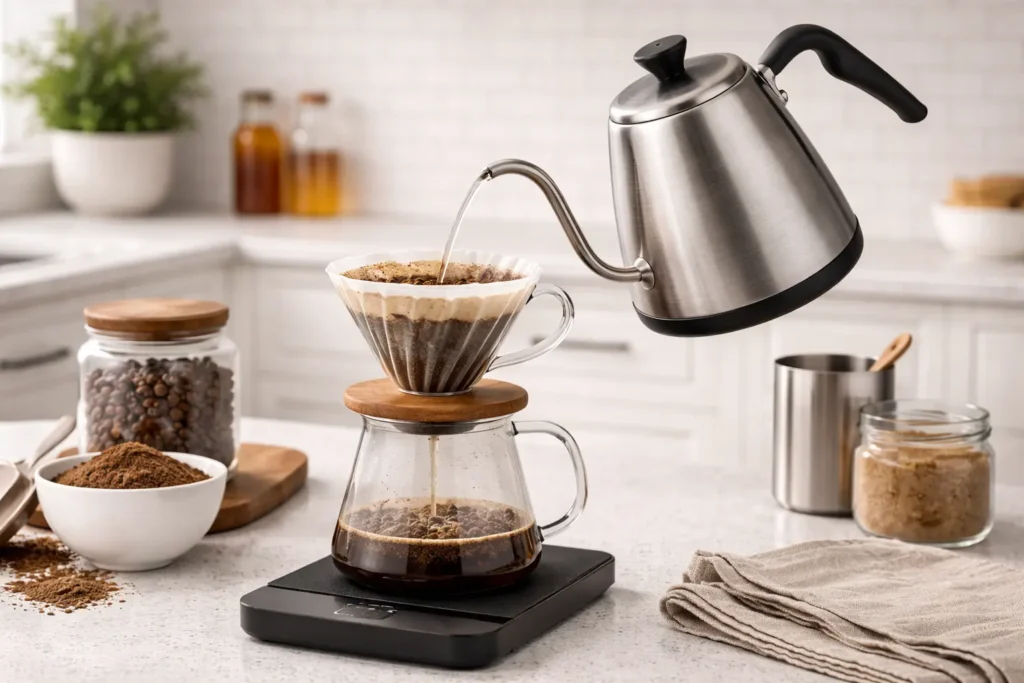
Editorial standards: temperature recommendations are presented as starting ranges and diagnostic tools, not fixed rules. Grind, roast, brewer, ratio, water, and altitude are considered together.
At a glance
What this guide covers
Most pour-over coffee starts well around 195–205°F, but roast level and extraction behavior determine where inside that range you should brew. This guide explains how to diagnose temperature, adjust without a thermometer, and account for brewer material and altitude.
Editorial analysis
Temperature is a refinement variable once grind and flow are close
Changing water temperature is most useful when drawdown is already reasonable but flavor still needs more or less extraction. If the brew is obviously too fast or too slow, grind usually deserves attention first.
Water Temperature Changes How Quickly Coffee Extracts
Hotter water generally extracts soluble coffee compounds more quickly. Cooler water slows that process. That makes temperature a powerful adjustment, but it works alongside grind size, ratio, roast level, agitation, and brew time rather than replacing them.
For most pour-over coffee, a useful starting range is roughly 195–205°F / 91–96°C. The right point inside that range depends on the coffee and the rest of the recipe. Light roasts often benefit from hotter water because they are denser and less soluble. Darker roasts can become harsh when pushed with very hot water and a fine grind.
A Practical Pour-Over Temperature Range
| Starting range | When it makes sense | What to watch for |
|---|---|---|
| 200–205°F / 93–96°C | Light roasts, dense coffees, recipes that need more extraction | Dryness or harshness if grind/agitation are already aggressive |
| 195–200°F / 91–93°C | Medium roasts and general-purpose starting point | Use taste and drawdown to decide whether to move |
| 185–195°F / 85–91°C | Darker roasts or coffees tasting harsh at hotter settings | Thinness or muted sweetness if temperature drops too far |
Temperature control options
Three kettle approaches for pour-over
A temperature-controlled electric kettle is convenient, but it is not mandatory. These three options represent premium variable-temperature, value variable-temperature, and stovetop workflows.
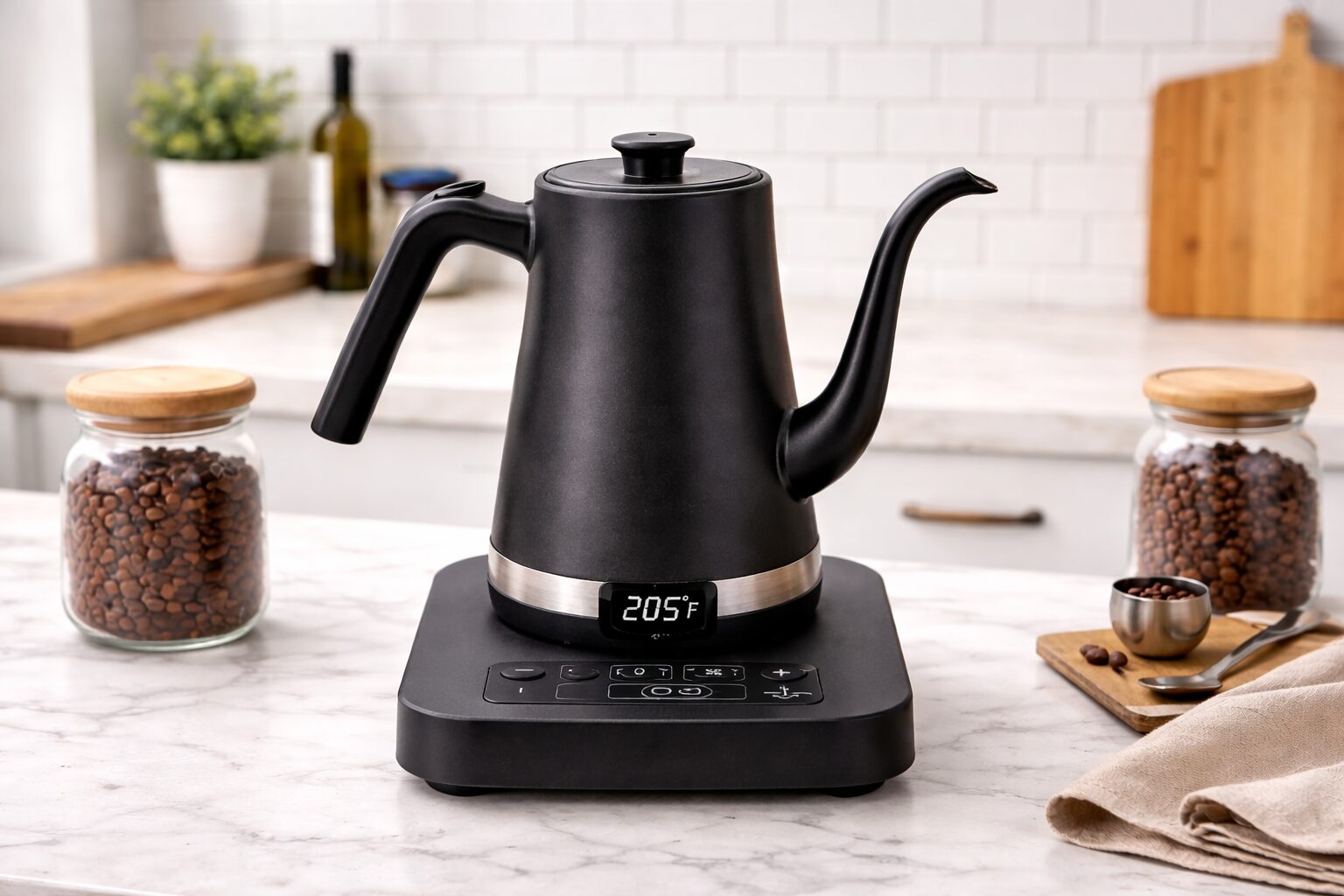 Fellow Stagg EKGVariable-temperature control with a pour-focused gooseneck and hold function.View on Amazon →
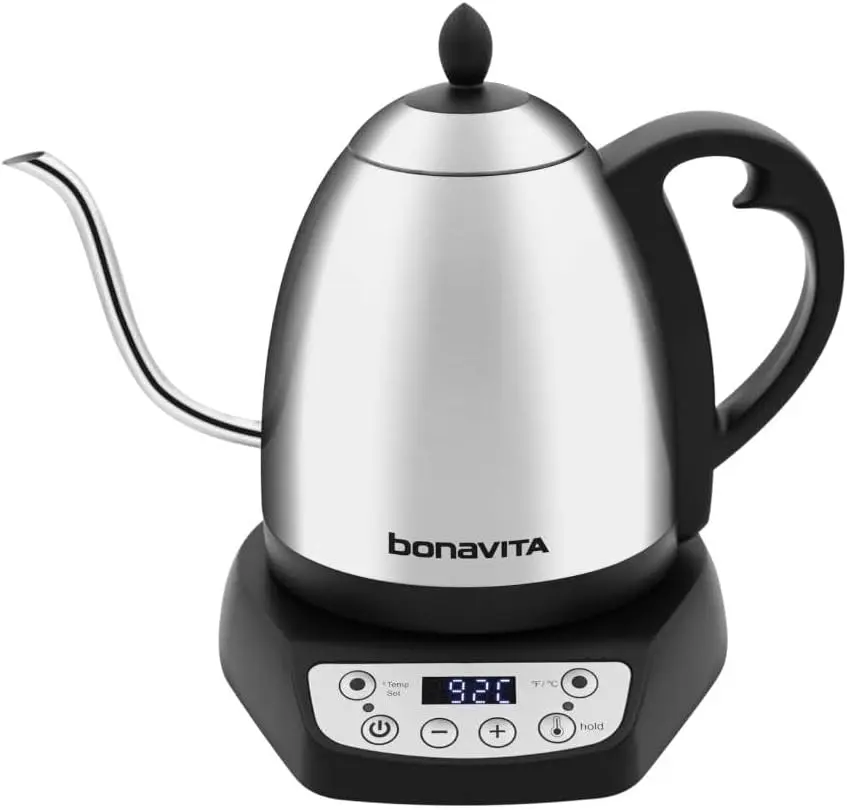 Bonavita Variable TemperatureStraightforward digital temperature control at a lower price point.View on Amazon →
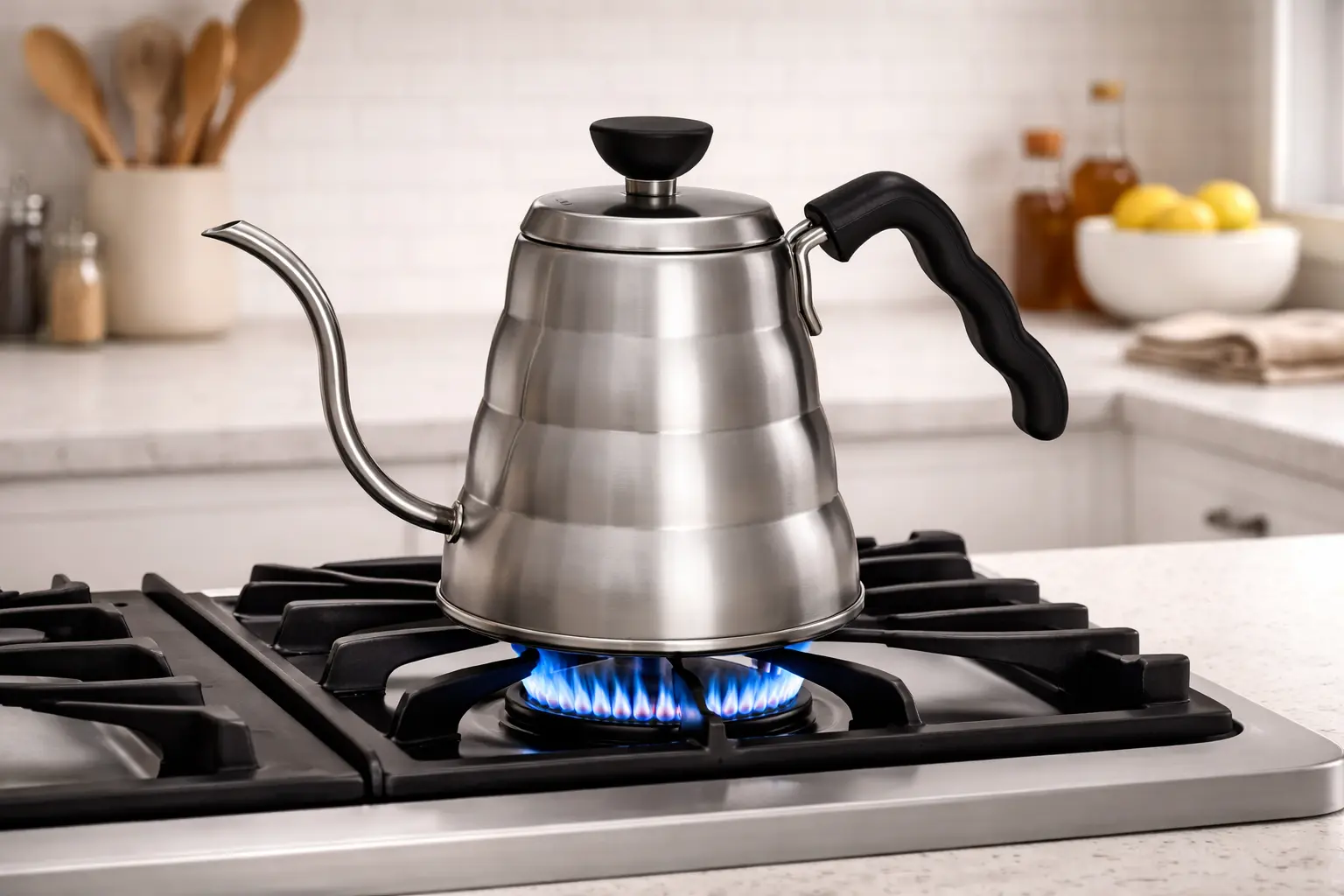 Hario V60 BuonoStovetop gooseneck for users who prefer an off-boil or thermometer workflow.View on Amazon →
Affiliate disclosure: These links may earn CoffeeGearHub a commission at no additional cost to you. As an Amazon Associate, we earn from qualifying purchases.
Adjust Temperature by Roast Level, Then Let Taste Override the Rule
Roast level is a useful first cue because roasting changes coffee structure and solubility. Light roasts often need more extraction energy. Darker roasts extract more readily and may reveal roast bitterness when the recipe is too aggressive.
| Roast | Starting temperature | Typical adjustment |
|---|---|---|
| Light | 200–205°F | Go hotter if the cup stays sharp or hollow after grind is close |
| Medium | 195–202°F | Use taste rather than chasing a specific number |
| Dark | 185–195°F | Go cooler if roast bitterness or dryness dominates |
Use Temperature to Fine-Tune a Recipe, Not to Rescue a Bad Grind
If a brew is obviously racing through the filter, grind size is usually the more direct fix. If drawdown looks reasonable but a light roast still tastes under-extracted, temperature becomes a cleaner adjustment because it can increase extraction without changing flow.
| Symptom | Temperature move | Check first |
|---|---|---|
| Sour, hollow, but drawdown is normal | Increase slightly | Confirm ratio and coffee freshness |
| Bitter, harsh, drying, drawdown normal | Decrease slightly | Confirm roast level and agitation |
| Very fast and sour | Do not lead with temperature | Grind finer first |
| Very slow and bitter | Do not lead with temperature | Grind coarser / reduce agitation first |
No Thermometer? Use an Off-Boil Method Consistently
A temperature-controlled kettle is convenient because it removes one variable, but a thermometer is not required to make good pour-over. At typical near-sea-level conditions, freshly boiled water cools predictably once heat is removed and the kettle is opened.
For a light or medium roast, pouring soon after boil is a reasonable starting point. For darker coffee, wait longer before brewing. The exact temperature will depend on kettle material, room temperature, water volume, and altitude, so consistency matters more than pretending an off-boil method gives laboratory precision.
Dripper Design Changes How Temperature Is Retained
Brewer material and geometry affect slurry heat. Plastic V60s heat quickly and tend to lose less energy during brewing than thick ceramic. Glass and metal also benefit from preheating. Kalita Wave and Chemex systems introduce different paper mass and brewer mass, which can change how much heat is lost before water reaches the coffee bed.
| Brewer factor | Temperature implication |
|---|---|
| Plastic dripper | Usually needs less preheating; stable practical choice |
| Thick ceramic/glass | Preheat well to reduce early slurry cooling |
| Chemex + bonded paper | Large glass vessel and thick paper make preheating useful |
| Small metal brewer | Can pull heat quickly if used cold |
Kettle Display Temperature Is Not the Same as Slurry Temperature
A digital kettle may show 200°F, but the coffee bed usually experiences something lower. Heat is lost as water leaves the kettle, travels through the air, contacts the brewer, wets the paper, and enters the coffee. The colder and heavier the brewer, the larger that early temperature drop can be.
This is why preheating matters most with thick ceramic, glass, and large Chemex vessels. A plastic V60 tends to absorb less heat, so the difference between kettle temperature and slurry temperature can be smaller. Two brewers using the same kettle setting can therefore extract differently even before grind and flow are considered.
| Source of heat loss | Effect | Practical response |
|---|---|---|
| Cold ceramic or glass brewer | Pulls heat from the first part of the brew | Preheat thoroughly with hot rinse water |
| Cold serving vessel | Cools brewed coffee immediately | Preheat carafe or mug if temperature stability matters |
| Slow, exposed pour | More heat lost between kettle and slurry | Do not over-interpret a kettle display as exact brew-bed temperature |
| Large batch | More total thermal mass; can stabilize after initial loss | Focus on consistent preheating and recipe repeatability |
Preheating Makes Temperature Recommendations More Transferable
A recipe calling for 200°F water assumes the brewer is not stealing a large amount of heat at the start. Rinsing the filter with hot water serves two jobs: it removes loose paper flavor and warms the brewing hardware. That makes the temperature at the coffee bed more repeatable from one brew to the next.
For a plastic V60, a quick rinse is usually enough. Ceramic and glass benefit from a more thorough preheat. Chemex needs attention because both the thick filter and the large glass vessel can absorb heat. Consistency is more important than chasing an exact preheat duration.
Water Chemistry and Temperature Work Together
Temperature changes how quickly coffee dissolves, but the water itself determines what can dissolve effectively. Very hard water can suppress acidity and make a hotter brew taste heavy. Extremely soft or poorly buffered water can make acidity feel sharp even when the temperature is reasonable.
If temperature changes never seem to improve a brew, water chemistry may be the limiting factor. Before pushing hotter and hotter, make sure the water tastes clean and is suitable for coffee. Temperature cannot compensate for chlorine, stale filter cartridges, or extreme mineral balance.
Batch Size Changes Thermal Stability
Small brews lose heat more quickly because there is less total thermal mass. A 15-gram V60 dose can cool faster than a 40-gram Chemex batch even if both start with the same kettle setting. Larger batches may therefore maintain temperature better, but they also run longer and create more resistance through the coffee bed.
When scaling a recipe up, do not automatically raise water temperature just because the brew is larger. First watch drawdown and taste. The larger thermal mass may already keep the slurry hotter for longer.
Use Brewer Design to Interpret Temperature, Not to Create Separate Rules
There is no need for completely different temperature charts for V60, Kalita Wave, and Chemex. The same general 195–205°F range works across all three. The difference is how each brewer loses heat and how filter resistance interacts with extraction.
| Brewer | Temperature consideration | What usually matters more |
|---|---|---|
| V60 | Plastic versions retain practical brew heat well | Grind and pour rate strongly affect extraction |
| Kalita Wave | Metal models can start cold; preheat helps | Outlet resistance and agitation |
| Chemex | Large glass body and thick paper absorb more heat | Preheating, grind, and batch size |
Run a Controlled Temperature Test Instead of Guessing
To learn whether temperature is actually the variable holding a coffee back, keep dose, ratio, grind, filter, and pouring identical. Brew once at your normal setting, then move 5°F hotter or cooler for the second brew. Taste the cups side by side once they have cooled to a similar drinking temperature.
If the hotter brew is sweeter and more complete without becoming drying, the coffee likely benefits from more extraction. If the cooler brew becomes cleaner and less harsh without turning hollow, you were probably extracting too aggressively. A third brew with a smaller adjustment can refine the range.
This approach is more reliable than changing temperature, grind, and ratio together. It also teaches you how sensitive a particular coffee is to temperature, which makes future dial-in faster.
Altitude Changes the Maximum Water Temperature Available
Water boils at a lower temperature as elevation increases because atmospheric pressure decreases. That means a brewer at high altitude may never reach the same water temperature as someone near sea level, even with the kettle at a full boil.
Do not treat this as a reason to abandon pour-over. Use the hottest practical water available for dense light roasts, then compensate with grind, contact time, and agitation if more extraction is needed. The cup remains the final reference.
A Simple Temperature Dial-In Method
Start with a stable grind and ratio. Brew once at a neutral temperature appropriate for the roast. If the cup tastes under-extracted but the flow is already reasonable, raise temperature by a small step. If the cup tastes harsh or drying, lower it. Avoid changing grind and temperature at the same time unless the brew is clearly far outside a workable range.
| Brew | Temperature action | Goal |
|---|---|---|
| 1 — Baseline | Use the roast-level starting range | Establish flavor and drawdown |
| 2 — Direction test | Move 3–5°F hotter or cooler | See whether extraction improves without changing flow |
| 3 — Refinement | Use a smaller temperature adjustment | Find the zone where sweetness and finish improve |
Brewing Temperature and Drinking Temperature Are Different Questions
A coffee brewed hotter will not necessarily taste “hotter” in the way that matters for flavor evaluation. As the cup cools, sweetness, acidity, and bitterness become easier to distinguish, which is why a brew that seems harsh immediately after pouring may taste balanced several minutes later.
Judge recipe changes at a similar drinking temperature whenever possible. Otherwise, a hotter brew may be penalized simply because it is being tasted sooner, while a cooler brew seems sweeter because it has already reached a more comfortable tasting range. Brewing temperature controls extraction; serving temperature controls how clearly you perceive the result.
Temperature Control Is Useful, but Pour Control Still Matters
A variable-temperature kettle solves temperature repeatability. A gooseneck solves water-delivery control. Many electric pour-over kettles provide both, but if the budget forces a choice, decide which uncertainty is causing more problems. Someone already using a thermometer may benefit more from a controlled gooseneck. Someone with good pouring technique but inconsistent water temperature may benefit more from digital temperature control. Our Fellow Stagg EKG review shows how one popular kettle handles both, including how accurate its temperature display really is.
FAQs: Pour Over Water Temperature
What is the best water temperature for pour over coffee?
A practical starting range for most pour-over coffee is about 195–205°F (91–96°C). Light roasts often benefit from the hotter end, around 200–205°F, because they are generally less soluble. Medium roasts often work well around 195–202°F, while darker roasts may taste cleaner around 185–195°F if hotter water emphasizes roast bitterness. Treat these as starting points and let taste override the number.
Can I use boiling water for pour over coffee?
Yes. Water at or near boiling is not automatically too hot for pour-over, and many light roasts can work well with very hot water. At sea level, boiling water begins near 212°F (100°C), but it cools as it leaves the kettle and enters the slurry. For darker roasts, a short cooling period can reduce harshness. Adjust by taste rather than assuming boiling water always causes over-extraction.
What temperature is too low for pour over?
There is no single cutoff that is wrong for every coffee, but water below about 185°F (85°C) usually makes extraction more difficult in a standard pour-over recipe. If the cup tastes sour, thin, or hollow while drawdown and grind are otherwise reasonable, raising the water temperature is a sensible next adjustment.
Does water temperature matter more than grind size for pour over?
Usually no. Grind size is the larger lever because it changes both flow and extraction. Temperature is most useful after drawdown and grind are already close. If the brew is racing through or stalling badly, correct the grind first; then use temperature to fine-tune flavor.
Do I need a temperature-controlled kettle for pour over?
No. A variable-temperature gooseneck kettle improves repeatability, but you can brew well with a standard kettle plus a thermometer or with a consistent off-boil routine. The biggest benefit of digital temperature control is reducing one source of day-to-day variation.
How does water temperature affect pour over taste?
Hotter water generally increases extraction rate, while cooler water reduces it. If a light roast tastes sharp or hollow after grind and flow are close, a hotter brew may help. If a darker roast tastes harsh or drying, a cooler brew may help. Temperature works together with grind size, ratio, agitation, water chemistry, and brew time rather than acting alone.
Should I use different temperatures for different pour over drippers?
Use the same broad starting range, then account for each brewer’s thermal behavior. A thick ceramic dripper that is not preheated may lose more heat than plastic, while larger batches retain heat better than small ones. Brewer material, preheating, flow resistance, and batch size matter more than assigning a fixed temperature to each dripper shape.
What is the best gooseneck kettle for pour over?
Choose based on the control you actually need. The Fellow Stagg EKG is a premium variable-temperature option with pour-focused controls, Bonavita variable-temperature kettles are a simpler value-oriented approach, and the Hario V60 Buono is a stovetop option for users who prefer to manage temperature separately. Capacity, flow control, serviceability, and price should decide the fit.
Does altitude affect pour over water temperature?
Yes. Water boils at a lower temperature as elevation increases. Around 5,000 feet, the boiling point is roughly 202°F, and around 8,000 feet it is roughly 198°F. At high elevation, brew close to the local boiling point; liquid water cannot be held above that boiling point at normal atmospheric pressure. If extraction is still low, compensate with grind size, agitation, ratio, or contact time rather than trying to set the kettle above the local boiling temperature.
Can I use the off-boil method instead of a thermometer?
Yes, but treat timing rules as approximate because cooling rate changes with kettle material, water volume, room temperature, lid design, and altitude. Use the same kettle, fill level, and waiting interval each time. Light roasts generally need a shorter wait and hotter water; darker roasts can use a longer wait if the cup tastes harsh.
CoffeeGearHub shortlist
Connect temperature with the rest of the brewing system
Continue Learning
In this guide
- Water Temperature Changes How Quickly Coffee Extracts
- A Practical Pour-Over Temperature Range
- Adjust Temperature by Roast Level, Then Let Taste Override the Rule
- Use Temperature to Fine-Tune a Recipe, Not to Rescue a Bad Grind
- No Thermometer? Use an Off-Boil Method Consistently
- Dripper Design Changes How Temperature Is Retained
- Kettle Display Temperature Is Not the Same as Slurry Temperature
- Preheating Makes Temperature Recommendations More Transferable
- Water Chemistry and Temperature Work Together
- Batch Size Changes Thermal Stability
- Use Brewer Design to Interpret Temperature, Not to Create Separate Rules
- Run a Controlled Temperature Test Instead of Guessing
- Altitude Changes the Maximum Water Temperature Available
- A Simple Temperature Dial-In Method
- Brewing Temperature and Drinking Temperature Are Different Questions
- Temperature Control Is Useful, but Pour Control Still Matters
- FAQs: Pour Over Water Temperature