

Last updated: January 2026
Grind size is the #1 lever you can control for better coffee at home. If your coffee tastes sour, bitter, weak, or muddy, grind size is often the fastest fix—sometimes faster than changing beans or buying a new brewer.
This guide explains how grind size affects extraction, the best grind size for each brewing method, and a simple step-by-step process to dial in your coffee. It’s written for home brewers using common gear (drip, pour-over, French press, AeroPress, moka pot, and espresso).
Quick navigation: Jump to Grind Size Chart • Grind by Brewing Method • How to Dial In • Common Mistakes • FAQ
What Is Grind Size (Really)?
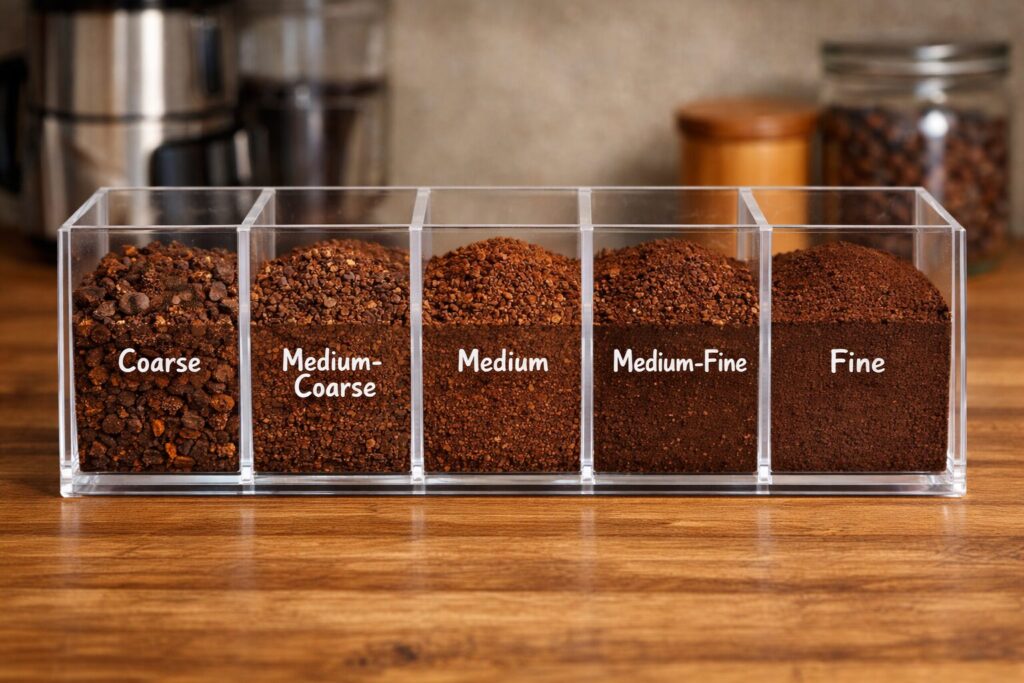
Grind size describes how coarse or fine your coffee particles are after grinding. But what matters isn’t the label—it’s what grind size controls during brewing:
- Surface area: finer grinds expose more surface area, extracting faster
- Flow rate: finer grinds slow water flow, coarser grinds speed it up
- Contact time: grind size changes how long water interacts with coffee
- Consistency: uneven grinds create both over- and under-extracted flavors in the same cup
That’s why grind size often has a bigger flavor impact than the brewer itself—especially for pour-over and espresso.
How Grind Size Affects Extraction (Under vs Over)
Coffee “extraction” is the process of water dissolving flavor compounds from coffee grounds. Grind size is the main control knob for extraction speed.
Too Coarse = Under-Extraction
- Sour / sharp acidity
- Thin body
- Weak sweetness
- Short, hollow finish
Fix: grind slightly finer (or extend brew time)
Too Fine = Over-Extraction
- Bitter / harsh
- Dry, astringent finish
- Muted flavors
- Heavy, sometimes “chalky” body
Fix: grind slightly coarser (or shorten brew time)
Pro tip: If your coffee swings between sour and bitter from cup to cup, it’s often a consistency problem (uneven particles), not a recipe problem. That usually points back to the grinder.
Coffee Grind Size Chart (Coarse to Fine)
Use this chart as your starting point. Then dial in based on taste. (Different grinders label settings differently, so “medium” on one grinder may be “medium-fine” on another.)

Image to use: a labeled grind chart graphic. This can be a simple Canva chart with brew methods mapped to coarse/medium/fine ranges.
| Brew Method | Recommended Grind | Texture Reference | Common Taste Issue | Adjustment |
|---|---|---|---|---|
| Cold Brew | Extra Coarse | Peppercorn / chunky | Watery | Grind finer |
| French Press | Coarse | Sea salt | Muddy / bitter | Grind coarser |
| Drip Coffee | Medium | Table salt | Bitter | Grind coarser |
| Pour-Over (V60/Chemex) | Medium-Fine | Sand | Sour | Grind finer |
| AeroPress | Medium to Fine | Sand to fine | Weak | Grind finer |
| Moka Pot | Fine (not espresso-fine) | Fine sand | Bitter | Grind coarser |
| Espresso | Fine | Powdery | Fast shot (sour) | Grind finer |
| Turkish Coffee | Extra Fine | Powdered sugar | Gritty | Grind finer |
Choosing a grinder? Grind size consistency depends heavily on the grinder. A burr grinder gives you better control than a blade grinder—especially for pour-over and espresso.
Best Grind Size by Brewing Method (Detailed)
Below is what each brew method typically wants from your grind. Use these as starting points, then adjust one notch at a time until the cup tastes balanced.
French Press: Coarse Grind (Cleaner Cup, Less Sludge)

French press is full immersion (coffee sits in water for minutes). A coarse grind helps prevent over-extraction and reduces sediment. If your French press tastes harsh or looks muddy, grind a bit coarser and consider pouring gently to avoid disturbing settled grounds.
- If it’s sour/weak: grind slightly finer
- If it’s bitter/muddy: grind slightly coarser
Drip Coffee: Medium Grind (Most Automatic Brewers)

Most drip machines are designed around medium grind sizes to balance flow rate and extraction. If drip coffee tastes bitter, move coarser. If it tastes weak, move slightly finer (or increase dose).
Pour-Over (V60/Chemex): Medium-Fine Grind (Clarity + Sweetness)

Pour-over methods are sensitive to grind size because you control the flow. A medium-fine grind often gives better clarity and sweetness. If the brew drains too fast and tastes sharp, grind finer. If it stalls and tastes bitter, grind coarser.
Related: Manual vs Electric Coffee Grinders
AeroPress: Medium to Fine (Recipe-Dependent)

AeroPress can use a range of grind sizes because recipes vary. Start at medium-fine for most recipes. If your press feels too easy and tastes weak, grind finer. If it’s hard to press and tastes harsh, grind coarser.
Moka Pot: Fine (But Not Espresso-Fine)

Moka pot likes a fine grind, but usually not as fine as espresso. Too fine can choke flow and cause bitterness. Aim for fine sand texture and adjust from taste.
Espresso: Fine Grind (Small Changes Matter)

Espresso uses pressure and short brew times, so grind size is critical. If your shot runs fast and tastes sour, grind finer. If it runs slow and tastes bitter, grind coarser. Make one small change at a time.
Important: Not all burr grinders can grind finely or consistently enough for espresso. Espresso requires precise adjustment and repeatability.
If you’re shopping for espresso gear, also see: Best Espresso Machines for Beginners and Beginner Espresso Guide.
Why Burr Grinders Matter (Consistency & Control)
Grind size only works as a control lever if your grinder produces consistent particles. Inconsistent grinding creates both fines (over-extracted) and boulders (under-extracted) in the same brew.

Burr Grinders
- More uniform grind size
- Better adjustment control
- Better for pour-over and espresso
Blade Grinders
- Inconsistent particle size
- Limited adjustment control
- Harder to repeat results
If you’re still using a blade grinder, upgrading to a burr grinder is one of the fastest ways to improve coffee quality—often more than changing beans or brewers.
Related: Burr vs Blade Coffee Grinders
How to Dial In Grind Size (Simple Step-by-Step)
Dialing in is simply adjusting grind size until the coffee tastes balanced. The key is to change one variable at a time and make small moves.
- Pick the recommended grind size for your brew method (use the chart above).
- Brew with a consistent recipe (same dose, same water amount, same time).
- Taste and identify the main issue: sour/weak vs bitter/harsh.
- If sour/weak → grind slightly finer. If bitter/harsh → grind slightly coarser.
- Repeat until the cup tastes balanced and repeatable.
Shortcut: If you’re close but not perfect, adjust grind size first before changing dose or temperature.
Common Grind Size Mistakes (And What to Do Instead)
- Using a blade grinder for espresso: choose an espresso-capable burr grinder.
- Changing multiple variables at once: change grind size first, then dose/time.
- Grinding too fine for French press: go coarser to reduce sludge and bitterness.
- Expecting one setting for all methods: each brew style needs its own range.
- Ignoring old beans: coffee changes as it ages; small grind tweaks help.
Next step: If grind size adjustments aren’t fixing flavor issues, your grinder may be the limiting factor.
👉 See our full guide to the best coffee grinders for home brewing
Frequently Asked Questions
Is grind size more important than brew method?
They work together. Even a great brewer can’t compensate for an incorrect grind size or inconsistent particles. Matching grind size to your method is one of the fastest ways to improve results.
Can one grinder handle both espresso and drip?
Some grinders can cover both ranges, but espresso usually benefits from tighter adjustment control. If espresso is your priority, choose an espresso-capable grinder first, then confirm it’s convenient for filter coffee too.
Does grind size affect caffeine?
Indirectly. Grind size affects extraction efficiency, which can influence how much caffeine ends up in the cup. In practice, brew ratio and total coffee used have a larger effect.
Why does my grind “look right” but still taste wrong?
Two common reasons: (1) your grinder produces an uneven mix of fines and boulders, or (2) your recipe variables (dose, time, temperature) aren’t consistent. If the taste swings between sour and bitter, consistency is the first thing to check.
Final Thoughts
Grind size gives you real control over flavor. Start with the chart, make small adjustments, and keep the rest of your recipe consistent. If you want repeatable “great coffee” outcomes, a burr grinder and sensible grind dialing are the foundation.