Last Updated: March 2026 • 20–25 min read • Cornerstone Guide: Grind Science + Extraction + Grinder Picks
✍️ Editorial note: This guide is researched and written by the editors at CoffeeGearHub.com using published brewing science, grinder manufacturer specifications, and established specialty-coffee community knowledge. Recommendations reflect research consensus rather than in-house lab testing. All product links are affiliate links — we may earn a commission at no cost to you.
The 30-Second Answer
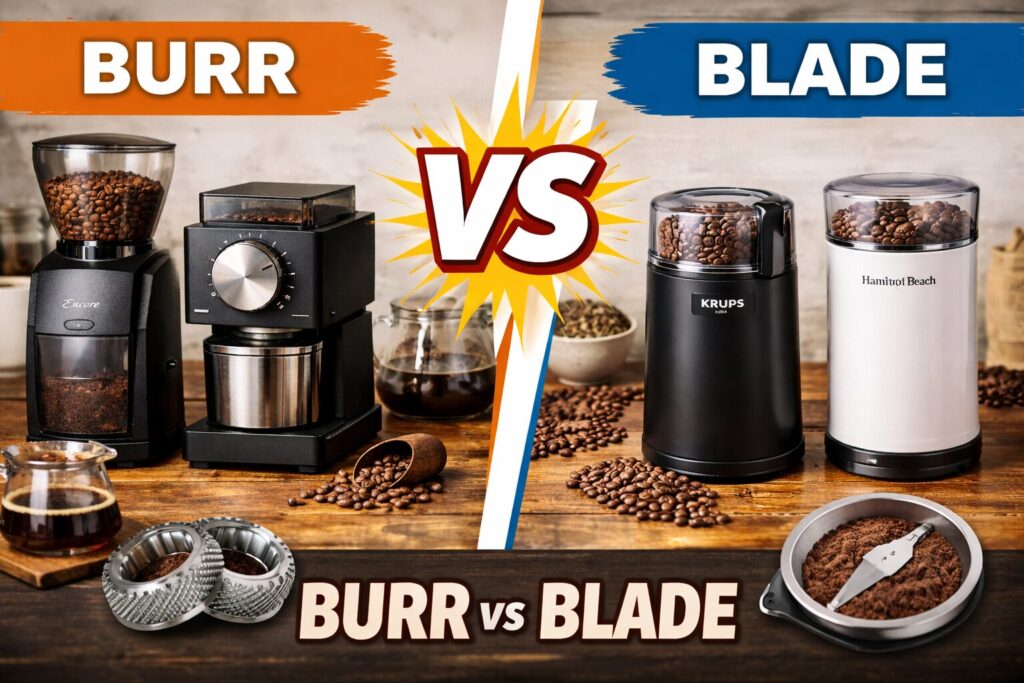
The question – Burr vs Blade coffee grinders is sometimes asked. Burr grinders are better for almost every brewing method. They crush beans between two precision surfaces to produce uniform particles, which extract evenly and taste clean and balanced. Blade grinders chop beans randomly with a spinning blade, producing a mix of powder and chunks that causes bitter and sour flavors simultaneously — a ceiling you cannot grind past no matter how good your beans or brewer are.
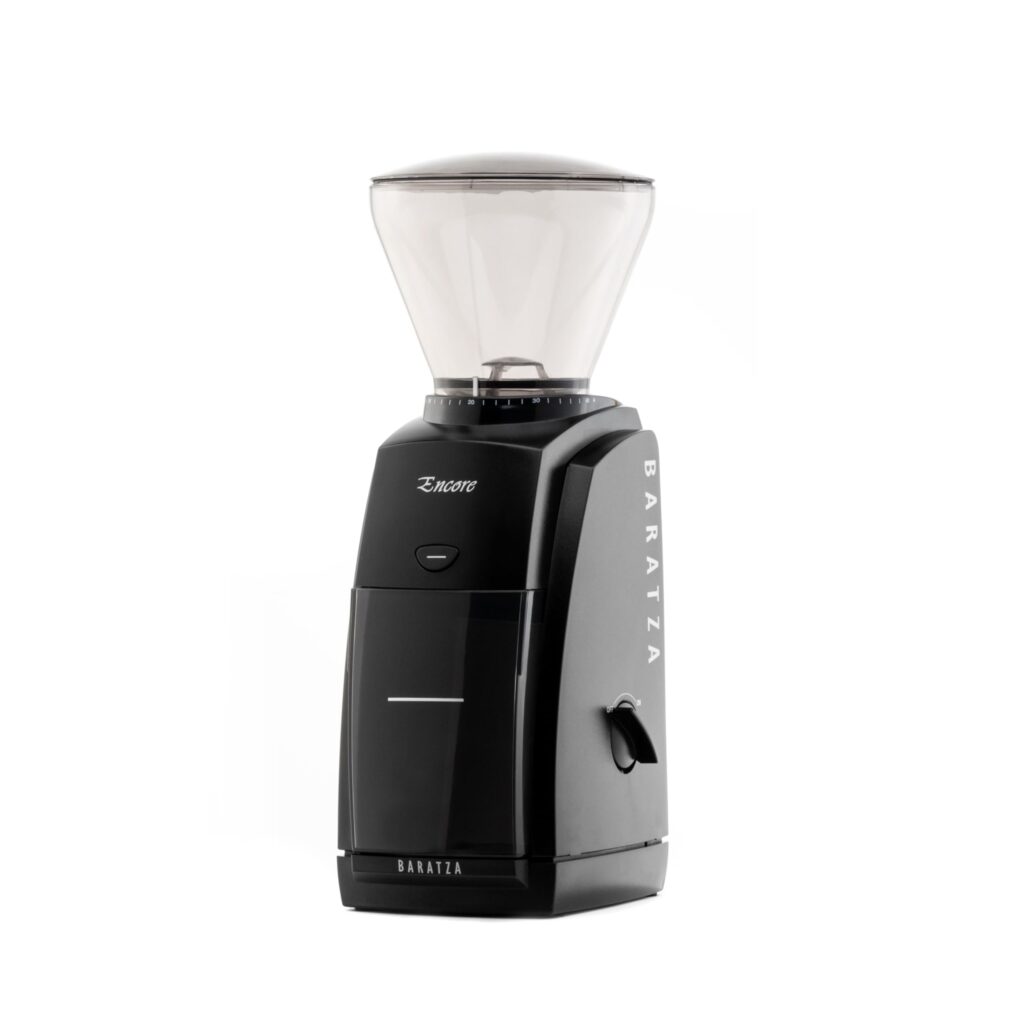
- Best entry-level electric: Baratza Encore — 40 grind settings, repairable, covers drip through pour-over
- Best value manual: KINGrinder K6 — outperforms any blade grinder at similar price, excellent for travel
- Fastest path: switch from blade to any burr grinder — the difference shows up in the first cup
Who This Guide Is For — Jump to What You Need
☕ Complete Beginner
Read the Quick Answer, then the Extraction Science and Which Should You Choose.
🔧 Troubleshooter
Jump straight to the Troubleshooting Matrix.
🛒 Ready to Buy
Go to Best Grinders for product picks at every price point.
🔬 Extraction Nerd
Read Extraction Science and Conical vs Flat Burr.
Table of Contents
Why Grind Consistency Makes or Breaks Your Cup
If you’ve ever brewed two cups from the same bag of coffee with the same brewer and gotten wildly different results, your grinder is almost certainly why. Grind consistency is the single biggest mechanical lever you have over flavor — more influential in most brewing scenarios than water temperature, brew time, or even bean quality.
The flavor in your cup isn’t stored in whole beans — it’s in the soluble compounds that hot water extracts from the ground coffee. This extraction process depends almost entirely on how uniformly your grounds are sized. Water can’t discriminate between a fine particle and a coarse chunk: it extracts both simultaneously, at different rates, producing two incompatible flavor profiles in the same cup.
Coffee extracts in a sequence. Early in the process, bright acidic compounds dissolve first. Sweet, balanced aromatics follow. Bitter, astringent compounds extract last. A well-extracted cup lands in the sweet middle range. The problem with uneven grind size — the defining characteristic of blade grinders — is that fine particles and coarse chunks don’t hit the sweet middle at the same time. Fines over-extract and turn bitter. Coarse pieces under-extract and stay sour. Both happen in every single brew.
🔬 If your coffee consistently tastes both sour and bitter at the same time: that’s the diagnostic signature of a blade grinder. It’s the number-one sign a burr grinder upgrade will produce immediate, obvious improvement.
What Is a Burr Grinder?
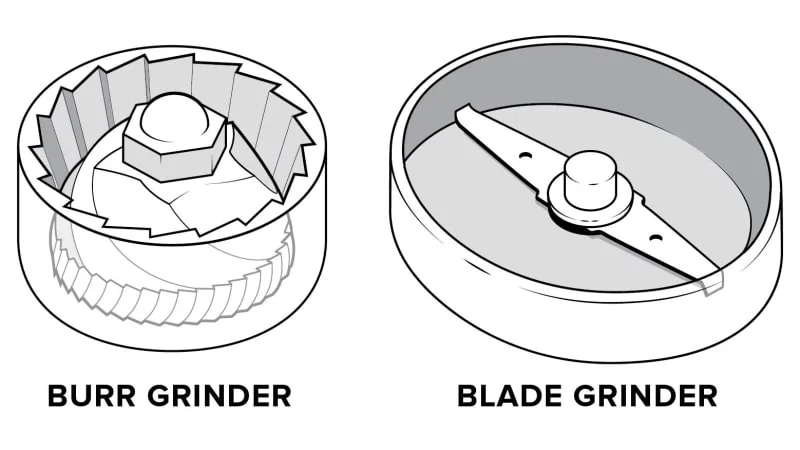
A burr grinder uses two abrasive surfaces — called burrs — set at a precise, adjustable distance. One burr rotates while the other stays fixed. Coffee beans fed between them are crushed to a size determined by the gap between the burrs. Change the gap, change the grind size. It’s mechanically precise and entirely repeatable — the same setting produces the same grind every time.
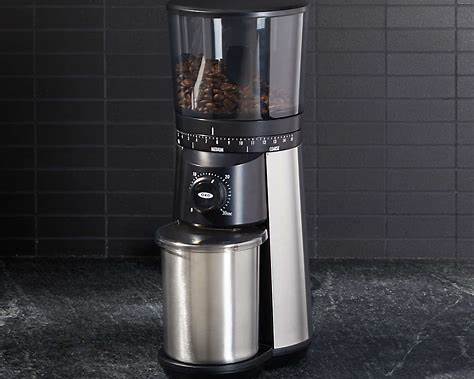
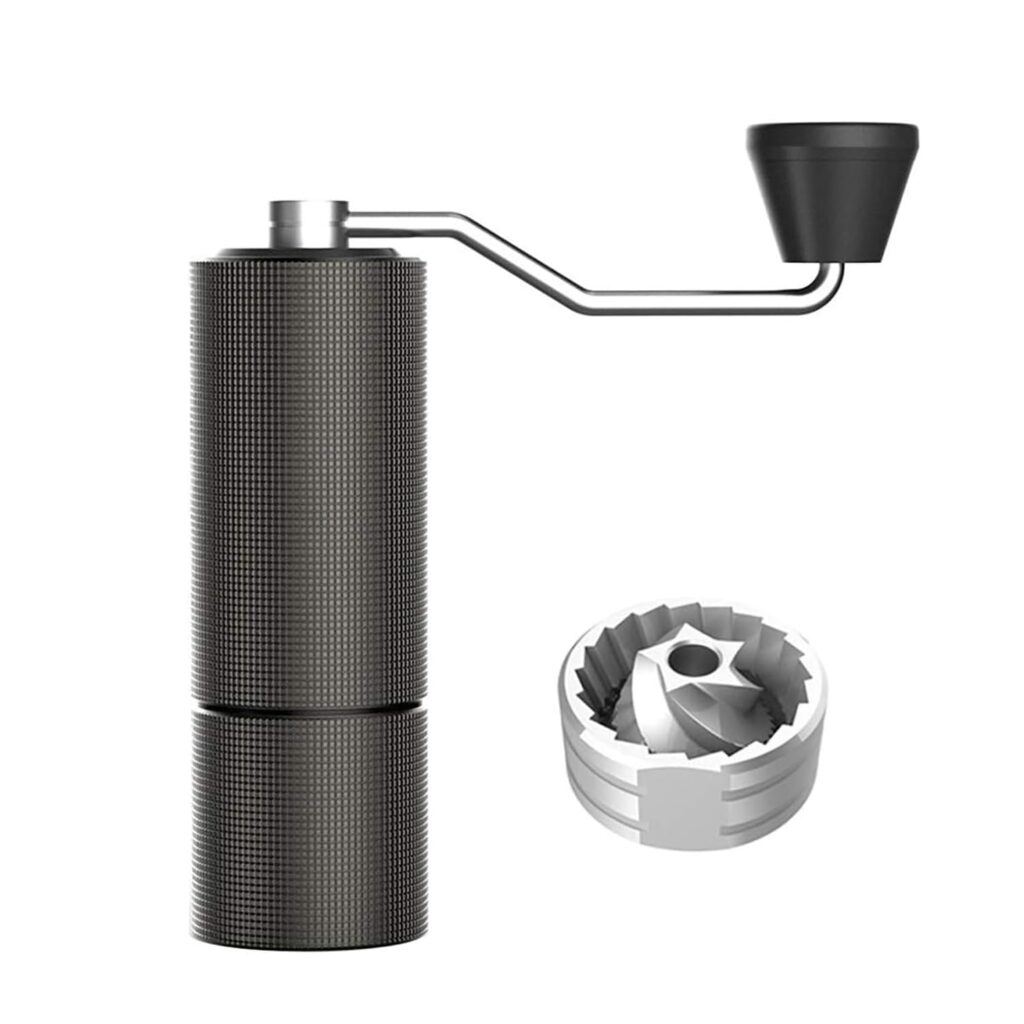
The mechanical advantage of a burr grinder shows up in three practical ways that blade grinders cannot replicate:
Controlled Grind Size
The gap between burrs determines particle size. Adjust the gap and every particle shifts accordingly — coarser for French press, medium for drip, finer for pour-over and AeroPress, very fine for espresso.
Repeatable Results
Because grind size is set by the burr gap rather than timing or guesswork, you get the same grind every time you use the same setting. This makes dialing in a recipe and improving systematically possible.
Full Brew Compatibility
Drip, pour-over, AeroPress, French press, cold brew, moka pot, and espresso all need different grind sizes. A burr grinder covers every method. A blade grinder covers none of them properly.
What Is a Blade Grinder?
A blade grinder uses a high-speed spinning metal blade to chop coffee beans — functionally identical to a spice grinder or miniature food processor. There is no adjustable gap, no precision grinding surface, no mechanism for controlling particle size. The only variable is how long you run it.
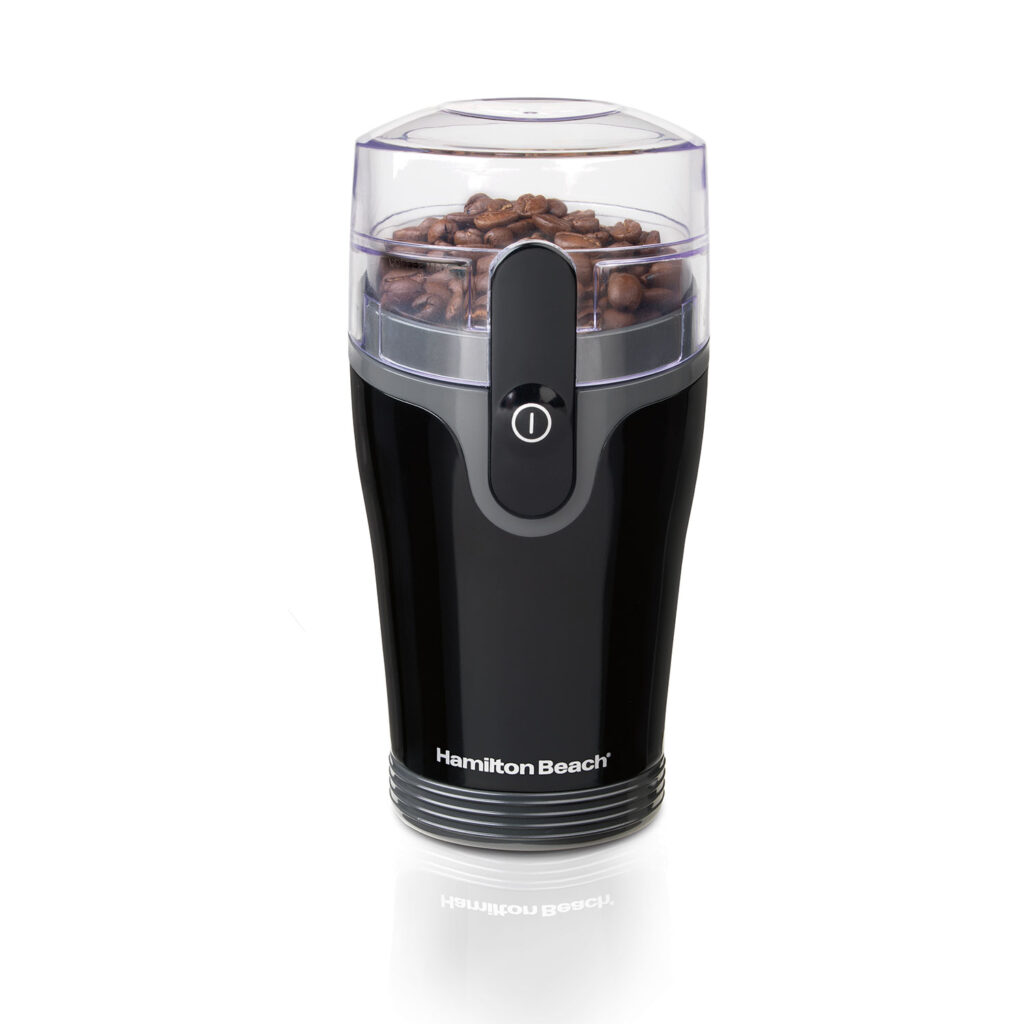
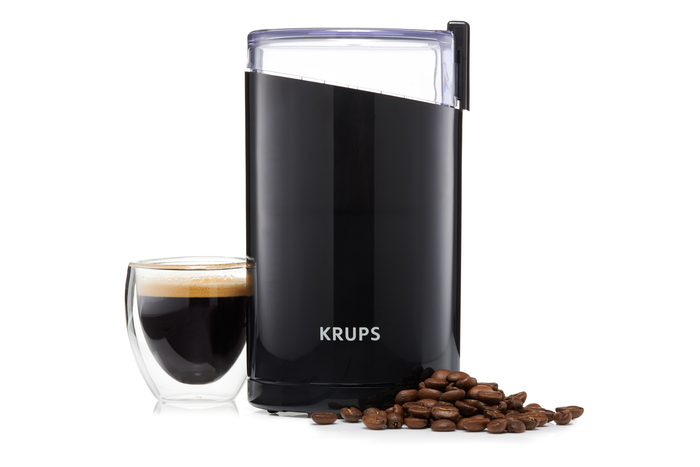
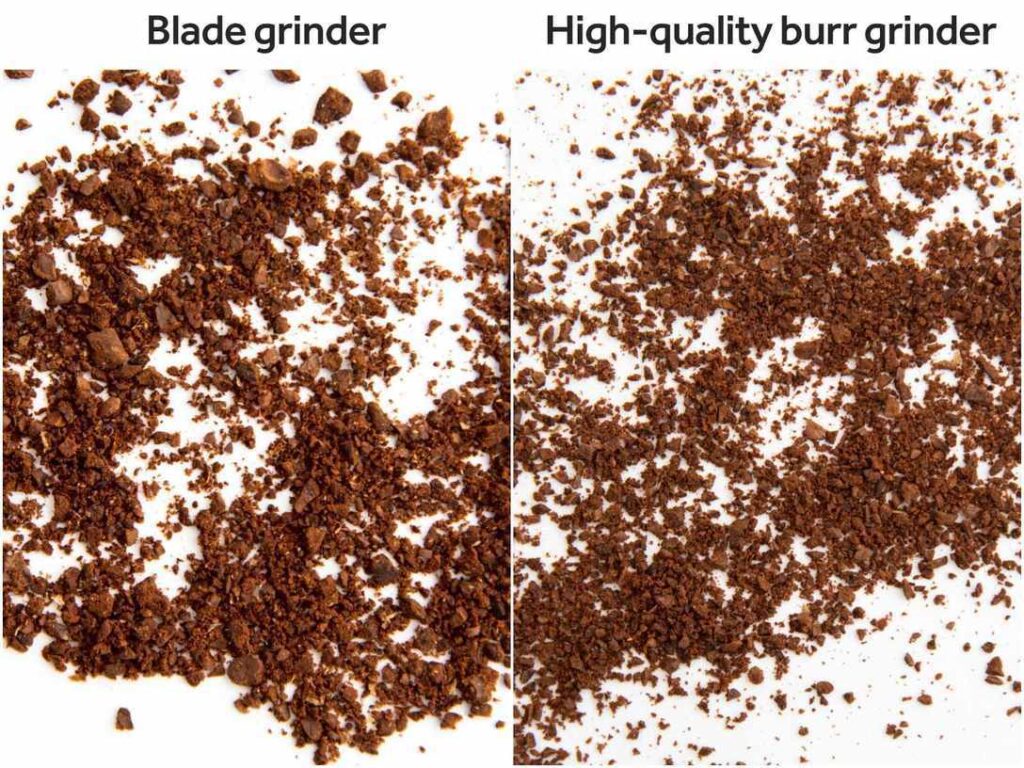
Because beans bounce randomly around the grinding chamber, some pieces hit the blade repeatedly and turn to fine powder while others barely get chopped at all. The result is a wide distribution of particle sizes — from dust to large chunks — in every single grind. No amount of shaking, pulsing, or timing fully corrects this. Blade grinders also generate more friction heat, which can volatilize aromatic compounds in freshly roasted coffee before they reach your cup.
The blade grinder extraction problem: Fine powder over-extracts → bitter. Large chunks under-extract → sour. Medium pieces extract inconsistently → muddy. All three happen simultaneously in every cup — and no brewing technique fixes it at the source.
Burr vs Blade Grinder: Full Comparison
Start here if you want the side-by-side view. Every row below reflects a real-world difference in what ends up in your cup.
| Feature | Burr Grinder | Blade Grinder |
|---|---|---|
| Grinding mechanism | Crushes between two precision burrs | Chops with spinning metal blade |
| Grind consistency | High — uniform particle size | Low — powder and chunks mixed |
| Grind size adjustment | Precise, repeatable settings | None — time-based only |
| Extraction quality | Even, balanced | Uneven — bitter and sour simultaneously |
| Brew method compatibility | All methods including espresso* | Basic drip only |
| Heat generation | Low (especially conical burr) | Higher due to friction |
| Repeatability | Excellent — same result every time | Poor — varies by grind time |
| Espresso capable | Yes (espresso-spec models) | No |
| Typical price range | $35–$300+ (manual starts lower) | $15–$40 |
| Best for | Most home coffee drinkers | Occasional drip, extreme budget |
*Espresso requires burr grinders specifically designed for fine, stepless or near-stepless grinding — not all burr grinders qualify. See the conical vs flat section for espresso-capable recommendations.
Why Burr Grinders Produce Better Coffee: The Extraction Science
Grind size controls extraction rate through two mechanisms: surface area and diffusion distance. A finer grind increases the total surface area of ground coffee exposed to water, and shortens the path water must travel to reach the center of each particle. Both effects speed up extraction — which is why finer grinds extract more in the same amount of time.
The key insight is that coffee extracts in a specific order regardless of grind size:
- Early extracts: acids and salts — brightness and sharpness
- Mid extracts: sugars and aromatics — sweetness and “coffee flavor”
- Late extracts: bitters and astringents — drying, harsh finish
A burr grinder lets you put all particles in the same size range, so water reaches stage two — sweetness — on all of them at approximately the same moment. A blade grinder’s particle distribution guarantees that fine particles are well into stage three (bitter) while coarse particles are still in stage one (sour). You taste all three stages simultaneously, with no way to isolate or fix any of them through brewing technique alone.
This is also why fines — the very fine particles produced in higher quantities by blade grinders and lower-quality burr grinders — cause muddiness and bitterness disproportionate to their volume. A small amount of very fine powder can over-extract rapidly and dominate the flavor of a larger bed of medium-ground coffee.
🔬 Permeability note: Finer particles pack tighter and reduce permeability, increasing resistance through the coffee bed. This is why espresso requires very fine grinds to build pressure — and why overly fine blade-grinder output can stall a press or cause channeling in espresso. Burr grinders let you dial permeability precisely.
Conical vs Flat Burr Grinders: What’s the Difference?
Once you’ve decided on a burr grinder, you’ll encounter a second choice: conical burr vs flat burr. Both produce dramatically better results than any blade grinder, but they have different characteristics worth understanding before you buy.
| Feature | Conical Burr | Flat Burr |
|---|---|---|
| Burr shape | Cone inside a ring | Two parallel discs |
| Typical RPM | Lower (400–600 RPM) | Higher (1,000+ RPM) |
| Heat generation | Less | More |
| Grind consistency | Excellent | Excellent to outstanding |
| Noise level | Lower | Higher |
| Typical use | Home, all brew methods | Café-grade, high-volume, espresso |
| Common examples | Baratza Encore, OXO Brew, KINGrinder K6 | Baratza Vario, Eureka Mignon, Weber EG-1 |
For most home brewers, conical burr grinders are the practical choice. They run quieter, generate less heat, require less frequent calibration, and are available at much lower price points. Flat burr grinders excel in café and espresso environments where absolute grind uniformity and high throughput matter more than noise or cost.
Pro tip: The conical vs flat decision only matters after you’ve committed to a burr grinder. For home use, conical burr wins on value and convenience. Don’t let the flat-vs-conical debate delay upgrading from a blade grinder — any burr grinder is a meaningful improvement.
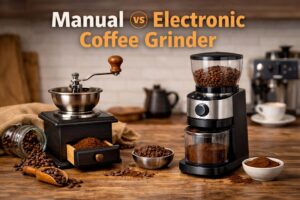
Manual vs Electric Burr Grinders
Manual burr grinders are one of the most overlooked upgrades in home coffee. For the same price as many blade grinders, you can buy a manual burr grinder that produces significantly better grounds — the only trade-off is 90 seconds to two minutes of hand cranking per dose.
| Feature | Manual Burr Grinder | Electric Burr Grinder |
|---|---|---|
| Grind quality | Excellent | Excellent |
| Speed | Slower (1–3 min per dose) | Fast (10–30 sec per dose) |
| Noise | Very low | Moderate to loud |
| Price entry point | ~$35–70 | ~$80–170+ |
| Portability | Excellent — no power needed | Counter-bound |
| Best examples | KINGrinder K6, Timemore C2 | Baratza Encore, OXO Brew |
Grind Size Reference Chart: Matching Grind to Brew Method
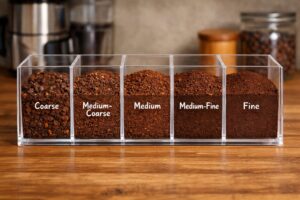
Different brewing methods require different particle sizes. This is the core reason burr grinders matter — they let you hit these targets reliably every time. Blade grinders cannot reach or hold any of these settings with consistency.
| Brew Method | Grind Size | Texture Reference | Baratza Encore Setting (approx.) | Why This Size |
|---|---|---|---|---|
| Cold brew | Extra coarse | Rough chunks — raw sugar | 38–40 | Long steep (12–24h) needs coarse to avoid over-extraction |
| French press | Coarse | Coarse sea salt | 28–32 | Long immersion; coarse reduces sludge and bitterness |
| Percolator | Medium-coarse | Slightly finer than French press | 22–26 | Recirculating water needs coarser grind |
| Drip coffee maker | Medium | Table salt | 18–22 | Gravity flow at medium pace |
| Pour-over (V60, Chemex) | Medium to medium-fine | Fine table salt | 14–18 | Controlled pour allows slightly finer than drip |
| AeroPress (standard) | Medium-fine | Between salt and fine sand | 10–15 | Short immersion benefits from finer grind |
| Moka pot | Fine | Fine sand | 8–12 | Pressure-driven; too fine stalls |
| Espresso | Very fine | Powdery — like flour | Not recommended* | High pressure requires extremely uniform fine grind |
*The standard Baratza Encore is not designed for espresso. The Baratza Encore ESP, Sette 270, or Breville Smart Grinder Pro are built for that range.
☕ Brew ratio quick reference: No matter your grind setting, start with a 1:15 coffee-to-water ratio (e.g., 20g coffee to 300g water) and adjust from there. Grind size affects extraction rate; ratio controls strength. A burr grinder lets you adjust both variables independently — a blade grinder lets you control neither reliably.
Troubleshooting Matrix: Taste → Cause → Fix
Start with grind. Most brewing problems trace back to particle size, and adjusting grind first gives you clean, isolated feedback. Use time and temperature only after grind is close.
| Symptom | Likely Cause | Fix (in order) |
|---|---|---|
| Sour + fast brew | Under-extraction — grind too coarse | Go finer → extend steep/contact time → raise temp (light roasts) |
| Bitter + harsh finish | Over-extraction — grind too fine | Go coarser → reduce contact time → lower temp (dark roasts) |
| Sour AND bitter simultaneously | Uneven grind — fines over-extract while coarse chunks under-extract | Switch to a burr grinder — this is a blade grinder problem and cannot be brewed around |
| Muddy, silty cup | Excess fines + metal filter or aggressive agitation | Switch to paper filter → reduce agitation → go 1 step coarser |
| Balanced but weak | Strength issue, not extraction | Increase dose by 1–2g or reduce water — do not change grind |
| Press stalls (AeroPress/espresso) | Grind too fine — clogged bed | Go coarser → reduce agitation → steady gentle pressure |
| Flat, lifeless cup despite dialing | Stale beans or poor water | Use beans within 4 weeks of roast date · filter chlorinated tap water |
| Grounds clumping / static | Low humidity or high-roast oils | Add single drop of water to beans before grinding (Ross Droplet Technique) |
When a Blade Grinder Might Be Acceptable
There are situations where a blade grinder is a defensible choice — it’s worth being honest about them rather than dismissing the option entirely.
Basic automatic drip, infrequently used. If you brew one or two cups a week from a basic drip machine and aren’t focused on flavor refinement, a blade grinder is workable. The inconsistency is real, but for very casual use it may not justify the upgrade cost.
Spice and herb grinding. Blade grinders are genuinely better than burr grinders for whole spices, dried herbs, and other non-coffee applications. If you need a dual-purpose grinder and coffee quality is secondary, a dedicated blade unit makes sense — just don’t also use it for coffee you care about.
Transitional step on a tight budget. Using a blade grinder temporarily while saving for a proper burr grinder is a reasonable decision. It’s not a long-term solution, but it’s not irrational either. Note that a manual burr grinder like the Timemore C2 or KINGrinder K6 costs about the same as a mid-range blade grinder and produces dramatically better results.
Which Grinder Should You Choose?
✅ Choose a Burr Grinder If:
- You brew pour-over, French press, or AeroPress
- You want consistent, repeatable results
- You’re pairing with an espresso machine
- You care about flavor improvement over time
- You want to understand and control your brew variables
- You plan to explore different brewing methods
⚠️ Consider a Blade Grinder Only If:
- You brew basic drip coffee only
- You grind infrequently (once a week or less)
- Budget is under $25 with no flexibility
- You also need a spice grinder
- You understand and accept the trade-offs
For most home coffee drinkers, a burr grinder is the right long-term choice. The Baratza Encore is the safest entry-level electric recommendation. The KINGrinder K6 is the best value if you don’t mind hand grinding. Both are in the grinder section below.
Best Grinders: Electric Burr Picks
These picks prioritize grind consistency, adjustment range, and value for home brewers. Electric options first, then manual.
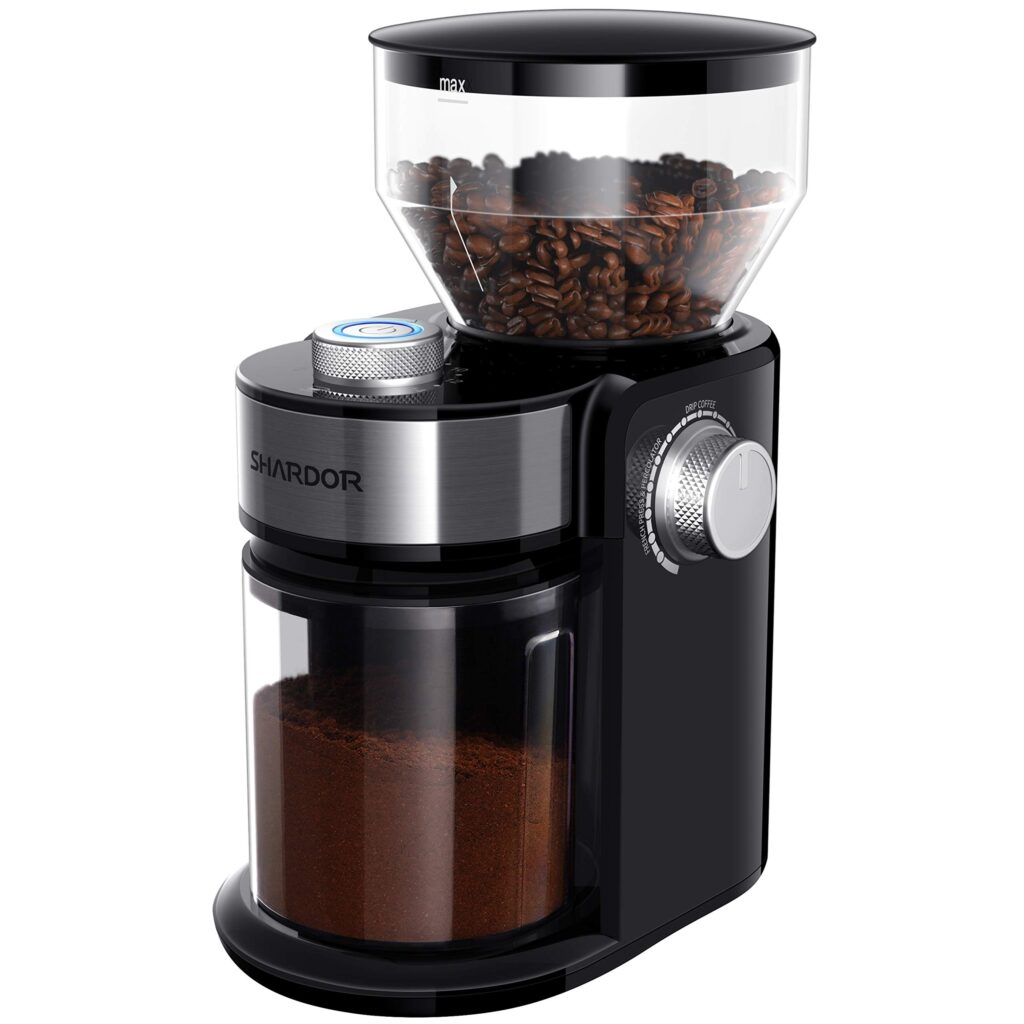
Baratza Encore
- Best overall electric value
- 40 grind settings, drip to pour-over
- Repairable + long-term support
Disclosure: CoffeeGearHub may earn from qualifying purchases.
OXO Brew Conical Burr
- Best budget electric pick
- One-touch timer, easy workflow
- Good daily consistency
Disclosure: CoffeeGearHub may earn from qualifying purchases.

Baratza Encore ESP
- Encore platform, espresso-capable
- Full range from drip to espresso
- Best single-grinder solution
Disclosure: CoffeeGearHub may earn from qualifying purchases.
Best Grinders: Manual Burr Picks
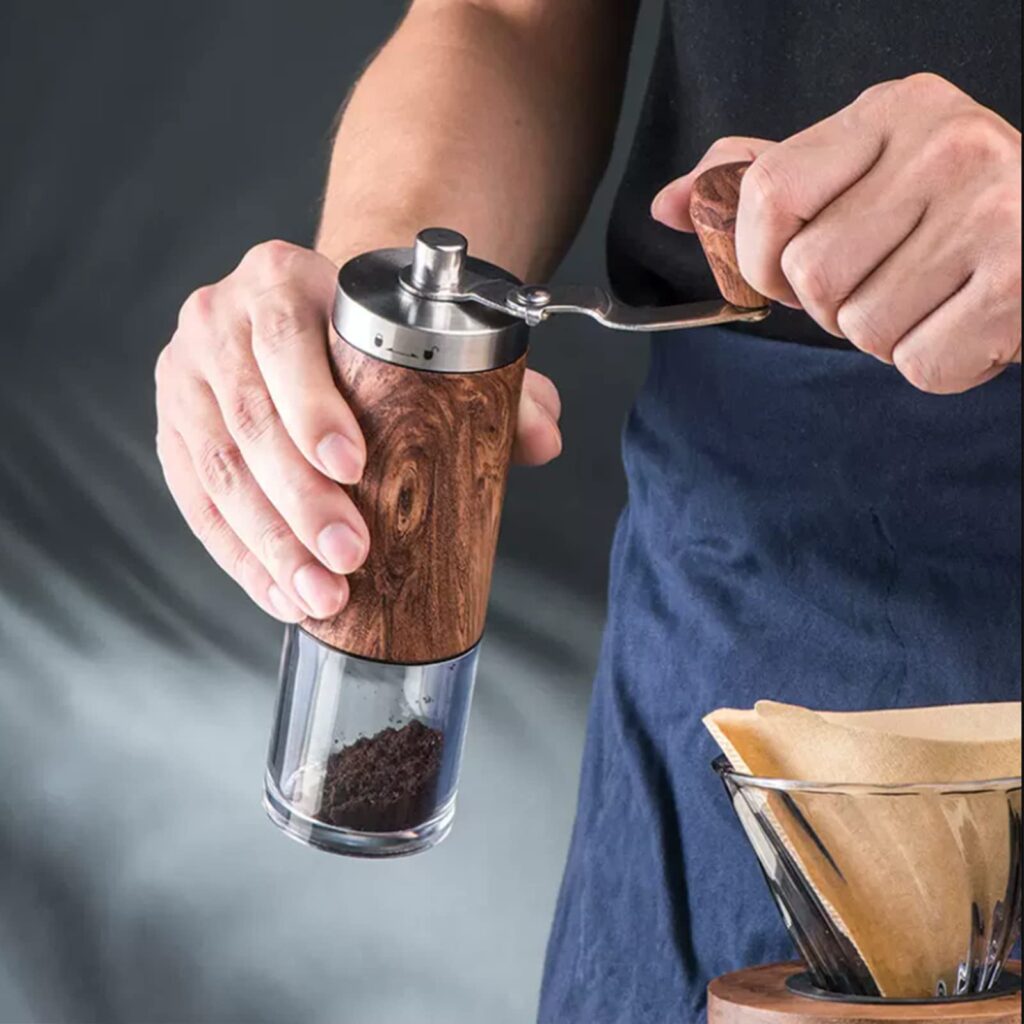
KINGrinder K6
- Best manual value pick
- Precise click-step adjustment
- Excellent travel grinder
Disclosure: CoffeeGearHub may earn from qualifying purchases.
Timemore Chestnut C2
- Best first burr upgrade
- Biggest flavor jump per dollar
- Solid steel burrs, great build
Disclosure: CoffeeGearHub may earn from qualifying purchases.
KRUPS F203 (Blade)
- Budget blade option — know the limits
- Acceptable for basic drip only
- Not suitable for pour-over or espresso
Disclosure: CoffeeGearHub may earn from qualifying purchases.
Full Grinder Comparison Table
| Grinder | Type | Price | Consistency | Adjustment | Espresso | Travel | Best for |
|---|---|---|---|---|---|---|---|
| Baratza Encore | Electric conical burr | $$ | Excellent | Good (40 steps) | No | Low | Daily home, drip to pour-over |
| Baratza Encore ESP | Electric conical burr | $$ | Excellent | Very good | Yes | Low | Full-range single grinder |
| OXO Brew | Electric conical burr | $ | Good | Fair (15 steps) | No | Low | Budget electric, beginners |
| KINGrinder K6 | Manual steel burr | $ | Excellent | Very good (click) | No | High | Value + travel |
| Timemore C2 | Manual steel burr | $ | Very good | Good | No | High | First burr upgrade |
| KRUPS F203 | Blade | $ | Poor | None | No | Medium | Basic drip only |
FAQs: Burr vs Blade Coffee Grinder
What is the main difference between burr and blade coffee grinders?
The main difference is how they grind coffee beans. Burr grinders crush beans between two precision-machined surfaces to produce uniform particle sizes, while blade grinders chop beans randomly with a spinning blade. This mechanical difference directly determines grind consistency, extraction quality, and the ceiling of your cup’s flavor.
Are burr grinders really better than blade grinders?
Yes, for virtually every brewing method. Burr grinders produce consistent grind size, which leads to even extraction and better-tasting coffee. Blade grinders produce a mix of fine powder and large chunks, causing simultaneous over-extraction (bitter) and under-extraction (sour) in every cup — a problem that cannot be brewed around.
Can you use a blade grinder for espresso?
No. Blade grinders cannot produce the fine, uniform grind espresso requires. Espresso needs very precise particle size control to build proper pressure and extraction. An espresso-capable burr grinder — such as the Baratza Encore ESP or Breville Smart Grinder Pro — is required.
What is the difference between conical and flat burr grinders?
Conical burrs use a cone-shaped inner burr rotating inside a ring-shaped outer burr — running slower, quieter, and with less heat. Flat burrs use two parallel discs spinning faster for exceptional consistency favored in café and espresso environments. Both dramatically outperform blade grinders for home brewing. For home use, conical burr wins on value and convenience.
Are manual burr grinders better than electric blade grinders?
In most cases, yes. A manual burr grinder produces better grind consistency than any electric blade grinder, despite requiring more effort. Options like the KINGrinder K6 or Timemore C2 deliver quality comparable to entry-level electric burr grinders at lower prices — making them the best value upgrade from a blade grinder.
Is upgrading from a blade grinder to a burr grinder worth it?
Yes — it’s one of the highest-impact improvements you can make to your coffee setup, often more noticeable than upgrading the brewer itself. Most people notice cleaner flavor, better balance, and less simultaneous bitterness and sourness immediately after switching.
Why are burr grinders more expensive than blade grinders?
Burr grinders require precision-machined burr surfaces, stronger motors in electric models, and more complex adjustment mechanisms. These components produce consistent particle size and long-term durability — both of which directly improve and maintain coffee quality over time.
Which grinder should I choose for everyday coffee at home?
For electric convenience, the Baratza Encore is the most widely recommended entry-level burr grinder. For maximum value on a tighter budget, the KINGrinder K6 or Timemore C2 manual burr grinders outperform any blade grinder at a similar price. A blade grinder is only acceptable for basic drip coffee with no expectation of flavor improvement.
Do burr grinders make better-tasting coffee?
Yes. Uniform particles extract evenly during brewing, producing clearer flavors, better balance, and less bitterness compared to coffee ground with a blade grinder. The difference is noticeable in the first cup after switching.
Are burr grinders harder to clean than blade grinders?
Burr grinders require slightly more maintenance, but most home models are straightforward to clean — many allow burr removal for thorough cleaning. Blade grinders trap coffee oils and grounds under the blade over time, which degrades flavor and is difficult to remove completely. Neither is a significant burden for home use.
Continue Learning
GRINDER & GRIND SCIENCE
Want espresso at home without a dedicated espresso grinder? The AeroPress concentrate method paired with a milk frother gets surprisingly close to café-quality lattes and cappuccinos.
☕
Written by the CoffeeGearHub Editorial Team
CoffeeGearHub is a specialty coffee equipment resource run by home brewers and coffee enthusiasts. Our guides are researched using published brewing science, grinder manufacturer specifications, and established specialty-coffee community knowledge. We review and update our pillar content regularly. About CoffeeGearHub →