Last Updated: February 27, 2026 • 18–25 min read • Accessories Guide: What Improves Moka Flavor + Extraction Science + Troubleshooting
✍️ Editorial note: This guide is researched and written by the editors at CoffeeGearHub.com using published brewing science, moka pot extraction principles, and established specialty-coffee community knowledge. All product links are affiliate links — we may earn a commission at no additional cost to you. This does not affect our recommendations.
The 30-Second Answer
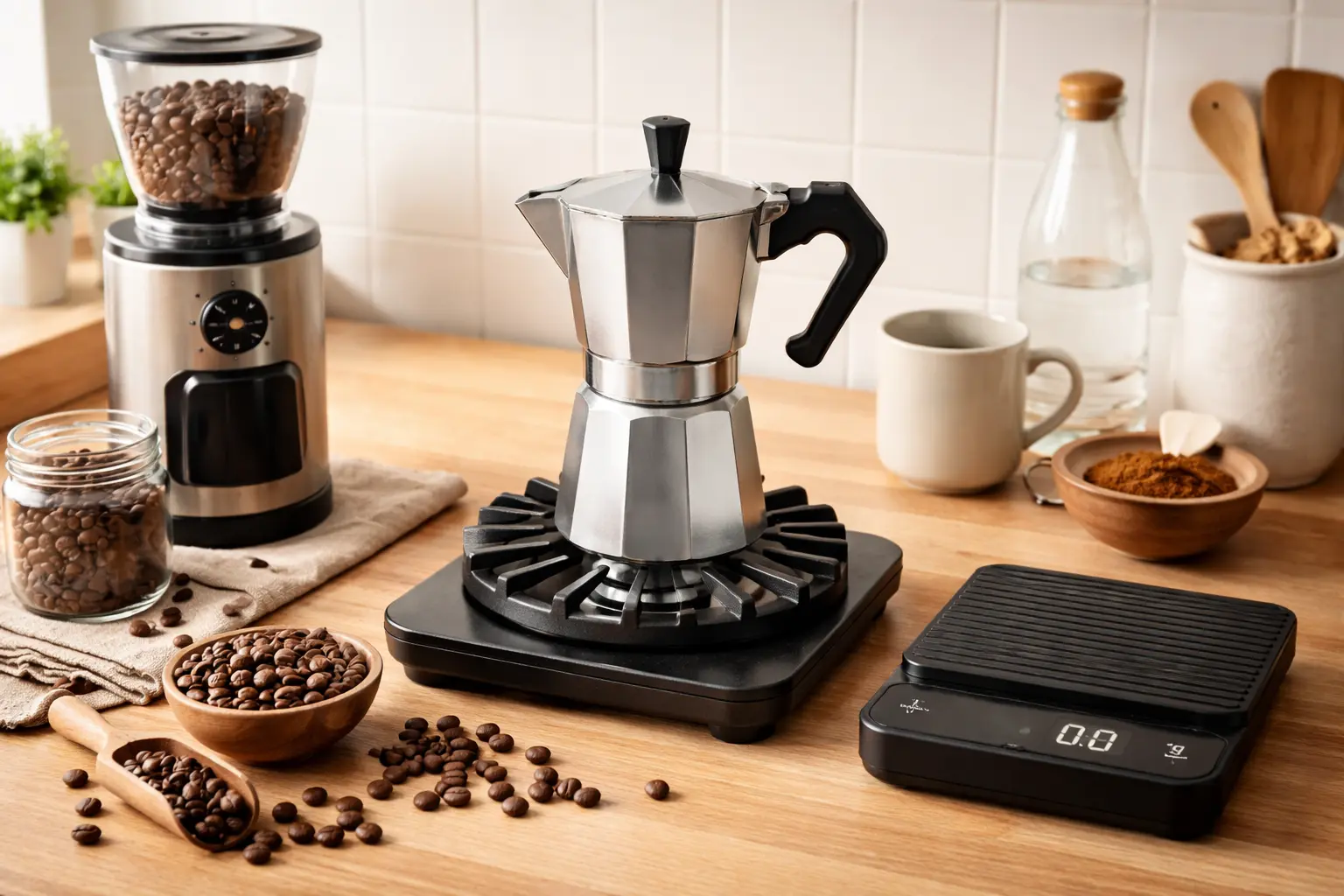
The moka pot is simple — but the right accessories dramatically improve consistency, flavor, and versatility. A burr grinder is the single highest-impact upgrade: it stabilizes flow through the coffee bed and eliminates the harsh, simultaneous sour-and-bitter problem that blade grinders cause. A heat diffuser plate is the second most impactful fix for bitterness. A precision scale makes every brew repeatable. Everything else is optional but genuinely useful once the fundamentals are locked in.
- Most important upgrade: KINGrinder K6 burr grinder — consistent medium-fine grind, numbered click system, works for moka and pour-over
- Best bitterness fix: Heat diffuser plate — smooths the heat ramp, reduces scorching and sputtering
- Best for repeatability: Precision scale — 0.1g resolution, makes dialing in fast and controlled
- Best for milk drinks: Automatic or handheld frother — moka concentrate + textured milk = café-style lattes at home
- Best maintenance upgrade: Replacement silicone gasket set — restores proper pressure, eliminates rubber off-flavors
Who This Guide Is For — Jump to What You Need
☕ Just getting started
Read Why Accessories Matter and go straight to Burr Grinder.
☕ Fixing a specific problem
Jump to Troubleshooting by Symptom for a direct diagnosis.
🥛 Making milk drinks
Go straight to Milk Frothing Tools and the moka latte workflow.
🔬 Understanding the science
Read Extraction Science before choosing accessories.
Table of Contents
Why Accessories Matter for Moka Brewing
A moka pot isn’t an espresso machine, but it’s also not “just drip.” It’s a compact pressure brewer that sits between the two: water heats in the base, pressure builds, and hot water is pushed through coffee into the upper chamber. Because there’s no built-in temperature control, pressure gauge, or pump, your results are disproportionately affected by small changes in the things you can control:
- Heat curve — how fast you ramp from room temp to brew pressure
- Grind consistency — particle size distribution and fines content
- Dose and basket fill — headspace and bed resistance
- Water chemistry — mineral content changes perceived bitterness and sweetness
- Seal integrity — gasket and filter plate condition govern the pressure path
The best accessories help you control the brew more gently (smoother heat), more consistently (repeatable ratios), or more cleanly (reduced sludge and off-flavors). If you want a broader dialing-in framework for all brew methods, see: How to Dial In Coffee at Home.
Extraction Science: What’s Happening Inside a Moka Pot

To choose moka accessories intelligently, it helps to understand the brew mechanics. A moka pot’s flavor is mostly determined by contact time, brew temperature, and flow resistance. Those variables are linked: grind size changes resistance and flow, which changes contact time; heat changes brew temperature and pressure, which changes flow speed.
Pressure & Flow: Why “Too Hot Too Fast” Tastes Harsh
When you blast high heat, the base chamber ramps quickly. Pressure rises fast, water surges through the coffee bed, and the brew can shift from a calm stream to aggressive sputtering rapidly. That tends to produce two problems: uneven extraction from channeling, and an overheated end phase where steam and very hot water push through spent grounds, increasing bitterness and astringency. Accessories like a heat diffuser plate help because they smooth the heat ramp. Your target is a steady brew phase with controlled output — then an intentionally early stop before the harshest end phase dominates.
Particle Size Distribution: The Real Grinder Story
Moka pots are sensitive to fines — tiny powder-like particles. Too many fines can choke flow, increase bitterness, and create mud in the cup. Too coarse overall leads to weak, sour coffee because water passes through too easily. Blade grinders typically produce a mix of boulders and powder. In moka brewing, boulders under-extract (hollow and sour) while powder over-extracts (bitter and dry) — both in the same cup. A burr grinder reduces both extremes and lets you make small, predictable changes rather than guessing.
Temperature Sweet Spot: Preheating and Heat Management
Preheating water can shorten time-on-heat, which sometimes reduces baked flavors from long slow heating. But boiling water combined with high heat can accelerate the brew and increase harshness. The practical approach: use moderately hot water from a kettle — not a rolling boil — then use a gentle heat setting or diffuser for a calm, controlled extraction.
Top Moka Pot Accessories: Quick Picks at a Glance
Each card below links to the specific product recommended for that accessory category. Detailed reviews follow in the sections below.
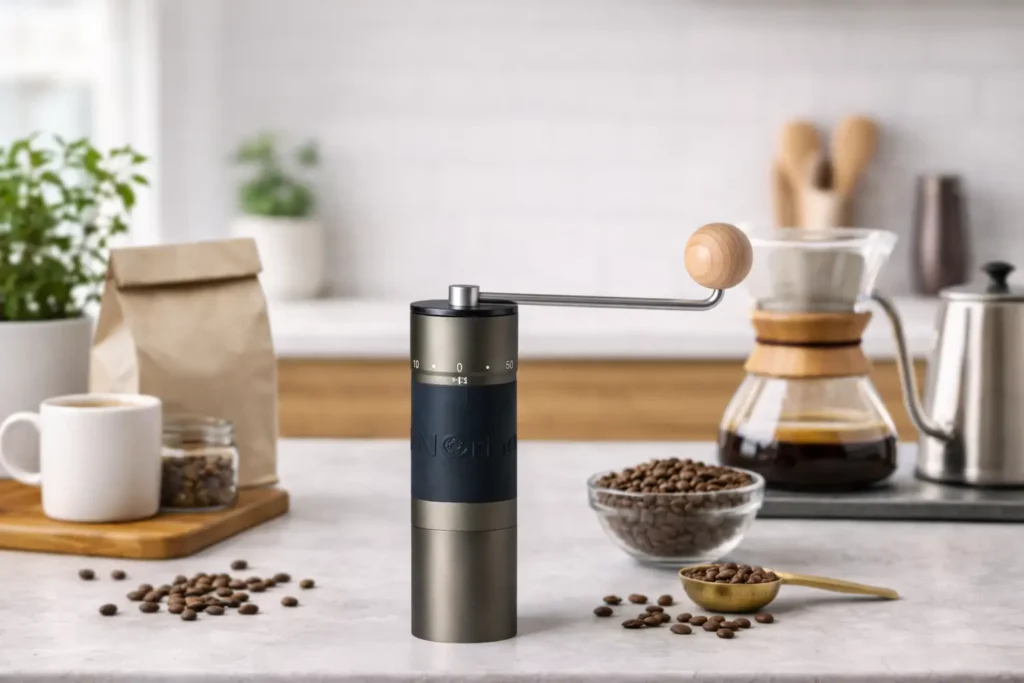
KINGrinder K6 — Best Burr Grinder
Why it works: Consistent medium-fine particles stabilize flow and eliminate the bitter-and-sour combination from blade grinding.
- Numbered click adjustment system
- Near-zero retention between brews
- Covers moka, pour-over, and AeroPress
Disclosure: CoffeeGearHub may earn from qualifying purchases.
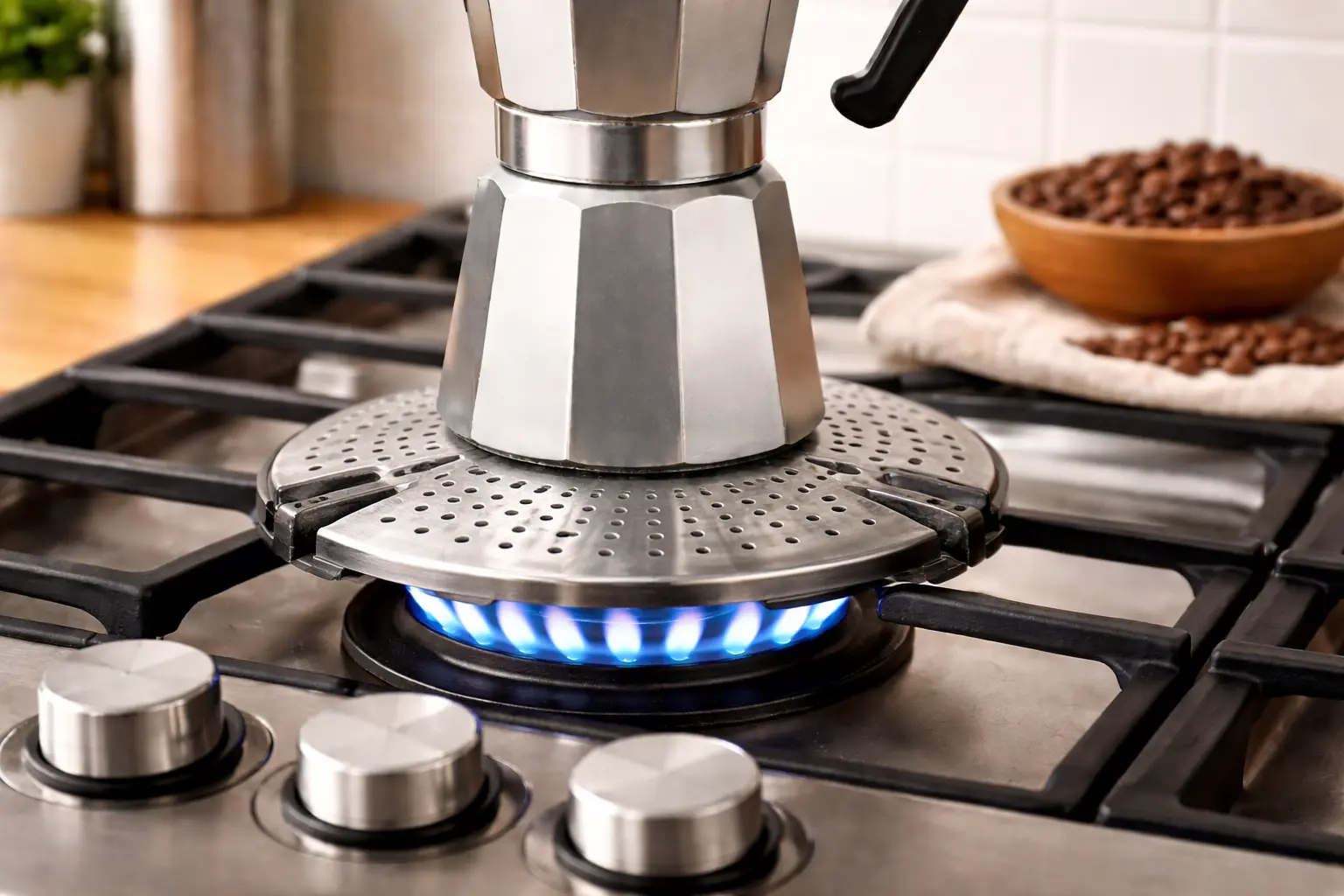
Heat Diffuser Plate — Best Heat Control
Why it works: Spreads heat evenly and slows the ramp — less scorching, less sputter, smoother finish.
- More forgiving on gas stoves
- Helps small moka sizes especially
- Improves sweetness and body
Disclosure: CoffeeGearHub may earn from qualifying purchases.
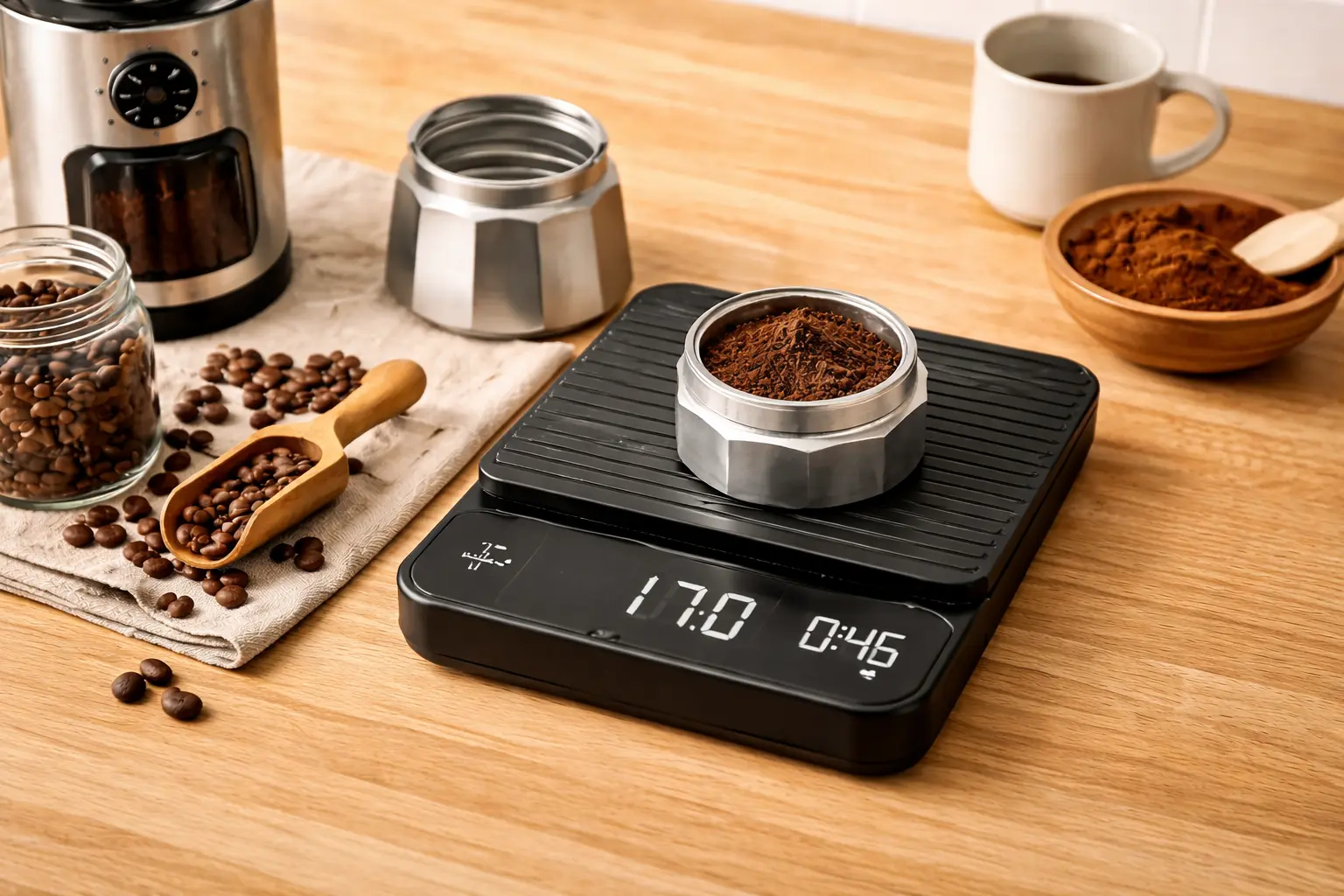
Precision Coffee Scale — Best for Consistency
Why it works: Repeatable dose and water fill means one-variable troubleshooting instead of guessing.
- 0.1g precision recommended
- Built-in timer is useful
- Small footprint fits tight spaces
Disclosure: CoffeeGearHub may earn from qualifying purchases.
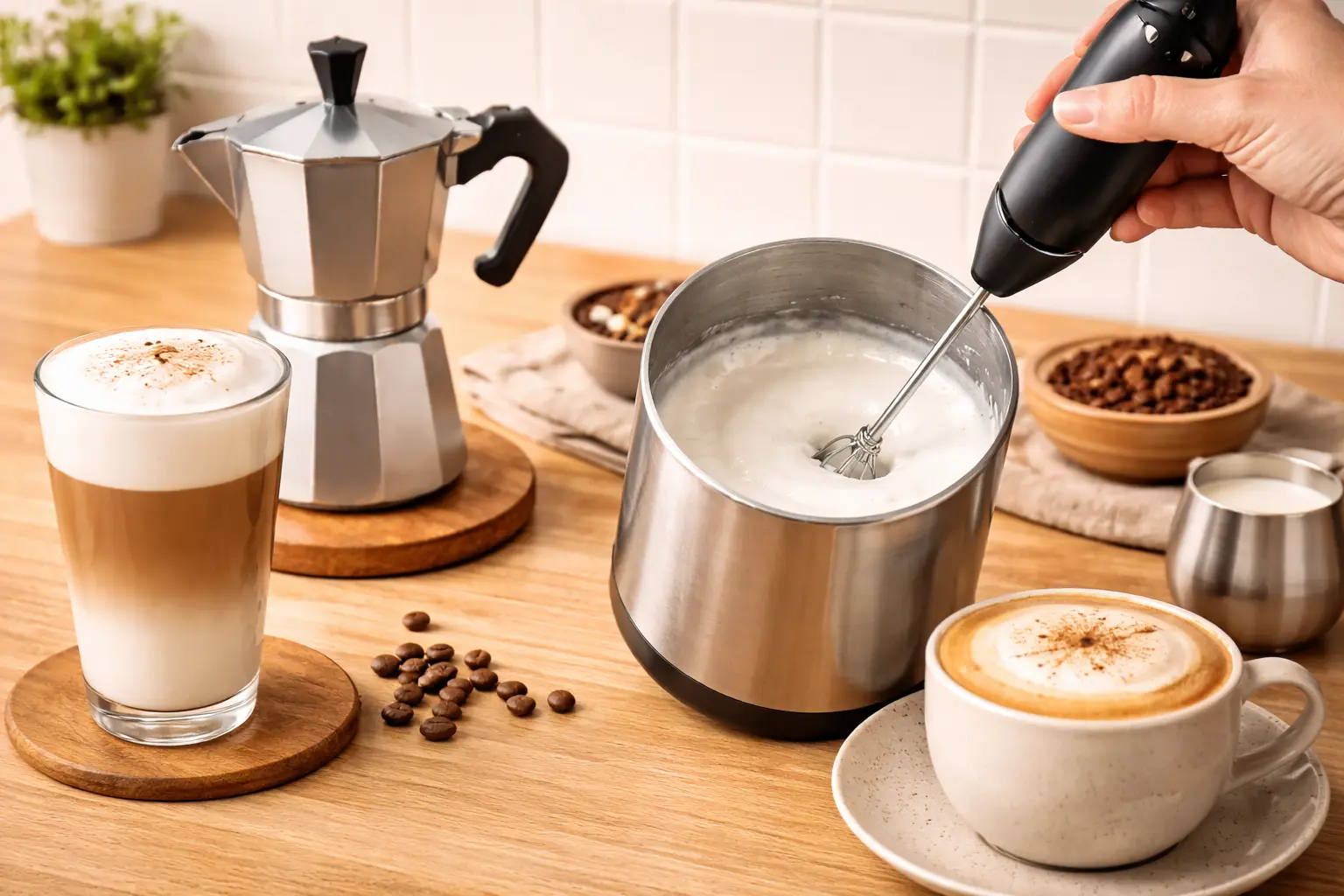
Milk Frother — Best for Moka Lattes
Why it works: Moka concentrate plus textured milk produces café-style lattes and cappuccinos at home.
- Handheld = budget and fast
- Automatic = most consistent foam
- Works great for iced drinks too
Disclosure: CoffeeGearHub may earn from qualifying purchases.
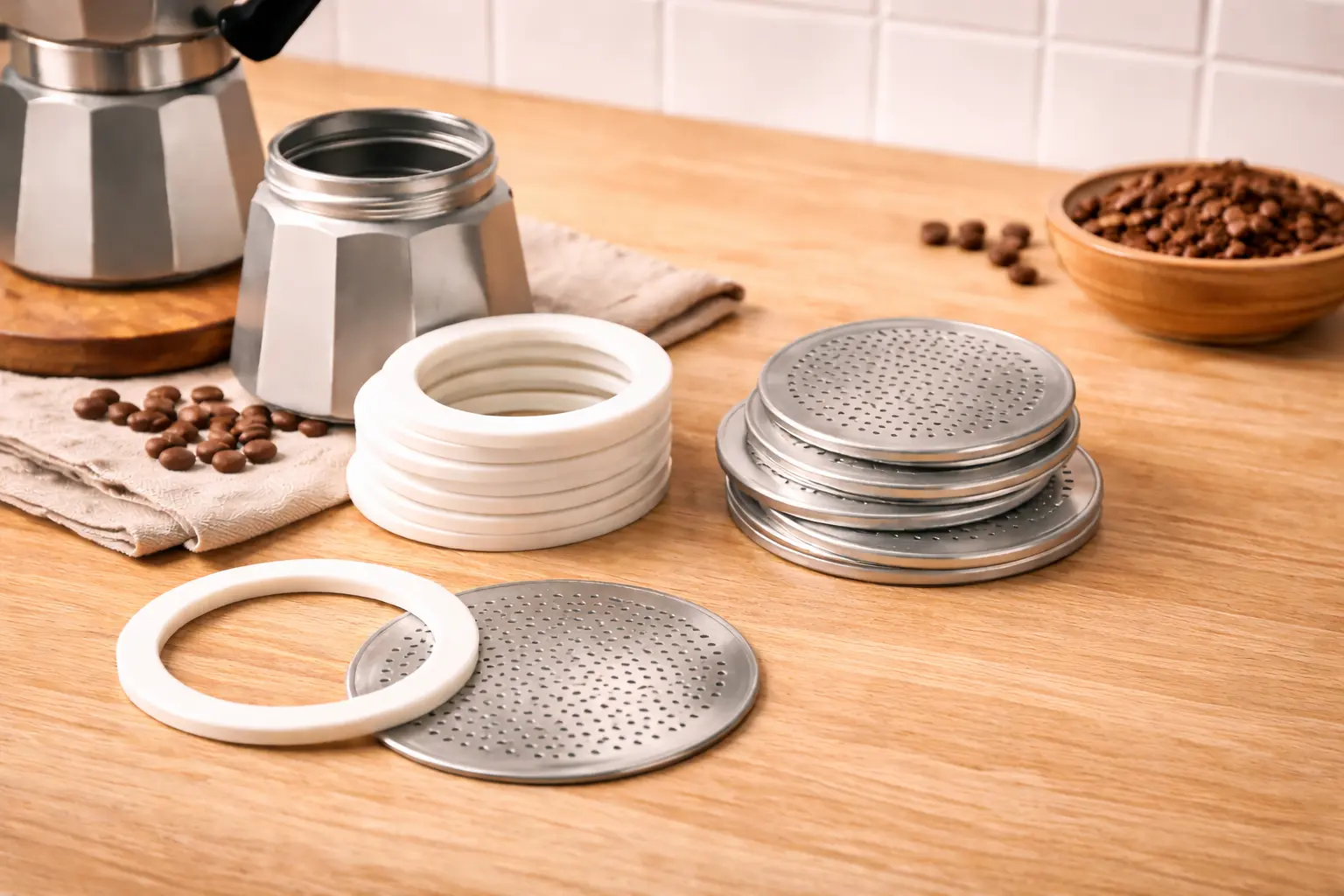
Replacement Gasket Set — Best Maintenance Upgrade
Why it works: A fresh seal restores proper pressure path, eliminates steam leaks, and removes rubber off-flavors.
- Fixes side-seam steam leakage
- Restores weak brew output
- Silicone lasts longer than rubber
Disclosure: CoffeeGearHub may earn from qualifying purchases.
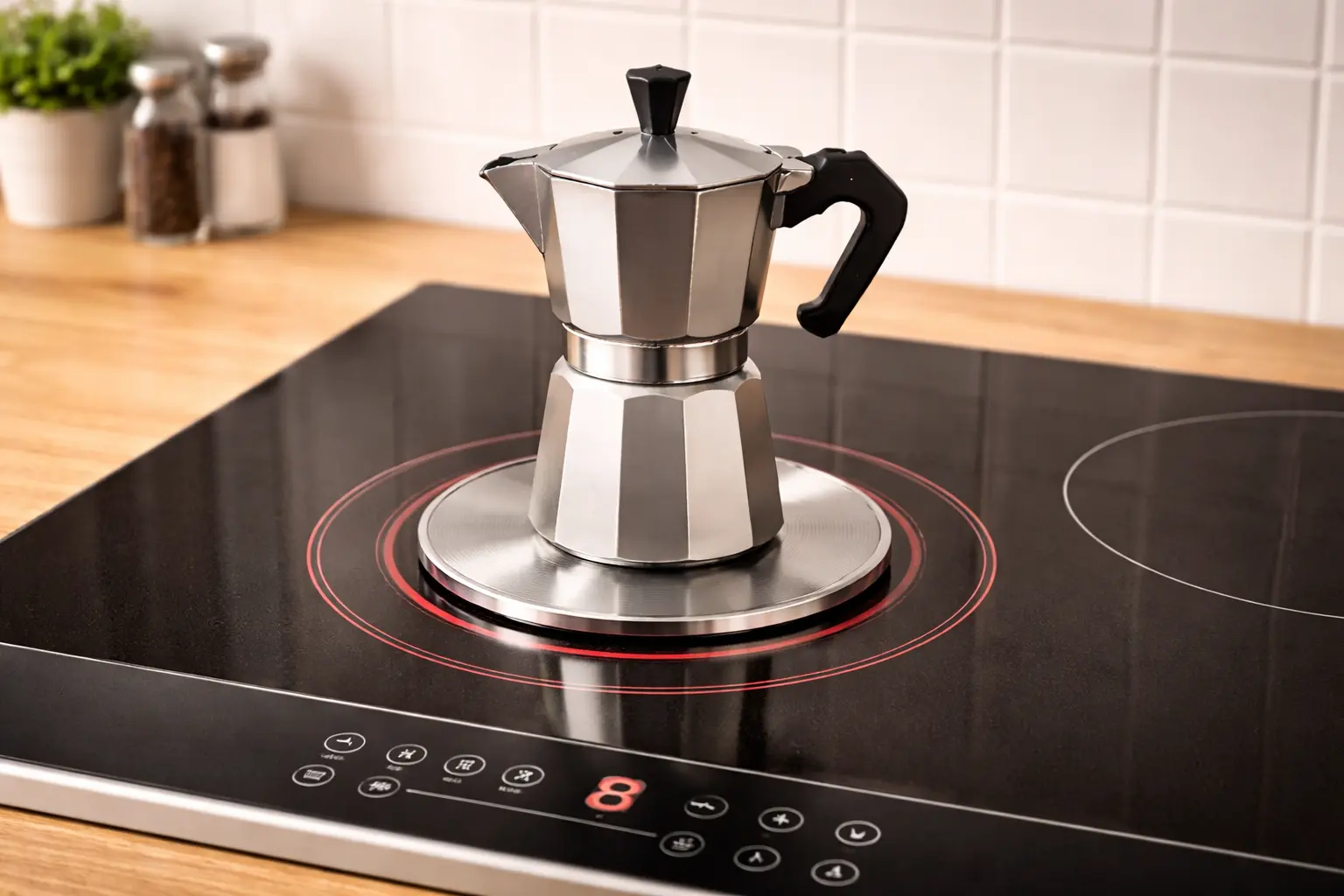
Induction Adapter Disc — Best for Induction Stoves
Why it works: Provides the magnetic interface that lets aluminum moka pots work on induction hobs.
- Required for most aluminum pots on induction
- Also helps on electric coil burners
- Pairs well with a diffuser plate
Disclosure: CoffeeGearHub may earn from qualifying purchases.
1) Burr Grinder — Most Important Upgrade
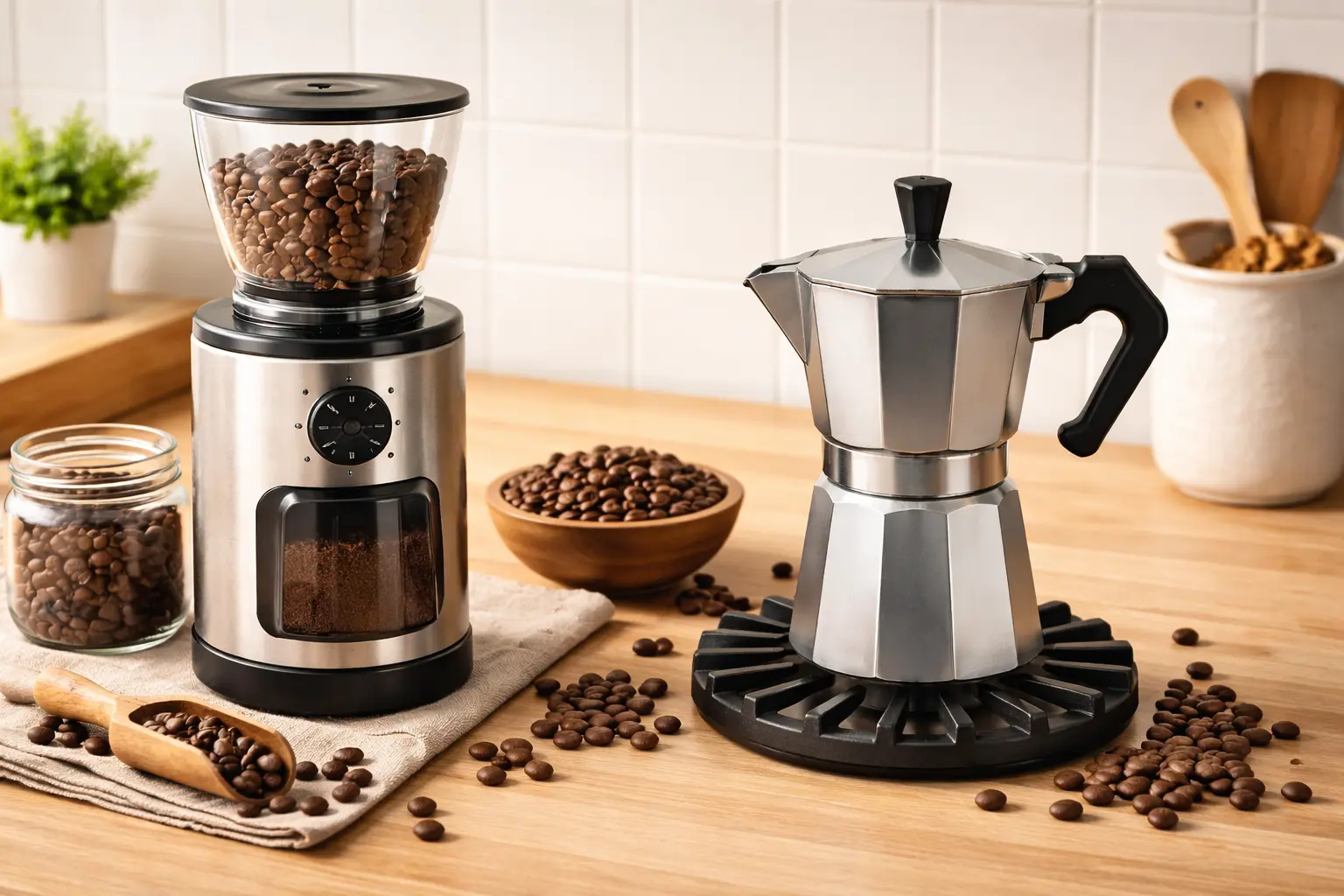
If your moka coffee tastes harsh one day and weak the next, your grinder is usually the reason. Moka needs a medium-fine grind — finer than drip, coarser than espresso. A burr grinder improves flavor because it creates a narrower particle size distribution, which stabilizes flow through the coffee bed and makes adjustments predictable.
How a Better Grinder Improves Extraction
Extraction happens at the particle surface. If you have boulders and powder in the same basket, water finds easy routes through gaps and gets stuck in dense pockets simultaneously. That produces both under-extracted and over-extracted flavors in the same cup — sour and bitter at once. A burr grinder reduces that chaos by making particles more consistent, so the bed behaves like a uniform filter and water flows evenly through it.
KINGrinder K6 — The Recommended Pick
The KINGrinder K6 is the CoffeeGearHub standard recommendation for moka pot grinding. Its numbered click-based adjustment system makes it easy to dial in medium-fine, record the setting, and return to it exactly next brew. Start around 2–3 full rotations from fully closed for moka and adjust 2–4 clicks at a time. Near-zero retention means no stale grounds from the previous session contaminating your next cup. The K6 also covers pour-over, AeroPress, and French press — making it the most versatile single grinder for a complete home coffee setup.
KINGrinder K6 — Best Grinder for Moka Pot
The K6’s numbered click system and consistent steel burrs make it ideal for moka’s medium-fine grind zone. Start at 2–3 rotations from closed and adjust 2–4 clicks at a time until cups are sweet and balanced.
- Numbered clicks — dial in once, repeat every brew
- Near-zero retention — no stale grounds between sessions
- Wide range — moka, pour-over, AeroPress, French press
Best for: moka pot • pour-over • AeroPress • travelers
Disclosure: CoffeeGearHub may earn from qualifying purchases.
What Grind Setting for Moka?
Start at table salt texture as your baseline. Then adjust based on taste: if the cup is bitter or harsh, go 2–4 clicks coarser and reduce heat. If weak or sour, go 2–4 clicks finer. Change only one variable between brews. For a full grind range reference across all brew methods, see the Coffee Grind Size Guide.
2) Heat Diffuser Plate — Heat Curve Control
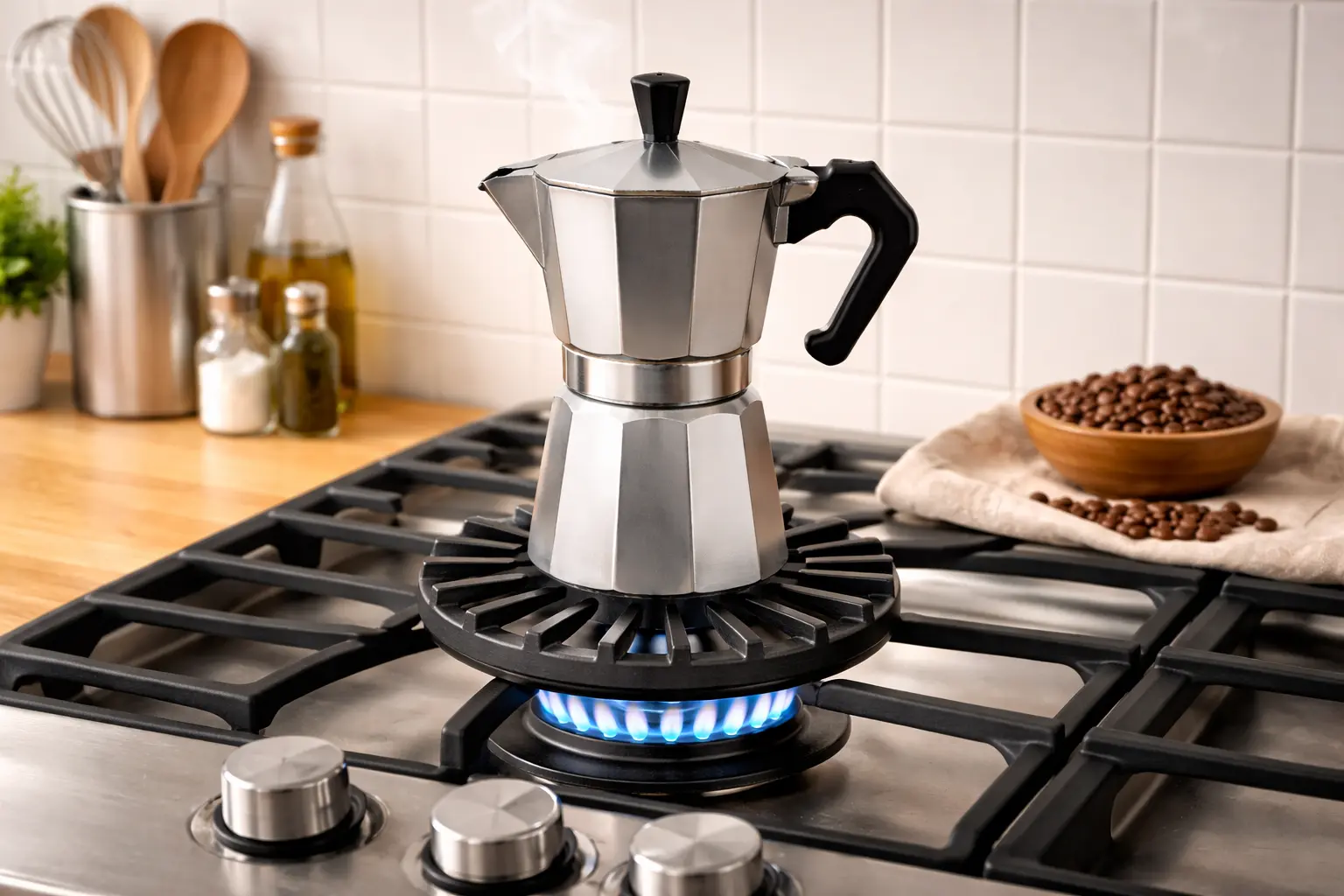
A diffuser plate is one of the most effective ways to reduce moka harshness. The main improvement is a smoother heat ramp and fewer hotspots. That helps you spend more time in the stable, sweet extraction phase — and less time in the harsh, steam-driven end phase where most bitterness originates.
What a Diffuser Fixes
- Burnt or ashy bitterness — often from overheating the base on high flame
- Sudden sputtering — abrupt boiling and steam surges from direct heat
- Inconsistent results — less sensitivity to burner personality and flame size
🔬 Pro tip: A diffuser plate is also useful on electric coil stoves for reducing the “on/off cycling” effect that causes temperature spikes mid-brew. On induction, pair the adapter disc with a diffuser for the smoothest heat transfer of any stove type.
3) Precision Scale — Repeatability Equals Better Coffee
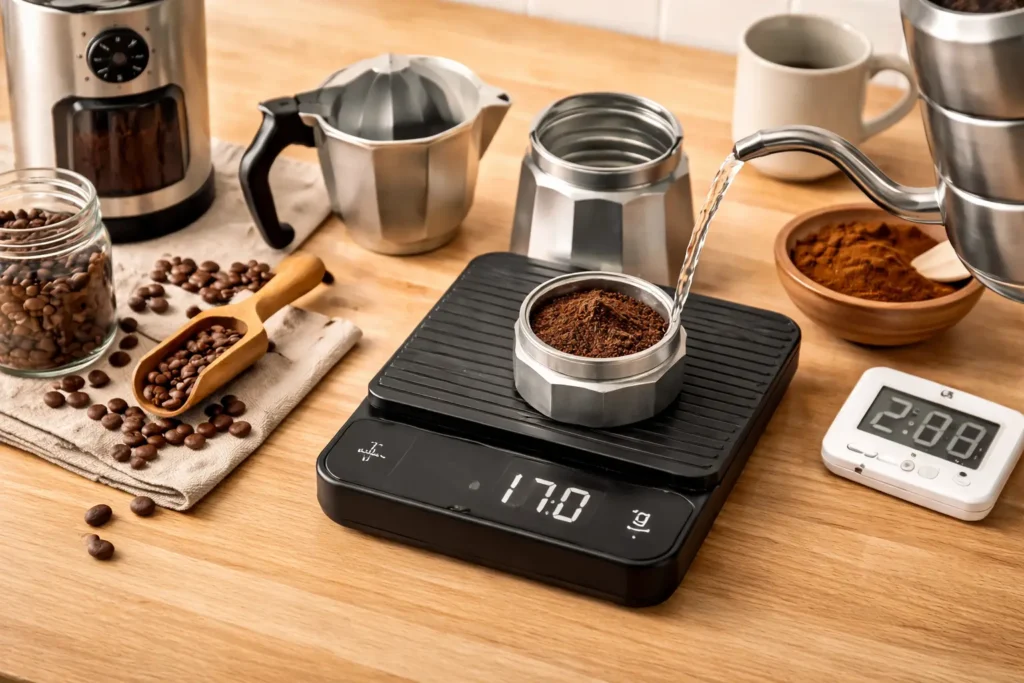
Moka brewing is often “fill the basket, fill the base” — which works, but it’s hard to troubleshoot. A scale turns your moka pot into a repeatable recipe. The best way to improve coffee is to change one variable at a time and keep everything else constant. Without a scale, you’re changing at least two variables on every brew without knowing it.
Baseline Ratios for Moka
Use these ratios as a starting point (coffee-to-water by weight). Note that moka pots are constrained by basket volume and safety fill lines — these ratios are most useful for comparison and dialing in across different coffees and sizes, not as hard targets to chase at the cost of overfilling.
| Ratio | Character | Notes |
|---|---|---|
| 1:7 | Stronger, more concentrated | Good for moka lattes and milk drinks |
| 1:8 | Balanced — recommended starting point | Best for tasting origin and roast character |
| 1:9 | Softer, lighter body | Good if moka normally tastes too intense |
4) Water Upgrades — The Hidden Lever
Water quality changes how you experience bitterness, sweetness, and clarity. If you’re already controlling grind and heat but still get sharp or metallic finishes, water chemistry is worth addressing. Very hard water can exaggerate chalky or harsh notes. Very soft water can taste flat or sour. The fix is usually simple.
Option A: Filtered Water (Best Simple Move)
A carbon filter pitcher or faucet filter is often sufficient to improve taste meaningfully. Many “metallic” complaints are partly water chemistry and partly old gaskets or built-up oils under the filter plate — addressing both together usually solves the problem.
Option B: Low-Mineral Bottled Water (Maximum Consistency)
If you want very consistent cups across different brew sessions, a low-mineral bottled water that tastes clean on its own is a reliable baseline. This is a “final 10%” move — most useful after grind and heat are already dialed in. See the Water Quality for Better Coffee guide for mineral target ranges.
5) Paper Filters — Optional But Useful
Paper filtering can be surprisingly effective for moka. Place a small paper filter — an AeroPress round fits most basket sizes — on top of the coffee bed, under the upper screen. It reduces fines migration, which often smooths bitterness and improves clarity. Especially useful with darker roasts or grinders that produce more fines.
What You’ll Notice With a Paper Filter
- Cleaner flavor — less sludge and fewer harsh edges in the finish
- Smoother finish — especially noticeable with medium-dark and dark roasts
- More clarity — easier to taste origin notes in lighter and medium roasts
If you love traditional thick moka texture, skip the paper filter. If you want cleaner flavors with less sludge, it’s a very low-cost experiment worth trying on your next brew.
6) Replacement Gaskets & Filter Plates — Fix Leaks and Off-Flavors
Gaskets directly affect brew mechanics. If the seal is compromised, pressure escapes through the side seam instead of pushing through the coffee bed, reducing extraction and output volume. Meanwhile, old rubber holds odors and can contribute off-flavors — often described as rubbery or metallic — to every subsequent brew.
Signs You Need a New Gasket
- Steam leaking from the side seam during brewing
- Weak output even with correct fill and grind
- Water pooling above the puck before brewing completes
- Persistent rubber smell or taste that cleaning doesn’t fix
Silicone gaskets are the preferred upgrade over standard rubber: they resist heat degradation, hold fewer odors over time, and typically last longer before needing replacement again. Replacement gaskets for most Bialetti models are available on Amazon for a few dollars and take under two minutes to swap.
7) Induction Adapter Disc — If You Brew on Induction
Most aluminum moka pots won’t work on induction cooktops because aluminum is not ferromagnetic. An induction adapter disc provides the magnetic interface, heats up on the induction hob, and transfers that energy to the moka pot base. If you brew on induction and love an aluminum pot, this accessory is essential — and it typically costs under $15.
If you want the simplest induction workflow without an adapter, consider an induction-compatible moka pot like the Bialetti Moka Induction or Bialetti Venus — both have ferromagnetic stainless bases. But if you already own an aluminum pot and love it, the disc is the practical and inexpensive solution.
8) Milk Frothing Tools — Make Café Drinks at Home
Moka coffee is concentrated and pairs exceptionally well with milk. If your goal is lattes or cappuccinos, a frother is the fastest quality-of-life upgrade and one of the lowest-cost accessories on this list.
Handheld vs. Automatic vs. Manual Pump
- Handheld wand — inexpensive, quick, best for casual foam and iced moka drinks
- Automatic frother — most consistent texture with the least effort; best for daily latte workflow
- Manual pump frother — capable of excellent microfoam with practice, no electricity required
For best results pouring into a moka latte, pair your frother with a small 12oz milk pitcher — the spout gives you more control over where and how the milk lands. For a full frother comparison, see the Best Milk Frothers guide.
9) Cleaning & Maintenance Tools — Prevent Off-Flavors
Many moka pots taste metallic or bitter because coffee oils build up — especially under the filter plate and around the gasket seat. A minimal maintenance kit keeps flavor clean and extends the life of every component.
- Soft brush — for threads, filter plate holes, and the gasket channel
- Microfiber cloth — for drying after rinse (prevents oxidation and water spots on aluminum)
- Equipment cleaner — used sparingly and rinsed thoroughly; never use soap on aluminum bodies as it strips the seasoned patina that helps reduce metallic taste
Avoid storing the pot assembled and sealed (traps odor inside), leaving brewed coffee in the upper chamber for more than a few minutes, and abrasive scouring pads that damage aluminum surfaces. See the full moka pot cleaning section for step-by-step instructions.
A “Pro” Moka Workflow — Repeatable and Sweet
Accessories help most when they support a consistent workflow. Here’s a method that produces clean, sweet moka coffee without harsh finishes.
- Fill the base with filtered water to just below the safety valve line — never over it.
- Grind medium-fine on your burr grinder — start around table salt texture.
- Fill the basket level without tamping. Use a finger or straight edge to level the surface.
- Optional: place an AeroPress paper filter on top of the coffee bed for cleaner flavor.
- Assemble snugly — firm hand-tight, but not forced. Use a cloth if the base is warm from preheated water.
- Brew on medium-low heat — or place on a diffuser plate for a gentler, more controlled ramp.
- Stop early — remove from heat when the stream turns from dark brown to pale tan, or when you hear the first signs of aggressive gurgling. Run the base under cold water for 10 seconds to stop extraction immediately.
💡 The core principle: Your grinder and diffuser plate do most of the heavy lifting in this workflow. The grinder controls how evenly water flows through the bed; the diffuser controls how gently heat builds. Together they define the sweet extraction window that makes a moka cup taste clean rather than harsh.
Accessories You Can Usually Skip
- Distribution tools / WDT tools — moka baskets are shallow and low-resistance; the impact is minimal compared to espresso puck preparation
- Tampers — tamping increases resistance and consistently produces harsher cups in moka brewing
- Pressure gauges and gadgets — not meaningfully actionable for home moka brewing
Troubleshooting by Symptom
Change one variable at a time. Grind is the highest-leverage fix and should always be the first thing you address.
| Symptom | Most likely cause | Fix — in this order |
|---|---|---|
| Bitter / harsh / dry finish | Heat too high / grind too fine / brewed past gurgling | Lower heat or add diffuser → grind 2–4 clicks coarser → stop brew earlier |
| Weak / sour / watery | Grind too coarse / basket under-filled / stale beans | Grind 2–4 clicks finer → fill basket fully level → use fresher beans |
| Violent sputtering early in brew | Heat too high / grind too fine / compromised gasket | Reduce heat → add diffuser → grind coarser → check gasket condition |
| Metallic taste | Oil buildup under filter plate / worn rubber gasket / hard water | Deep clean filter plate and gasket seat → replace gasket (silicone) → use filtered water |
| Steam leaking from side seam | Worn or improperly seated gasket | Tighten assembly firmly → inspect gasket → replace if stiff, cracked, or compressed flat |
| Both sour AND bitter simultaneously | Inconsistent particle size from blade grinder | Upgrade to a burr grinder — this is the only fix for bimodal extraction |
| Weak output with correct fill | Gasket leak diverting pressure / clogged filter plate | Check side seam for steam → replace gasket → clean filter plate holes with soft brush |
FAQs: Moka Pot Accessories
What is the single best accessory for a moka pot?
A burr grinder. Grind consistency is the biggest driver of moka flavor because it stabilizes flow through the coffee bed and eliminates the simultaneous sour-and-bitter problem that blade grinders cause. The KINGrinder K6 is the recommended starting point for most moka brewers.
Do paper filters actually improve moka pot coffee?
They can. A small paper filter placed on top of the basket can reduce fines migration, smoothing bitterness and improving clarity — especially with darker roasts or grinders that produce more fines. If you prefer traditional heavy moka body, skip the filter.
Should I tamp coffee in a moka pot?
No. Tamping often chokes the basket and increases harshness because moka relies on steam pressure rather than a pump. Fill the basket level with your finger or a straight edge and leave it untamped.
Why does my moka pot sputter and spray?
Usually too much heat causing a fast pressure ramp, a clogged filter plate, or a compromised gasket seal. Lower heat, use a diffuser plate, clean the filter plate holes, and replace old gaskets if steam leaks at the side seam.
What grind size is best for moka pot?
Medium-fine — finer than drip, coarser than espresso. Visually, aim for the texture of table salt or fine sand. If the cup tastes bitter or harsh, go slightly coarser and reduce heat. If weak or sour, go slightly finer in small increments.
How often should I replace moka pot gaskets?
Usually every 6–12 months depending on use frequency and heat exposure. Replace sooner if you notice steam leaking at the side seam, weak brew output despite correct fill, or a persistent rubber smell in the cup. Silicone gaskets typically last longer than standard rubber.
Can I use an aluminum moka pot on induction?
Not directly in most cases. Aluminum is not ferromagnetic so standard induction hobs won’t recognize it. You need an induction adapter disc to provide a magnetic heating interface between the hob and the pot base. Alternatively, consider a stainless moka pot with a ferromagnetic base like the Bialetti Moka Induction.
Why does my moka coffee taste metallic?
The most common causes are built-up coffee oils under the filter plate, a degraded rubber gasket leaching flavor, and hard water amplifying mineral notes. Deep clean the filter plate and gasket seat, replace worn gaskets (silicone preferred), and test with filtered water.
Is a scale really necessary for moka pot brewing?
Not required, but it is one of the fastest ways to improve consistency. A scale lets you repeat the same dose and water fill precisely, which means when something tastes off you can isolate the variable and fix it rather than guessing at multiple things simultaneously.
What accessories help most for making moka lattes?
A milk frother — handheld or automatic — plus a small milk pitcher. Moka coffee is concentrated and pairs exceptionally well with steamed or frothed milk. A handheld wand is the lowest-cost entry point; an automatic frother produces the most consistent texture with the least effort.
Our Top Recommendation
If you’re only buying one thing, make it a burr grinder. The KINGrinder K6 is the CoffeeGearHub standard recommendation for moka — it covers every brew method you’re likely to add, costs significantly less than comparable electric grinders, and delivers an immediate, dramatic improvement in cup quality on the first use.
KINGrinder K6 — Start Here
The single best upgrade for any moka pot setup. Numbered click adjustments, near-zero retention, and a grind range wide enough for every brew method you’ll want to explore next.
Disclosure: CoffeeGearHub may earn from qualifying purchases.
Continue Learning
☕
Written by the CoffeeGearHub Editorial Team
CoffeeGearHub is a specialty coffee equipment resource run by home brewers and coffee enthusiasts. Our guides are researched using published brewing science, manufacturer specifications, and established specialty-coffee community knowledge. We review and update our pillar content regularly. About CoffeeGearHub →