
Robusta Coffee Guide: How to Brew, Dial In & Use Robusta Beans (2026)

Editorial standards: this guide distinguishes Coffea canephora (commonly called Robusta) from Arabica using published coffee science, processing and roasting context, and practical brewing guidance. Flavor descriptions are tendencies rather than guarantees.
At a glance
What this guide covers
This guide explains what Robusta is, why it tastes and extracts differently from Arabica, where it works well in espresso and other brew methods, and how to adjust grind, ratio, and temperature when using it.
Editorial analysis
Robusta is a different ingredient, not simply lower-quality Arabica
Robusta typically has more caffeine and a different balance of acids, sugars, and bitter compounds than Arabica. That can create heavier body and more bitterness, but quality varies widely with genetics, growing, processing, roasting, and freshness.
The best brewing approach is to account for the coffee in front of you. Darker Robusta-heavy coffees often benefit from slightly cooler water or coarser grinding, while lighter specialty lots may tolerate more extraction.
The 30-Second Answer
Robusta can produce heavy body, strong flavor, and espresso-friendly crema, but it often needs a different dial-in than Arabica. Start with a slightly conservative extraction and adjust grind, temperature, and ratio by taste rather than assuming all Robusta is the same.
Robusta vs Arabica: What’s Different and Why It Matters for Brewing
Robusta and Arabica aren’t “good vs bad.” They are different species with different chemistry — and that chemistry changes how flavor shows up in the cup and how quickly extraction tips into bitterness. The practical takeaway: Robusta is less forgiving if you extract too hot, too long, too fine, or too aggressively under pressure. Every technique in this guide addresses that asymmetry directly.
| Factor | Robusta | Arabica | Brewing impact |
|---|---|---|---|
| Caffeine | ~2.7% (higher) | ~1.5% (lower) | More bitterness potential + stronger kick |
| Chlorogenic acids | Higher | Lower | Degrades into bitter quinic acid faster under heat |
| Perceived acidity | Lower | Higher | Less brightness to balance bitterness |
| Lipid content | Lower | Higher | Changes crema texture and mouthfeel |
| Body | Heavier | Often lighter | Excellent in milk drinks and cold brew |
| Crema tendency | Higher | Lower | Thicker, more persistent crema in espresso |
| Sweetness buffer | Often lower | Often higher | Over-extraction tastes harsher, faster |
Robusta Coffee Myths — Debunked
Myth #1: “Robusta is always low quality”
Most bad Robusta experiences come from commodity-grade beans with inconsistent picking, uneven fermentation, and rushed drying — then dark-roasted to hide defects. The species is not the problem. Properly processed Robusta can be chocolate-forward, nutty, and syrupy, especially when brewed for body and paired with milk or ice.
Myth #2: “Robusta only belongs in instant coffee”
Instant coffee is one use, but Robusta is also a classic espresso blend tool. Many traditional Italian-style espresso profiles rely on Robusta specifically for crema stability and structural body. Vietnamese phin coffee is another strong example where Robusta is culturally and technically the correct choice.
Myth #3: “Robusta always tastes burnt”
Burnt flavors come from over-roasting, not the species. When roast development is controlled and extraction is managed (temperature + flow), Robusta reads as dark chocolate, toasted nuts, and earthy spice — bold, not ashy.
Myth #4: “Robusta has no place in specialty coffee”
This is the most common misconception in third-wave coffee culture, and it’s changing fast. Fine Robusta — traceable, carefully processed beans from Uganda, India, and Vietnam — is increasingly recognized in specialty circles. The issue was never the species. It was processing and sourcing standards that lagged behind specialty Arabica. As those improve, Robusta’s reputation is being actively reassessed.
Robusta Flavor Profile: What to Expect
Robusta delivers body and intensity first. Compared to Arabica’s brighter aromatics, Robusta leans chocolatey, earthy, and heavy. That can be a feature — especially in milk drinks and cold brew — if you control bitterness through proper extraction technique.
| Flavor note | Typical intensity | Best brew method to express it |
|---|---|---|
| Dark chocolate / cocoa powder | High | Espresso, cold brew |
| Toasted nuts (peanut, hazelnut) | Medium–high | Phin, espresso |
| Earthy spice / wood | Medium | Phin, cold brew |
| Low acidity (flat brightness) | — | All methods — balance with milk or ice |
| Heavy, syrupy mouthfeel | High | Espresso, cold brew concentrate |
| Rubber / grain (commodity) | High when present | Signal to switch to Fine Robusta or adjust roast |
Robusta Extraction Science: Why It Gets Bitter and How to Prevent It
Pour-over and immersion brewers can extract Robusta passably with temperature and grind adjustments. Espresso brewers face an additional challenge: Robusta’s dense cell structure makes channeling significantly more disruptive than with Arabica. Understanding the chemistry explains why each dial-in adjustment actually works.
The Chemistry Behind Robusta Bitterness
Robusta contains roughly twice the caffeine of Arabica — and caffeine itself is bitter. More critically, Robusta is higher in chlorogenic acids (CGAs), which under heat degrade into quinic acid and caffeic acid — two primary compounds responsible for the harsh, drying bitterness that makes badly brewed Robusta taste medicinal. This degradation happens faster and more aggressively in Robusta than Arabica under identical brew conditions. The same recipe that produces smooth chocolate from an Arabica single origin can taste harsh and astringent unchanged from a Robusta-heavy blend.
Robusta also has a denser cell structure and lower lipid content than Arabica. Under espresso pressure, that density makes channeling more disruptive — water finds the path of least resistance through the denser material, creating uneven extraction zones that spike bitterness while under-extracting others.
The 5 Levers That Control Robusta Harshness
- Grind size: too fine increases surface area, accelerates CGA breakdown into quinic acid. Err slightly coarser than Arabica baseline.
- Temperature: higher heat accelerates CGA degradation. Robusta targets 195–200°F (90–93°C) — noticeably lower than many Arabica espresso recipes.
- Contact time: long contact pushes late bitter and drying fractions. Shorten before you taste over-extraction.
- Agitation: heavy stirring or aggressive pours increase extraction rate and bitterness risk in pour-over and immersion methods.
- Flow and pressure (espresso): early channeling through dense Robusta pucks creates harsh extraction spikes. Pre-infusion and controlled peak pressure are the primary mitigation tools.
Robusta “Safe Zone” Brewing Targets
| Method | Temp | Baseline ratio | Time target | Primary goal |
|---|---|---|---|---|
| Espresso | 195–200°F | 1:2 (18g/36g) | 25–30s | Crema + chocolate body without harsh tail |
| Pour-over | 195–200°F | 1:16 | 3:00–3:30 total | Reduce agitation; keep sweetness and body |
| Cold brew | Room temp or fridge | 1:5 concentrate | 16–18 hours | Smooth strength + high caffeine without bitterness |
| Phin | 195–200°F | 1:6–1:8 | 4–6 min drip | Slow drip intensity that balances condensed milk |
💡 Temperature first, always. Before touching grind size, try dropping brew temperature 2–3°F. With Robusta, temperature is often the single highest-leverage variable — and a faster fix than regrinding. See the full extraction framework in How to Dial In Coffee at Home.
Robusta Espresso Dial-In: Baseline Parameters + Advanced Adjustments
Robusta espresso shines when you aim for chocolate body and crema texture — and stop before the bitter tail. The baseline below is your starting point. Adjust one variable at a time and taste before changing anything else.
Baseline Parameters
| Variable | Baseline |
|---|---|
| Dose | 18g |
| Yield | 36g (1:2) — stop at 30s |
| Time | 25–30s (lean 25–27s if bitter) |
| Temperature | 195–200°F (90–93°C) |
| Pressure | 8–9 bar (reduce for bitter control) |
| Pre-infusion | 3–6s recommended |
| KINGrinder K6 grind | ~3.0–3.5 clicks coarser than Arabica espresso |
| 1Zpresso JX-Pro grind | ~1–2 clicks coarser than Arabica espresso |
Taste → Fix Order
- Harsh or bitter: lower temp 2–3°F first
- Still harsh: coarsen grind 1 click
- Still harsh: shorten shot time / taper earlier
- Thin or hollow: fix puck prep + extend pre-infusion
- Thin AND bitter: classic channeling — fix distribution and tamp
- Fast shot (<20s): finer grind + check dose for gaps
- Slow shot (>35s): coarser grind + check for clumping
Rule: change one variable per shot, then taste before adjusting again. See Espresso Troubleshooting Guide for the full diagnostic workflow.
The Dial-In Protocol: Fix Any Robusta Espresso in 3–5 Shots
Goal: isolate one variable per shot so each change gives clean feedback.
- Shot #1 — baseline: pull at the parameters above, note yield, time, and taste (one word: harsh / thin / hollow / balanced).
- If harsh: drop temperature 2°F only. Pull identical shot. Taste.
- If still harsh: coarsen grind 1 click. Keep temp at new setting. Taste.
- If thin + bitter simultaneously: stop adjusting grind and temp — fix puck distribution and add pre-infusion before the next shot.
- Stop when: chocolate body is obvious, finish is clean, no drying aftertaste, yield lands 34–38g in 25–30s.
Pressure Profiling & Flow Control for Robusta Espresso
Pressure profiling and flow control make Robusta significantly smoother by reducing early turbulence and channeling through the dense puck. The goal is even saturation during pre-infusion, controlled mid-shot flow, and a clean finish without a bitter tail. Even on machines without full profiling, extended pre-infusion and a lower peak pressure (via OPV adjustment) make a meaningful difference.
Which Machines Support Robusta Profiling
| Machine type | Profiling capability | Robusta benefit |
|---|---|---|
| Breville Barista Express / Pro | Pre-infusion via pressure settings | Reduces early channeling in dense Robusta pucks |
| Gaggia Classic Pro | Pressure mod + OPV adjustment | Lower peak pressure (7–8 bar mod) benefits Robusta significantly |
| Lelit Bianca / ECM Synchronika | Full flow control paddle | Maximum Robusta control — ramp, hold, taper |
| Decent Espresso DE1 | Full digital profiling | Best-in-class for dialing Robusta profiles precisely |
| Single boiler (no mod) | None / manual timing only | Focus on grind + temp as primary levers instead |
Two Profiles to Try
Profile A — “Creamy Robusta”
- Pre-infusion: 3–6s at 1–2 bar
- Ramp: smooth ramp to 8–9 bar over 5–8s
- Hold: maintain through mid-shot
- Taper: slight pressure taper in final 5–8s
Best for: most machines with basic pre-infusion settings. Reduces channeling; preserves crema and body.
Profile B — “Low-Pressure Chocolate”
- Pre-infusion: 5–8s
- Peak: 6–7 bar (requires OPV mod or flow control)
- Hold: maintain at lower pressure for longer
- Taper: earlier taper; stop at 25–28s
Best for: bitter control. Lower pressure = less aggressive extraction of harsh CGAs. For machines with OPV spring access or a full flow control paddle.
💡 No flow control machine? Maximize pre-infusion time and consider an OPV spring adjustment to lower peak pressure to 7–8 bar. This single mod is one of the most impactful changes for Robusta on entry-level machines. Full breakdown: Flow Control Espresso Machines: Are They Worth It?
Robusta Espresso Blending: How Much to Use
Robusta is a strategic blend tool for crema stability and body in milk drinks. The right percentage depends on what you’re optimizing for. Start low — the blend percentage is easier to increase than to undo.
| Robusta % | Crema boost | Body boost | Bitterness risk | Best for |
|---|---|---|---|---|
| 10–15% | Moderate | Moderate | Low | Crema improvement without noticeable flavor shift |
| 15–25% | High | High | Medium | Milk drinks — lattes, flat whites, cappuccinos |
| 25–40% | Very high | Very high | High — manage with temp and flow | Traditional Italian espresso, straight shots with milk |
| 50%+ | Maximum | Maximum | Very high — careful process required | Vietnamese-style espresso, Fine Robusta showcase |
💡 Bitterness rising as you increase Robusta %? The fix is almost always brew process — lower temperature or extended pre-infusion — not reducing the Robusta percentage. Follow the full diagnostic in the Espresso Troubleshooting Guide.
Robusta Cold Brew: High Caffeine, Low Acid Method
Cold brew is one of the best formats for Robusta. The cold extraction process sidesteps the heat-driven CGA degradation that causes harshness, leaving Robusta’s strongest characteristics intact: heavy body, chocolate depth, and high caffeine — without the drying bitterness you’d get at 200°F. A well-made Robusta cold brew concentrate is one of the most effective high-caffeine coffee formats available for home brewing.
Step-by-Step Cold Brew Method
Concentrate Method (1:5)
- Grind coarse — French press texture. Too fine causes sediment and over-extraction even cold.
- Combine coffee and cold or room-temp water at 1:5 ratio.
- Stir gently to saturate all grounds. Avoid aggressive agitation.
- Steep: 16–18 hours fridge / 12–14 hours room temp. Fridge = cleaner; room temp = more body.
- Filter twice — coarse mesh first, then paper or fine mesh.
- Dilute 1:1 with water or milk to serve. Taste and adjust.
Storage & Dilution Guide
- Shelf life: 7–10 days refrigerated in a sealed container
- Dilution — regular cold brew: 1:1 concentrate to water
- Dilution — cold brew latte: 1:1 concentrate to milk or oat milk
- Over ice: pour concentrate over ice, then dilute — don’t dilute first or it waters down too fast
- Robusta note: high caffeine makes this concentrate stronger than typical Arabica cold brew at the same ratio — most drinkers prefer dilution
Robusta Cold Brew Ratio Scaling Table
Once your 1:5 concentrate is dialed in, scaling batch size is straightforward — keep the ratio fixed and scale dose and water together.
| Batch size | Coffee (coarse grind) | Water | Ratio | Yield after filtering |
|---|---|---|---|---|
| Small (1 cup concentrate) | 50g | 250ml | 1:5 | ~180–200ml concentrate |
| Medium (mason jar) | 100g | 500ml | 1:5 | ~380–420ml concentrate |
| Large (quart jar) | 180g | 900ml | 1:5 | ~700–750ml concentrate |
| Full pitcher (64oz) | 300g | 1500ml | 1:5 | ~1100–1200ml concentrate |
Vietnamese Phin Coffee: Robusta’s Home Turf
Vietnamese phin coffee is perhaps the most native expression of Robusta. The slow-drip, gravity-fed phin filter is perfectly matched to Robusta’s heavy body and low acidity — and the traditional pairing with sweetened condensed milk (cà phê sữa đá) turns bitterness into a feature rather than a flaw. The intensity that would be harsh in a pour-over becomes bold and balanced when layered over ice and condensed milk.
Phin Brew Guide: Step-by-Step
Brew Steps
- Add 1–2 tbsp condensed milk to glass (traditional for cà phê sữa đá).
- Place phin filter on top of glass.
- Add 18–22g medium-coarse Robusta (K6: ~25–35 clicks finer than French press).
- Place press plate — finger-tight only. Over-tightening stops drip.
- Bloom: 20–25g of 195–200°F water. Wait 30–45s.
- Fill chamber with remaining water (total 120–150g).
- Place lid. Target drip: 4–6 minutes.
- Pour over ice, stir to combine with condensed milk.
Hot vs Iced Phin Parameters
| Variable | Hot phin | Iced phin (cà phê sữa đá) |
|---|---|---|
| Coffee dose | 18–20g | 20–22g |
| Water | 120–130g | 130–150g |
| Condensed milk | 1 tbsp (optional) | 1.5–2 tbsp |
| Target drip | 4–6 min | 4–6 min |
Drip too fast (<4 min): grind finer or tighten press plate slightly.
Drip too slow (>6 min): grind coarser or loosen press plate.
Fine Robusta: What It Is and Whether It’s Worth Buying
Fine Robusta is a growing category of specialty-grade Robusta defined by traceable sourcing, careful processing (washed or natural), and quality standards that bring the bean closer to specialty Arabica — while keeping Robusta’s intrinsic characteristics: caffeine density, heavy body, and thick crema potential.
| Attribute | Fine Robusta | Commodity Robusta |
|---|---|---|
| Processing | Washed or natural — traceable | Often wet-hulled or unknown |
| Defect rate | Low — quality sorted | High — mixed defect lots |
| Flavor profile | Dark chocolate, nutty, clean finish | Harsh, rubber, grain notes common |
| Roast approach | Medium-dark for flavor development | Often dark-roasted to mask defects |
| Price point | Higher — comparable to mid-tier Arabica | Low — commodity pricing |
| Best origins | Uganda, India (Wayanad), Vietnam highlands | Global commodity market |
🔬 Is Fine Robusta worth it? For espresso milk drinks, cold brew, or high-caffeine brews with clean chocolate flavor — yes. For blending at 10–15% purely to boost crema, commodity-grade is usually sufficient since flavor differences are less perceptible at low percentages. Learn how processing impacts flavor in the Coffee Bean Buying Guide.
Robusta Troubleshooting Matrix: Taste → Fix
Start with temperature. Use grind adjustments second. Technique and equipment fixes come last. Change one variable per brew.
| Symptom | What it usually means | Fix (in order) |
|---|---|---|
| Harsh bitterness | Too hot / too fine / too long | Lower temp 2–3°F → coarsen grind 1 click → shorten time |
| Drying, astringent finish | Late over-extraction / high CGA degradation | Shorten brew/shot → reduce agitation → taper pressure earlier |
| Thin + bitter simultaneously | Channeling (espresso) / bypass (pour-over) | Fix distribution + tamp → extend pre-infusion → lower peak pressure |
| Flat, dull, no sweetness | Under-extracted or dose too low | Increase dose slightly → minor finer grind → temp +1–2°F |
| Rubber or grainy taste | Bean defect or commodity-grade Robusta | Switch to Fine Robusta or quality-sourced beans |
| Harsh but fast shot (<20s) | Channeling through puck — not a grind issue | Fix distribution and tamp → add pre-infusion → WDT tool |
| Good espresso but thin crema | Blend % too low or stale beans | Increase Robusta % in blend → check roast date freshness |
| Inconsistent cup day to day | No scale; variable dose and yield | Weigh dose and water every brew — scale is non-negotiable |
Best Gear for Brewing Robusta Coffee
These picks prioritize grind consistency, adjustment resolution, and value at each price point — all specifically relevant to Robusta’s sensitivity to uneven extraction.
Best Grinders for Robusta
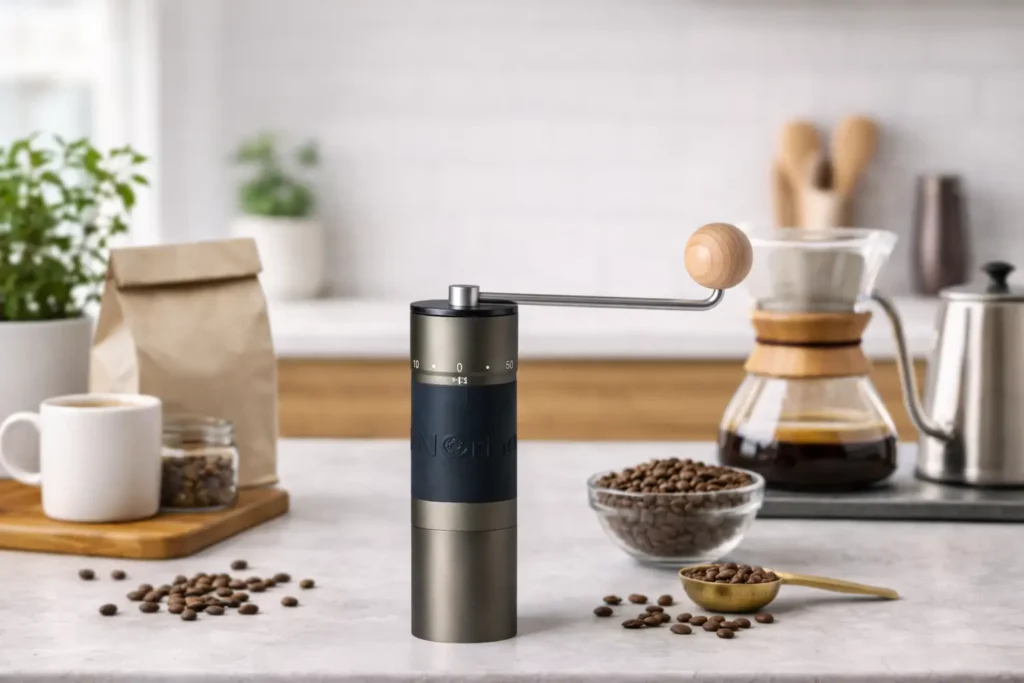
KINGrinder K6 — Best for Robusta Espresso
The K6’s fine-click adjustment system lets you precisely dial in the slightly coarser setting Robusta needs vs Arabica — and make small, repeatable adjustments without losing your place. Excellent grind uniformity reduces channeling in dense Robusta espresso pucks.
- Outstanding grind uniformity for espresso — minimizes channeling
- Fine-click system: precise Robusta-to-Arabica adjustments
- Site standard recommendation for espresso dial-in
Disclosure: CoffeeGearHub may earn from qualifying purchases.
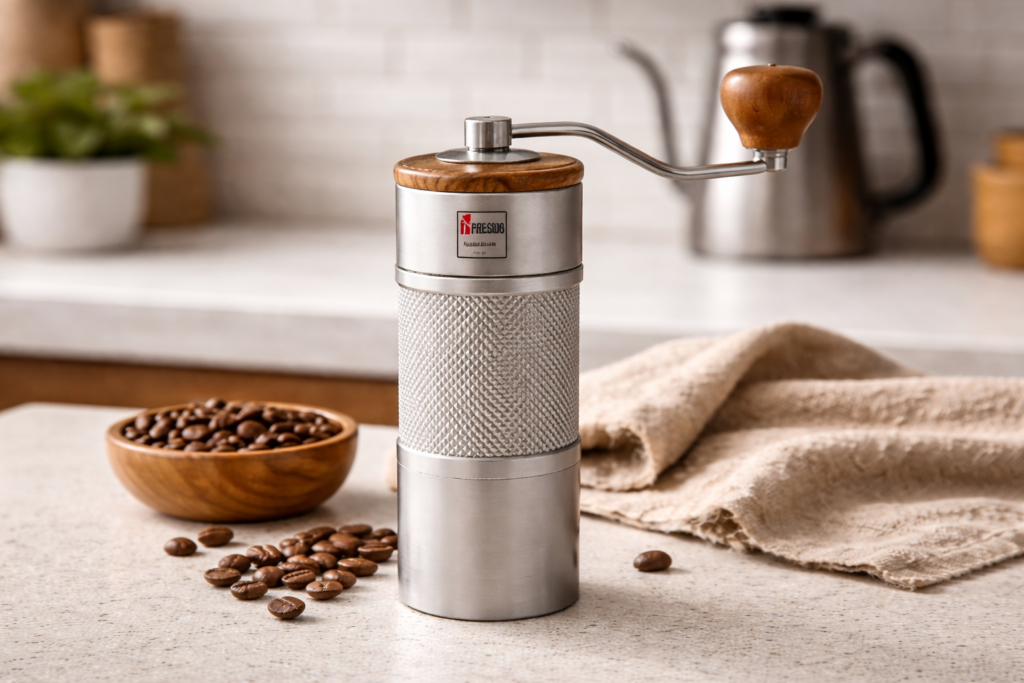
1Zpresso JX-Pro — Best for Robusta Espresso Blends
Excellent grind uniformity in the espresso range with per-click adjustment finer than most manual grinders. A strong choice for Robusta-forward espresso blends where uniform particle size is the primary tool against channeling and harshness.
- Very high grind uniformity — reduces channeling in Robusta pucks
- Fine per-click adjustment for espresso precision
- Portable and durable for daily use
Disclosure: CoffeeGearHub may earn from qualifying purchases.
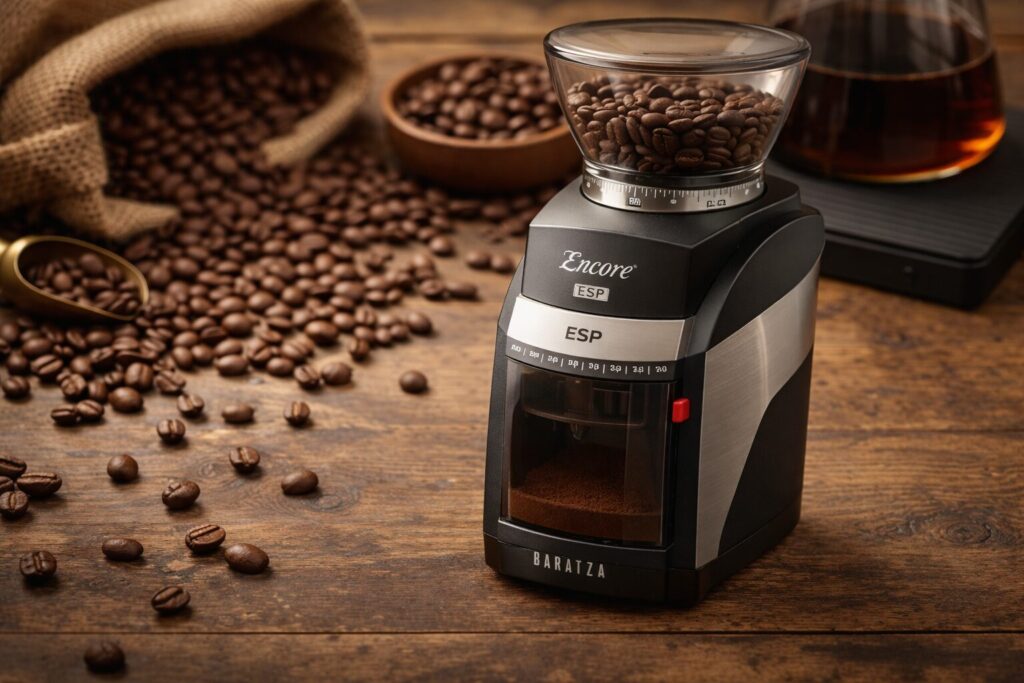
Baratza Encore ESP — Best Electric for Robusta Cold Brew & Pour-Over
The Encore is the most practical daily-driver electric for Robusta cold brew and pour-over. Consistent grind at coarser settings reduces harshness and makes dial-in repeatable. Repairable and well-supported long term.
- Excellent consistency at coarse Robusta cold brew settings
- Easy coarse-setting adjustment for cold brew batches
- Repairable + long-term Baratza support
Disclosure: CoffeeGearHub may earn from qualifying purchases.
Cold Brew Maker & Phin Filter
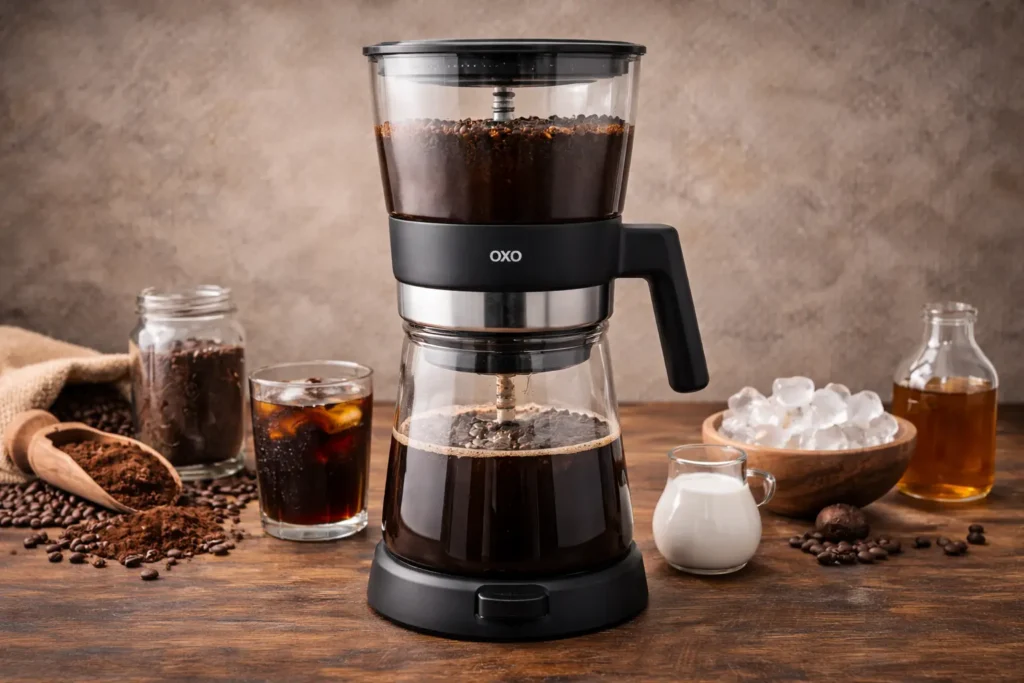
OXO Good Grips Cold Brew Maker
- Built-in fine mesh filter — no separate paper needed
- Rainmaker lid for even water distribution over grounds
- 32oz capacity — ideal for 1:5 Robusta concentrate batches
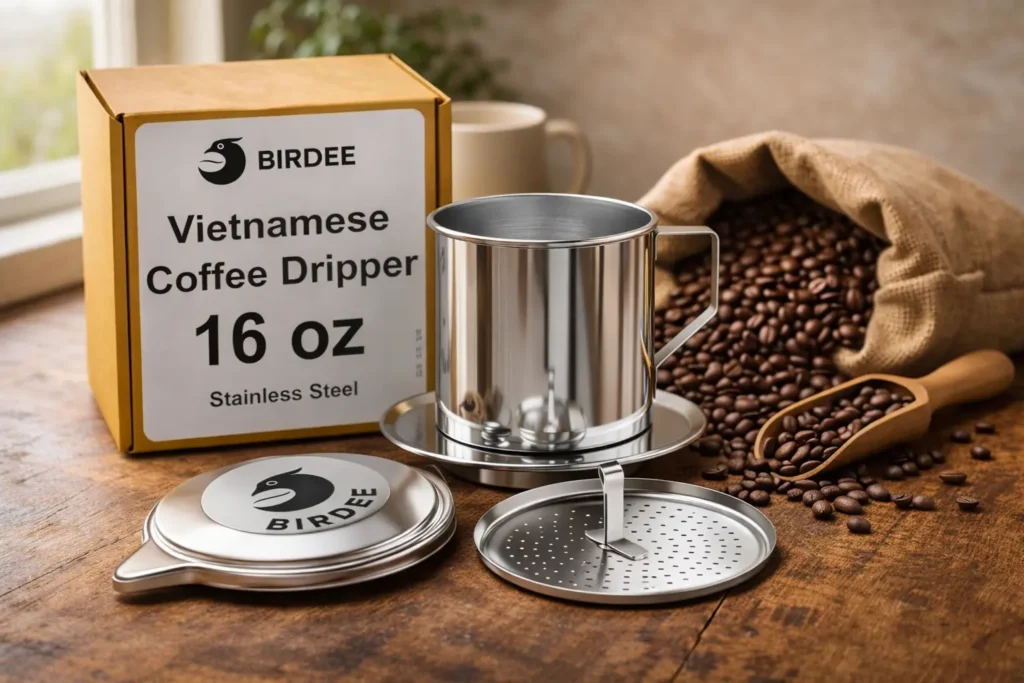
Vietnamese Phin Filter (Stainless Steel)
- Gravity-fed slow drip — matched to Robusta’s density
- Stainless steel — durable, easy to clean
- Inexpensive entry into traditional Vietnamese-style brewing
Full Gear Comparison Table
| Gear | Type | Price | Grind consistency | Adjustment resolution | Best Robusta use case |
|---|---|---|---|---|---|
| KINGrinder K6 | Manual steel burr | $ | Excellent | Very good (fine-click) | Robusta espresso dial-in — site standard pick |
| 1Zpresso JX-Pro | Manual steel burr | $$ | Excellent | Very good | Robusta espresso blends, channeling control |
| Baratza Encore ESP | Electric conical burr | $$ | Excellent | Good | Robusta cold brew + pour-over, daily driver |
| OXO Cold Brew Maker | Cold brew brewer | $ | — | — | 1:5 Robusta concentrate — built-in fine mesh filter |
| Phin Filter (stainless) | Gravity dripper | $ | — | — | Traditional cà phê sữa đá, Robusta’s best format |
FAQs
How do I brew Robusta coffee without bitterness?
Lower brew temperature to 195–200°F and use a slightly coarser grind than you would for Arabica. Avoid long contact times and aggressive agitation. For espresso, add pre-infusion to reduce channeling through the dense Robusta puck. Temperature is often the highest-leverage variable — try dropping 2–3°F before changing grind size. See the full framework in How to Dial In Coffee at Home.
What is the best espresso ratio for Robusta beans?
Start with 18g in and 36g out (1:2 ratio) in 25–30 seconds at 195–200°F. If harsh, coarsen grind 1 click or taper pressure earlier. If thin or inconsistent, the problem is usually channeling — fix puck prep and extend pre-infusion before adjusting grind. Full diagnostic in the Espresso Troubleshooting Guide.
Is Robusta better for cold brew concentrate?
Robusta is excellent for cold brew. Cold extraction bypasses the heat-driven CGA degradation that causes harshness, leaving the chocolate body and high caffeine intact. Use a 1:5 concentrate ratio with coarse grind for 16–18 hours, then dilute 1:1 to serve. Full method in the Cold Brew Coffee Guide.
What grind size works best for Vietnamese phin coffee?
Use a medium-coarse grind (KINGrinder K6: approximately 25–35 clicks finer than French press) and target a 4–6 minute drip. Faster than 4 minutes means too coarse or press plate too loose. Slower than 6 minutes means too fine or press plate over-tightened.
Should I use lower temperature for Robusta espresso blends?
Usually yes. Robusta-forward blends taste smoother at 195–200°F (90–93°C). Higher temperatures accelerate the degradation of chlorogenic acids into bitter quinic acid — which happens faster in Robusta than Arabica. Temperature is a core extraction lever covered in How to Dial In Coffee at Home.
Why does Robusta produce thicker crema in espresso?
Robusta has higher protein levels and produces more CO₂ during roasting, contributing to thicker, more persistent crema. That’s why it’s traditionally used in espresso blends — especially for milk drinks where crema structure matters. Learn profiling basics to get smoother crema with less harshness in Flow Control Espresso Machines: Are They Worth It?
How much Robusta should I add to an espresso blend?
Start at 10–15% Robusta to boost crema and body while staying smooth. Increase to 20–30% for milk drink structure or bolder flavor. If bitterness rises, the fix is temperature and flow control — not reducing the Robusta percentage. Follow the fixes in the Espresso Troubleshooting Guide.
Does pressure profiling help Robusta taste smoother?
Yes. Pre-infusion plus lower peak pressure (6–8 bar) reduces early channeling through the dense puck, producing a smoother, more chocolate-forward shot. Machines without full profiling benefit from extended pre-infusion settings and an OPV spring mod. See Flow Control Espresso Machines: Are They Worth It?
What roast level is best for Robusta espresso?
Medium-dark is the best balance for espresso: strong chocolate body without the ashy flavors of very dark roasts. Very dark roasting is often done to mask commodity defects — not to improve flavor. For roast selection fundamentals, use the Coffee Bean Buying Guide.
Is Fine Robusta worth buying for home brewing?
If you brew espresso milk drinks, cold brew, or want high-caffeine coffee with clean chocolate flavor, Fine Robusta is worth the premium. Properly processed Fine Robusta from Uganda or India (Wayanad) is noticeably cleaner and more chocolate-forward than commodity Robusta. Learn how processing impacts flavor in the Coffee Bean Buying Guide.
CoffeeGearHub product shortlist
Compare coffee and brewing gear
Review CoffeeGearHub catalog pages for coffee and brewing equipment before opening merchant offers.
Continue Learning
Understand coffee species
In this guide
- The 30-Second Answer
- Robusta vs Arabica: What’s Different and Why It Matters for Brewing
- Robusta Coffee Myths — Debunked
- Robusta Flavor Profile: What to Expect
- Robusta Extraction Science: Why It Gets Bitter and How to Prevent It
- Robusta Espresso Dial-In: Baseline Parameters + Advanced Adjustments
- Pressure Profiling Flow Control for Robusta Espresso
- Robusta Espresso Blending: How Much to Use
- Robusta Cold Brew: High Caffeine, Low Acid Method
- Vietnamese Phin Coffee: Robusta’s Home Turf
- Fine Robusta: What It Is and Whether It’s Worth Buying
- Robusta Troubleshooting Matrix: Taste → Fix
- Continue Learning