
Best Manual Coffee Grinders (2026 Buyer’s Guide)

Editorial standards: this guide compares manual coffee grinders by burr quality, grind consistency, adjustment range, ergonomics, portability, speed, and value. Product recommendations are based on published specifications and use-case fit unless hands-on testing is explicitly stated.
At a glance
What this guide covers
This guide compares manual grinders for filter coffee, AeroPress, moka pot, and espresso-oriented use, with emphasis on where hand grinding offers strong value and where daily effort becomes the limiting factor.
Editorial analysis
Manual grinders trade convenience for burr quality per dollar
A well-designed hand grinder can put more of the purchase price into burrs, bearings, and alignment because it does not need a motor or electronics. That often makes manual grinders compelling at entry and mid-range prices.
The trade-off is workflow. Grinding one filter dose can be quick and quiet; repeated espresso doses or larger batches can become tedious. Choose for the amount and fineness you actually grind each day.
The 30-Second Answer
Manual grinders are strongest when you want high grind quality, low noise, portability, and good value and you do not mind hand grinding. Prioritize burr consistency, usable adjustment range, comfortable ergonomics, and realistic grind speed.
Top Manual Coffee Grinder Picks
Every grinder below has been evaluated on burr consistency, adjustment precision, build quality, retention, and value for its price tier. The picks are organized by category — start with the best overall value and move up only if your brew method or budget demands it.
Best Overall & Best Budget Picks
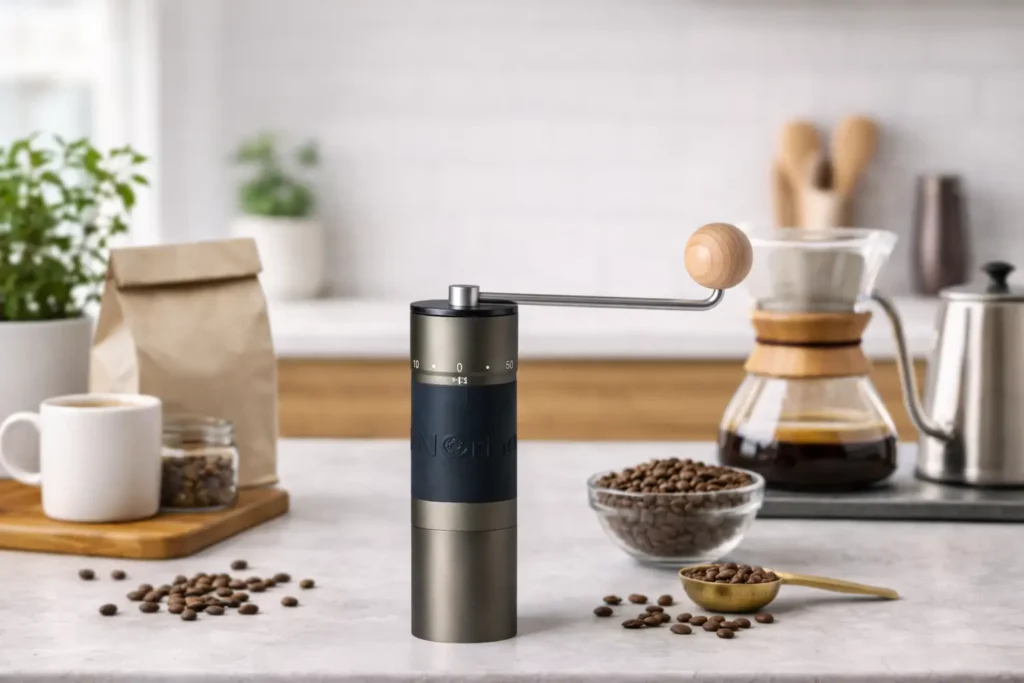
🏆 BEST OVERALL — Best value-to-performance ratio; covers every brew method
KINGrinder K6 — Best Overall
Burrs: 48mm stainless steel conical • Adjustment: Click-based, numbered • Capacity: ~30g • Brew range: Turkish through cold brew. The K6 is the CoffeeGearHub standard recommendation for a reason: it delivers burr quality and adjustment precision that punches well above its price class. The numbered click system makes it easy to dial in a grind, record the setting, and return to it exactly on future brews. Near-zero retention. Handles moka pot, pour-over, AeroPress, and French press with equal confidence.
- 48mm burrs — larger than most at this price tier, reducing heat and grinding time
- Numbered click system — set it, record it, repeat it across every brew
- Under 0.1g retention — no stale grounds from the previous session
- Stainless body — durable at home and on the road
✅ Pros
- Numbered system — easiest to use repeatedly
- 48mm burrs grind faster than 38mm rivals
- <0.1g retention — zero stale carry-over
- Excellent value at mid-range price
⚠️ Watch-Outs
- Not ideal for true espresso dialing
- Heavier than plastic-body alternatives
- 30g cap — not for brewing 3+ cups
Best for: pour-over, moka pot, AeroPress, French press • most households • travelers
Disclosure: CoffeeGearHub may earn from qualifying purchases.
💰 BEST BUDGET — Best build quality at the lowest price tier
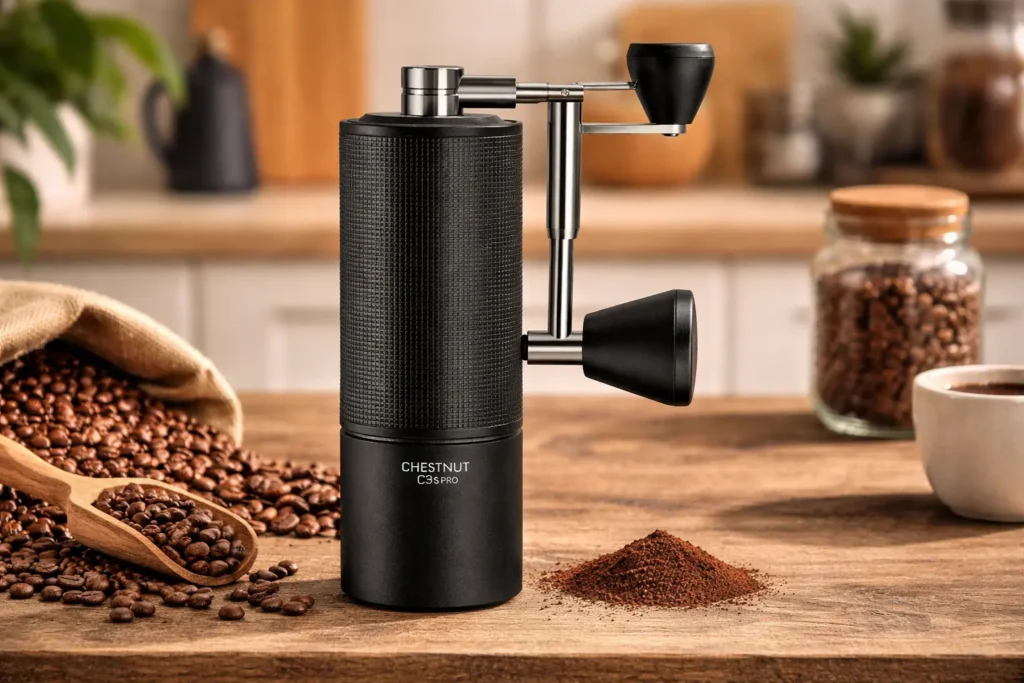
Timemore C3 Pro — Best Budget Pick
Burrs: 38mm stainless steel conical • Adjustment: Stepless • Capacity: ~25g • Brew range: Moka pot through cold brew. The C3 Pro is the budget benchmark for a reason. Timemore’s S2C burrs produce grind consistency that far exceeds what the price tag suggests. The stepless adjustment system takes a bit more patience to dial in than a click-based system, but the range is more than sufficient for all non-espresso methods. The aluminum and polycarbonate body is lightweight and well-balanced for one-handed grinding.
✅ Pros
- Best grind quality at this price tier
- Lightweight — ideal for travel use too
- Stepless = infinite fine-tuning range
⚠️ Watch-Outs
- Stepless harder to reproduce than numbered clicks
- 38mm burrs are slower than 48mm options
- Not suited for espresso dialing
Best for: first-time hand grinder buyers • pour-over • drip • moka pot
Disclosure: CoffeeGearHub may earn from qualifying purchases.
✈️ BEST TRAVEL — Pocketable, no-power, TSA-friendly
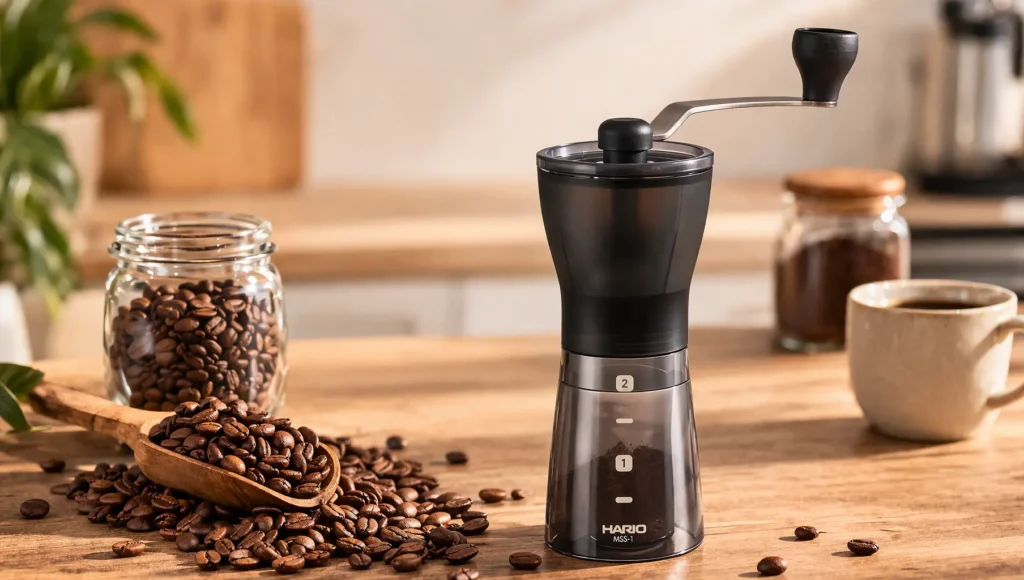
Hario Mini Slim Plus — Best Travel Pick
Burrs: 38mm ceramic conical • Adjustment: Stepped collar • Capacity: ~24g • Brew range: Pour-over through French press. The Mini Slim Plus is the lightest option in this list and genuinely pocketable. Ceramic burrs are slower to wear than steel and chemically inert — no metallic taste risk. This is the grinder to throw in a travel bag or a hiking pack alongside an AeroPress. Grind quality is solid for pour-over and French press; not recommended for espresso or moka.
✅ Pros
- Lightest / most compact on this list
- Ceramic burrs — no metallic taste risk
- TSA carry-on friendly
⚠️ Watch-Outs
- Ceramic = less sharp than steel burrs
- Not for espresso or moka pot
- Limited adjustment range vs. other picks
Best for: travel • camping • AeroPress • light pour-over use
Disclosure: CoffeeGearHub may earn from qualifying purchases.
Best Espresso-Capable & Precision Picks
⚙️ ALL-PURPOSE STEP-UP — external adjustment, 35–40g capacity
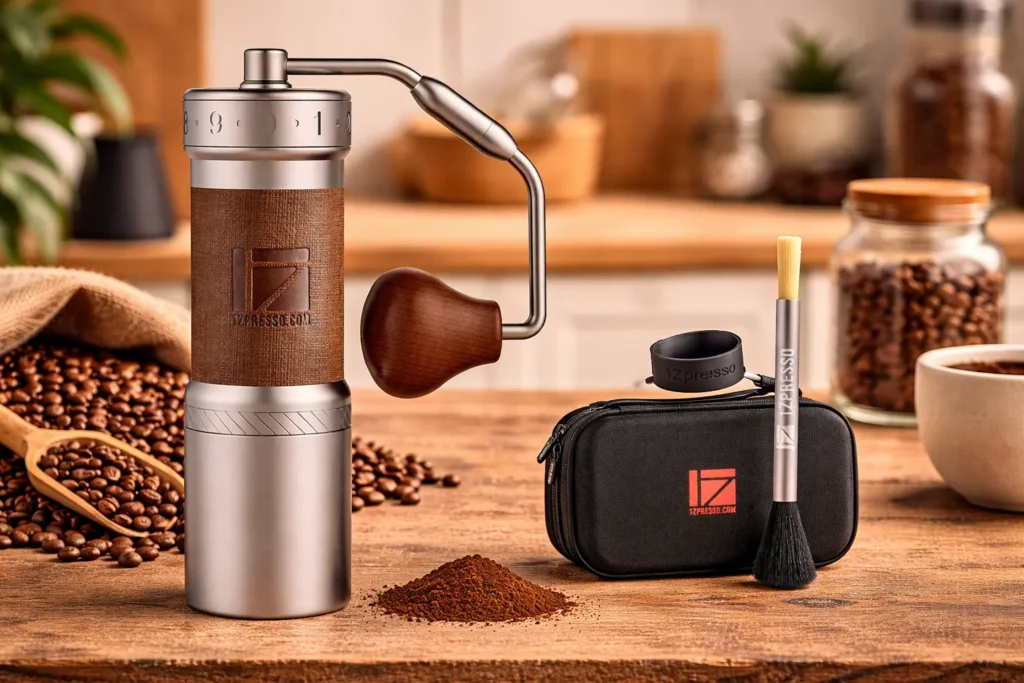
1Zpresso K-Ultra — Best All-Purpose Step-Up
Burrs: Heptagonal conical K burr • Adjustment: External dial, 100 clicks per rotation, 20 microns per click • Capacity: 35–40g • Brew range: Fine through coarse. The K-Ultra is the all-purpose step-up in this guide: its external adjustment ring is easy to read and return to, while the broad range suits filter methods, moka pot, AeroPress, and occasional espresso use. The magnetic catch cup and foldable handle also improve day-to-day workflow.
✅ Pros
- External numbered ring — easy to read and return to
- 35–40g capacity — useful for larger manual doses
- 20-micron adjustment steps across a broad all-purpose range
⚠️ Watch-Outs
- Costs more than the K6 with modest gains for filter
- Espresso capable, not espresso-optimized
Best for: multi-method brewing • precise filter adjustment • larger manual doses
Disclosure: CoffeeGearHub may earn from qualifying purchases.
☕ BEST FOR ESPRESSO — 100 clicks per rotation; 8-micron adjustment
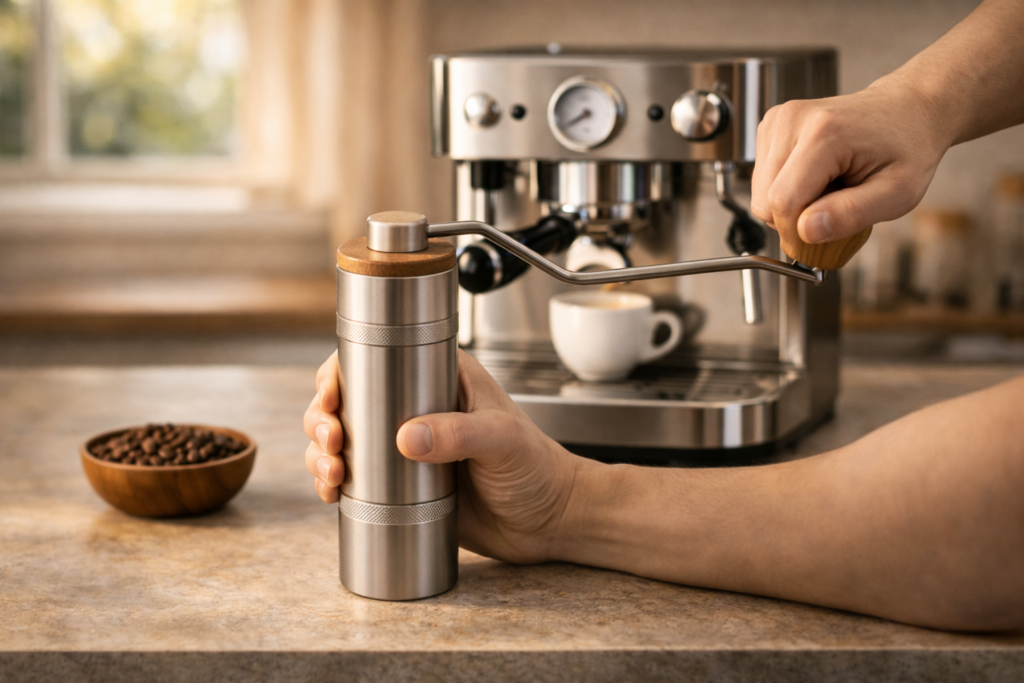
1Zpresso J-Ultra — Best for Espresso
Burrs: 48mm stainless steel conical • Adjustment: 100-click-per-rotation external dial, 8 microns per click • Capacity: 35–40g • Brew range: Espresso through French press. The J-Ultra is 1Zpresso’s current espresso-focused manual grinder. Its external adjustment provides 100 clicks per rotation with 8-micron burr movement per click, giving users fine, repeatable control for dialing in espresso. The 48mm coated burr, numbered external dial, and 35–40g capacity also make settings easy to record and return to between shots.
✅ Pros
- Fine adjustment designed specifically for espresso dialing
- 100-click-per-rotation external dial — easy to record and reproduce
- Fine adjustment resolution designed around espresso dialing
⚠️ Watch-Outs
- Premium price over K6 — justified only for espresso
- Finer adjustment = more patience for filter dialing
Best for: espresso on lever / manual machines • serious pour-over dialing
Disclosure: CoffeeGearHub may earn from qualifying purchases.
Best Premium Pick
👑 BEST PREMIUM — The hand-grinder benchmark; proprietary HN-steel burrs
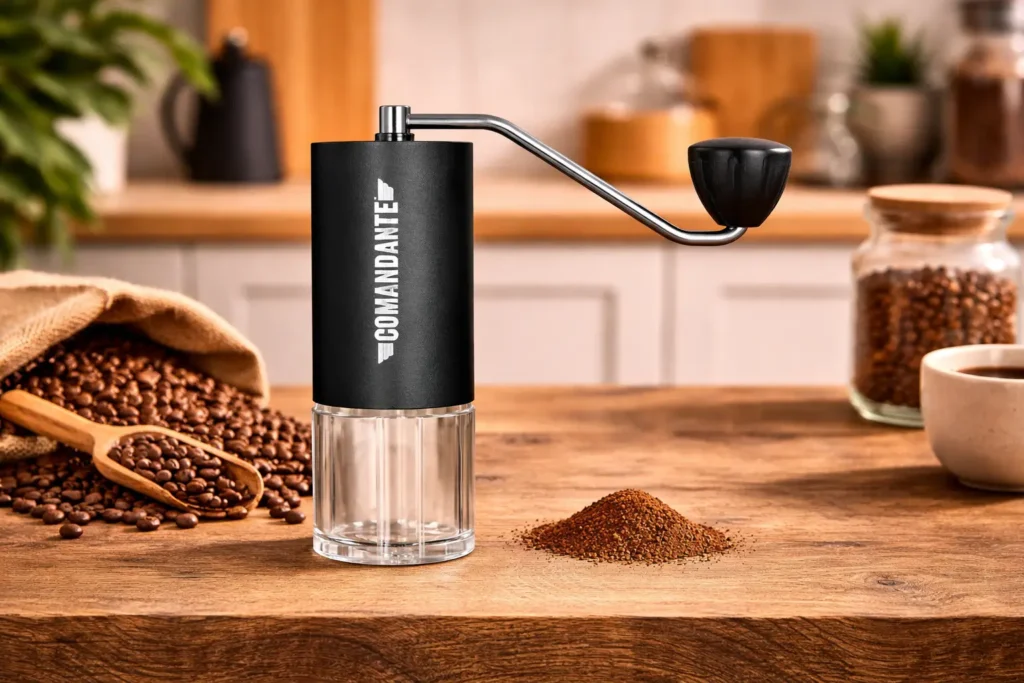
Comandante C40 MK4 — Best Premium
Burrs: 39mm high-nitrogen steel conical (proprietary) • Adjustment: Stepped “click” system, ~31µm per click • Capacity: ~30g • Brew range: Espresso through cold brew. The C40 MK4 is the hand-grinder benchmark that every other grinder in this list is compared against. Comandante’s high-nitrogen stainless steel burrs are proprietary and produce a grind consistency that is noticeably cleaner than anything at a lower price tier — especially in the fine-to-medium range used for espresso and pour-over. The build quality is exceptional: glass catch jar, sealed bearing, and German precision tolerances.
- High-nitrogen steel burrs — proprietary alloy with superior edge retention
- Exceptional build precision — sealed bearing, glass catch jar, German tolerances
- Consistent across all brew methods — the only grinder on this list equally suited to espresso and filter
✅ Pros
- Proprietary HN-steel burrs — best edge retention
- Glass catch jar + German tolerances
- Excellent for espresso AND filter both
- Will outlast most machines it’s paired with
⚠️ Watch-Outs
- Premium price — hard to justify for filter-only brewers
- Glass jar adds fragility for travel use
- Narrower burr (39mm) than the K6 / J-Ultra (48mm)
Best for: serious home brewers • espresso + filter dual use • long-term investment
Disclosure: CoffeeGearHub may earn from qualifying purchases.
⚖️ Who Should Buy the Comandante vs. the K6?
If you brew pour-over or moka at home and want consistent, repeatable results — the K6 is all you need. The quality gap between the K6 and the C40 is real but narrow for filter methods, and the K6 wins on value by a wide margin.
The C40 earns its premium over the K6 in two specific scenarios: espresso dialing (where grind particle distribution measurably affects shot quality) and competition / daily serious use (where the build longevity and burr sharpness retention over years of heavy use justify the cost). For everyone else, the K6 is the smarter buy.
Why Choose a Manual Grinder Over Electric?
Manual grinders aren’t a compromise — for most home brewers, they’re a deliberate upgrade. The case for a hand grinder comes down to what you’re actually paying for when you buy an electric grinder: the motor. Burr quality is what determines grind consistency, and burr quality costs the same whether a motor drives it or your arm does. The result is that a hand grinder consistently delivers better burrs at any given price point than a comparably priced electric model.
Here’s the honest comparison:
| Factor | Manual grinder advantage | Electric grinder advantage |
|---|---|---|
| Price per burr quality | ✓ Significantly better — no motor cost overhead | — |
| Noise | ✓ Near-silent — ideal for early mornings, apartments | — |
| Portability | ✓ Compact, no power required, TSA-friendly | — |
| Retention | ✓ Typically under 0.1g — no stale grounds | — |
| Grinding speed | — | ✓ 5–15 seconds vs 30–90 seconds by hand |
| High-volume brewing | — | ✓ Better for 3+ cups simultaneously |
| Convenience | — | ✓ Set-and-forget with hopper models |
🔬 The practical rule: If you brew 1–2 cups per session, brew 1–2 times a day, and want the best grind quality per dollar — a manual grinder wins. If you regularly brew 4+ cups at once or want to grind without touching anything at 6am, an electric grinder is worth the extra spend on motors. For the majority of specialty coffee home brewers, the manual grinder is the better tool. See our Manual vs. Electric Grinder comparison guide for a full breakdown.
What to Look for in a Manual Coffee Grinder
Before buying, understand which specs actually matter for your use case and which ones are marketing noise. Here’s what to evaluate — in priority order for most home brewers.
Burr size. Larger burrs reduce the time and effort needed to grind a dose — a 48mm burr grinds noticeably faster than a 38mm burr with less physical force. Larger burrs also generate less frictional heat during grinding, which can affect flavor in long espresso-dose sessions. For most brew methods, 38mm is sufficient; 48mm or above is preferable if you grind espresso doses daily.
Burr material. Steel burrs are sharper, more consistent, and produce better results for fine grinding (espresso, moka). Ceramic burrs are slower to wear and chemically inert — no metallic taste risk — but are less sharp and less suitable for fine settings. For any serious use, steel is the correct choice. Ceramic is acceptable for casual pour-over and travel use.
Adjustment system. This is the most underrated spec in a manual grinder. There are three types: stepless (smooth, infinite adjustment — requires patience to dial in and reproduce), stepped clicks without numbers (repeatable but requires counting from zero each time), and numbered click system (the most user-friendly — set it once, record the number, return to it exactly on any future brew). For home use, a numbered click system like the KINGrinder K6 significantly reduces dialing-in friction.
Grind range. A wide grind range means one grinder can handle both espresso and cold brew — valuable if you brew multiple methods. A narrow range optimized for one method (espresso-specific grinders) offers more adjustment resolution within that range at the cost of versatility. Identify your primary and secondary brew methods before choosing.
Retention. Retention is the amount of ground coffee that stays inside the grinder after each dose — trapped in the burr chamber or exit chute. High-retention grinders waste coffee (old grounds mix into your next brew) and are harder to calibrate for single dosing. Look for grinders that advertise under 0.1g retention for precision use.
Body material and build quality. Stainless steel and titanium bodies are more durable, resist odors, and don’t flex during grinding. Polycarbonate or ABS plastic bodies work fine and reduce weight — useful for travel. Check that the top burr carrier feels solid with no wobble when the grinder is assembled — lateral burr play is the primary driver of grind inconsistency.
Grind Range by Brew Method
Grind setting names (medium, coarse, etc.) mean nothing without a reference point — every grinder’s scale is different. Use this table to understand the target zone for your brew method, then use the KINGrinder K6 click references as a starting point if that’s your grinder. Adjust from there based on taste.
| Brew method | Target grind | Visual reference | K6 starting point (approx.) |
|---|---|---|---|
| Turkish coffee | Extra fine | Flour / talc powder | ~15–30 clicks (¼–½ rotation) |
| Espresso | Fine | Powdered sugar | ~35–45 clicks (about ⅔ rotation) (J-Ultra / C40 recommended) |
| Moka pot | Medium-fine | Table salt / fine sand | ~65–75 clicks (about 1.1–1.25 rotations) |
| AeroPress (concentrated) | Medium-fine | Table salt | ~60–70 clicks (about 1–1.2 rotations) |
| AeroPress (standard / filter) | Medium | Coarse sand | ~70–85 clicks (about 1.2–1.4 rotations) |
| Pour-over (V60, Kalita) | Medium | Raw sugar / coarse sand | ~90–105 clicks (about 1.5–1.75 rotations) |
| Chemex | Medium-coarse | Sea salt / coarse sand | ~105–120 clicks (about 1.75–2 rotations) |
| Flat-bottom drip | Medium | Raw sugar | ~100–115 clicks (about 1.7–1.9 rotations) |
| French press | Coarse | Flaky sea salt / coarse breadcrumbs | ~135–150 clicks (about 2.25–2.5 rotations) |
| Cold brew | Extra coarse | Coarse breadcrumbs | ~145–160 clicks (about 2.4–2.7 rotations) |
🔬 How to use these numbers: The K6 click figures are approximate starting points only — actual sweet spots will vary by coffee origin, roast level, and freshness. Use them to get your first brew in the right zone, then adjust 2–4 clicks at a time based on taste. Sour/thin = go finer. Bitter/harsh = go coarser. For a complete grind-size reference covering all brew methods, see the Coffee Grind Size Guide.
How to Use a Manual Coffee Grinder
The technique for using a hand grinder matters — especially for consistency across brews. Follow these steps each time to maintain grind uniformity and reduce waste.
- Set your grind adjustment before adding beans. Adjust the grinder to your target setting with the hopper empty. Changing the setting mid-grind or after beans are in the hopper can cause uneven grinding and grind setting drift on some models. On the K6, close the burrs fully (until they just touch with no resistance), then count clicks to the target setting (60 clicks = one full rotation).
- Weigh your dose. Consistent brewing starts with a consistent dose. Use a scale to weigh your whole beans to the nearest gram before grinding. For a standard V60 single cup, 15–18g is typical. For moka pot, use the full basket weight for your pot size (see the moka pot brewing guide for per-size references).
- Add beans to the hopper and seat the catch cup. Pour your weighed dose into the top of the grinder. Make sure the catch cup is fully threaded onto the body — a loose catch cup leads to grounds escaping and grounds falling out mid-grind.
- Grind with steady, even strokes. Hold the body of the grinder stable in your non-dominant hand — brace it against your stomach or hip for leverage. Use your dominant hand to rotate the handle in smooth, continuous circles. Avoid short, jerky strokes; these create inconsistency in the burr gap and generate more fines. A steady 60–80 rpm rotation rate is ideal for most grinders.
- Clear the grinder at the end of the dose. When resistance drops and the rotation becomes light and easy, grinding is complete. Give the handle 2–3 final rotations to clear any remaining grounds from the burr chamber. This reduces retention and ensures you’re not leaving grounds to go stale before the next session.
- Tap gently and pour into your brewer immediately. Lightly tap the bottom of the catch cup against your palm once or twice to settle the grounds and release any electrostatic clumps. Pour directly into your brewer. Ground coffee oxidizes rapidly — brew within a few minutes of grinding for best results.
💡 Electrostatic grounds tip: Static cling in the catch cup is common — especially with lighter roasts and in dry climates. The simplest fix is the “Ross Droplet Technique”: add 1–2 drops of water to your bean dose before grinding. It dramatically reduces static clumping without measurably affecting extraction.
How to Clean and Maintain a Manual Coffee Grinder
A well-maintained hand grinder performs consistently for years. The cleaning process is simple but must be done regularly — especially if you switch between coffee origins, roast levels, or brew methods.
- Quick brush after every use. Disassemble the catch cup and use the included brush (or a dry pastry brush) to sweep loose grounds from the inner chamber and exit chute. This prevents ground buildup from going rancid and affecting future cups. Takes 30 seconds.
- Full burr disassembly monthly (or when switching beans). Remove the top burr by loosening and removing the adjustment mechanism. On most click-based grinders this means unscrewing the adjustment collar and lifting out the upper burr axle. Brush both burr surfaces thoroughly. Never use water on steel burrs — moisture causes rust and permanently damages the cutting edges.
- Clean the burr surfaces without water. For oil buildup on the burrs (especially from dark roasts), use dry grinder cleaning tablets (Grindz or equivalent) or run a small handful of plain white rice through the grinder at medium-coarse setting. These absorb oils and push residue out through the exit. Grind and discard — don’t brew the output.
- Clear the exit chute. Coffee oils concentrate in the exit chute and can go rancid. Use a thin, soft brush or pipe cleaner to push through the chute occasionally, especially if you notice a stale or oily off-note developing in your cups.
- Re-calibrate after cleaning. Reassemble the grinder and verify your grind setting before brewing. Some grinders drift slightly after disassembly — especially stepless models. Run a small calibration dose to confirm the setting matches your recorded target before brewing for drinking.
- Check and protect the bearing annually. Most premium hand grinders use sealed bearings in the axle — these require no maintenance. If you notice lateral wobble developing in the upper burr that wasn’t present before, the bearing may be worn. Contact the manufacturer; most offer bearing replacement as a service.
🔬 New grinder break-in: New burrs — especially steel — benefit from a short break-in period. Run 100–200g of inexpensive coffee through the grinder before committing to your dialed-in settings. New burr edges have micro-burrs and manufacturing residue that affect grind consistency until they smooth. Cups from the first several sessions are often slightly less consistent than they will be after break-in is complete.
Troubleshooting: Bitter, Sour, Inconsistent, Hard to Turn
Almost every manual grinder problem traces back to one of the issues below. Work through grind adjustment first — it accounts for the majority of off-flavors — before assuming equipment failure.
| Symptom | Most likely cause(s) | Fix — in this order |
|---|---|---|
| Bitter, harsh cups | Grind too fine / using too much coffee | Go 2–4 clicks coarser → reduce dose by 1–2g → use fresher beans at medium roast |
| Sour, thin, hollow cups | Grind too coarse / stale beans / under-dosed | Go 2–4 clicks finer → use fresher beans → fill basket or dose fully for brew method |
| Both bitter AND sour simultaneously | Inconsistent particle size — likely residue from a blade grinder or worn burrs | Clean burrs thoroughly → if previously using blade grinder, run break-in dose → check burr wear |
| Extremely hard to turn the handle | Grind set too fine / foreign object / beans wedged in burrs | Back off to a coarser setting first → never force the handle → disassemble and inspect burrs |
| Grind setting drifts during use | Loose adjustment ring or locking collar | Tighten the lock collar or adjustment nut → on stepless grinders, use a small mark to track drift |
| Grounds leaking or falling out mid-grind | Catch cup not fully threaded / cracked catch cup | Fully thread catch cup onto grinder body → inspect for cracks → replace catch cup if needed |
| Metallic taste in the cup | New grinder / dirty burrs / steel oxidation | Run break-in dose of 100–200g → clean burrs → if using ceramic, rule out water damage |
| Inconsistent grind — fines mixed with large particles | Upper burr not seated evenly / lateral burr wobble | Disassemble and reseat upper burr → tighten axle assembly → check for bearing wear |
| Slow grinding even at correct setting | Burr wear / dark or dense beans | Check burr sharpness (if 500+ kg ground, replace burrs) → adjust grind 1–2 clicks coarser |
Torn between a budget pick and a step-up grinder? Our KINGrinder K6 vs 1Zpresso K-Ultra comparison breaks down burrs, adjustment, and which of the two suits espresso versus filter brewing.
FAQs: Best Manual Coffee Grinders
What is the best manual coffee grinder overall?
The KINGrinder K6 is our top overall pick for most home brewers. It delivers consistent burr performance, a precise numbered click adjustment system, and a grind range wide enough to cover pour-over, moka pot, AeroPress, and French press — at a price significantly below comparable electric grinders.
Are manual coffee grinders better than electric grinders?
Manual grinders aren’t universally better, but they offer specific advantages: quieter operation, lower cost for equivalent grind quality, no electricity required, and superior portability. For equivalent burr quality, a hand grinder typically costs significantly less than a comparable electric model. The trade-off is time and physical effort, which increase with larger doses and finer grind settings.
How long does it take to hand grind coffee?
Grinding time varies substantially by dose, burr geometry, roast level, grinder, and grind setting. Fine espresso settings generally require more effort and time than filter or French-press settings, so treat any timing estimate as grinder-specific rather than universal.
Can a manual grinder grind fine enough for espresso?
Yes, but not all manual grinders are suited for espresso-level precision. Espresso requires very fine, very consistent grinds with a narrow particle size distribution. The 1Zpresso J-Ultra and Comandante C40 MK4 are among the manual grinders capable of true espresso-grade performance. Budget grinders like the Timemore C3 Pro can approach espresso territory but lack the fine-adjustment precision needed for consistent shot dialing.
What grind setting should I use for pour-over with the KINGrinder K6?
For pour-over (V60, Chemex, Kalita), start around 90–110 clicks (about 1.5–1.8 rotations) from fully closed on the KINGrinder K6. This puts you in the medium range — roughly the texture of raw sugar or coarse sand. Adjust finer if the cup tastes sour or thin; coarser if it tastes bitter or astringent. A V60 total brew time of 3–4 minutes is a useful calibration signal.
What grind setting should I use for moka pot on the KINGrinder K6?
Start at 65–75 clicks (about 1.1–1.25 rotations) from fully closed on the KINGrinder K6 for moka pot. This puts you in the medium-fine zone — between drip and espresso. Adjust 2–4 clicks at a time between brews. If the cup is bitter or the pot sputters early, go 4 clicks coarser. If it tastes sour or watery, go 4 clicks finer.
How do I clean a manual coffee grinder?
Disassemble the grinder fully by removing the top burr via the adjustment mechanism. Brush loose grounds from the burrs and inner chamber with the included brush or a dry pastry brush. Never use water on steel burrs — this causes rust. For oil buildup, run dedicated grinder cleaning tablets or a small amount of plain rice through the grinder periodically. Reassemble and re-verify your grind setting after cleaning.
How long do manual grinder burrs last?
Manual-grinder burr life varies with burr material, coffee volume, roast style, alignment, and maintenance. Signs of meaningful wear can include declining consistency or a need to move settings noticeably finer over time. Check the manufacturer’s parts and service guidance before assuming a fixed replacement interval.
What is the difference between conical and flat burrs in hand grinders?
Conical burrs use a cone-shaped inner burr inside a ring-shaped outer burr, producing a slightly bimodal particle distribution — a mix of fines and larger particles that creates body and complexity in the cup. Flat burrs grind between two parallel disc-shaped burrs, producing more uniform particle size that results in clarity and precision. Most manual grinders use conical burrs, which perform well across all brew methods. Flat-burr manual grinders are less common and tend to be premium-priced.
Can I use a manual grinder for cold brew?
Yes — cold brew requires an extra-coarse grind, which is actually the easiest and fastest setting on any hand grinder. At coarse settings, grinding is usually easier than at espresso-fine settings, but batch time still depends on the grinder and dose. Both the KINGrinder K6 and Timemore C3 Pro have sufficient range to reach cold brew coarseness.
Do I need an expensive manual grinder to get good results?
Not for most brew methods. The KINGrinder K6 delivers excellent results for pour-over, moka pot, AeroPress, and French press at a mid-range price. Espresso is the exception — it demands tighter particle distribution, making higher-end grinders like the 1Zpresso J-Ultra worth the investment. For everything except espresso, spending above the K6 price tier offers diminishing returns for most home brewers.
Are manual grinders good for travel and camping?
Manual grinders are ideal for travel — compact, no power required, and quiet. The Hario Mini Slim Plus and KINGrinder K6 are both excellent travel options. For air travel, check current TSA and airline guidance before packing a grinder because screening decisions and rules can change. Pair with a collapsible pour-over dripper or AeroPress for a complete, high-quality travel brewing kit.
CoffeeGearHub product shortlist
Compare manual and home coffee grinders
Review current grinder pages and verified merchant offers in the CoffeeGearHub catalog.
Continue Learning
In this guide
- The 30-Second Answer
- Top Manual Coffee Grinder Picks
- Why Choose a Manual Grinder Over Electric?
- What to Look for in a Manual Coffee Grinder
- Grind Range by Brew Method
- How to Use a Manual Coffee Grinder
- How to Clean and Maintain a Manual Coffee Grinder
- Troubleshooting: Bitter, Sour, Inconsistent, Hard to Turn
- FAQs: Best Manual Coffee Grinders
- Continue Learning