
Last updated: March 2026 • 26–30 min read
Quick takeaway: “Dialing in” means making small, repeatable tweaks until your coffee tastes balanced. Start with a burr grinder — it’s the one tool that makes every other adjustment in this guide work — then follow the one-variable-at-a-time method: grind first, ratio second, time or temp last. This guide covers drip, pour-over, AeroPress, French press, and espresso.
Jump to:
⭐ #1 Pick — Works for Every Brew Method
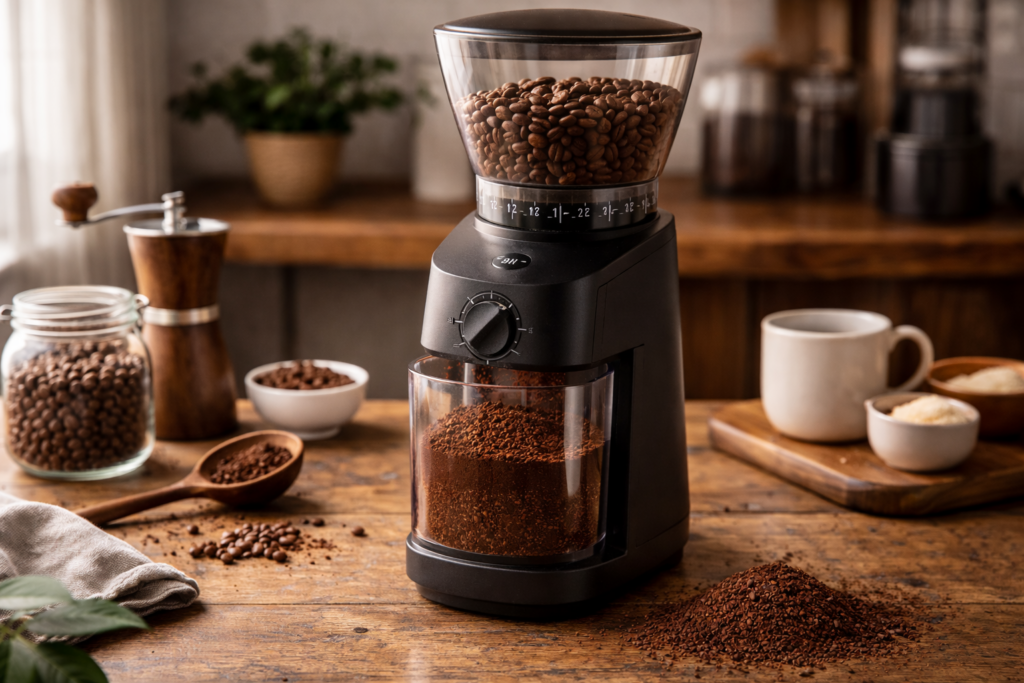
Burr Grinder
Every dial-in technique in this guide — grinding finer, grinding coarser, chasing sour or bitter — only works if your grinder produces consistent particle sizes. A blade grinder makes that impossible. A burr grinder makes it automatic. This is the one upgrade that makes every other fix actually stick.
⚡ Makes Every Change Repeatable
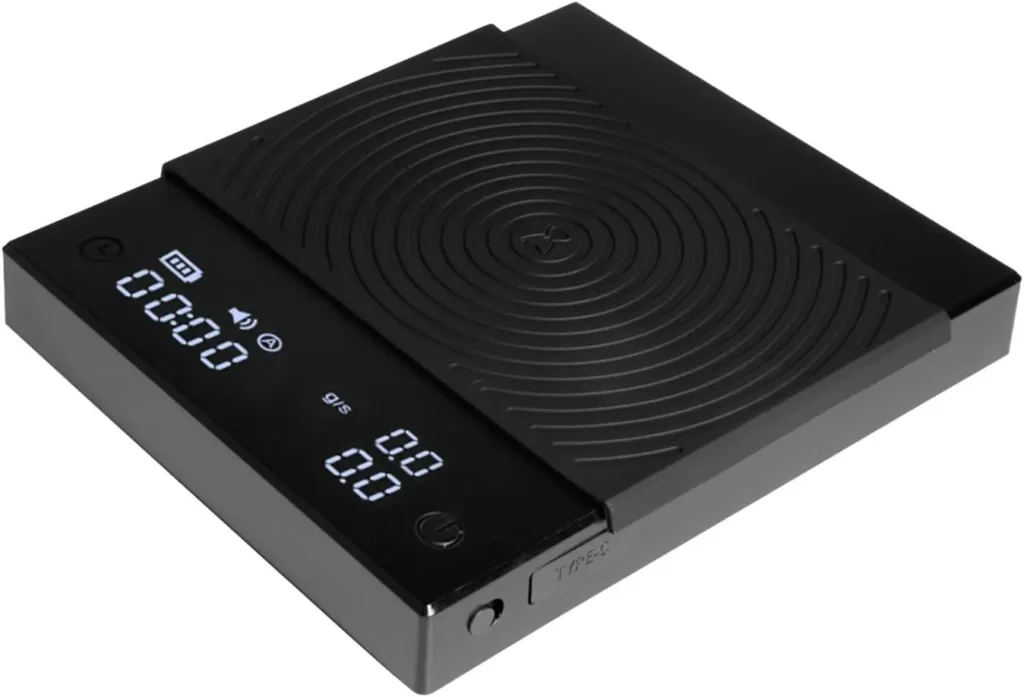
Digital Coffee Scale
Without a scale you can’t know whether a better cup came from the grind change you made or from accidentally using slightly different amounts. A scale turns “that tasted better” into something you can reproduce every time.
As an Amazon Associate, we may earn from qualifying purchases. Prices may vary.
All Our Gear Picks at a Glance
Every product recommended in this guide. The first two work for every method — start there before anything else.
| Product | Best For | Why It Matters | Check Price |
|---|---|---|---|
| Burr Grinder ⭐ | All methods — start here | Consistent particle size makes every grind adjustment work as intended | Check Price → |
| Digital Scale | All methods | Repeatable ratios are impossible without one | Check Price → |
| Gooseneck Kettle | Pour-over, AeroPress | Steady flow rate reduces channeling and uneven extraction | Check Price → |
| Pour-Over Dripper | Pour-over | Consistent hardware makes each brew a fair test of your last change | Check Price → |
| AeroPress | AeroPress | Most forgiving brewer to dial in — wide grind and temp tolerance | Check Price → |
| French Press | French press | Double-wall stainless keeps temperature stable through the steep | Check Price → |
| WDT Tool | Espresso | Breaks clumps before tamping — eliminates a major cause of channeling | Check Price → |
| Level Tamper | Espresso | Consistent puck pressure = predictable shot timing every pull | Check Price → |
| Bottomless Portafilter | Espresso | Shows channeling visually so you can diagnose and fix it at the source | Check Price → |
As an Amazon Associate, we may earn from qualifying purchases. Prices may vary.
Key Takeaways
- Change one variable at a time — grind first, ratio second, time/temp last.
- Sour = under-extracted (grind finer). Bitter = over-extracted (grind coarser).
- Drip, pour-over, AeroPress, French press: start at 1:15–1:16. Espresso: 1:2 in 25–30 seconds.
- Beans roasted within 2–4 weeks — stale beans make dial-in harder regardless of grind.
The Dial-In Method That Works for Every Brewer
Most people dial in by changing grind, ratio, and brew time all at once — then wondering why the next cup is worse. Use this order instead. It’s fast, repeatable, and applies to every brew method in this guide.
1) Lock in your baseline
- Same beans for 3–5 brews (roasted within 2–4 weeks).
- Same water — filtered if possible.
- Weigh coffee and water — skip scoops entirely.
2) Change grind first
Grind controls extraction flavor. Sour or sharp? Grind finer. Bitter or dry? Grind coarser. One notch at a time — keep everything else identical.
3) Adjust ratio second
Ratio controls strength. Fix extraction with grind first. Then use ratio to tune strength — more coffee for stronger, less for weaker.
Starting Points by Brew Method
| Method | Grind | Starting Ratio | Target Time | Primary Lever | Our Pick |
|---|---|---|---|---|---|
| Drip | Medium | 1:16 | Machine-controlled | Ratio + freshness | Burr Grinder → |
| Pour-Over | Medium-fine | 1:16 | 2:30–3:30 | Grind + pour technique | Gooseneck Kettle → |
| AeroPress | Medium to medium-fine | 1:13–1:15 | 1:30–2:30 total | Grind + steep time | AeroPress → |
| French Press | Coarse | 1:15–1:16 | 4 min steep | Grind coarseness + steep time | Burr Grinder → |
| Espresso | Fine | 1:2 (18g in / 36g out) | 25–30 sec | Grind (most sensitive) | WDT Tool → |
Also useful: Drip Coffee Ratio Guide · Grind Size Chart
💡 Already know you need a grinder? Skip the reading — jump straight to our recommendation or the Final Verdict below.
Dial In Drip Coffee (Automatic Coffee Makers)
Drip machines don’t give you much control mid-brew, so your wins come from ratio, grind, and freshness. Fix those three and you’ll eliminate 90% of bad drip coffee.
Best starting recipe (drip)
- Ratio: 1:16 (60g coffee / 960g water)
- Grind: medium — a touch finer if the cup tastes sharp or sour
- Batch size: at least 500g water — tiny batches can taste uneven
- Freshness: beans roasted within 2–4 weeks
Drip troubleshooting — fix by taste
| Problem | Likely cause | Fix |
|---|---|---|
| Weak / watery | Too little coffee or too coarse | Move to 1:15.5 or grind slightly finer. A burr grinder makes small adjustments precise. |
| Bitter / harsh | Too fine or too dark a roast | Grind slightly coarser and hold ratio at 1:16. |
| Sour / sharp | Under-extraction | Grind finer first — don’t try to fix sour with more coffee. A burr grinder gives you the step resolution to do this cleanly. |
| Flat / dull | Stale beans or dirty brewer | Try fresher beans and run a descaler through the machine. |
💡 The fix that works for “sour” and “bitter” permanently: a burr grinder. Blade grinders produce a mix of fine powder and large chunks that make sour and bitter happen simultaneously — a problem that’s impossible to dial out. Consistent particle size makes both fixes straightforward.
Related: Drip Coffee Ratio (Chart + Fixes) · Common Drip Coffee Mistakes
Dial In Pour-Over (V60, Kalita, Chemex)
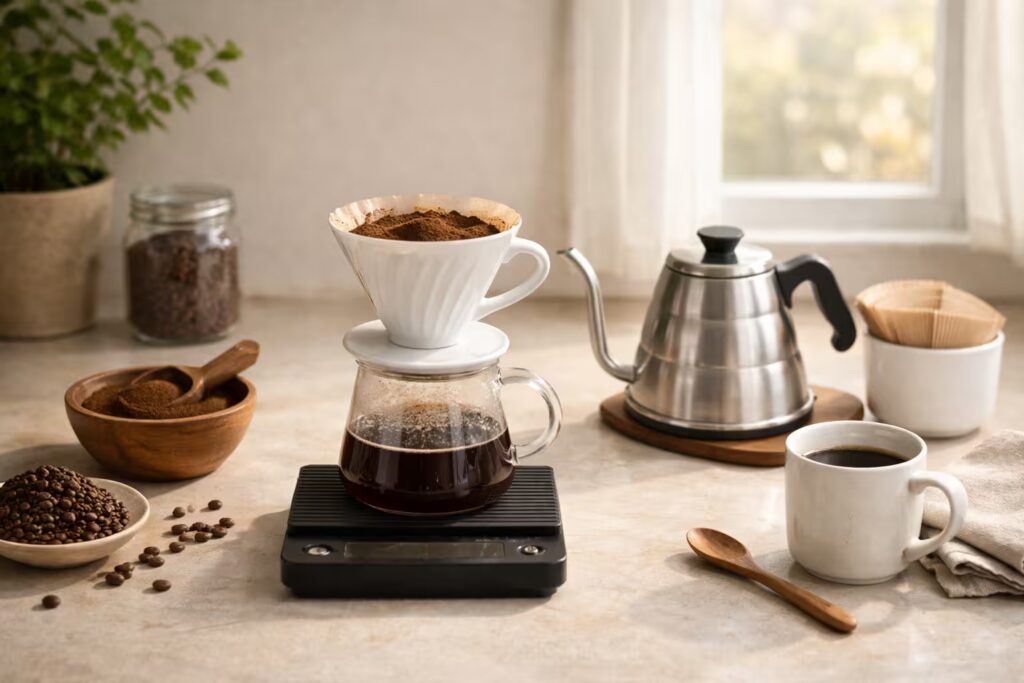
Pour-over gives you more control than any other filter method. Your big levers are grind size, pour structure, and drawdown time.
Best starting recipe (pour-over)
- Ratio: 1:16 (25g coffee / 400g water)
- Water temp: 200–205°F for medium roasts; 190–195°F for dark roasts
- Grind: medium-fine — adjust based on drawdown speed and taste
- Bloom: 50g pour, wait 30–45 seconds to let CO₂ off-gas before the main pour
- Target total time: 2:30–3:30
Pour-over troubleshooting — fix by drawdown and taste
| What you see / taste | What it means | Fix |
|---|---|---|
| Fast drawdown (<2 min), tastes sharp | Too coarse / under-extraction | Grind finer — one notch on your burr grinder. |
| Slow drawdown (>4 min), muddy bed | Too fine / over-extraction | Grind coarser; pour more gently and evenly. |
| Channeling or uneven bed surface | Pour too aggressive or off-center | Slow the pour; a gooseneck kettle gives you the flow control to fix this permanently. |
| Good extraction taste but too weak | Ratio too low | Increase dose to 1:15.5 rather than grinding finer. |
💡 The pour-over fix with the highest ROI: a gooseneck kettle. Channeling and uneven drawdown — two of the most common pour-over problems — are almost always a pour-control issue, not a grind issue. A gooseneck fixes both in one purchase.
Related: Pour-Over Brewing Setup · Pour-Over Troubleshooting · Best Burr Grinders for Pour Over
Dial In AeroPress (Standard and Inverted)
The AeroPress is the most forgiving brewer to dial in. It tolerates a wide range of grind sizes, temperatures, and ratios. Your primary levers are grind size and steep time.
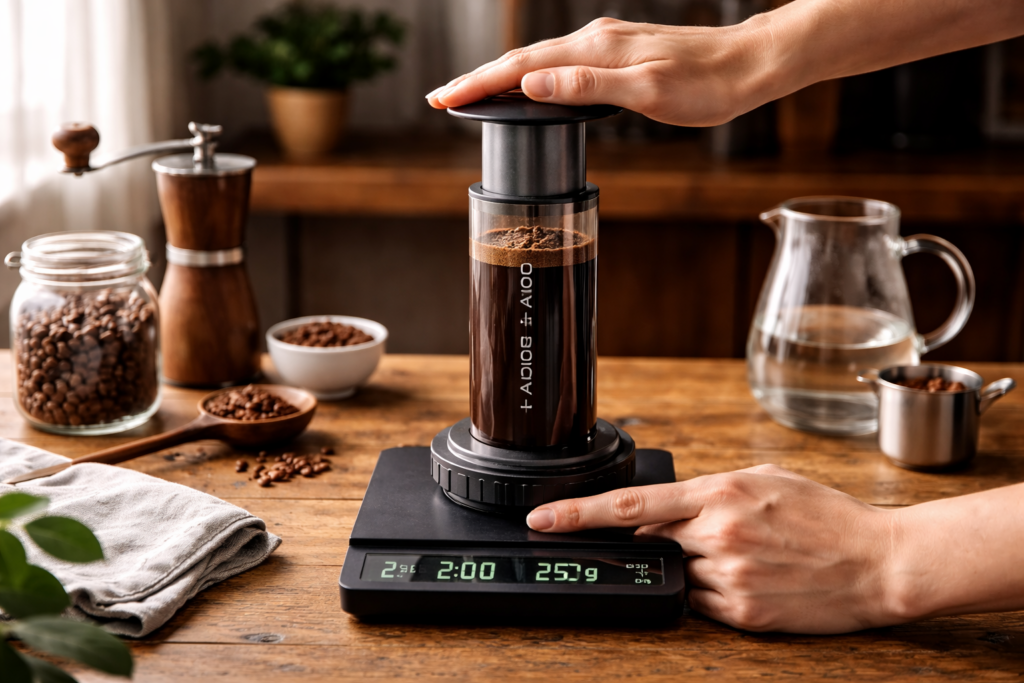
Best starting recipe (AeroPress)
- Dose: 15g coffee
- Water: 195–210g at 175–205°F — forgiving across this full range
- Grind: medium-fine for standard; medium-coarse for inverted or longer steep
- Steep: 1:00–1:30, press slowly over ~30 seconds
- Ratio: 1:13 for concentrate (add hot water after pressing); 1:15 for filter-style
🔬 AeroPress has two extraction levers where other methods have one: grind size and steep time both affect flavor. Change grind first — exactly as you would for any other method — before adjusting steep time.
AeroPress troubleshooting — fix by taste
| Tastes like | Likely cause | Fix |
|---|---|---|
| Sour / sharp | Under-extraction | Grind finer (burr grinder). If still sour, steep 15–20 seconds longer. |
| Bitter / harsh | Over-extraction | Grind coarser. If still bitter, shorten steep by 15–20 seconds. |
| Weak / thin | Too much dilution | Use 1:13 ratio and add hot water to the cup after pressing to taste. |
| Muddy / silty | Filter not sealed or grind too coarse for paper | Rinse the paper filter first; stack two filters for clarity. |
💡 Don’t have an AeroPress yet? It’s the best brewer for beginners who want to dial in fast — the wide tolerance for temperature and grind means fewer failed batches while you’re learning.
Related: AeroPress Brewing Guide · Best Kettles for AeroPress · AeroPress vs Pour-Over
Dial In French Press
French press is a full-immersion brewer — coffee steeps in contact with water for the entire brew time. Grind coarseness and steep duration are your two primary levers. The metal mesh filter doesn’t block fine particles the way paper does, so getting the grind right matters even more here.
Best starting recipe (French press)
- Ratio: 1:15–1:16 (30g coffee / 450–480g water)
- Grind: coarse — like coarse sea salt or raw sugar
- Water temp: just off boil (200–205°F / 93–96°C)
- Steep time: 4 minutes exactly
- Press: slow and gentle — fast pressing forces fine particles through the mesh
⚠ Common mistake: steeping longer to get a stronger cup. Longer steep extracts more bitterness, not more strength. For a stronger cup, tighten your ratio from 1:16 to 1:15 — keep the steep at 4 minutes.
French press troubleshooting — fix by taste
| Problem | Likely cause | Fix |
|---|---|---|
| Muddy / silty / gritty | Grind too fine | Grind coarser — a burr grinder set to coarse produces the uniform large particles a blade grinder can’t. Also press more slowly. |
| Weak / thin | Grind too coarse or too little coffee | Grind slightly finer or increase dose to 1:15. |
| Bitter / harsh | Over-steeped or very dark roast | Reduce steep to 3:30; try a lighter roast. |
| Flat / dull | Stale beans or hard water | Fresher beans and filtered water both make a noticeable difference. |
💡 Looking for a French press? A double-wall stainless model keeps temperature stable through the full steep — the most common reason French press coffee tastes weaker than expected is heat loss during the brew.
Dial In Espresso (Beginner-Friendly Workflow)
Espresso is the most sensitive brew method to dial in — small grind changes matter more here than anywhere else. Once you learn the pattern, you can dial in a new shot within 3–5 pulls.
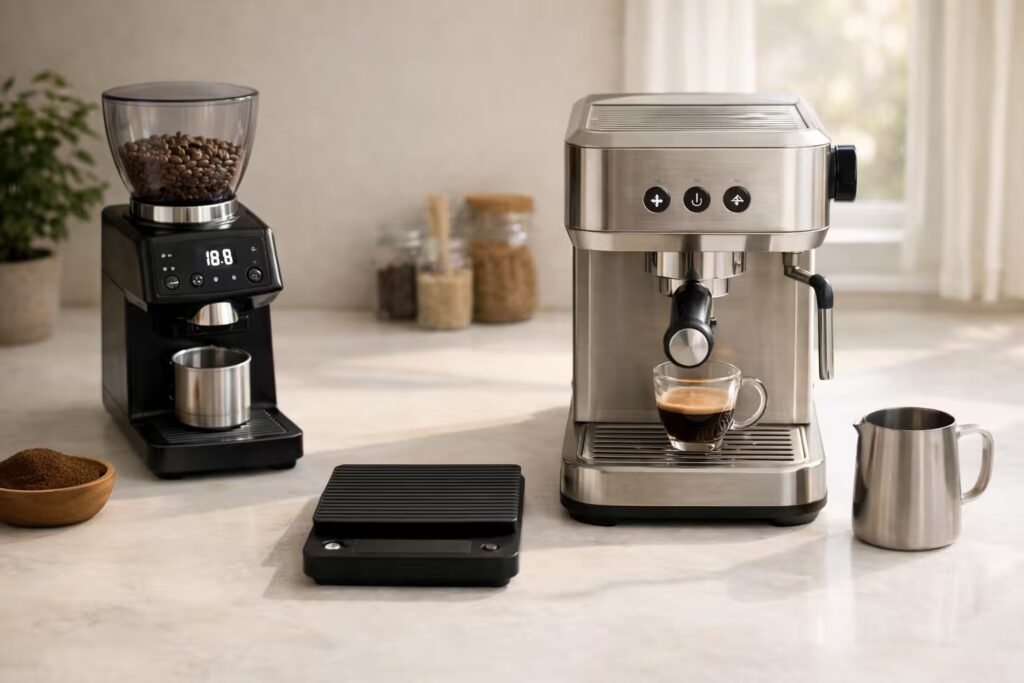
Baseline espresso target (start here)
- Dose: fill your basket (most double baskets: 18g)
- Yield: 1:2 ratio (18g in → 36g out)
- Time: 25–30 seconds from first drip
- Temperature: 195–203°F (91–95°C) — lighter roasts need the higher end
Espresso troubleshooting — fix by shot behavior and taste
| Taste / shot behavior | What it means | Fix |
|---|---|---|
| Runs fast (<20 sec), tastes sour | Under-extracted | Grind finer — one notch. Fine step resolution matters here; a quality espresso burr grinder is essential. |
| Drips slowly (>35 sec), tastes bitter | Over-extracted | Grind coarser — one notch. |
| Channeling / spurting to one side | Uneven puck prep | Use a WDT tool before tamping; follow with a level tamper. |
| Balanced taste but too weak | Yield too high | Reduce yield to 1:1.5 rather than grinding finer. |
🔬 Channeling is the #1 espresso problem grind adjustment can’t fix. A WDT tool breaks up clumps before tamping; a bottomless portafilter lets you see channeling happen so you can confirm when your puck prep has actually fixed it.
Related: Manual vs Automatic Espresso Machines · Best Espresso Grinders · How to Descale an Espresso Machine
Fix Coffee by Taste (Sour, Bitter, Weak, Harsh)
This applies across all five methods. Start with the taste description, make one change, brew again before adjusting anything else.
| Tastes like… | Usually means… | Fix order |
|---|---|---|
| Sour / sharp / thin | Under-extraction | Grind finer (burr grinder) → keep ratio → adjust time or temp only after |
| Bitter / dry / harsh | Over-extraction | Grind coarser → keep ratio → lower temp if adjustable |
| Weak / watery | Strength too low | Tighten ratio slightly → then re-check grind. A scale makes ratio changes precise. |
| Flat / dull | Stale beans or poor water | Fresher beans → filtered water → clean gear |
| Muddy / silty (French press or AeroPress) | Grind too fine for method | Grind coarser (burr grinder); use two filters (AeroPress) or press slowly (French press) |
Also useful: Water Quality for Better Coffee · Coffee Equipment Maintenance
💡 Ready to make these fixes permanent? The two tools that solve most of the problems in this table:
FAQs: How to Dial In Coffee
What does ‘dialing in coffee’ mean?
Dialing in means making small, repeatable adjustments — usually starting with grind size — until your coffee tastes balanced. The key is changing one variable at a time so you learn what actually improves the cup.
Why does my coffee taste sour?
Sour coffee is usually under-extracted — most often from a grind that’s too coarse, water that’s too cool, or a brew that ran too fast. Grind slightly finer. If you’re using a blade grinder, that’s the root cause — switching to a u003ca href=u0022https://amzn.to/4qh3vB8u0022 target=u0022_blanku0022 rel=u0022nofollow sponsored noreferrer noopeneru0022u003eburr grinderu003c/au003e is the fix that actually holds.
Why does my coffee taste bitter or harsh?
Bitter coffee is usually over-extracted — from a grind that’s too fine, a brew that ran too long, or very dark roasts. Grind slightly coarser. If you can’t make small, precise adjustments, that’s a grinder problem — a u003ca href=u0022https://amzn.to/4qh3vB8u0022 target=u0022_blanku0022 rel=u0022nofollow sponsored noreferrer noopeneru0022u003eburr grinderu003c/au003e gives you the step resolution to fix this predictably.
Why is my French press coffee muddy or gritty?
Almost always means the grind is too fine for the metal mesh filter. Grind coarser — aim for the texture of coarse sea salt. A u003ca href=u0022https://amzn.to/4qh3vB8u0022 target=u0022_blanku0022 rel=u0022nofollow sponsored noreferrer noopeneru0022u003eburr grinderu003c/au003e produces the consistent large particles that blade grinders can’t reliably achieve. Also try pressing more slowly.
Do I need a scale to dial in coffee?
Yes — it’s the single most impactful thing you can do besides upgrading your grinder. Without a scale, you can’t know whether a better cup came from your grind change or from accidentally using slightly different amounts of coffee. A u003ca href=u0022https://amzn.to/4qVd7Tju0022 target=u0022_blanku0022 rel=u0022nofollow sponsored noreferrer noopeneru0022u003edigital coffee scaleu003c/au003e turns guesswork into a repeatable system.
What’s the best starting ratio for drip and pour-over?
Start at 1:16 (1 gram coffee to 16 grams water). Adjust slightly stronger (1:15–1:15.5) if weak, or slightly weaker (1:16.5–1:17) if too strong. A u003ca href=u0022https://amzn.to/4qVd7Tju0022 target=u0022_blanku0022 rel=u0022nofollow sponsored noreferrer noopeneru0022u003edigital scaleu003c/au003e is what makes hitting and repeating these ratios reliable.
What’s the fastest way to improve coffee at home?
Use fresh whole beans (roasted within 2–4 weeks), grind right before brewing, and weigh both coffee and water. The two tools that unlock the fastest improvement: a u003ca href=u0022https://amzn.to/4qh3vB8u0022 target=u0022_blanku0022 rel=u0022nofollow sponsored noreferrer noopeneru0022u003eburr grinderu003c/au003e and a u003ca href=u0022https://amzn.to/4qVd7Tju0022 target=u0022_blanku0022 rel=u0022nofollow sponsored noreferrer noopeneru0022u003edigital scaleu003c/au003e. Every other technique in this guide works better once those two are in place.
How long does it take to dial in espresso?
Most people dial in a new espresso within 3–5 shots once they understand what to change. The process feels slow when you’re changing multiple variables at once — grind, dose, yield, and time simultaneously. Change one thing per shot and you’ll reach a balanced cup faster. A u003ca href=u0022https://amzn.to/4qVd7Tju0022 target=u0022_blanku0022 rel=u0022nofollow sponsored noreferrer noopeneru0022u003escaleu003c/au003e is what makes this fast: without one, you can’t confirm what actually changed between shots.
Does water temperature affect coffee taste?
Yes, significantly. Water that’s too cool under-extracts coffee, producing sour or flat results. Water that’s too hot over-extracts, especially with dark roasts, producing harsh or bitter cups. For most methods, 200–205°F (93–96°C) is the target. Dark roasts do better at 190–195°F. Water mineral content also matters — hard or heavily chlorinated water introduces harshness that no grind adjustment can fix. u003ca href=u0022https://amzn.to/4tFrm0fu0022 target=u0022_blanku0022 rel=u0022nofollow sponsored noreferrer noopeneru0022u003eFiltered wateru003c/au003e removes that variable entirely.
Why does my espresso taste different every day?
Day-to-day inconsistency in espresso almost always comes from one of three sources: inconsistent puck prep (clumps or uneven tamping), inconsistent dosing (no scale), or beans changing as they age past peak. A u003ca href=u0022https://amzn.to/3On9aIPu0022 target=u0022_blanku0022 rel=u0022nofollow sponsored noreferrer noopeneru0022u003eWDT toolu003c/au003e fixes puck prep. A u003ca href=u0022https://amzn.to/4qVd7Tju0022 target=u0022_blanku0022 rel=u0022nofollow sponsored noreferrer noopeneru0022u003escaleu003c/au003e fixes dosing. Fresh beans — roasted within 2–4 weeks and used within 2–3 weeks of opening — fix the rest.
Should I adjust grind size or coffee ratio first?
Grind size first, always. Grind controls extraction — the flavor quality of the cup (sour vs. balanced vs. bitter). Ratio controls strength — how concentrated the cup is. If you adjust ratio to fix a sour cup, you’re masking the problem rather than solving it. Fix extraction with grind first. Once the cup tastes balanced, then use ratio to tune strength up or down. A u003ca href=u0022https://amzn.to/4qh3vB8u0022 target=u0022_blanku0022 rel=u0022nofollow sponsored noreferrer noopeneru0022u003eburr grinderu003c/au003e is what makes grind adjustments precise enough to actually work.
Final Verdict
Every technique in this guide works better once you have these two tools. Without them, “grind finer” and “hit a 1:16 ratio” are instructions you can follow approximately. With them, they’re instructions you can follow exactly — and repeat the same cup tomorrow.
⭐ Best Overall — All Brew Methods
Burr Grinder
What it does that a blade grinder can’t: produces particles of consistent size, so “grind finer” and “grind coarser” cause predictable, isolated changes — not a random mix that makes sour and bitter happen at the same time.
Works for: drip, pour-over, AeroPress, French press, and espresso.
⚡ Makes Every Change Repeatable
Digital Coffee Scale
What it does that scoops can’t: confirms the only thing that changed between your last brew and this one is the variable you intended to change. That’s what makes the one-variable method work.
Works for: drip, pour-over, AeroPress, French press, and espresso.
As an Amazon Associate, we may earn from qualifying purchases. Prices may vary.
Next Steps
Pick the path that matches what you brew most often.