
Last Updated: March 2026 • 35–55 min read • Cornerstone Brewing Science + Dial-In Framework
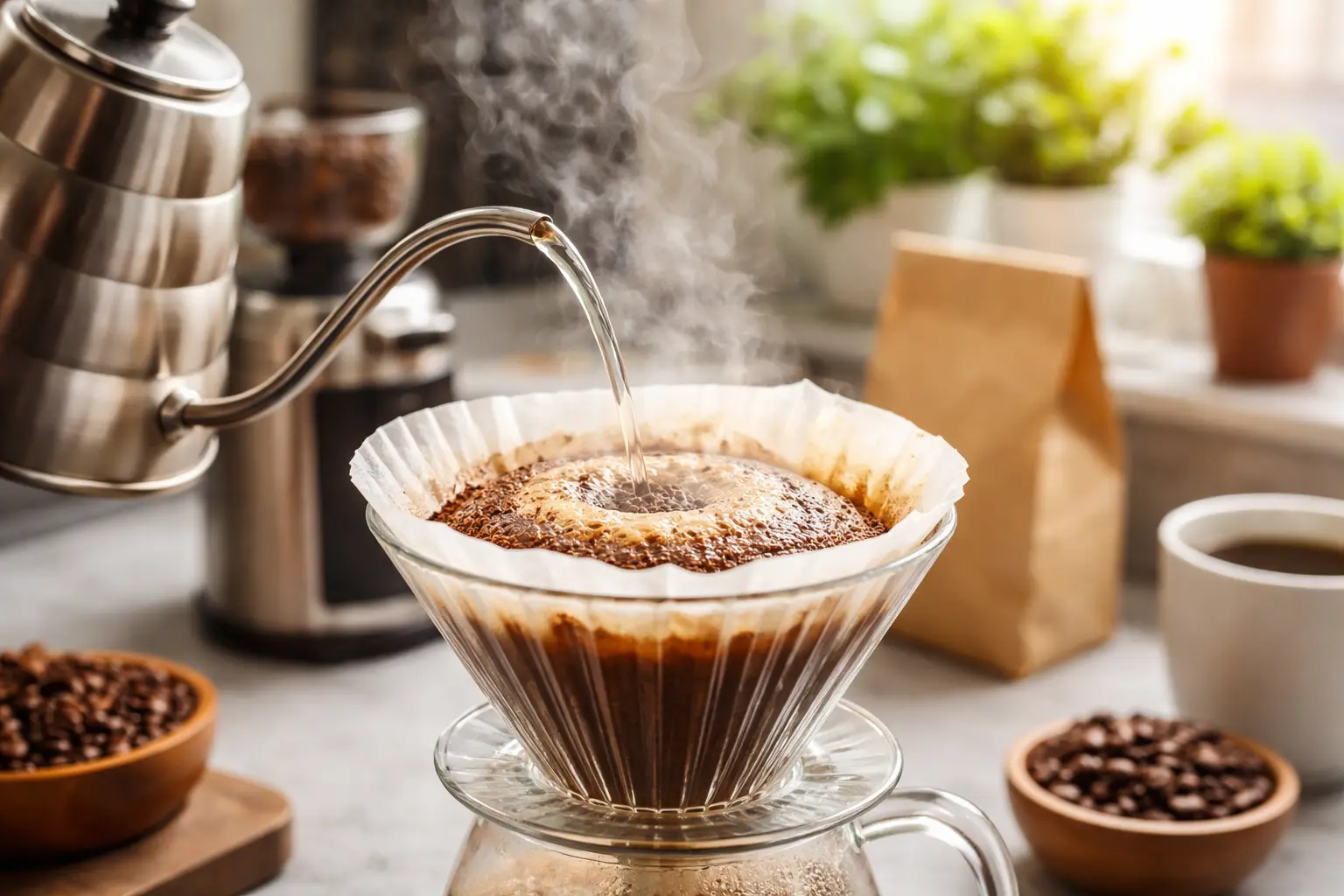
✍️ Editorial note: This guide is researched and written by the editors at CoffeeGearHub.com using published brewing science, equipment manufacturer specifications, and established specialty-coffee community knowledge. Recommendations reflect research consensus rather than in-house lab testing. All product links are affiliate links — we may earn a commission at no cost to you.
The 30-Second Answer
Coffee extraction is the controlled transfer of soluble compounds from coffee grounds into water. Balanced extraction — roughly 18–22% of the coffee’s mass — produces sweetness, clarity, and structured acidity. Under-extraction tastes sour and hollow. Over-extraction tastes bitter and drying. When a cup is both sour and bitter at once, the cause is almost always uneven extraction, not the wrong time or temperature.
- Grind is the #1 variable: particle size controls extraction speed and evenness more than any other factor
- Sour = under-extracted: grind finer, increase contact time, or raise temperature
- Bitter = over-extracted: grind coarser, reduce agitation, lower temperature
- Sour + bitter together = uneven extraction: fix grind consistency and channeling first
Who This Guide Is For — Jump to What You Need
🔬 Learning the science
Read What Extraction Means + Coffee Chemistry + Extraction Stages.
⚙️ Dialing in right now
Jump to Dial-In Protocol + Troubleshooting Matrix.
🛒 Upgrading gear
Go straight to Grind Section + Gear Recommendations.
🌊 Method-specific help
Read How Methods Extract Differently + Flow & Channeling.
Table of Contents
- What coffee extraction really means
- The chemistry inside roasted coffee
- What dissolves out of coffee (and when)
- Stages of extraction and why flavor shifts
- Extraction yield vs strength (TDS)
- Grind size, surface area, and particle distribution
- Time and contact: why “brew longer” isn’t always the fix
- Temperature and solubility: the 195–205°F truth
- Brew ratio and how concentration changes perception
- Water chemistry that actually matters
- Flow rate, agitation, and channeling
- How espresso, pour-over, immersion, and AeroPress extract differently
- Freshness, bloom, and CO₂
- A repeatable dial-in protocol
- Taste-based troubleshooting matrix
- Tools that improve extraction the most
The fastest upgrade for better coffee extraction
If you only change one thing, change your grinder. Uneven particles cause uneven extraction: fines over-extract while larger particles under-extract in the same brew. A consistent burr grinder improves clarity, sweetness, and repeatability across every method.
What Coffee Extraction Really Means
Coffee extraction science starts with a simple fact: coffee extraction is the transfer of soluble compounds from coffee grounds into water. “Soluble” means the molecules can dissolve into water and remain suspended in your drink. Roasted coffee is packed with soluble material — acids, sugars, aromatic compounds, and roasting-derived compounds that create color and body. It also contains insoluble material, which affects texture and mouthfeel but doesn’t dissolve in the same way. Brewing is the act of choosing how much of that soluble material ends up in the cup and how evenly it’s pulled from the coffee bed.
The reason extraction feels confusing is that we often talk about it like a single knob. In reality, extraction has two separate goals: level (how much you extracted) and evenness (how uniformly you extracted across the coffee bed). A cup can be “high extraction” but still taste bad if extraction is uneven. That’s the classic sour-and-bitter-at-the-same-time problem — some areas are under-extracted while others are over-extracted.
Extraction also isn’t a moral judgment. Under-extraction isn’t “wrong” in a vacuum — some styles of coffee emphasize high acidity and lower extraction. Likewise, slightly higher extraction can emphasize body and roast character. The real question is whether the cup tastes balanced for the coffee you’re brewing and the drink you’re trying to make.
To make this usable, we’ll treat extraction as a cause-and-effect system. You’ll learn which variables increase extraction, which decrease it, and how to prioritize changes so you don’t chase your tail with random adjustments.
The Chemistry Inside Roasted Coffee
Coffee extraction science starts before brewing — during roasting. Green coffee beans contain carbohydrates, proteins, acids, lipids, and a long list of precursor compounds. When coffee roasts, heat triggers the Maillard reaction and caramelization, transforming those precursors into hundreds of new aromatic and flavor-active molecules. This is why roasted coffee smells like fruit, chocolate, caramel, toast, or florals depending on the bean and roast.
Roasting also changes the physical structure of coffee. Beans become porous. CO₂ forms and becomes trapped within the bean structure. Oils migrate. As beans age after roasting, those volatile aromatics slowly dissipate and CO₂ gradually escapes. These changes influence extraction because they affect how water enters coffee particles and how quickly compounds can dissolve and escape into the brew.
When you grind coffee, you create thousands of small particles with fresh surfaces. Water begins dissolving compounds at those surfaces immediately. But extraction also involves water penetrating into the interior of particles, dissolving compounds inside the matrix, and carrying them back out into the surrounding liquid. That’s why grind size, particle distribution, and contact time matter so much: they determine how far water has to travel and how long it can work.
One more important point: different roasts behave differently. Light roasts tend to be less soluble and often benefit from higher temperatures and slightly longer contact times to reach sweetness. Dark roasts are generally more soluble and can tip into bitterness more easily if brewed too hot or too long. Extraction science stays the same, but the sweet spot shifts.
What Dissolves Out of Coffee (and When)
A practical way to understand coffee extraction is to picture the cup as a blend of families of compounds, each contributing a different sensory job. Acids contribute brightness and structure. Sugars and caramelized compounds contribute sweetness and roundness. Aromatic compounds contribute the smell that your brain interprets as flavor. Melanoidins contribute color and body. Bitter phenols and tannin-like compounds contribute bitterness and dryness — pleasant in small amounts, harsh when dominant.
These families don’t dissolve at the same speed. Fast-dissolving compounds show up early — especially acids and some aromatics. The mid phase tends to emphasize sweetness, fuller aromatics, and satisfying body. Later extraction pulls more bitter and drying compounds as the coffee bed becomes depleted of the easier-to-dissolve material. This sequential behavior is why coffee flavor changes so dramatically as you adjust grind, time, and flow. You’re not just making coffee stronger — you’re changing which parts of the coffee’s chemistry become prominent.
This also explains why “more time” is not automatically better. More time can mean more sweetness — until it means more bitterness. The skill is finding the point where sweetness and aroma peak without tipping into harshness. The best brews often taste sweet even without added sugar because the extraction captured enough sugar-like compounds to balance acidity.
Stages of Extraction and Why Flavor Shifts
Think of extraction as a curve. At the beginning of brewing, water hits dry grounds and starts dissolving the most accessible compounds immediately. As the brew progresses, the coffee bed becomes saturated, the temperature stabilizes, and water continues pulling compounds from deeper inside particles. Eventually, the bed becomes spent of easy-to-extract sweetness, and water begins pulling more late-stage bitter and drying compounds.
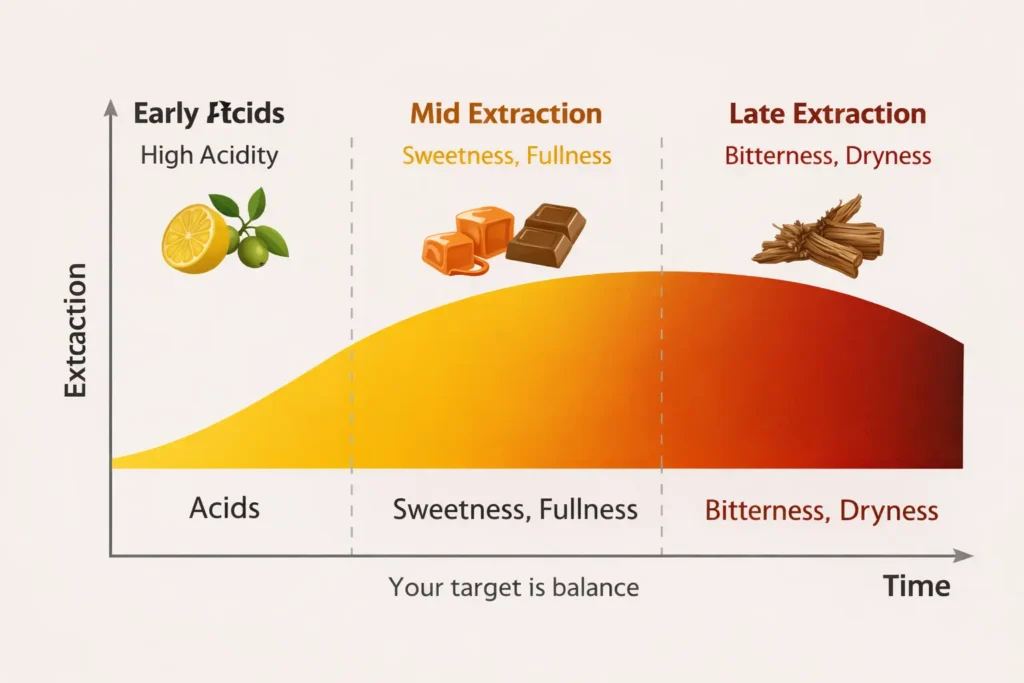
In real cups, you can taste these stages. Under-extracted coffee often tastes sharp, lemony, or vegetal, with a thin body and a finish that drops off quickly. Balanced extraction tastes sweet, aromatic, and complete — acidity feels integrated rather than aggressive, and the finish is clean. Over-extracted coffee tastes bitter and drying, sometimes woody or smoky, and the aftertaste lingers unpleasantly.
These stages overlap, and different coffees express them differently. A bright Ethiopian coffee might taste vibrant even when balanced, while a chocolatey Latin American coffee might taste round and sweet with lower perceived acidity. The extraction goal is still the same: integrate the coffee’s acidity with enough sweetness and body so the cup tastes intentional, not accidental.
One of the most useful insights for home brewers is this: when you change a variable, you are changing the extraction curve. A finer grind makes extraction faster and can shift more sweetness into your brew window — but it can also increase fines, slow flow, and increase channeling risk if you push too far. A hotter temperature increases solubility and can unlock sweetness in light roasts — but it can also pull harshness in darker roasts if you brew too aggressively. Coffee extraction is always a balancing act.
Extraction Yield vs Strength (TDS): The Confusion That Stops Progress
Professional coffee science often uses two measurements: extraction yield and TDS (total dissolved solids). Extraction yield is how much of the coffee you dissolved. TDS is how concentrated the final beverage is. They’re related, but they are not the same thing, and confusing them leads to bad troubleshooting.
Here’s the simplest way to understand it: you can make a drink that is strong but under-extracted (concentrated sourness), and you can make a drink that is weak but over-extracted (thin bitterness). Strength is mostly controlled by ratio. Extraction is mostly controlled by grind, time, temperature, and flow dynamics. When you keep ratio constant, you can adjust extraction without chasing strength at the same time.
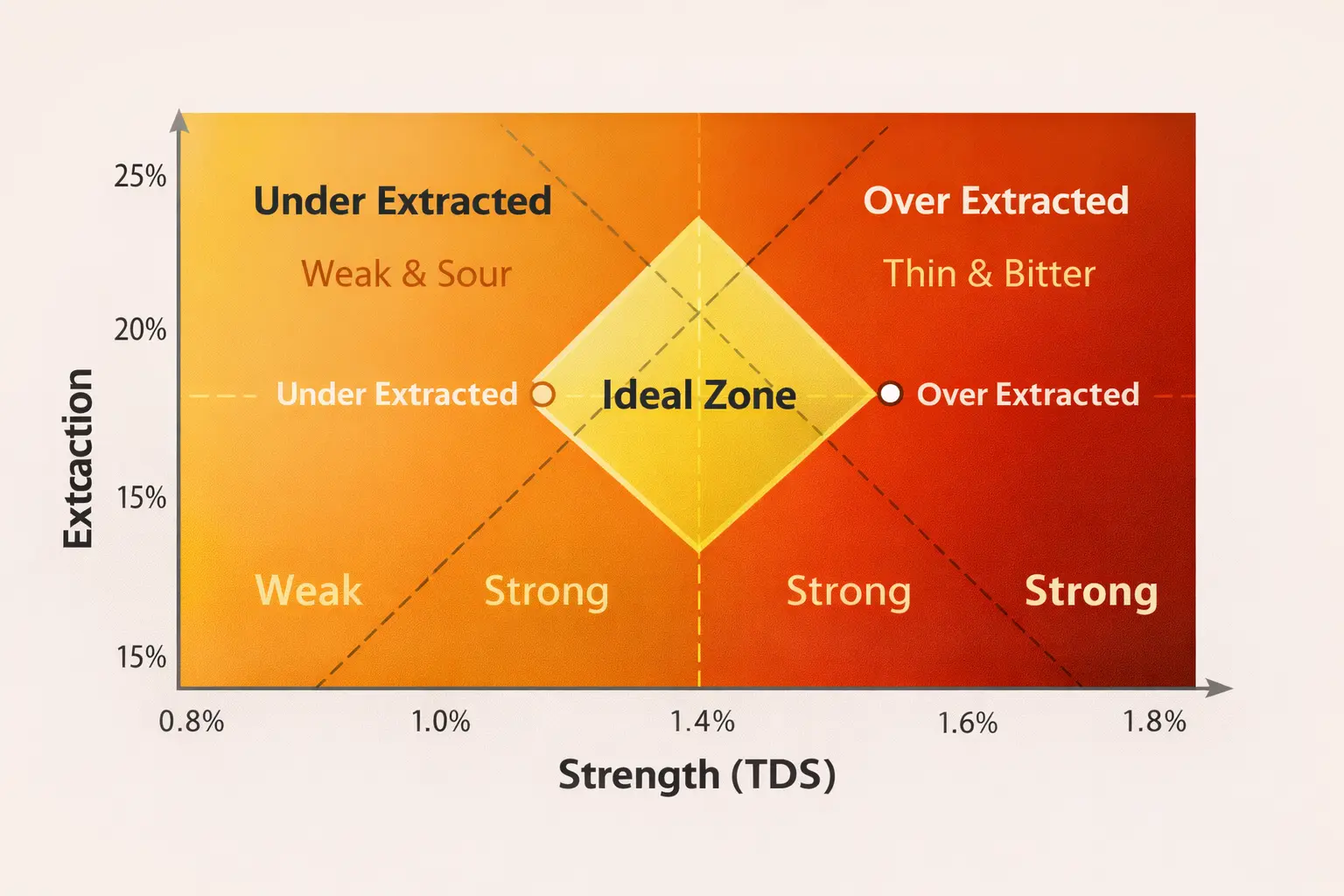
💡 Rules of thumb: If your coffee is too strong or too weak, change ratio. If your coffee is sour or bitter, change extraction variables (usually grind first). If your coffee is sour and bitter at the same time, prioritize evenness and reduce channeling rather than pushing time or temperature.
Grind Size, Surface Area, and Particle Distribution
Grind size controls extraction speed because it controls surface area. Smaller particles expose more surface area to water, so compounds dissolve faster. Larger particles extract more slowly because water must penetrate deeper into each particle to dissolve compounds inside. This is why espresso uses a fine grind (very short contact time) and French press uses a coarse grind (longer contact time).
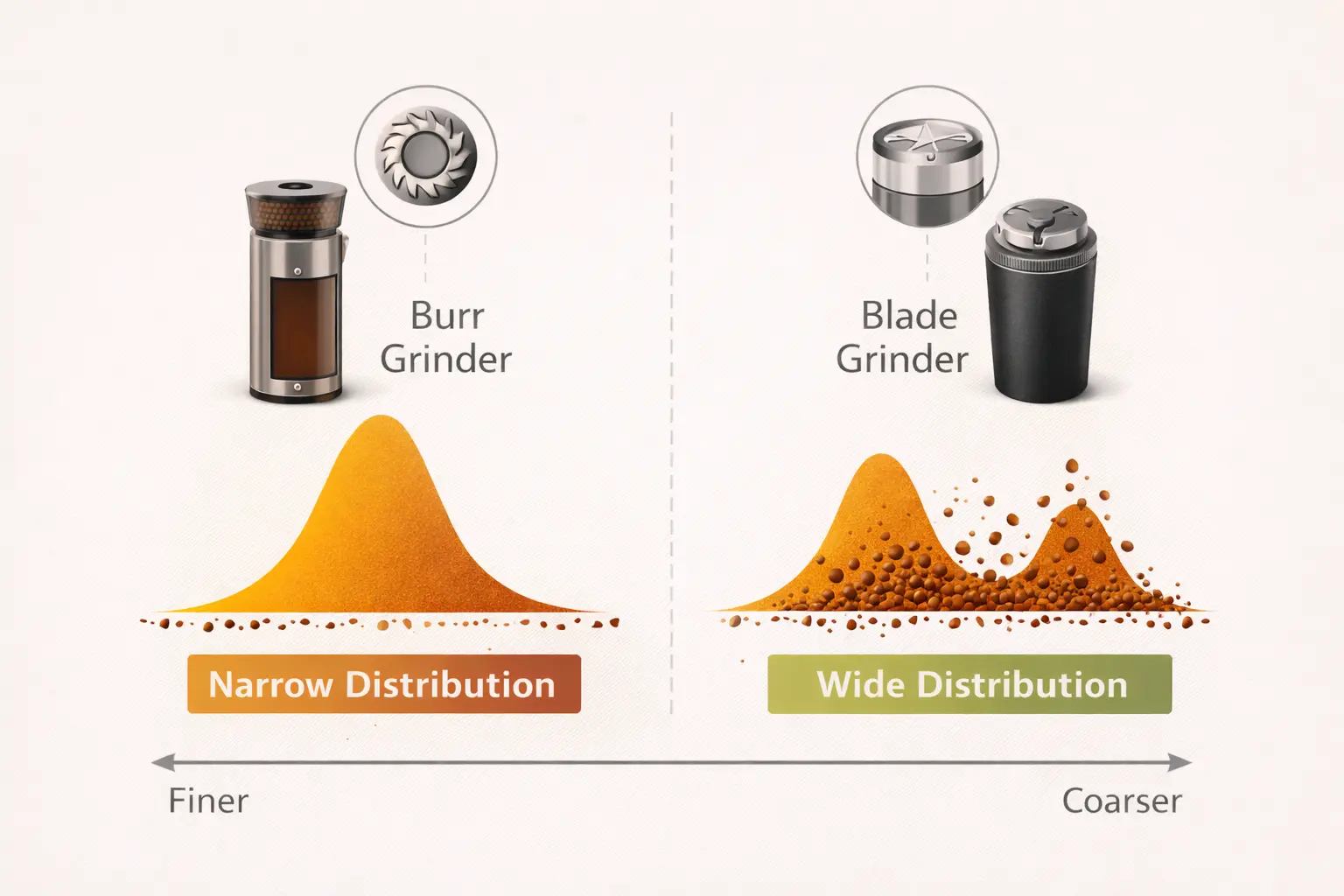
But the bigger story in coffee extraction science is particle distribution. A grinder doesn’t produce perfectly identical particles — it produces a range of sizes. When that range is wide, you get mixed extraction in the same brew. Fines extract quickly and can push bitterness and dryness. Larger particles extract slowly and push sourness and hollowness. In the same cup, you can experience both at once. That’s why “sour and bitter simultaneously” is often a grinder problem, not a recipe problem.
Burr grinders typically produce a narrower particle distribution, which improves evenness. Blade grinders produce a wide distribution, which makes it hard to dial in a brew because any adjustment is fighting multiple particle behaviors at once. If you’re serious about coffee extraction, a burr grinder is less a luxury and more a foundation tool.
There’s also an underappreciated factor: different brewing methods respond differently to fines. Paper-filter pour-over can clog and stall if fines are excessive, increasing contact time and promoting bitterness. Metal filtration allows fines into the cup, increasing body but also muddiness if the grind is inconsistent. Espresso is extremely sensitive to fines and distribution because water under pressure will carve channels through weak spots in the puck.
Grind Size Reference by Brew Method
| Brew Method | Grind Size | KINGrinder K6 (clicks from zero) | Baratza Encore (setting) | Extraction Notes |
|---|---|---|---|---|
| Espresso | Extra fine | ~8–12 | ~5–10 | Very short contact; distribution critical |
| Moka pot | Medium-fine | ~14–18 | ~10–15 | Never tamp; slightly coarser than espresso |
| AeroPress (concentrate) | Medium-fine | ~16–20 | ~12–16 | Short steep, higher extraction |
| AeroPress (standard) | Medium | ~20–26 | ~16–22 | 60–90 second steep; most forgiving range |
| Pour-over / V60 | Medium | ~22–28 | ~18–24 | Flow rate and bloom critical for evenness |
| Drip machine | Medium | ~22–28 | ~18–24 | Match to machine’s brew time |
| French press / immersion | Coarse | ~28–34 | ~24–30 | 4-minute steep; metal filter passes fines |
💡 Click settings note: KINGrinder K6 click counts are approximate starting points — your ideal setting will vary slightly by bean, roast, and personal taste. Always adjust one or two clicks at a time and taste before making further changes. See our full AeroPress Grind Size Guide for expanded K6 settings.
Amazon picks that directly improve extraction

Baratza Encore (Burr Grinder)
Reliable consistency for drip, pour-over, and AeroPress. One of the best value upgrades for most home brewers.
Fellow Stagg EKG Temp-Control Kettle
Stable temperature + controlled flow. Makes pour-over extraction repeatable and reduces over-agitation.
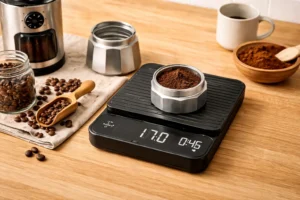
Timemore Black Mirror (Scale + Timer)
Locks in ratio and timing so you can make single-variable adjustments with confidence.
Time and Contact: Why “Brew Longer” Isn’t Always the Fix
Time matters because it determines how long water can dissolve compounds — but time is only meaningful within a broader extraction environment. If your grind is too coarse, water may pass through quickly and extraction will be incomplete even if you wait longer after the water has already drained. If your grind is too fine, water may stall and extract harshness while also creating channels — so more time becomes more bitterness, not more sweetness.
Instead of treating time as the primary control knob, treat it as a diagnostic output. If your pour-over is finishing in 1:45 and tasting sour, the brew likely needs more contact: grind finer, pour slower, or reduce bypass and channeling. If your pour-over is finishing in 4:30 and tasting bitter, the system is likely clogged or overly fine: grind coarser, reduce agitation, and consider whether your grinder is creating too many fines.
Immersion methods behave differently. In French press, time is a real control knob because water stays with the coffee the whole brew. In AeroPress, steep time plus agitation plus filtration choices influence extraction and body. Espresso is a special case: time is tightly linked to flow rate through a packed coffee puck, and small changes in grind or dose can shift shot time dramatically.
The practical strategy is to use time as feedback and change the variable that caused the time to be off. That’s how cafés dial in quickly: keep dose and ratio stable, target a reasonable time window, then adjust grind to hit both time and taste simultaneously.
Temperature and Solubility: The 195–205°F Truth
Temperature changes solubility and extraction speed. Hotter water dissolves more compounds faster. That sounds like a simple win — until you remember that coffee contains both desirable and harsh compounds, and different roasts have different solubility profiles. For most specialty coffee, 195–205°F (90–96°C) is an excellent starting range. Light roasts often benefit from the higher end to unlock sweetness. Dark roasts often benefit from the lower end to reduce harshness.
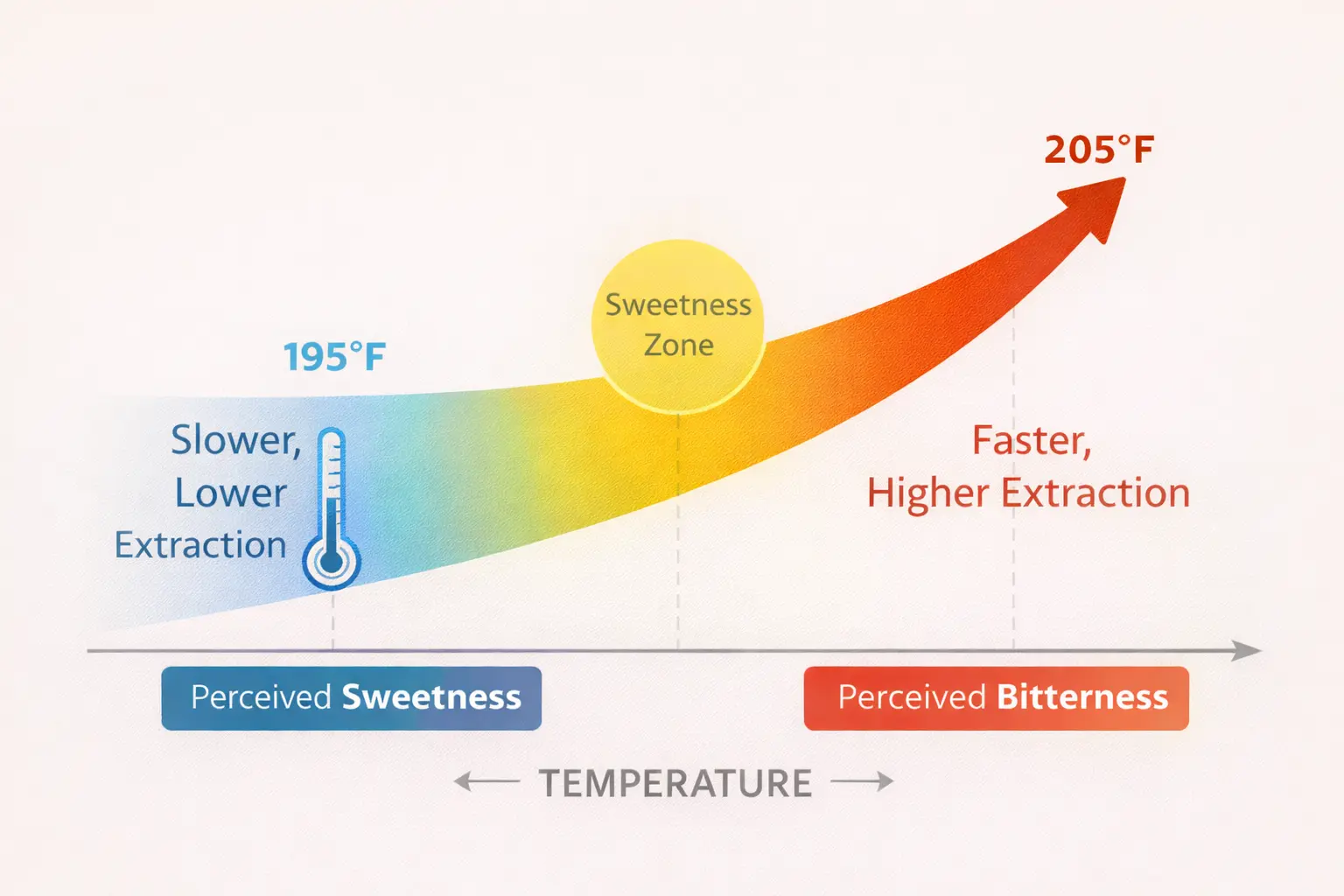
What matters most is consistency. If your brewing temperature is drifting wildly, the extraction curve shifts cup to cup, and it becomes difficult to know whether you should change grind, ratio, or technique. Stability makes improvement possible because you’re not solving a moving target.
| Roast Level | Recommended Starting Temp | Why | Signs to Adjust |
|---|---|---|---|
| Light roast | 200–205°F (93–96°C) | Less soluble; needs more heat to unlock sweetness | Still sour after grind adjustments → raise temp |
| Medium roast | 197–202°F (92–94°C) | Good all-purpose starting range | Dial from here based on taste |
| Medium-dark roast | 195–200°F (90–93°C) | More soluble; lower temp reduces roast bitterness | Consistently harsh → lower temp |
| Dark roast | 192–197°F (89–92°C) | Highly soluble; aggressive temps amplify bitterness | Adjust down if sourness persists despite coarser grind |
Brew Ratio and How Concentration Changes Perception
Ratio is the relationship between coffee dose and brew water. It strongly influences strength (concentration) and also changes how you perceive acidity, sweetness, and bitterness. A more concentrated brew can make bitterness and acidity feel more intense, even when extraction is similar. A less concentrated brew can make a well-extracted coffee taste thin or hollow, even if the extraction level is technically fine.
| Method | Typical Ratio Range | Example (15g coffee) | Flavor Character |
|---|---|---|---|
| Pour-over / drip | 1:15 to 1:17 | 15g : 225–255g water | Balanced to light; clarity-forward |
| AeroPress (standard) | 1:14 to 1:16 | 15g : 210–240g water | Full-bodied, smooth |
| AeroPress (concentrate) | 1:5 to 1:7 | 18g : 90–126g water | Base for milk drinks or dilution |
| French press / immersion | 1:14 to 1:16 | 15g : 210–240g water | Fuller body, more texture from oils |
| Espresso | 1:1.5 to 1:2.5 | 18g in : 27–45g out | Concentrated, intense, high TDS |
| Cold brew | 1:7 to 1:10 | 50g : 350–500g water | Concentrate; dilute 1:1 before serving |
When dialing in, keep ratio fixed. That isolates extraction variables and makes taste feedback reliable. Once the coffee tastes balanced, you can adjust ratio to preference: slightly stronger for milk drinks, slightly lighter for clarity and tea-like character.
Water Chemistry That Actually Matters (Hardness, Alkalinity, TDS)
If coffee is the ingredient, water is the extractor. Water chemistry affects coffee extraction because minerals influence how efficiently compounds dissolve and how acidity presents in the cup. Two concepts matter most for everyday brewers: hardness and alkalinity. Hardness (often calcium and magnesium) affects extraction efficiency and body. Alkalinity (buffering capacity) affects how acidity is perceived — high alkalinity can mute brightness and flatten flavor; very low alkalinity can make acidity feel sharp and unbalanced.
This is why the same coffee can taste vivid in one home and dull in another. Filtered water is not a recipe by itself — filters vary, and starting water varies even more. The goal isn’t perfection; it’s consistency. When your water is stable, your dial-in sticks. When your water changes, a coffee that tasted perfect last week can taste off today even with the same grinder setting.
If you want a practical approach, start with good-tasting filtered water that isn’t extremely hard or extremely soft. If your coffee consistently tastes muted and flat, your alkalinity may be high. If your coffee consistently tastes sharp and thin even when extraction seems right, your water may be too soft or too low in minerals. Specialty brewing waters exist for a reason — they standardize extraction behavior.
Water products that improve extraction consistency
Third Wave Water Mineral Packets
Pre-measured mineral packets that turn distilled or reverse-osmosis water into optimized brewing water. Eliminates water chemistry variables entirely for consistent extraction result every time.
TDS Meter / Water Hardness Tester
Inexpensive digital meter that tells you your water’s total dissolved solids in seconds. Useful for diagnosing whether flat, dull extraction might be a water chemistry problem before you change anything else.
Flow Rate, Agitation, and Evenness (Why Channeling Ruins Cups)
Even coffee extraction is the difference between bright and sweet and sour and bitter at the same time. Evenness is controlled by how water travels through the coffee bed. In percolation brewing (pour-over, drip, espresso), water seeks the path of least resistance. If there is a crack, void, or weak spot, water will rush through it, over-extracting that route while under-extracting the rest of the bed. This is channeling.
Channeling produces mixed extraction. The over-extracted path contributes bitterness and dryness. The bypassed grounds contribute sourness and hollowness. No amount of “brewing longer” fixes a badly channeled bed because the water isn’t extracting evenly — it’s just repeating the same mistake for longer.
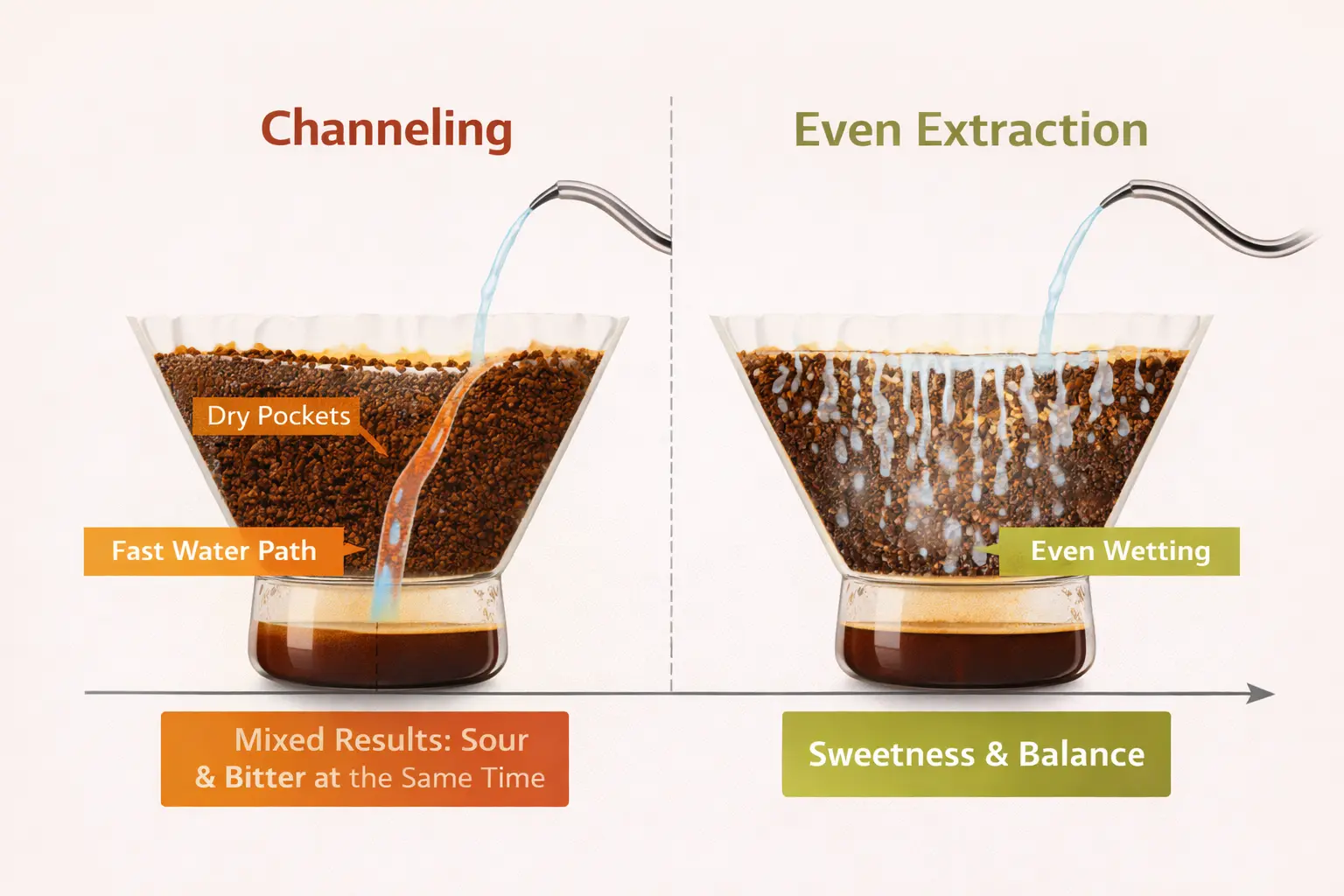
In pour-over, channeling often comes from uneven wetting, aggressive pouring that excavates the bed, or an uneven bed shape that creates a fast route down the side. In espresso, channeling often comes from uneven distribution, poor puck prep, clumps, or inconsistent grind. In drip machines, channeling can happen if the showerhead wets unevenly or if the basket has uneven depth.
Agitation is a double-edged sword. Some agitation is beneficial: it ensures all grounds get wet and prevents dry pockets. Too much agitation can push fines down into the filter, slowing flow and encouraging channeling. The goal is controlled agitation — enough to saturate and level, not enough to disturb and clog.
How Brewing Methods Extract Differently (and What That Means for Flavor)
Brewing methods are different extraction environments. Understanding these differences is a core part of practical coffee extraction science. Espresso is pressure-driven percolation: rapid, intense extraction with high concentration. Pour-over is gravity percolation: clarity-driven extraction where technique strongly shapes flow. Immersion brewing (French press, cupping) is full-contact extraction: water surrounds the coffee particles for the entire brew, reducing channeling risk. AeroPress sits between worlds: primarily immersion with optional gentle pressure and filtration choices that let you tune body and clarity.
| Method | Extraction Type | Channeling Risk | Body | Flavor Character | Best For |
|---|---|---|---|---|---|
| Espresso | Pressure percolation (~9 bar) | High — puck dependent | Very thick, syrupy | Concentrated, intense, roast-forward | Milk drinks, espresso-based recipes |
| Pour-over (V60, Chemex) | Gravity percolation | Moderate — technique dependent | Light to medium | Clean, transparent, origin-highlighting | Single origin, light/medium roast |
| Drip machine | Gravity percolation (automated) | Low-moderate — machine dependent | Medium | Consistent, approachable | Daily volume brewing |
| AeroPress | Immersion + gentle pressure | Very low | Medium (paper) to full (metal) | Smooth, low-bitterness, flexible | Dialing in, travel, versatility |
| French press | Full immersion | Very low | Heavy, textured, oily | Rich, full body, less clarity | Heavier roasts, those who like body |
| Cold brew | Cold immersion (12–24 hrs) | Very low | Medium to full | Smooth, low-acid, chocolatey | Hot weather, low-acid preference |
Espresso: pressure and precision
Espresso forces hot water through a packed coffee puck at high pressure. Because contact time is short and concentration is high, small changes in grind or puck prep create large taste changes. Espresso shines when evenness is high: distribution, tamping, and grind consistency reduce channeling and unlock sweetness.
Pour-over: flow and clarity
Pour-over highlights origin character and aromatics. Flow rate, agitation, and filter behavior matter. Great pour-over tastes transparent — distinct flavors show up clearly because the brew is clean and evenly extracted. See our Dial-In Guide for pour-over-specific technique.
Immersion & AeroPress: forgiving and flexible
Immersion reduces channeling risk and produces reliable balance. AeroPress adds filtration choice (paper vs metal) and gentle pressure, letting you tune body vs clarity and explore extraction adjustments quickly. It’s also the best brewer for learning extraction variables fast.
AeroPress: the best extraction “training tool”
If you want a brewer that teaches coffee extraction without punishing you, AeroPress is hard to beat. It’s quick, repeatable, and makes grind and steep-time experiments obvious in the cup. It also travels anywhere.
Fresh Coffee, Bloom, and CO₂: Why Resting Coffee Helps Extraction
Freshly roasted coffee contains CO₂ trapped in the bean’s porous structure. When hot water hits freshly ground coffee, that gas escapes rapidly — the bloom. Bloom is not just visual; it affects coffee extraction. Excess trapped gas can repel water and reduce initial wetting, creating dry pockets and uneven extraction. Allowing coffee to rest after roasting reduces that extreme CO₂ release and often improves clarity and sweetness.
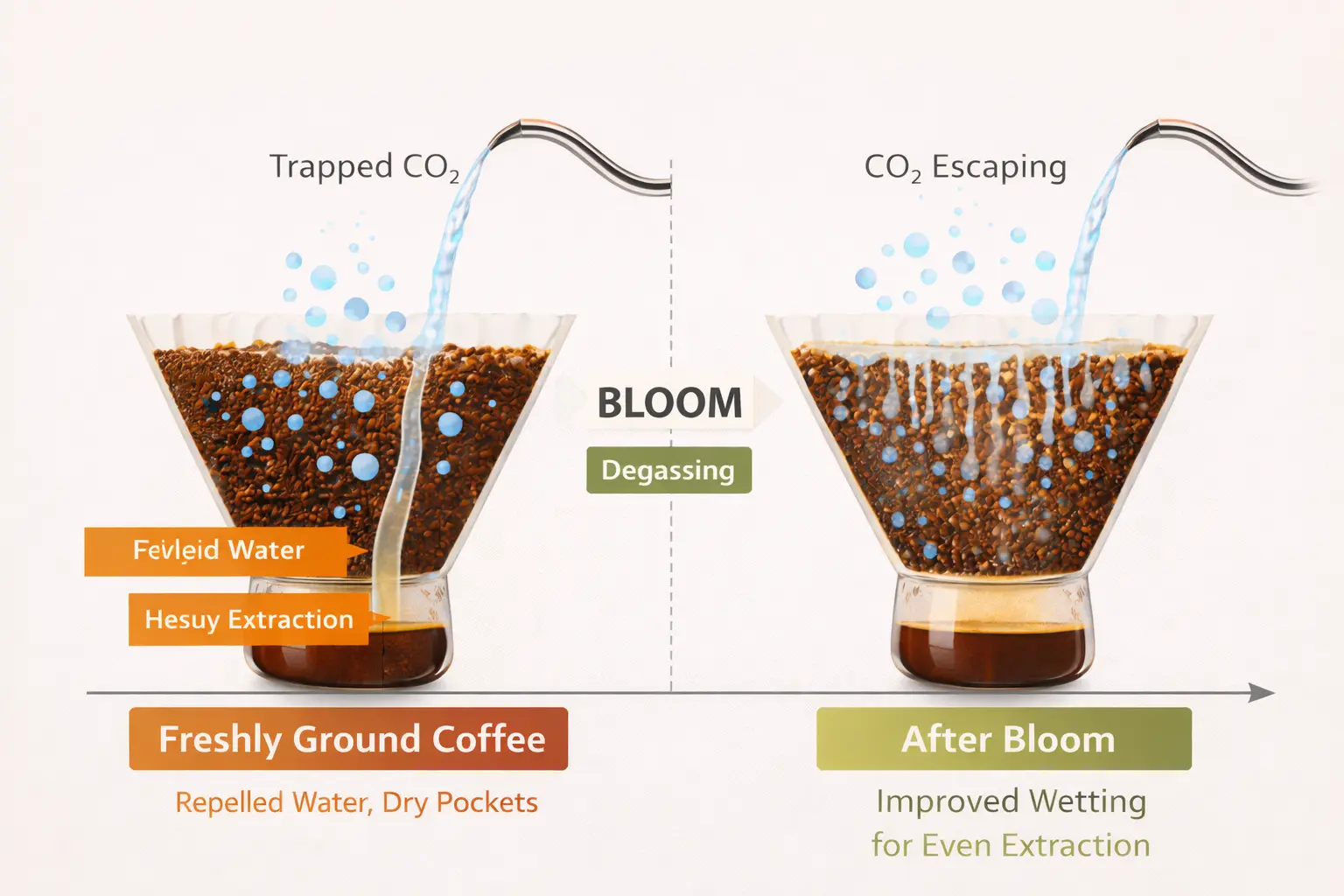
Practically, many coffees taste best after a rest period. Light roasts often benefit from longer rest because they can show sparkly sourness without enough sweetness if brewed too fresh. Darker roasts degas faster and often taste best sooner. The exact timing depends on roast style, but if your brews feel inconsistent from day to day, test the same coffee after several more days — you may find it becomes easier to dial in.
Bloom also helps you control evenness. In pour-over, a proper bloom phase wets all grounds and releases gas so later pours can extract evenly. Skipping bloom often leads to channeling, especially with fresh coffee. A controlled bloom is one of the highest-impact technique tweaks available for improving extraction quality.
A Repeatable Dial-In Protocol You Can Use at Home
If you want café-level improvement in coffee extraction, you need a repeatable process. The most common home mistake is changing multiple variables at once. That makes it impossible to learn what caused the improvement or the problem. Instead, lock in the variables that set strength and consistency, then make one change at a time based on taste feedback.
- Lock in a consistent ratio. Use a scale to weigh both coffee and water every time. Choose a ratio and keep it fixed throughout the dial-in process — 1:16 is a good starting point for pour-over or drip; 1:15 for AeroPress.
- Set a stable temperature. Use a temperature-controlled kettle or thermometer. Start at 200°F (93°C) for most coffees. Don’t let temperature drift between cups or you’ll be chasing a moving target.
- Brew and taste your baseline. Taste the result and identify the dominant problem: sour / sharp / hollow = under-extracted; bitter / drying / harsh = over-extracted; both at once = uneven extraction.
- Adjust grind first. Under-extracted: grind slightly finer. Over-extracted: grind slightly coarser. Change only one step at a time. Grind is the most powerful and most commonly needed adjustment.
- Fix evenness if sour and bitter coexist. Ensure even wetting, use a proper bloom, slow down agitation, and check for channeling. Improve grind consistency before chasing time or temperature.
- Refine with temperature. Once grind and technique are close, use temperature as a refinement tool. Raise temperature to unlock sweetness in light roasts; lower it to reduce harshness in dark roasts.
- Adjust ratio to preference. Once the coffee tastes balanced, adjust ratio to taste. Stronger (1:14–1:15) for milk drinks or fuller body; lighter (1:17–1:18) for clarity and tea-like character.
Make extraction repeatable — and faster to improve
The combination that most improves consistency is a burr grinder + scale + temperature stability. Once those three are in place, dialing in becomes a 2–3 cup process instead of a week of guessing.
Troubleshooting Coffee Extraction by Taste (Pro-Level Cheat Sheet)
Taste is your best measurement tool. You don’t need a refractometer if you can identify the direction of imbalance. Sourness that reads like lemon without sweetness usually points to under-extraction. Bitterness that lingers with a drying finish points to over-extraction. A hollow cup often means not enough dissolved sweetness and body. A muddy cup often means too many fines or too much agitation. The key is to make a single change, taste again, and let the coffee teach you what the variable did.
| Symptom | Root Cause | Fix — In Priority Order |
|---|---|---|
| Sour, sharp, or lemony | Under-extraction: acids without balancing sweetness | 1. Grind finer 2. Increase contact time 3. Raise temperature 4. Improve bloom / even wetting |
| Bitter, harsh, or drying | Over-extraction: late-stage compounds dominant | 1. Grind coarser 2. Reduce agitation 3. Lower temperature 4. Shorten steep if flow is stalling |
| Sour AND bitter simultaneously | Uneven extraction — mixed particle extraction | 1. Improve grind consistency 2. Reduce channeling 3. Bloom properly 4. Simplify agitation |
| Hollow or empty body | Too little dissolved sweetness / body compounds | 1. Grind slightly finer 2. Increase ratio (use more coffee) 3. Try metal filter (if using AeroPress) |
| Muddy or gritty | Too many fines in cup; over-agitation | 1. Switch to paper filter 2. Grind slightly coarser 3. Reduce stirring / agitation |
| Flat and dull despite correct extraction | Stale beans or poor water | 1. Check roast date — aim within 2–6 weeks 2. Switch to filtered water 3. Test water chemistry |
| Inconsistent cup to cup | No scale; temperature drift; variable technique | 1. Add a scale (weigh coffee and water) 2. Use temp-control kettle 3. Standardize technique |
If it tastes sour, sharp, or hollow
- Grind slightly finer (most common fix)
- Increase contact time slightly (slower pour or longer steep)
- Increase temperature slightly (especially for light roasts)
- Improve wetting and reduce channeling (better bloom, gentler pours)
Signal: acidity dominates because sweetness and body did not fully develop in the brew window.
If it tastes bitter, harsh, or drying
- Grind slightly coarser
- Reduce agitation (stir less, pour gentler)
- Lower temperature slightly (especially for dark roasts)
- Shorten contact time if flow is stalling
Signal: late-stage compounds are dominating the cup, often amplified by fines and uneven flow.
If the cup is both sour and bitter, assume uneven extraction first. Improve grind consistency, ensure a level coffee bed, bloom properly, and keep pouring controlled. In espresso, focus on distribution and puck prep. In pour-over, focus on even wetting and avoid aggressive agitation that collapses the bed. For more method-specific help, see: How to Dial In Coffee at Home.
Tools That Improve Coffee Extraction the Most (and Why)
Great coffee extraction is limited by how precisely you can control variables. If your grinder produces inconsistent particles, your extraction will be inconsistent. If you eyeball ratio, your strength and extraction will drift. If your temperature varies cup to cup, you’ll chase flavor changes that aren’t caused by your recipe. The goal isn’t to buy expensive gear — it’s to remove chaos so you can learn faster and brew better consistently.
Recommended Gear for Better Extraction
Baratza Encore — Best Entry Burr Grinder
Why it matters: Narrows particle distribution, reduces mixed extraction, and improves sweetness and clarity across every brew method. The highest-impact upgrade most home brewers can make.
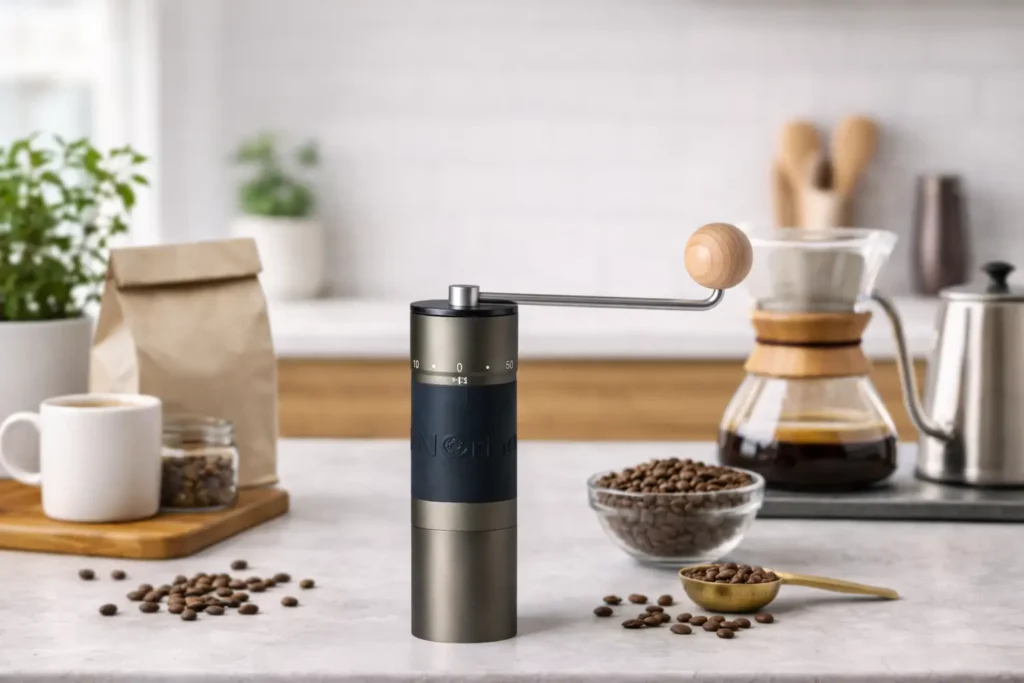
KINGrinder K6 — Best Manual Grinder
Why it matters: Precise click-step adjustment for AeroPress, pour-over, and moka pot. Consistent grind at medium and medium-fine ranges with very low retention. Ideal for travel and home.
Timemore Black Mirror — Best Scale + Timer
Why it matters: Stabilizes ratio and time so you can make one-variable improvements. Without a scale, you can’t reliably repeat what worked or isolate what failed.
Fellow Stagg EKG — Best Temp-Control Kettle
Why it matters: Stabilizes extraction rate and improves pour control. Critical for pour-over evenness and for holding consistent temperatures across light and dark roast dialing.
FAQs: Coffee Extraction Science
What is coffee extraction?
Coffee extraction is the process of dissolving soluble compounds from ground coffee into water during brewing. Those dissolved compounds create the drink’s flavor, aroma, sweetness, and body.
What causes under-extracted coffee?
Under-extraction happens when the brew doesn’t dissolve enough sweetness and body compounds. Common causes include a grind that’s too coarse, brew time that’s too short, water that’s too cool, an insufficient bloom (pour-over), or uneven wetting and channeling.
What causes over-extracted coffee?
Over-extraction occurs when the brew pulls too many late-stage bitter and drying compounds. Common causes include a grind that’s too fine, excessive agitation, overly hot water for the roast level, stalled flow (pour-over), or overly long contact time (especially in immersion).
Why can coffee taste both sour and bitter?
This usually indicates uneven extraction. Fines can over-extract and add bitterness and dryness while larger particles under-extract and add sourness and hollowness. Improving grind consistency, reducing channeling, and simplifying agitation often fixes this faster than changing brew time alone.
What water temperature is best for coffee extraction?
Most coffees perform well around 195–205°F (90–96°C). Light roasts often benefit from hotter water to unlock sweetness; darker roasts often benefit from slightly cooler water to reduce harshness. Temperature stability is more important than chasing a single perfect number.
Does brew ratio affect extraction?
Yes. Ratio affects beverage concentration and changes how you perceive acidity, sweetness, and bitterness. For dialing in, keep ratio consistent while you adjust grind size and technique to target balanced extraction.
What is extraction yield?
Extraction yield is the percentage of coffee mass that dissolves into the beverage. Professionals often reference an ideal band around 18–22% for balanced flavor, but home brewers can dial in effectively by taste with consistent ratios and small grind adjustments.
How do I fix sour coffee quickly?
The most common fix is grinding slightly finer. If needed, increase contact time slightly or raise temperature — especially for light roasts. Make one small change at a time and taste again.
How do I fix bitter coffee quickly?
Grind slightly coarser and reduce agitation. If bitterness persists, shorten contact time or lower temperature slightly — especially for darker roasts or if your grinder produces many fines.
What’s the best upgrade for better extraction?
A consistent burr grinder is usually the biggest upgrade. It narrows particle distribution, improves evenness, reduces mixed extraction, and makes dialing in far faster across every brew method.
Next Reads
Strengthen your brewing fundamentals with these CoffeeGearHub guides.
DIAL-IN & TECHNIQUE
AEROPRESS CLUSTER
☕
Written by the CoffeeGearHub Editorial Team
CoffeeGearHub is a specialty coffee equipment resource produced by the CoffeeGearHub Editorial Team. Our guides are researched using published brewing science, equipment manufacturer specifications, and established specialty-coffee community knowledge. We review and update our pillar content regularly to reflect current research and community best practices. About CoffeeGearHub →