
Last Updated: March 16, 2026 • 18–22 min read • Covers: Drip vs. Pour Over Taste + Ease of Use + Full Gear Cost Breakdown + Brew Time + Troubleshooting Matrix + Gear Picks

✍️ Editorial note: This guide is researched and written by the editors at CoffeeGearHub.com using published brewing science, SCA certification standards, equipment manufacturer specifications, and established specialty-coffee community knowledge. Recommendations reflect research consensus rather than in-house lab testing. All product links are affiliate links — we may earn a commission at no cost to you.
The 30-Second Answer
Drip coffee vs pour over, which is it?. Both drip coffee and pour over run hot water through ground coffee and a paper filter — so why do they taste so different? The answer comes down to control, consistency, and what you want from your morning cup. Drip wins on convenience: press a button and walk away, ideal for households and busy mornings. Pour over wins on flavor clarity and control, especially with single-origin beans. For most people, a quality SCA-certified drip machine delivers café-grade results with zero effort. If you enjoy the ritual and want to taste everything a bean has to offer, pour over is worth the extra five minutes.
- Best drip machine for most households: Breville Precision Brewer — SCA-certified, bloom cycle, thermal carafe
- Best pour over for beginners: Hario V60 Plastic (Size 02) — forgiving, affordable, excellent heat retention
- Best pour over for 2–4 cups: Chemex 6-Cup — clean, smooth, and scales up without a machine
- Grinder rule: a burr grinder matters more than the brewing method — fresh-ground, consistent coffee is the foundation of both
- Key insight: the gap between drip and pour over almost disappears when you use an SCA-certified machine — the real comparison is budget drip vs. pour over
Who This Guide Is For — Jump to What You Need
☕ The Busy Morning Brewer
You need reliable coffee without a learning curve. Jump to Drip →
🌿 The Flavor Chaser
You want to taste every note in a single-origin bean. Jump to Pour Over →
💸 The Budget Planner
You want to know what gear actually costs. Jump to Gear Cost →
🔄 The Switcher
You use one method and wonder if you’re missing out. Jump to Verdict →
Table of Contents
Key Differences at a Glance
| Factor | Drip Coffee | Pour Over |
|---|---|---|
| Automation | Fully automatic | Fully manual |
| Hands-on time | 1–2 min (setup only) | 4–6 min (active pouring) |
| Total brew time | 6–10 min (full pot) | 5–8 min (single cup) |
| Batch size | 2–12 cups typical | 1–3 cups typical |
| Flavor profile | Balanced, full-bodied | Bright, clean, nuanced |
| Extraction control | Low (machine decides) | High (you decide) |
| Grind size | Medium | Medium to medium-fine |
| Gear entry cost | $30–$350+ | $15–$80 (dripper only) |
| Skill required | Low | Medium |
| Portability | Not portable | Travel-friendly |
| Cleanup | Moderate (carafe, basket) | Easy (rinse dripper) |
| Ideal for | Households, offices | Solo brewers, coffee enthusiasts |
What Is Drip Coffee?
Drip coffee — also called automatic drip or filter coffee — is brewed by an electric machine that heats water and dispenses it over a basket of ground coffee held in a paper or permanent filter. Gravity pulls the water through the grounds and the brewed coffee drips into a carafe below. The core appeal is automation: add water and grounds, press a button, and the machine handles temperature, flow rate, and timing.
Most households have owned a drip machine at some point. They range from basic $20 models to SCA-certified precision brewers that replicate high-end café extraction at home. The quality gap between the two extremes is enormous — and it’s almost entirely explained by one variable: brew water temperature.
How Drip Coffee Works
- Cold water from the reservoir is heated by a boiler element to brewing temperature.
- Heated water is distributed through a showerhead over the ground coffee bed.
- Water saturates the grounds and extracts soluble compounds as it passes through.
- Brewed coffee drips through the filter into a carafe, where it’s kept warm by a heating plate or vacuum insulation.
💡 The drip temperature problem: Budget machines often struggle to reach the 195–205°F sweet spot and distribute water unevenly, causing channeling — where water finds the path of least resistance and leaves half the grounds under-extracted. Premium SCA-certified machines like the Breville Precision Brewer solve both problems. If your drip coffee tastes mediocre, your machine is almost certainly the culprit, not the method itself.
What Is Pour Over Coffee?
Pour over is a manual brewing method where you pour hot water over ground coffee in a filter-lined dripper by hand. There’s no machine involved — you control the water temperature, pour rate, and saturation pattern yourself, using a gooseneck kettle for precision. The technique was popularized globally by the Hario V60 and Chemex and is a cornerstone of third-wave specialty coffee culture, prized for producing an exceptionally clean, nuanced cup that lets a bean’s terroir shine through.
How Pour Over Works
- Heat water to 200°F (or about 30 seconds off boil). A gooseneck kettle with temperature control is ideal.
- Place a paper filter in your dripper (Hario V60, Chemex, Kalita Wave, etc.) and rinse it with hot water to remove papery taste and preheat the vessel.
- Add freshly ground coffee — medium-fine for V60, medium for Chemex or Kalita.
- Bloom: pour about twice the coffee’s weight in water over the grounds, then wait 30–45 seconds while CO₂ escapes.
- Continue pouring in slow, steady circles in two or three pours until you reach your target brew weight.
- Allow the drawdown to complete — total brew time should be 3–4 minutes.
💡 Every variable you control matters: pour height, pour speed, bloom time, and grind size all affect the final cup. That’s precisely the point. Pour over rewards attention with remarkable clarity and brightness that most machines can’t replicate — especially with high-quality single-origin beans.
Taste and Flavor Comparison
This is where the real debate lives. Both methods use hot water, ground coffee, and a paper filter — yet the cups taste meaningfully different. Here’s why, and when the gap matters.
Drip Coffee Flavor
A quality drip machine produces a rounded, balanced cup with good body and a consistent flavor profile batch to batch. The automated water distribution and consistent temperature create reliable extraction — you won’t get a transcendent cup, but you also won’t get a bad one. Budget drip machines often produce flat or slightly bitter coffee because they don’t reach optimal temperature and their showerheads leave grounds unevenly saturated. SCA-certified machines eliminate these problems entirely.
Pour Over Flavor
Pour over is famous for its clarity — a clean, bright cup where individual tasting notes (florals, fruit, chocolate, citrus) come through with remarkable definition. The paper filter removes most of the oils and fine particles that add body, resulting in a lighter-feeling cup that prioritizes clarity over richness. This makes pour over the ideal showcase for high-quality single-origin beans. If you’re spending $20+ per bag on a washed Ethiopian Yirgacheffe, pour over will reveal those blueberry and jasmine notes in a way a standard drip machine won’t.
Bottom Line on Flavor
| Matchup | Winner | Why |
|---|---|---|
| Pour over vs. budget drip machine | Pour over | Budget machines underbrew; pour over has full temperature and saturation control |
| Pour over vs. SCA-certified drip | Even — different characters | Both brew correctly; pour over = brighter and cleaner; drip = more rounded and consistent |
| Pour over vs. drip for single-origin beans | Pour over | Clarity reveals terroir notes that full-body drip masks |
| Pour over vs. drip for dark roasts/blends | Drip | Flavor clarity matters less; consistency and volume matter more |
Ease of Use
Drip: Set It and Forget It
Drip machines are as simple as brewing gets. Add water to the reservoir, coffee to the basket, press start. Many models have programmable timers so your coffee is ready before you’re out of bed. If you brew for two or more people daily, drip is almost certainly the right call — there’s no skill wall, no learning curve, and the machine handles everything. Cleanup is also straightforward: dump the grounds and filter, rinse the carafe and basket, and run a descaling cycle monthly.
Pour Over: Rewarding but Requires Attention
Pour over has a modest learning curve. Your first few attempts may be uneven — either too fast (weak, under-extracted coffee) or too slow (bitter, over-extracted). Dialing in your grind size and pour technique takes a few sessions, but most people find a reliable groove within a week. The main friction points are equipment: you need a gooseneck kettle (ideally with temperature control), a burr grinder, a digital scale, and a timer. Without a scale, consistent results are difficult. With these tools, pour over becomes a meditative and highly satisfying morning ritual.
| Ease-of-Use Factor | Drip | Pour Over |
|---|---|---|
| First-time use | ✅ Immediate | ⚠️ 2–3 practice brews to dial in |
| Morning speed | ✅ Hands-free | ⚠️ 5–6 min active time |
| Programmable timer | ✅ Most models | ❌ Manual only |
| Brewing for 4+ people | ✅ Full carafe | ⚠️ Multiple brews needed |
| Equipment required | Machine only | Dripper + gooseneck kettle + scale + burr grinder |
| Cleanup time | ~3 minutes | ~1 minute |
Equipment and Cost Breakdown
Pour over has a surprisingly low entry cost for the brewer itself — a Hario V60 costs under $20. But once you account for the full kit (gooseneck kettle, scale, burr grinder), you’re in a similar range to a mid-tier drip machine. Here’s what both setups actually cost, and the specific gear we recommend.
Top Drip Coffee Makers
⭐ COFFEEGEARHUB TOP PICK — BEST DRIP MACHINE FOR MOST BREWERS
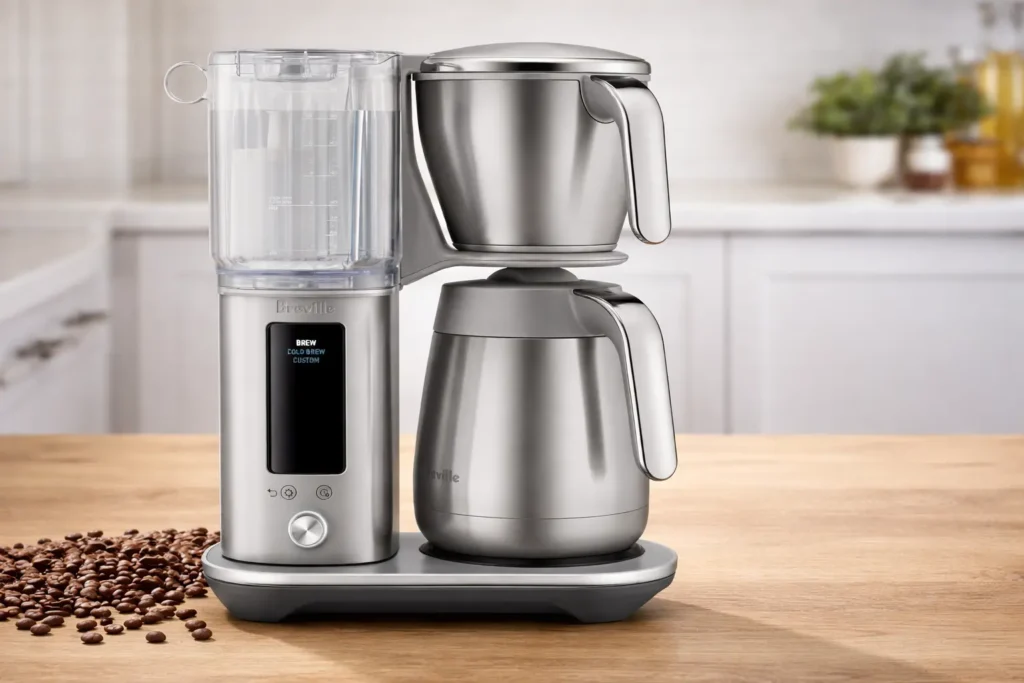
Breville Precision Brewer Thermal — Best Drip Machine for Most Brewers
The Precision Brewer is SCA-certified and offers six brew modes including a Specialty mode that adds a proper bloom cycle — something most machines skip entirely. The thermal carafe keeps coffee hot for hours without a heating plate that degrades flavor. It’s the drip machine we recommend for anyone serious about their cup who doesn’t want to give up the automation of drip brewing.
- SCA-certified — verified 197°F–204°F brew temperature throughout cycle
- Specialty mode — includes bloom cycle for even saturation, just like pour over
- Thermal carafe — no hot plate, no flavor degradation over time
- Six brew modes including single-cup and full carafe
- Programmable 24-hour auto-start
Affiliate link — we may earn a commission at no cost to you.
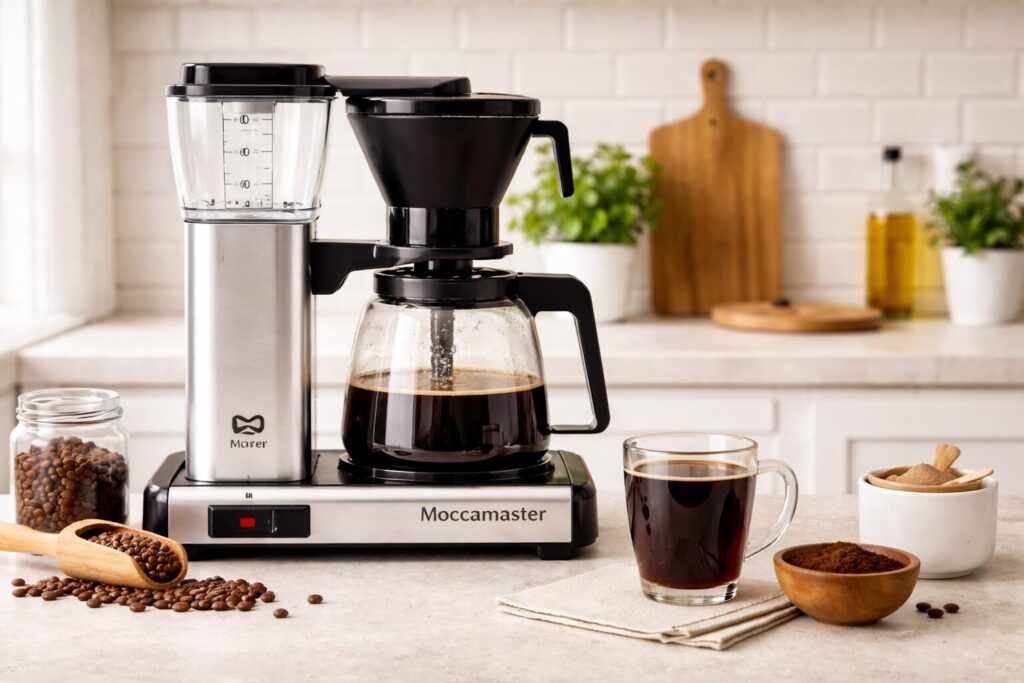
Technivorm Moccamaster KBG — Premium Pick, Built to Last Decades
The Moccamaster is the gold standard of home drip coffee — handmade in the Netherlands, SCA-certified, and built with component-level quality that keeps it running for a decade or more. It brews a full pot in under six minutes using a copper boiler that hits 196–205°F reliably every brew. For enthusiasts who want the last drip machine they’ll ever buy, this is it.
- SCA-certified — copper boiler, 196°F–205°F every brew
- Full 10-cup brew in under 6 minutes
- Handmade in Amerongen, Netherlands — repairable, five-year warranty
- Manual brew basket switch — adjusts flow rate for lighter or darker roasts
Affiliate link — we may earn a commission at no cost to you.
Top Pour Over Brewers
⭐ COFFEEGEARHUB TOP PICK — BEST POUR OVER FOR BEGINNERS
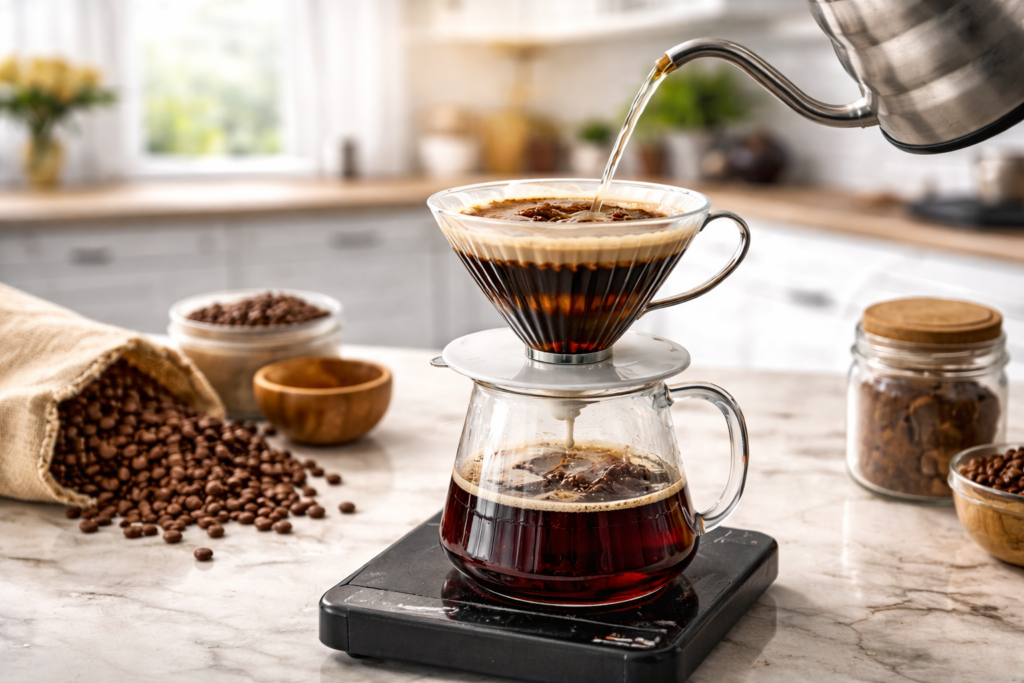
Hario V60 Plastic Dripper (Size 02) — Best Pour Over for Beginners
The V60 is the most forgiving and versatile pour over dripper available. The plastic version retains heat better than ceramic or glass during your pour, making it easier to maintain temperature consistency — especially while you’re still developing technique. The iconic spiral ribs and large single aperture give you a wide range of brew times to work with. Start here, then graduate to ceramic if you want.
- BPA-free plastic — better heat retention than ceramic or glass for beginners
- Size 02 — brews 1–4 cups; the most widely used size
- Large single aperture — flexible brew time, forgiving of pour speed variation
- Uses Hario V60 tabbed or untabbed paper filters (widely available)
Affiliate link — we may earn a commission at no cost to you.
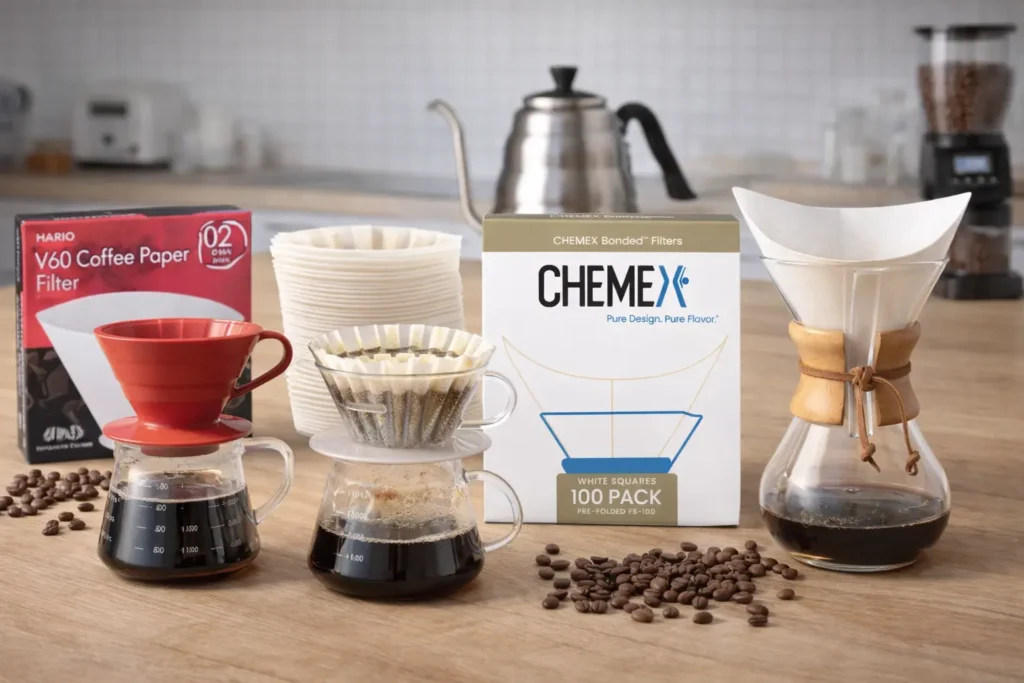
Chemex Classic Series 6-Cup — Best Pour Over for 2–4 Cups
The Chemex bridges the gap between single-serve and the household. Its thick bonded filters produce one of the cleanest, smoothest cups in any brewing method — essentially no oils, no sediment, just pure extracted flavor. The all-in-one glass design functions as both dripper and carafe, and it’s a beautiful countertop piece that even non-coffee-people tend to notice. If you regularly brew manually for two or more people, this is the right tool.
- 6-cup capacity (30 oz) — brews 2–4 generous mugs in one go
- Thick bonded filters — cleanest cup of any pour over brewer; zero oils or sediment
- All-in-one glass design — dripper and server combined, no separate vessel needed
- Borosilicate glass, wooden collar, leather tie — heat-resistant and countertop-worthy
Affiliate link — we may earn a commission at no cost to you.
The Grinder: Essential for Both Methods
A burr grinder is the single most impactful upgrade you can make regardless of which brewing method you choose. Pre-ground coffee goes stale fast and produces inconsistent particle sizes that cause uneven extraction. Fresh-ground, consistently sized coffee is the foundation of any great cup — drip or pour over. For drip, set to medium. For pour over, set to medium-fine and adjust from there.
⭐ COFFEEGEARHUB SITE STANDARD MANUAL GRINDER RECOMMENDATION
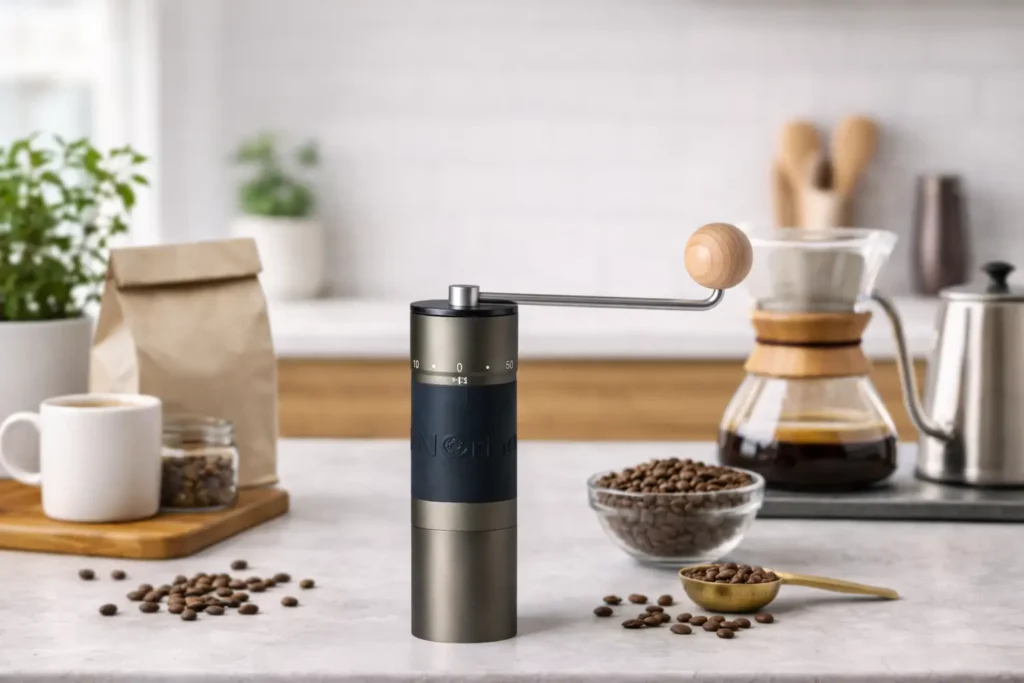
KINGrinder K6 — Best Manual Grinder for Both Methods
The KINGrinder K6 is the manual grinder we recommend across CoffeeGearHub, and it performs just as well for drip as it does for pour over. Its 48mm stainless steel burrs produce an impressively uniform grind across the full spectrum from espresso to French press, and the click-stop adjustment system makes it easy to repeat a grind size once you’ve dialed it in. For pour over, set it to medium-fine (around steps 18–22); for drip, medium (steps 24–28). Low retention means no stale grounds carry over between sessions.
Affiliate link — we may earn a commission at no cost to you.
Full Kit Cost Comparison
| Setup | Core Gear Needed | Approx. Entry Cost | Approx. Premium Cost |
|---|---|---|---|
| Budget drip | Basic drip machine + blade grinder | ~$30–$60 | — |
| Quality drip | SCA-certified machine + burr grinder | ~$200–$300 | $350–$500+ |
| Entry pour over | V60 + basic kettle + K6 grinder + scale | ~$80–$120 | — |
| Full pour over kit | V60 or Chemex + temp-control kettle + K6 + scale | ~$150–$200 | $250–$350 |
Brew Time Comparison
Brew time is one of the most misunderstood parts of this comparison. “Pour over is faster” and “drip is faster” are both true depending on how you measure — and the more important question is how you spend that time.
| Timing Factor | Drip (Full Pot) | Pour Over (Single Cup) |
|---|---|---|
| Water heat time | Built into machine — 0 min hands-on | 3–5 min (kettle boil) |
| Setup time | 1–2 min | 1–2 min |
| Active brew time | 0 min (hands-free) | 3–4 min (active pouring) |
| Total machine/brew time | 6–10 min | 3–4 min |
| Total wall-clock time | 7–12 min | 7–10 min |
| Hands-on time | ~2 min | ~8–10 min |
🔬 The real time comparison: Total wall-clock time is roughly the same for a single cup. The difference is how you spend that time. Drip requires almost nothing from you after setup; pour over keeps you at the counter the entire time. For households brewing four or more cups at once, drip is significantly more efficient — there’s no practical way to make four cups of pour over faster than a single drip machine brew cycle.
Which Should You Choose? Practical Decision Guide
| Your situation | Best method | Our pick |
|---|---|---|
| You brew for two or more people every morning | Drip | Breville Precision Brewer — SCA-certified, bloom cycle, thermal carafe |
| You want coffee ready before you’re fully awake | Drip | Any SCA-certified machine with a 24-hour programmable timer |
| You brew mostly for yourself (1–2 cups) | Pour over | Hario V60 Plastic — fast, forgiving, inexpensive |
| You want to taste every note in a single-origin bean | Pour over | V60 for clarity; Chemex for a larger, slightly smoother batch |
| You brew 2–4 cups manually without a machine | Pour over | Chemex 6-Cup — most practical manual option for small households |
| You enjoy the morning ritual and process | Pour over | Either V60 or Chemex depending on batch size |
| You want the last machine you’ll ever buy | Drip | Technivorm Moccamaster — repairable, 10–20 year lifespan |
| You drink dark roasts and blends daily | Drip | Any SCA-certified machine — consistency matters more than clarity here |
| You can’t decide | Both | A V60 costs under $20 — keep it next to your drip machine for weekends |
Troubleshooting Matrix: Fix Drip and Pour Over Problems at the Source
Most coffee problems are not method problems — they’re grind problems, temperature problems, or technique problems. This matrix works through the most common symptom patterns across both methods and traces them to their most likely causes.
| Symptom | Method | Most Likely Cause | Fix (in order) |
|---|---|---|---|
| Weak, watery coffee | Both | Grind too coarse; incorrect ratio | Go finer by 1–2 clicks → use 1:15 coffee-to-water ratio by weight → verify brew temperature |
| Bitter, harsh coffee | Both | Over-extraction; grind too fine; coffee sitting on heat plate | Go coarser → lower water temp to 200°F → switch to thermal carafe or drink promptly |
| Flat, dull flavor | Drip | Machine not reaching 195°F; old pre-ground coffee | Upgrade to SCA-certified machine → grind fresh beans per brew |
| Sour, under-extracted taste | Pour over | Grind too coarse; water too cool; pour too fast | Grind finer → use 200°F water → slow your pour → extend bloom to 45 sec |
| Brew takes too long (5+ min pour over) | Pour over | Grind too fine; filter not rinsed | Grind coarser → rinse filter with hot water before adding grounds |
| Grounds overflow basket or filter | Both | Dose too large; grind too fine causing slow flow | Reduce dose → go slightly coarser → ensure filter and basket are properly matched |
| Coffee cools too fast | Pour over | Ceramic or glass dripper pulling heat from brew | Switch to plastic V60 → preheat server and cup before brewing |
| Machine makes weak coffee despite full dose | Drip | Scale buildup reducing water temperature | Descale with citric acid or white vinegar → run two clear-water cycles → retest |
| Coffee tastes papery | Both | Paper filter not rinsed before brewing | Always rinse paper filter with hot water before adding coffee — on every brew |
| Inconsistent results day to day | Both | No scale; inconsistent grind; stale beans | Weigh coffee and water by grams → use a click-step burr grinder → buy fresher beans |
🔬 The scale rule: The single most impactful habit change for either brewing method is weighing your coffee and water. A cheap kitchen scale removes dose variability entirely — which is the most common source of inconsistent results across both drip and pour over. If you’re eyeballing scoops, you are not brewing the same cup twice.
FAQs: Drip Coffee vs. Pour Over
Is pour over coffee stronger than drip?
Pour over coffee is not automatically stronger than drip, but it often tastes more intense because the slower extraction highlights clarity and brightness. Strength is mainly controlled by your coffee-to-water ratio in both methods. Use a 1:15 ratio for a standard cup in either method.
Does pour over coffee have more caffeine than drip?
Caffeine content is very similar between the two methods when using the same ratio of coffee to water. The extraction rate differs slightly, but neither method produces dramatically more caffeine than the other. Caffeine is primarily determined by the amount of coffee used and the bean variety, not the brewing method.
Is pour over worth it over a drip machine?
Pour over is worth it if you enjoy the ritual, want more control over your brew, or are chasing flavor clarity in single-origin beans. If you prioritize convenience and brew for multiple people daily, a quality drip machine is likely the better fit. Many enthusiasts own both and use each for different occasions.
Can you use the same coffee grind for drip and pour over?
Both drip and pour over use a medium grind, but pour over generally benefits from a slightly finer grind within that range. Using the exact same grind may produce acceptable results on both, but dialing in separately — slightly coarser for drip, slightly finer for pour over — will improve each brew individually.
Why does pour over taste better than my drip machine?
Most budget drip machines don’t reach the optimal brewing temperature of 195–205°F and lack even water distribution across the coffee bed, leading to under-extraction. Pour over gives you full control over both temperature and pour pattern, which typically produces a more even, flavorful extraction. Upgrading to an SCA-certified drip machine eliminates most of this gap.
How long does pour over take compared to drip?
A single-cup pour over takes roughly 3–4 minutes of active brew time once water is heated. A standard drip machine brews a full pot in 6–10 minutes with almost no hands-on time. When you factor in kettle heating, total wall-clock time is similar for one cup — but the key difference is that pour over requires your full attention the entire time, while drip is hands-free.
What grinder should I use for pour over?
A burr grinder is essential for pour over. The KINGrinder K6 is our recommended manual burr grinder — its 48mm stainless steel burrs produce consistent medium-fine grinds ideal for V60 or Chemex brewing, and its click-stop dial makes it easy to reproduce your preferred grind size. For an electric option, look for conical or flat burr grinders with numbered grind adjustment.
Is a Chemex considered pour over?
Yes, the Chemex is a pour over brewer. It uses a thicker bonded paper filter than the Hario V60, which produces an even cleaner cup with essentially no oils or sediment. The all-in-one glass design functions as both dripper and carafe. It brews larger batches (3–6 cups) than most single-serve pour over devices, making it practical for households brewing manually for two or more people.
Can a drip machine make coffee as good as pour over?
Yes — premium drip machines like the Breville Precision Brewer and Technivorm Moccamaster are SCA-certified to brew at the correct temperature with proper bloom and even saturation, producing cups that rival a well-executed pour over. Budget machines under $60 generally cannot match a good pour over, but this is a machine quality issue, not a fundamental limitation of the drip method.
Which brewing method wastes less coffee?
Pour over wastes less coffee because you brew exactly the amount you plan to drink. Drip machines typically require brewing at least several cups, and coffee left on a warming plate continues to degrade in quality — leading many people to discard the remainder. If you regularly brew more than you drink, a pour over (or a drip machine with a thermal carafe) will save both coffee and money over time.
Continue Learning
DRIP COFFEE GUIDES
POUR OVER GUIDES
BREWING COMPARISONS
Need to dial in your grind for pour over or drip? The grind size guide covers the full spectrum from coarse French press to espresso fine — with method-specific dial-in sections that walk through how to adjust by taste, not guesswork.
☕
Written by the CoffeeGearHub Editorial Team
CoffeeGearHub is a specialty coffee equipment resource produced by the CoffeeGearHub Editorial Team. Our brewing method guides are researched using published extraction science, SCA certification standards, equipment manufacturer specifications, and established specialty-coffee community knowledge. We review and update our pillar content regularly to reflect current product availability and community consensus. About CoffeeGearHub →