Last Updated: March 2026 • 18–24 min read • Covers: Ideal Temperature Range + Roast Level Adjustments + How Temperature Affects Taste + Kettle Picks + Dial-In Guide
✍️ Editorial note: This guide is researched and written by the editors at CoffeeGearHub.com using published brewing science, SCA certification standards, and established specialty-coffee community knowledge. Recommendations reflect research consensus rather than in-house lab testing. All product links are affiliate links — we may earn a commission at no cost to you.
The 30-Second Answer
The ideal pour over water temperature is 195–205°F (90–96°C) — the range the Specialty Coffee Association specifies for optimal extraction. Within that range, roast level determines where you should land: darker roasts extract more easily and need slightly lower temperatures to avoid bitterness, while lighter roasts are denser and need temperatures toward the higher end to extract fully.
- Light roast: 200–205°F (93–96°C) — higher temperature needed to break down denser cellular structure and extract fully without sourness
- Medium roast: 197–202°F (91–94°C) — the most forgiving range, works well across most pour over drippers and grind sizes
- Dark roast: 195–200°F (90–93°C) — lower end of the range prevents over-extraction of the more soluble, bitter compounds in darker-roasted beans
- No thermometer: boil water and wait 45 seconds for medium roast, 30 seconds for dark roast, brew immediately from boil for light roast if at sea level
Who This Guide Is For — Jump to What You Need
🌡️ Quick answer on temperature
Read How Temperature Affects Taste + Temperature by Roast.
☕ No thermometer or kettle
Jump to Off-Boil Method + Kettle Picks.
🔧 Fixing a bad-tasting cup
Go to Taste Diagnosis + Dial-In Guide.
🏔️ Brewing at altitude
Read Altitude Adjustment.
Table of Contents
How Water Temperature Affects Pour Over Extraction
Water temperature controls extraction rate — how quickly and how completely water dissolves soluble compounds from ground coffee. Coffee contains hundreds of different compounds that dissolve at different rates and temperatures. Sugars, acids, and aromatic oils dissolve relatively easily. Bitter and astringent compounds require more energy to dissolve and come out last. The goal of temperature control is to extract enough of the desirable compounds without triggering the undesirable ones.
This is why temperature matters so much in pour over specifically. Drip machines and immersion brewers have some tolerance for temperature variation — the long contact time in a French press or the large batch volume in a drip machine buffers against small temperature errors. Pour over has neither buffer: water passes through the grounds once, in a relatively short window of 2.5 to 4 minutes. If the temperature is off, there is no mechanism to correct the under- or over-extraction that follows.
| Temperature Range | Extraction Effect | Taste Result |
|---|---|---|
| Below 185°F (85°C) | Severely under-extracted — only the most soluble acids dissolve | Sour, sharp, thin, flat — no sweetness or body |
| 185–194°F (85–90°C) | Under-extracted — moderate acid extraction, incomplete sugar and aromatic dissolution | Sour or acidic, weak body, muted aroma |
| 195–205°F (90–96°C) | Balanced extraction — acids, sugars, and aromatics all dissolve in proportion | Sweet, bright, full-bodied, aromatic — the target range |
| 206–210°F (96–99°C) | Slightly over-extracted — bitter compounds begin dissolving at elevated rate | Slightly harsh or bitter, especially on dark roasts |
| 212°F+ (100°C) | Over-extracted risk — all compound classes extracting at maximum rate | Bitter, astringent, harsh — particularly damaging for dark and medium roasts |
🔬 Why grind size and temperature interact: Finer grinds increase surface area and extraction rate — the same way hotter water does. This means you can partially compensate for low temperature with a finer grind, and vice versa. However, the compensation is imperfect: temperature also affects which compounds extract, not just how fast. Getting both variables right produces a qualitatively better cup than optimising one at the expense of the other.
The Ideal Pour Over Temperature Range
The Specialty Coffee Association specifies 195–205°F (90–96°C) as the optimal brewing temperature for filter coffee — and this range is the right starting point for pour over. It is wide enough to accommodate different roast levels and preferences while narrow enough to exclude the most common sources of extraction failure.
Most coffee professionals and specialty roasters land somewhere between 198–205°F for their pour over recipes. The reason the range skews toward the higher end in practice is that heat loss during the pour is significant: water at 205°F in your kettle arrives at the grounds at 198–202°F after being poured through the bloom and main pour. Starting too low means the grounds are receiving water below the minimum extraction threshold by the end of the brew.
💡 The heat loss reality: A standard gooseneck kettle loses 1–3°F per minute once removed from heat. During a 3-minute pour, water temperature at the grounds is typically 5–8°F lower than what the kettle reads at the start of the brew. This is why temperature-controlled kettles that maintain a set temperature throughout the pour — rather than just heating to a target — produce more consistent results than kettles that simply reach a temperature and then cool.
Temperature by Roast Level
Roast level is the primary variable that determines where within the 195–205°F range you should brew. The reason comes down to cellular structure: roasting breaks down the cell walls of coffee beans. Lightly roasted beans retain more of their original dense structure and require higher temperatures to extract fully. Darkly roasted beans have more porous, soluble-rich structures that release compounds more readily — and release bitter compounds faster when over-heated.
| Roast Level | Recommended Temperature | Why | Taste if Too Low | Taste if Too High |
|---|---|---|---|---|
| Light roast | 200–205°F (93–96°C) | Dense structure resists extraction — higher heat needed to pull flavors fully | Sour, underdeveloped, thin — fruity notes disappear | Slightly harsh, acidic bite becomes sharp |
| Light-medium roast | 199–203°F (93–95°C) | Transitional — benefits from high-end temperature without full light roast intensity | Lacks sweetness and body | Slightly astringent on finish |
| Medium roast | 197–202°F (91–94°C) | Most forgiving range — balanced extraction across the full compound range | Flat, lacking complexity | Bitterness creeps in on finish |
| Medium-dark roast | 196–200°F (91–93°C) | More soluble — lower temperature prevents bitter extraction from dark-roasted compounds | Tastes flat rather than complex | Noticeably bitter, dry finish |
| Dark roast | 195–200°F (90–93°C) | Highly soluble — over-extraction happens quickly at higher temperatures | Slightly flat or one-dimensional | Bitter, harsh, ashy aftertaste |
🔬 When in doubt, start at 200°F: 200°F (93°C) is the most universally useful starting temperature for pour over. It sits in the middle of the SCA range, works well across medium and light-medium roasts, and produces a reference point you can adjust from. If the cup tastes sour or thin, increase to 203–205°F. If it tastes bitter or harsh, drop to 196–198°F. One adjustment at a time — change temperature before changing anything else when diagnosing flavor issues.
Taste Diagnosis: Is Temperature the Problem?
Temperature produces specific, identifiable flavor problems — but it overlaps with grind size and ratio issues in ways that make diagnosis tricky. The table below maps symptoms to their most likely cause and the recommended first adjustment. The principle is always to change one variable at a time. If you change temperature and grind size simultaneously, you will not know which fix worked.
| Symptom | Most Likely Temperature Cause | Could Also Be | First Adjustment |
|---|---|---|---|
| Sour, sharp, acidic | Water too cool — under-extracted | Grind too coarse, ratio too weak | Increase temperature by 3–5°F. If no improvement, grind finer. |
| Flat, thin, no sweetness | Water well below ideal range — severe under-extraction | Grind far too coarse, stale beans | Increase temperature significantly. Check kettle is reaching target temp. Grind finer if sourness remains. |
| Bitter, harsh, dry finish | Water too hot — over-extracted | Grind too fine, brew time too long | Decrease temperature by 3–5°F. If bitter persists, grind coarser. |
| Astringent, chalky mouthfeel | Water too hot on dark roast — bitter compounds over-extracted | Grind too fine, over-extended brew time | Drop temperature to 195–198°F for dark roasts specifically. |
| Hollow, lacks body | Temperature too low reducing total extraction yield | Grind too coarse, ratio off | Increase temperature. Recheck ratio (1:15–1:17 is standard pour over range). |
| Tastes fine but inconsistent cup to cup | Temperature varying without a controlled kettle | Inconsistent pour technique, grind variation | Invest in a temperature-controlled kettle or use a thermometer consistently. |
💡 Temperature vs grind size — which to fix first: If you are unsure whether sourness is a temperature problem or a grind size problem, start with temperature — it is easier to adjust precisely with a controlled kettle than grind size, which varies between grinder models. If increasing temperature by 5°F does not improve sourness, then grind finer. For bitterness, the opposite: try coarser grind first, since over-grinding is a more common cause of bitterness than excessive temperature in most home setups. For more on grind size see Coffee Grind Size for Pour-Over.
No Thermometer: The Off-Boil Method
A temperature-controlled kettle is the most reliable approach, but it is not the only one. If you have a standard kettle without temperature control, the off-boil method gives you reasonable accuracy without additional equipment. It is based on the predictable cooling rate of water after boiling — approximately 2–3°F per minute at sea level in a standard metal kettle.
| Roast Level | Wait Time After Boiling | Approximate Temperature | Notes |
|---|---|---|---|
| Light roast | 0–15 seconds | ~208–212°F (97–100°C) | Brew near-immediately off boil at sea level. At altitude, boil is already within range — brew immediately. |
| Light-medium roast | 15–30 seconds | ~204–208°F (95–97°C) | Brief rest brings temperature into the high end of the ideal range. |
| Medium roast | 30–45 seconds | ~200–205°F (93–96°C) | The most common recommendation — lands in the centre of the SCA range. |
| Medium-dark roast | 45–60 seconds | ~197–200°F (91–93°C) | Slightly longer rest reduces temperature to the appropriate level for more soluble darker roasts. |
| Dark roast | 60–90 seconds | ~194–198°F (90–92°C) | Longest rest brings temperature to the lower end of the ideal range where dark roast extracts best. |
🔬 Off-boil method limitations: Cooling rate varies with ambient temperature, kettle material, kettle size, and how full the kettle is. A small stainless steel kettle in a cold kitchen cools faster than a large ceramic kettle in a warm room. If you use the off-boil method consistently, track your results and adjust wait times based on what your specific kettle and environment produce — the times above are starting points, not universal rules.
Gooseneck Kettle Picks
A gooseneck kettle does two things for pour over that a standard kettle cannot: it gives you precise flow control for the bloom and main pour, and a temperature-controlled model holds temperature throughout the entire brew rather than dropping during the pour. Both matter — but temperature control is the more impactful upgrade if you are currently guessing at temperature with the off-boil method.
🏆 Fellow Stagg EKG
Best overall pour over kettle
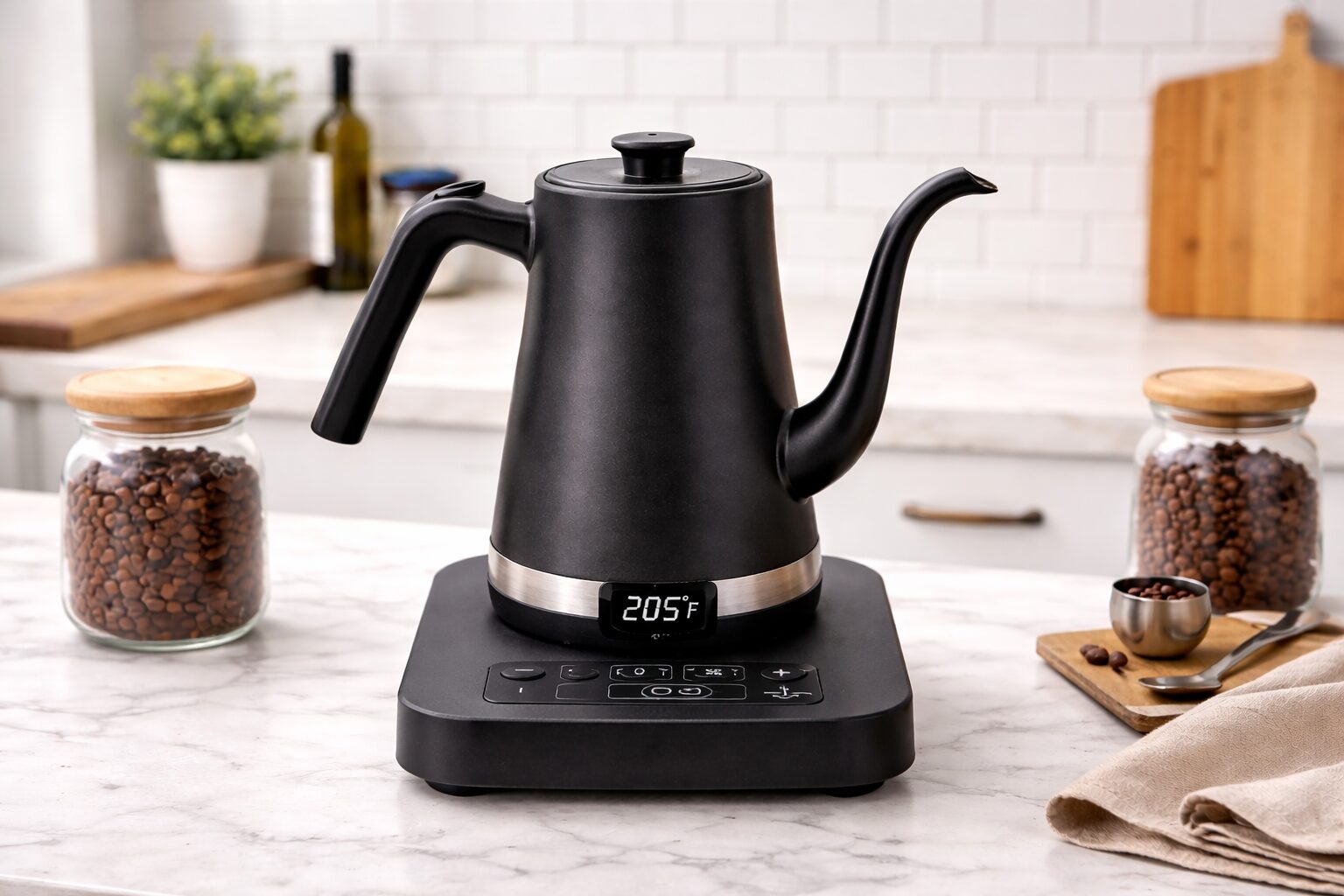
The most widely recommended temperature-controlled gooseneck kettle for pour over. Precise to within 1°F, holds temperature throughout the entire pour rather than simply reaching a target and cooling, and has a counterbalanced handle that makes controlled pouring significantly easier. The 0.9L capacity is adequate for single and double-dose pour over without being excessive.
- Temperature precision: ±1°F — the most accurate in its class
- Hold mode — maintains set temperature for 60 minutes
- Variable temperature: 135–212°F in 1°F increments
- Capacity: 0.9L electric / 1.0L stovetop version available
- Price: check Amazon for current price
Best for: serious pour over drinkers who want the most consistent temperature control available and plan to brew daily.
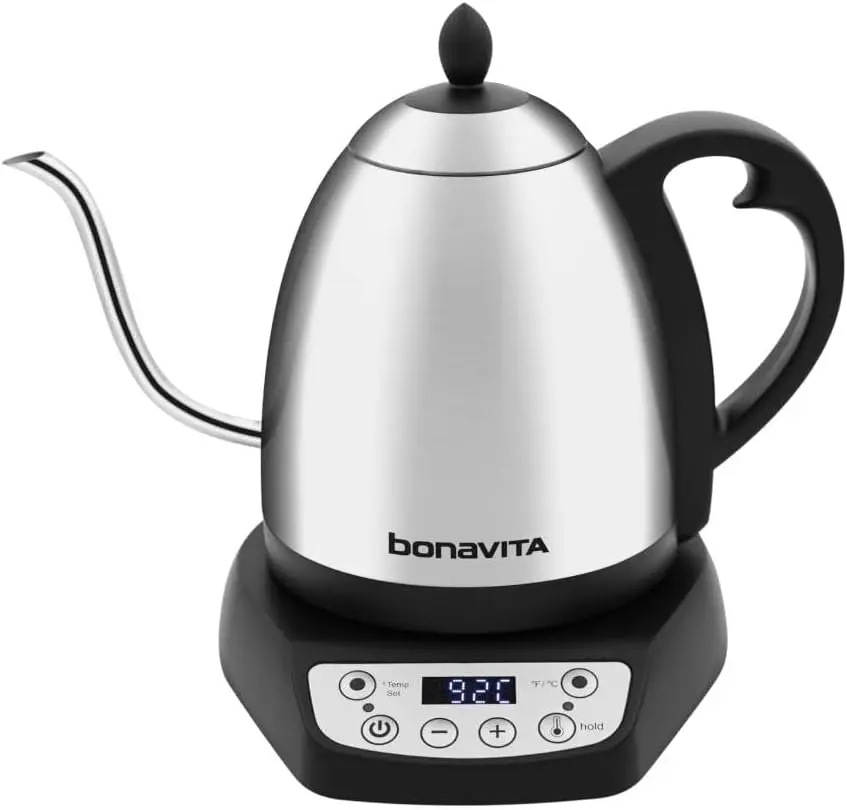
Bonavita Variable Temperature Gooseneck
Best value temperature-controlled kettle
The most straightforward temperature-controlled gooseneck at a lower price than the Fellow Stagg EKG. Temperature accuracy is slightly wider (±2°F) but entirely adequate for pour over. The 1.0L capacity is generous for most home brewing volumes and the simple dial interface makes it faster to set and use than app-connected alternatives.
- Temperature precision: ±2°F — solid accuracy for everyday pour over
- 60-minute hold mode at set temperature
- Variable temperature: 140–212°F
- Capacity: 1.0L
- Price: check Amazon for current price
Best for: daily pour over brewers who want reliable temperature control without the Fellow’s premium price tag.
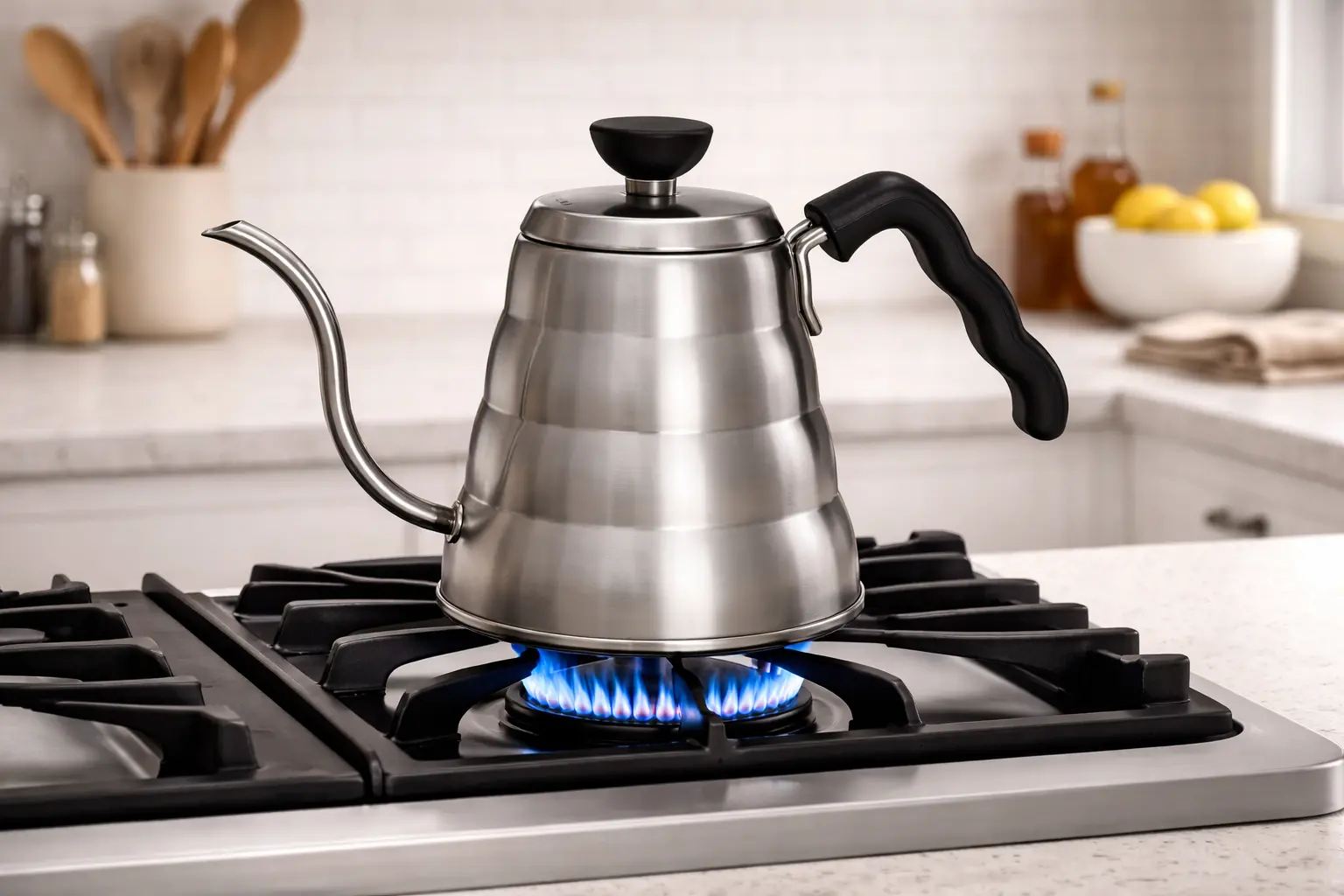
Hario V60 Buono Stovetop
Best budget gooseneck kettle
The stovetop gooseneck kettle most recommended for beginners who want precise pour control without the cost of a temperature-controlled model. No electronics, no settings — just the gooseneck spout and a thermometer used alongside it. The 1.2L capacity is the largest of the three picks here and works well for multi-cup brewing.
- No temperature control — use with a separate thermometer
- Excellent gooseneck flow control — the main advantage over standard kettles
- Capacity: 1.2L — largest of the three picks
- Stovetop only — works on gas, electric, and induction
- Price: check Amazon for current price
Best for: beginners who want the pour control benefits of a gooseneck without spending on a temperature-controlled model — pair with a simple thermometer clip.
Dripper Differences and Temperature
The optimal water temperature range — 195–205°F — applies across all common pour over drippers. The dripper shape affects flow rate and contact time, which interact with temperature, but the fundamental temperature targets remain the same. A few nuances worth knowing:
| Dripper | Temperature Note | Reason |
|---|---|---|
| Hario V60 | Use standard range — 195–205°F by roast | Cone shape and single large hole produce fast, consistent flow. Temperature has full effect on extraction. |
| Chemex | Consider 195–202°F — slightly lower end | Thick bonded paper filter slows flow and extends contact time slightly, which marginally increases extraction rate. Lower temperature compensates. |
| Kalita Wave | Use standard range — 195–205°F by roast | Flat bottom and three small holes create an even, forgiving flow. Temperature recommendations apply as standard. |
| Flat-bottom drippers | Use standard range — 195–205°F by roast | Similar to Kalita Wave in flow behavior. Even saturation means temperature has predictable extraction effect. |
For a full comparison of dripper types and how they affect flavor, see V60 vs Chemex vs Kalita Wave and Flat-Bottom vs Cone Drippers.
Brewing at Altitude
Water boils at lower temperatures as elevation increases — because atmospheric pressure is lower at altitude, less energy is required to turn water into steam. This directly affects pour over brewing because your boiling point may already be within or below the ideal range, changing how you should approach temperature.
| Elevation | Water Boiling Point | Brewing Implication |
|---|---|---|
| Sea level (0 ft) | 212°F (100°C) | Standard — use off-boil timing or temperature-controlled kettle as normal |
| 2,500 ft | ~207°F (97°C) | Boiling point approaches upper ideal range — light roasts can brew near-immediately off boil |
| 5,000 ft | ~202°F (94°C) | Boiling point is within ideal range for medium roasts — brew immediately off boil for most coffees |
| 7,500 ft | ~198°F (92°C) | Boiling point is ideal for medium-dark and dark roasts. For light roasts, a temperature-controlled kettle set above boiling point is not possible — compensate with finer grind. |
| 10,000 ft | ~193°F (89°C) | Below ideal range for all roasts — use a temperature-controlled kettle set to 200°F, or compensate with significantly finer grind and extended brew time |
💡 High altitude tip: Above 7,000 feet, a temperature-controlled kettle set to 200°F is the most reliable solution — it will not reach a boiling point above its setting and will simply heat to and hold at the target temperature. If you only have a standard kettle at high altitude and your pour over tastes sour or thin, grinding finer to increase extraction rate is the most effective compensation for lower brew temperature.
Temperature Dial-In Guide
Use this step-by-step process to identify and fix temperature-related flavor issues in your pour over. Change one variable at a time — temperature first, then grind size, then ratio. Changing multiple variables simultaneously makes it impossible to identify which adjustment improved the cup.
If Your Pour Over Tastes Sour or Thin
- Step 1: Confirm your actual brew temperature with a thermometer — do not assume the kettle is reaching its target
- Step 2: Increase temperature by 3–5°F and brew with everything else unchanged
- Step 3: If sourness reduces but does not resolve, increase another 3°F
- Step 4: If you reach 205°F and sourness persists, the cause is grind size — grind finer in small increments
- Step 5: If thinness persists after temperature and grind adjustments, check your ratio — increase coffee dose by 1–2g
If Your Pour Over Tastes Bitter or Harsh
- Step 1: Check roast level — dark roasts should be brewing at 195–200°F, not 205°F
- Step 2: Reduce temperature by 3–5°F and brew with everything else unchanged
- Step 3: If bitterness reduces, continue reducing in 2°F increments until balanced
- Step 4: If bitterness persists below 200°F, the cause is grind size — grind coarser in small increments
- Step 5: If astringency or dryness persists, check brew time — a pour over taking more than 4 minutes is likely over-extracting
🔬 Reference starting point: If you are brewing pour over for the first time or resetting from a problem, use these parameters as your baseline before making any adjustments: 200°F, 1:16 ratio (e.g. 25g coffee to 400g water), medium-fine grind, 2.5–3.5 minute total brew time. This produces a balanced cup across most medium roasts and gives you a clear reference point to adjust from. For a complete pour over setup guide see Pour-Over Coffee Brewing Setup.
FAQs: Pour Over Water Temperature
What is the best water temperature for pour over coffee?
The ideal pour over water temperature is 195–205°F (90–96°C), which is the SCA-recommended range for optimal extraction. Within that range, 200–205°F works well for medium and dark roasts, while 195–200°F is better for light roasts, which are denser and require slightly lower temperatures to avoid harsh bitterness.
Can I use boiling water for pour over coffee?
Boiling water (212°F / 100°C) is slightly above the ideal range and can over-extract pour over coffee, pulling bitter and astringent compounds from the grounds. For most roasts, letting boiling water rest off heat for 30–45 seconds brings it to around 200–205°F — which is within the ideal range. For light roasts specifically, wait 60–90 seconds to reach 195–200°F.
What temperature is too low for pour over?
Water below 185°F (85°C) produces noticeably under-extracted pour over — sour, thin, and flat with muted aromatics. Most budget kettles without temperature control consistently brew below the ideal range. If your pour over tastes sour or weak even with correct grind size and ratio, low brew temperature is a likely cause.
Does water temperature matter more than grind size for pour over?
Grind size has the larger impact on extraction in most cases — a significantly wrong grind size will produce a noticeably poor cup regardless of temperature. However, once grind size is dialled in, water temperature becomes the most important remaining variable. Both matter and they interact: finer grinds at lower temperatures may extract similarly to coarser grinds at higher temperatures.
Do I need a temperature-controlled kettle for pour over?
A temperature-controlled gooseneck kettle is the most reliable way to brew pour over at the correct temperature consistently. Without one, you can use any kettle plus a thermometer, or use the off-boil timing method — waiting 30–45 seconds after boiling for medium and dark roasts, or 60–90 seconds for light roasts. A temperature-controlled kettle removes the guesswork and improves consistency significantly.
How does water temperature affect pour over taste?
Water temperature directly controls extraction rate — hotter water dissolves more soluble compounds from coffee grounds faster. Too low produces under-extraction: sour, thin, acidic, and flat coffee. Too high produces over-extraction: bitter, harsh, astringent coffee. The 195–205°F range extracts the balanced middle ground — sweetness, acidity, and body in the right proportions.
Should I use different temperatures for different pour over drippers?
The dripper type has minimal effect on optimal brew temperature — the 195–205°F range applies to V60, Chemex, Kalita Wave, and flat-bottom drippers alike. The bigger temperature consideration is roast level, not dripper shape. That said, Chemex’s thick paper filter slightly slows flow, which marginally increases contact time — some brewers use the lower end of the range (195–200°F) to compensate.
What is the best gooseneck kettle for pour over?
The Fellow Stagg EKG is the most widely recommended temperature-controlled gooseneck kettle for pour over — precise to within 1°F, holds temperature throughout the pour, and has excellent flow control. The Bonavita 1.0L Variable Temperature is a more budget-friendly alternative with solid temperature accuracy. The Hario V60 Buono is the best option if you want gooseneck pour control without temperature electronics.
Does altitude affect pour over water temperature?
Yes. Water boils at lower temperatures at higher altitudes — at 5,000 feet water boils at approximately 202°F, and at 8,000 feet at around 197°F. If you brew at elevation, your boiling point may already be within the ideal pour over range, meaning you can brew immediately off boil. At very high altitude (above 8,000 feet), use a temperature-controlled kettle set to 200°F to ensure adequate extraction.
Can I use the off-boil method instead of a thermometer?
Yes. Boiling water in a standard kettle drops approximately 2–3°F per minute after removing from heat. For medium and dark roasts, waiting 30–45 seconds after boiling reaches approximately 200–205°F. For light roasts, waiting 60–90 seconds reaches approximately 195–200°F. This method works reasonably well but introduces variability — ambient temperature, kettle material, and starting water temperature all affect cooling rate.
Next Reads
POUR OVER GUIDES
BREWING FUNDAMENTALS
Still troubleshooting a sour or bitter cup? The pour over troubleshooting guide covers every common problem — temperature, grind size, ratio, and pour technique — with a systematic diagnosis process so you know exactly which variable to change first.
☕
Written by the CoffeeGearHub Editorial Team
CoffeeGearHub is a specialty coffee equipment resource run by home brewers and coffee enthusiasts. Our guides are researched using published brewing science, equipment manufacturer specifications, and established specialty-coffee community knowledge. We review and update our pillar content regularly. About CoffeeGearHub →