Last Updated: March 2026 • 30–35 min read • Complete Guide: Espresso Grind Science + Dial-In System + Grinder Settings + Roast-Level Reference + Troubleshooting
Espresso grind size is the single most important variable in home espresso — more important than machine pressure, more important than temperature, more important than dose. The reason is simple: at 9 bars of pressure, even a one-click change on your grinder changes the resistance of the coffee puck enough to shift shot time by 3–7 seconds and transform the taste from sour to balanced to bitter. No other brewing method is this sensitive to grind. A French press brewed at the wrong grind produces a mediocre cup. An espresso brewed at the wrong grind produces something close to undrinkable. Getting grind right is what makes the difference between a home espresso setup that frustrates you and one that produces a consistently excellent shot every morning. This complete guide covers exactly what fine means in practice, how grind controls every measurable espresso variable, the correct dial-in sequence from your first shot to a locked recipe, grind settings for the most common home espresso grinders, how roast level changes your target, and the full troubleshooting matrix for every espresso problem that traces back to grind.
✍️ Editorial note: This guide is researched and written by the editors at CoffeeGearHub.com using published brewing science, SCA brewing standards, and established specialty-coffee community knowledge. All product links are affiliate links — we may earn a commission at no cost to you. Affiliate Disclosure: CoffeeGearHub.com participates in the Amazon Services LLC Associates Program. As an Amazon Associate, we earn from qualifying purchases.
The 30-Second Answer
Espresso needs a fine, consistent grind — finer than any other common brew method — and the correct setting is the one that produces a 25–30 second shot at your target ratio. Start at 18g dose, 36g yield (1:2 ratio), 91°C. Pull a shot. If it runs under 20 seconds, grind one step finer. If it chokes or runs over 40 seconds, grind one step coarser. Repeat until the timing is in window. Taste at that point — if still sour, raise temperature 1°C; if still bitter, lower temperature or reduce yield. Lock the setting when the shot is balanced. Write it down.
- Target grind texture: fine — between table salt and powdered sugar; finer than pour over, coarser than Turkish
- Target shot time: 25–30 seconds for 18g in / 36g out (1:2 ratio)
- Fast shot (under 20s) = grind too coarse — the puck is not offering enough resistance
- Slow or choking (over 40s) = grind too fine — the puck is over-compressed
- Adjust one step at a time — 1 click moves shot time 3–7 seconds on a quality grinder
- Grind is the primary lever — temperature and ratio are refinements after grind is in window
Jump to What You Need
☕ First shot, no idea where to start
Read What Fine Means for Espresso and the Baseline Parameters — then go to the Dial-In System.
☕ Shot is running fast or slow
Jump to Time as Diagnosis for the exact fix — then the Troubleshooting Matrix.
🔬 Switched roast level
See the Roast-Level Reference for the correct grind adjustment by roast and the temperature changes that accompany it.
🛒 Need a better grinder
Jump to Grinder Picks — the two grinders recommended for home espresso at entry and step-up tiers.
Table of Contents
What Fine Grind Actually Means for Espresso
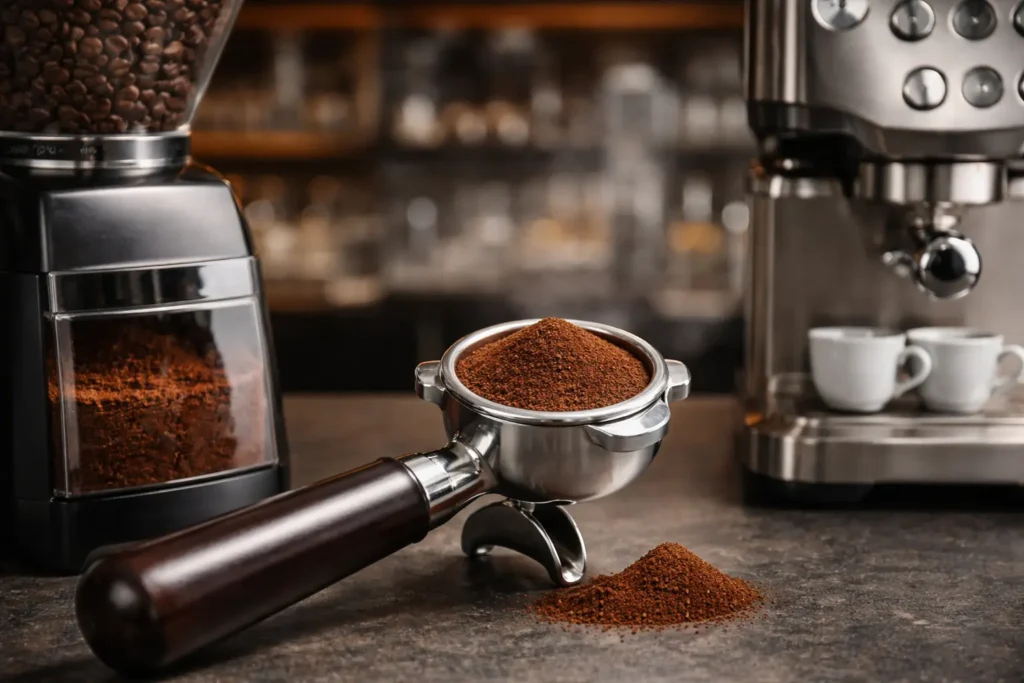
Espresso grind occupies a narrow band between table salt and powdered sugar — finer than every other common brew method except Turkish coffee, but not as fine as flour. In practical terms, a correct espresso grind looks like fine sand, feels slightly chalky when rubbed between your fingers, and clumps lightly when pressed. The challenge is that “fine” varies meaningfully between grinders — the number 5 on one espresso grinder may produce a coarser particle than the number 12 on another. The grinder’s click setting is a starting reference; shot time is the actual calibration tool.
| Grind level | Texture descriptor | Common methods | Espresso relevance |
|---|---|---|---|
| Extra fine | Powdered sugar / flour | Turkish coffee | Too fine for espresso — will choke any machine |
| Fine ✓ | Fine sand to table salt | Espresso | The target zone — exact setting varies by grinder and bean |
| Medium-fine | Fine sand | Pour over (V60), AeroPress | Too coarse for true espresso — will produce fast, sour shots |
| Medium | Sand | Drip coffee, flat-bottom pour over | Far too coarse — water will drain in under 10 seconds |
| Coarse | Sea salt | French press | Not functional for espresso — effectively no puck resistance |
🔬 Why texture feel is unreliable for espresso calibration: The difference between a grind that produces a 22-second shot and one that produces a 28-second shot is often imperceptible by touch. At the espresso fine range, particle sizes are measured in microns and the differences between settings are invisible without equipment. This is why shot time — not texture, not appearance, not the number on the grinder — is the correct calibration tool for espresso grind. Use texture as an initial sanity check (if it looks like coarse salt, it is definitely wrong) and shot time for all precise adjustment.
Why Espresso Grind Matters More Than Any Other Variable
Espresso is the only common brew method that uses pressure — 9 bars — to force water through the coffee bed. At that pressure, the physical resistance of the coffee puck (determined by grind size, dose, and preparation) directly controls how fast water flows through, how long extraction takes, and which compounds end up in the cup. Every other variable in espresso operates within the position that grind has already set.
Consider what happens when you adjust grind by a single click on a quality espresso grinder. The gap between the burrs changes by a fraction of a millimetre. The resulting particle size changes by a few microns. But that microscopic change produces a measurably different puck resistance, shifts the shot time by 3–7 seconds, and changes the extraction yield by 1–2 percentage points — enough to clearly transform the taste. No other variable responds this sensitively at this scale. A 1°C temperature change produces a smaller and less immediate effect. A 1g dose change is meaningful but affects strength more than extraction quality. Grind is the primary lever; everything else refines the position it sets.
⚠️ The most common espresso dial-in mistake: Changing grind and temperature or grind and ratio simultaneously. If you adjust two variables at once, you cannot identify which one changed the shot. When a new grind setting produces a better shot, you genuinely do not know whether it was the grind, the temperature, or the interaction between them. Change grind only. Then taste. Then — only if grind is in the timing window — adjust temperature or ratio as secondary refinements.
Baseline Parameters: Lock These Before Dialling In
Espresso dial-in only works when all other variables are fixed and only grind is changing. Troubleshooting a shot where dose, yield, temperature, and grind have all changed since the last pull is impossible — you cannot isolate cause and effect. Set these parameters before pulling any dial-in shots and do not change them until grind is in the timing window.
| Parameter | Starting value | Why this number | When to adjust |
|---|---|---|---|
| Dose | 18g | Fills a standard 58mm double basket to the correct headspace for puck integrity at 9 bar | Only after grind and temperature are dialled — small dose changes adjust strength, not extraction quality |
| Yield target | 36g (1:2 ratio) | The specialty coffee standard for a double espresso; the universal starting reference for any new bean or machine | Extend to 38–40g (1:2.2) if sour persists after grind is in window; reduce to 32–34g (1:1.8) if bitter persists in window |
| Temperature | 91°C for medium roast | Mid-range SCA-aligned starting point for medium roast; light roasts need 93–96°C, dark roasts 88–91°C | After grind is in the 25–30 second window — raise 1°C for sourness in window, lower 1°C for bitterness in window |
| Shot time target | 25–30 seconds | The extraction window for a balanced 1:2 double at standard pressure — a diagnostic reference, not a pump-stop trigger | Not adjusted directly — flows from grind adjustment. Stop pump when scale reads 36g, not when timer hits 30s. |
| Pump pressure | 9 bar | Industry standard; produces the correct extraction dynamics for the espresso fine grind range | Not adjustable on most home machines. Some prosumer machines allow pressure profiling — keep at 9 bar until grind is dialled. |
Shot Time as Grind Diagnosis: Reading What the Clock Tells You
Shot time is the fastest, most reliable signal that your grind is in or out of range — before you even taste the shot. Understanding what different timing outcomes mean gives you an immediate adjustment direction rather than pulling shot after shot without a systematic approach.
| Shot time (18g in / 36g out) | What it means | Grind adjustment | Do not adjust |
|---|---|---|---|
| Under 10 seconds | Grind drastically too coarse — barely any puck resistance | Grind 5–8 steps finer immediately; confirm dose is at 18g | Do not pull repeated shots at this setting — extract data, not coffee |
| 10–20 seconds | Grind too coarse — water flowing through puck too quickly | Grind 2–4 steps finer; pull and record | Do not adjust temperature or yield yet |
| 20–24 seconds | Approaching window — slightly too coarse | Grind 1–2 steps finer | Do not adjust temperature or yield yet |
| 25–30 seconds ✓ | Target window — puck resistance is correct for this grind and dose | No adjustment — taste the shot now | Taste first before touching anything |
| 31–40 seconds | Slightly too fine or slight channeling — approaching over-extraction | Grind 1–2 steps coarser; or check puck prep for channeling | Do not adjust temperature yet — confirm channeling is not the cause |
| Over 40 seconds | Grind too fine — excessive puck resistance; or channeling compounding fine grind | Grind 2–4 steps coarser; confirm puck prep is correct | Do not pull multiple choked shots — risks damaging pump on some machines |
| Machine chokes — pump runs, no flow | Grind far too fine — complete puck blockage | Grind 5–8 steps coarser immediately; purge and re-pull | Do not force the machine — stop pump immediately |
🔬 Stop on yield weight, not on time. Shot time is a diagnostic reference — not how you determine when to stop the pump. Stop the pump when your scale reads 36g (or your target yield). If you stop at 30 seconds regardless of yield, you are using a different ratio every shot depending on how quickly the coffee is flowing. Weigh yield every time. Shot time tells you where you are on the extraction spectrum; yield weight tells you the ratio. Both matter; weight is primary.
The Espresso Grind Dial-In System: From First Shot to Locked Recipe
This is the complete dial-in process used across every CoffeeGearHub espresso guide — a single, systematic workflow that works for any machine, any bean, and any grinder with sufficient espresso range. The goal is to reach a locked grind setting as efficiently as possible, with every adjustment providing useful diagnostic information rather than random changes.
Phase 1: Find the Timing Window
- Set baseline: 18g dose, 36g yield target, 91°C, your grinder at its finest espresso setting or a known mid-range starting point
- Prepare puck: WDT to distribute grounds, level tamp, confirm no tilt
- Pull and record: start timer when pump starts; stop pump when scale reads 36g; record time and observations
- Adjust grind per the timing table above — move toward the 25–30 second window one step at a time
- Repeat until shot lands in window. Change nothing else until this step is complete.
Phase 2: Refine by Taste
- Taste the in-window shot — note whether it is balanced, sour, or bitter
- If sour despite correct timing: raise temperature 1°C → re-pull at same grind setting → if still sour, extend yield to 38g
- If bitter despite correct timing: lower temperature 1°C → re-pull at same grind setting → if still bitter, reduce yield to 32–34g
- If balanced: write down the grind setting, dose, yield, temperature, and shot time. This is your locked recipe for this bean.
✅ The grind log habit: Keep a notebook or phone note beside your machine. After every dial-in session write: bean name, roast date, grinder setting, dose, yield, temperature, shot time, and taste notes. When you open a new bag of the same bean, start at the same setting. When you switch beans, start at your medium-roast reference point. Over time, this log becomes a reference library that makes every new dial-in faster and more confident.
Espresso Grind Settings by Grinder Model
These starting settings are reference points based on community consensus for each grinder’s typical espresso range. Start here, pull a test shot, and adjust per the timing table above. Every setting assumes a standard 18g dose, 36g yield target, and medium roast bean at 91°C.
⚠️ These are starting references, not target settings. Grind size numbers are not standardised across brands or manufacturing batches. Use these settings as a starting point, pull a test shot, and use shot time to guide adjustment. Never assume the reference setting will produce a 25–30 second shot without testing — roast batch variation, machine temperature, and dose weight all shift the effective result.
| Grinder | Espresso starting range | Basket type | Adjustment increment | Notes |
|---|---|---|---|---|
| Breville Smart Grinder Pro | Settings 5–16 (out of 60) | Pressurised and non-pressurised | 1 setting = ~3–5 seconds | Wide espresso range; LCD timer aids repeatability; start at 10 for medium roast |
| Baratza Virtuoso+ | Settings 2–8 (out of 40) | Non-pressurised (single-wall) | 1 setting = ~4–7 seconds | Better for light-pressure non-pressurised work; settings 3–6 for medium roast |
| Baratza Encore | Settings 1–5 (out of 40) | Pressurised only | 1 setting = ~5–8 seconds | Only suitable for pressurised baskets; not recommended for non-pressurised espresso — insufficient fine range |
| KINGrinder K6 | 10–25 clicks from zero | Pressurised | 1 click = ~2–4 seconds | 100-click system gives fine control in espresso zone; best for pressurised baskets; excellent value for filter + light espresso |
| Generic blade grinder | Not applicable | Not applicable | No adjustment | Cannot produce consistent espresso grind — produces chaotic particle mix that causes channeling and simultaneous over/under-extraction. Switch to a burr grinder. |
🚫 Pressurised vs non-pressurised baskets — why it matters for grind: Most beginner espresso machines ship with a pressurised (double-wall) portafilter basket. Pressurised baskets have a restricted exit hole that creates artificial pressure regardless of grind fineness — meaning a wide range of grinds produce something resembling espresso. Non-pressurised (single-wall) baskets require the grind itself to create the correct resistance — which demands a genuinely fine, consistent grind and a grinder capable of producing it. If you have a non-pressurised basket, the Breville Smart Grinder Pro or Baratza Virtuoso+ is the minimum grinder recommendation. If you have a pressurised basket, the K6 or Baratza Encore covers your needs.
Roast-Level Grind Reference: How Roast Changes Your Setting
Roast level changes the physical and chemical structure of the bean — density, porosity, and solubility — in ways that directly affect how a given grind size performs under 9 bars of pressure. A medium roast locked recipe does not transfer to a light roast or dark roast without adjustment. Use this reference when switching roast levels and expect to re-dial grind, temperature, and yield.
| Roast level | Bean characteristics | Grind adjustment vs medium | Temperature | Recommended ratio | Common problem |
|---|---|---|---|---|---|
| Light roast ☀️ | Dense, hard, less soluble — extracts slowly under pressure | 2–5 steps finer than medium roast reference | 93–96°C — higher temperature needed to extract sweetness from dense beans | 1:2.5 to 1:3 — longer yield extracts more sweetness from dense, slowly extracting beans | Persistently sour despite finer grind — often a machine temperature limitation; many entry machines cannot reach 93°C |
| Medium roast 🌤 ✓ | Balanced density and solubility — the calibration reference | Baseline — all reference settings in this guide are for medium roast | 91–93°C | 1:2 standard | Most forgiving — standard dial-in sequence applies directly |
| Medium-dark roast | More porous than medium — extracts faster and tips into bitterness more quickly | 1–3 steps coarser than medium roast reference | 89–92°C | 1:1.8 to 1:2 — slightly tighter to prevent over-extraction | Bitterness arriving early in extraction — coarsen grind before adjusting temperature |
| Dark roast 🌑 | Highly porous, brittle, very soluble — extracts bitter compounds extremely rapidly | 3–6 steps coarser than medium roast reference | 88–91°C — lower temperature slows the extraction of bitter compounds | 1:1.5 to 1:2 — short yield stops extraction before bitter phase dominates | Harsh, ashy bitterness that does not respond to coarser grind — the beans may be too dark for balanced espresso extraction regardless of parameters |
| Very fresh beans (under 7 days post-roast) | High CO2 — creates variable puck resistance that changes shot-to-shot | Often 1–2 steps coarser than the same bean at 10–14 days — CO2 creates additional resistance | Standard for roast level | Standard for roast level | Inconsistent shot times at the same grind setting — rest beans 7–10 days before serious dial-in |
| Old beans (40+ days post-roast) | Stale — CO2 depleted, aromatic compounds degraded | Often 1–2 steps finer than peak freshness — beans are less dense as they age | Standard for roast level | Standard for roast level | Flat, hollow shots with no sweetness despite correct parameters — buy fresh beans; no dial-in adjustment recovers flavour from stale coffee |
Grind Drift: Why Your Setting Changes Without You Touching It
A locked grind setting that produced a perfect shot yesterday may produce a noticeably different shot today — without any changes to the grinder, recipe, or machine. This is grind drift, and it is a real, predictable phenomenon with specific causes and specific fixes.
| Drift cause | What happens | How to identify it | Fix |
|---|---|---|---|
| Humidity increase | Grounds absorb moisture from the air and clump more tightly after grinding; the puck packs more densely, increasing resistance and slowing the shot | Shot runs slower on rainy or humid days at the same setting | Grind 1–2 steps coarser on high-humidity days; return to original setting in dry conditions |
| Beans ageing within the bag | CO2 depletes as beans age; less outgassing means the puck compresses differently; older beans often require a slightly finer setting to maintain the same shot time | Same setting produces progressively faster shots as the bag ages through week 2–4 | Grind 1 step finer every few days as the bag ages; keep a note of where you started and how much adjustment the bag required |
| New bag — same bean | Roast batch variation; seasonal harvest differences; different roast date means different bean age at time of purchase | First shot from new bag runs noticeably faster or slower than last shot from previous bag at same setting | Start new bag at previous setting as reference; pull a test shot; adjust 1–2 steps as needed; re-dial |
| Machine not at full temperature | Cold group head acts as a heat sink on the first shot — actual brew temperature is lower than set, producing a slower, more under-extracted shot than warmed subsequent shots | First shot of the day always different from second shot at identical settings | Allow 20+ minutes warm-up; run a blank flush shot before pulling the first coffee shot to bring group head to full temperature |
| Retained grounds in grinder chute | Old grounds from the previous session sit in the chute and mix with the fresh dose — changing the effective grind distribution of each pull | First shot after a day off-rest tastes different from the second shot | Purge 3g of beans at the start of each session before grinding your dose; this clears stale retained grounds |
Puck Preparation and How It Interacts With Grind Size
Puck preparation — how you distribute and compact the grounds in the portafilter basket before pulling — interacts directly with grind size in a way that is critical to understand. A perfect grind setting with poor puck prep produces a channeled, inconsistent shot. Incorrect grind with excellent puck prep is still an incorrect grind. Both must be correct simultaneously for repeatable espresso.
The most important puck prep step for grind interaction is WDT — the Weiss Distribution Technique. After grinding into the basket or a dosing cup, using a WDT tool (thin wire needles stirred through the grounds) breaks up clumps that form during grinding and homogenises the density of the coffee bed. Clumps create dense spots and sparse spots in the puck; at 9 bar, water finds the sparse spots immediately and channels through them, over-extracting along those paths while bypassing the dense areas. This produces the classic simultaneous sour and bitter shot — not a grind problem but a preparation problem that mimics one.
🔬 The grind-prep interaction rule: If your shot runs fast AND tastes bitter — which seems contradictory — channeling is almost certainly the cause. A fast shot should taste sour (under-extracted); if it tastes bitter, water found a channel through the puck, over-extracted along that path (bitter), and drained the rest of the dose in seconds. Fix puck prep first. Then if the shot is still running fast after a clean, level tamp with WDT, grind finer. Never grind finer to fix channeling — that only increases the pressure differential that drives water into channels even faster.
Correct Puck Prep Sequence
- Grind into a dosing cup or directly into basket
- WDT: stir through grounds with thin wire needles in circular motion — 10–15 seconds — to break clumps and homogenise density
- Distribute: tap portafilter lightly on a flat surface; use a finger sweep or distribution tool to level the surface before tamping
- Tamp level: portafilter on a flat surface; elbow at 90°; press straight down with consistent pressure (15–20kg on a scale). Tilted tamp = channeling.
- Confirm headspace: the puck surface should have 5–8mm clearance from the shower screen when the portafilter is locked in
Puck Prep Problems and Their Grind Symptoms
| Prep problem | How it mimics a grind problem | The actual fix |
|---|---|---|
| Clumps not broken up (no WDT) | Fast shot despite fine grind; sour and bitter simultaneously | WDT before tamping |
| Tilted tamp | Shot runs fast from thin side; inconsistent timing between pulls | Level tamp on flat surface; confirm with a spirit level or tamp stand |
| Under-dose (less than 18g) | Shot runs very fast even at fine grind settings | Weigh every dose; confirm 18g before pulling |
| Unrinsed shower screen with dried grounds | Uneven pre-infusion; channeling from screen contact | Rinse group head and screen before each shot |
Grinder Picks: The Two Grinders CoffeeGearHub Recommends for Home Espresso
Espresso grind quality is the limiting variable in home espresso more often than any other piece of equipment. A great machine paired with an inadequate grinder produces inconsistent, undiallable shots. A modest machine paired with a quality espresso grinder produces shots that are consistently in the right ballpark and improves linearly with technique. These two picks cover the most common home espresso setups at entry and step-up tiers.
Disclosure: CoffeeGearHub may earn a commission on qualifying purchases through affiliate links on this page, at no cost to you. Our recommendations are editorially independent. CoffeeGearHub.com participates in the Amazon Services LLC Associates Program. As an Amazon Associate, we earn from qualifying purchases.
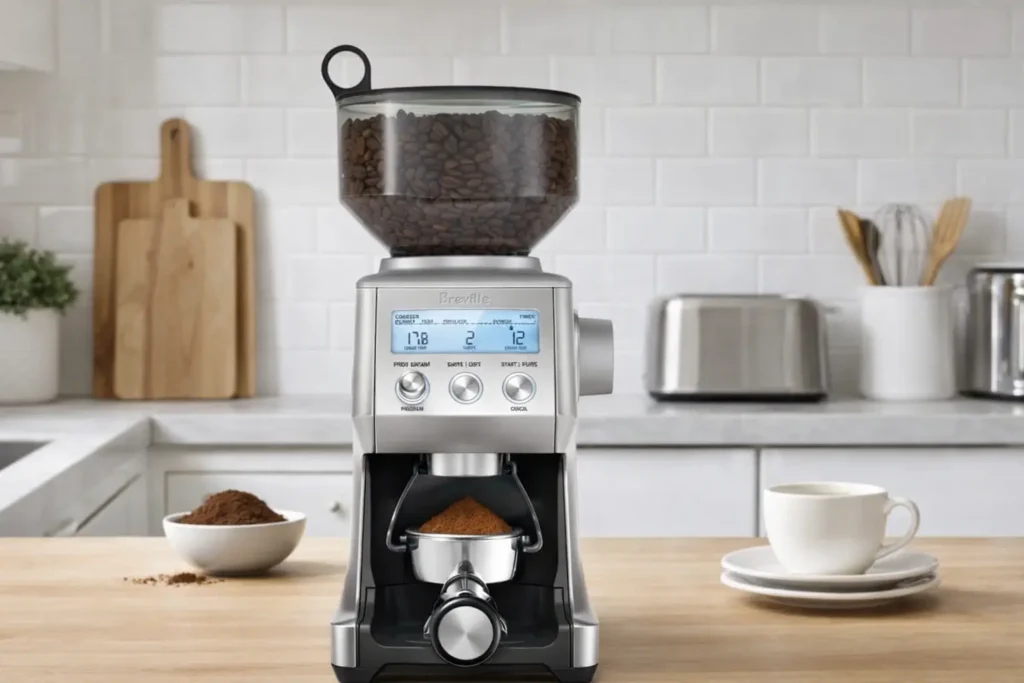
🏆 Best Espresso Grinder for Most People: Breville Smart Grinder Pro
Best for: beginners struggling with sour/fast shots, inconsistent timing, or upgrading from blade/filter grinders
The Breville Smart Grinder Pro is the CoffeeGearHub standard entry espresso grinder recommendation — the grinder that makes the dial-in system in this guide actually work. Its 60 stepped settings provide dedicated espresso micro-adjustment across the full espresso fine range, with each step producing a 3–5 second change in shot time on a well-prepared puck. The portafilter cradle doses directly into the portafilter basket, the LCD timer makes dose weight repeatable without weighing every grind, and the numbered settings make every dial-in session loggable in your grind record. For anyone currently using a blade grinder or a filter grinder for espresso, switching to the Smart Grinder Pro is the single upgrade that makes systematic espresso dial-in possible.
- Espresso range: Settings 5–16 for medium roast with pressurised or non-pressurised baskets
- 60 settings: dedicated micro-adjustment across the full espresso fine range — more resolution per step than most grinders at this tier
- LCD dose timer: repeatable output without weighing every grind; reduces one variable in the dial-in process
- Best for: entry to mid-range espresso machines (Bambino Plus, Gaggia Classic Pro, Breville Barista Express, De’Longhi Dedica); pressurised and non-pressurised baskets
If your espresso is inconsistent, this is the upgrade that fixes it immediately.
Disclosure: CoffeeGearHub may earn from qualifying purchases.
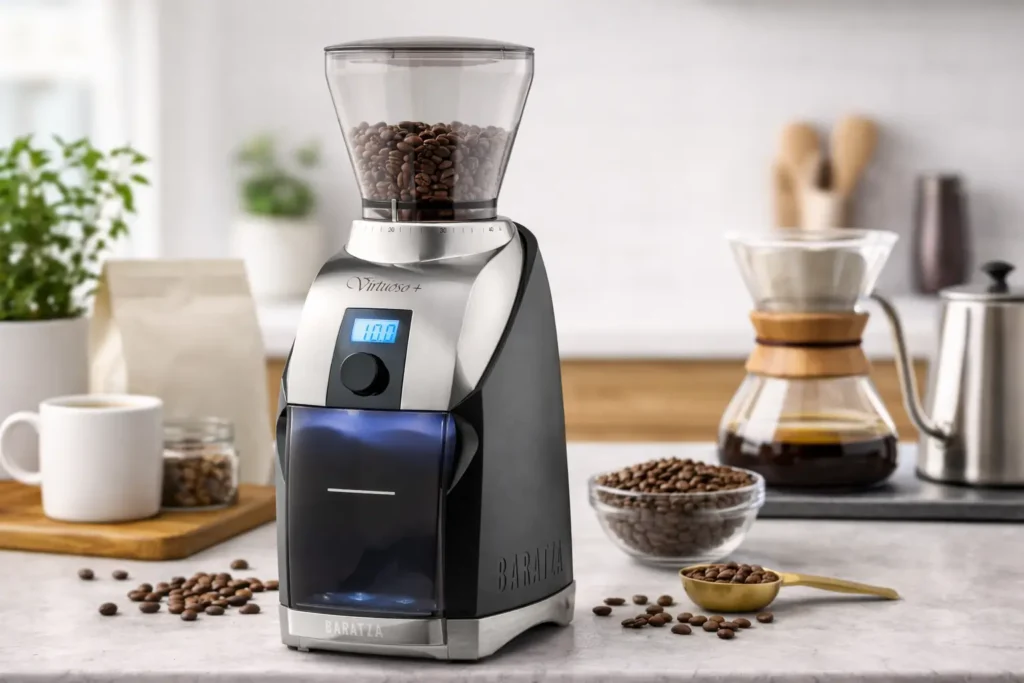
Step-Up Versatile Pick: Baratza Virtuoso+
The Baratza Virtuoso+ is the correct choice for espresso brewers who also brew pour over or drip daily from the same grinder, or who want the Baratza repair ecosystem and DC motor consistency for non-pressurised espresso work. Its DC motor maintains more consistent grinding speed than AC motor competitors — which matters specifically for espresso because motor speed variation changes particle distribution shot-to-shot. At settings 2–8, it covers non-pressurised espresso with fine resolution; across settings 12–40 it covers the full filter range with the same consistency. Baratza’s repair program makes it a genuinely long-term investment — replacement burrs, motors, and components are all sold separately.
- Espresso range: Settings 2–8 for non-pressurised baskets; settings 1–5 for pressurised
- DC motor: consistent grinding speed eliminates motor variation as a shot-to-shot variable
- Covers filter and espresso: the best single grinder for households doing both daily
- Best for: Gaggia Classic Pro, Rancilio Silvia, and prosumer non-pressurised single-wall machines; households also brewing pour over or drip
Disclosure: CoffeeGearHub may earn from qualifying purchases.
Essential Accessories: WDT Tool and Scale
The grinder produces a correct grind; the WDT tool and scale make that grind work consistently in the cup. Without the WDT tool, grind-related channeling produces sour-and-bitter shots that appear to be a grind problem but are actually a preparation problem. Without the scale, every shot is pulled at an unknown yield ratio — making grind adjustments unreadable because yield variation is changing the result simultaneously.

Highest-ROI Accessory: WDT Distribution Tool
The WDT tool is the highest-impact espresso accessory per dollar — more impactful for shot consistency than any temperature or pressure upgrade on most home machines. Stirring the grounds with thin wire needles after grinding and before tamping takes 15 seconds and eliminates the clumping that causes most channeling events. For anyone who regularly gets simultaneously sour and bitter shots, or whose shot times vary inconsistently between pulls at the same grinder setting, this is the first purchase to make. It costs a fraction of any grinder upgrade and frequently resolves dial-in problems that home baristas spend weeks blaming on grind.
- What it fixes: clumping → channeling → simultaneous sour and bitter → fast shots despite fine grind
- How to use: stir through grounds in basket with thin wire needles in circular motion — 10–15 seconds; then tamp level
- Highest consistency upgrade per dollar in home espresso accessories
Disclosure: CoffeeGearHub may earn from qualifying purchases.
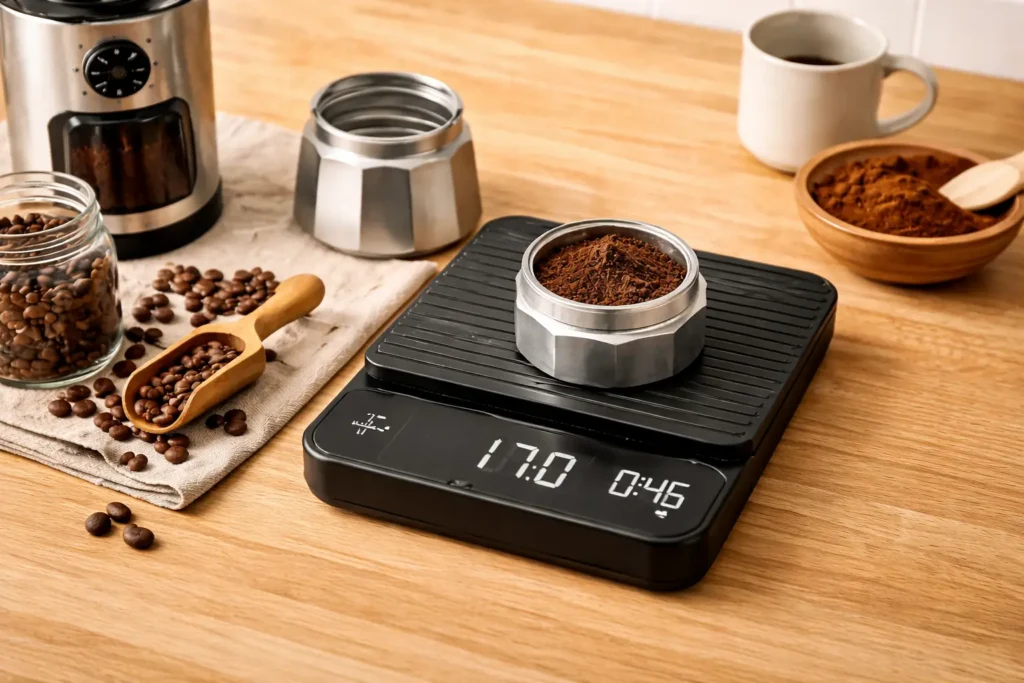
Makes Dial-In Readable: OXO Brew Precision Scale with Timer
Without a scale, you cannot know your yield ratio — and without a known yield ratio, grind adjustments produce unreadable results because yield variation is changing the shot simultaneously with grind. The OXO Brew Precision Scale auto-starts when liquid hits the platform, tracks shot time automatically, and reads to 1g — sufficient for all espresso ratio work. Placed under the cup during extraction, it tells you exactly when 36g (or your target yield) is reached, so you can stop the pump on yield rather than on time. This is the single most important habit for readable espresso dial-in.
- Auto-start timer: triggers when liquid hits the platform — tracks shot time without a separate timer
- 1g resolution: accurate enough for all espresso yield work
- What it solves: yield inconsistency that makes grind adjustments unreadable; enables stopping on weight rather than time
Disclosure: CoffeeGearHub may earn from qualifying purchases.
Troubleshooting Matrix: Every Espresso Grind Problem Diagnosed
Identify your symptom in the first column. Apply fixes in the order listed — the first fix resolves the problem in the majority of cases. Change one variable per shot throughout.
| Symptom | Grind-related cause | Fix — in order |
|---|---|---|
| Shot under 20 seconds, tastes sour and thin | Grind too coarse — insufficient puck resistance | Grind 2–3 steps finer → confirm dose is 18g → confirm tamp is level and consistent |
| Shot over 40 seconds, tastes bitter and harsh | Grind too fine — excessive puck resistance | Grind 2–3 steps coarser → confirm no clumps (use WDT) → confirm dose is not over 18.5g |
| Machine chokes — pump runs, no flow | Grind far too fine — complete puck blockage | Grind 5+ steps coarser immediately → do not force the machine → re-pull after adjustment |
| Shot fast and bitter simultaneously | Channeling — not a grind problem | WDT to break clumps → level tamp → rinse shower screen → do not grind finer |
| Shot in timing window but sour | Temperature too low for roast; or beans too fresh | Raise temperature 1°C → confirm beans are 7+ days post-roast → extend yield to 38g |
| Shot in timing window but bitter | Temperature too high; or dark roast at standard parameters | Lower temperature 1°C → for dark roast target 88–91°C → reduce yield to 32–34g |
| Shot times inconsistent pull to pull at same setting | Dose weight varying; or retained stale grounds in chute | Weigh every dose to 0.1g → purge 3g at start of each session → confirm grind setting unchanged |
| First shot always different from second | Machine not at full temperature; cold group head acting as heat sink | Allow 20+ minutes warm-up → run a blank flush shot before first coffee pull |
| Grind setting has drifted — same shot as before now runs differently | Humidity, bean ageing, or new bag variation | Check humidity — coarsen if rainy/humid → confirm bag age → if new bag, start at reference setting and pull test shot |
| Shot quality declining over weeks at same settings | Burr oil buildup or scale on machine heating element | Clean grinder burrs → descale machine → re-dial after cleaning before changing any recipe parameter |
| Flat, hollow — no sweetness despite correct timing | Stale beans — not a grind problem | Check roast date — if 40+ days, the beans are the problem. Buy fresh roast-dated beans; no grind adjustment recovers flavour from stale coffee. |
| Light roast persistently sour despite very fine grind | Machine cannot reach 93°C — a machine temperature limitation | Confirm machine is at full temperature; use maximum temperature setting; consider whether machine is capable of light roast espresso |
Final Takeaway: The Espresso Grind System
Espresso grind size is not something you set once and forget — it is the primary ongoing adjustment in home espresso, responding to bean age, humidity, roast level changes, and new bags. The system that makes this manageable is simple: lock dose and yield, pull a test shot, read the time, adjust grind one step in the correct direction, repeat until in the 25–30 second window, taste, and use temperature or yield as secondary refinements only after grind is correct. Write down every result. The grind log you build across months of espresso brewing becomes the most useful tool you have — a reference library of every bean you have used, every setting that worked, and every adjustment that found the sweet spot. Espresso rewards systematic patience over intuitive tweaking, and a logged dial-in session is always faster and more confident than starting from zero every time.
FAQs: Espresso Grind Size
What grind size is best for espresso?
Espresso requires a fine grind — between table salt and powdered sugar, finer than pour over or drip. The correct setting is the one that produces a 25–30 second shot at 18g in / 36g out (1:2 ratio). If the shot runs faster than 20 seconds, grind finer. If it runs over 40 seconds or chokes, grind coarser. Shot time is the calibration tool — not texture, appearance, or the number on the grinder.
How do I know if my espresso grind is too fine or too coarse?
Shot time at a standard 1:2 ratio: under 20 seconds = too coarse; 25–30 seconds = target window; over 40 seconds or machine choking = too fine. Taste confirms: fast shot tastes sour and thin; slow shot tastes bitter and harsh. Always weigh yield on a scale — stopping by eye or timer alone is not accurate enough for espresso dial-in.
Why does my espresso grind setting change from day to day?
Several causes produce grind drift: high humidity causes grounds to clump and pack more densely (grind 1 click coarser on humid days); beans age within the bag and lose CO2 density (grind slightly finer as bag ages); new bags of the same bean require re-dialling; cold machine on the first shot of the day produces different results from fully warmed subsequent shots. Purging 3g before each session and consistent warm-up time reduce most of these effects.
What is the correct espresso shot time?
The target for a standard double at 1:2 ratio (18g in / 36g out) is 25–30 seconds from pump start. This is a diagnostic reference, not a pump-stop trigger — stop when the scale reads 36g, not when the timer hits 30 seconds. Shot time tells you where grind is on the extraction spectrum; yield weight tells you the ratio. Both matter; weight is primary.
Does a new bag of beans require re-dialling espresso grind?
Almost always yes, even if it is the same coffee. Roast batch variation, seasonal harvest differences, and different roast dates all change extraction behaviour. Start a new bag at your last locked setting, pull a test shot, and be prepared to adjust 1–2 steps. Keep a grind log by bag so you build a reference library over time.
What grind size should I use for light roast espresso?
Light roast espresso requires a finer grind than medium or dark roast — dense light roast beans extract more slowly and need higher temperature (93–96°C) and a longer ratio (1:2.5 to 1:3). Start 3–5 steps finer than your medium roast reference setting. Persistent sourness despite very fine grind often indicates the machine cannot reach 93°C — a machine temperature limitation rather than a grind problem.
Can I use any burr grinder for espresso?
No. Filter grinders like the Baratza Encore reach their finest settings around medium-fine — not fine enough for true non-pressurised espresso. Dedicated espresso grinders have burr designs and step resolution specifically for the espresso fine range. The Breville Smart Grinder Pro is the CoffeeGearHub recommended entry espresso grinder; the Baratza Virtuoso+ covers both filter and non-pressurised espresso work.
How many grind clicks should I adjust at a time for espresso?
Adjust by the smallest increment your grinder allows — typically 1 click or 1 step. On most quality espresso grinders, a 1-click adjustment changes shot time by 3–7 seconds — a meaningful and clearly perceptible change. Adjusting 3–5 clicks at once makes it impossible to identify the exact setting that produced the result. Espresso dial-in requires small, deliberate adjustments.
What should I do if my espresso shot both runs fast and tastes bitter?
A fast shot that also tastes bitter is almost always channeling — water found a weak path through the puck, over-extracting along that channel (bitter) while bypassing the rest of the puck (fast, low resistance). Fix puck preparation first: use a WDT tool to break up clumps, ensure the tamp is level, confirm dose is 18g. Do not grind finer — that only makes channeling worse.
Why does my espresso grind from a blade grinder never work?
Blade grinders cannot produce the fine, consistent particle distribution espresso requires. They chop beans randomly, producing powder-fine dust alongside large barely-touched chunks. At espresso pressure, fine dust clogs the puck while large chunks create channels — producing simultaneously over-extracted and under-extracted results. No blade grinder setting or technique adjustment produces reliable espresso. A dedicated espresso burr grinder is required.
Continue Learning
ESPRESSO TECHNIQUE
Grind dialled in — now ready to build the full recipe? The complete espresso dial-in guide covers the 7-step process from machine setup through locked recipe — grind, dose, yield, temperature, puck prep, and how to maintain consistency shot after shot and bag after bag.
☕
Written by the CoffeeGearHub Editorial Team
CoffeeGearHub is a specialty coffee equipment resource run by home brewers and coffee enthusiasts. Our guides are researched using published brewing science, SCA standards, grinder manufacturer specifications, and established specialty-coffee community knowledge. We review and update our pillar content regularly. About CoffeeGearHub →