
Last Updated: March 2026 • 35–45 min read • Cornerstone Guide: Espresso Ratio Science + Standard Ratios + Roast-Level Reference + Milk Drink Ratios + Dial-In Applications
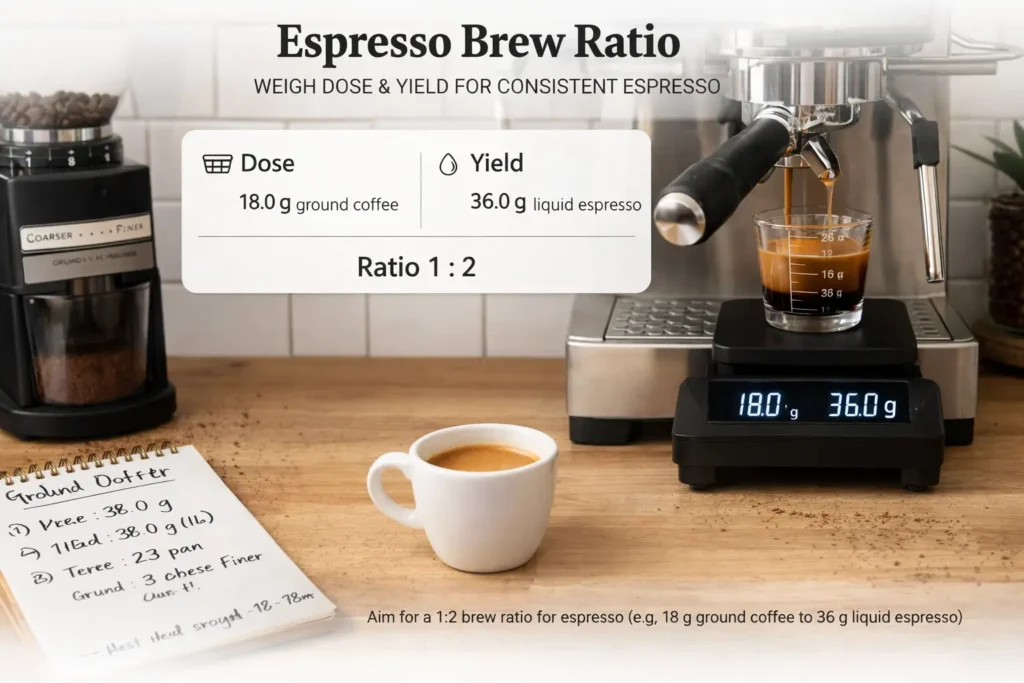
Espresso brew ratio is the single most under-understood concept in home espresso — and one of the most powerful tools available to any home barista who grasps it fully. The ratio is simply the relationship between the weight of dry coffee in the portafilter basket (the dose) and the weight of liquid espresso that flows into the cup (the yield). An 18g dose producing 36g of espresso is a 1:2 ratio. An 18g dose producing 27g is a 1:1.5 ratio. An 18g dose producing 54g is a 1:3 ratio. These numbers are not arbitrary style labels — they are direct controls for the concentration of dissolved solids in your cup, the total extraction yield from your grounds, and the flavour balance of the final shot. Change the ratio and you change all three simultaneously. Understanding ratio means understanding exactly what you are changing and why — and that understanding is what separates guessing from deliberate, reproducible espresso craft. This complete guide covers everything: what ratio means and why it matters, how to calculate it, the full spectrum from ristretto to lungo, how ratio interacts with grind, temperature, and shot time, how to choose the right ratio for your roast level and drink style, how to use ratio as a finishing dial-in tool, and the complete reference tables for every common espresso application.
✍️ Editorial note: This guide is researched and written by the editors at CoffeeGearHub.com using published brewing science, SCA brewing standards, and established specialty-coffee community knowledge. All product links are affiliate links — we may earn a commission at no cost to you. Affiliate Disclosure: CoffeeGearHub.com participates in the Amazon Services LLC Associates Program. As an Amazon Associate, we earn from qualifying purchases.
🛒 New to Amazon? Try Prime free for fast, free shipping on every pick in this guide — or try Audible free if you’d rather listen while your coffee brews.
The 30-Second Answer
Espresso brew ratio is the weight of coffee in divided by the weight of liquid espresso out, expressed as 1:X. The specialty coffee standard is 1:2 — 18g in, 36g out, extracted in 25–30 seconds. This is your starting point for any espresso setup. A shorter ratio (1:1.5 — ristretto) produces a sweeter, more concentrated, syrupy cup. A longer ratio (1:3 — lungo) produces a lighter, more transparent cup. Always measure ratio by weight — never by volume or time alone. Ratio is the finishing dial after grind and temperature are set; it controls intensity and concentration, not extraction quality.
- Standard espresso (1:2): 18g in / 36g out / 25–30 seconds — balanced, full body, the universal starting point
- Ristretto (1:1 to 1:1.5): very concentrated, sweeter, heavier; shorter extraction time; best for milk drinks
- Lungo (1:3 to 1:4): lighter, more transparent, longer extraction; suited to some light roasts
- Light roast: benefits from 1:2.5 to 1:3 with higher temperature (93–96°C)
- Dark roast: benefits from 1:1.5 to 1:2 with lower temperature (88–91°C)
- Always measure by weight — crema density makes volume measurements unreliable
Who This Guide Is For — Jump to What You Need
☕ New to Espresso Ratio
Start with What Ratio Means and Why We Measure by Weight — the foundations before the numbers.
⚡ Need the Numbers
Jump to the Complete Ratio Reference Table or the Dose and Yield Calculator for your specific setup.
🔧 Dialling In
See Using Ratio as a Dial-In Tool for how to apply ratio adjustments systematically without disrupting your grind setting.
🥛 Milk Drinks
Jump to Ratio for Milk-Based Drinks for cappuccino, latte, and flat white espresso ratio guidance.
Table of Contents
What Espresso Brew Ratio Means
Espresso brew ratio is the relationship between two weights: the weight of dry coffee in the portafilter basket (the dose) and the weight of liquid espresso that flows into the cup (the yield). It is written as 1:X, where X is the yield multiplier. A 1:2 ratio means the yield is twice the dose — 18g of coffee produces 36g of espresso. A 1:1.5 ratio means the yield is 1.5 times the dose — 18g produces 27g. A 1:3 ratio means the yield is three times the dose — 18g produces 54g.
The ratio matters because it is the primary determinant of two properties in the finished shot simultaneously. First, concentration — how many dissolved coffee solids are present per gram of liquid. A shorter ratio produces more concentrated espresso; a longer ratio produces more dilute espresso. Second, total extraction yield — what percentage of the coffee’s soluble mass has been extracted into the liquid. More water pulling through the same grounds extracts a higher proportion of soluble mass, which at some point extracts harsh bitter compounds alongside the desirable sweet and acidic ones. Ratio is the control for both these properties at once, which is why changing it changes the fundamental character of the shot rather than simply making it stronger or weaker.
🔬 Ratio is not the same as strength. In casual usage, “strong espresso” means intense and concentrated. In technical terms, strength (total dissolved solids — TDS) is affected by ratio but also by extraction yield and dose weight independently. Two shots at the same 1:2 ratio but extracted at different grind settings and temperatures will have different effective TDS because they pulled different percentages of soluble mass from the grounds. Ratio tracks the dose-to-yield relationship; TDS and extraction percentage describe the quality of what happened during extraction. Ratio is the input you control; the tasting experience is the output you assess.
Why We Always Measure Espresso Ratio by Weight
This is one of the most practically important technical points in home espresso: espresso yield must be measured by weight on a scale, not by volume in a measuring cup or shot glass, and never by shot time alone. The reason is crema — the reddish-brown foam layer on the surface of a freshly pulled shot.
Crema is an emulsion of coffee oils and CO2 gas produced under high-pressure extraction. It has a dramatically lower density than liquid espresso — crema is approximately 30–40% air by volume. This means a shot glass that appears to contain 36ml may actually weigh anywhere from 26g to 44g depending on crema volume and density. Crema volume varies significantly with roast level (fresh light roasts produce more crema), bean freshness (peak CO2 at 7–21 days post-roast), and grind setting (finer grinds generally produce denser crema). If you are measuring yield by volume you are measuring how much crema you produced as much as you are measuring how much espresso you produced — and those two things respond to completely different variables.
Shot time has the same problem in the other direction: stopping the pump at exactly 30 seconds regardless of yield produces shots of dramatically different ratios depending on flow rate, which changes with every grind adjustment. A shot that flows slowly may yield only 28g in 30 seconds at a fine grind; a shot that flows quickly may yield 46g in 30 seconds at a coarser grind. Neither is a 1:2 ratio despite having the same time. Time tells you about flow rate — not about the ratio you achieved.
🚫 The correct measurement setup: Place your scale on the drip tray. Place an empty, preheated cup on the scale. Zero the scale. Lock the portafilter in. Start the pump. Stop the pump when the scale reads your target yield weight (36g for a 1:2 ratio from an 18g dose). The scale reads only liquid yield because the portafilter and cup weight are zeroed out. This is the only measurement setup that produces reliable, repeatable ratio tracking.
How to Calculate Your Espresso Ratio
Espresso ratio is calculated by a simple division: yield divided by dose. The result gives you the ratio multiplier X in the 1:X notation. To go the other direction — finding your target yield from a known dose and desired ratio — multiply dose by the ratio multiplier.
| What you want to find | Formula | Example | Result |
|---|---|---|---|
| Your current ratio | Yield ÷ Dose | 34g out ÷ 18g in | 1.89 → approximately 1:1.9 |
| Target yield for a desired ratio | Dose × Ratio multiplier | 18g × 2 (for 1:2) | 36g target yield |
| Target yield for ristretto | Dose × 1.5 | 18g × 1.5 | 27g target yield |
| Target yield for lungo | Dose × 3 | 18g × 3 | 54g target yield |
| Required dose for a target yield at a fixed ratio | Yield ÷ Ratio multiplier | 30g yield ÷ 2 | 15g dose required for 1:2 |
💡 How to read your ratio in practice: Your scale reads 34.8g when you stop the pump. Your dose was 18.1g. Ratio = 34.8 ÷ 18.1 = 1.92 — approximately 1:1.9. That is slightly shorter than the 1:2 standard. If the shot tasted balanced but slightly too intense, extending yield to 36g on the next shot moves you cleanly to 1:2. The arithmetic takes 5 seconds and tells you exactly how far from your target you are.
Complete Ratio Reference: Ristretto to Lungo
This is the complete spectrum of espresso ratios from the shortest ristretto through the standard double to the longest lungo, with the yield calculation for an 18g dose, the target shot time, the flavour profile, and the best applications for each.
| Name | Ratio | Dose | Yield (18g dose) | Target time | Flavour character | Best for |
|---|---|---|---|---|---|---|
| Ristretto | 1:1 to 1:1.5 | 14–18g | 14–27g | 15–22s | Maximum concentration; intensely sweet, syrupy, heavy body; almost no perceivable bitterness; caramel and dark fruit character | Milk-based drinks (cappuccino, cortado, flat white); dark and medium-dark roast; drinkers who want maximum intensity in a small volume |
| Short double / Normale | 1:1.5 to 1:2 | 16–18g | 24–36g | 20–28s | High concentration with more sweetness than a standard double; full body; controlled bitterness — between ristretto and standard | Medium-dark and dark roasts; milk drinks; experienced drinkers who find standard doubles too bright |
| Standard double ✓ | 1:2 | 18g | 36g | 25–30s | The specialty coffee standard — balanced sweetness, controlled bitterness, full body, clean finish. The correct starting point for any new setup or new bean | All roast levels as a starting point; straight espresso; all milk drink types; the universal reference |
| Extended double | 1:2.2 to 1:2.5 | 18g | 40–45g | 28–35s | Lighter concentration; more brightness and acidity; sometimes sweeter as more sugar compounds extract; lighter body than standard | Light roast single origins; drinkers who find standard doubles too intense or bitter; specialty third-wave espresso style |
| Lungo | 1:3 to 1:4 | 18g | 54–72g | 35–55s | Low concentration; transparent, light-bodied; brightness-forward; can develop savoury or grain-like notes at very long yields as bitter and astringent compounds extract | Light roast pourover-style espresso; drinkers who want a larger volume without adding water; with caution — extended pulls easily over-extract into harshness |
⚠️ Lungo does not mean Americano. A lungo is espresso extracted at a 1:3+ ratio — the water passes through the coffee grounds under pump pressure for the full extraction. An Americano is a standard espresso shot with hot water added after extraction. They produce different cups: a lungo has higher total extraction yield (more compounds dissolved under pressure) while an Americano has lower extraction yield diluted to a similar volume with neutral water. Lungo shots at very long yields risk over-extracting into harshness; Americanos do not because the espresso shot itself stops at the standard yield.
Dose and Yield Calculator: Every Common Dose at Every Standard Ratio
Use this table to find your target yield for any dose and ratio combination without doing the arithmetic. Dose in the left column; ratio across the top; yield at the intersection. All weights in grams.
| Dose | 1:1 yield | 1:1.5 yield | 1:2 yield ✓ | 1:2.5 yield | 1:3 yield | 1:4 yield |
|---|---|---|---|---|---|---|
| 14g | 14g | 21g | 28g | 35g | 42g | 56g |
| 15g | 15g | 22.5g | 30g | 37.5g | 45g | 60g |
| 16g | 16g | 24g | 32g | 40g | 48g | 64g |
| 17g | 17g | 25.5g | 34g | 42.5g | 51g | 68g |
| 18g ✓ | 18g | 27g | 36g | 45g | 54g | 72g |
| 19g | 19g | 28.5g | 38g | 47.5g | 57g | 76g |
| 20g | 20g | 30g | 40g | 50g | 60g | 80g |
| 21g | 21g | 31.5g | 42g | 52.5g | 63g | 84g |
| 22g | 22g | 33g | 44g | 55g | 66g | 88g |
What Ratio Controls — and What It Does Not
One of the most common errors in espresso dial-in is assigning the wrong problem to ratio. Changing ratio when grind, temperature, or puck prep is the actual issue produces a different-looking shot that still tastes wrong in the same underlying way. Understanding what ratio does and does not control keeps the dial-in process clean and efficient.
| Variable | Does ratio control this? | What actually controls it |
|---|---|---|
| Shot concentration (TDS) | ✅ Yes — primary control; shorter ratio = higher TDS; longer ratio = lower TDS | Ratio + dose weight + extraction yield together determine cup TDS |
| Total extraction yield (%) | ✅ Yes — longer ratio extracts a higher percentage of the bean’s soluble mass | Ratio + grind + temperature + time all affect extraction percentage |
| Shot time | ⚠️ Indirectly — changing yield target stops the pump at a different point; but flow rate is unchanged | Grind size and puck preparation determine flow rate; ratio determines when you stop |
| Sourness / under-extraction | ⚠️ Partially — a shorter ratio (less yield) can increase sourness by extracting fewer sweet compounds | Primarily grind (too coarse) or temperature (too low); fix grind before changing ratio |
| Bitterness / over-extraction | ⚠️ Partially — a very long ratio can extend extraction into the bitter phase | Primarily grind (too fine) or temperature (too high); fix grind before shortening ratio |
| Channeling | ❌ No | Puck preparation — uneven distribution and tilted tamping; fix before any ratio adjustment |
| Crema density | ❌ No | Bean freshness, roast level, and grind fineness produce crema volume and density independently of ratio |
| Body and mouthfeel | ✅ Yes — shorter ratio = heavier body from higher TDS; longer ratio = lighter body | Ratio + extraction yield together produce mouthfeel; grind fineness also contributes |
🔬 The correct order of operations: Grind first (establish timing), then temperature (establish character), then ratio (establish intensity). Using ratio to correct sourness or bitterness that is caused by grind or temperature produces a different-tasting shot that still has the same underlying extraction problem — it is treating the symptom, not the cause. A sour shot from too-coarse a grind made ristretto-style will still taste sour, just more concentrated. The same shot with the grind fixed will taste balanced at both 1:2 and 1:1.5. Always resolve the extraction problem at the grind and temperature level before using ratio as a finishing adjustment.
How Ratio Relates to Shot Time
Shot time and brew ratio are related but not the same measurement. Understanding their relationship prevents the common mistake of confusing one for the other — and prevents the even more common mistake of stopping the pump by time instead of by weight.
Shot time describes how quickly espresso flows through the puck — which is determined by puck resistance (controlled by grind fineness and puck preparation). Ratio describes the relationship between input mass and output mass — which is controlled by when you stop the pump. At a given flow rate, a shorter ratio means you stop the pump earlier; a longer ratio means you stop later. At a given ratio target, a faster flow rate means you reach that yield weight in less time; a slower flow rate means you take longer.
This interdependency is why every ratio has a corresponding expected time range — but it is the ratio that is the fixed target, and the time that is the floating consequence. The table below shows the expected time range for each ratio at a well-calibrated 18g standard espresso setup. If your times are dramatically outside these ranges at a given ratio, the problem is grind or puck prep — not the ratio itself.
| Ratio | Dose / yield (18g dose) | Expected time range | If time is much shorter than expected | If time is much longer than expected |
|---|---|---|---|---|
| 1:1 (ristretto) | 18g / 18g | 12–18s | Grind too coarse for puck to build adequate resistance; grind finer | Grind too fine; or puck prep issue (clump, tilted tamp); grind coarser and check prep |
| 1:1.5 (ristretto) | 18g / 27g | 18–24s | Grind too coarse; grind finer | Grind too fine; grind coarser |
| 1:2 (standard) ✓ | 18g / 36g | 25–30s | Grind too coarse; grind 2 steps finer | Grind too fine or channeling; grind coarser, check distribution |
| 1:2.5 (extended) | 18g / 45g | 30–38s | Grind coarser than ideal; grind finer | Grind very fine or severe channeling; grind coarser |
| 1:3 (lungo) | 18g / 54g | 35–50s | Grind too coarse for lungo range; grind finer | Risk of over-extraction at very slow long pull; grind coarser and check puck prep |
Ratio by Roast Level: The Full Reference
Roast level is the biggest single factor in choosing your target ratio beyond the 1:2 default. Light, medium, and dark roasts have different densities, different solubility profiles, and different compound distributions — the compounds responsible for sweetness, acidity, and bitterness exist in different proportions at each roast level. This means the ratio that produces a balanced shot from a medium roast produces an under-extracted sour shot from a light roast and an over-extracted bitter shot from a very dark roast using the same setup. Use this table as your starting ratio for each roast level — then fine-tune based on taste.
| Roast level | Recommended ratio | Starting temp | Expected time (18g dose) | Why this ratio | What to watch for |
|---|---|---|---|---|---|
| Light roast ☀️ | 1:2.5 to 1:3 | 93–96°C | 28–38s | Light roasts are dense, less soluble, and high in acids — a longer ratio extracts more fully and dilutes sharp acid concentration; the extended yield draws out the floral, fruit, and sugar notes that don’t extract at shorter yields | Very easy to under-extract — sour and hollow; ensure machine reaches 93°C minimum; most entry machines cannot reliably brew light roast espresso |
| Medium-light roast | 1:2.2 to 1:2.5 | 92–94°C | 27–35s | Similar to light roast but slightly more soluble — a moderately extended ratio works better than the 1:2 standard | Requires a capable machine; similar risks to light roast but more forgiving |
| Medium roast 🌤 | 1:2 (standard) | 91°C | 25–30s | The baseline roast for espresso dial-in — medium roast is designed for 1:2 extraction; this is the ratio all espresso guidance assumes as the default | Most forgiving roast level; the best starting point for beginners and for testing a new setup |
| Medium-dark roast | 1:1.8 to 1:2 | 89–91°C | 22–28s | Slightly more soluble than medium; shorter ratio stops extraction before the increased concentration of roasting-derived bitter compounds dominates | Easy to over-extract with standard parameters; watch for harsh dark notes at 36g+ yields |
| Dark roast 🌑 | 1:1.5 to 1:1.8 | 88–90°C | 18–24s | Dark roasts are highly porous and soluble — bitter compounds extract very rapidly; a shorter ratio produces a sweeter, cleaner result by stopping before the bitter phase dominates; lower temp further reduces bitter compound extraction | Very easy to over-extract; many dark roasts simply do not produce balanced espresso at any ratio — low-quality dark roasts mask sourness with bitterness by design |
🔬 Why light roast espresso needs both a longer ratio AND higher temperature: Light roast beans have higher cell wall integrity — the roasting process hasn’t degraded the bean structure as much as darker roasting does. This means soluble compounds are physically harder to extract, requiring more thermal energy (higher temperature) to dissolve and more water contact (higher yield, longer ratio) to extract fully. This is why light roast espresso consistently under-extracts to sourness on budget machines that cannot reach 93°C+ — neither a ratio adjustment nor a grind adjustment can compensate for insufficient brew temperature on dense light roast beans.
Ratio for Milk-Based Drinks
Choosing the right espresso ratio for milk drinks is one of the most practically impactful applications of ratio knowledge — and one of the areas where home baristas most commonly undermine an otherwise good espresso setup. Milk has a strong, creamy flavour that competes with and partially masks espresso. A shot that is perfectly balanced on its own becomes thin and ghost-like when mixed with even a small amount of milk at a low concentration. This is why milk drinks almost universally benefit from a shorter, higher-concentration ratio than straight espresso.
| Drink | Espresso volume | Recommended ratio | Dose / yield | Why this ratio for this drink |
|---|---|---|---|---|
| Espresso (straight) | 36g | 1:2 | 18g / 36g | Standard — balanced at full concentration; no milk dilution to account for |
| Ristretto (straight) | 27g | 1:1.5 | 18g / 27g | Maximum sweetness and body; favoured by drinkers who want the purest, most intense espresso expression |
| Macchiato | 36g | 1:2 | 18g / 36g | Only a small amount of milk foam; standard ratio holds up well; some baristas prefer 1:1.5 for a more defined espresso character |
| Cortado / Gibraltar | 36–50g | 1:2 to 1:2.5 | 18g / 36–45g | Equal parts espresso and milk (approximately 1:1 drink ratio); medium espresso concentration needed to balance the milk |
| Flat white | 36–50g (double or triple shot) | 1:1.5 to 1:2 | 18g / 27–36g | Flat white uses less milk than a latte; espresso concentration should cut through micro-foam clearly; ristretto-style base is favoured by many flat white specialists |
| Cappuccino | 36g | 1:2 | 18g / 36g | Roughly equal thirds espresso / steamed milk / foam; standard ratio works; some recipes use double ristretto (18g/27g) for stronger coffee-forward result through milk |
| Latte (small — 200ml) | 36g | 1:2 | 18g / 36g | Less milk than large latte; standard ratio sufficient to taste through milk volume |
| Latte (large — 350ml+) | 50g (double + extended) | 1:1.5 to 1:2 | 18–20g / 27–40g | Large volume milk completely overwhelms a standard single or weak double — use a strong double or ristretto-style base; many specialty cafes use a triple for large lattes |
⚠️ The milk drink espresso problem most home baristas don’t realise they have: If your lattes and cappuccinos taste predominantly milky with only a vague hint of coffee, the problem is almost certainly not the machine — it is that your espresso shot is either too long a ratio (too dilute) or too small a dose for the milk volume. The fix is almost always one of: shorten your ratio to 1:1.5 (ristretto), increase your dose by 2–3g, or reduce the milk volume in the drink. No milk steaming technique improvement compensates for espresso that cannot hold its own in milk.
Using Ratio as a Dial-In Tool
In the dial-in hierarchy — grind first, temperature second, ratio and dose third — ratio is the finishing tool used after extraction quality is already balanced. This places it in a specific and deliberate role: not fixing sourness or bitterness (which are grind and temperature problems), but dialling in the intensity and character of an already well-extracting shot. Here is how to use ratio at each stage of the finishing phase.
Adjusting Yield for Intensity
Once your shot is balanced at 1:2 (36g from 18g, 25–30 seconds), taste for intensity. If the shot is balanced but too intense or sharp for your preference, extend the yield by 3–5g on the next pull — keeping dose and grind identical. The shot will run slightly longer and the concentration will drop, often increasing perceived sweetness as well. If the shot is balanced but too light or watery, reduce the yield by 3–5g. Each adjustment moves you along the ristretto-to-lungo spectrum without disturbing the extraction quality.
When Ratio Changes Require Grind Re-Adjustment
Moving significantly between ratio styles — from a 1:2 standard double to a 1:1.5 ristretto — often requires a grind adjustment to keep the shot time proportionally correct. A ristretto should run approximately 18–24 seconds (proportionally shorter than the 25–30 seconds of a 1:2), which typically requires grinding 1–2 steps finer than your standard double setting to maintain adequate puck resistance at the shorter yield. If you pull a 1:1.5 at your standard 1:2 grind setting and the shot runs in under 15 seconds, the grind is too coarse for the shorter ratio — grind slightly finer.
Ratio Adjustments Within a Bag
As beans age within a bag (from 7 days post-roast toward 35 days), they become progressively more soluble — CO2 depletes, cell walls degrade, and the same grind setting produces a slightly faster shot and slightly higher extraction yield. Many experienced home baristas account for this by extending the yield by 2–3g every week or so as the bag ages, maintaining the same cup character without re-grinding. This is a subtle application of ratio as a maintenance tool — keeping the effective extraction level constant as the beans change.
Ratio, TDS, and Extraction Yield: The Three-Way Relationship
For home baristas who want to understand espresso at a deeper level than simply “does it taste good,” the relationship between brew ratio, total dissolved solids (TDS), and extraction yield is the analytical framework that explains why every recipe adjustment does what it does. This section is optional for beginners but extremely useful for anyone who wants to troubleshoot systematically rather than intuitively.
| Term | Definition | How you control it | Typical target (specialty espresso) |
|---|---|---|---|
| Brew ratio | Dose weight divided by yield weight (1:2 = 1 part coffee to 2 parts espresso) | Stopping the pump at a specific yield weight on the scale | 1:2 for standard; 1:1.5 for ristretto; 1:2.5–3 for light roast extended |
| TDS (total dissolved solids) | The percentage of the liquid espresso that is dissolved coffee matter — the rest is water | Ratio (shorter ratio = higher TDS), extraction yield, and dose weight | 8–12% TDS for espresso (compared to 1.2–1.5% for drip coffee) |
| Extraction yield | The percentage of the dry coffee’s soluble mass that was dissolved into the espresso | Grind size, temperature, contact time (shot time), and ratio all affect extraction percentage | 18–22% extraction yield — below 18% = under-extraction (sour); above 22% = over-extraction (bitter) |
| The relationship | Extraction yield = (TDS × yield weight) ÷ dose weight. A 1:2 shot with 10% TDS has extracted 20% of the bean’s soluble mass (10% × 36g ÷ 18g = 20%). A 1:1.5 ristretto at 10% TDS has a higher extraction percentage despite the same TDS because less water extracted that TDS from the same grounds. | ||
🔬 Why you don’t need a TDS meter to brew excellent espresso: TDS meters (refractometers calibrated for coffee) allow precise numerical measurement of extraction percentage. They are valuable for professional calibration and for diagnosing persistent problems that aren’t resolving through taste-based dial-in. But every home barista who follows the shot-time and taste-based dial-in system in this guide — grind for timing, temperature for character, ratio for intensity — is already achieving well-extracted shots in the specialty target range without a meter. Your palate is the instrument. A balanced-tasting shot in the 25–30 second window at 1:2 is a well-extracted shot, full stop. The numbers confirm what the tasting already tells you.
Common Ratio Mistakes
| Mistake | Why it happens | What to do instead |
|---|---|---|
| Measuring yield by volume, not weight | Shot glasses have ml markings; easier than using a scale | Place a scale under the cup on the drip tray. Zero it before the shot starts. Stop the pump when the scale reads your target yield in grams. Crema volume makes ml measurement unreliable by 5–15g per shot |
| Stopping the pump by time instead of by weight | Timers feel like the natural espresso measurement; “30-second shot” is a common shorthand | Time and ratio are not the same thing. Always stop the pump by yield weight. Record time as a secondary diagnostic signal, not as the primary control |
| Changing ratio to fix sourness or bitterness | Seems like “more espresso” or “less espresso” should fix the flavour | Sourness and bitterness are extraction quality problems — caused by grind and temperature. Fix grind first (get into 25–30 second window), then temperature, then use ratio only for intensity after the shot is balanced |
| Using the same 1:2 ratio for all roast levels | The 1:2 standard sounds like a universal rule | 1:2 is the starting point for medium roast. Light roasts typically need 1:2.5 to 1:3. Dark roasts often benefit from 1:1.5 to 1:1.8. Treat roast level as a primary factor in ratio selection |
| Using a lungo ratio for milk drinks | More volume seems like it should produce more flavour in a large latte | A lungo at 1:3 produces more liquid but at dramatically lower concentration — the espresso character disappears completely in milk. Use 1:2 or ristretto for milk drinks; increase dose if more volume is needed |
| Not accounting for dose variation when comparing ratios | Grinding by timer rather than weight produces inconsistent doses | Ratio calculations are meaningless if dose varies between shots. Weigh every dose to 0.1g. A 1g dose variation at 18g changes yield target and shot time simultaneously — impossible to compare cleanly without fixed dose weight |
| Conflating espresso ratio with Americano dilution | “I just add water after” seems like the same as a lungo ratio | An Americano adds water after extraction — the espresso shot itself is still 1:2. A lungo ratio sends water through the grounds at pressure for the full extended yield. These are different extraction processes producing different cups — not the same drink made different ways |
Scale and Grinder Picks: What You Need to Measure and Dial Ratio Accurately
Ratio is only measurable with a scale. A grinder that cannot reach espresso-fine settings cannot be dialled in to the ratios and times described in this guide. These are the two categories of gear that matter specifically for ratio-accurate espresso.
Disclosure: CoffeeGearHub may earn a commission on qualifying purchases through affiliate links on this page, at no cost to you. Our recommendations are editorially independent.
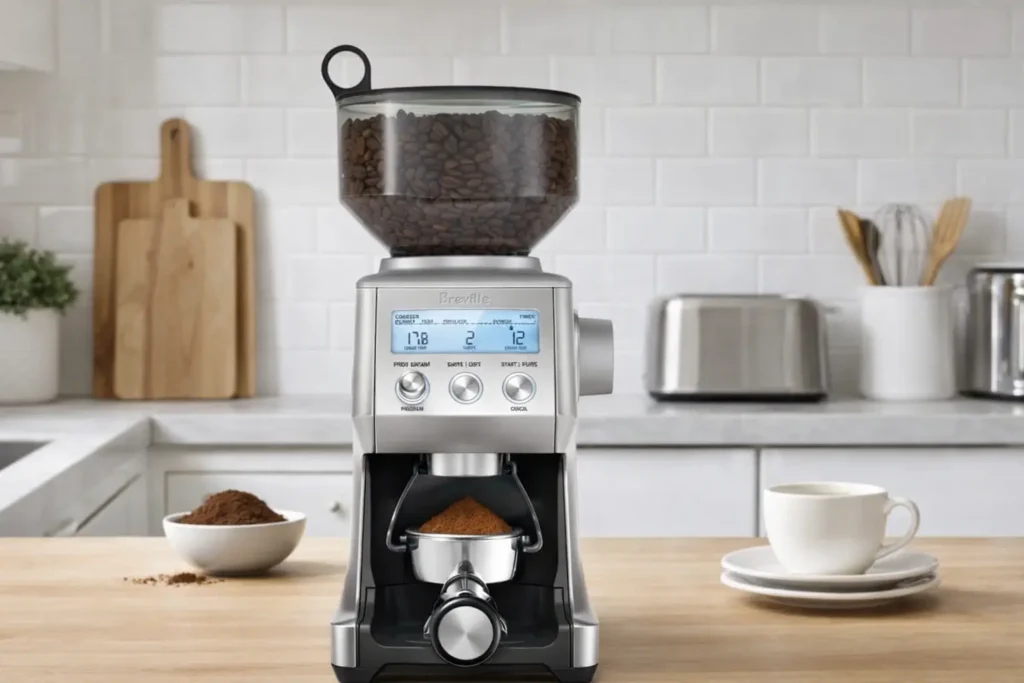
Recommended Espresso Grinder: Breville Smart Grinder Pro
Precise ratio measurement requires a grinder that produces consistent, repeatable output at a fixed setting — so that the only variable changing between shots during ratio dial-in is the yield you stop at, not the dose weight or grind consistency. The Breville Smart Grinder Pro delivers this: 60 numbered settings in the espresso range, a portafilter cradle for direct dosing, and a dose timer that produces consistent output weight once dialled. The numbered settings make ratio logging precise — you can note “setting 12, 18g dose, 36g yield, 27 seconds” and return to it exactly next session. For any home barista working with the ratio system described in this guide, this is the grinder that makes every parameter reproducible.
- Settings: 60 — dedicated espresso fine range with clear numbered positions
- Dosing: portafilter cradle + LCD timer for consistent, repeatable dose output
- Ratio relevance: numbered settings + repeatable dosing = clean ratio comparison between shots
- Compatible with: pressurised and non-pressurised baskets; 54mm and 58mm portafilters
Disclosure: CoffeeGearHub may earn from qualifying purchases.
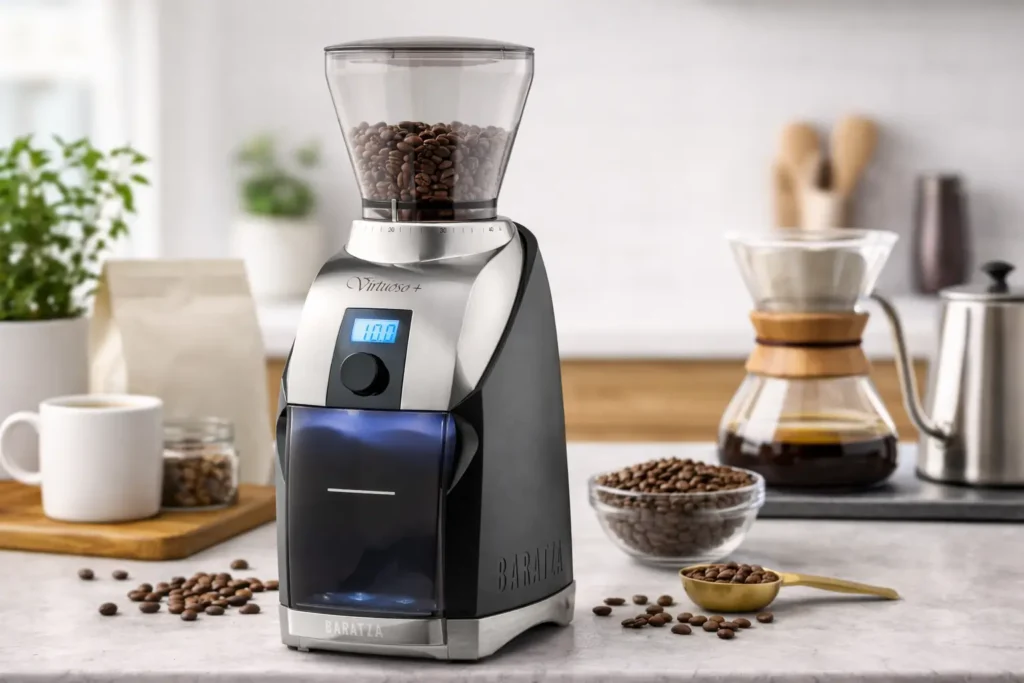
Best Step-Up Grinder: Baratza Virtuoso+
The Baratza Virtuoso+ is the recommended grinder for non-pressurised portafilter setups where tighter grind consistency matters most for ratio accuracy. Its DC motor maintains more stable grinding speed than AC motors — speed variation at espresso-fine settings changes particle size even at a fixed setting, introducing noise into your dose weight that makes ratio comparisons between shots ambiguous. The Virtuoso+’s digital dose timer provides consistent output weight once set, and its 54 settings cover the full espresso range for single-wall baskets. For any home barista using a Gaggia Classic Pro, Rancilio Silvia, or similar non-pressurised machine, the Virtuoso+ provides the consistency that systematic ratio dial-in requires.
- Settings: 54 — covers full espresso range for non-pressurised baskets
- Motor: DC — more consistent grind speed = more consistent dose weight per timer setting
- Ratio relevance: DC consistency reduces dose weight variation; numbered settings enable clean ratio logging
- Compatible with: pressurised and non-pressurised baskets; optimal for non-pressurised
Disclosure: CoffeeGearHub may earn from qualifying purchases.
Troubleshooting: Ratio and Flavour Problems
Use this matrix to identify whether a flavour problem is actually a ratio problem or whether ratio is being used to address a problem that belongs to grind, temperature, or puck prep. Correct attribution before any adjustment.
| Symptom | Is it a ratio problem? | Actual cause | Correct fix |
|---|---|---|---|
| Shot tastes too intense, too thick | ✅ Likely yes | Ratio too short for taste preference; too much dissolved solids per gram of liquid | Extend yield 3–5g at same dose and grind — move from 36g to 40–42g; re-taste |
| Shot tastes thin and watery | ✅ Possibly yes | Ratio too long; or dose too low for the basket size | Reduce yield 3–5g at same dose — move from 36g toward 30–32g; or increase dose by 1g |
| Shot tastes sour despite correct ratio | ❌ No — this is a grind/temperature problem | Grind too coarse (shot too fast) or brew temperature too low | Check shot time — if under 25s, grind finer; if in window, raise temperature 1°C. Do not shorten ratio to fix sourness |
| Shot tastes bitter despite correct ratio | ❌ No — this is a grind/temperature problem | Grind too fine (shot too slow) or brew temperature too high; or very dark roast at standard parameters | Check shot time — if over 32s, grind coarser; if in window, lower temperature 1°C. Do not extend ratio to fix bitterness |
| Milk drink has very little coffee flavour | ✅ Yes — ratio and/or dose problem | Espresso concentration too low to cut through milk; ratio too long or dose too small | Shorten yield to 27g (1:1.5 ristretto) from the same 18g dose; or increase dose by 2g to 20g for a stronger base |
| Shot times are inconsistent between pulls at the same ratio target | ❌ No — this is a grinder retention or dose consistency problem | Dose weight varying between pulls; stale retained grounds contaminating each fresh dose | Weigh every dose individually; purge 2–3g before each session; confirm grinder retention is not large enough to skew dose |
| Shot is balanced but I want a ristretto and it runs too fast | ⚠️ Partial — grind adjustment needed alongside ratio change | Current grind setting produces correct flow at 1:2 but is too coarse for the shorter 1:1.5 yield | Grind 1–2 steps finer and re-pull at 27g yield — the finer grind maintains adequate puck resistance at the shorter ratio |
| Light roast shot always sour even at extended 1:3 ratio | ❌ No — this is a temperature problem | Machine brew temperature insufficient for light roast extraction; no ratio extension compensates for temperature below 93°C on light roast | Verify machine reaches 93°C minimum; upgrade to SCA-certified or PID-equipped machine if it does not |
Final Takeaway: Ratio Is a Finishing Tool, Not a Starting Fix
Espresso brew ratio is one of the most elegant controls in espresso because it directly describes the relationship between what you put in and what you get out. Once you understand it — once you stop thinking in volume and time and start thinking in grams and ratios — espresso dial-in becomes dramatically more systematic. The 1:2 standard is your starting point for any new setup or new bean: 18g in, 36g out, 25–30 seconds. From there, use roast level as your first ratio guidance signal, adjust within a few grams based on taste preference, and recognise when a flavour problem is a ratio problem versus a grind or temperature problem. The best espresso ratio is the one that produces a balanced shot at the correct extraction for your specific beans and machine. For most home baristas on most medium roast blends, that is 1:2. For light roast enthusiasts, it is 1:2.5 to 1:3. For dark roast devotees, it is 1:1.5. The number is less important than the understanding behind it — and that understanding is what this guide is built to give you.
FAQs: Espresso Brew Ratio
What is the standard espresso brew ratio?
The specialty coffee standard for a balanced double espresso is a 1:2 ratio — 18g of coffee in, 36g of liquid espresso out. This ratio produces a cup with balanced sweetness, controlled bitterness, and full body when extracted in 25–30 seconds at the correct brew temperature. The 1:2 ratio is the correct starting point for any new espresso setup, any new bag of beans, and any dial-in session.
What is the difference between a ristretto and a lungo ratio?
A ristretto uses a shorter yield relative to dose — typically a 1:1 to 1:1.5 ratio (18g in, 18–27g out), producing a very concentrated, syrupy, sweet shot with minimal bitterness. A lungo uses a longer yield — typically a 1:3 to 1:4 ratio (18g in, 54–72g out), producing a lighter, more transparent espresso-style drink. A standard espresso (1:2) sits between these extremes with balanced concentration, full body, and controlled bitterness.
Should I measure espresso ratio by weight or volume?
Always by weight. Espresso volume is unreliable because crema — the foam on the surface of a shot — has a different density than liquid espresso. A shot that looks like 36ml of liquid may weigh anywhere from 26g to 44g depending on crema volume and density. Measuring by weight with a scale accurate to 0.1g gives you consistent, repeatable ratio data.
How does changing the ratio affect extraction?
Changing the yield at a fixed dose changes the concentration of dissolved solids in the cup and the total extraction yield. A lower yield (shorter ratio) produces a more concentrated shot — more dissolved solids per gram, sweeter and heavier. A higher yield (longer ratio) produces a more dilute shot — fewer dissolved solids per gram, lighter and sometimes sweeter due to more sugars extracted. Changing the dose at a fixed yield changes concentration without directly changing extraction time, though more dose increases puck resistance and slows the shot.
What ratio should I use for light roast espresso?
Light roast espresso typically benefits from a longer ratio — many specialty coffee roasters recommend 1:2.5 to 1:3, targeting 28–35 seconds. Light roasts are denser and less soluble, meaning they need more water contact to reach full extraction. A longer ratio also balances the higher inherent acidity of light roast. Pair with higher brew temperature (93–96°C) for best results.
What ratio should I use for dark roast espresso?
Dark roast espresso benefits from a slightly shorter ratio — a 1:1.5 to 1:2 range, targeting 22–26 seconds at 88–91°C. Dark roasts are highly porous and soluble — bitter compounds extract rapidly. A shorter yield stops extraction before harsh bitter compounds dominate. Many dark roast drinkers find the 1:1.5 ratio produces a sweeter, smoother result than extending to 36g.
What ratio is best for milk drinks like cappuccino or latte?
For milk-based drinks, a ristretto or tight standard ratio (1:1.5 to 1:2) produces the best result — the higher concentration means espresso flavour cuts through the milk rather than disappearing. A lungo shot diluted into a latte produces a thin, ghost-like coffee flavour overwhelmed by milk. For a double shot latte or flat white, 18g with a 1:2 yield (36g out) works well for standard intensity; 1:1.5 (27g out) for a stronger coffee-forward result.
Does changing my ratio change my shot time?
Yes — but only because you are stopping the pump at a different yield weight. The flow rate through the puck does not change because you changed the yield target; puck resistance and flow rate are determined entirely by grind size and puck preparation. A ristretto at 1:1.5 should run approximately 18–24 seconds. A lungo at 1:3 should run 35–50 seconds. If your ratio change produces wildly different timing, the cause is grind or puck prep — not the ratio itself.
How do I calculate my espresso brew ratio?
Divide the yield (grams of liquid espresso out) by the dose (grams of dry coffee in). Example: 36g out divided by 18g in equals 2.0, expressed as a 1:2 ratio. To find your target yield: multiply the dose by the ratio multiplier. 18g times 2 equals 36g yield for a 1:2 ratio. 18g times 1.5 equals 27g yield for a 1:1.5 ratio. Always weigh both dose and yield on a scale accurate to 0.1g.
Why does my espresso taste different even at the same ratio?
Ratio is one of four variables that determine espresso flavour — grind size, temperature, and puck preparation all interact with ratio to produce the final result. Two shots at the same 1:2 ratio can taste completely different if one was extracted in 18 seconds and the other in 35 seconds, or if one was at 88°C and the other at 94°C. Fix grind and timing first, then use temperature for character, then use ratio for intensity — that is the correct order.
Continue Learning
💡 New to Amazon? Try Prime free for fast shipping on picks like these.
ESPRESSO CLUSTER
Ready to put ratio knowledge to work? Our complete dial-in guide walks through the full seven-step espresso dial-in system — using ratio as the finishing tool within a systematic grind-first, temperature-second approach.
☕
Written by the CoffeeGearHub Editorial Team
CoffeeGearHub is a specialty coffee equipment resource produced by the CoffeeGearHub Editorial Team. Our guides are researched using published brewing science, SCA standards, grinder manufacturer specifications, and established specialty-coffee community knowledge. We review and update our pillar content regularly. About CoffeeGearHub →
Compare current CoffeeGearHub product pages
Use these stable CoffeeGearHub product pages to compare specifications and current verified merchant offers before leaving the site.