Beginner Espresso Guide (2026): Setup, Dial-In, and Your First Perfect Shot

Last Updated: March 2026 • 45–55 min read • Cornerstone Guide: Home Espresso Setup + Technique + Dial-In System + Gear Picks

Beginner Espresso Guide - Espresso Machine on Kitchen table
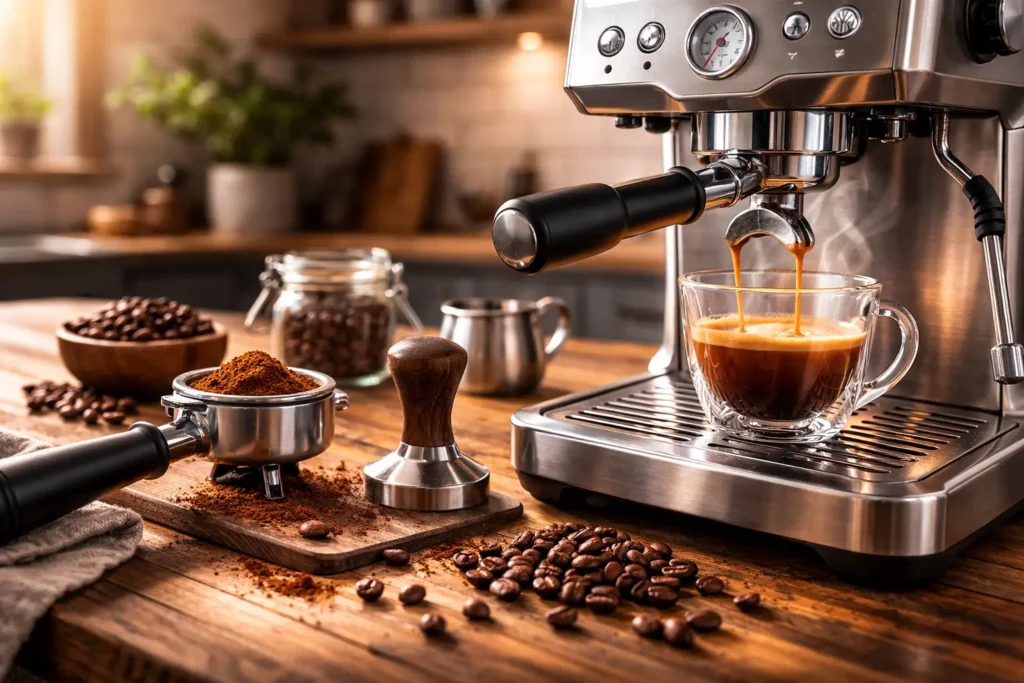
If you are new to espresso, this beginner espresso guide is for you. Making great espresso at home is entirely achievable — but only if you understand what you’re actually doing and why. Espresso is the most technically demanding coffee brewing method because every variable matters simultaneously: grind size, dose, yield, temperature, extraction time, and bean freshness all interact under 9 bars of pressure in under 30 seconds. Pull one variable off and the whole shot falls apart. Get them aligned and the same machine that produces bitter, flat espresso produces a genuinely cafe-quality double shot — from the same beans, the same water, the same kitchen. This complete CoffeeGearHub beginner espresso guide covers everything you need to know to go from zero experience to pulling consistently excellent espresso at home: the right equipment at every budget, how to choose your first beans, a step-by-step shot-pulling method, a systematic dial-in process, milk steaming basics, and a full troubleshooting matrix for every common problem a beginner encounters.

✍️ Editorial note: This guide is researched and written by the editors at CoffeeGearHub.com using published brewing science, SCA brewing standards, manufacturer specifications, and established specialty-coffee community knowledge. Recommendations reflect research consensus and community reputation rather than in-house lab testing. All product links are affiliate links — we may earn a commission at no cost to you.

The 30-Second Answer

To make good espresso at home, you need three things above all else: a burr grinder (not a blade grinder), fresh beans with a visible roast date, and a machine that holds stable brew temperature. Everything else is refinement. Start with an 18g dose, target 36g out (a 1:2 ratio) in 25–30 seconds, and adjust your grind — one click at a time — until the shot tastes balanced rather than sour or bitter. Weigh everything. Write it down. The learning curve is shorter than most beginners expect: most people pull their first genuinely good shot within 15–30 attempts.

  • Best Beginner Machine: Breville Bambino Plus — compact, stable temp, automatic milk steam for under $350
  • Best All-in-One: Breville Barista Express — integrated grinder + PID temp control, one unit for everything
  • Best Manual Grinder: KINGrinder K6 — 100-click precision at espresso settings, no electric grinder required
  • Best First Bean: Intelligentsia Black Cat Classic Espresso — engineered wide extraction window, roast-dated, beginner-forgiving
  • Starting Recipe: 18g in / 36g out / 25–30s / 91°C — adjust grind only until balanced

Who This Guide Is For — Jump to What You Need

🛒 Buying Your First Setup
Start with Equipment Overview, then jump to Machine Picks and Grinder Picks for full recommendations.

☕ Ready to Pull Shots
Go straight to Your First Espresso for the step-by-step method, then Dial-In Guide for systematic improvement.

🔧 Fixing a Problem
Jump to the Troubleshooting Matrix — sour, bitter, no crema, channelling, and flat shot fixes are all there.

🥛 Want Milk Drinks
See Milk Steaming Basics for cappuccino and flat white technique, plus the best beans for milk-based espresso.

What Is Espresso — And Why Is It Different From Other Coffee?

Espresso is not a bean, a roast level, or a flavour profile — it’s a brewing method. Specifically, it’s the process of forcing hot water through a compact puck of finely ground coffee at approximately 9 bars of pressure over 25–30 seconds. That pressure — roughly 9 times atmospheric pressure — is what makes espresso fundamentally different from every other brewing method and what makes it both the most technically demanding and the most rewarding to master.

The pressure extraction produces a concentrated, emulsified liquid — typically 30–40ml from 18g of ground coffee — that contains dissolved solids, coffee oils (which filter brewing removes), and a layer of reddish-brown crema formed by CO2 releasing from the grounds under pressure. This combination of concentration, emulsification, and crema is what gives espresso its characteristic body, intensity, and the syrupy texture that makes a well-pulled shot unlike anything you can produce with a drip machine or AeroPress.

Brew methodPressureContact timeGrindOutputOils in cup
Espresso9 bar25–30 secondsVery fine30–40ml concentratedYes — emulsified with crema
Filter / Pour-overGravity only2.5–4 minutesMedium250–350mlFiltered out by paper
AeroPress~0.5–1 bar (hand)1–2 minutesFine-medium100–200mlPartially (no paper)
French pressNone (immersion)4 minutesCoarse200–350mlYes — unfiltered
Moka pot~1.5–2 bar (steam)4–5 minutesMedium-fine60–100ml concentratedYes — some oils

🔬 Why pressure matters so much: At 9 bars, water extracts compounds from coffee 5–10× faster than gravity alone and emulsifies coffee oils that paper filters remove entirely. This is why espresso has a heavier, more syrupy texture than filter coffee and why small changes to grind size — even 1–2 microns in average particle diameter — produce measurable changes in shot time and flavour. Every variable is amplified by pressure. This is what makes espresso demanding to dial in — and extraordinarily rewarding when you get it right.

Equipment Overview: What You Actually Need (And What You Don’t)

The espresso equipment market is full of accessories marketed as essential that are actually optional, and one genuinely essential piece of gear — the grinder — that beginners routinely underinvest in. Here is the honest breakdown of what you need to buy, what you should buy, and what you can safely ignore until you’re pulling consistently good shots.

ItemRequired?Why it mattersBudget tierPriority
Espresso machine✅ EssentialGenerates 9 bars of pressure; heats water to brew temp$250–$600 for a capable beginner unit#1
Burr grinder✅ EssentialConsistent particle size is the single biggest lever on shot quality$60–$150 for manual; $200+ for electric#1 (equal to machine)
Tamper✅ EssentialCompresses the puck for even water flow$15–$40#2
Digital kitchen scale✅ EssentialWeighing dose and yield is the only way to dial in reliably$20–$40#2
Shot timer✅ EssentialShot time is the primary feedback signal when dialling in — phone timer works fine$0 (phone)#2
Fresh espresso beans✅ EssentialBeans roasted 7–21 days ago; roast date visible on bag$15–$25 per 250g#1
Milk frothing pitcher⚠️ If making milk drinksRequired for cappuccino and lattes; 12oz for smaller drinks, 20oz for lattes$15–$30#3 (milk drinks only)
WDT distribution tool💡 RecommendedBreaks up clumps for even puck distribution — dramatically reduces channelling$15–$30#3
Knock box💡 RecommendedPuck disposal — optional but convenient$20–$40#4
Portafilter basket upgrade💡 Recommended laterPrecision baskets (IMS, VST) improve extraction evenness once technique is dialled$30–$60#5 — upgrade later

⚠️ The most common beginner mistake: spending $500 on a machine and $30 on a blade grinder. A consistent grinder matters more than an expensive machine. The Breville Barista Express at $700 with its integrated grinder outperforms a $1,000 machine paired with a blade grinder — every time. If your budget is constrained, allocate at least as much to the grinder as to the machine.

Choosing Your First Espresso Machine: Our Picks by Budget

The entry-level espresso machine market ranges from unusable to excellent — and the difference isn’t always obvious from spec sheets. The key features that separate genuinely good beginner machines from ones that produce frustratingly inconsistent espresso are brew temperature stability, actual pump pressure (not marketing pressure claims), and whether the steam wand is capable enough for basic milk texturing. These three picks represent the best beginner options at each budget tier.

Disclosure: CoffeeGearHub may earn a commission on qualifying purchases through affiliate links on this page, at no cost to you. Our recommendations are editorially independent.

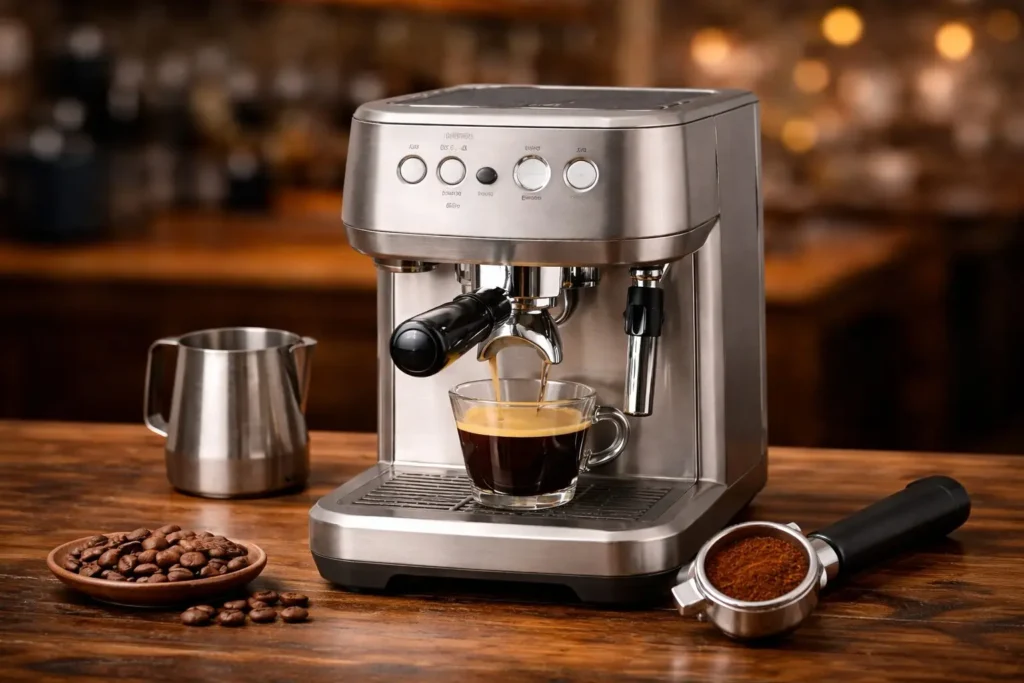
Breville Bambino Plus

Best Beginner Machine: Breville Bambino Plus

The Bambino Plus is the best first espresso machine for most beginners — compact enough for a small kitchen, fast to heat (3-second heat-up time), and equipped with the key features that make espresso learnable: a thermojet heating system for stable brew temperature, a 54mm portafilter that produces shots comparable to prosumer machines, and an automatic steam wand that textures milk without requiring manual wand technique. That last feature is significant for beginners — the automatic milk function removes one learning curve entirely while you focus on dialling in your shots. The machine supports pre-infusion, handles medium to dark roast beans reliably, and operates at genuine 9-bar extraction pressure. It’s the lowest price point where beginner espresso becomes genuinely achievable and consistently satisfying.

  • Heating system: Thermojet — 3-second heat up, stable brew temp
  • Portafilter: 54mm — includes single and dual-wall (pressurised) baskets
  • Steam wand: Automatic milk texturing — removes manual technique barrier for beginners
  • Pre-infusion: Yes — 3-second pre-infusion standard
  • Best for: beginner home baristas, small kitchens, anyone who wants milk drinks without a steep milk-steaming learning curve
  • Note: Use the single-wall (non-pressurised) basket once you’re comfortable — it gives more accurate extraction feedback than the pressurised basket

⚠️ Verify ASIN before publishing. Disclosure: CoffeeGearHub may earn from qualifying purchases.

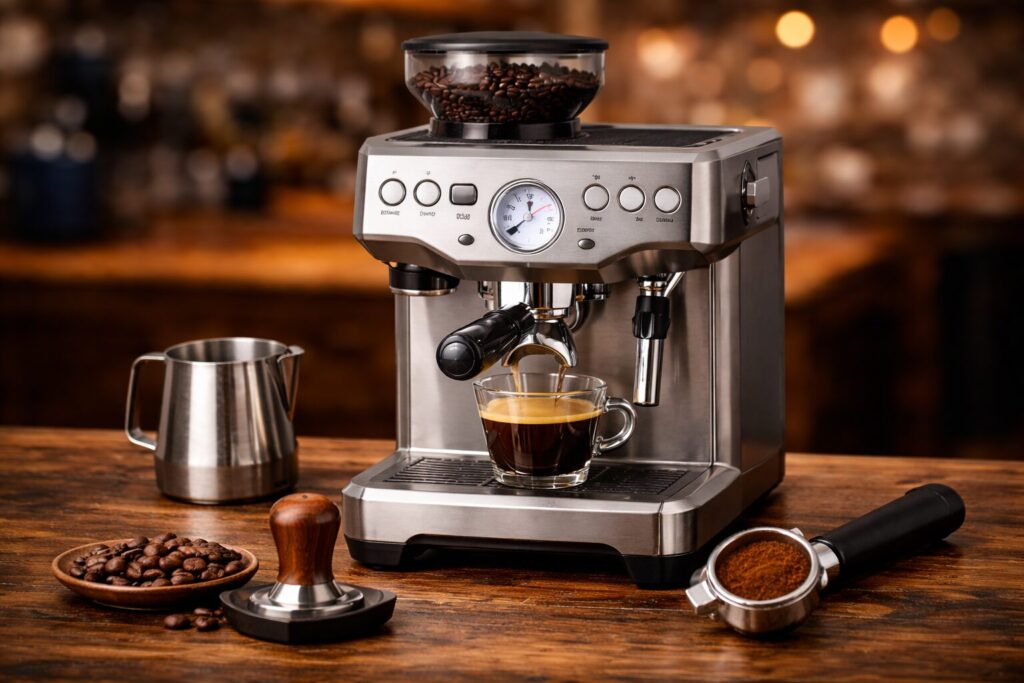
Breville Barista Express all-in-one espresso machine with integrated grinder

Best All-in-One: Breville Barista Express

The Barista Express solves the biggest beginner dilemma — how to get a capable grinder and a capable machine without buying and housing two separate units — by integrating a 16-setting conical burr grinder directly into the machine. The grinder covers the full espresso range from ristretto to lungo, the machine has a PID temperature controller for adjustable brew temp (critical for exploring light vs dark roast beans), and the full-size steam wand teaches real milk texturing technique rather than automating it away. For beginners who want a complete setup in one unit, room to grow as their technique improves, and the ability to adjust temperature for different roast levels, the Barista Express is the most complete value in home espresso. It’s the unit we recommend most often to beginners who plan to take espresso seriously.

  • Integrated grinder: 16-setting conical burr — covers full espresso range without a separate unit
  • Temperature: PID controller — adjustable brew temp for light, medium, and dark roast beans
  • Portafilter: 54mm — single and dual-wall baskets included
  • Steam wand: Manual — teaches proper milk texturing from day one
  • Pre-infusion: Yes — adjustable pre-infusion for better light roast extraction
  • Best for: beginners who want one complete unit, anyone planning to dial in seriously across roast levels

Disclosure: CoffeeGearHub may earn from qualifying purchases.

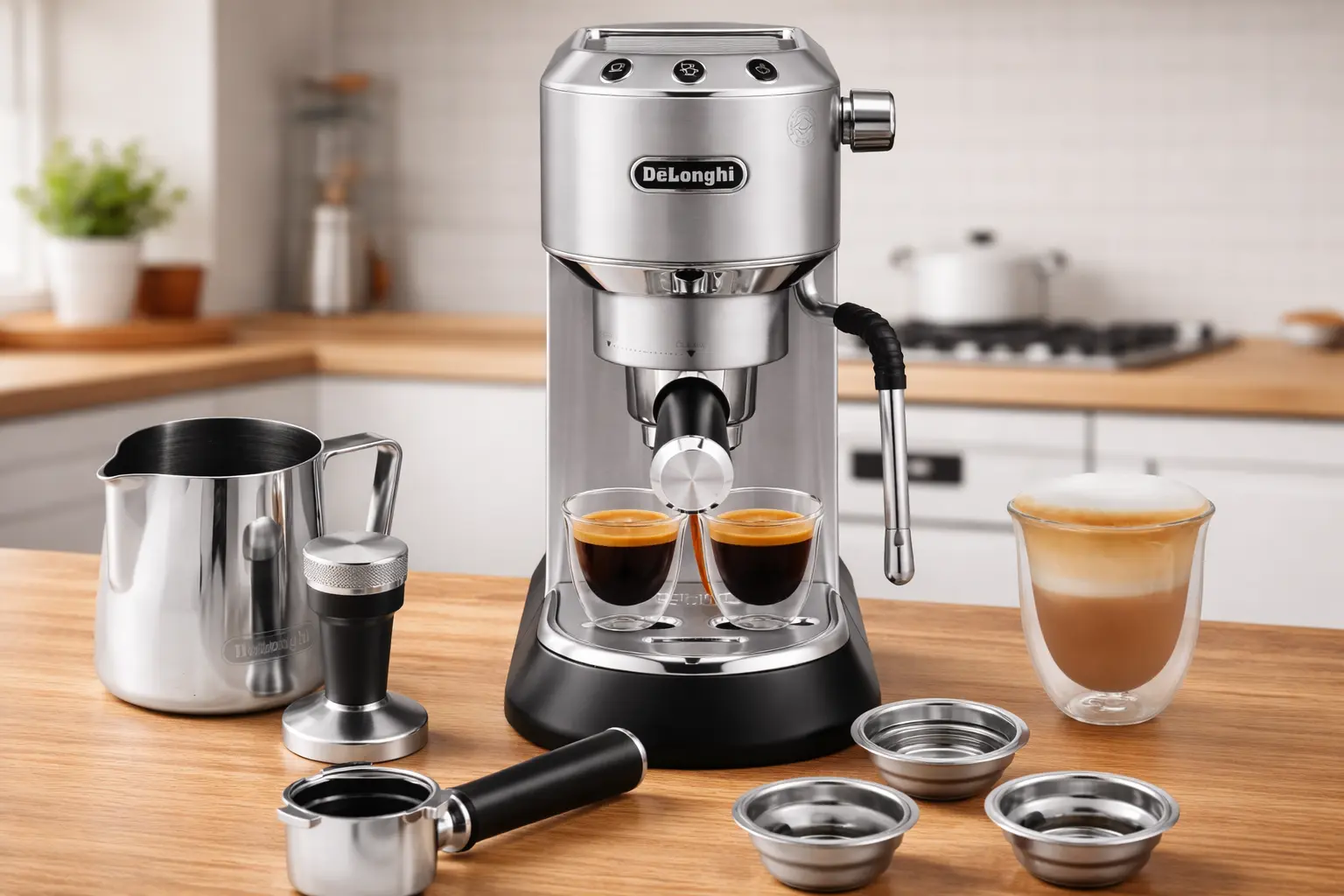
De'Longhi Dedica Arte slim espresso machine

Best Budget Pick: De’Longhi Dedica Arte

The De’Longhi Dedica Arte is the best option for beginners on a tighter budget who still want genuine 9-bar pump pressure and a thermoblock heating system capable of stable brew temperature. At just 6 inches wide it fits almost any kitchen counter, heats up in under 40 seconds, and produces real espresso — not the under-pressured, superheated output of the cheapest pod-style machines at the same price. The panarello steam wand produces frothed (not textured) milk — fine for cappuccino foam, less suitable for flat white microfoam — which is a fair tradeoff at the price. For anyone who wants to start making real espresso at home on a budget, and is willing to pair it with a capable burr grinder like the K6, the Dedica Arte is a genuinely good starting machine.

  • Heating: Thermoblock — fast heat up, stable enough for everyday espresso
  • Portafilter: 54mm — single and dual-wall baskets included
  • Steam wand: Panarello frother — produces foam for cappuccino; not suitable for latte art
  • Pre-infusion: Limited — basic pre-infusion only
  • Best for: tight budgets, small kitchens, beginners who want a dedicated espresso machine without an all-in-one
  • Note: No PID temperature control — use medium to medium-dark roast beans for most reliable results

⚠️ Verify ASIN before publishing. Disclosure: CoffeeGearHub may earn from qualifying purchases.

Machine Comparison: Which Is Right for You?

Breville Bambino PlusBreville Barista ExpressDe’Longhi Dedica Arte
Best forBeginners wanting milk drinks without milk techniqueSerious beginners wanting one complete unit to grow withBudget-conscious beginners; small kitchens
Grinder included?No — pair with K6 or electricYes — 16-setting conical burr integratedNo — pair with K6 or electric
Temp controlThermojet — stable, not adjustablePID — fully adjustableThermoblock — stable for medium/dark only
Pre-infusionYes — automatic 3sYes — adjustableBasic only
Steam wandAutomatic — milk textured for youManual — learn real milk techniquePanarello frother — foam only
Best roast rangeMedium to darkLight through darkMedium to dark
Upgrade headroomModerate — good for 1–2 yearsHigh — room to improve for 3–5 yearsLimited — budget ceiling reached quickly

Choosing Your First Grinder: Why the Grinder Matters More Than the Machine

The grinder is the most important piece of equipment in your espresso setup — more important than the machine. Here’s why: espresso extraction is entirely controlled by how much resistance the water meets passing through the coffee puck, and that resistance is determined by the grind size. Too coarse and water blasts through in under 15 seconds (under-extraction: sour, thin). Too fine and water can barely pass (over-extraction: bitter, slow). The grinder’s job is to produce particles of consistent, adjustable size — and a blade grinder cannot do this. Only a burr grinder — where beans pass through two abrasive surfaces at a set gap — produces the consistent particle size espresso requires.

🚫 Never use a blade grinder for espresso. Blade grinders chop beans randomly — the result is a mix of powder and coarse chunks that produces channelling (water finds the easy path through coarse particles, bypassing the fine ones), wildly inconsistent shot times, and espresso that no machine can make taste good. This is not a refinement issue — a blade grinder is physically incapable of producing espresso-quality grind consistency. A manual burr grinder at $60–$80 outperforms a $200 blade grinder for espresso on every measurable metric.

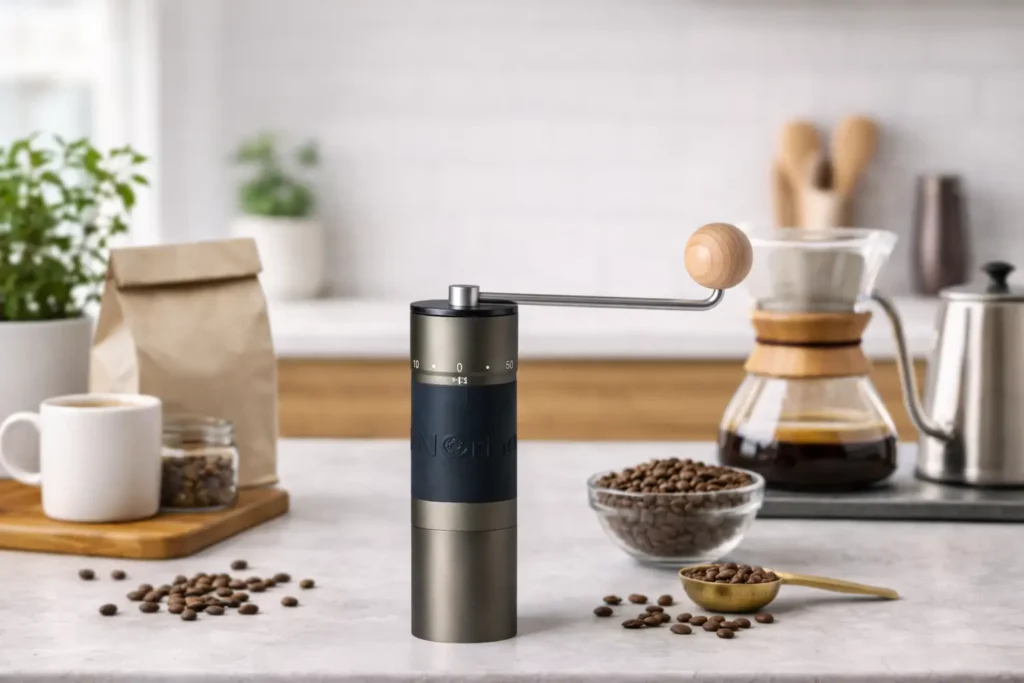
KINGrinder K6 manual hand coffee grinder for espresso

Our Recommended Grinder: KINGrinder K6

The KINGrinder K6 is our standard grinder recommendation across all CoffeeGearHub espresso content, and it earns that position because of one feature that most burr grinders at this price point don’t offer: 100-click adjustment resolution across the full grinding range. At espresso settings (clicks 8–20), each single click produces a meaningful, readable change in shot time — which is exactly what beginner dial-in requires. You need to be able to move one click at a time and taste the difference; the K6 delivers that control. The 48mm stainless conical burrs handle the full espresso spectrum from ristretto concentrate to lungo, the all-metal body is durable for daily dosing, and the price point makes it accessible even when the machine budget is tight. At espresso settings, grinding 18g takes 2–3 minutes — perfectly manageable for a daily habit.

  • Adjustment: 100 click steps — 1-click changes at espresso range produce clean, readable shot time changes
  • Burrs: 48mm stainless conical — capable from espresso (8 clicks) through coarse French press
  • Build: All-metal body — durable for daily espresso dosing; no flex at fine settings
  • Espresso range: K6 clicks 8–20 covers the full espresso spectrum (see grind table in dial-in section)
  • Best for: beginners wanting electric-quality consistency without the electric grinder price

Disclosure: CoffeeGearHub may earn from qualifying purchases.

Essential Accessories: Tamper, Scale, and Portafilter

Beyond the machine and grinder, three accessories meaningfully affect shot quality for beginners: the tamper, the scale, and (once your technique is consistent) the portafilter basket. Everything else is optional until you’re pulling reliably good shots.

Tamper

Your tamper must match your portafilter basket diameter — 54mm for most Breville and De’Longhi beginner machines, 58mm for prosumer units. A tamper that doesn’t cover the basket edge leaves a gap where water channels around the puck edge, producing channelling and uneven extraction. Flat-based tampers are standard for beginners. Spend $20–$40; anything in this range with the correct diameter will perform well. The included plastic tamper in most machine boxes is usually undersized — replace it.

  • Required diameter: 54mm (Breville Bambino/Barista Express, De’Longhi Dedica)
  • Pressure: 15–20kg downward — firm, level, consistent
  • Budget: $20–$40 for a solid metal tamper

Digital Scale

A digital kitchen scale with 0.1g precision is non-negotiable for dialling in espresso. You must weigh both your dry dose (coffee in) and your liquid yield (espresso out) to execute a consistent 1:2 ratio. Measuring by spoon volume or by eye produces results that vary by 2–4g shot to shot — enough to shift your shot time by 5–8 seconds and completely change the flavour. A $20–$35 scale with a tare function and 0.1g readability is all you need. Dedicated espresso scales with built-in timers exist for $50–$80 but are not required at the beginner stage.

  • Required spec: 0.1g resolution; tare function; fits under your portafilter
  • Budget: $20–$35 for a basic kitchen scale; $50–$80 for an espresso-specific scale with timer
  • Note: Check that your scale fits under your machine’s group head with the portafilter locked in

Portafilter Basket

Most entry-level machines include both a pressurised (dual-wall) basket and a standard (single-wall) basket. Use the pressurised basket for your first few sessions — it’s more forgiving of grind inconsistency and helps you practice distribution and tamping without stressing about extraction variables. Switch to the single-wall basket once you’re comfortable: it gives accurate extraction feedback that lets you dial in properly. Eventually, an IMS or VST precision basket ($30–$50) improves extraction evenness — but this is a later-stage upgrade, not a first purchase.

  • Start with: Pressurised basket (dual-wall) — forgiving, good for learning technique
  • Progress to: Single-wall basket — accurate extraction feedback for real dial-in
  • Upgrade later: IMS or VST precision basket — extraction evenness improvement

Choosing Your First Espresso Beans

Bean choice is the foundation of espresso quality — and freshness is the single most overlooked variable by beginners. A medium roast whole bean coffee, roasted 7–21 days ago, from any reputable roaster will outperform any supermarket “espresso blend” in a vacuum-sealed can without a roast date, regardless of machine or technique. For a complete guide to espresso bean selection — roast levels, origins, processing, and all five of our top picks — see our dedicated guide below. For beginners starting out, here is the one-sentence version: buy the Intelligentsia Black Cat Classic Espresso or Lavazza Super Crema, check the roast date, use it between 10 and 21 days off-roast.

The 4 Beginner Bean Rules

  1. Always buy whole bean — pre-ground espresso coffee stales in minutes; ground-to-order from your own grinder is the only way to control freshness at the grind level
  2. Always check the roast date — if the bag only shows a best-before date, the beans could be 6–12 months off-roast. Only buy bags with a roast date printed on them
  3. Use medium to medium-dark roast to start — light roast espresso rewards technique; start with a forgiving medium-dark and move to lighter roasts once you’re dialling in consistently
  4. Start with blends, not single origins — blends are engineered to be consistent and forgiving across a wide extraction window; single origins require tighter grind and temperature control than most beginners have yet developed

Step-by-Step: Pulling Your First Espresso Shot

Follow this method exactly for your first 10–15 shots. Do not skip the weighing steps and do not adjust more than one variable per shot. The goal of these first sessions is not to produce a perfect espresso — it’s to build a reproducible baseline so that when you adjust the grind, you know what changed and why.

1

Flush and warm up your machine

Turn on your machine and allow it to reach full operating temperature. Thermocoil machines need 20–30 minutes; thermoblock machines heat up in 40–60 seconds but benefit from a 5-minute warm-up for group head stability. Run a blank shot — water through the group head with no coffee — to flush residue from the previous session and stabilise the temperature at the group head. This “purge shot” makes a measurable difference to brew temperature accuracy, especially on machines without PID controllers.


2

Weigh and grind your dose

Place your portafilter basket (or a dosing cup) on the scale and zero it. Weigh 18g of whole beans. Transfer to your grinder and grind at your starting espresso setting — KINGrinder K6 at 14 clicks from zero for a medium roast starting point. If your machine has an integrated grinder (Barista Express), use setting 5 as a starting point and adjust from there. Grind directly into the portafilter basket or transfer from a dosing cup immediately — ground coffee begins staling within minutes.


3

Distribute the grounds evenly

Espresso grounds rarely land evenly in the basket — clumps and mounds form that create high-density and low-density zones. Water follows the path of least resistance through the puck, which means it bypasses dense clumps and channels through loose spots, producing uneven extraction and sour/bitter notes in the same shot. Before tamping, level the grounds: use a finger to gently sweep excess grounds level with the basket rim, then use a WDT tool (or a toothpick) to stir through the grounds in a circular motion, breaking up any visible clumps. The bed should look uniform and matte — no peaks, no loose areas.


4

Tamp level and firm

Place the portafilter on a flat, stable surface (a tamping mat helps). Hold the tamper with your thumb and first two fingers, keeping your wrist straight and your elbow at 90°. Apply firm, even downward pressure — approximately 15–20kg — while keeping the tamper face perfectly parallel to the basket rim. An uneven tamp creates a thick side and a thin side in the puck; water flows through the thin side faster, producing channelling. At the end of the tamp, give a slight twist (the “polish”) to smooth the surface. Do not tap the portafilter with the tamper — this can crack the puck and introduce channels.


5

Lock in, pre-infuse, and start your shot

Lock the portafilter firmly into the group head — it should feel secure and level. Place your scale and a preheated shot glass (or small pitcher) under the portafilter spout. Zero the scale. Start your timer and begin the shot. If your machine has a pre-infusion setting, the machine will run at low pressure for 3–5 seconds before full pressure begins — this is normal and beneficial. The first espresso should begin flowing within 5–8 seconds of starting. If nothing flows by 10 seconds, your grind is too fine; stop the shot.


6

Stop at your target yield and check your time

Stop the shot when your scale reads 36g. Note your total elapsed time. For a medium roast at a 1:2 ratio, your target is 25–30 seconds. If the shot ran in under 20 seconds: your grind is too coarse — the water passed through too quickly. If it ran over 40 seconds: your grind is too fine — the water had too much resistance. Both are normal on the first attempt; this is exactly what the dial-in process is for. Record: dose, yield, time, and how the shot tasted.


7

Taste — then make exactly one adjustment

Taste the shot without sugar or milk. A good espresso tastes balanced — you should notice sweetness alongside any bitterness and acidity, with a lingering finish rather than a sharp ending. If sour or hollow: grind 1 click finer before the next shot. If bitter or harsh: grind 1 click coarser. If both sour and bitter simultaneously: you have channelling — focus on distribution and tamping before adjusting grind. If balanced but too weak: increase dose to 18.5g. Change one variable only. Pull the next shot. Repeat until balanced. The average beginner reaches their first truly good shot in 10–20 attempts.

Understanding Extraction: What Your Espresso Is Telling You

Every espresso shot tastes the way it does because of extraction sequence — the order in which compounds dissolve out of the coffee grounds under pressure. Acids extract first and fastest, then sugars and body, then bitter compounds last. A balanced shot successfully extracts through all three phases without ending too early (sour) or running too long (bitter). Understanding which phase you’re tasting tells you exactly what adjustment to make.

What you tasteExtraction phaseWhat it meansPrimary fix
Sharp sourness, hollow body, thin cremaAcids only — stopped too earlyUnder-extraction: grind too coarse, shot too fast, temp too low, or beans too freshGrind 1 click finer → re-pull
Sweetness, chocolate, caramel, round bodySugars and aromatics — the target zoneCorrect extraction — the flavour you’re aiming forNo change — you’re dialled in
Dry bitterness, harsh finish, dark cremaBitter compounds — ran too long or too hotOver-extraction: grind too fine, temp too high, shot too slow, or stale beansGrind 1 click coarser → re-pull
Sour AND bitter in the same shotUneven — channels and dense zones extracting differentlyChannelling from uneven distribution or tampingImprove distribution + WDT before adjusting grind
Flat, papery, hollow — no brightness or sweetnessExtraction is technically correct but from stale materialStale beans — CO2 depleted, aromatics oxidisedBuy fresh beans with a roast date — no technique fix available

Dialling In for Beginners: The One-Variable Method

Dialling in is the process of systematically adjusting your espresso variables until the shot tastes balanced. The rule that separates beginners who improve quickly from those who stay stuck is simple: change only one variable per shot. When you adjust grind size and dose and temperature all at once between shots, you have no way to know which change improved or worsened the result. The one-variable method turns the dial-in process into a straightforward feedback loop rather than guesswork.

Starting Baseline Recipe

  • Dose: 18g (weighed precisely)
  • Target yield: 36g (1:2 ratio)
  • Target time: 25–30 seconds
  • Temperature: 91°C for medium roast; 93°C for light; 89°C for dark
  • K6 grind: 14 clicks (medium starting point)
  • Pre-infusion: 3–5 seconds if available

Pull the shot, weigh the yield, time the extraction, taste the result. Write everything down. Adjust only one thing.

Taste → Adjustment Decision Tree

  1. Shot <20s: grind 1 click finer → re-pull
  2. Shot >40s: grind 1 click coarser → re-pull
  3. Correct time but sour: raise temp 1°C → re-pull
  4. Correct time but bitter: lower temp 1°C → re-pull
  5. Balanced but weak: increase dose 0.5g (keep yield same)
  6. Balanced but too intense: increase yield to 40g (keep dose same)
  7. Sour + bitter simultaneously: fix distribution/tamping first, then grind

The rule: one variable per shot. Always. Write down every result before pulling the next shot.

KINGrinder K6 Espresso Grind Reference

Espresso styleRoast levelK6 clicksTarget shot timeYield ratioFlavour target
Standard double — light roastLight8–1230–35s1:2 to 1:2.5Bright, fruit-forward, tea-like body, clean finish
Standard double — medium roastMedium12–1625–30s1:2Caramel, chocolate, balanced acidity — beginner’s target
Standard double — medium-darkMedium-dark14–1824–28s1:2Dark chocolate, brown sugar, low bitterness
Standard double — dark roastDark16–2022–26s1:1.5 to 1:2Traditional Italian — rich, bittersweet, full body
RistrettoMedium-dark / Dark10–1418–22s1:1 to 1:1.5Intense, very sweet, concentrated — strong body
LungoMedium / Light14–1835–45s1:3 to 1:4Lighter, more transparent, sweeter — extended shot

🔬 K6 espresso note: All click settings are measured from zero (burrs touching). Espresso is the finest end of the K6’s range. At clicks 8–14, grinding 18g takes approximately 2–3 minutes — this is normal for a manual grinder at fine settings. The grind quality at espresso settings is sufficient for home semi-automatics; it will not match a dedicated electric espresso grinder like the Niche Zero or DF64 for shot-to-shot consistency, but produces genuinely good results for its price.

Milk Steaming Basics: Cappuccino and Flat White

Learning to steam milk adds the most visible element of barista skill to your home espresso practice — and it genuinely takes practice. Most beginners produce acceptable foam (large bubbles, not smooth texture) within their first few attempts and genuinely textured milk (smooth, microfoam-like, with a glossy sheen) within 2–4 weeks of regular practice. The difference between foam and microfoam is not just cosmetic: properly textured milk integrates with espresso rather than sitting on top of it, producing a creamier, sweeter drink.

Manual Steam Wand Method

  1. Fill a stainless frothing pitcher to just below the spout’s lower air inlet — 150ml for cappuccino, 220ml for latte
  2. Purge the steam wand for 1 second to clear condensed water before touching milk
  3. Submerge the wand tip just below the milk surface at a slight angle; open the steam valve fully
  4. For the first 2–3 seconds, keep the tip near the surface — you’ll hear a hissing sound as air incorporates (stretching phase)
  5. Once volume has increased by ~50%, lower the tip deeper into the milk — the hissing quiets and you hear a swirling sound (texturing phase)
  6. Heat to 60–65°C — the pitcher should be hot but just holdable on the outside
  7. Close the steam valve; remove the wand; wipe immediately with a damp cloth and purge again
  8. Swirl the pitcher firmly 10–15 times to integrate any remaining bubbles — the surface should look glossy and paint-like

Milk for Each Drink

DrinkEspressoMilkTexture target
CappuccinoDouble (36g)100–120mlThick microfoam — equal parts liquid, microfoam, dry foam
Flat whiteDouble (36g)100–130mlSilky microfoam — minimal dry foam, integrates smoothly
LatteDouble (36g)200–250mlLight microfoam — mostly steamed milk, thin foam layer
CortadoDouble (36g)60–80mlLightly textured — equal espresso and milk

Beginner tip: Whole milk textures most forgivingly — the higher fat content makes it more tolerant of beginner technique errors. Practice with whole milk until your texture is consistent, then try oat or almond milk.

10 Most Common Beginner Espresso Mistakes

These are the ten mistakes that most commonly prevent beginners from pulling consistently good espresso. Most of them are fixable in one session once you know what to look for.

  1. Using a blade grinder. There is no workaround. Blade grinders cannot produce espresso-quality particle consistency. Upgrade to any burr grinder — even the cheapest manual burr grinder outperforms the best blade grinder for espresso.
  2. Not weighing dose and yield. “About a double shot” is not a recipe. Shot-to-shot variation of 2–3g in dose or yield shifts extraction time by 5–8 seconds. Weigh everything, every time, until it becomes muscle memory.
  3. Buying beans without a roast date. Stale beans produce flat, hollow espresso that no technique or equipment can fix. A roast date is not optional — it’s the only way to know whether your beans are in the 7–21 day peak window.
  4. Adjusting multiple variables at once. If you change grind size, dose, and temperature between two shots, you cannot know which variable changed the result. One variable per shot. Always.
  5. Using beans too soon after roasting. Beans within 5 days of roasting contain high CO2 that disrupts extraction — shots run fast, produce uneven crema, and taste hollow. Rest freshly roasted beans for 7–10 days before use for espresso.
  6. Skipping the machine warm-up. A cold group head acts as a heat sink, dropping your brew temperature significantly below your target. A 20-minute warm-up and a purge shot stabilise the group head temperature. This is not optional.
  7. Tamping at an angle. An uneven tamp creates a thick and a thin side in the puck. Water goes through the thin side faster, bypassing the thick side — producing a shot that’s simultaneously over and under-extracted. Tamp on a flat surface with your wrist straight.
  8. Skipping distribution before tamping. Clumps in the coffee bed cause channelling. Spend 15 seconds distributing grounds with a finger or WDT tool before every tamp. This single step eliminates the most common cause of inconsistent shots.
  9. Using the pressurised basket forever. The pressurised (dual-wall) basket masks extraction feedback — it produces consistent-looking crema regardless of grind quality. Switch to the single-wall basket within your first few weeks so you can read what’s actually happening in your shot.
  10. Not writing anything down. Espresso dial-in is iterative — without a record of your last shot’s grind, dose, yield, time, and flavour, you’re starting from scratch every session. Keep a simple notepad at your brew station. One line per shot. This habit alone accelerates improvement faster than any equipment upgrade.

Troubleshooting Matrix: Every Common Beginner Problem → Fix

Identify your symptom below. Check whether it’s a bean, technique, or equipment issue before adjusting variables — most problems are solvable without changing anything expensive.

SymptomMost likely causeFix — in order
Espresso always sour, regardless of grindBeans too fresh (<7 days post-roast) or temperature too lowRest beans 3–5 more days → raise temp 2°C → grind finer 1 click
Espresso always bitter, regardless of grindTemperature too high, beans too dark/stale, grind still too fineLower temp 2°C → grind 1 click coarser → check roast date (discard if 60+ days old)
No crema / flat pale shotStale beans — CO2 depletedBuy fresh beans with roast date — no technique fix for this
Crema disappears within 30 secondsBeans past peak (21–40 days post-roast) or too much Robusta in puckUse fresher beans → try a different bean with Robusta component for more crema stability
Shot runs too fast (<15s) even at finest grindGrinder can’t grind fine enough, or grind setting slipped, or basket too largeCheck grinder is at minimum click → verify burrs are seated correctly → consider a finer grinder or smaller basket
Shot runs too slow (>50s) at all grind settingsGrind too fine, beans too fresh (puffing puck), or dose too highGrind 2 clicks coarser → reduce dose 0.5g → rest beans further if <10 days post-roast
Sour AND bitter in the same shotChannelling — uneven distribution or tampingImprove WDT distribution → check tamper level → consider naked portafilter for visual diagnosis
Shot starts fast then slows mid-pullPuck swelling from very fresh beans (CO2 degassing) or fines migrationRest beans further (minimum 7 days) → check grind for excessive fines → reduce dose 0.5g
Good shots in the morning, poor shots laterMachine temperature not fully stable on second use, or grinder warming shifts particle sizePull a purge shot before each session → allow 10 minutes between back-to-back sessions → purge grinder before dosing
Milk won’t texture — large bubbles persistWand tip too deep during stretching phase, or milk too hot before enough air incorporatedStart with wand tip closer to surface during first 2 seconds → use colder milk from fridge (not room temp) → reduce pitcher fill level
Portafilter leaks or sprays during shotPortafilter not fully locked, damaged gasket, or basket overfilledCheck lock position (should be firmly at 6 o’clock) → inspect group head gasket for cracks → reduce dose 1g
Light roast always under-extracts regardless of grindMachine temperature too low for light roast densityRaise to 93–96°C → extend pre-infusion to 8s → grind 1–2 clicks finer → check machine temperature accuracy with a thermometer

What to Buy Next: Your Espresso Upgrade Path

Once you’re pulling consistently balanced shots on your starter setup, the upgrade path becomes clear. Here is how to prioritise additional investment in order of impact per dollar spent.

StageWhat to upgradeWhy nowImpact
Stage 1 (Weeks 1–4)WDT distribution toolChannelling from clumps is the #1 beginner problem — a $15–$20 tool eliminates most of itHigh — immediately reduces inconsistency
Stage 1Proper metal tamper (54mm)Replaces the plastic tamper in most machine boxesMedium — more consistent tamp pressure and levelness
Stage 2 (Month 2–3)Precision portafilter basket (IMS or VST)Better flow uniformity once your tamping technique is consistentMedium-high once technique is solid
Stage 2Digital espresso scale with built-in timerSimultaneous yield-weight + shot-time readout makes dial-in fasterMedium — convenience and accuracy improvement
Stage 3 (Month 4+)Dedicated electric espresso grinderIf using a manual grinder and pulling 2+ shots daily — an electric grinder adds speed and marginally better consistencyHigh for volume; moderate for quality over a good manual grinder
Stage 3Machine upgrade (if on budget entry model)When your technique ceiling exceeds your machine’s temperature stability or pressure consistencyHigh — unlocks light roast espresso and more precise dial-in

Quick Reference: Beginner Espresso Cheat Sheet

Bookmark this table for your brew station. Start with the baseline recipe and adjust grind first — one click at a time — before touching any other variable.

VariableBeginner targetIf sour →If bitter →If balanced but weak →
Dose18gMaintain; fix grind firstMaintain; fix grind firstIncrease 0.5g
Yield36g (1:2)Try extending to 38–40gReduce to 32–34gKeep at 36g
Shot time25–30sIf <20s: grind finerIf >40s: grind coarser
Temperature91°C (medium roast)Raise 1–2°CLower 1–2°C
K6 clicks (medium)12–16Go lower (finer)Go higher (coarser)
Pre-infusion3–5sExtend to 6–8sReduce to 2–3s
Bean freshness7–21 days post-roastIf <7 days: rest longerIf 60+ days: replace beansCheck roast date first

💡 The one-sentence beginner summary: Buy fresh beans with a roast date, grind with a burr grinder, weigh your dose and yield, adjust only your grind one click at a time, and write everything down. Everything else is refinement of these five habits.

Final Takeaway

Home espresso rewards persistence more than equipment. The most important variables — bean freshness, grind consistency, even distribution, level tamping, and weighing your yield — cost almost nothing to get right and produce the largest single improvement in shot quality. Start with a medium roast whole bean coffee, a consistent burr grinder, and an 18g / 36g starting recipe. Pull one shot, taste it, adjust one thing, pull another. Within 20 shots you’ll have better espresso than most coffee shops. Within a month you’ll understand what your machine and your beans are capable of — and you’ll have the foundation to explore everything from light roast single origins to traditional dark Italian ristretto from the same setup.


FAQs: Beginner’s Guide to Home Espresso

What equipment do I need to start making espresso at home?

At minimum, you need an espresso machine, a burr grinder, a tamper, and fresh whole bean coffee. The most important single purchase is the grinder — a consistent burr grinder matters more than an expensive machine. A digital kitchen scale and a shot timer are strongly recommended. Optional but useful accessories include a WDT distribution tool, a milk frothing pitcher (if you want milk drinks), and a knock box for puck disposal.

How much does a beginner home espresso setup cost?

A capable beginner espresso setup starts at around $400–$600 total: an entry-level machine ($300–$500), a manual burr grinder ($60–$100), a tamper ($15–$30), and a scale ($20–$40). Spending more on a machine with temperature control and pre-infusion — like the Breville Barista Express — gives you room to improve without upgrading equipment again. The minimum spend to make genuinely good espresso at home is around $400; below that, equipment limitations become the ceiling.

Why does my espresso taste sour?

Sour espresso is almost always under-extraction. The most common beginner causes are: grind too coarse (shot runs too fast), beans too fresh (under 7 days post-roast, high CO2), or water temperature too low. Fix by grinding 1 click finer and re-pulling. If still sour at the same shot time, raise your brew temperature 1–2°C. If using very fresh beans, rest them 3–5 more days before trying again.

Why does my espresso taste bitter?

Bitter espresso means over-extraction. Common causes: grind too fine (shot runs too slow), dose too high, water temperature too high, or beans that are stale or very darkly roasted. Grind 1 click coarser and re-pull. If still bitter after grind adjustment with correct shot time, lower brew temperature 1–2°C. If using dark roast beans, try a slightly longer yield (1:2.5 ratio) to dilute harsh compounds with more water.

Do I need an expensive machine to make good espresso at home?

No — but you do need a machine that can maintain stable brew temperature and reach 9 bars of pressure consistently. Machines below $200 often fail on temperature stability, which makes dialling in espresso frustratingly unpredictable. The Breville Bambino Plus is the lowest price point where stable, repeatable espresso becomes achievable for beginners. What matters more than machine price is grinder quality — invest in a consistent burr grinder first.

Can I use a blade grinder for espresso?

No — blade grinders cannot produce the consistent, fine grind espresso requires. They chop beans unevenly, producing a mix of coarse and very fine particles that causes channelling, uneven extraction, and unpredictable shot times. Even the finest setting on a blade grinder produces particle size variation that a good burr grinder avoids entirely. For espresso, a burr grinder is non-negotiable — manual burr grinders like the KINGrinder K6 are a much better option than any blade grinder at any price.

What is a 1:2 ratio in espresso?

A 1:2 ratio means you use 1 gram of dry coffee to produce 2 grams of liquid espresso. The most common beginner recipe is 18g of coffee in and 36g of espresso out — this is the specialty coffee standard for a balanced double espresso. Always weigh your yield (output) on a scale; measuring by volume or time alone produces inconsistent results because espresso density varies with grind, roast, and extraction.

What is pre-infusion and do I need it?

Pre-infusion is a low-pressure water phase at the beginning of the shot — typically 3–8 seconds — that wets the coffee puck before full 9-bar pressure kicks in. It reduces channelling, improves extraction evenness, and is especially important for lighter roast espresso. Many entry-level machines include a basic pre-infusion or ‘blooming’ function. It’s not mandatory for everyday dark roast espresso, but it noticeably improves shot consistency once you’re dialling in properly.

How do I steam milk for a cappuccino?

Fill a frothing pitcher to just below the spout’s air inlet, submerge the steam wand tip just below the milk surface, and open the steam valve fully. Keep the wand tip near the surface to introduce air (stretching) for the first 2–3 seconds until milk volume increases by about 50%, then lower the tip deeper to heat and texture the milk without adding more air. Target 60–65°C — hot to the touch but not scalding. Swirl the pitcher after steaming to integrate any large bubbles. Good cappuccino milk should resemble wet paint — shiny, smooth, no visible bubbles.

How long does it take to learn home espresso?

Most beginners pull their first genuinely good shot within 1–2 weeks of starting — typically after 15–30 practice shots with a consistent grinder and scale. The learning curve is steeper than filter coffee but shorter than most beginners expect, because the dial-in process is systematic: one variable changes at a time, and the shot time and flavour give you immediate feedback. Milk steaming takes longer — typically 2–4 weeks of daily practice before the texture becomes reliable. The most important accelerator is using fresh beans with a roast date and weighing every shot.


Written by the CoffeeGearHub Editorial Team

CoffeeGearHub is a specialty coffee equipment resource run by home brewers and coffee enthusiasts. Our guides are researched using published brewing science, SCA standards, grinder manufacturer specifications, and established specialty-coffee community knowledge. We review and update our pillar content regularly. About CoffeeGearHub →


Leave a Comment

Scroll to Top