
AeroPress Brew Guide: Master Every Variable and Recipe (2026)
Editorial standards: this guide is based on published brewing science, established specialty-coffee practice, manufacturer documentation, and World AeroPress Championship recipe history. Product recommendations are separated from editorial guidance, and CoffeeGearHub does not claim hands-on testing where it has not occurred.
At a glance
What this guide covers
The AeroPress gives you unusually direct control over grind size, ratio, temperature, steep time, agitation, and filtration. This guide explains what each variable changes, how the variables interact, and how to dial in repeatable recipes instead of making random adjustments.
Editorial analysis
The AeroPress rewards controlled experimentation
Because several variables can compensate for one another, AeroPress brewing can feel forgiving and confusing at the same time. The fastest route to consistency is to lock a baseline, change one variable, taste the result, and record the setting.
The recipes in this guide work best as reference points rather than fixed rules. Coffee, roast level, grinder, filter, and serving style all shift the final setting, so the goal is a repeatable system you can adapt.
The 30-Second Answer
AeroPress has six major variables: grind size, coffee-to-water ratio, water temperature, steep time, agitation, and filter type. Grind and ratio are the primary levers. Temperature and steep time are refinements. Agitation and filter type shift body and clarity. Change one variable per brew, taste the result, and write down the settings that work.
Useful AeroPress gear
Start with these representative choices
Start with the brewer itself, then add a consistent grinder before buying secondary accessories.
AeroPress Original — brewer reference
The standard all-round brewer and the simplest reference point for the recipes in this guide.
Timemore Chestnut C2 — grinder reference
A value-focused manual grinder for making AeroPress recipes more repeatable.
Affiliate disclosure: Amazon links may earn CoffeeGearHub a commission at no additional cost to you. Prices and availability can change.
The Six Variables — What Each One Does to the Cup
Understanding what each variable controls — precisely and independently — is the foundation of systematic AeroPress brewing. When you understand the mechanism, every adjustment becomes deliberate rather than random, and every brew teaches you something reproducible about the bean you are brewing.
Variable 1: Grind Size — the Primary Extraction Lever
Grind size controls the surface area of coffee exposed to water and therefore the rate and completeness of extraction. Finer grounds have more surface area — they extract faster and more completely, producing more body, more sweetness at the correct level, and beyond that point bitterness. Coarser grounds have less surface area — they extract more slowly and less completely, producing less body and, beyond a certain point, sourness and thinness.
Unlike pour over, the AeroPress can partially compensate for grind errors with steep time — a coarser grind steeped longer can approach a similar extraction yield to a medium-fine grind at a shorter steep. This is why AeroPress is more forgiving than pour over. It is also why it is harder to isolate the cause of a problem if you are adjusting grind and steep time simultaneously. Always adjust grind first, steep time second.
| Grind level | Visual reference | AeroPress result | Best for |
|---|---|---|---|
| Fine | Fine sugar / powdered sand | Rich, heavy body — can become bitter at steeps over 0:45 | Espresso-style concentrate, short 0:30 steep recipes |
| Medium-fine ✓ Baseline | Table salt | Clean, balanced, good body — all-purpose starting point | Standard method, inverted 1:00–1:30, most daily recipes |
| Medium | Coarse sand | Lighter body, brighter acidity — extend steep to compensate | Inverted long-steep (2:00+), cold brew, bypass recipes |
| Medium-coarse | Raw sugar granules | Very light body, low extraction — needs long steep or high temperature | Cold brew with room-temperature water only |
Variable 2: Coffee-to-Water Ratio — Concentration, Not Extraction
Ratio controls the concentration of dissolved solids in the final cup — in practical terms, how strong or light the coffee tastes. It is important to distinguish ratio from extraction: a cup can taste bitter at any ratio if over-extracted, and sour at any ratio if under-extracted. Ratio determines the ceiling of intensity and body, not the balance. Use ratio as a secondary adjustment after extraction quality is correct.
| Ratio | Example (dose / water) | Cup character | Best for |
|---|---|---|---|
| 1:5–1:8 (concentrate) | 20g / 100–160g | Very thick, intense — must dilute with bypass water | Espresso-style; Americano base; bypass method |
| 1:11–1:13 | 17g / 187–221g | Full body, strong, assertive | Rich inverted; daily brewing for those who prefer stronger coffee |
| 1:16 ✓ Baseline | 15g / 240g | Balanced, clean — SCA filter coffee standard | Starting point for every new bean or recipe |
| 1:17–1:18 | 15g / 255–270g | Lighter body, more delicate, higher clarity | Light roasts; tea-like preference; long-steep clarity recipes |
Variable 3: Water Temperature — Secondary Refinement
Temperature controls the solubility of coffee compounds in water — higher temperatures dissolve compounds faster and more completely. In AeroPress, temperature is a secondary adjustment lever: it fine-tunes extraction after grind and ratio are already producing a close-to-balanced cup. Using temperature as the primary fix for sourness or bitterness is less efficient than grind adjustment because temperature changes affect all compounds simultaneously rather than selectively.
🔬 Why the original AeroPress temperature recommendation is wrong for most recipes: The original instruction manual recommends 175°F (79°C). This was designed around the original AeroPress recipe — a very fine grind at a 1:6 concentrate ratio — conditions that extract efficiently even at lower temperatures. Applied to standard filter-style recipes at 1:16, 175°F produces flat, underdeveloped, low-extraction cups. The specialty coffee consensus — supported by the WAC archive — is to brew at 195–205°F (90–96°C) for filter-style outputs and adjust downward only for very dark roasts or specific concentrate recipes. Start at 200°F and work from there.
Variable 4: Steep Time — Contact Time Control
Steep time controls how long water is in contact with the grounds before the pressure phase begins. It is directly linked to grind size: shorter steep requires finer grind; longer steep allows coarser grind to reach the same extraction yield. The standard 1:00 steep at medium-fine is a starting reference, not a rule. WAC-winning recipes range from 0:20 (espresso-style, fine grind) to 4:00 (long immersion, medium grind). Steep time is a creative variable with wide latitude, not merely a diagnostic lever.
Variable 5: Agitation — Turbulence and Saturation
Agitation — stirring during the steep phase — accelerates extraction by increasing contact between fresh water and unsaturated grounds. More agitation = more extraction from the same grind, ratio, temperature, and steep time. The standard 10-stir pattern (5 North-South, 5 East-West) is a moderate baseline. Reducing to 5 stirs produces slightly lower extraction; increasing to 15–20 produces meaningfully higher. Some WAC recipes skip stirring entirely for a gentler, layered extraction; others stir multiple times at different points in the steep. Stir count is an underutilised adjustment tool.
Variable 6: Filter Type — Clarity vs Body
Filter type controls which compounds reach the cup. Paper filters trap coffee oils (primarily diterpenes — cafestol and kahweol) and fine particles, producing a clean, bright, pour-over-like cup. Metal and nylon reusable filters allow those oils through, adding body, richness, and heavier mouthfeel — closer to French press character but without the sediment. Dual-stacking two paper filters produces even more filtration than a single paper. Filter type is the quickest, cheapest variable to experiment with — a metal upgrade changes the cup character immediately and dramatically.
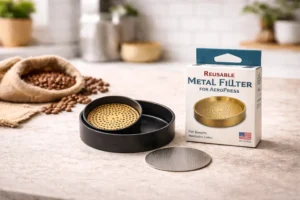
🔄 Swapping from a paper filter to a reusable metal filter is the fastest way to experience how dramatically filter type changes your AeroPress cup — from clean and bright to rich and full-bodied — without adjusting a single other variable. One metal filter also eliminates your ongoing paper filter cost permanently.
As an Amazon Associate, CoffeeGearHub earns from qualifying purchases.
How Variables Interact — and Why You Must Change One at a Time
AeroPress variables do not operate independently. Grind size and steep time are directly coupled — changing one changes the effective extraction rate, so adjusting both simultaneously makes it impossible to identify which one produced the result or whether they are working against each other. Temperature and agitation are similarly coupled to extraction rate. The interaction table below gives you a practical map of how to compensate when you deliberately move one variable in a direction.
⚠️ The most common AeroPress mistake: Changing grind, temperature, and steep time simultaneously when a brew tastes wrong. Because the AeroPress is forgiving, brewers who change multiple variables at once occasionally land on a good cup by accident — and then cannot reproduce it because they do not know which change mattered. Change one variable per brew. Write every result down. This is how you build a reliable mental model of the bean and the device.
| If you change this… | Extraction effect | If you want to keep extraction constant, compensate with… |
|---|---|---|
| Grind finer | Higher | Shorter steep, or lower temperature, or fewer stirs |
| Grind coarser | Lower | Longer steep, or higher temperature, or more stirs |
| Higher temperature | Higher | Shorter steep, or coarser grind |
| Lower temperature | Lower | Longer steep, or finer grind |
| Longer steep time | Higher | Coarser grind, or lower temperature |
| More agitation (stirs) | Higher | Shorter steep, or coarser grind |
| Metal instead of paper filter | Perceived as higher (more oils = richer mouthfeel) — not a true extraction change but perceived as stronger | May need 1 step coarser grind if bitterness appears after switching to metal |
| Bypass water (dilute after pressing) | Lower concentration in final cup — not an extraction change | Brew at a higher dose-to-water ratio before pressing, then dilute to target serving volume |
The Three-Phase AeroPress Dial-In System
This is the systematic dial-in process used across every CoffeeGearHub AeroPress guide. It works for any bean, any roast, and any recipe style. The goal is to reach a locked, reproducible recipe in as few brews as possible, with every session providing useful diagnostic information rather than random experimentation.
Phase 1: Establish the Baseline
- Set every variable to baseline before the first brew: 15g dose, 240g water, 200°F, medium-fine grind, 1:00 steep, 10 stirs (N-S + E-W), standard upright method, paper filter. Record all values before brewing.
- Pull the first brew and taste it without judging everything at once. Identify the most prominent problem: is the cup bitter, sour, thin, flat, or balanced?
- If two problems exist simultaneously (e.g. slightly sour and slightly weak), address sourness first — it is an extraction problem. Weakness is a concentration problem and is easier to solve once extraction is correct.
- If the cup tastes flat with no aroma, check the roast date before adjusting anything. Beans older than 5–6 weeks produce flat, hollow cups that no recipe parameter can fix. Buy fresh beans, then restart.
Phase 2: Adjust Grind and Confirm
- Apply the primary fix for the identified problem. Bitter: grind 1–2 steps coarser. Sour: grind 1–2 steps finer. Weak: increase dose by 2g (adjust water proportionally to maintain ratio). Change one variable only.
- Pull the next brew at the new setting. Compare it directly against the previous brew — ideally taste them side by side. Note whether the problem improved, resolved, or overcorrected (now bitter where it was sour = adjustment too large; find the midpoint).
- Repeat until extraction is balanced. Two to four brews is typical for a new bean at baseline parameters. When the cup tastes clean and sweet, pull one confirmation brew at the same settings. If it also tastes good, the grind is locked.
Phase 3: Refine and Lock
- Once grind is locked and producing a balanced cup, consider one secondary refinement: if the cup is balanced but slightly cool or flat at the finish, raise temperature 2°C. If balanced but slightly harsh, lower temperature 2°C.
- Consider a ratio adjustment last: if extraction is correct but the cup still feels too light, increase dose by 2g (and water proportionally). If too intense, add 30g water to the same dose.
- Write down the locked recipe completely: bean name, roast date, grind setting, dose, water weight, temperature, steep time, stir count, filter type, press time. Every field matters for reproducibility.
- When you open the next bag of the same bean, start at the locked grind and adjust from there — most batches of the same bean from the same roaster require only a one-click correction.
✅ The brew log habit — the most underused AeroPress tool: Keeping a notebook or phone note recording every dialled-in recipe is the single most effective long-term improvement tool available. World AeroPress Championship competitors maintain detailed logs across years of competing. This habit is one of the clearest differentiators between brewers who improve quickly and those who stay stuck resetting from scratch every time they open a new bag.
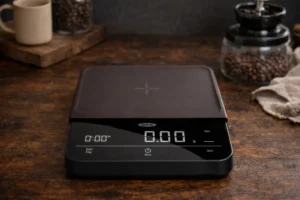
⚖️ The dial-in system only works if you measure every variable. The most common reason AeroPress brews are unrepeatable is dose measured by scoop and water by eye. The included AeroPress scoop varies by 1–3g depending on grind density and packing. A basic digital kitchen scale in grams eliminates this immediately and makes the three-phase system above reliable from session one.
As an Amazon Associate, CoffeeGearHub earns from qualifying purchases.
Complete AeroPress Filter Guide
Filter type is the variable most AeroPress brewers experiment with least despite producing some of the most dramatic cup changes for the least effort. The guide below covers every common filter option — what it physically does, what it produces in the cup, and which recipes it suits best.
| Filter type | What passes through | Cup character | Key pros | Key cons | Best for |
|---|---|---|---|---|---|
| Single paper (standard) | Dissolved solids only — oils and fines trapped | Clean, bright, tea-like clarity — resembles pour over | Cheapest per use; cleanest cup; widely available | Recurring cost; must rinse before use to remove paper taste | Light and medium roasts; clarity preference |
| Dual paper (two stacked) | Even less oils and fines than single paper | Maximum clarity — very tea-like, almost filtered water quality | No new equipment; cleanest possible AeroPress cup | Higher press resistance; uses two filters per brew | Competition-level clarity; very light floral single-origins |
| Metal (stainless disc) | Dissolved solids + coffee oils + very fine particles | Full body, rich mouthfeel — clean French press character without sediment | Zero ongoing cost; richer cup; easy to clean | More sediment than paper; can taste grittier if not kept clean | Medium and dark roasts; body preference over clarity |
| Nylon / cloth | Between paper and metal — passes some oils, traps most fines | Moderate body — middle ground between paper and metal | Reusable; moderate body without full metal sediment | Can absorb flavours over time; less widely stocked | Brewers who find paper too thin and metal too heavy |
| Aesir paper (premium specialty) | Similar to standard paper but slightly slower flow | Exceptionally clean — preferred in competition | Superior clarity vs standard paper; used in WAC winning recipes | More expensive than standard; not in every retailer | Competition brewing; maximum clarity from light roast single-origins |
🔬 Why paper filters produce a chemically different cup: Paper micro-filters remove diterpenes — lipid compounds (cafestol and kahweol) present in coffee oils. Research has confirmed that paper-filtered brews contain significantly lower concentrations of these compounds than unfiltered methods. For brewers advised to limit unfiltered coffee for health reasons, paper-filtered AeroPress is the correct choice. For brewers who want every oil and compound in the cup, metal is the correct choice. Both are legitimate; the decision is taste preference and health context.
7-Recipe Library: Every AeroPress Output Style
These seven recipes cover the full range of what the AeroPress can produce — from a clean, light filter cup to a thick espresso-style concentrate. Each recipe is complete, with every variable specified. Use them as starting points and adjust using the Phase 2 dial-in process for your specific bean.
⚙️ Every recipe below requires a burr grinder to work as written. Which describes your current situation?
Timemore C2
Best value manual grinder. Consistent medium-fine to fine range. Travels with the AeroPress.
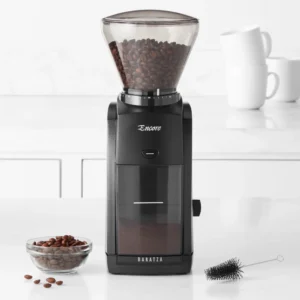
Baratza Encore ESP
Best home electric grinder. 40 stepped settings. Covers AeroPress, pour over and drip from the same machine.
AeroPress Original
Don’t have one yet? The Original is the recommended starting point — every recipe in this guide is calibrated for it.
As an Amazon Associate, CoffeeGearHub earns from qualifying purchases. Full gear guide with all picks →
Recipe 1: Clean Daily Driver
Clean, balanced, fast — the everyday AeroPress recipe for any roast
- Method: Standard upright
- Dose / Water: 15g / 240g at 200°F (1:16)
- Grind: medium-fine (table salt)
- 0:00 — pour all 240g; stir 10× (N-S then E-W)
- 0:15 — insert plunger to create seal
- 1:00 — press 20–30 sec; stop at hiss
- Filter: single paper
- Notes: the universal starting point — adjust grind based on Phase 2 taste diagnosis
Recipe 2: Rich Inverted (WAC-Style)
Full body, complex, maximum immersion — competition-inspired
- Method: Inverted
- Dose / Brew water: 17g / 200g at 203°F
- Bypass water: 70g hot water in cup before pressing
- Grind: medium-fine
- 0:00 — pour 200g; stir 10×
- 1:20 — attach rinsed filter cap
- 1:30 — flip; press 20–25 sec onto bypass water
- Filter: single paper or Aesir
- Notes: bypass dilutes concentrate without changing extraction chemistry — a core competition technique
Recipe 3: Espresso-Style Concentrate
Thick, intense — Americano base or milk drink foundation
- Method: Standard upright
- Dose / Water: 20g / 100g at 205°F (1:5)
- Grind: fine (finer than table salt)
- 0:00 — pour 100g; stir 5×
- 0:30 — press over 20 seconds
- Filter: paper
- Serve: add 150–200g hot water for Americano; use as-is over steamed milk
- Notes: not true espresso (AeroPress ~0.75 bar vs espresso’s 9 bar) but a functional substitute
Recipe 4: Full-Body Metal Filter
Rich, oily, French-press character — without sediment
- Method: Inverted
- Dose / Water: 16g / 220g at 198°F (1:13.75)
- Grind: medium — 1 step coarser than paper baseline to compensate for oil-passing filter
- 0:00 — pour 220g; stir 8×
- 1:30 — attach metal filter cap
- 1:45 — flip; press 25–30 sec
- Filter: metal reusable disc
- Notes: coarser grind is intentional — metal passes oils that amplify bitterness if grind is too fine
Recipe 5: AeroPress Cold Brew
Smooth, low-acid concentrate — ready in minutes
- Method: Inverted with cold water
- Dose / Water: 20g / 200g cold or room-temp filtered water
- Temperature: room temperature (68–72°F / 20–22°C)
- Grind: medium-coarse
- Steep: 2–5 minutes; stir at start and at 2:00
- Press: slowly over 30–40 sec (cold water = more resistance)
- Serve: over ice; dilute 1:1 with cold water or milk
- Notes: faster than traditional 12–24 hour cold brew; AeroPress pressure adds brightness vs gravity-drip cold brew
Recipe 6: Iced Flash Chill
Bright, clean iced coffee — finished in under 2 minutes
- Method: Standard upright, brew directly over ice
- Dose / Hot water: 18g / 130g at 207°F
- Ice: 110g in the glass below the AeroPress
- Grind: medium-fine
- 0:00 — pour 130g hot water; stir 10×
- 0:15 — seal with plunger; steep to 1:00
- 1:00 — press 20 sec directly onto ice
- Notes: hot concentrate flash-chills on contact with ice — bright, clear, cold immediately; total active time under 2 minutes
Recipe 7: Long-Steep Clarity (Light Roast)
Maximum origin expression — for floral, fruity light roasts and Ethiopian, Kenyan, or Gesha beans
- Method: Inverted
- Dose / Water: 15g / 250g at 205°F (1:16.7)
- Grind: medium — 1 step coarser than baseline; long steep compensates
- 0:00 — pour all 250g; stir 6× gently
- 2:00 — attach dual paper filter cap (two filters stacked)
- 2:15 — flip; press very slowly over 35–40 sec
- Filter: dual paper (maximum clarity)
- Notes: gentle agitation and dual-paper filter preserve delicate floral and fruit notes that aggressive extraction muddies; allow cup to cool to 55–60°C before tasting for full aroma
Roast-Level Brewing Reference
Roast level changes the density, porosity, and solubility of the bean in ways that directly affect how a given grind, temperature, and steep time performs. These adjustments apply across all seven recipes above.
| Roast level | Grind vs medium baseline | Temperature | Steep time | Agitation | Common problem |
|---|---|---|---|---|---|
| Light roast ☀️ | 1–2 steps finer — dense, low-solubility beans extract slowly | 203–205°F / 95–96°C | 1:15–1:30 or longer inverted | Standard — or slightly less to preserve delicate aromatics | Persistent sourness: confirm temperature is genuinely above 200°F — light roasts penalise low-temperature brewing most severely |
| Medium roast 🌤 ✓ | Baseline — all recipes calibrate for medium | 198–202°F / 92–94°C | 1:00 | 10 stirs standard | Most forgiving — standard recipe applies directly |
| Medium-dark roast | 1–2 steps coarser — more porous, extracts faster | 196–200°F / 91–93°C | 0:45–1:00 | 8 stirs — reduce slightly | Early bitterness at finish: coarsen grind before adjusting temperature |
| Dark roast 🌑 | 2–3 steps coarser — highly soluble, bitter compounds extract rapidly | 193–197°F / 89–92°C | 0:30–0:45 — short steep prevents over-extraction | 5–8 stirs | Harsh, ashy bitterness that persists despite coarser grind: try short steep at the lowest temperature; very dark roasts are not ideal for AeroPress |
| Very fresh (<7 days post-roast) | 1 step coarser — active CO2 adds resistance similar to a finer grind | Standard for roast level | Add 10–15 sec to let CO2 escape before extraction dominates | Pour slowly at start to avoid CO2 blocking even saturation | Inconsistent results — rest beans 5–10 days before serious dial-in |
| Old beans (40+ days post-roast) | 1 step finer than peak freshness | Standard | Standard | Standard | Flat, hollow cup regardless of parameters: no recipe adjustment recovers flavour from stale coffee; buy fresh beans |
World Championship Advanced Techniques
The World AeroPress Championship has published a complete archive of winning recipes since 2008. Analysing this archive reveals a consistent set of advanced techniques that appear repeatedly in top-placing recipes. None require additional equipment beyond what most AeroPress owners already have — they are technique refinements implementable immediately.
Bypass Brewing — the Most-Used WAC Technique
Bypass brewing adds hot water directly to the cup before pressing rather than brewing at the full diluted ratio. The logic: brewing at a higher concentration (e.g. 1:8 or 1:10) and diluting to final serving strength with bypass water produces a different flavour profile than brewing at 1:16 directly. At higher concentration, early-extracting sweet and acidic compounds dominate proportionally. Diluting with bypass fixes extraction at that earlier point while achieving target serving strength. The result is a cup with brighter acidity and clearer sweetness than a direct-ratio brew — the signature of most WAC-winning bypass recipes. Recipe 2 in this guide uses this technique.
🔬 The 2025 WAC winner (Némo Pop, Australia) used an upright standard method with 18g dose, 100g brew water, and 70g bypass water in the carafe — a total of 170g final cup from 18g coffee (1:9.4 effective). The concentrate was pressed at a controlled 0.5–0.75 g/s press rate and diluted to 170g final weight. This is bypass brewing taken to its logical extreme: a very high concentration extract diluted precisely to target serving strength.
Dual-Filter Stacking
Stacking two paper filters produces measurably more filtration than a single filter — more oils trapped, fines further reduced, and exceptional clarity in the cup. The trade-off is slightly higher press resistance making the plunge marginally harder. Dual-filter stacking appears in a significant proportion of WAC light-roast recipes targeting maximum clarity and brightness. Implementation is simple: place two standard AeroPress paper filters in the cap and rinse both together before use. Recipe 7 (Long-Steep Clarity) uses dual paper.
Controlled Press Speed
Press speed affects the final phase of extraction. A fast press (under 10 seconds) generates more turbulence at the filter and extracts additional compounds from the puck during pressing. A slow press (30–45 seconds) produces a gentler, cleaner final press with less turbulence. Most WAC recipes specify press time explicitly — 20–30 seconds is the most common target. The 2024 WAC winner specified pressing to stop exactly when the output reached 66g, then diluting — a level of press-phase control rarely practised in home brewing. For everyday use, a consistent 20–30 second press is the right target.
Cooling the Cup Before Tasting
Allowing pressed AeroPress coffee to cool to 54–60°C before tasting — rather than drinking immediately at full brew temperature of 80–90°C — significantly changes the perceived flavour profile. Many aromatic compounds are masked at very high temperatures; cooling to the 54–60°C range reveals sweetness, fruit clarity, and complexity that are hidden at scalding temperature. This is documented explicitly in several WAC recipes as a serving instruction. If your AeroPress cups always taste better as they cool naturally, this is the mechanism. Recipe 7 includes this as a serving note.
Pre-Infusion for Very Fresh Beans
A 20–30 second mini pre-infusion with 30–40g of water before adding the main pour allows CO2 to escape from very fresh beans before full extraction begins. This reduces CO2 interference with even saturation during the main steep. For beans roasted within 5–8 days, this technique meaningfully improves saturation consistency. Implementation: pour 30–40g first, wait 25 seconds, then add the remaining water and proceed normally. For beans older than 10 days this step is unnecessary and can be skipped.
Gear Picks: What CoffeeGearHub Recommends for AeroPress Brewing
Disclosure: CoffeeGearHub may earn a commission on qualifying purchases through affiliate links on this page, at no cost to you. Our recommendations are editorially independent. CoffeeGearHub.com participates in the Amazon Services LLC Associates Program. As an Amazon Associate, we earn from qualifying purchases.
🛒 New to Amazon? Try Prime free for fast, free shipping on every pick in this guide — or try Audible free if you’d rather listen while your coffee brews.
Grinders
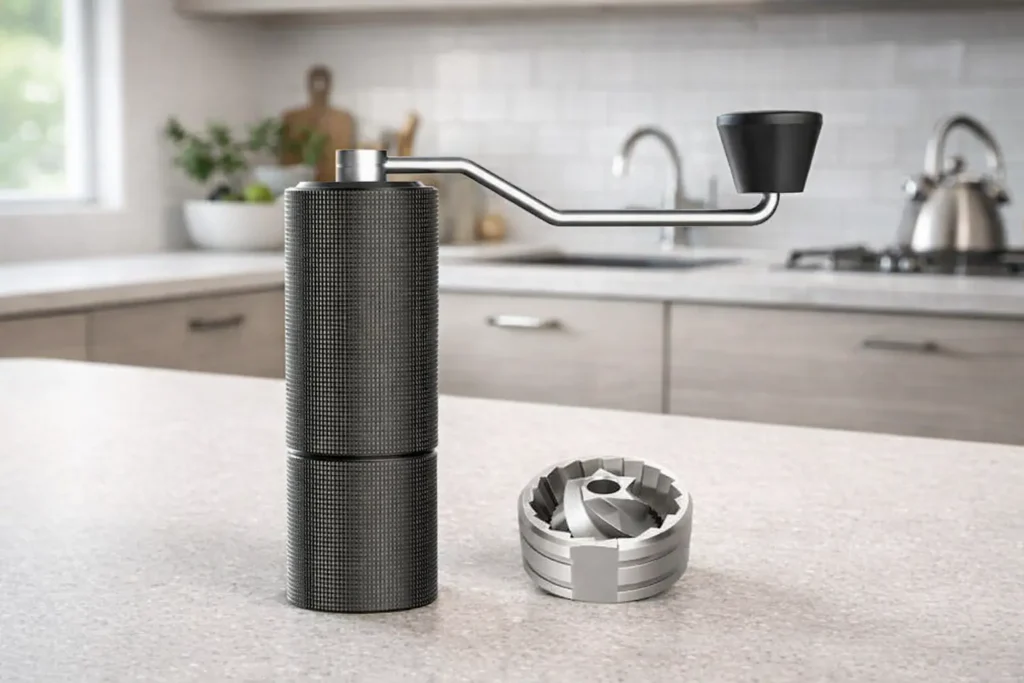
🏆 Best Value Grinder: Timemore Chestnut C2
Best for: daily AeroPress brewers and travellers who want consistent medium-fine grind without a large investment
The Timemore Chestnut C2 is the CoffeeGearHub recommended value grinder for AeroPress. Stainless steel conical burrs produce consistent medium-fine to fine output across the full AeroPress range; internal adjustment holds settings reliably between sessions; the textured body provides good grip for single-hand grinding. Grinds a 15g AeroPress dose in under a minute. Compact enough to travel alongside the AeroPress Go or fit inside the AeroPress Original plunger tube.
- Range: covers fine (espresso-style concentrate recipes) through medium-coarse (cold brew) — versatile for every recipe in this guide
- Travel: compact enough to pack alongside the AeroPress Go
- Upgrade path: Timemore C3S Pro has improved burrs and refined adjustment for those wanting daily use over several years
Disclosure: CoffeeGearHub may earn from qualifying purchases.
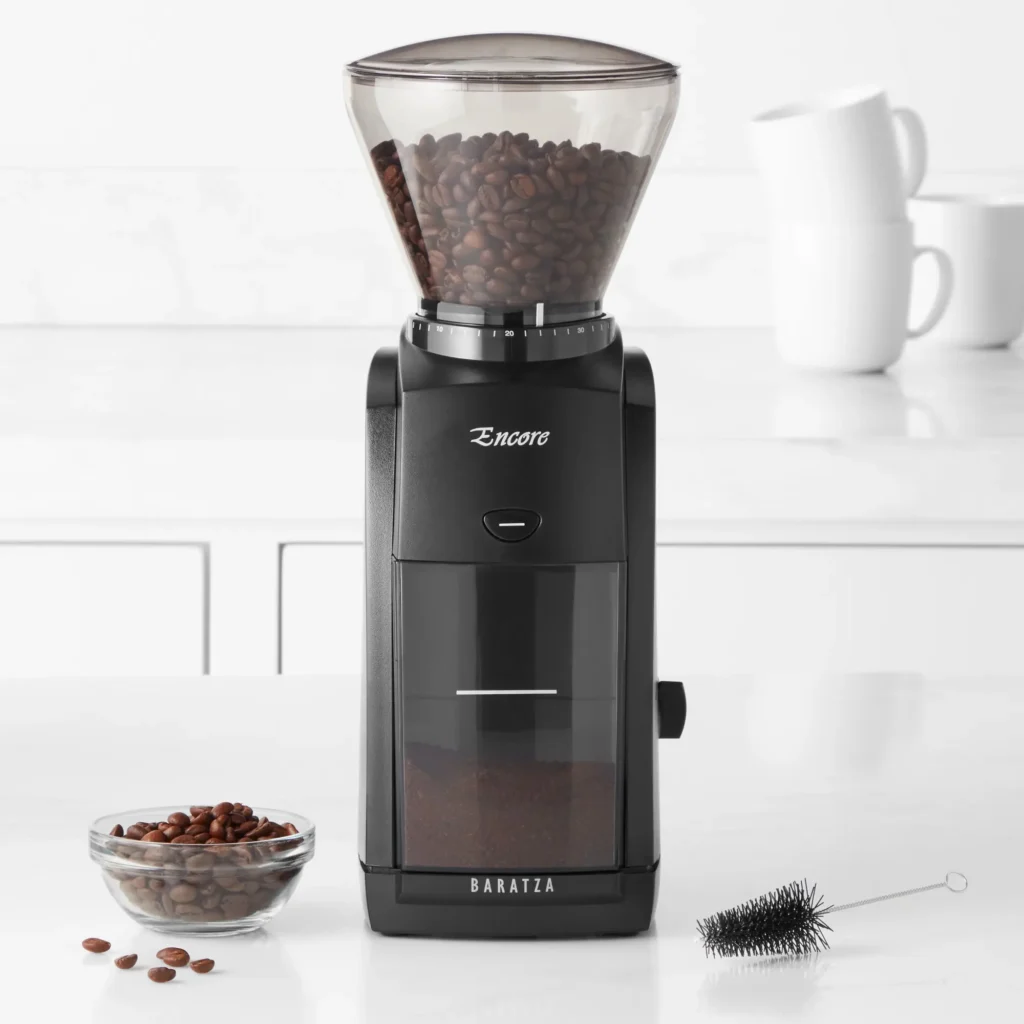
Best Electric Grinder: Baratza Encore ESP
For home AeroPress brewers who also use pour over or drip from the same grinder. 40 settings with predictable linear adjustment across the full filter range including the medium-fine AeroPress zone. Each click changes particle size measurably and consistently, making the three-phase dial-in system reliable from session one. Baratza’s repair ecosystem — replacement burrs, motors, and hoppers sold separately — makes this a long-term investment rather than a disposable appliance.
- 40 settings: linear adjustment across pour over, AeroPress, and drip range
- Best for: households using AeroPress, pour over, and drip from one machine
- Repair ecosystem: long-term investment — parts available separately
Disclosure: CoffeeGearHub may earn from qualifying purchases.
Scales, Filters, and Key Accessories
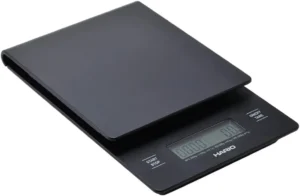
⚖️ Every technique in this guide requires measured doses and water weights. The Hario V60 Drip Scale combines a 0.1g resolution gram scale with a built-in timer — placed under your AeroPress it tracks steep time and yield simultaneously. The most compact dedicated coffee scale available and the one most AeroPress enthusiasts reach for.
As an Amazon Associate, CoffeeGearHub earns from qualifying purchases.
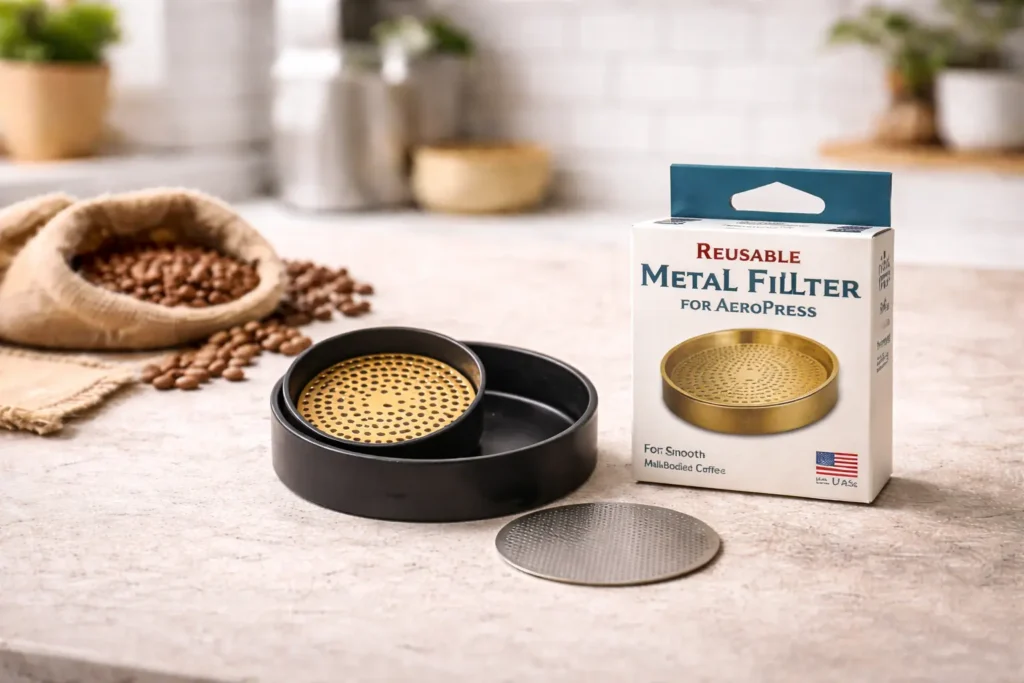
Cup Character Upgrade: AeroPress Reusable Metal Filter
A reusable metal filter is the fastest, cheapest way to experience how dramatically filter type changes the AeroPress cup — shifting from pour-over-like clarity to French-press-like richness without adjusting any other variable. Eliminates ongoing paper filter cost. Multiple versions are available; look for stainless steel construction with a fine mesh that seats flat against the filter cap without edge gaps. Use Recipe 4 (Full-Body Metal Filter) in this guide to dial in the correct grind for your metal filter.
- Cup change: adds body, richness, heavier mouthfeel — passes coffee oils paper blocks
- Cost: one purchase eliminates all ongoing paper filter cost
- Grind note: when switching from paper to metal, grind 1 step coarser — oils amplify extraction perception
Disclosure: CoffeeGearHub may earn from qualifying purchases.
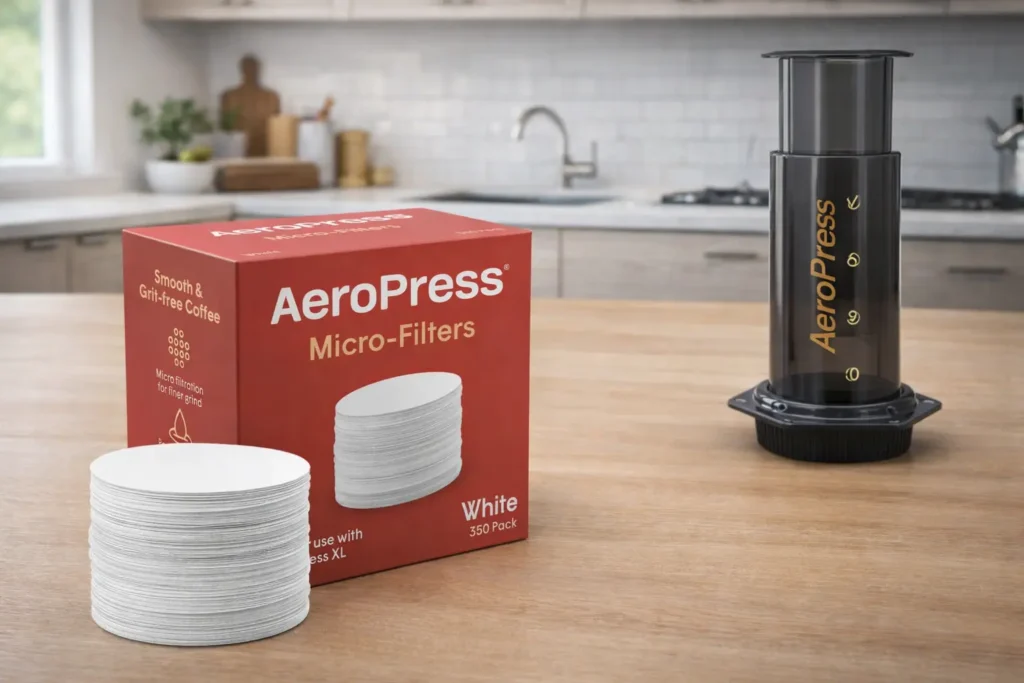
AeroPress Replacement Paper Filters (350 Pack)
AeroPress paper micro-filters are proprietary — not interchangeable with V60, Chemex, or Melitta filters. Each pack contains 350 filters (approximately one year of daily brewing). Individual filters can be rinsed and reused up to 10 times; the dual-stack technique (Recipes 7 and the Championship section) uses two filters per brew. Standard AeroPress filters cover all models except the XL, which requires XL-size filters sold separately.
Disclosure: CoffeeGearHub may earn from qualifying purchases.
Troubleshooting Matrix: Every AeroPress Brewing Problem Diagnosed
Identify your symptom in the first column. Apply fixes in the order listed — the first fix resolves the problem in the majority of cases. Change one variable per brew throughout the diagnosis.
| Symptom | Cause | Fix — in order |
|---|---|---|
| Bitter, harsh, dry aftertaste | Over-extraction — grind too fine, steep too long, temperature too high, or too many stirs | Grind 1–2 steps coarser → shorten steep by 15 sec → lower temperature 2°C → reduce stir count to 8 |
| Sour, sharp, mouth-puckering | Under-extraction — grind too coarse, steep too short, or temperature too low | Grind 1–2 steps finer → extend steep by 15 sec → raise temperature 2°C → increase stirs to 12 |
| Weak, thin, watery — not sour | Concentration too low — ratio too dilute for the dose | Increase dose by 2g (keep water the same) → or reduce water by 30g → grind slightly finer to increase extraction yield |
| Flat, no aroma, hollow flavour | Stale beans — CO2 depleted, aromatics oxidised | Check roast date: if 40+ days, the beans are the problem; no recipe adjustment recovers flavour from stale coffee; buy beans roasted within the last 3–6 weeks |
| Plunge stalls or is very hard | Grind too fine — excessive resistance at filter; or filter cap overtightened | Grind 2–3 steps coarser → confirm filter is flat and fully seated (no edge folds or gaps) → do not overtighten filter cap → always rinse paper filter before use |
| Coffee drips before pressing (standard method) | Filter cap not fully locked; or paper filter not flat; or plunger not inserted promptly after adding water | Confirm cap is fully locked → rinse paper filter so it adheres flat → insert plunger within 10 seconds of adding water |
| Gritty sediment in cup | Grind too coarse for the filter mesh; or filter torn or seated with a gap | Grind 1–2 steps finer → inspect filter for tears → confirm filter is fully flat → try double-stacking two paper filters for maximum filtration |
| Sour and bitter simultaneously | Channelling — uneven extraction through clumped or unevenly distributed grounds | Ensure stir fully saturates all grounds with no dry clumps remaining; gently tap AeroPress after pouring to encourage even distribution — this is a saturation problem, not a grind problem |
| Tastes good hot, bitter when cool | Mild over-extraction — bitterness masked at high temperature, revealed on cooling | Grind 1 step coarser → shorten steep by 10–15 sec; bitterness revealed only on cooling is a reliable signal of mild over-extraction |
| Inconsistent results at the same settings | Dose or water weight inconsistent — measuring by scoop or eye | Weigh every dose and every water pour on a gram scale — this single change eliminates most batch-to-batch inconsistency; inconsistency is almost always a measurement problem |
| Inverted method spill during flip | Hesitation; unstable surface; or plunger not deep enough before filling | Insert plunger at least 1cm before adding water → place on a stable flat surface → flip in one smooth, confident motion — hesitation causes spills, not speed |
Final Takeaway
The AeroPress is the most systematically rewarding manual brewer available. Its six variables each produce specific, predictable effects — learnable and reproducible once approached methodically. The three-phase dial-in system in this guide works for every bean, every roast, and every output style from a clean light-roast clarity cup to a dark-roast concentrate base for milk drinks. The brew log you build over months becomes the most useful tool in your coffee kit — a reference library that makes every new bag an exercise in refinement rather than a frustrating restart. The World AeroPress Championship has been demonstrating the device’s ceiling for nearly twenty years. That potential is in the same brewer sitting in your kitchen right now.
FAQs: AeroPress Brew Guide
What is the best AeroPress recipe for beginners?
Start with 15g coffee, 240g water at 200°F, medium-fine grind, 1:00 steep, 10 stirs, standard upright method, paper filter. This 1:16 ratio is the SCA filter coffee standard and produces a clean, balanced cup that clearly reveals the effect of each variable as you adjust. Once this baseline tastes good, every change becomes an exploration rather than a rescue.
How does grind size affect AeroPress coffee?
Grind size is the primary extraction lever. Finer grounds increase surface area and extract more completely — producing more body and, beyond a point, bitterness. Coarser grounds extract less completely — producing less body and, beyond a point, sourness. AeroPress can partially compensate for grind errors with steep time, which is why it is more forgiving than pour over. Start at medium-fine (table salt) and adjust one step at a time based on taste.
Why does my AeroPress coffee taste bitter?
Bitterness is almost always over-extraction. Fix in order: grind 1–2 steps coarser; shorten steep time by 15–20 seconds; lower water temperature by 2–3°C; if using a metal filter, try a paper filter. If bitterness persists despite all adjustments, check the roast date — beans older than 5–6 weeks produce harsh, flat bitterness that no recipe change resolves.
Why does my AeroPress coffee taste sour or weak?
Sourness is under-extraction: grind 1–2 steps finer; extend steep by 15–20 seconds; raise temperature 2–3°C. Weakness without sourness is a concentration problem — increase dose by 2g or reduce water by 30g. Both can also result from stale beans; always check the roast date first.
What is the difference between AeroPress standard and inverted methods?
Standard method: filter-cap-down on the mug — some coffee drips before pressing, limiting steep time precision. Inverted method: device flipped upside down during steep — no dripping until you flip and press, giving complete steep time control. World AeroPress Championship competitors predominantly use the inverted method for this precision. Start with standard to learn the device; move to inverted when you want longer, more controlled steeps.
Paper filter vs metal filter — which is better for AeroPress?
Neither is better — they produce different cups. Paper filters produce a clean, bright, pour-over-like cup by trapping coffee oils and fines. Metal filters allow oils through, adding body and richness similar to French press but without sediment. If your cup tastes clean but thin, try a metal filter. The choice is purely taste preference.
What is bypass brewing in AeroPress?
Bypass brewing adds hot water to the cup before pressing rather than brewing at the full diluted ratio. Brewing at higher concentration (e.g. 1:8) and diluting with bypass water produces brighter acidity and clearer sweetness than brewing at 1:16 directly — because early-extracting sweet compounds dominate proportionally in the concentrate. Bypass recipes dominate the World AeroPress Championship archive and are used in Recipe 2 of this guide.
Can I make cold brew in an AeroPress?
Yes — AeroPress cold brew is one of the device’s most underrated uses. Use the inverted method with cold or room-temperature water, a medium-coarse grind, and steep 2–5 minutes. The result is a smooth, low-acid concentrate far faster than traditional 12–24 hour cold brew. Serve over ice, diluted 1:1 with cold water or milk. See Recipe 5 in this guide for the full cold brew recipe.
CoffeeGearHub product shortlist
Compare AeroPress products on CoffeeGearHub
Review specifications and current verified merchant offers on CoffeeGearHub before leaving the site.
Continue Learning
In this guide
- The 30-Second Answer
- The Six Variables — What Each One Does to the Cup
- How Variables Interact — and Why You Must Change One at a Time
- The Three-Phase AeroPress Dial-In System
- Complete AeroPress Filter Guide
- 7-Recipe Library: Every AeroPress Output Style
- Roast-Level Brewing Reference
- World Championship Advanced Techniques
- Gear Picks: What CoffeeGearHub Recommends for AeroPress Brewing
- Troubleshooting Matrix: Every AeroPress Brewing Problem Diagnosed
- FAQs: AeroPress Brew Guide
- Continue Learning